In this paper, we introduce the concept of complex fuzzy left and complex fuzzy right hyperideals and discuss some basic properties of LA-hyperrings. We also introduce the concept of (α, β)-complex fuzzy hyperideals and discuss the important features of non-associative LA-hyperrings.
Introduction
In the introductory section we provide a brief history in the form of three subsections.
Hyperstructures
Hyperstructure theory was brought-out by Marty [1] in 1934, when he defined hypergroup, set-about analyzing their properties and exerted them to a group. Several papers and books have been compiled in this direction, see [2–4]. Another book by Davvaz and Fotea [6] is devoted especially to the study of hyperring theory. The volume ends with an outline of applications in chemistry and physics, analyzing several special kinds of hyperstructures: e-hyperstructures and transposition hypergroups. Hoskova [7] discussed the abelization of quasi-hypergroups, Hv-rings and transposition Hv-groups as a categorical reflection.
Kazim and Naseeruddin [8] introduced the concept of left almost semigroups (LA-semigroups) and shifted the discussion toward non-associative structures. Yusuf gave the idea of left almost rings [9]. Hila and Dine [10] shifted the associative structures to non-associative hyperstructures and furnished the idea of LA-semihypergroup. Yaqoob et al. [11] expanded the work of Hila and Dine and characterized intra-regular left almost semihypergroup by their hyperideals, using pure left identity. Yousafzai et al. [12] showed the existence of non-associative algebraic hyperstructures. The idea of partially ordered left almost semihypergroups was developed by Yaqoob and Gulistan in [13]. Rehman et al. [14] initiated the study of LA-hyperrings and discussed its hyperideals and hypersystems in 2017. Nawaz et al. [15] introduced the concept of left almost semihyperrings.
Fuzzy sets
The fundamental concept of a fuzzy set was introduced by Zadeh in his paper [16] of 1965, provides a natural frame-work for generalizing several basic notions of algebra. Kuroki initiated the study of fuzzy semigroups [17–19]. Dib et al. [20] discussed, fuzzy rings and fuzzy ideals in rings. Murali [21] defined the concept of belongingness of a fuzzy point to a fuzzy subset under a natural equivalence on a fuzzy subset. In [22], the idea of quasi-coincidence of a fuzzy point with a fuzzy set is defined. The concept of a (α, β)-fuzzy subgroup was first considered by Bhakat and Das in [23, 24] by using the “belongs to” relation (∈) and “quasi coincident with” relation (q) between a fuzzy point and a fuzzy subgroup, where α, β ∈ {∈ , q, ∈ ∨ q, ∈ ∧ q} and α ≠ ∈ ∧ q. Shabir et al. discussed (α, β)-fuzzy ideals and (∈ , ∈ ∨ qk)-fuzzy ideals of semigroups in [25, 26]. Sen et al. [27] introduced and analyzed fuzzy semihypergroups.
Complex fuzzy sets
Buckly [28] gave the concept of fuzzy complex numbers. In 2002, Ramot et al. [29, 30] generalized the concept of fuzzy set and introduced the notion of complex fuzzy set. There are many researchers who have worked on complex fuzzy set for instance, Nguyen et al. [31] and Zhang et al. [32]. Abd Uazeez et al. [33] added the non-membership term to the idea of complex fuzzy set which is known as complex intuitionistic fuzzy sets, the range of values are extended to the unit circle in complex plan for both membership and non-membership functions instead of [0, 1], see also [34–37].
In this paper, we introduce the concept of complex fuzzy hyperideals and discuss the basic properties of complex fuzzy LA-hyperrings. We also introduce the concept of (α, β)-complex fuzzy hyperideals and discuss the important features of a non-associative LA-hyperrings.
Preliminaries
In this section, we present some basic definitions and results, which are necessary to prove the main results.
Definition 2.1. [10] A hypergroupoid (H, •) is called an LA-semihypergroup, if it satisfies the following law:
for all x, y, z ∈ H.
Definition 2.2. [14] A hypergroupoid (H, •) is said to be an LA-hypergroup if it satisfy the following axioms:
for all x, y, z ∈ H, (x • y) • z = (z • y) • x,
for every x ∈ H, x • H = H • x = H .
Example 2.3. [14] Let H = {a, b, c} be a set with the hyperoperations ⊗1and ⊗2 defined as follows:
⊗1
a
b
c
a
a
H
H
b
H
{b, c}
{b, c}
c
H
b
b
⊗2
a
b
c
a
a
H
H
b
H
{b, c}
{b, c}
c
H
{a, b}
{a, b}
Then (H, ⊗ 1) and (H, ⊗ 2) are LA-hypergroups.
Definition 2.4. [14] An algebraic system (R, + , ·) is said to be an LA-hyperring, if
(R, +) is an LA-hypergroup;
(R, ·) is an LA-semihypergroup;
· is distributive with respect to +.
Example 2.5. Let R = {0, a, b} be a set with the hyperoperations " + " and " · " defined as follows:
+
0
a
b
0
0
a
b
a
b
R
{a, b}
b
a
{a, b}
R
and
.
0
a
b
0
0
0
0
a
0
{0, a}
{0, b}
b
0
{0, b}
{0, a}
Then (R, + , ·) is an LA-hyperring.
Definition 2.6. [29] A complex fuzzy set (CFS) Cf over the universe U, is an object having the form
where
Both the amplitude and the phase terms rCf (x), and wCf (x) are real valued, for every x ∈ U, and the amplitude term rCf (x) : U → [0, 1] and phase term wCf (x) lying in the interval [0, 2π] .
Complex fuzzy hyperideals
Here in this section, we introduce the concept of complex fuzzy hyperideals and discuss some basic properties of complex fuzzy LA-hyperrings. R stands for an LA-hyperring in the whole paper.
Remark 3.1.CfF (R) denote the collection of all complex fuzzy subsets of R.
Definition 3.2. Let Cf and Cg be any two complex fuzzy subsets of R. Then
Union: Cf ∪ Cg ⇔ max {γCf (x) , γCg (x)} , max {wCf (x) , wCg (x)} ,
Intersection: Cf ∩ Cg ⇔ min {γCf (x) , γCg (x)} , min {wCf (x) , wCg (x)} ,
Complement: of R is a function from R into the closed unit interval [0, 1] , i.e., with where and
Definition 3.3. Let A≠ ∅ be a subset of R. The complex characteristic function of A is denoted by CχA and defined by
Note that R can be considered as a complex fuzzy subset of itself and we write R = CχR, i.e., CχR (x) =1ei(2π) for all x ∈ R.
Definition 3.4. Let A be a subset of R. The complex fuzzy level set of A is denoted by Cf(t,s) and defined by
where γCf (x) , t ∈ [0, 1] and wCf (x) , s ∈ [0, 2π] .
Definition 3.5. Let Cf = {(x, μCf (x)) , x ∈ R} and Cg = {(x, μCg (x)) , x ∈ R} be two complex fuzzy subsets of R. Then
the sum Cf ⊕ Cg is defined by
and (Cf ⊕ Cg) (x) = 0ei(0) if x cannot be ex-pressible as an element in a + b for all x ∈ H .
the product Cf ⊗ Cg is defined by
and (Cf ⊗ Cg) (x) =0ei(0) if x cannot be expressible as an element in a · b for all x ∈ H .
the intrinsic product Cf ⊙ Cg is defined by
and (Cf ⊙ Cg) (x) =0ei(0) if x cannot be expressible as an element in for all x ∈ H .
Lemma 3.6.Let A and B be any non-empty subset of R. Then the following properties hold.
If A ⊆ B then CχA ⊆ CχB,
CχA ⊙ CχB = CχA·B,
CχA ∪ CχB = CχA∪B,
CχA ∩ CχB = CχA∩B.
Proof. Proof is straightforward.□
Proposition 3.7.If Cf, Cg, Ch are complex fuzzy subsets of R, then (Cf ⊙ Cg) ⊙ Ch = (Ch ⊙ Cg) ⊙ Cf.
Proof. Let Cf, Cg, Ch are complex fuzzy subsets of R and x ∈ R. Now
Thus (Cf ⊙ Cg) ⊙ Ch = (Ch ⊙ Cg) ⊙ Cf.□
Proposition 3.8.If Cf, Cg, Ch are complex fuzzy subsets of R, then
(Cf ⊕ Cg) ⊕ Ch = (Ch ⊕ Cg) ⊕ Cf.
(Cf ⊗ Cg) ⊗ Ch = (Ch ⊗ Cg) ⊗ Cf.
Proof. Proof is similar to the proof of Proposition 3.□
Proposition 3.9.Let R be an LA-hyperring with pure left identity e . Then
Cf ⊙ (Cg ⊙ Ch) = Cg ⊙ (Cf ⊙ Ch) ,
(Cf ⊙ Cg) ⊙ (Ch ⊙ Ck) = (Cf ⊙ Ch) ⊙ (Cg ⊙ Ck) ,
(Cf ⊙ Cg) ⊙ (Ch ⊙ Ck) = (Ck ⊙ Ch) ⊙ (Cg ⊙ Cf) ,
for all complex fuzzy subset Cf, Cg, Ch and Ck of R.
Definition 3.10. A complex fuzzy subset Cf of R is called complex fuzzy LA-subhyperring of R if
,
for all a, b ∈ R.
Example 3.11. Let R ={ 0, a, b } be a set with the hyperoperation + and · defined as follows:
+
0
a
b
0
0
R
R
a
R
{a, b}
{a, b}
b
R
R
R
and
.
0
a
b
0
0
0
0
a
0
R
b
b
0
R
R
Then (R, + , ·) is an LA-hyperring. One can see that (R, +) and (R, ·) both satisfy left invertive law and also both are non associative, as {a, b } = a + (a + b) ≠ (a + a) + b = R and {b } = a · (a · b) ≠ (a · a) · b = R [14]. Now let Cf be a complex fuzzy subset of R such that
then clearly Cf is a complex fuzzy LA-subhyperring of R .
Definition 3.12. A complex fuzzy subset Cf of R is called a complex fuzzy left hyperideal of R if
for all a, b ∈ R.
Definition 3.13. A complex fuzzy subset Cf of R is called a complex fuzzy right hyperideal of R if
for all a, b ∈ R.
A complex fuzzy subset Cf of R is called a complex fuzzy hyperideal of R if Cf is a complex fuzzy right hyperideal and a complex fuzzy left hyperideal of R.
Example 3.14. Let R ={ 0, a, b, c, d, e } be a set with the hyperoperation + and · defined by Table † and Table ‡, respectively.
Cayley table for R ={ 0, a, b, c, d, e } in Example 3.
+
0
a
b
c
d
e
0
0
{0, a}
b
{b, c}
d
{d, e}
a
{0, a}
a
{b, c}
c
{d, e}
e
b
d
{d, e}
{0, b, d}
R
{b, d}
{b, c, d, e}
c
{d, e}
e
R
{a, c, e}
{b, c, d, e}
{c, e}
d
b
{b, c}
{b, d}
{b, c, d, e}
{0, b, d}
R
e
{b, c}
c
{b, c, d, e}
{c, e}
R
{a, c, e}
Cayley table for R ={ 0, a, b, c, d, e } in Example 3.
·
0
a
b
c
d
e
0
0
0
0
0
0
0
a
0
{0, a}
0
{0, a}
0
{0, a}
b
0
0
b
b
d
d
c
0
{0, a}
b
{b, c}
d
{d, e}
d
0
0
d
d
b
b
e
0
{0, a}
d
{d, e}
b
{b, c}
Then (R, + , ·) is an LA-hyperring. Now let Cf be a complex fuzzy subset of R such that
then clearly Cf is a complex fuzzy hyperideal of R .
Theorem 3.15.Let A be a non-empty subset of R. Then the following properties hold.
A is an LA-subhyperring of R if and only if is a complex fuzzy LA-subhyperring of R.
A is a left (right, two-sided) hyperideal of R if and only if is a complex fuzzy left (right, two-sided) hyperideal of R.
Proof. Proof is straightforward.□
Theorem 3.16.Let Cf be a complex fuzzy subset of R, then the following assertions are true.
Cf is a complex fuzzy LA-subhyperring of R if and only if Cf ⊕ Cf ⊆ Cf and Cf ⊗ Cf ⊆ Cf,
Cf is a complex fuzzy left hyperideal of R if and only if Cf ⊕ Cf ⊆ Cf and R ⊗ Cf ⊆ Cf,
Cf is a complex fuzzy right hyperideal of R if and only if Cf ⊕ Cf ⊆ Cf and Cf ⊗ R ⊆ Cf,
Cf is a complex fuzzy hyperideal of R if and only if Cf ⊕ Cf ⊆ Cf, R ⊗ Cf ⊆ Cf and Cf ⊗ R ⊆ Cf.
Proof. (1) Suppose that, Cf is a complex fuzzy LA-subhyperring of R. Let x ∈ R. If
This implies Cf ⊕ Cf ⊆ Cf and Cf ⊗ Cf ⊆ Cf. Otherwise, for x ∈ a · b, we have
and
Conversely, assume that Cf ⊕ Cf ⊆ Cf and Cf ⊗ Cf ⊆ Cf. Thus, for all x, y ∈ R, we have
and
This implies Cf is a complex fuzzy LA-subhyperring of R. The other cases can be seen in similar way.□
Lemma 3.17.If Cf, Cg are the complex fuzzy LA-subhyperrings of R with pure left identity e, then Cf ⊗ Cg is a complex fuzzy LA-subhyperring of R.
Proof. Proof is straightforward.□
Lemma 3.18.If R contains pure left identity e, then every complex fuzzy right hyperideal of R is a complex fuzzy hyperideal of R.
Proof. Let a, b ∈ R and let z ∈ a · b ⊆ ((e · a) · b) ⊆ ((b · a) · e) .
Thus Cf is a complex fuzzy hyperideal of R.□
Theorem 3.19.If Cf is a complex fuzzy right hyperideal of R and Cg is a complex fuzzy left hyperideal of R with pure left identity e, then Cf ⊗ Cg ⊆ Cf ∩ Cg.
Proof. Let Cf, Cg be complex fuzzy hyperideals of R and x ∈ R. If
then (Cf ⊗ Cg) (x) ≤ (Cf ∩ Cg) (x) , otherwise for x ∈ a · b, we have
Hence this shows that Cf ⊗ Cg ⊆ Cf ∩ Cg.□
Theorem 3.20.Let R be an LA-hyperring and Cf a complex fuzzy right hyperideal of R . Then Cf ⊗ Cf is a complex fuzzy hyperideal of R.
Proof. Proof is straightforward.□
Remark 3.21. Let Cf be a complex fuzzy left hyperideal of R, then Cf ⊗ Cf is a complex fuzzy hyperideal of R.
For an LA-hyperring R, the complex fuzzy subset R of R is defined as R (x) =1ei2π, for all x ∈ R .
Lemma 3.22.Let R be an LA-hyperring with pure left identity e . Then R ⊗ R = R.
Proof. Every x in R can be written as x ∈ e · x, where e is the pure left identity in R. So
This implies that R ⊗ R = R . □
(α, β)-Complex fuzzy
hyperideals
Here in this section we generalized the concept of (α, β)-fuzzy hyperideals by introducing the idea of (α, β)-complex fuzzy hyperideals in LA-hyperrings based on our newly defined concept of complex fuzzy point. We then discussed the important features of a non-associative LA-hyperrings by using (α, β)-complex fuzzy hyperideals. Here, α, β denotes any one of ∈, q, ∈ ∨ q or ∈ ∧ q unless otherwise specified.
Definition 4.1. A complex fuzzy subset Cf over R of the form
is said to be a complex fuzzy point with support x and value seiθ and is denoted by xseiθ, where s ∈ (0, 1] and θ ∈ (0, 2π]. For a complex fuzzy point xseiθ and complex fuzzy set Cf over R, we define;
xseiθ ∈ Cf if and only if Cf (x) ≥ seiθ which implies that γCf (x) ≥ s and wCf (x) ≥ θ,
xseiθqCf if and only if Cf (x) + seiθ ≥ 1ei(2π) which implies that γCf (x) + s > 1 and wCf (x) + θ > 2π,
xseiθ ∈ ∨ qCf if and only if xseiθ ∈ Cf or xseiθqCf,
means that xseiθ ∈ Cf does not hold.
Definition 4.2. A complex fuzzy subset Cf of R is called an (α, β)-complex fuzzy LA-subhyperring of R if for all s1, s2 ∈ (0, 1], θ1, θ2 ∈ (0, 2π] and x, y ∈ R, the following conditions hold:
xs1eiθ1αCf, and ys2eiθ2αCf
⇒z(s1∧s2)ei(θ1∧θ2)βCf, for each z ∈ x + y .
xs1eiθ1αCf, and ys2eiθ2αCf
⇒z(s1∧s2)ei(θ1∧θ2)βCf, for each z ∈ x · y .
Let Cf be a complex fuzzy subset of R such that Cf (x) ≤ (0.5, π) which implies that γCf (x) ≤0.5 and wCf (x) ≤ π for all x ∈ R. Let x ∈ R be such that xseiθ ∈ ∧ qCf . Then Cf (x) ≥ (s, θ) implies that
Also Cf (x) + (s, θ) ≥1ei(2π) implies that
It follows that
and
so that γCf (x) >0.5 and wCf (x) > π . This means that {xseiθ | xseiθ ∈ ∧ qCf } = ∅ . Therefore the case α = ∈ ∧ q is omitted.
Definition 4.3. A complex fuzzy subset Cf of R is called an (α, β)-complex fuzzy left hyperideal of R if for all s1, s2 ∈ (0, 1], θ1, θ2 ∈ (0, 2π] and x, y ∈ R, the following conditions hold:
xs1eiθ1αCf and ys2eiθ2αCf
⇒z(s1∧s2)ei(θ1∧θ2)βCf, for each z ∈ x + y .
x ∈ R and yseiθαCf
⇒zseiθβCf, for each z ∈ x · y .
Definition 4.4. A complex fuzzy subset Cf of R is called an (α, β)-complex fuzzy right hyperideal of R if for all s1, s2 ∈ (0, 1], θ1, θ2 ∈ (0, 2π] and x, y ∈ R, the following conditions hold:
xs1eiθ1αCf, and ys2eiθ2αCf
⇒z(s1∧s2)ei(θ1∧θ2)βCf, for each z ∈ x + y .
xseiθαCf and y ∈ R
⇒zseiθβCf, for each z ∈ x · y .
A complex fuzzy subset Cf of R is called an (α, β)-complex fuzzy hyperideal of R if it is both an (α, β)-complex fuzzy left hyperideal and (α, β)-complex fuzzy right hyperideal of R .
Lemma 4.5.A complex fuzzy subset Cf of R is a complex fuzzy LA-subhyperring of R if and only if, for all s1, s2 ∈ (0, 1] and θ1, θ2 ∈ (0, 2π] , it satisfies,
xs1eiθ1 ∈ Cf, and ys2eiθ2 ∈ Cf
⇒z(s1∧s2)ei(θ1∧θ2) ∈ Cf for each z ∈ x + y,
xs1eiθ1 ∈ Cf, and ys2eiθ2 ∈ Cf
⇒z(s1∧s2)ei(θ1∧θ2) ∈ Cf for each z ∈ x · y.
Proof. Suppose Cf is a complex fuzzy LA-subhyperring of R. Let x, y ∈ R and s1, s2 ∈ (0, 1] and θ1, θ2 ∈ (0, 2π] be such that xs1eiθ1 ∈ Cf and ys2eiθ2 ∈ Cf . Then Cf (x) ≥ s1eiθ1 implies that
and Cf (y) ≥ s2eiθ2 implies that
Since Cf is a complex fuzzy LA-subhyperring of R,
and
for each z ∈ x · y . Also
and
for each z ∈ x + y . Hence z(s1∧s2)ei(θ1∧θ2) ∈ Cf for each z ∈ x + y, z(s1∧s2)ei(θ1∧θ2) ∈ Cf for each z ∈ x · y and s1, s2 ∈ (0, 1], θ1, θ2 ∈ (0, 2π].
Conversely, assume that Cf satisfy the given conditions. We show that γCf (z)≥ min { γCf (x) , γCf (y) }, wCf (z)≥ min { wCf (x) , wCf (y) } for each z ∈ x · y and
for each z ∈ x + y . On contrary assume that there exist x, y ∈ R such that γCf (z)< min { γCf (x) , γCf (y) }, wCf (z)< min { wCf (x) , wCf (y) } for each z ∈ x · y and
for each z ∈ x + y . Let t ∈ (0, 1] and s ∈ (0, 2π] be such that γCf (z)< t ≤ min { γCf (x) , γCf (y) }, wCf (z)< s ≤ min { wCf (x) , wCf (y) } for each z ∈ x · y. Then xt ∈ Cf and yt ∈ Cf but for each z ∈ x · y and for each z ∈ x + y . This contradicts our hypothesis. Similarly we can show it for each z ∈ x + y . Hence Cf is a complex fuzzy LA-subhyperring of R .□
Lemma 4.6.A complex fuzzy LA-subhyperring Cf of R is a complex fuzzy left hyperideal of R if and only if yseiθ ∈ Cf and x ∈ R ⇒ zseiθ ∈ Cf, for all z ∈ x · y and for all s ∈ (0, 1] , θ ∈ (0, 2π] .
Proof. Suppose Cf is a fuzzy left hyperideal of R . Let yseiθ ∈ Cf, then Cf (y) ≥ seiθ implies that γCf (y) ≥ s and wCf (y) ≥ θ . Since Cf is a complex fuzzy left hyperideal of R, so
for each z ∈ x · y . Hence zseiθβCf for each z ∈ x · y . Conversely, suppose that Cf satisfy the given condition. We show that γCf (z) ≥ γCf (y) and wCf (z) ≥ wCf (y) for each z ∈ x · y . On the contrary assume that there exist x, y ∈ R such that γCf (z) < γCf (y) and wCf (z) < wCf (y) for each z ∈ x · y . Let s ∈ (0, 1] and θ ∈ (0, 2π] be such that γCf (z) < s ≤ γCf (y) and wCf (z) < θ ≤ wCf (y) for each z ∈ x · y . This implies that yseiθ ∈ Cf. But which contradicts our hypothesis. So γCf (z) ≥ γCf (y) and wCf (z) ≥ wCf (y) for each z ∈ x · y . Hence Cf is a complex fuzzy left hyperideal of R .□
Remark 4.7. Every complex fuzzy left (right) hyperideal of R is an (∈ , ∈)-complex fuzzy left (right) hyperideal of R but converse is not true.
Theorem 4.8.Let Cf be a nonzero (α, β)-complex fuzzy LA-subhyperring of R . Then the set Cf0 = {x ∈ R|γCf (x) >0 and wCf (x) >0} is an LA-subhyperring of R.
Proof. Let x, y ∈ Cf0 . Then γCf (x) >0 and wCf (x) >0 . Let γCf (z) = 0 and wCf (z) = 0 for each z ∈ x · y . If α ∈ { ∈ , ∈ ∨ q } , then xγCf(x)αγCf and ywCf(y)αwCf, but
and
So for every β∈ { ∈ , q, ∈ ∨ q, ∈ ∧ q } and z ∈ x · y . This is a contradiction. Hence γCf (z) > 0 and wCf (z) > 0 that is z ∈ x · y ∈ Cf0 . Also x1ei(2π)qCf and y1ei(2π)qCf but for every β∈ { ∈ , q, ∈ ∨ q, ∈ ∧ q } and z ∈ x · y . Hence γCf (z) > 0 and wCf (z) > 0 that is z ∈ x · y ∈ Cf0 . Similarly we can show it for z ∈ x + y . Thus Cf0 is an LA-subhyperring of R .□
Theorem 4.9.Let Cf be a nonzero (α, β)-complex fuzzy left (resp . , right) hyperideal of R . Then the set Cf0 = {x ∈ R|γCf (x) >0 and wCf (x) >0} is a left (resp . right) hyperideal of R .
Proof. Similar to the proof of Theorem 4.□
Theorem 4.10.Let L be a left (resp . right) hyperideal of R and let Cf be a complex fuzzy subset in R such that,
and
Then Cf is a (q, ∈ ∨ q)-fuzzy left (resp . right) hyperideal of R and also Cf is a (∈ , ∈ ∨ q)-fuzzy left (resp . right) hyperideal of R .
Proof. Proof is straightforward.□
Theorem 4.11.Let A be a LA-subhyperring of R and let Cf be a complex fuzzy subset in R such that,
and
Then Cf is an (q, ∈ ∨ q)-complex fuzzy LA-subhyperring of R and also f is an (∈ , ∈ ∨ q)-fuzzy LA-subhyperring of R .
Proof. Proof is straightforward.□
(∈ , ∈ ∨ q)-Complex Fuzzy hyperideals
In this section we investigate some useful results of LA-hyperrings by using the properties of (∈ , ∈ ∨ q)-complex fuzzy hyperideals.
Definition 5.1. A complex fuzzy subset Cf of R is called an (∈ , ∈ ∨ q)-complex fuzzy LA-subhyperring of R if for all s1, s2 ∈ (0, 1], θ1, θ2 ∈ (0, 2π] and x, y ∈ R, the following conditions hold:
xs1eiθ1 ∈ Cf, and ys2eiθ2 ∈ Cf
⇒z(s1∧s2)ei(θ1∧θ2) ∈ ∨ qCf, for each z ∈ x + y .
xs1eiθ1 ∈ Cf, and ys2eiθ2 ∈ Cf
⇒z(s1∧s2)ei(θ1∧θ2) ∈ ∨ qCf, for each z ∈ x · y .
Lemma 5.2.Let Cf be a complex fuzzy subset of R. Then Cf is an (∈ , ∈ ∨ q)-complex fuzzy LA-subhyperring of R if and only if
Proof. Let Cf be an (∈ , ∈ ∨ q)-complex fuzzy LA-subhyperring of R . On the contrary,
(i) let for any s ∈ (0, 1] and θ ∈ (0, 2π] such that
Then Cf (x) > seiθ and Cf (y) > seiθ implies that xseiθ ∈ Cf and yseiθ ∈ Cf . But for each z ∈ x + y, which is a contradiction. Thus
(ii) let for any s ∈ (0, 1] and θ ∈ (0, 2π] such that
Then Cf (x) > seiθ and Cf (y) > seiθ implies that xseiθ ∈ Cf and yseiθ ∈ Cf . But for each z ∈ x · y, which is a contradiction. Thus
Conversely. (i) Assume that
for all x, y, z ∈ R . Let xs1eiθ1 ∈ Cf and ys2eiθ2 ∈ Cf for all s1, s2 ∈ (0, 1], θ1, θ2 ∈ (0, 2π]. Then Cf (x) ≥ s1eiθ1 and Cf (y) ≥ s2eiθ2 . Thus, we have
If min { s1eiθ1, s2eiθ2 } ≥ 0.5eiπ, then which implies that
If min { s1eiθ1, s2eiθ2 } < 0.5eiπ, then Therefore, z(s1∧s2)ei(θ1∧θ2) ∈ ∨ qCf, for each z ∈ x + y .
(ii) Assume that
for all x, y, z ∈ R . Let xs1eiθ1 ∈ Cf and ys2eiθ2 ∈ Cf for all s1, s2 ∈ (0, 1], θ1, θ2 ∈ (0, 2π]. Then Cf (x) ≥ s1eiθ1 and Cf (y) ≥ s2eiθ2 . Thus, we have
If min { s1eiθ1, s2eiθ2 } ≥ 0.5eiπ, then which implies that
If min { s1eiθ1, s2eiθ2 } < 0.5eiπ, then Therefore, z(s1∧s2)ei(θ1∧θ2) ∈ ∨ qCf, for each z ∈ x · y . Thus, from the both cases we see that Cf is an (∈ , ∈ ∨ q)-complex fuzzy LA-subhyperring of R .□
Definition 5.3. A complex fuzzy subset Cf of R is called an (∈ , ∈ ∨ q)-complex fuzzy right hyperideal of R if for all s1, s2 ∈ (0, 1], θ1, θ2 ∈ (0, 2π] and x, y ∈ R, the following conditions hold:
xs1eiθ1 ∈ Cf, and ys2eiθ2 ∈ Cf
⇒z(s1∧s2)ei(θ1∧θ2) ∈ ∨ qCf, for each z ∈ x + y .
xs1eiθ1 ∈ Cf ⇒ zs1eiθ1 ∈ ∨ qCf, for each z ∈ x · y .
Definition 5.4. A complex fuzzy subset Cf of R is called an (∈ , ∈ ∨ q)-complex fuzzy left hyperideal of R if for all s1, s2 ∈ (0, 1], θ1, θ2 ∈ (0, 2π] and x, y ∈ R, the following conditions hold:
xs1eiθ1 ∈ Cf, and ys2eiθ2 ∈ Cf
⇒z(s1∧s2)ei(θ1∧θ2) ∈ ∨ qCf, for each z ∈ x + y .
ys1eiθ1 ∈ Cf ⇒ zs1eiθ1 ∈ ∨ qCf, for each z ∈ x · y .
Lemma 5.5.Let Cf be a complex fuzzy subset of R. Then Cf is an (∈ , ∈ ∨ q)-complex fuzzy left hyperideal of R if and only if
.
Proof. Proof is similar to the proof of Theorem 5.□
Lemma 5.6.Let Cf be a complex fuzzy subset of R. Then Cf is an (∈ , ∈ ∨ q)-complex fuzzy right hyperideal of R if and only if
.
Proof. Proof is similar to the proof of Theorem 5.□
Lemma 5.7.Intersection of (∈ , ∈ ∨ q)-complex fuzzy left (resp., right) hyperideals of R is an (∈ , ∈ ∨ q)-complex fuzzy left (resp., right) hyperidealof R .
Proof. Proof is straightforward.□
Lemma 5.8.The characteristic function is an (∈ , ∈ ∨ q)-complex fuzzy left (resp., right) hyperideal of R if and only if T is a left (resp., right) hyperideal of R .
Proof. Proof is straightforward.□
Conclusion
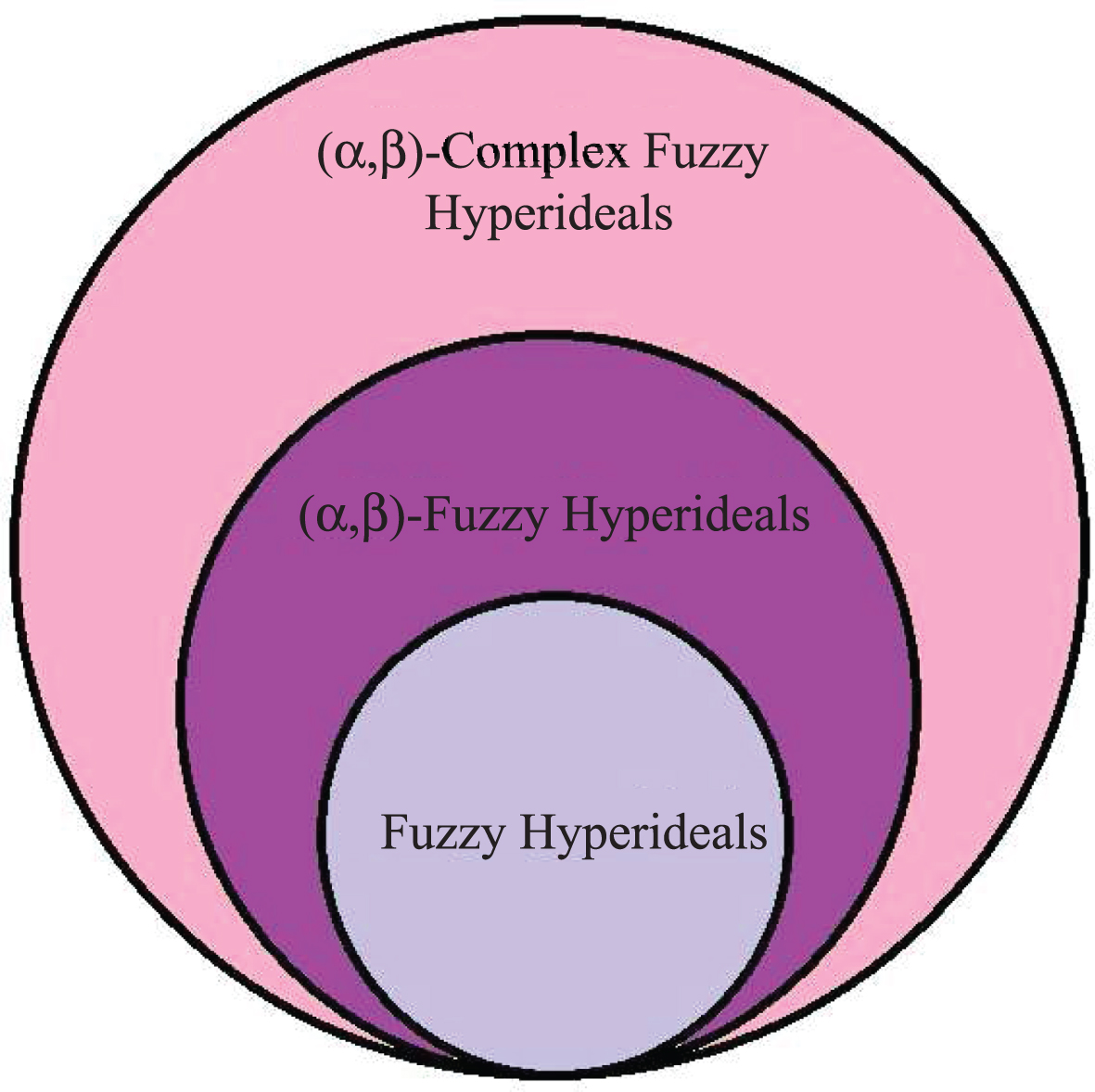
This paper generalize the idea of fuzzy hyperideals and (α, β)-fuzzy hyperideals by introducing the concept of (α, β)-complex fuzzy hyperideals. All types of (α, β)-fuzzy hyperideals are the special case of (α, β)-complex fuzzy hyperideals as shown in the following Figure 1 and Figure 2.
Generalization of sets
Generalization of fuzzy hyperideals
We discussed different types of complex fuzzy hyperideals and (α, β)-complex fuzzy hyperideals with some interesting results. In future we are aiming to discuss the following types of generalized complex fuzzy hyperideals in detail,
(i) (∈ , ∈ ∨ qk)-complex fuzzy hyperideals,
(ii) -complex fuzzy hyperideals,
(iii) (∈ γ, ∈ γ ∨ qδ)-complex fuzzy hyperideals,
(iv) -complex fuzzy hyperideals.
Footnotes
Acknowledgments
The 2nd author would like to thank the Deanship of Scientific Research at Majmaah University for supporting this work under Project Number 1440-62.
References
1.
F.Marty, Sur une generalization de la notion de groupe, 8iem Congres des Mathematicians Scandinaves Tenua Stockholm (1934), 45–49.
2.
P.Corsini, Prolegomena of hypergroup theory, Aviani Editore (1993).
3.
T.Vougiouklis, Hyperstructures and their representations, Hadronic Press, Palm Harbor, Flarida, USA, 1994.
4.
P.Corsini and V.Leoreanu, Applications of hyperstructure theory, Kluwer Academic (2003).
5.
T.Vougiouklis, A new class of hyperstructures, Journal of Combinatorics, Information and System Sciences20 (1995), 229–235.
6.
B.Davvaz and V.L.Fotea, Hyperring theory and applications. International Academic Press, USA, 2007.
7.
S.Hoskova, Abelization of quasi-hypergroups, Hv-rings and transposition hv-groups as a categorial reflection, Global Journal of Pure and Applied Mathematics3(1) (2007), 105–112.
8.
M.A.Kazim and N.Naseerudin, On almost semigroups, Aligarh Bulletin of Mathematics2 (1972), 1–7.
9.
S.M.Yusuf, On Left Almost Ring, Proc of 7th International Pure Math Conference, Islamabad, 2006.
10.
K.Hila and J.Dine, On hyperideals in left almost semihypergroups, ISRN Algebra, Article ID 953124, 2011, p. 8.
11.
N.Yaqoob, P.Corsini and F.Yousafzai, On intra-regular left almost semihypergroups with pure left identity, Journal of Mathematics (2013), 10. Article ID 510790
12.
F.Yousafzai, K.Hila, P.Corsini and A.Zeb, Existence of nonassociative algebraic hyperstructures and related problems, Afrika Matematika26(5) (2015), 981–995.
13.
N.Yaqoob and M.Gulistan, Partially ordered left almost semihypergroups, J Egyptian Math Soc23 (2015), 231–235.
14.
I.Rehman, N.Yaqoob and S.Nawaz, Hyperideals and hypersystems in LA-hyperrings, Songklanakarin J Sci Techn39(5) (2017), 651–657.
15.
S.Nawaz, I.Rehman and M.Gulistan, On left almost semihyperrings, International Journal of Analysis and Applications16(4) (2018), 528–541.
16.
L.A.Zadeh, Fuzzy sets, Inform and Control8 (1965), 338–353.
17.
N.Kuroki, Fuzzy bi-ideals in semigroups, Comment Math Univ St Paul28 (1979), 17–21.
18.
N.Kuroki, On fuzzy ideals and fuzzy bi-ideals in semigroups, Fuzzy Sets and Systems5 (1981), 203–215.
19.
N.Kuroki, On fuzzy semigroups, Inform Sci53 (1991), 203–236.
20.
K.A.Dib, N.Galhum and A.A.M.Hassan, Fuzzy rings and fuzzy ideals, Fuzzy Math4 (1996), 245–261.
D.Ramot, M.Friedman, G.Langholz and A.Kandel, Complex fuzzy logic, IEEE Transaction on Fuzzy Systems11(4) (2003), 450–461.
31.
H.T.Nguyen, A.Kandel and V.Kreinovich, Complex fuzzy sets, Towards New Foundations, IEEE (2000), 7803–5877.
32.
G.Zhang, T.S.Dillon, K.Y.Cai, J.Ma and J.Lu, Operation properties and δ-equalities of complex fuzzy sets, International Journal of Approximate Reasoning50 (2009), 1227–1249.
33.
M.Abd Ulazeez, S.Alkouri and A.R.Salleh, Complex intuitionistic fuzzy sets, international conference on fundamental and applied sciences, AIP Conference Proceedings1482 (2012), 464–470.
34.
M.Abd Ulazeez, S.Alkouri and A.R.Salleh, Complex Atanassov's Intuitionistic fuzzy relation, Hindawi Publishing Corporation Abstract and Applied Analysis, Volume 2013, p. 18. Article ID 287382.
M.Gulistan, A.Khan, A.Abdullah and N.Yaqoob, Complex neutrosophic subsemigroups and ideals, International Journal of Analysis and Applications16(1) (2018), 97–116.
37.
M.Al-Tahan and B.Davvaz, Generalized complex fuzzy and anti fuzzy Hv-subgroups, International Journal of Analysis and Applications16(5) (2018), 628–642.