



Abstract
This paper presents a disturbance-observer based sliding mode control (SMC) for fuzzy singularly perturbed systems (SPSs) with uncertainties and disturbances. Firstly, we designed a linear sliding surface. The sliding surface parameter matrix is determined by solving linear matrix inequalities (LMIs). The stability of the sliding mode is proved by a Lyapunov function. Secondly, a disturbance observer is designed to estimate the disturbance, and the obtained disturbance estimate is incorporated in the design of SMC. The reachability condition under the fuzzy SMC law is shown to be satisfied. Finally, simulation results show the feasibility and effectiveness of the proposed control method.
Keywords
Introduction
In many industrial systems such as robots, large nuclear reactors and power systems, contain small parasitic parameters which may lead to high dimensionality and ill-conditioned numerical issues in dynamic system modeling, system analysis and control method design process [1–3]. In order to avoid the above mentioned problems, such systems are typically modeled as SPSs with a singular perturbation parameter ɛ. In recent years, some scholars have reported excellent research results on SPSs [2–5]. The common methods are the quasi-steady state method [6, 7] and block diagonalization method [8, 9], which decompose SPSs into slow subsystem and fast subsystem, then design controller for each of the two subsystems and finally construct a composite control law for the overall system by combining the two controllers. These methods of decomposing into subsystems can avoid high dimensional and ill-conditioned numerical problems, but non-standard SPSs which cannot be decomposed into subsystems is not applicable [10]. Thus, based on full-order system model, an alternative approach called descriptor system was proposed [11].
In the robust control field, sliding mode control (SMC) is a common and effective method, especially for systems with uncertainties. SMC can make the system move along a specified trajectory under certain characteristics [12]. Many scholars have studied SMC of linear SPSs [13–18]. In [16], for the fast subsystem, a feedback controller was designed and the integral SMC method was adopted for the slow subsystem. In [17], SMC method was studied for SPSs with matched disturbances. In [18], SMC was proposed for a three– time– scale system. These studies are focused on SMC of linear SPSs. However, there are relatively few studies on nonlinear SPSs [19, 20]. Lin [19] discussed an adaptive SMC based on neural network composite method for SPSs. In [20], the design of an exponentially stabilized controller based on observer for nonlinear SPSs was studied.
The Takagi-Sugeno (T-S) fuzzy modeling method is effective in representing nonlinear systems [21]. The nonlinear system can be approximated by a series of linear subsystems. The virtues of T– S fuzzy model are as follows: 1) T-S models can generate relatively complex nonlinear functions. This can effectively reduce fuzzy rules when dealing with multivariable systems. 2) The T-S fuzzy system can utilize many sophisticated linear model control theories to analyze and synthesize complex nonlinear models. In the past few decades, T-S fuzzy modeling method has been widely studied in the field of nonlinear SPSs. In [22], a robust H∞ control based on fuzzy Lyapunov function and non-PDC control were proposed for fuzzy SPSs. In [23], for fuzzy SPSs, a H∞∼ control approach based on LMI was proposed. In [24], for a class of fuzzy SPSs, a state feedback control method was proposed to achieve multi-objective control. Asemani and Majd [25] studied a H∞ controller based on multiple Lyapunov functions for fuzzy SPSs. In recent years, many scholars have studied SMC of T-S fuzzy systems and some excellent results have been published. In [26], for the T-S fuzzy systems, under the condition of unmatched uncertainties and external disturbances, a composite adaptive SMC method was proposed. In [27], a speed control strategy for the T-S fuzzy model of SPMSM was designed. Hong et al. [28] investigated an adaptive integral SMC for general T-S fuzzy systems, the fuzzy integral sliding surface was designed. However, there are few people who are concerned about the SMC method for the T-S fuzzy SPSs. Wang et al. [29] developed an integral SMC strategy for T-S fuzzy SPSs. However, it is still an open problem for designing a disturbance-observer based SMC for T-S fuzzy SPSs.
This paper will develop a new SMC strategy for fuzzy SPSs with uncertainties and disturbances. Firstly, a linear sliding surface is constructed and the parameter matrix of the sliding mode controller is determined by solving of a set of LMIs. The stability of the sliding mode is proved by a Lyapunov function. After that, designing an ɛ-dependent fuzzy disturbance observer to obtain the estimate of the matched disturbance, and the estimate value is included in the design process of SMC. It is further shown that the reaching condition under the effect of the fuzzy SMC can be satisfied. Finally, this paper provides two examples to verify the validity of the proposed control method.
Problem statement and preliminaries
Consider the T-S fuzzy SPSs described as follows
Fuzzy Rule i:
IF θ1 (t) is Mi1, θ2 (t) is Mi2, . . . , and θ p (t) is M ip ,
THEN
The overall T-S fuzzy SPSs is written as follows:
The following lemma is given, which will be used for subsequent process.
This section will design a linear sliding surface. Because the f (t) is unknown, we will also design a disturbance observer to obtain the estimate of f (t) and incorporate it into the design process of the controller. And at last, stability of the system is proven.
Disturbance observer and sliding motion analysis
Motivated by [31] a fuzzy disturbance observer for system (2) is designed and the estimate value of the disturbance is obtained.
Substituting Equation (4) into Equation (5) yields
Thus, we have
Define
We design a linear sliding surface for the system (2) as
To design the parameter matrix S, define a transformation matrix T satisfying Equation (11)
Thus, we have
Under the transformation
system (2) becomes
When the system states go into sliding mode, by setting
Define a Lyapunov function
Then,
Using Lemma 1, it is easy to see that Equation (20) is rewritten as
We define
If the inequality (17) is satisfied, then there is a small constant ɛ2 > 0 such that Φ + ɛΦ0 < 0 for any given ɛ ∈ (0, ɛ2], which shows that
The upper bound estimate of ɛ* is also an important problem for SPSs. By the method of [33], the theorem 3 is given.
The work in the previous section has two parts. One part is to design a disturbance observer to obtain the estimate value of f (t), the other part is to design a linear sliding surface, and system asymptotically stable can be guaranteed. The next section is focused on designing control law and ensuring all the system states can reach the sliding mode surface.
When the system states are in the sliding surface, we have
We use the sliding mode equivalent control method, the solution to Equation (28) yields
We choose the switching law as
where λ > 0 is a constant.
Therefore, the SMC law can be organized as
Calculating the time-derivative of V (t) along (28) yields
This section will verify the validity of the proposed method by two examples. The first example considers an electric circuit nonlinear system [29], and the second example considers a permanent magnet synchronous motor (PMSM).
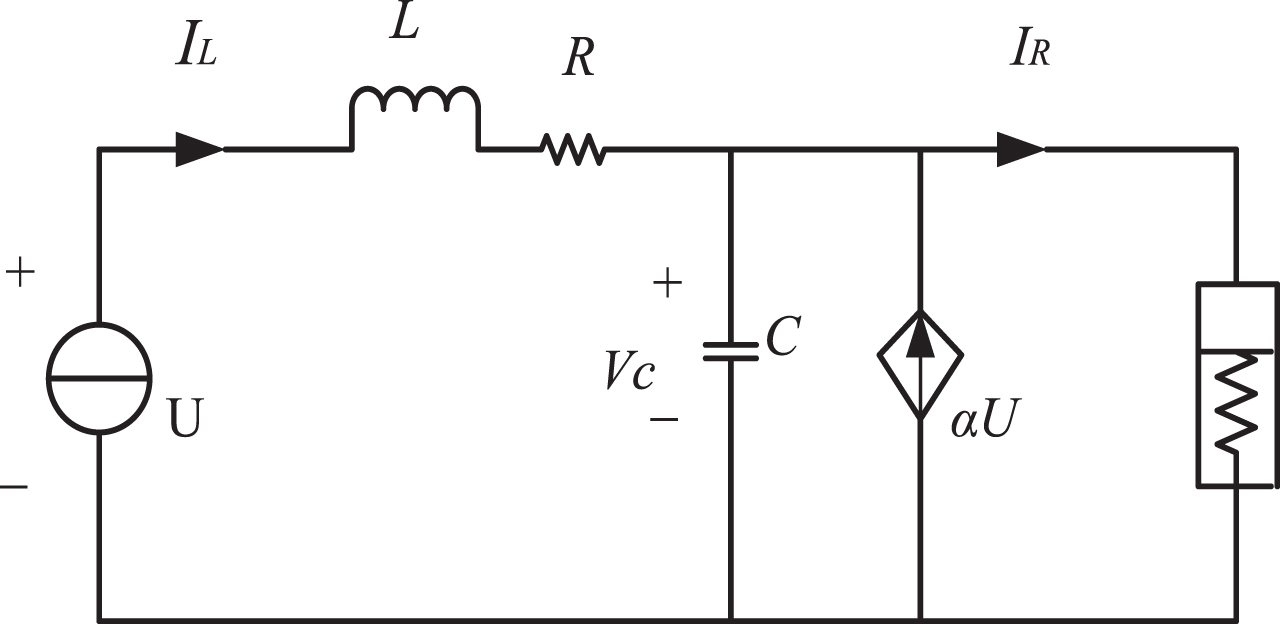
Electric circuit.
According to the knowledge of circuit principle, circuit system state equation can be written
Define x1 (t) = L · I
L
(t), x2 (t) = V
c
(t), and select the voltage U as the control input. The membership functions are chosen as
In this example, uncertainties are assumed to satisfy
Considering circuit system uncertainties, the system (34) can be modeled under x2 (t) ∈ [3, - 3].
Fuzzy Rule 1: IF x2(t) is about h1(x2(t))
THEN
Fuzzy Rule 2: IF x2(t) is about h2(x2(t)),
THEN
In this example, according to the Lemma 1, we choose the corresponding parameter matrices as
Let
The simulation results of the nonlinear circuit under the control law (31) are shown in Figs. 2– 5. The state curves are given in Figs. 2 and 3. It can be seen that the T-S model-based SMC method proposed in the paper makes the closed-loop system asymptotically stable. Moreover, the proposed disturbance observer-based SMC law can lead to shorter response times, less overshoots than the integral SMC (ISMC) presented in [29] because the estimate rather than the bound of the disturbance is used in this paper. The control signal u (t) and the switching surface σ (t) response curves are shown in the Figs. 4 and 5, respectively. It can be clearly seen that the sliding motion can be achieved in a limited time.
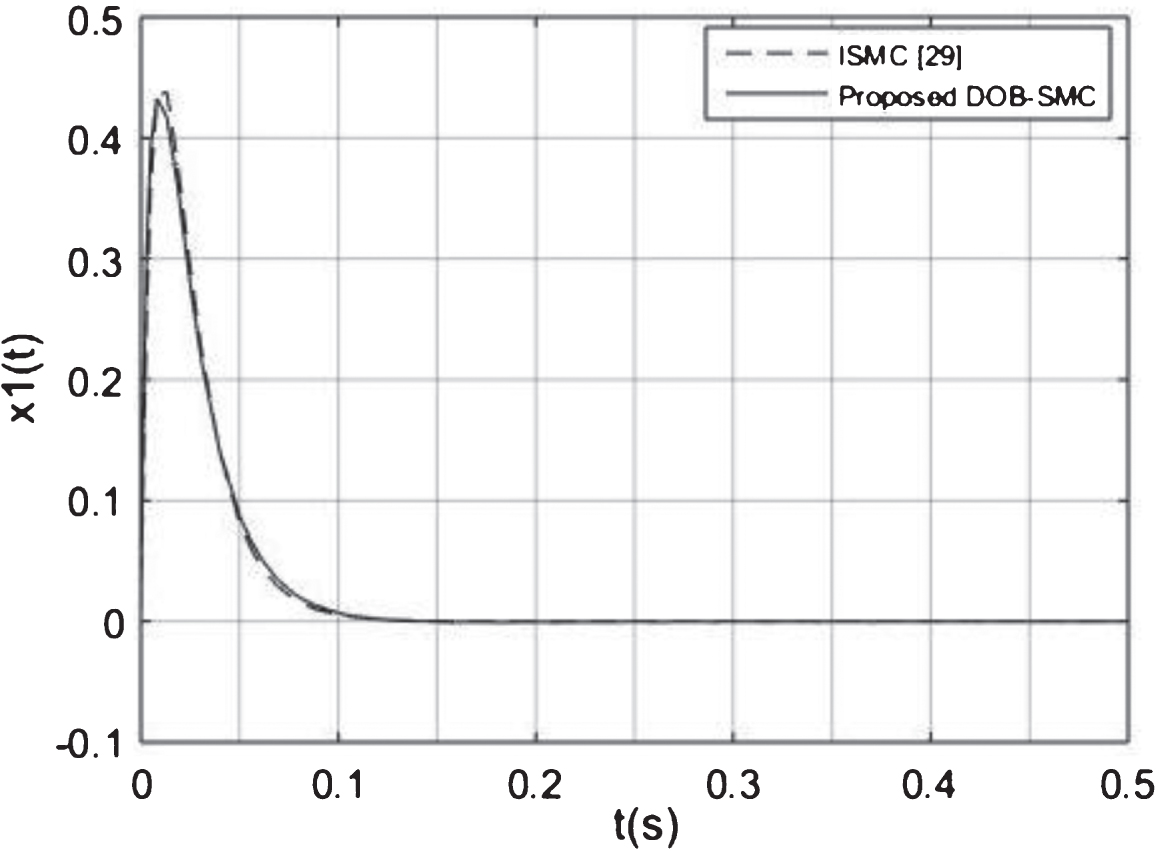
Responses of x1 (t) with ɛ = 0.1.
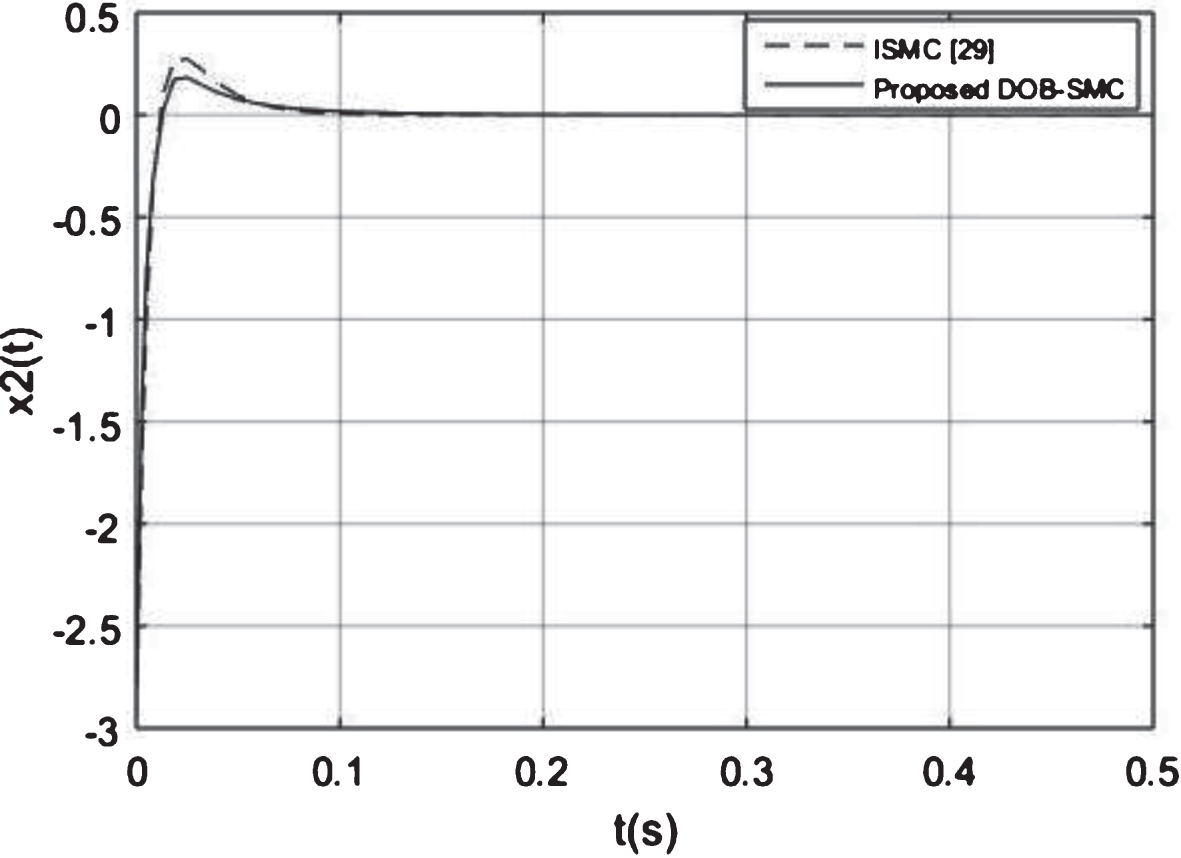
Responses of x2 (t) with ɛ = 0.1.
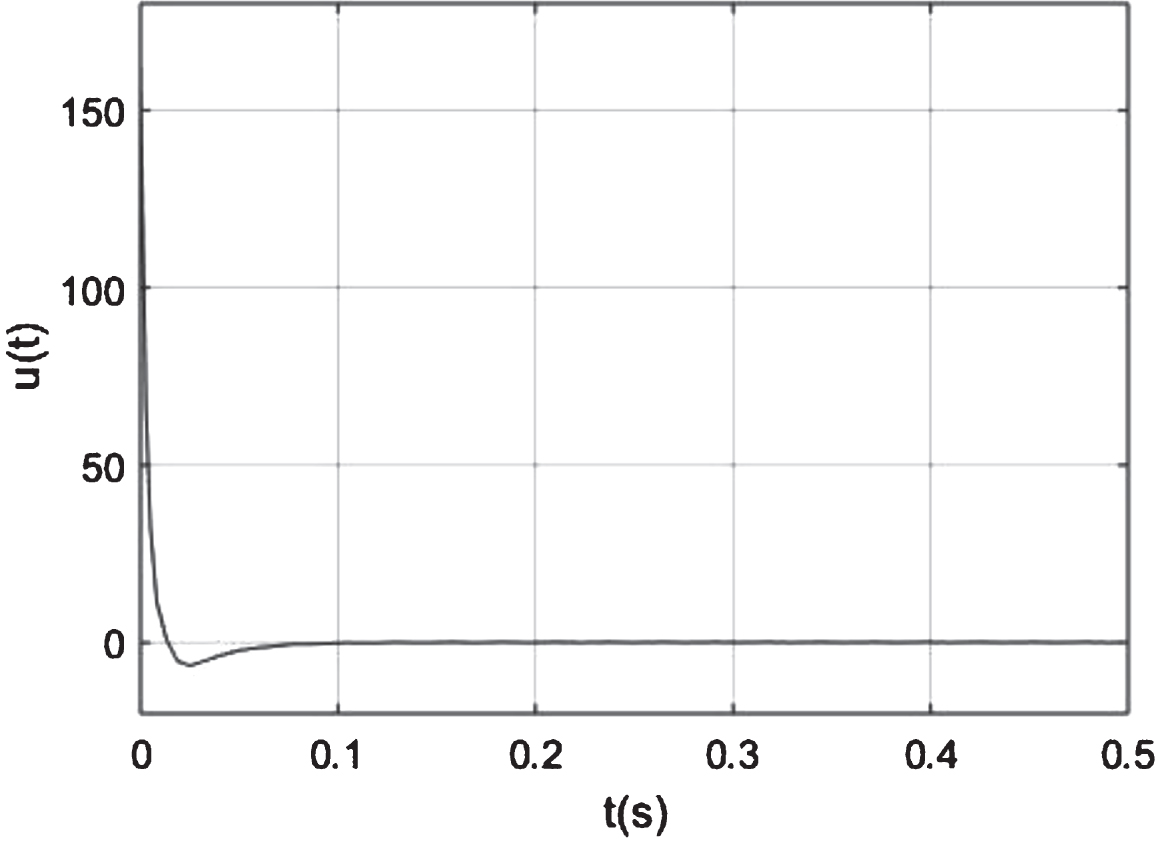
Responses of u (t).
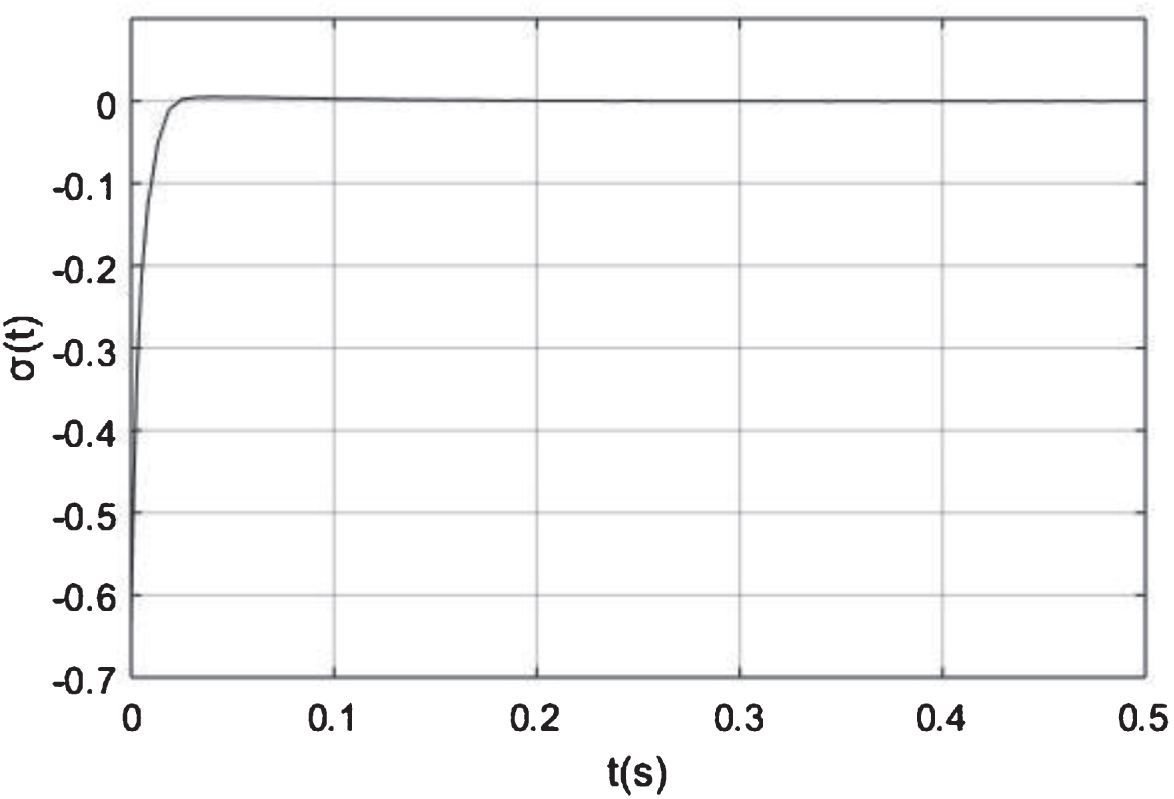
Responses of σ (t).
The specific parameter values of PMSM are listed in Table 1.
Motor parameters
Rule i (i = 1, 2, . . . r): If w is W
i
, Then
We can approximate the dynamics model of PMSM with the following linear subsystem
Fuzzy rule 1: IF w is about W1 (W1 = -500) , THEN
Fuzzy rule 2: IF w is about W2 (W2 = 500) , THEN
where
In this example, according to Lemma 1, the corresponding parameter matrix is selected as follows:
The exogenous disturbances are f1 (t) =5000 sin(20t) and f2 (t) =3000 sin(20t). Let
Then, solves the LMIs in theorem 2 and 3 yields the following solutions
The simulation results under the control law are shown in Figs. 6– 9. The given speed is w = 60 rad/s, and the actual angular speed of the PMSM can quickly follow the given value under disturbances. Figure 7 shows the three-phase stator current. Figures 8 and 9 show the actual disturbance signal and the observed disturbance value. It can be seen from the figure that the observer designed in this paper can estimate the disturbance with high accuracy.
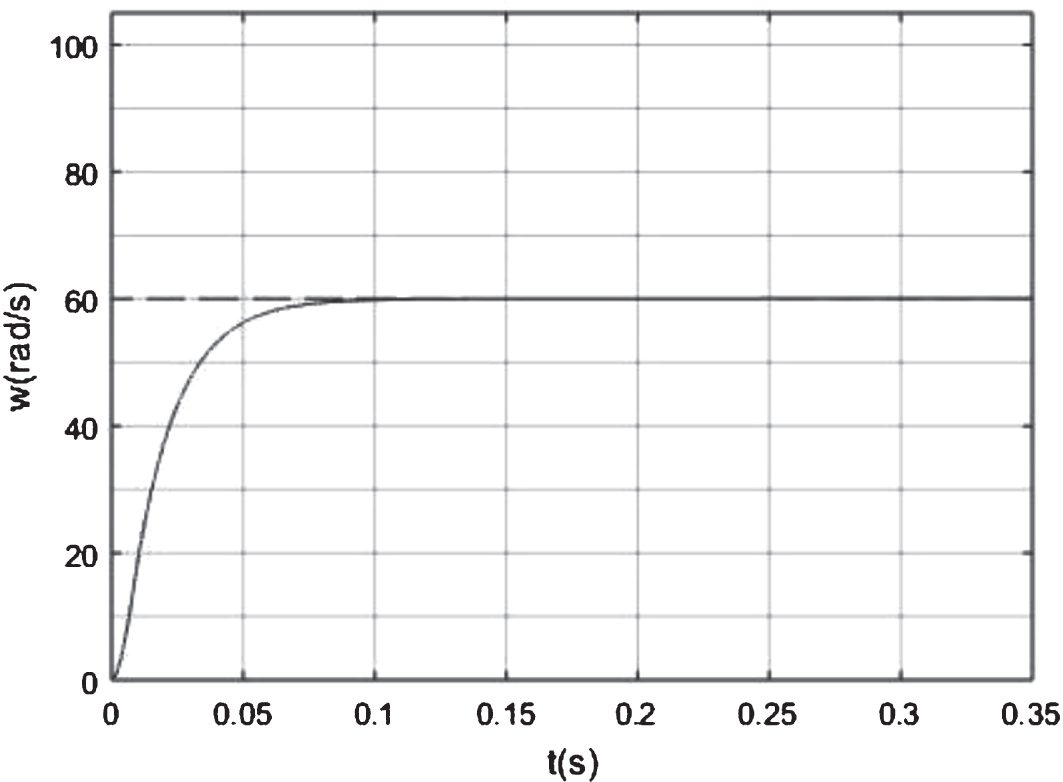
Angular speed of motor.
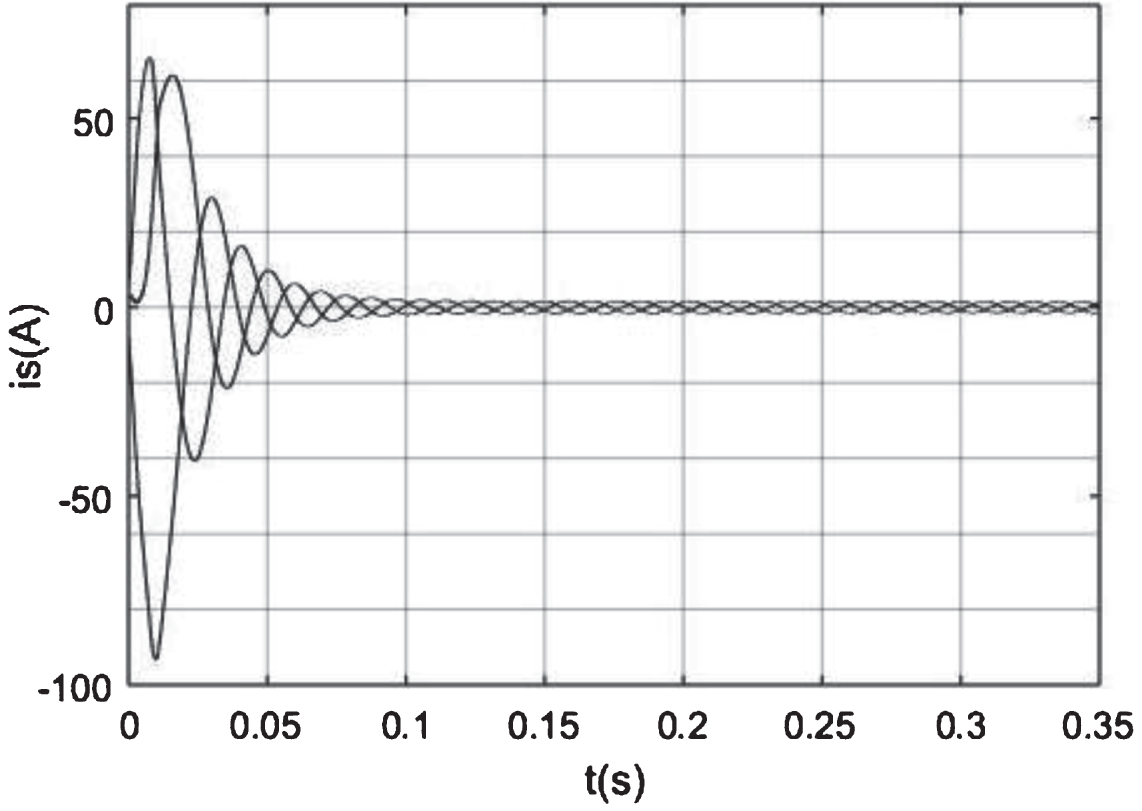
Stator three-phase current.
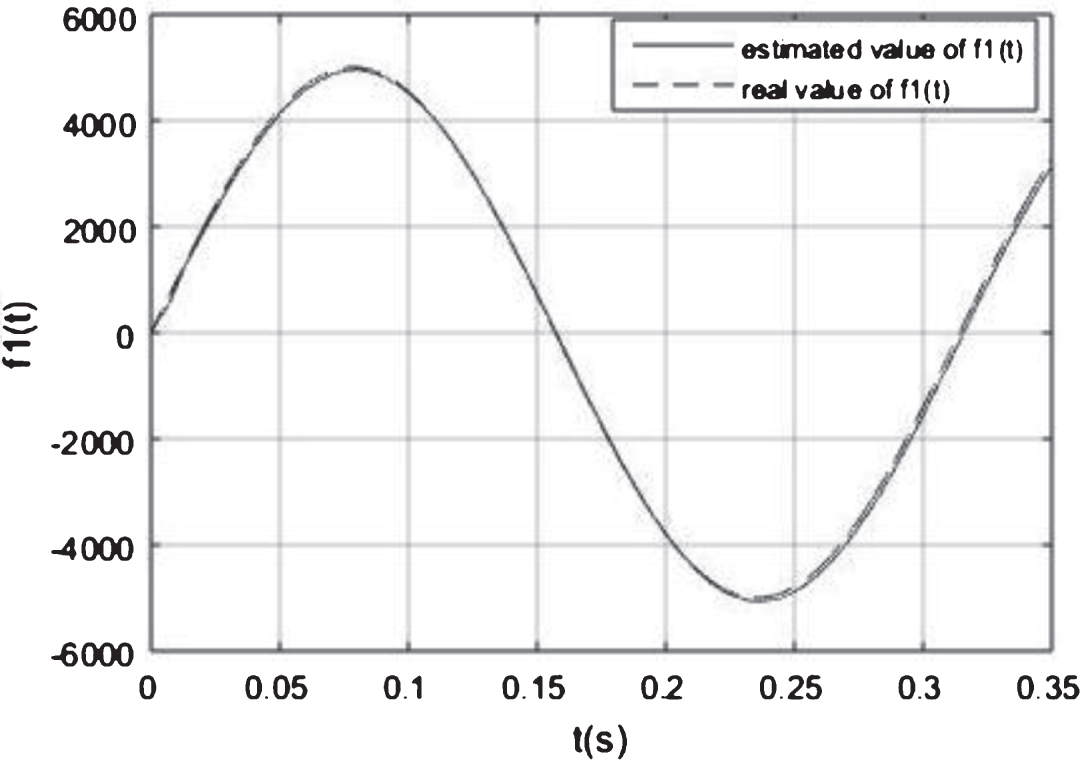
The estimate of f1 (t).
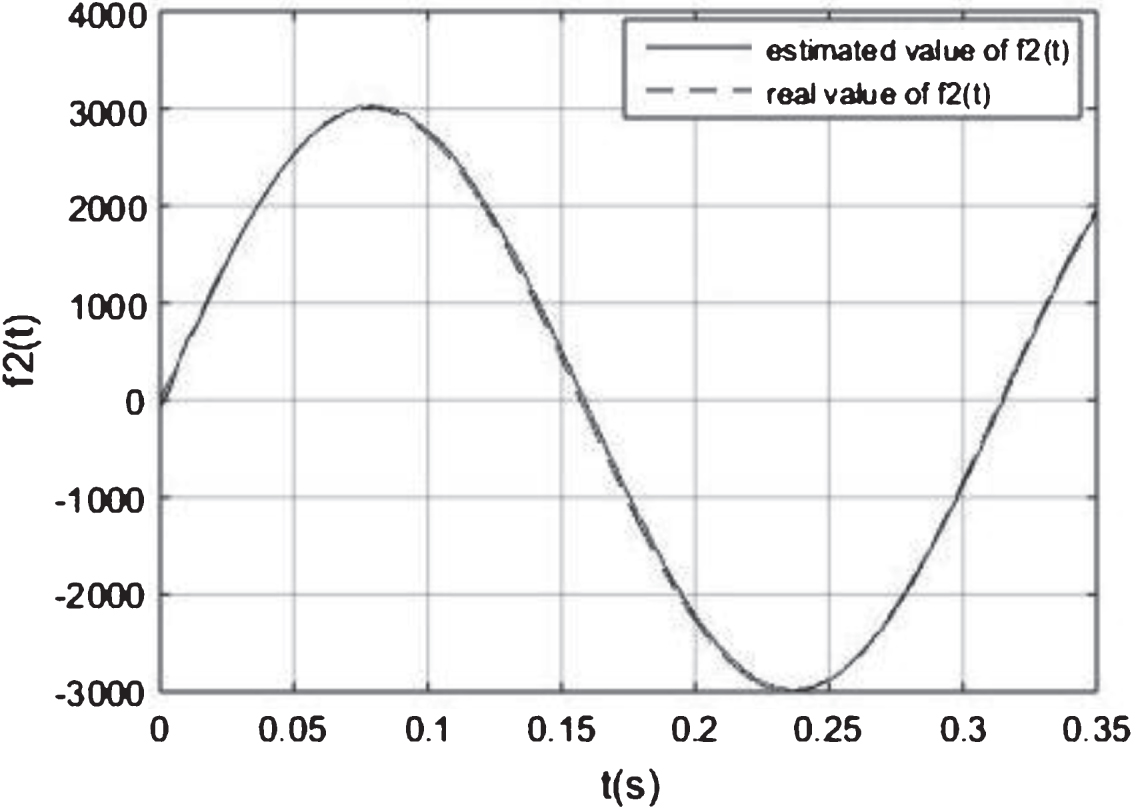
The estimate of f2 (t).
In this paper, the SPSs based on T-S fuzzy model with uncertainties and disturbances have been studied. The proposed SMC strategy based on disturbance observer not only effectively makes the closed-loop system asymptotically stable, but also reduces the influence of disturbance on the system. The simulation examples also show that the proposed method is meaningful for nonlinear SPSs affected by disturbances and uncertainties.
Footnotes
Acknowledgments
This work was supported by the National Natural Science Foundation of China under Grant 61873272 and 61603392, and Fundamental Research Funds for the Central Universities under Grant 2017QNB16.