



Abstract
Aim at achieving the energy conservation and fully taking advantage of the multi-radio resource for multi-radio wireless sensor networks (MRWSNs), the interval type-2 fuzzy logic (IT2FL) based energy-optimal radio resource management mechanism is proposed, by taking the complex uncertainties existed in MRWSNs into consideration. The contribution of this paper is as follows. Firstly, the IT2FL inference mechanism is proposed to handle the complex uncertainties better. In the proposed IT2FL inference mechanism, three important factors, i.e., the transceiver energy consumption, the residual energy, and the channel quality, are considered as the input variables and the selection probability of each transceiver is regard as output variable. Secondly, the proposed IT2FL is utilized to the decision-making of the energy-efficient radio resource allocation in MRWSNs, when there are multiple new/delivery tasks. Following that, full simulations are deployed, in order to validate the proposed IT2FL based radio resource management mechanism can effectively improve the network performance, in terms of the energy efficient, throughput, data transmission success rate, and prolong the network lifetime etc.
Introduction
The wireless sensor networks (WSNs) are generally deployed randomly in hazardous places where traditional infrastructure based network is practically infeasible [1]. The data-sensitive application environment, for instance industrial monitoring/control, earthquake/health-care monitoring, etc, brings many harsh challenges, including demand lower latency and lower energy consumption, higher throughput, etc. Unfortunately, the traditional WSNs designed based on single-radio single-channel and worked in contention-based model is hard to meet the requirement of massive/time-sensitive data transmission in data-sensitive applications [2]. The development of microelectronic technology, wireless communication technology, distributed information processing technology and embedded computer technology, etc, makes it is possible to equip multiple RF transceivers on the same node and construct multi-radio WSNs (MRWSNs). Hence, multi-radio technology is regarded as a promising way for salving the above mentioned problems. Radio resource management has been proved as a completed NP-hard problem. Thus, it is essential to research an advanced and intelligent energy-efficient radio resource management scheme for improving the network performance, reducing the energy consumption, and maximizing the lifetime of MRWSNs.
In this paper, the IT2FL is introduced to MRWSNs, and then built by considering three factors, the transceiver energy consumption, the residual energy and the channel quality, in order to achieve the energy efficient radio resource management, and then applying it to decision-making of the energy-optimal transceiver allocation in MRWSNs. The simulation results indicate that the proposed IT2FL based radio resource management scheme can effectively improve the performance of MRWSNs, such as end-to-end (e2e) delay, throughput, and network lifetime.
The rest of the paper is organized as follows. Section II summaries the related work. Section III formulates and analyzes the radio resource allocation problem. And then the three input variable models in the proposed IT2FL are built and analyzed. Section IV presents the proposed IT2FL based radio resource management scheme in detail. The performance of the proposed IT2FL based radio resource management scheme is evaluated and analyzed in Section V. The conclusions of our work are presented in Section VI.
Related work
Although MRWSNs can provide multi-transceiver choice for sending/delivering data and effectively improve network performance, energy constraint is one of serious challenges. Similarly to the conventional WSNs, wireless nodes have few limitations, like limited power energy, storage capability, processing capability, and being unattended after deployment in the network field [3]. Hence, efficient and energy conserved radio resource management scheme is very important to relieve the energy constraint in MRWSNs. Imari et al. [4] and Zhang et al. [5] proposed a convex optimization method to solve the dynamic resource allocation problem. Giannakis et al. [6] took convex and stochastic optimization as tools to solve resource allocation and scheduling problems for multiuser wireless OFDM systems. Lin et al. [7] improved the spectrum efficiency via distributed random source code and proposed a greedy networking algorithm to decrease the e2e delay and guarantee the statistical QoS. McNair et al. [8] improved the energy efficiency and network lifetime via dynamic spectrum access with packet size adaptation and residual energy balancing. Kimet al. [9, 10] proposed greedy heuristic approaches, simulated annealing and particle swarm optimization, for scheduling wireless resource to minimize the e2e delay in time-constrained multi-hop environment. Lin et al. [11] used nonlinear mixed integer programming (NLMIP) method to separately optimize the resource allocation coefficients of sensors in each FieldNet and the channel allocation among the cascaded FieldNets. Xiong et al. [12] proposed sliding window based multiple secondary user (SU) selection schemes that are applicable to both best-effort primary user (PU) interference mitigation and hard interference temperature (IT) constraints. Tanab et al. [13, 14], Gállego et al. [15] and Ngo et al. [16] proposed distributed resource scheduling approaches for multiple-input multiple-output (MIMO) cognitive radio network.
Fuzzy logic theory is widely used in many fields, including control, time series forecasting, classification, and decision making, etc, since it has the ability to cope with the problems with uncertainties and imprecise information [17–21]. Moreover, interval type-2 fuzzy logic (IT2FL) can provide more accurate results than type-1 fuzzy logic (T1FL), owing to the member functions (MFs) of the IT2FL are also fuzzy [22]. Many researcher had applied T2FL to handle some problems, like cluster head election, energy-efficient routing etc, in WSNs. Greenfield et al. [23] evaluated the different methods for defuzzifying the interval type-2 fuzzy set, including the Karnik-Mendel iterative procedure, the Wu-Mendel approximation, the Greenfield-Chiclana Collapsing defuzzifier and the Nie-Tan method, and then proved that the Greenfield-Chiclana Collapsing defuzzifier outperform with others methods in terms of both accuracy and speed. Moreover, Greenfield et al. [24] presented the details of the collapsing algorithm for the defuzzifier of IT2FL. Nayak et al. [25] proposed a cluster head election algorithms based on T2FL, by considering three fuzzy variables, remaining battery power, distance to base station, and concentration. Xie et al. [26] had considered three fuzzy inputs, residual energy, the number of neighbor nodes and the distance to the base station, and proposed a clustering routing protocol for WSNs based on T2FL and ant colony optimization (CRT2FLACO). Own [27] proposed a type-2 based mobility-aware inference mechanism for energy balancing in WSNs, by considering four fuzzy inputs, the energy, distance, mobility, and interference time between nodes. To extend the lifetime of the energy constrained WSNs, Shu et al. [28] and Liang et al. [29] presented a novel approach based on T2FL system to analyze the lifetime of a WSNs. To our best knowledge, there is a lack of research result with IT2FL for MRWSNs. Hence, this paper applies the IT2FL to MRWSNs for energy-optimal radio resource management.
Problem formulation and analysis
In this section, the MRWSNs construction and radio resource allocation problem are formulated firstly. Subsequently, the models of corresponding input variables, i.e., the channel quality, the transceiver energy consumption and the residual energy, are respectively constructed and analyzed.
Problem formulation
In order to reduce the data e2e delay and increase the network throughput, the multi-radio node should send/delivery the data as soon as possible. Hence, it considers the energy conservation and data transmission success rate (DTSR), and then selects the best transceiver for data transmission. Thus quickly and effectively confirm the energy-optimal transceiver in multi-radio environment is very important, when the transmission is necessary.
For anyone multi-radio node, suppose there are m half-duplex RF transceivers equipped on the node and the radio resource set is denoted by R = {R1, R2, …, R m }. To convenient description, suppose the number of tasks waiting to be scheduled is q and the task set is denoted by T = {T1, T2, …, T q }. The radio resource allocation process for a multi-radio node is shown in Fig. 1.
As shown in Fig. 1, in monitoring fields, a multi-radio node generates/deliveries multiple data tasks. It quickly and effectively allocates all of the tasks to the energy-optimal transceiver by using the proposed IT2FL based radio resource management mechanism. Thus the radio resource can be efficiently utilized and the energy consumption of radio node can be largely reduced.

Radio resource allocation process.
To estimate the channel quality, each packet which is transferred by the same RF transceiver within the same statistic period is individually marked with a continuous and monotonically increasing sequence number. If the transmission failure, the retransmitted packets are considered as new packets and re-marked according to increasing sequence order. By continuous statistics, the total number of transmitted packets and the numbers of successfully transmitted packets can be obtained respectively. Then, the DTSR can be calculated, and the channel quality can be estimated based on the current calculated DTSR. Channel quality is measured by the times of extra expected transmission. Hence, the lower estimated result, the better channel quality, vice versa.
For the i-th channel, DTSR and channel quality estimation (CQE) can be respectively derived as follows
As well know, the transceiver mainly contains the following states: T
x
, R
x
, Sleep, Listen. Thus, the total energy consumption of a transceiver can be obtained as follows
The state energy consumption E
state
contains the above mentioned states and can be derived as follows
The states change energy consumption E
change
can be expressed as follows
The e
change
(i) is calculated by the average energy consumption of the start state and end state, and can be obtained as follows
Due to the natural properties of energy, multi-radio node’s energy decreases with the times of communication (send or receive). Hence, the remaining energy of the node is called its residual energy, and defined as the initial energy subtracts the total accumulated energy consumption of all the transceivers equipped on the same node. Based on the analyzed transceiver energy consumption model, the accumulated energy consumption is the sum of the energy consumption of transceiver state and the energy consumption of state change. Thus, the residual energy can be obtained as follows
In this section, a T2FLS is introduced firstly. Then the IT2FL based energy-efficient radio resource management scheme is established in detail. In the designed IT2FL, the channel quality, the transceiver energy consumption and the residual energy are considered as the input variables and the chance of the transceiver to be used for sending data is the output variable. Thus, by adopting a balanced trade off strategy between the data delay and the energy-efficient, the multi-radio node selects the transceiver with maximize chance and energy-optimal as the best candidate to send the current data.

Block diagram of a T2FL.
The most difference between T2FL and T1FL is that the type-2 fuzzy set is characterized by a fuzzy MF. The value/grade of MF for each input is a fuzzy set in the interval [0,1]. Therefore, the MFs of type-2 fuzzy sets are three dimensional functions. The third dimension is known as the set’s footprint of uncertainty (FOU), which provides the additional degrees of freedom for T2FL and makes the T2FL handle more types of uncertainties with higher magnitudes than T1FL. A block diagram of a typical T2FL is shown in the Fig. 2. The T2FLS is mainly composed as the following components: the fuzzifier, the knowledge base, the fuzzy inference engine and the output processing which includes the type-reducer and defuzzifier.
Fuzzifier: it converts the input data or crisp values into a type-2 fuzzy set, according to the corresponding MFs. The triangular, trapezoidal and Gaussian shaped functions are commonly used membership functions [30]. Knowledge base: it stores the fuzzy rules that consist of a set of linguistic statements and are expressed by IF-THEN form. Fuzzy inference engine: the inference engine combines the fuzzy value (i.e., the outputs of the fuzzifier) and fuzzy rules together to produce a mapping from the type-2 fuzzy input set to the type-2 fuzzy output set. Output processing: it consists of type reduction that reduces the type-2 fuzzy set to the type-1 fuzzy set, and defuzzifier that converts the reduced type-1 fuzzy set to the corresponding crisp output. The center of singleton, center of gravity and maximum methods are the frequently used techniques for defuzzifier.
Proposed IT2FL algorithm
In this subsection, the IT2FL algorithm is built in detailed, by considering the three important factors, the channel quality, the transceiver energy consumption and the residual energy, as input variables. The chance of each transceiver to be candidate for sending data is regarded as output variable. The energy optimal transceiver which will be used for sending/delivering data is calculated by the proposed IT2FL based algorithm for MRWSNs. Figure 3 shows the block diagram of our proposed IT2FL.
Proposed IT2FL. Fuzzification Module: The function of fuzzifier is transforming each crisp input vector x = (x1, ⋯, x
p
)
T
to a type-2 fuzzy set 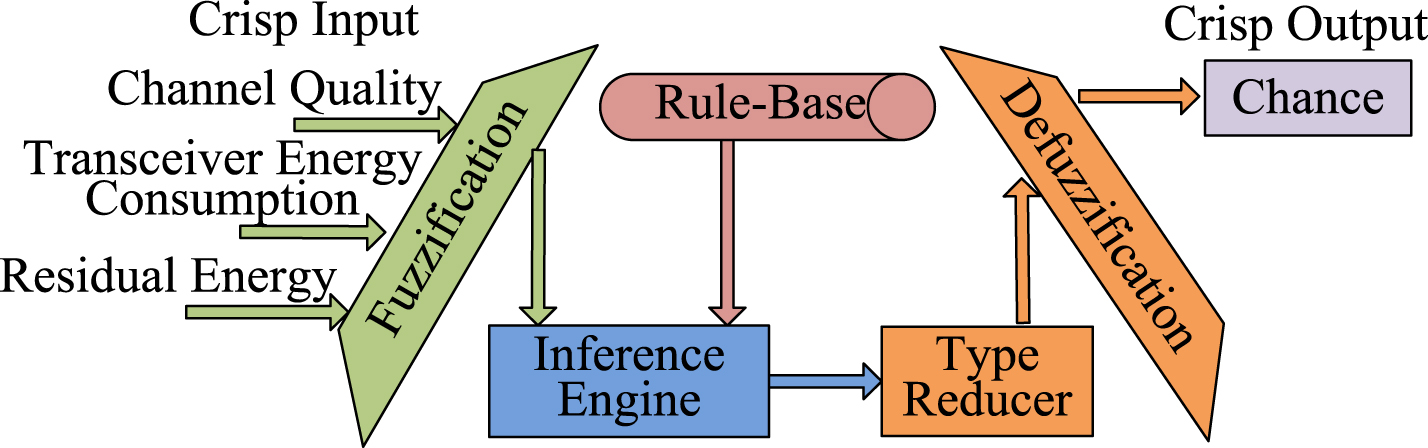
where u ∈ J
x
, which indicates the primary membership of x and
In this paper, adopting the interval type-2 fuzzy set to express
The FOU represents the uncertainty in the primary membership grades of a type-2 fuzzy set
The upper bound of
The Gaussian shaped MFs are considered in this proposed model. The three input variables are denoted as X, Y and Z respectively. The chance of transceiver is selected is regarded as output variable and denoted as C. The corresponding MFs of the three input variables are shown in Fig. 4(a-c) respectively. In order to describe easily, the linguistic variables for the channel quality are considered as bad, medium and good. The linguistic variables for the transceiver energy consumption and the residual energy are the same and taken as low, average and high. The linguistic variables for the type-2 fuzzy output set contain seven statuses and are depicted as very low, low, below average, average, above average, high and very high, as depicted in Fig. 4(d).

Gaussian shaped membership function plot. (a) membership function for input variable: channel quality; (b) membership function for input variable: residual energy; (c) membership function for input variable: transceiver energy consumption; (d) membership function for output variable: select probability.
Table 1 presents the MFs of the corresponding three type-2 fuzzy input variables and the type-2 fuzzy output variable, in respectively.
MFs for the corresponding variables
2) Fuzzy Rules and Inference Engine: The fuzzy rule in IT2FL is similar to the type-1. The nature of MF is the main difference between IT2FL and T1FL, but this doesn’t affect the construction of fuzzy rules. Hence, the basic structure of fuzzy rules in type-2 can also be depicted as follows.
Table 2 lists the all of the 33 (27) type-2 fuzzy rules.
The complete 33 (27) Type-2 Fuzzy Rules
Figure 5(a-c) show the 3D surfaces between the arbitrary two inputs and the output, in respectively. Figure 5(a) is that the relationship from residual, the channel quality and the selection chance of transceiver. Similarly, Fig. 5(b) shows the relationship from the transceiver energy consumption, the channel quality and the selection chance of transceiver. Figure 5(c) presents the relationship from the transceiver energy consumption, the residual energy and the selection chance of transceiver.
The 3D surfaces between the arbitrary two different inputs and the output. (a) the relationship from two inputs (i.e., residual energy, channel quality) to output (i.e., select probability); (b) the relationship from two inputs (i.e., transceiver energy consumption, channel quality) to output (i.e., select probability); (c) the relationship from two inputs (i.e., transceiver energy consumption, residual energy) to output (i.e., select probability).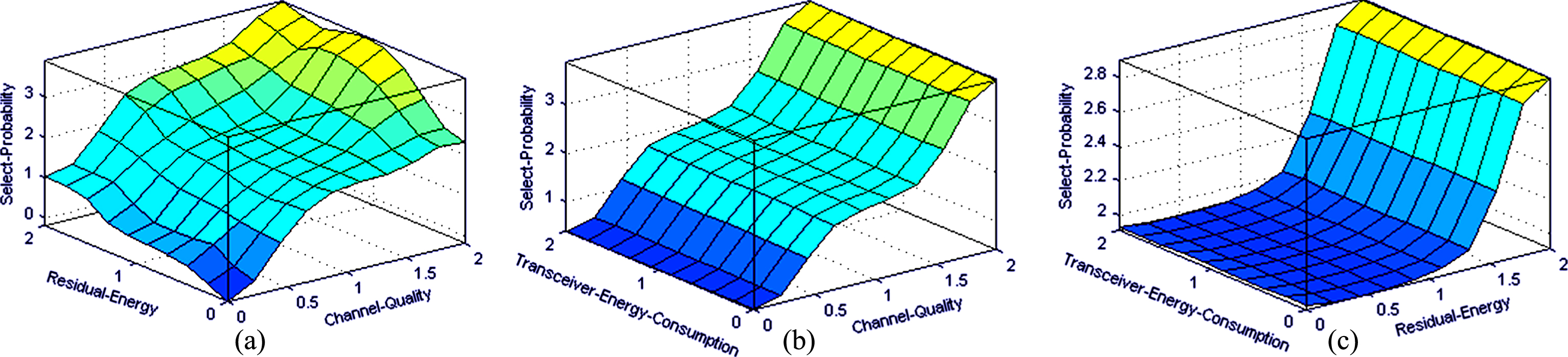
In the fuzzy inference process, the ‘firing level’ for each rule is calculated and then applied them to the consequent fuzzy set. The firing level of the l-th rule can be derived as follows
The corresponding output consequent fuzzy set of the l-th rule can be characterized by the follows MF.
3) Output Processing: The output processing includes the type reducer which reduces the type-2 fuzzy set to the type-1 fuzzy set, and the defuzzifier that transfers the reduced type-1 fuzzy set into the corresponding crisp output. In this paper, the Greenfield-Chiclana Collapsing defuzzifier [24] is utilized as the defuzzifer for the proposed IT2FL. The collapsing method transfers the interval type-2 fuzzy set into a type-1 representative embedded set (RES), whose defuzzified values closely approximates that of the original type-2 set. Thus, the RES converted type-1 set can then be defuzzified straightforwardly. As shown in Fig. 6 a converted RES (continuous case). The full detailed collapsing method can be found at [23, 24].
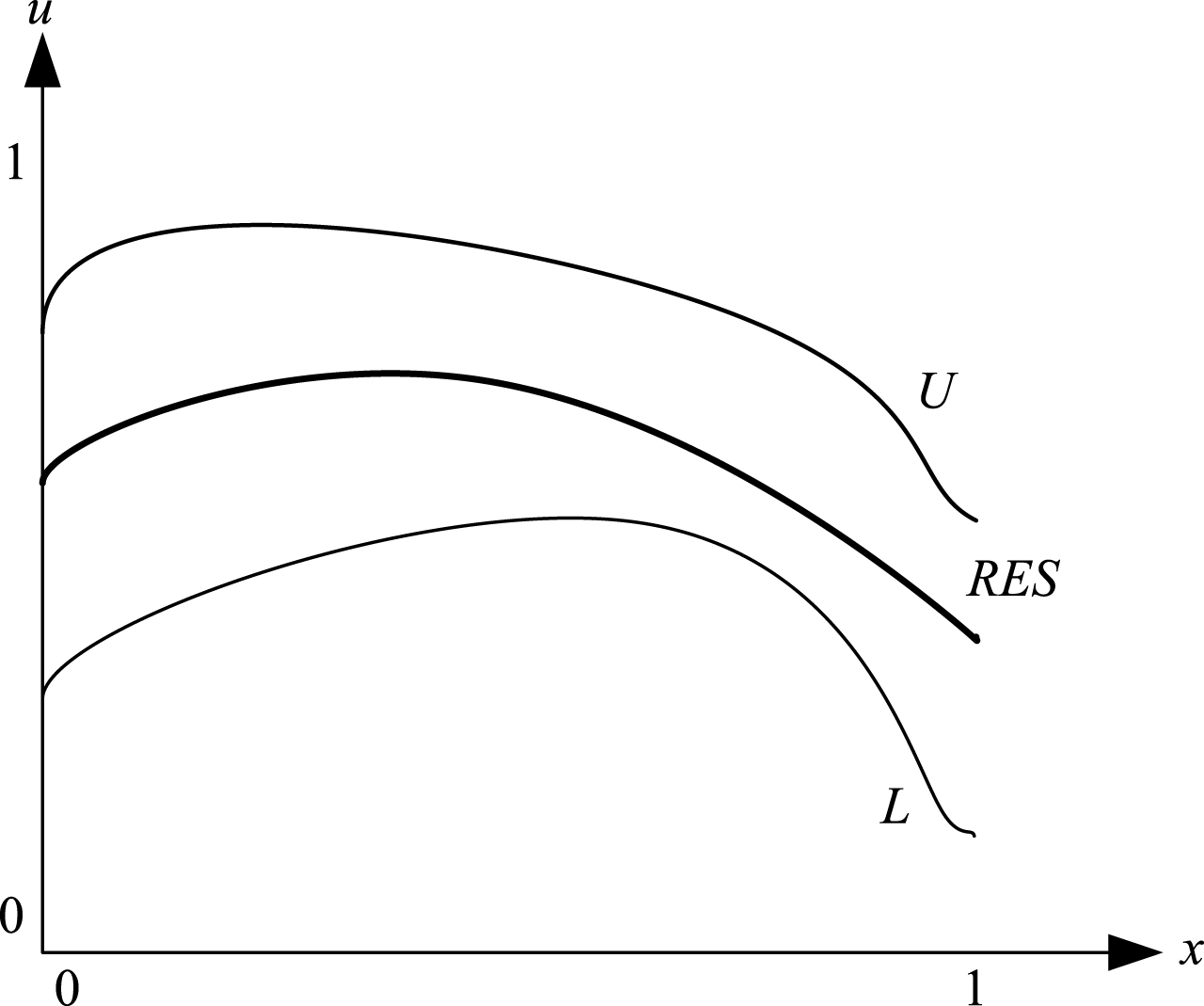
A converted RES (continuous case).
Thus, it can use the dynamically collapsing slices of a discretised interval type-2 fuzzy set
After the defuzzification for IT2FL, all of transceivers which are equipped on the same node have their own probability p j , (j = 1, 2, …, m) to be the candidate transceiver for sending/delivering data. The multi-radio node selects the transceiver with the highest probability to be the energy-optimalcandidate for data transmission in current round, if the selected transceiver is not busy. Otherwise, by tradeoff the delay and energy save, the node re-selects the alternative transceiver with the sub-high probability and checks the state (idle or busy). The maximum value of repeat is set to be 2. Thus, the node will randomly delay and then repeat the above process, if the re-selected transceiver is also busy. Algorithm 1 provides the pseudo-code of the transceiver selection.
Figure 7 presents the flowchart of the proposed IT2FL based radio resource management process in MRWSNs. The multi-radio node collects the transmission result, including energy consumption and transmission power when sending data. Based on the collected data, it estimates channel quality, calculates residual energy and transceiver energy consumption, in respectively. The designed IT2FL provides the chance of each transceiver for sending data in current round, and then recommends the best one to the node. Node sends data through the recommended transceiver, and then re-enters the next round for evaluating the optimal transceiver which will used to send the coming data.
the flowchart of the proposed IT2FL based radio resource management process.
In this section, the performance of DTSR based channel quality estimation algorithm is evaluated firstly. Then, both experiments and simulations are conducted for MRWSNs to verify the effectiveness of the proposed IT2FL based radio resource management scheme. For comparison, FOU with 0.8 denoted as IT2FL(0.8), FOU with 0.5 denoted as IT2FL(0.5) and FOU with 0.2 denoted as IT2FL(0.2) in the IT2FL model are randomly chosen in the evaluation. Furthermore, the T1FL model with the same fuzzy input variables and fuzzy rules is also applied for comparison. We compare the network performance with IT2FL(0.8), IT2FL(0.5), IT2FL(0.2), T1FL and Randomly Schedule (RS), in terms of transmission success rate, e2e delay, first node dies, network lifetime and throughput.
Effectiveness of channel quality estimation
To evaluate the effectiveness of the proposed DTSR based channel quality estimation method, some experiments under different smoothing factors α and the different DTSR are conducted. Firstly, fix the transmission frequency and DTSR, change the smoothing factor α from 0 to 1, and then validate how the smoothing factors α impact the channel quality estimation. Secondly, set the smoothing factor α to be a constant, change the DTSR from 0 to 1, and then check how the DTSR impact the channel quality estimation. Finally, the corresponding results of evaluation are depicted as Fig. 8(a-b).
results of channel quality estimation with different smoothing factors α and DTSR. (a) the impact of different smoothing factors α (α= 0.2, α= 0.7, α= 0.9) to channel quality estimation under the fixed DTSR (DTSR = 0.99); (b) the impact of different DTSR (DTSR = 0.6, DTSR = 0.8, DTSR = 0.99) to channel quality estimation under the fixed smoothing factors α= 0.4.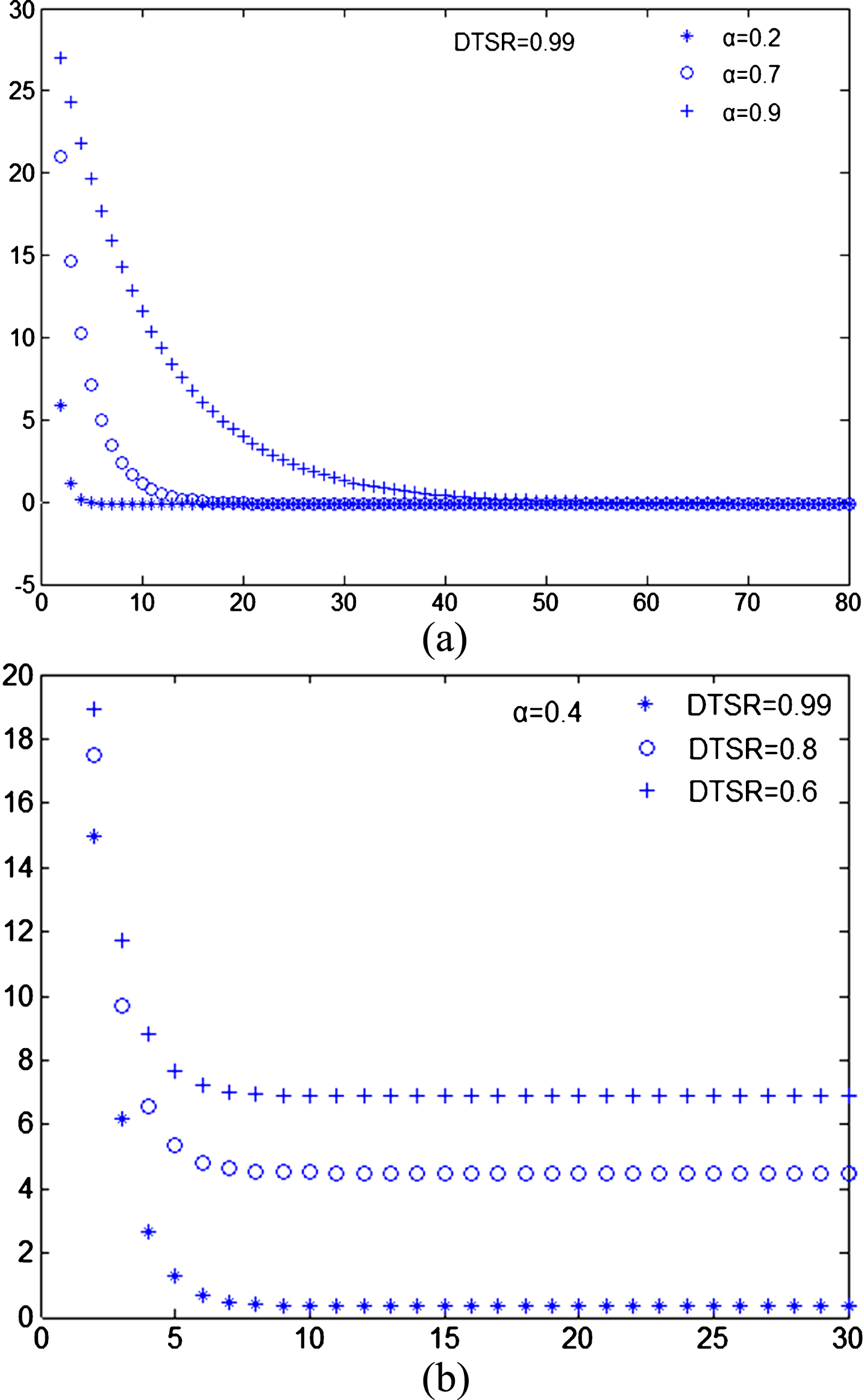
Figure 8(a) indicates how the smoothing factors α impact the required time of channel quality estimation. From the figure, we can clearly observe that the required time of channel quality estimation is positive correlation with the smoothing factor α. The larger smoothing factor is, the more required time is, the vice versa.
Figure 8(b) presents the plots of channel quality estimation under different DTSR. This figure clearly reflects that value of estimation is opposite correlation with DTSR. The higher DTSR is, the lower estimation value is, the vice versa.
State Current and Required Time of State Change
Simulation parameters
The proposed IT2FL based radio resource management scheme is evaluated for multi-radio network size of 120 multi-radio nodes. The energy efficient transceiver is selected based on the proposed IT2FL with the three type-2 fuzzy inputs variables.
The transceiver energy consumption is the sum of energy consumption of state and energy consumption of state change. In order to test the transceiver energy consumption, we deploy some experiments based on our designed multi-radio node hardware (shown in Fig. 9(a)) and the Agilent Digital Multi-Meter. The multi-radio node supports four RF transceivers (Semtech SX1231H) at most. The current consumption is recorded by the Agilent Digital Multi-Meter supported PC software (shown in Fig. 9(b)). Figure 9 shows the experimental test hardware and the PC software user-interface respectively.
Transceiver energy consumption test. (a) multi-radio node; (b) interface of current consumption record
Table 3 lists the current of each state and the required time of state change (one transceiver).
To further evaluate the performances of network, some simulations are deployed based on the NetSim simulator. Table 4 gives the simulation parameters.
In the simulation, 120 multi-radio nodes are uniformly deployed from (x = 0, y = 0) to (x = 100, y = 100). The data packet size is set to be 128 bytes. The simulator records the time of first node died and runs about 500 seconds. All of the results of simulation are shown in Fig. 10(a-e).
Figure 10(a) indicates the transmission success rate of the three different transceiver resource management schemes. The transmission success rate of IT2FL based radio resource management scheme outperforms others, since the transceiver which is used to send data each round is selected based on IT2FL considering the channel quality factor. The FOU provides the additional degrees of freedom for IT2FL and makes it is possible for IT2FL to handle more types of uncertainties with higher magnitudes than the type-1 counterparts. Hence, the higher FOU is, the better performance is, and the lower FOU is, the closer type-1 result is. As shown in Fig. 10(b), the e2e delay of packets based on the IT2FL is lowest. It is reasonable that the selected transceiver based on IT2FL is tradeoff between data delay and energy-efficient, that means the better channel quality is, the lower retransmission probability is, and the lower e2e delay. The simulator records the time of the first node dies. The fuzzy models (IT2FL and T1FL) overall consider the channel quality, the residual energy and the transceiver energy consumption. That can prolong the lifetime of node. Since the RS scheme randomly selects the transceiver, the channel quality of the selected transceiver may be not good and thus the transceiver energy consumption may be high. The retransmission and energy consumption is higher, and it leads to the node quickly die. The corresponding results of first node dies are depicted in Fig. 10(c), the first node dies in RS first, then in T1FL, IT2FL(0.2), IT2FL(0.5), the last in IT2FL(0.8). The network lifetime is measured by the total number of alive nodes which have not yet exhausted all of their energy. Hence, the larger the number is reflects the longer network lifetime is. As shown in Fig. 10(d), the network lifetime of IT2FL(0.8) is the longest. The reason is similar to the first node died. Figure 10(e) plots the result of the network throughput. The multi-radio node chooses the optimal transceiver for sending data based on our proposed mechanism. That makes that the higher transmission success is, the lower retransmission is, and the higher throughput is.
Simulation results of performance evaluation. (a) transmission success rate; (b) e2e delay; (c) the first node dies; (d) network lifetime (NO. of alive nodes); (e) network throughput.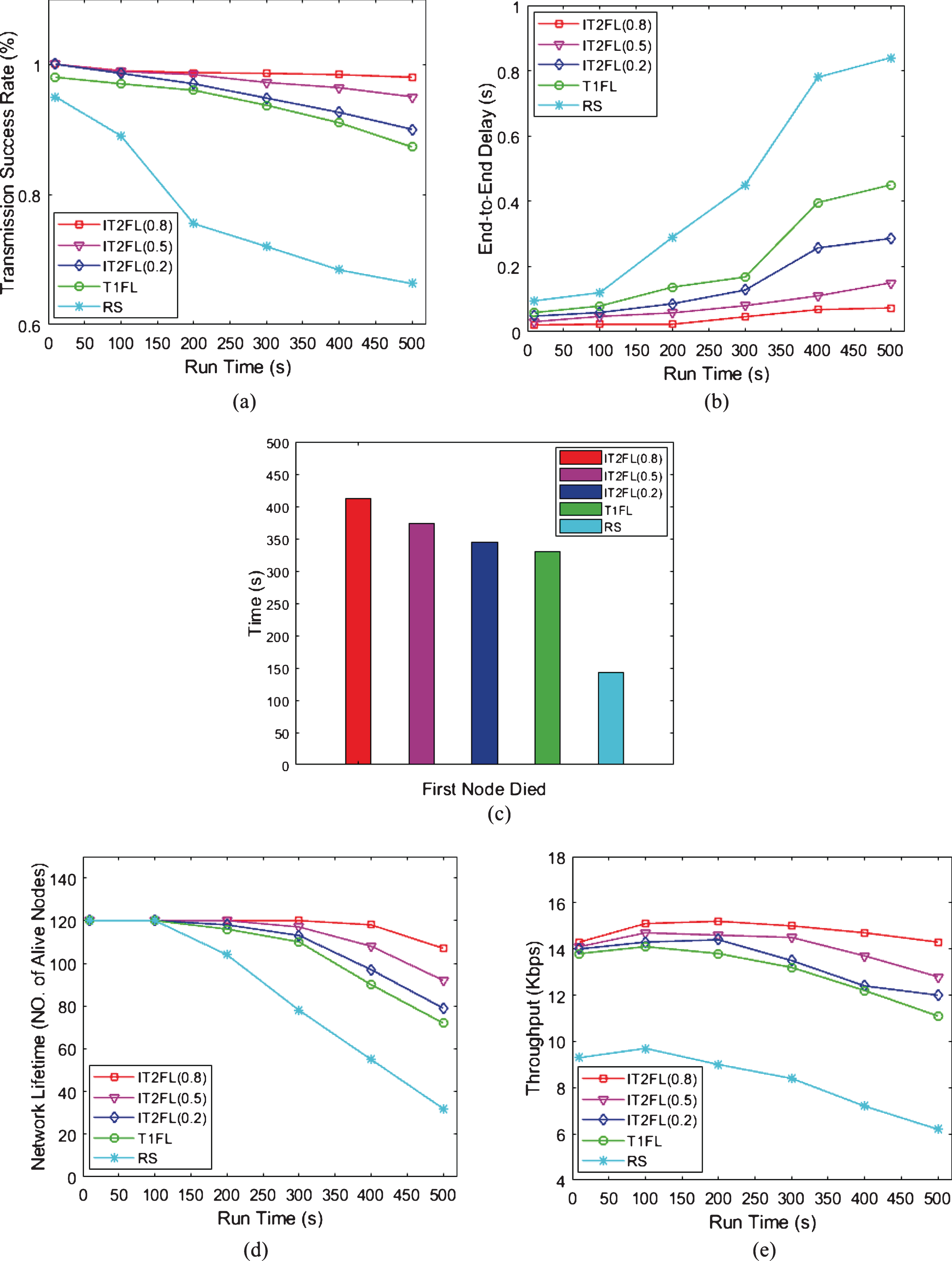
In order to achieve the efficient radio resource management in MRWSNs, this paper proposed IT2FL based energy-efficient radio resource management mechanism. The proposed mechanism comprehensively considered the channel quality, the energy consumption and the residual energy as type-2 fuzzy input variables, and the chance of each transceiver was regarded as type-2 output variable. Then applied the proposed mechanism to the MRWSNs, the multi-radio node could elect the optimal energy-efficient transceiver for sending data.
The simulation results demonstrated that the proposed mechanism could effectively improve the DTSR and greatly cut energy consumption, so as to greatly prolong the network lifetime. However, the proposed mechanism only considered the three variable and the rules were fixed and were defined by experience. In the future work, we would like to consider more parameters and design the adaptive algorithm to optimize the rules.
Footnotes
Acknowledgments
This work was supported by the National Natural Science Foundation of China under Grant NO. 61573225 and NO. 61473176.