



Abstract
A huge range of human decisions is involved bipolar subjective thoughts. For illustration, effects and side effects are two different aspects of decision analysis. The equilibrium and mutual coexistence of these two aspects are treated as a key for balanced social environment. A verity of bipolar fuzzy decision making with different technique is available for bipolar fuzzy characterizations of the universe of options that depend on a limited number of grades. So, the concept of simple bipolar fuzzy set is insufficient to provide the information about the occurrence of ranking with accuracy because information is limited. In this regard, we use cubic bipolar fuzzy sets (CBFSs) as the generalization of bipolar fuzzy sets. In human decisions, the second important part is ranking of alternatives obtained after evaluation. The motivation behind this research is to develop an appropriate aggregation method which is simple reliable and efficient enough to handle cubic bipolar fuzzy data. We propose aggregation operators, including, cubic bipolar fuzzy weighted averaging operator, cubic bipolar fuzzy ordered weighted averaging operator and cubic bipolar fuzzy hybrid weighted averaging operator for
Introduction
In daily life, we encounter with many decision making circumstances, which involve ambiguities and uncertainties due to insufficient knowledge, meager information, incompatible data, inconsistent and rare information. In 1965, Zadeh [52] brought out the idea of fuzzy set theory to overcome such problems. Fuzzy set theory has been successfully used in decision making problems to handle uncertain and ambiguous data from many decades. In fuzzy decision making, Zadeh [53] introduced similarity relations and fuzzy ordering. He also described the rating of each alternative and the weight of each criterion using linguistic terms induced by fuzzy linguistic variables which can be expressed in triangular fuzzy numbers [54, 55]. In short, fuzzy set theory has been auspiciously adapted in fields of computer sciences [5], management sciences [22], engineering [11], medical sciences [38] and physics [28] etc.
After fuzzy set theory, many set theories have been developed, including, interval valued set theory [53], intuitionistic fuzzy set theory [6], bipolar fuzzy set theory [60], neutrosophic set theory [36], soft set theory [32], fuzzy soft set theory [33], pythagorean fuzzy set [50] and m-polar fuzzy set theory [10] etc. All these theories have been developed according to necessity of handling specific type of data and its useability in different suitable domains. For other hybrid theories, terminologies and applications, the readers are referred to [8, 62].
For data analyzing of many types, bipolarity of knowledge is a vital part to be considered while developing a mathematical framework for most of the situations. Bipolarity indicates the positive and negative aspects of a particular problem. The concept behind the bipolarity is that a huge range of human decisions analysis is involved bipolar subjective thoughts. For illustration, happiness and grief, sweetness and sourness, effects and side effects are two different aspects of decision analysis. The equilibrium and mutual coexistence of these two aspects are treated as a key for balanced social environment. Zhang [58] introduced the extension of fuzzy set with bipolarity, called, bipolar-valued fuzzy sets. Bipolar fuzzy set is suitable for information which involve property as well as its counter property. In 2000, Lee [29] discussed some basic operations of bipolar-valued fuzzy set. Lee [30] proposed a comparison of intuitionistic fuzzy set, interval-valued set and bipolar fuzzy set. Dubois and Prade [12] introduced three major types of bipolar fuzzy set. Zhang [59] established a computational framework for bipolar cognitive modeling and multi attribute decision analysis. In bipolar-valued fuzzy set interval of membership value is [-1, 1]. The bipolar fuzzy set involves positive and negative memberships. The elements with 0 membership indicate that they are not satisfying the specific property, the interval (0, 1] indicates elements satisfying property with different degrees of membership, whereas [-1, 0) shows that elements satisfying implicit counter property. Bipolar fuzzy sets have been also used in many fields and decision making problems which involve bipolar type information [1–3, 35].
In 2013, Jun et al. [27] introduced the concept of cubic set (extension of interval-valued fuzzy set and fuzzy set) and its operations. They presented idea of internal and external cubic sets and their properties. the concept has been extended with many other theories. Cubic set has been also successfully used in decision making processes due to its efficiency of containing enough information of a particular type of data.
Multi-criteria group decision making provides a unanimous decision on basis of different criterions to seek the most accurate solution of real world problems. Decision making is an integral part of modern management and business. Essentially, rational or sound decision making is a primary goal of the management. In primitive times, decisions were framed without handling the uncertainties in the data, which may lead to inadequate results toward the real-life operating situations. Decision making has a vital role in our daily life problems. We encounter with many difficulties to handle a problem which contains big amount of data. In this regard, different techniques with aggregation operators have been introduced to handle such type of data. Fahmi et al. studied aggregation operators and their application in MCGDM based on triangular cubic hesitant fuzzy and triangular neutrosophic cubic fuzzy set [13, 14]. Gul [23] worked on aggregation operators under environment of bipolar fuzzy set with MCGDM. Beg and Rashid [7] studied group decision making in the context of intuitionistic hesitant fuzzy set. Garg and Arora introduced different aggregation operators and their applications in MCDM [17–20]. Xia and Xu [47, 48] introduced aggregation operators on different extensions of fuzzy set with MCGDM. Many authors have been auspiciously adopted many capable techniques to solve decision making problems. Ghodsypour and Brien discussed decision making of supplier selection using AHP technique [21]. Hwang and Yoon [25, 26] introduced technique of TOPSIS first in 1988. Gulcin and Cifci studied many efficient techniques of MCDM including DEMATEL, ANP, TOPSIS on fuzzy sets [24]. Liu et al. [31] studied group decision making with multiple-attribute strategic weight manipulation with minimum cost. Peng and Selvachandran discussed decision making methods for pythagorean fuzzy sets. Zhan et al. [56, 57] studied many MCGDM method for domain of rough set. Zhang and Xu [61] introduced TOPSIS for pythagoren fuzzy set with decision making. Zhang et al. [64] studied priority weights and consistency for incomplete hesitant fuzzy preference relations. Zhang and Guo [65] discussed deriving priority weights from intuitionistic multiplicative preference relations under group decision-making settings. Yu et al. studied extended TODIM for multi-criteria group decision making based on unbalanced hesitant fuzzy linguistic term sets [51].
Consensus decision making or consensus reaching process (CRPs) is a type of group decision making process in which group members develop, and agree to support a decision in the best interest of the whole group or common goal. It is used to describe both the decision and the process of reaching a decision. CRPs is thus concerned with the process of finalizing a decision, and the social, economic, legal, environmental and political effects of applying this process. In short it has great importance in group decision making. Zhang et al. [66] reviewed some existed CRPs and introduced a series of CRPs as the comparison object. They also developed new multi-stage optimization-based CRPs. There are many MAGDM problems which need to assign two rank levels only, so as to create a ranking of one subset of alternatives above another subset. This type of MAGDM problem is called a 2-rank MAGDM problem. Zhang et al. [63] investigated the 2-rank MAGDM problem under the multi granular linguistic context, and proposed a 2-rank consensus reaching framework with the minimum adjustments. In multiple attribute decision making (MADM), strategic weight manipulation is understood as a deliberate manipulation of attribute weight setting to achieve a desired ranking of alternatives. Liu et al. [31] studied the strategic weight manipulation in a group decision making (GDM) context with interval attribute weight information. Zhang et al. [68] developed a novel consensus reaching process for MAGDM with hesitant fuzzy linguistic term sets (HFLTSs). Based on the proposed consensus rule and aggregation model, They presented a consensus reaching process for MAGDM with HFLTSs. Information loss is an other issue in multiple attribute group decision making. In real-world decision problems, decision makers usually express their opinions with different preference structures. In order to deal with the heterogeneous preference information in group decision making, Zhang et al. [67] presented an optimization-based consensus model for group decision making with heterogeneous preference structures. They developed the technique to minimize the information loss between decision makers’ heterogeneous preference information and individual preference vectors and solution with a consensus.In MADM decision makers may not be honest, to deal with this issue, Liu et al. [31, 69] presented some useful methods for MADM.
The motivation behind this research is to develop an appropriate aggregation method which is simple reliable and efficient enough to handle cubic bipolar fuzzy data. From latest research surveys of hybrid fuzzy set models, most of the researchers in fuzzy-set-inspired models focused on real numbers between 0 and 1. But in most of the real life problems, we encounter with the negative part of a particular decision. For example, a medicine which is not effective may not has any side effect. So the bipolarity is an important aspect of human decisions. In human decisions, the second important part is ranking and rating of different alternatives obtained after particular evaluation. A verity of bipolar fuzzy decision making with different technique is available in literature. This range of applications of the theories can be used to deal with bipolar vagueness and uncertainty, which introduced the simple bipolar fuzzy characterizations of the universe of options that depend on a limited number of grades. So the concept of simple bipolar fuzzy set is insufficient to provide the information about the occurrence of ratings or grades with accuracy because information is limited, and it is also unable to describe the occurrence of uncertainty and vagueness very well specially, when sensitive cases are involved in decision making problems. Similarly, the concept of interval valued bipolar fuzzy sets(IVBFSs) is also insufficient to provide the information about the opinion of experts depending upon the properties of alternatives. For this purpose, Riaz and Tehrim [42] introduced the novel model with application, called cubic bipolar fuzzy sets as the generalization of bipolar fuzzy sets. This model provides more accuracy and flexibility as compared to previously existing approaches, because it contains more information and it is more comprehensive and reasonable. The model provides complete information about occurrence of ratings, uncertainty and bipolarity. On the other hand, an arithmetic mean is useful when comparing different items finding a single “ figure of merit” for these items when each item has multiple properties that have different numeric ranges. The arithmetic operations are useful in multiple-attribute group decision making because these operations provide an average value of a collection of observational data against each attribute. Yager [49] introduced averaging aggregation operators first in 1988. These operators satisfied some important properties and are useful in many fields including economics, business and finance etc. The motivation of this paper is to introduce a series of aggregation operators on cubic bipolar fuzzy set using arithmetic operations. It is also valuable because we extend the method of aggregation operators by using arithmetic operations under cubic bipolar fuzzy data for MAGDM. We compile the final decision by using these extended operators method because of the complex structure of proposed model. In this paper, firstly, we use the concept of bipolar fuzzy set and cubic set to initiate the notion of cubic bipolar fuzzy set, secondly, we introduce six cubic bipolar fuzzy averaging aggregation operators to aggregate the cubic bipolar fuzzy data then we apply both concepts to a multi-criteria group decision making problem to handle a specific type of data with bipolar imprecision which is inexact. We also check and compare results obtained by these averaging operators.
The proposed aggregation operators on cubic bipolar fuzzy set have following merits. The presented operators are simple in calculation and efficient to calculate huge amount of data, which is often unable or time-taking to handle in group decision making with multi attributes. The proposed algorithm with these averaging aggregation operator is suitable to handle business or related MAGDM. The average based operations are suitable in multiple-attribute group decision making because these operations provide an average value of a collection of observational data against each attribute. The loss of data is less as compare to other techniques. These averaging aggregation operators on cubic bipolar fuzzy set provide a dual check because of dual perspective that is There is need of good technique for handling bipolar fuzzy information in simple as well as efficient manners. The proposed aggregation operators method is combined with cubic bipolar fuzzy set is more strong but ease.
The paper is organized as follows: In Section 2 we discuss some preliminaries, in Section 3 we introduce averaging aggregation operators on CBFSs under
Preliminaries
In the present section, we review some basic definitions which are useful throughout this research work.
Fuzzy set, bipolar fuzzy set, interval-valued bipolar fuzzy set and cubic set
Cubic bipolar fuzzy set with operations
In the present section, firstly we define an improved score function for cubic bipolar fuzzy data for both orders. Secondly, we define a collection of aggregation operators for CBFSs. We define different averaging operators for both
Score and accuracy functions for CBFEs
In [42], we define score function for
-order cubic bipolar fuzzy weighted average(
-CBFWA) Operator
Suppose that
-Order cubic bipolar fuzzy ordered weighted averaging(
-CBFOWA) Operator
Suppose that
which can be computed under
-order cubic bipolar fuzzy hybrid weighted averaging(
-CBFHWA) operator
Let
In this operator we first assign weights to parameters and rearrange the
now we compute the score function
Now we define all averaging operators under
-order cubic bipolar fuzzy weighted averaging(
-CBFWA) Operator
Suppose that
-order cubic bipolar fuzzy ordered weighted averaging(
-CBFOWA) Operator
Suppose that
-Order cubic bipolar fuzzy hybrid weighted averaging(
-CBFHWA) operator
Let
(Idempotent) For (Bounded) (Commutative) If (Monotonic) Let
CBFSs application to multi-criteria group decision making using averaging aggregation operators
The multi-attribute group decision making (also called conjoint decision making with a collection of alternatives) is a process in which a panel cooperatively take a decision from a collection of different alternatives. The choice can not be further attributable to a single member of the panel. This is so because in such processes the whole panel and related social aspects contribute in final choice. The final results obtained by groups are clearly strong and correct as compare to obtained by a single person. This type of decision making is more useful when the problems involve more uncertainties and ambiguities. More precisely, a collective decision making has extreme tendency to manifest an inclination towards discussing shared material. The role of bipolarity is also important in decision making process, which involve uncertain bipolar type information. Here we use a collection of averaging aggregation operators on cubic bipolar fuzzy set to tackle a multi-attribute group decision making problem.
Proposed technique
In this subsection, we introduce the technique of cubic bipolar fuzzy geometric aggregation operators to solve a multi-criteria group decision making problem under the environment of cubic bipolar fuzzy data. In this terminology the following notions are included.
The effectiveness of technique can be seen by the application given below.
Computative example of averaging aggregation operators in multi-attribute group decision making problem
Suppose that four business partners want to initiate a new business. They have three preferences as alternatives including, ς1 = land business, ς2 = construction business and ς3 = transport business before them. Obviously, they want a business with more profit and lesser cost and loss. Three business experts
Since
collection of three decision matrices
Now we apply
we further aggregate
ς1 ≻ ς2 ≻ ς3. The best alternative is ς1. Now we apply
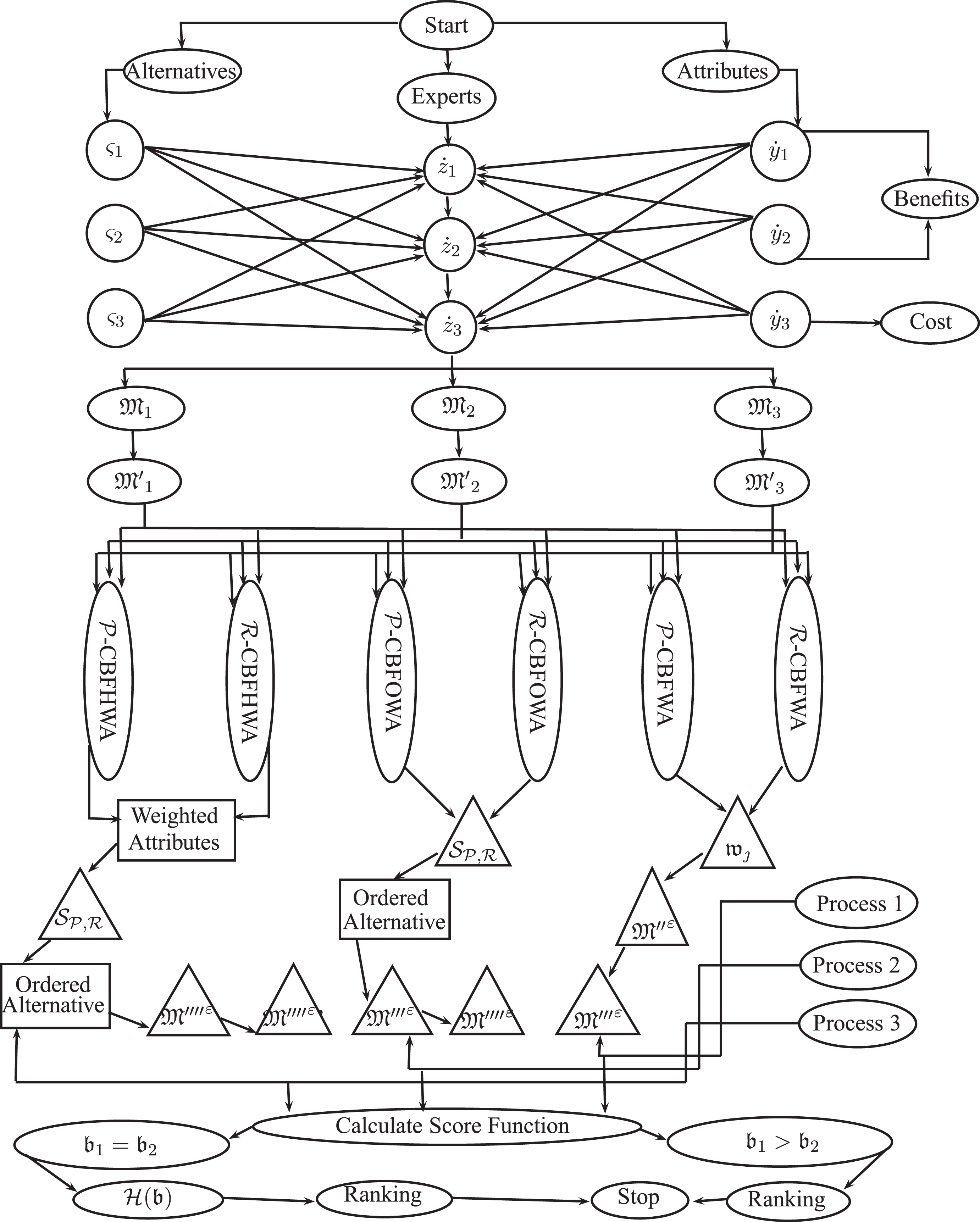
Flow chart of the whole technique
We further aggregate
ς3 ≻ ς2 ≻ ς1. The best optimal choice is ς3. The rankings of alternatives by both operators can be seen in Figs. 3 and 4.

Algorithm A. for application of

Ranking of alternatives using
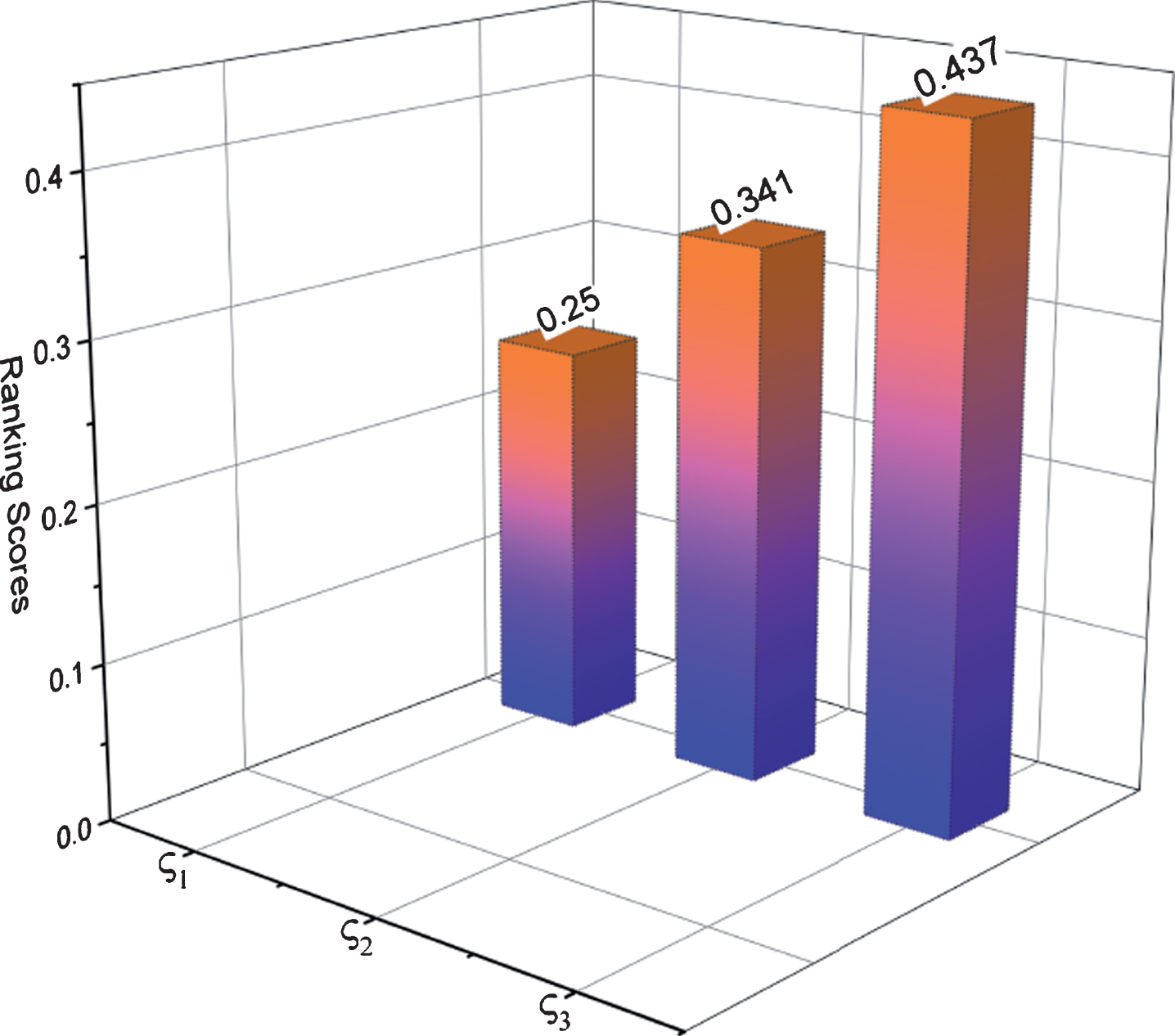
Ranking of alternatives using
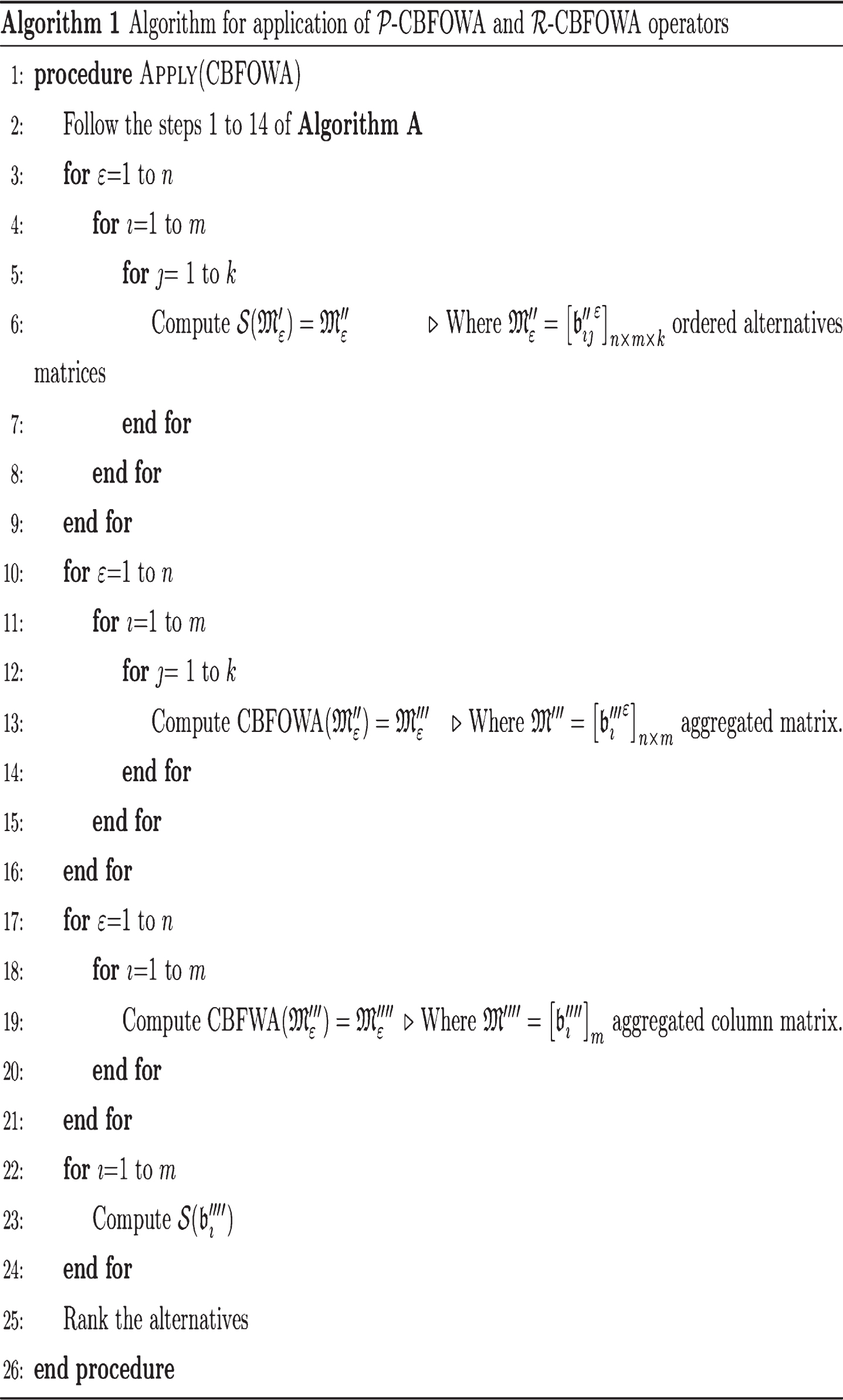
Algorithm B. for application of
We apply
now we use
Now aggregate
After applying
Now we get, aggregate
Now calculate score function for ranking of alternatives. After computing score function, we get
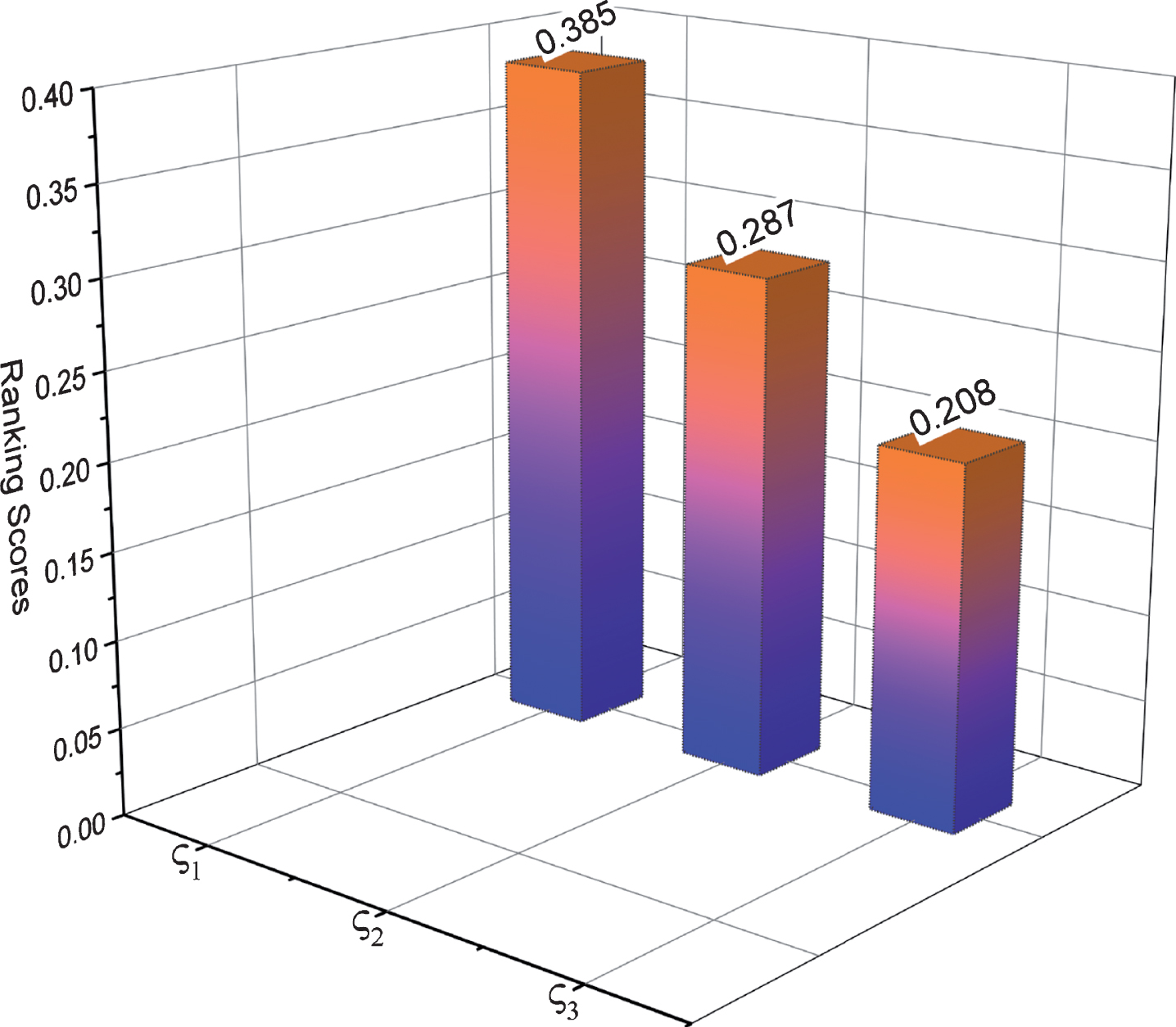
Ranking of alternatives using
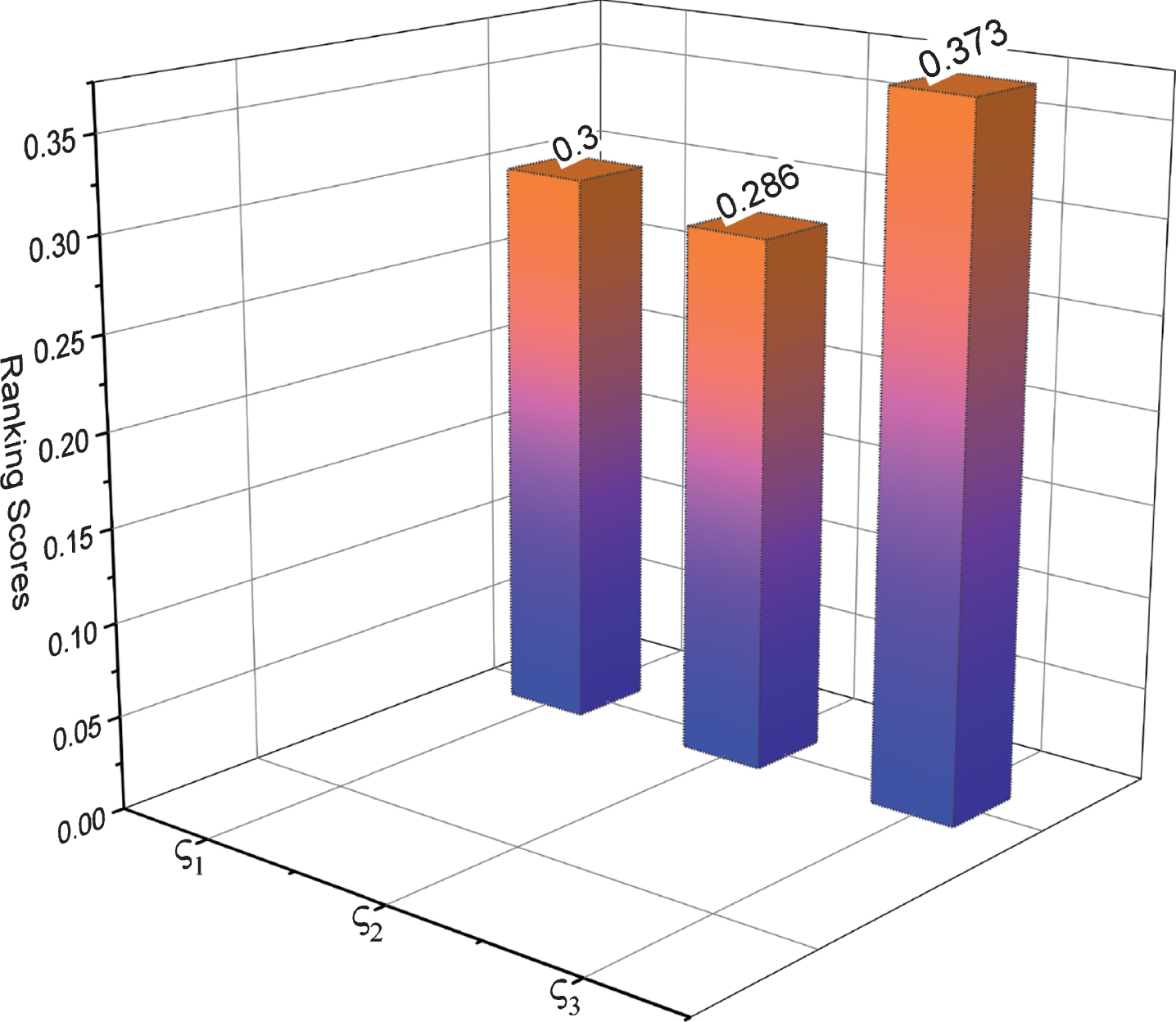
Ranking of alternatives using
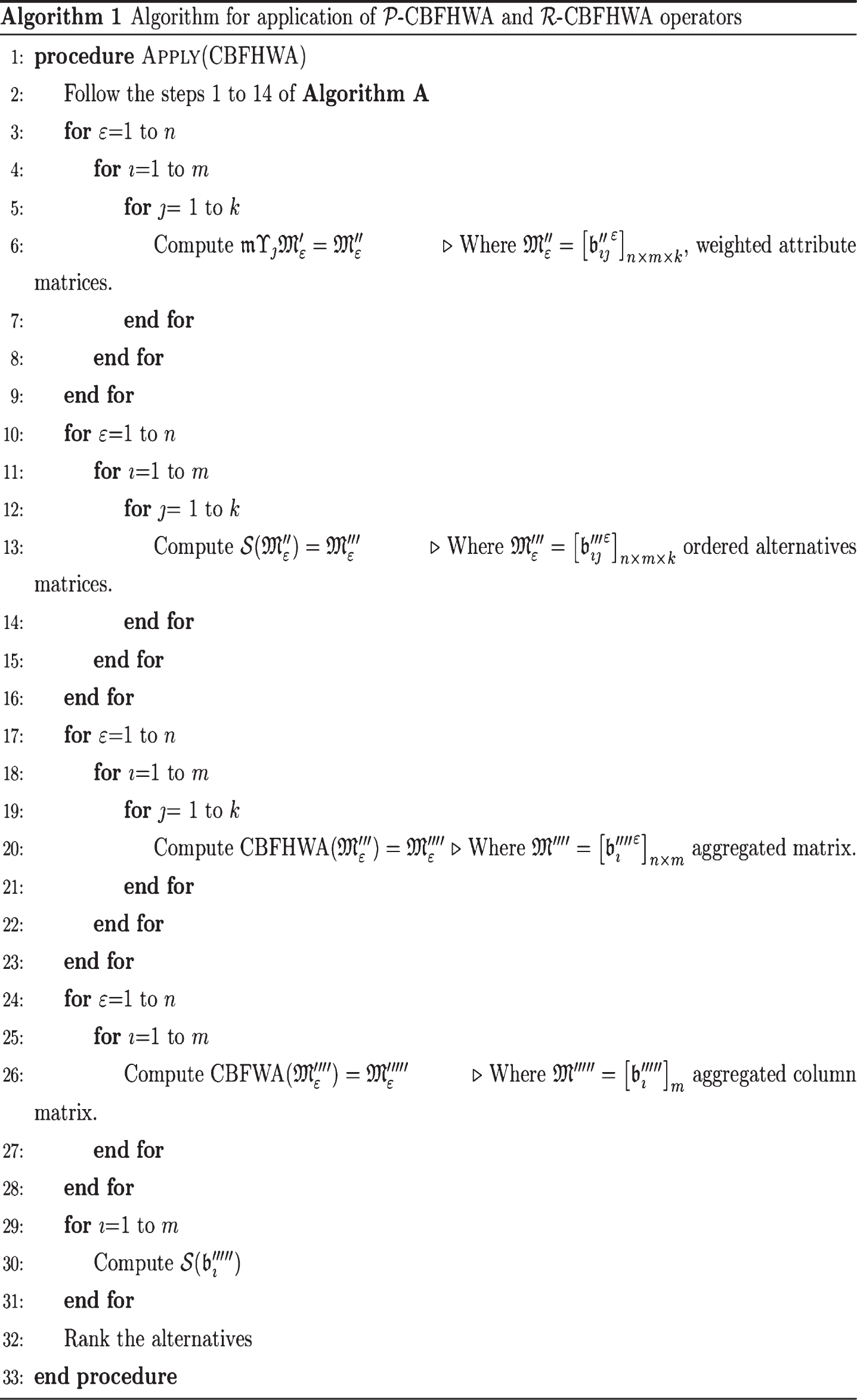
Algorithm C. for application of
We apply now
Now calculate score function and get the matrices with ordered alternatives (see Table 10).
We apply
We get, aggregate
We get the collection of matrices with ordered alternatives by calculating score function (see Table 13). We compute
now we obtain, aggregated matrix
Method base comparison with existed method
Now calculate score function for ranking of alternatives.
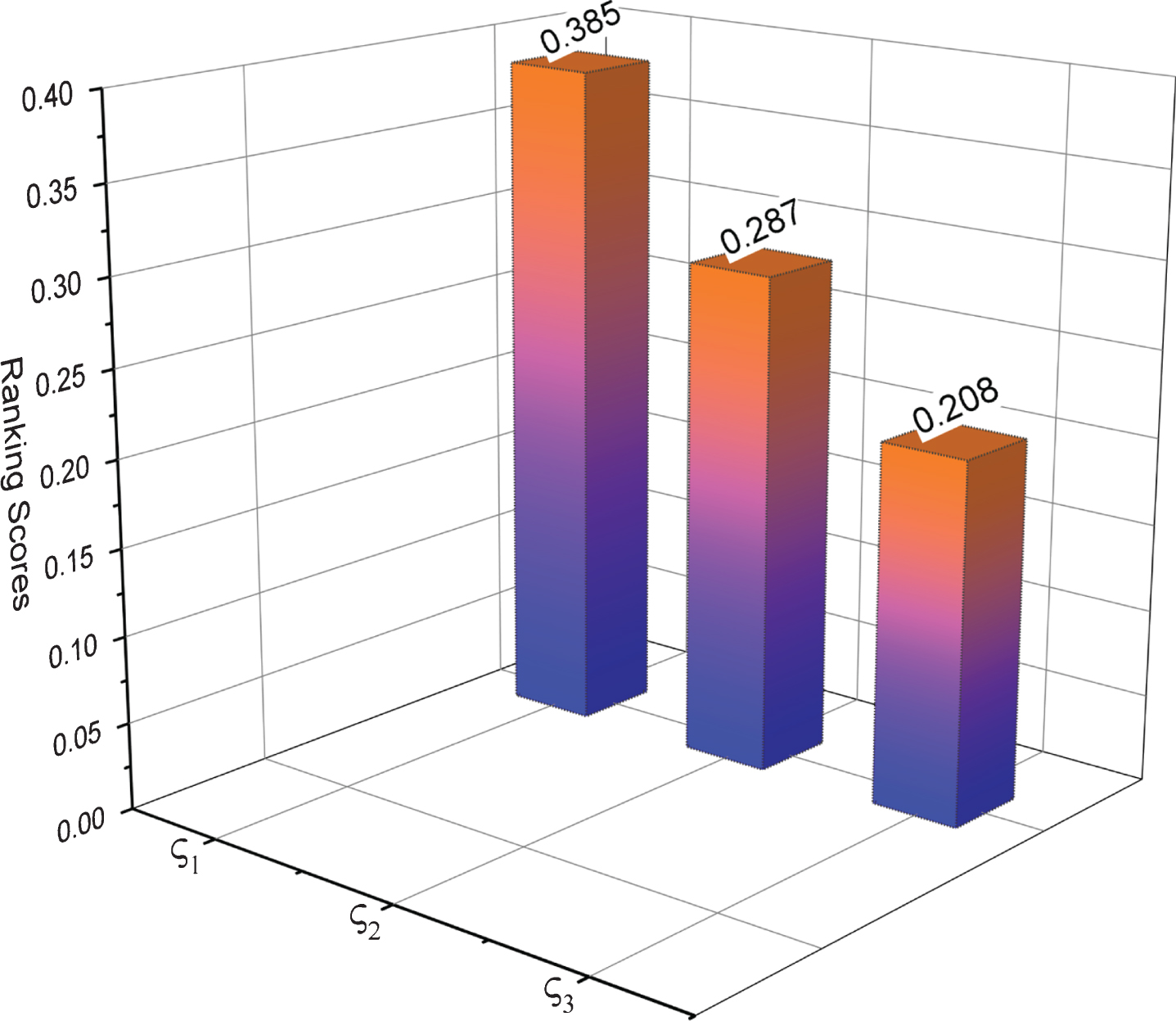
Ranking of alternatives using
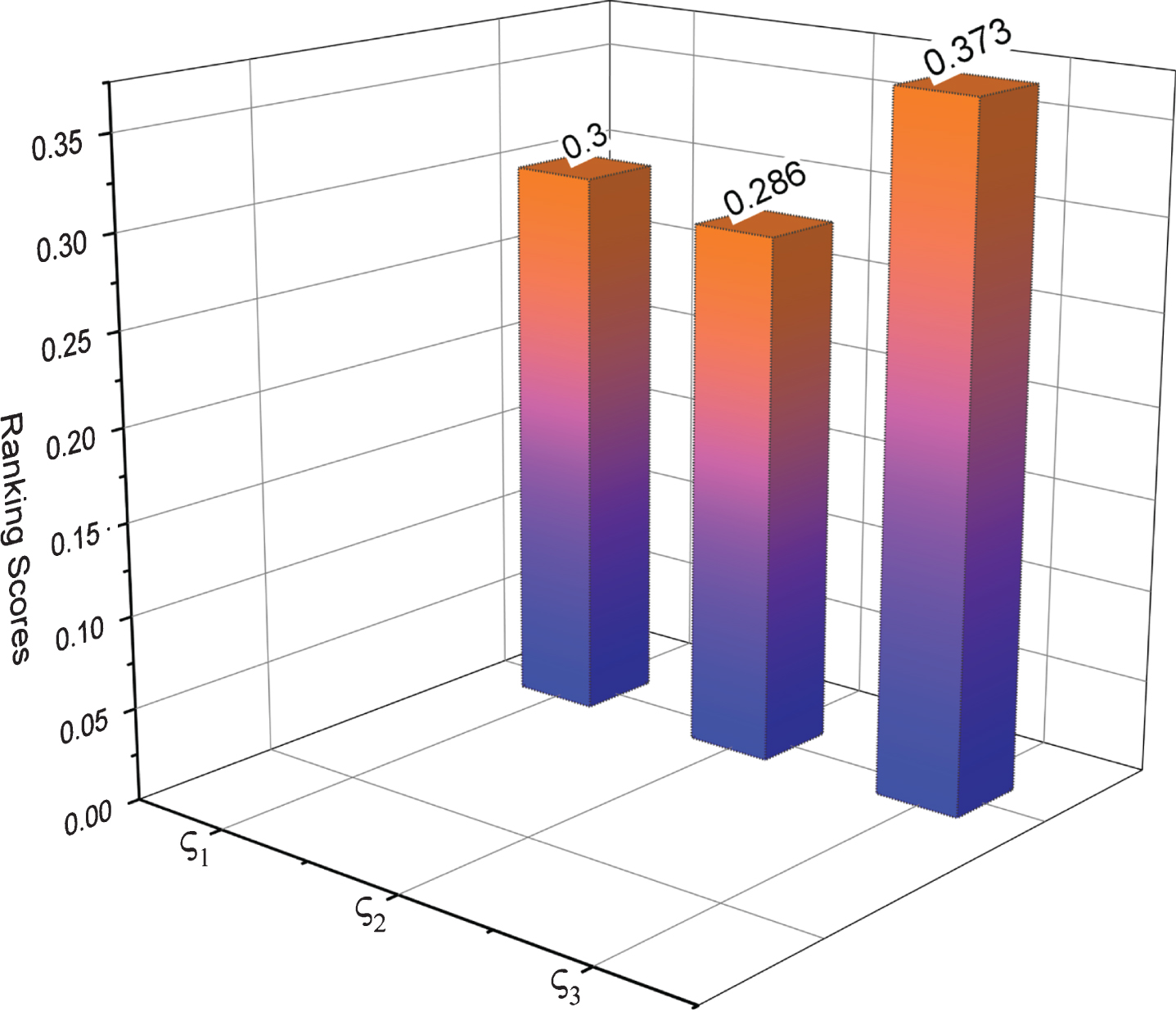
Ranking of alternatives using
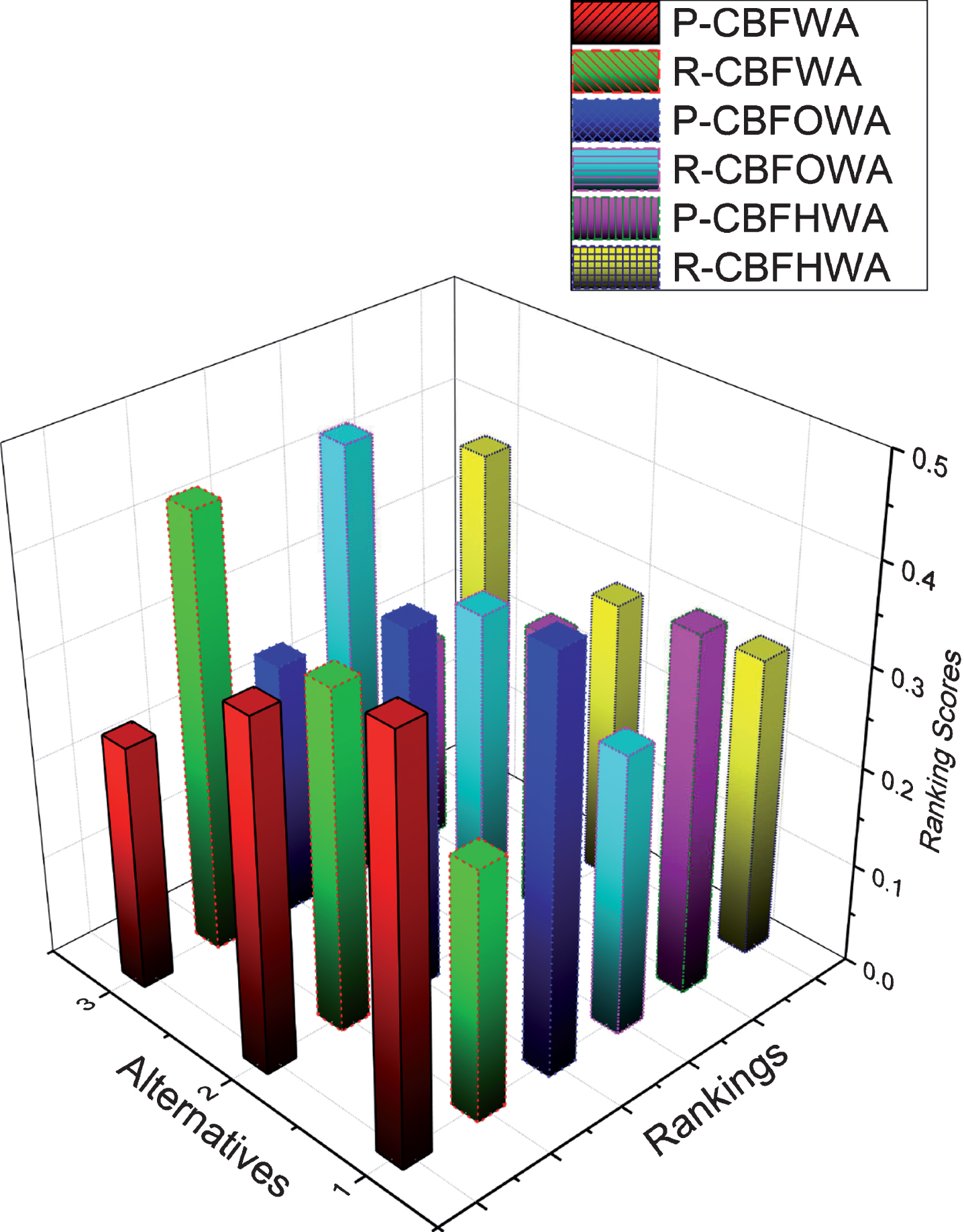
Ranking of alternatives of all operators
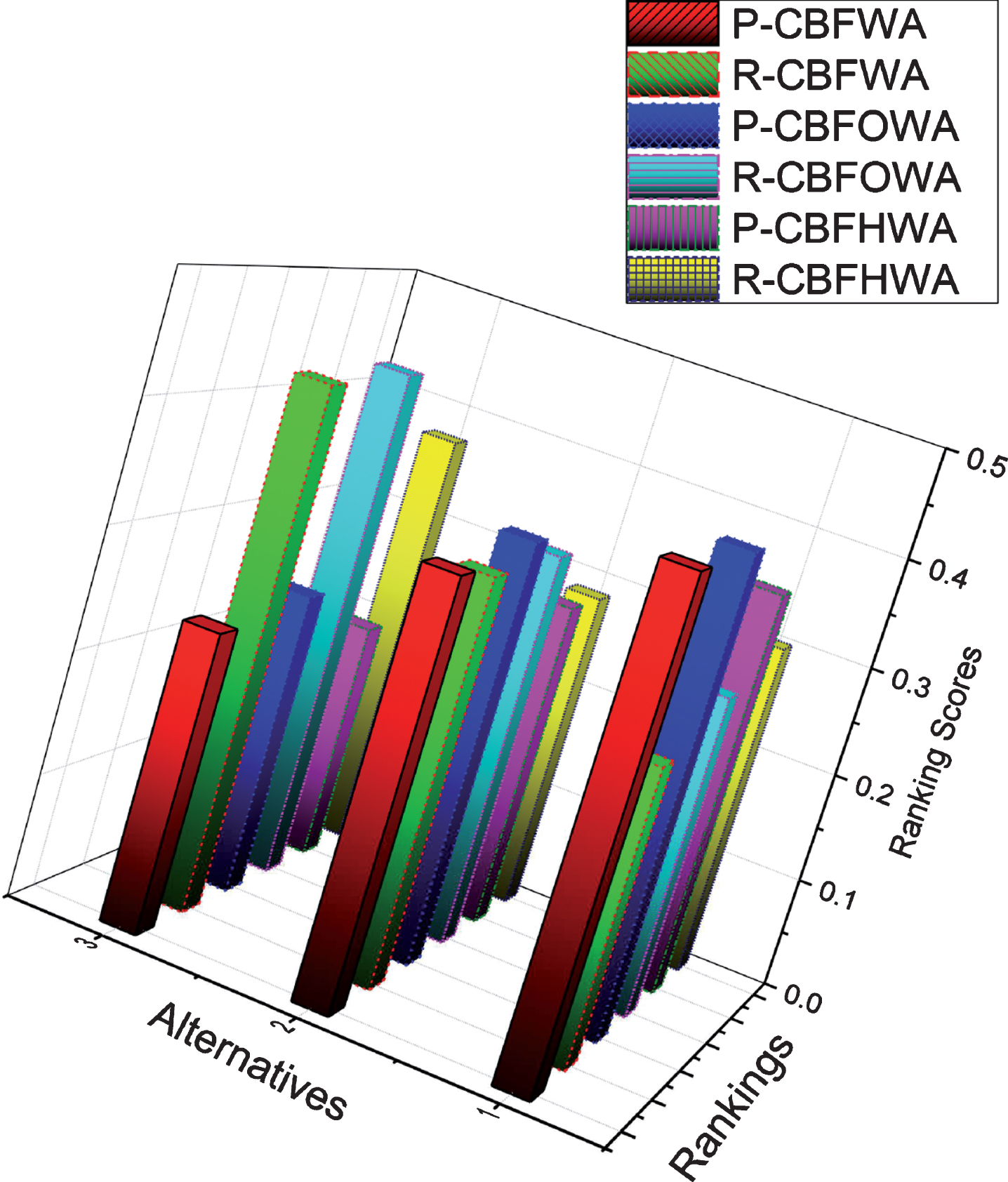
Ranking of alternatives of all operators
In this section, firstly we compare our domain with interval valued bipolar fuzzy(IVBF) domain. Secondly, we differentiate between proposed operators. We also make an analysis between all proposed operators and point out the best one. Thirdly, we compare our aggregation operators with existed operators proposed in [46].
IVBFS vs CBFS
Firstly, we see the difference of particular information in both domains. The IVBF domain contains less information as compare to CBF domain. In CBF domain we have triplet of bipolar fuzzy information with two types of operations, including,
Define the score function for IVBF domain as
Analysis of proposed aggregation operators
In this subsection, we differentiate among proposed operators. We develop three operators cubic bipolar fuzzy averaging operator, cubic bipolar fuzzy ordered weighted averaging operator and cubic bipolar fuzzy hybrid weighted averaging operator with dual order due to cubic set. In
Comparison with existed aggregation operator
Our third focus is methodology, the proposed method has three futures including, simplicity, double order, and generalized.
i . The existed operators are simple as compare to proposed in [46]. The proposed algorithm is also simple and effective for business MAGDM because of its normalizing property whereas algorithms presented in [46] is more complicated for MAGDM. Calculations are feasible and as a result aggregated values are easy to calculate.
ii . The presented approach tackle a particular problem in two perspectives i.e.
iii . The proposed method is more suitable to handle group decision making whereas operators in [46] is time consuming in case of big data. So presented technique unambiguously solves numerous incompatible criteria or points of comparison in decision making in the terms such as government, business, medicine, physics, information technology etc.
Conclusion
For data analyzing of many types, bipolarity of knowledge is a vital part to be considered while developing a mathematical framework for most of the situations. Bipolarity indicates the positive and negative aspects of a particular problem. The concept behind the bipolarity is that a huge range of human decisions analysis is involved bipolar subjective thoughts. A verity of bipolar fuzzy decision making with different technique is available in literature. But the concept of simple bipolar fuzzy set is insufficient to provide the information about the occurrence of ratings or grades with accuracy because information is limited, and it is also unable to describe the occurrence of uncertainty and vagueness very well specially, when sensitive cases are involved in decision making problems. For this purpose, we considered cubic bipolar fuzzy sets as the generalization of bipolar fuzzy sets. This model provides more accuracy and flexibility as compared to previously existing approaches, because it contains more information and it is more comprehensive and reasonable. In human decisions, the second important part is ranking and rating of different alternatives obtained after particular evaluation. we developed an appropriate aggregation method which is simple reliable and efficient enough to handle cubic bipolar fuzzy data. In this study, we discussed a multi-attribute group decision making problem under cubic bipolar fuzzy environment. We deduce some averaging aggregate operators, including,