In this paper, we introduce the notions of node, nodal filter and seminode in equality algebras and study some properties of them. First, we study the relation between nodes and other specific elements. Furthermore, by defining some operations on , which is the set of all nodal filters in an equality algebra E, we prove that is an equality algebra. In fact, we show that is a Hertz algebra, BCK-algebra, Hilbert algebra, Kleene algebra and semi-De Morgan algebra. Then we investigate the relation among nodal filters and (positive) implicative, fantastic, prime, and boolean filters in any equality algebras. Finally, we study the relation between nodes and seminodes. And we prove the set of all seminodes SN (E) is a lattice, Heyting algebra and Hertz algebra under the conditions.
Every many valued logic is uniquely determined by the algebraic properties of the structure of its truth values. The well-know algebraic structure is residuated lattice. BL-algebras, MTL-algebras, MV-algebras, and so forth, are the best know classes of residuated lattice [9, 10]. Since the algebra of truth values is no longer a residuated lattice, a specific algebra is introduced and called an EQ-algebra [20] by Novk and De Baets. EQ-algebras are a generalization of residuated lattice. It have three binary operations, meet, multiplication, fuzzy equality, and a unit element. As it was mentioned in [13], if the product operation in EQ-algebras is replaced by another binary operation smaller or equal than the original product we will still obtain an EQ-algebras, and this fact might make it difficult to obtain certain algebraic results. For this reason, a new structure was introduced by Jenei in [13], called equality algebra consisting of two binary operations meet and equivalence and constant 1. Filter theory plays an important rule in studying these algebras. From logical point of view, various filters correspond to various set of provable formula. Jenei [14] introduced the notions of filter in equality algebra. Ameri [1] introduced Prime filters of hyperlattices. Borzooei [5] introduced some types of filters such as (positive)implicative, fantastic, Boolean, and prime filter in equality algebra, and he showed that positive implicative, implicative, and Boolean filters are equivalent on bounded commutative equality algebra. And Haveshki [11] introduced some types of filters in BL-algebras, Motamed [18] introduced n-fold obstinate filters in BL-algebras.
The notion of a node was first introduced by Balbes and Horn [3] in the context of a lattice. Varlet and Liege [23] introduced the notions of nodes and nodal filter in semi-lattices. Tayebi Khorami and Borumand Saeid [15, 16] introduced the notions of nodal filter in BL-algebra and BCK-algebra. Afterward, Bakhshi [19], introduced the notion of a nodal filter in residuated lattices and proved that the class of all nodal filters of a residuated lattice forms a Heyting algebra. Then Namdar and Borzooei [19] introduced nodalfilter in hoop algebras. Now, in this paper, we study the notions of node, nodal filter and seminode in equality algebras and research some properties of them. Then we discuss the relationships between nodes and other specific elements in equality algebras and prove is a bounded equality algebra. As a matter of fact, also is a Hertz algebra, BCK-algebra, Hilbert algebra, Kleene algebra and semi-De Morgan algebra. Last, we discuss the relation between nodes and seminodes and prove the set of all seminodes SN (E) is a lattice, Heyting algebra and Hertz algebra under the conditions.
Preliminaries
In this section, we recollect some definitions and results which will be used in the following sections.
Definition 2.1. [13] An algebras (E, ∧, ∼, 1) of the type (2,2,0) is called an equality algebra, if it satisfies the following conditions: for all x, y, z ∈ E,
(E, ∧, 1) is a commutative idempotent integral monoid (i.e., meet semilattice with top element 1),
x ∼ y = y ∼ x,
x ∼ x = 1,
x ∼ 1 = x,
x ≤ y ≤ z implies x ∼ z ≤ y ∼ z and x ∼ z ≤ x ∼ y,
x ∼ y ≤ (x ∧ z) ∼ (y ∧ z),
x ∼ y ≤ (x ∼ z) ∼ (y ∼ z). Where x ≤ y if and only if x ∧ y = x.
The operation ∧ is called meet and ∼ is an equality operation. Also, other two operations are induced by ∧ and ∼, called implication and equivalence operation, respectively:
x → y = x ∼ (x ∧ y)
x ↔ y = (x → y) ∧ (y → x)
If ∼ coincides with ↔, then an equality algebra is called equivalential. An equality algebra (E, ∼, ∧, 1) is bounded if there exists an element 0 ∈ E such that 0 ≤ x, for all x ∈ E. In a bounded equality algebra E, we define the negation “ ′ " on E by , for all x ∈ E. An equality algebra E is called prelinear if 1 is the unique upper bound of the set {x → y, y → x}, for all x, y ∈ E. A latticeequalityalgebra is an equality algebra which is a lattice, as well.
Definition 2.2. [12] A BCK-algebras is a structure (B, →, 1) of the type (2,0) which satisfies the following conditions: for any x, y, z ∈ B,
(x → y) → ((y → z) → (x → z)) =1,
1 → x = x,
x → 1 =1,
x → y = 1 and y → x = 1 imply x = y.
Definition 2.3. [14] Let (E, ∧, ∼, 1) be an equality algebra and F be a non-empty subset of E. Then F is called a deductive system or a filter of E if, for all x, y ∈ E we have
1 ∈ F,
if x ∈ F and x ≤ y, then y ∈ F,
if x ∈ F and x ∼ y ∈ F, then y ∈ F.
Denote by F (E) the set of all filter of E. Clearly, F (E) is closed under arbitrary intersections and {1} ∈ F (E), so (F (E), ⊆) is a complete lattice. A filter F of E is called a proper filter if F ≠ E. It can be easily seen that if E is a bounded equality algebra, then a filter is proper if and only if it does not contain 0. A proper filter of E is called a maximal filter if it is not contained in any other proper filter of E.
Proposition 2.4. [14] Let (E, ∧, ∼, 1) be an equality algebra. Then F ∈ F (E) if and only if, for all x, y ∈ E,
1 ∈ F,
if x ∈ F and x → y ∈ F, then y ∈ F.
Theorem 2.5. [25] Let X be a subset of an equality algebra E. Then
The deductive system generated by X which is denoted by 〈X〉 is 〈X〉 = {a ∈ E ∣ existsn ∈ Nandx1, ⋯, xn ∈ Xsuchthatx1 → (x2 → ⋯ (xn → a) ⋯) =1},
If D is a deductive system ofE andS ⊆ E, then 〈D ∪ S〉 = {a ∈ E ∣ existsn ∈ Nands1, ⋯, sn ∈ Ssuchthats1 → (s2 → (⋯ (sn → a) ⋯)) ∈ D}.
For each x belongs to an equality algebraE, the deductive system generated byx is called principal. Clearly,
〈x〉 = {a ∈ E ∣ x → na = 1, forsomen ∈ N},
where x → 0b = b, x → nb = x → (x → n-1b).
Definition 2.6. [5] Let F be a subset of E such that 1 ∈ F. Then for any x, y, z ∈ E:
F is called positive implicative filter of E, if x → (y → z) ∈ F and x → y ∈ F imply x → z ∈ F.
F is called implicative filter of E, if z → ((x → y) → x) ∈ F and z ∈ F, then x ∈ F.
F is called fantastic filter of E, if z → (x → y) ∈ F and z ∈ F imply ((x → y) → y) → x ∈ F.
Definition 2.7. [5] Let E be a bounded lattice equality algebra. A filter F of E is called a Boolean filter, if , for all x ∈ E.
Definition 2.8. [5] Let E be an equality algebra. Then a proper filter F of E is called a prime filter if x → y ∈ F or y → x ∈ F, for all x, y ∈ E.
Theorem 2.9 [5] Let F be a proper filter of prelinear equality algebra E. Then the following statements are equivalent:
F is a prime filter,
if x ∨ y ∈ F, then x ∈ F or y ∈ F, for each x, y ∈ E.
Proposition 2.10. [13] Let (E, ∧, ∼, 1) be an equality algebra. Then the following properties hold: for all x, y, z ∈ E,
x → y = 1 if and only if x ≤ y,
x → (y → z) = y → (x → z),
x ≤ y → x,
x → y ≤ (y → z) → (x → z).
Proposition 2.11. [24] Let (E, ∧, ∼, 1) be an equality algebra.Then the following properties hold: for all x, y, z ∈ E,
x ≤ y implies y → z ≤ x → z, z → x ≤ z → y,
x → y = x → (x ∧ y),
x → y ≤ (z → x) → (z → y).
Proposition 2.12. [24] Let E be a lattice equality algebra. Then the following statement holds: for all x, y, z ∈ E, (x ∨ y) → z = (x → z) ∧ (y → z).
Proposition 2.13. [24] Let E be a prelinear equality algebra. Then the following statements hold: for all x, y, z ∈ E,
(x ∧ y) → z = (x → z) ∨ (y → z),
x → (y ∧ z) = (x → y) ∧ (x → z).
Definition 2.14. [6] A Hertz-algebra is an algebra (E, ∧, →, 1) of type (2,2,0) which satisfies the following axioms: for all x, y, z ∈ E,
x → x = 1,
y ∧ (x → y) = y,
x ∧ (x → y) = x ∧ y,
x → (y ∧ z) = (x → y) ∧ (x → z).
Definition 2.15. [8] A Hilbert algebra is an algebra (H, →, 1) of type (2,0) such that the following axioms hold: for all x, y, z ∈ E,
x → (y → x) =1,
(x → (y → z)) → ((x → y) → (x → z)) =1,
if x → y = y → x = 1, then x = y.
Definition 2.16. [21, 22] A bounded lattice (L, ∨, ∧, ′, 0, 1) is called a Kleene algebra if , for any x, y ∈ L.
Definition 2.17. [21, 22] An algebra (L, ∨, ∧, ′, 0, 1) of type (2,2,1,0,0) is called a semi-De Morgan algebra if (L, ∨, ∧, 0, 1) is a distributive lattice, 0' = 1, 1' = 1, and for any x, y ∈ L, and .
Definition 2.18. [4] Heyting-algebra is an algebra (E, ∨, ∧, →, 1), where (E, ∨, ∧, 1) is a lattice with the greatest element and the binary operation → on E verifies, for any x, y, z ∈ E, x ≤ y → z if and only if x ∧ y ≤ z.
Nodes in equality algebras
In this section, we introduce the notion of node in equality algebras and investigate some properties of it. Also we discuss the relation between nodes and other specific elements in equality algebras.
Definition 3.1. Let (L, ≤) be a poset. Then an element x ∈ L is called a node, if for any y ∈ L, x ≤ y or y ≤ x. Now, since any equality algebra is a poset, the notion of node in an equality algebra is defined similarly.
The set of all nodes in an equality algebra E is denoted by N (E), since 1 ∈ N (E), N (E)≠ ∅.
An element x of E is called dense if , is called regular if x″ = x. In a bounded equality algebra, an element x is called a co-atom if it is a maximal element in E ∖ {1} and is called an atom if it is a minimal element in E ∖ {0}.
In the following examples, we show that the notion of node is different with regular, atom, co-atom, dense elements in equality algebras generally.
Example 3.2. (i) Let E = {0, a, b, 1} be a chain that diagram is below. Define the operations ∼ and → as follows:
Then (E, ∧, ∼, 1) is an equality algebra(see [24]). Which all elements of E are nodes.
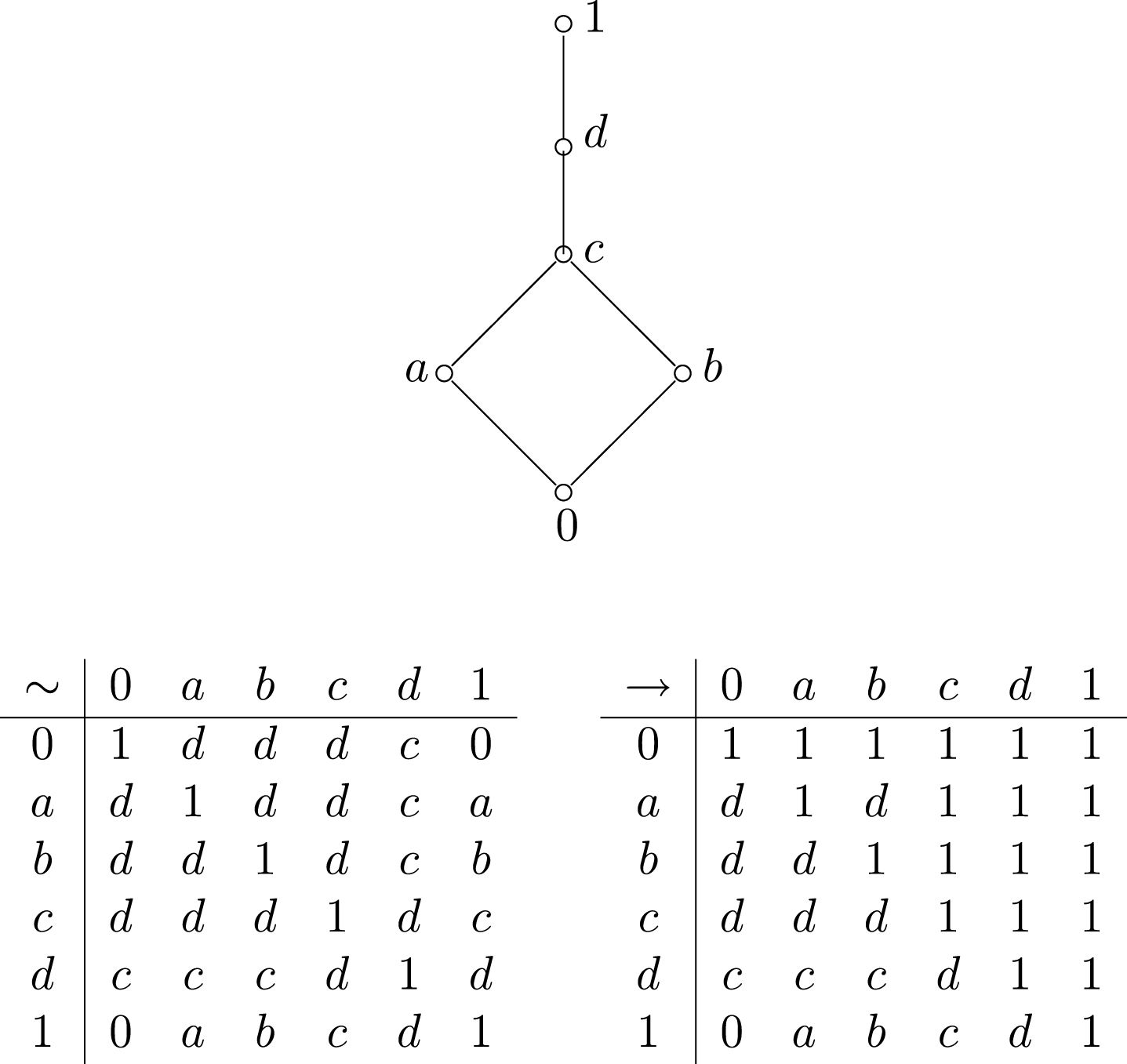
(ii) Let E = {0, a, b, c, d, 1} and (E, ≤) be a lattice that diagram is below. Define the operations ∼ and → as follows:
Then (E, ∧, ∼, 1) is an equality algebra(see [24]). It is clear that N (E) = {0, 1}. The elements b, d are atoms but are not nodes. All elements are regular, but only element 1 is dense.
(iii) Let E = {0, a, b, c, d, 1} and (E, ≤) be a lattice that diagram is below. Define the operations ∼ and → as follows:
Then (E, ∧, ∼, 1) is an equality algebra(see [24]). It is clear that N (E) = {0, c, d, 1}. The elements a, b are atoms, but they are not nodes. And the elements 0, c, d, 1 are regular.
Note that in a chain E, every element is a node.
Theorem 3.3Let E be a bounded lattice equality algebra and B (E) = {x ∈ E ∣ existsy ∈ E such that x ∨ y = 1 and x ∧ y = 0}. Then N (E) ∩ B (E) = {0, 1}.
Proof. We know that {0, 1} ⊆ N (E) ∩ B (E). Now, let x ∈ N (E) ∩ B (E). Since x ∈ B (E), there exists y ∈ E, such that x ∧ y = 0 and x ∨ y = 1. Since x ∈ N (E), we have x ≤ y or y ≤ x, for any y ∈ E. Thus x ∧ y = x, x ∨ y = y or x ∧ y = y, x ∨ y = x. Hence x = 1 or x = 0 and so x ∈ {0, 1}. Therefore, N (E) ∩ B (E) = {0, 1}. □
Definition 3.4. Let E be an equality algebra. A filter F of E is called a nodal filter, if F is a node in poset (F (E), ⊆).
In what follows, we will denote the set of all nodal filters of E by .
Example 3.5. (i) Let E be an equality algebra. Then E and {1} are the trivial nodal filters of E.
(ii) In Example 3.2(ii), we have F (E) = {{1}, {1, c}, {a, b, 1}, E} and .
(iii) Let E = {0, a, b, c, 1} and (E, ⩽) be a lattice that diagram is below. Define the operation thicksim and → on E as follows,
Then (E, ∧, ∼, 1) is an equality algebra(see [5]). It is easy to check that F (E) = {{1}, {1, a}, {1, b}, {a, b, c, 1}, E} and .
Proposition 3.6. Let E be an equality algebra and F be a filter of E. If for any x ∈ F and y ∉ F, we have y < x, then F is a nodal filter of E.
Proof. Let for any x ∈ F and y ∉ F, y < x and there exists G ∈ F (E), which is incomparable with F. Then there exists x, y ∈ E such that x ∈ F ∖ G and y ∈ G ∖ F. Since by the hypothesis y < x and G is a filter, by Definition 2.3(ii), we get x ∈ G, which is a contradiction. So every filter G of E is comparable with F. Therefore, F is a nodal filter of E. □
Theorem 3.7.Let E be an equality algebra and x be a node of E. Then the principle filter 〈x〉 is a nodal filter of E.
Proof. Let x ∈ E be a node and F be a filter of E. If x ∈ F, then 〈x〉 ⊆ F. Assume x ∉ F. If F ⊈ 〈x〉, then there exists y ∈ F such that y ∉ 〈x〉. Since x is a node, we obtain y ≤ x and so 〈x〉 ⊆ 〈y〉 ⊆ F, that is x ∈ F, which is a contradiction. Hence if x ∉ F, we get y ∈ 〈x〉, and so F ⊆ 〈x〉. Therefore, 〈x〉 is a nodal filter of E. □
Now, we give an example to show the converse of Theorem 3.7 may not true.
Example 3.8. In Example 3.2 (ii), 〈d〉 = E is a nodal filter of E, but d is not a node of E.
Theorem 3.9Let E be an equality algebra. If F is a nodal filter of E and x is a node of E. Then F (x) = 〈F ∪ {x} 〉 is a nodal filter of E.
Proof. If x ∈ F, then F (x) = F. Hence, F (x) is a nodal filter of E. Since x is a node of E, byTheorem 3.7, we know that 〈x〉 is a nodal filter of E. Now, let G ∈ F (E) and G ⊈ F (x). Assume G ⊆ F or G ⊆ 〈x〉. Then G ⊆ F (x), which is a contradiction. So F, 〈x〉 ⊆ G. If y ∈ F (x), there exists n ∈ N such that x → ny ∈ F ⊆ G. Hence by G is a filter, we obtain that y ∈ G. Therefore, F (x) is a nodal filter of E. □
In the following example, we show that if F is a nodal filter of E and x is not a node element of E, then F (x) is not a nodal filter of E, in general. Also, we show that the converse of Theorem 3.9 may not true.
Example 3.10. In Example 3.2(ii), F = {1} is a nodal filter of E. It is clear that b is not a node of E and F (b) = {a, b, 1} is not a nodal filter of E. Also, G = {1, c} is not a nodal filter of E, but G (b) = F (d) = E are nodal filters of E.
Note that let E be an equality algebra and (E, ≤) be a chain. If F is a(an) positive implicative(implicative), fantastic, boolean filter of E, then we can obtain F is a nodal filter.
In the following example, we show that the nodal filters are different with (positive)implicative, prime, fantastic and Boolean filters, in general.
Example 3.11. (i) In Example 3.5(iii), F = {1, a} is a positive implicative filter and a prime filterof E, but it is not a nodal filter. Also, G = {1} is a nodal filter of E. But it is not a prime filter, since a → b = b ∉ G and b → a = a ∉ G.
(ii) In Example 3.2(ii), F = {a, b, 1} is a implicative filter of E, but it is not a nodal filter.
(iii) In Example 3.2(ii), F = {1, c} is a fantastic filter of E, but it is not a nodal filter.
(iv) In Example 3.2(iii), F = {1} is a nodal filter of E. But it is not a boolean filter, because
.
Theorem 3.12.Let E be a prelinear equality algebra. Then 〈x ∨ y〉 = 〈x〉 ∩ 〈y〉, for all x, y ∈ E.
Proof. First, we prove 〈x ∨ y〉 ⊆ 〈x〉 ∩ 〈y〉. Suppose a ∈ 〈x ∨ y〉. Then there exists n ∈ N such that (x ∨ y) → na = 1. Owing to x, y ≤ x ∨ y, we can get 1 = (x ∨ y) → na ≤ x → na, y → na. Hence, we have a ∈ 〈x〉 and a ∈ 〈y〉, that is a ∈ 〈x〉 ∩ 〈y〉. Second, we prove 〈x〉 ∩ 〈y〉 ⊆ 〈x ∨ y〉. Before that we need to prove (x ∨ y) → na = ⋀ (t1 → (t2 → (⋯ → (tn → a) ⋯))), where ti = x or y, i = 1, 2, ⋯, n. When n = 1, by Proposition 2.12, (x ∨ y) → a = (x → a) ∧ (y → a) = ⋀ (ti → a), where ti = x or y, i = 1, 2. Assume that when n = k. We have (x ∨ y) → ka = ⋀ (t1 → (t2 → (⋯ → (tk → a) ⋯))), where ti = x or y, i = 1, 2, ⋯, k. When n = k + 1, by Proposition 2.12 and Proposition 2.13(ii), we can obtain
(x ∨ y) → k+1a = (x ∨ y) → ((x ∨ y) → ka) = (x ∨ y) → (⋀ (t1 → (t2 → (⋯ → (tk → a) ⋯)))) = (x → (⋀ (t1 → (t2 → (⋯ → (tk → a) ⋯))))) ∧ (y → (⋀ (t1 → (t2 → (⋯ → (tk → a) ⋯))))) = (⋀ (x → ((t1 → (t2 → (⋯ → (tk → a) ⋯)))))) ∧ (⋀ (y → ((t1 → (t2 → (⋯ → (tk → a) ⋯)))))) = ⋀ (t0 → ((t1 → (t2 → (⋯ → (tk → a) ⋯)))), where ti = x or y, i = 0, 1, 2, ⋯, k.
Now, Assume a ∈ 〈x〉 ∩ 〈y〉. Then there exists m, n ∈ N such that x → ma = 1 and y → na = 1. Let r = max {m, n}. We can conclude x → ra = 1 and y → ra = 1, and by Proposition 2.10 (ii), we can get ((x ∨ y) → 2ra) = ⋀ (t1 → (t2 → (⋯ → (t2r → a) ⋯))) =1, where ti = x or y, i = 1, 2, ⋯, 2r. Thus a ∈ 〈x ∨ y〉. Therefore, we have 〈x ∨ y〉 = 〈x〉 ∩ 〈y〉. □
Theorem 3.13Let E be a prelinear equality algebra and F be a non principal nodal filter. Then F is a prime filter.
Proof. Assume that there exists x, y ∈ E such that x ∨ y ∈ F and x ∉ F, y ∉ F. Then we have 〈x ∨ y〉 ⊆ F, 〈x〉 ⊈ F and 〈y〉 ⊈ F. Because F is a nodal filter, we can obtain F ⊆ 〈x〉 and F ⊆ 〈y〉. Hence by Theorem 3.12, F ⊆ 〈x〉 ∩ 〈y〉 = 〈x ∨ y〉. For this reason, we have F = 〈x ∨ y〉, which is a contradiction. Therefore, we get x ∈ F or y ∈ F. By Theorem 2.9, F is a prime filter. □
Lemma 3.14.Let . Define F ∧ G = F ∩ G, F ∨ G = 〈F ∪ G〉. Then .
Proof. Let H ∈ F (E). If F, G ⊆ H, then we have F ∨ G = 〈F ∪ G〉 ⊆ H. If H ⊆ F, G, we can get H ⊆ 〈F ∪ G〉 = F ∨ G. Now, if F ⊆ H ⊆ G or G ⊆ H ⊆ F, then H ⊆ 〈F ∪ G〉 = F ∨ G. Hence, . By the similar way, we can prove that . □
Theorem 3.15. is a bounded distributive lattice.
Proof. The proof is similar to the proof of Theorem 4.13 in [19]. □
Note that for any , we define:
F → G = {x ∈ E ∣ F ∩ 〈x〉 ⊆ G},
Proposition 3.16. Let E be an equality algebra. Then the following properties are satisfied: for all ,
E → F = F, F → F = E, F → E = E, {1} → F = E,
, for F ≠ {1},
, for F, G ≠ {1},
F ⊆ G implies G → H ⊆ F → H, H → F ⊆ H → G,
F ⊆ G if and only if F → G = E,
G ⊆ F → G.
Proof.
E → F = {x ∈ E ∣ E ∩ 〈x〉 ⊆ F} = {x ∈ E ∣ 〈x〉 ⊆ F} = F. The proof of other cases are similar.
We know that . Now assume x ∈ E and x ≠ 1. If x ∈ F, then F ∩ 〈x〉 = 〈x〉 ⊈ {1}, which is impossible. If x ∉ F, then 〈x〉 ⊈ F. Since F is a nodal filter, we have F ⊆ 〈x〉. Hence F ∩ 〈x〉 = F ≠ {1}, which is impossible. Then x = 1 and so . Moreover, by (i), we get .
By (ii), we have . Hence . Similarly, we can obtain . Therefore, .
If x ∈ G → H, we have G ∩ 〈x〉 ⊆ H. By F ⊆ G, we can get F ∩ 〈x〉 ⊆ G ∩ 〈x〉 ⊆ H, hence x ∈ F → H. That is G → H ⊆ F → H. Similarly, H → F ⊆ H → G.
F ⊆ G if and only if for any x ∈ E, 〈x〉 ∩ F ⊆ G if and only if F → G = E.
It is clear. □
Proposition 3.17. Let E be an equality algebra and . Then .
Proof. When F = G, we can obtain F → G = E. When F ≠ G, Assume F ⊆ G, we have F ∩ 〈x〉 ⊆ F ⊆ G, for any x ∈ E. Thus F → G = E. If G ⊆ F, we will prove F → G = G. For any x ∈ F → G, if x ∈ G, we can easily get F → G ⊆ G. Assume x ∉ G and x ∈ F, we have 〈x〉 ⊆ F, hence F ∩ 〈x〉 = 〈x〉 ⊆ G, which is a contradiction. Suppose x ∉ G and x ∉ F. We have F ⊆ 〈x〉, thus F ∩ 〈x〉 = F ⊆ G, and by G ⊆ F, we conclude that F = G, which is a contradiction. For this reason, F → G ⊆ G. And for any x ∈ G, we get 〈x〉 ⊆ G, and then F ∩ 〈x〉 ⊆〈x〉 ⊆ G, that is x ∈ F → G. Hence G ⊆ F → G. Therefore, F → G = G. □
Theorem 3.18.Let E be an equality algebra. Then is a bounded equality algebra. Where F ↔ G = (F → G) ∧ (G → F) and → denotes the implication of .
Proof. By Lemma 3.14 and Proposition 3.17, we have . Then . Since F, G are nodal filters, we can get F ∧ G = F ⊆ E or F ∧ G = G ⊆ E. So is a meet semilattice with top element E. And we can easily check (E2),(E3) and (E4) are hold. Next, we prove (E5). Assume and F ⊆ G ⊆ H. We can get F ↔ H = (F → H) ∧ (H → F) = E ∧ F = F and G ↔ H = (G → H) ∧ (H → G) = E ∧ G = G. Hence we conclude that F ↔ H ⊆ G ↔ H. Similarly, F ↔ H ⊆ F ↔ G. So condition (E5) is satisfied. By (E5), we know that (E6) is satisfied. Last, we prove condition (E7). If F ⊆ G ⊆ H, we can obtain F ↔ G = G → F = F and (F ↔ H) ↔ (G ↔ H) = (H → G) → (H → F) = G → F = F. If F ⊆ H ⊆ G, we can get F ↔ G = G → F = F and (F ↔ H) ↔ (G ↔ H) = (G → H) → (H → F) = H → F = F. If G ⊆ F ⊆ H, we have F ↔ G = F → G = G and (F ↔ H) ↔ (G ↔ H) = (H → F) → (H → G) = F → G = G. If G ⊆ H ⊆ F, we can get F ↔ G = F → G = G and (F ↔ H) ↔ (G ↔ H) = (F → H) → (H → G) = H → G = G. If H ⊆ F ⊆ G, we have F ↔ G = G → F = F and (F ↔ H) ↔ (G ↔ H) = (F → H) → (G → H) = H → H = E. If H ⊆ G ⊆ F, then we have F ↔ G = F → G = G and (F ↔ H) ↔ (G ↔ H) = (F → H) → (G → H) = H → H = E. So we conclude that F ↔ G ⊆ (F ↔ H) ↔ (G ↔ H), hence condition (E7) is satisfied. Therefore, is an equality algebra. □
Theorem 3.19.Let E be an equality algebra. Then is a Hertz-algebra. Where → denotes the implication of .
Proof. First, we can easy to check (HT1) and (HT3). Then by Proposition 3.16(vi), (HT2) hold. Now, we prove (HT4). Assume that F ⊆ G ⊆ H. We have F → (G ∧ H) = F → G = E = E ∧ E = (F → G) ∧ (F → H). Suppose F ⊆ H ⊆ G. We can get F → (G ∧ H) = F → H = E = E ∧ E = (F → G) ∧ (F → H). If G ⊆ F ⊆ H, then F → (G ∧ H) = F → G = G = G ∧ E = (F → G) ∧ (F → H). If G ⊆ H ⊆ F, we conclude that F → (G ∧ H) = F → G = G = G ∧ H = (F → G) ∧ (F → H). Assume H ⊆ F ⊆ G. We can obtain F → (G ∧ H) = F → H = H = E ∧ H = (F → G) ∧ (F → H). Suppose H ⊆ G ⊆ F. Then F → (G ∧ H) = F → H = H = G ∧ H = (F → G) ∧ (F → H). From the above proof, we get is a Hertz-algebra. □
Theorem 3.20.Let E be an equality algebra. Then (i) is a BCK-algebra, (ii) is a Hilbert algebra.
Proof. (i) Since is an equality algebra, by Theorem 2.4 in [24], we can get is a BCK-algebra.
(ii) Since is an equality algebra, by Proposition 2.10(iii) and (i), we conclude that (H1) and (H3) are hold. Then we prove the (H2). We consider the following cases. For any . If F ⊆ G ⊆ H, we can get [F → (G → H)] → [(F → G) → (F → H)] = [F → E] → [E → E] = E. Assume F ⊆ H ⊆ G. Then [F → (G → H)] → [(F → G) → (F → H)] = [F → H] → [E → E] = E. If H ⊆ F ⊆ G, we can obtain [F → (G → H)] → [(F → G) → (F → H)] = [F → H] → [E → H] = E. Suppose that H ⊆ G ⊆ F. We have [F → (G → H)] → [(F → G) → (F → H)] = [F → H] → [G → H] = E. If G ⊆ F ⊆ H, we have [F → (G → H)] → [(F → G) → (F → H)] = [F → E] → [G → E] = E. Assume G ⊆ H ⊆ F. Then [F → (G → H)] → [(F → G) → (F → H)] = [F → E] → [G → H] = E. So (H2) is satisfied. Therefore, is a Hilbert algebra. □
Theorem 3.21.Let E be an equality algebra. Then is a Kleene algebra.
Proof. By Theorem 3.15, we can get is a bounded distributive lattice. For any . . It is clear that {1} ⊆ 〈G ∪ {1} 〉. Therefore, is a Kleene algebra. □
Theorem 3.22.Let E be an equality algebra. Then is a semi-De Morgan algebra if for any .
Proof. The proof is similar to Theorem 4.24 in [19]. □
Note that is not a residuated lattice, MV-algebra, BL-algebra and hoop, in general. Where the operation ⊙ defined as follow and → denote the implication of . Since, let F, G, H ∈ NF (E) and {1} = F ⊂ H ⊂ G. Then we have (F ⊙ G) → H = H ≠ E = F → (G → H). Moreover, F ∧ G = {1} ≠ E = F ⊙ (F → G). Hence, is not a residuated lattice, MV-algebra, BL-algebra and hoop commonly.
For every nodal filter F of E, define θF on equality algebra E by:
(x, y) ∈ θF if and only if x → y ∈ F, y → x ∈ F.
θF is congruence relation on E. For x ∈ E, let [x] be the equivalence class of modulo θF and E/F be the set of all congruence classes of θF. The induce partial ordering on E/F is define as [x] F ≤ [y] F if and only if x → y ∈ F.
Theorem 3.23.Let F be a non principal nodal filter of prelinear equality algebra E. Then (E/F, ⊓, ⊔, ≈, 1/F) is a equality algebra and is a chain. Where [x] ⊓ [y] = [x ∧ y], [x] ⊔ [y] = [x ∨ y], [x] ≈ [y] = [x ∼ y], for all x, y ∈ E.
Proof. Assume a/F, b/F ∈ E/F and a/Fnleqb/F. For this reason, we have a → b ∉ F. And F is a non principal nodal filter, by Theorem 3.13, F is a prime filter. So b → a ∈ F, that is [b] F ≤ [a] F. Therefore, E/F is a chain. □
Seminodes in equality algebras
Since all nodes in an equality algebra form a chain, its structure is simple. Hence we introduce the definition of seminode in equality algebras, it is more general than node. And then we discuss the relation between seminodes and nodes in equality algebras. Last, we investigate some properties of seminodes.
Definition 4.1. Let E be an equality algebra. Then an element x ∈ E is called a seminode, if 1 is the unique upper bound of the set {x → y, y → x}, for all y ∈ E.
The set of all seminodes in an equality algebra E is denoted by SN (E). Since 1 ∈ SN (E), SN (E)≠ ∅.
Example 4.2. (i) In Example 3.2(i), all elements of E are seminodes.
In Example 3.2(ii), SN (E) = {0, a, b, c, d, 1}.
In Example 3.2(iii), SN (E) = {0, c, d, 1}.
Corollary 4.3.Every node is a seminode. But the converse may not true.
Proof. By Definition 3.1 and Definition 4.1, it is clear that every node is a seminode. And by Example 3.2 (ii) and Example 4.2 (ii), we know that a seminode may not a node. □
Proposition 4.4. Let E be a distributive lattice equality algebra. Then the following properties are satisfied: for all x, y, z ∈ SN (E),
(x ∧ y) → z = (x → z) ∨ (y → z),
x → (y ∧ z) = (x → y) ∧ (x → z).
Proof. (i) By Proposition 2.11 (ii), x → y = x → (x ∧ y) by Proposition 2.10 (iv) ≤ ((x ∧ y) → z) → (x → z) by Proposition 2.11 (i) ≤ ((x ∧ y) → z) → ((x → z) ∨ (y → z))
By the similar way, y → x ≤ ((x ∧ y) → z) → ((x → z) ∨ (x → z)). Since x, y ∈ SN (E), we have (x → y) ∨ (y → x) =1, and so ((x ∧ y) → z) → ((x → z) ∨ (x → z)) =1. Then (x ∧ y) → z ≤ ((x → z) ∨ (x → z)). Since x ∧ y ≤ x, by Proposition 2.11 (i), x → z ≤ (x ∧ y) → z. By the similar way, y → z ≤ (x ∧ y) → z. Thus, (x → z) ∨ (y → z) ≤ (x ∧ y) → z. Therefore, (x ∧ y) → z = (x → z) ∨ (y → z). (ii) By Proposition 2.11 (ii), (iii) and (i), y → z = y → (y ∧ z) ≤ (x → y) → (x → (y ∧ z)) ≤ ((x → y) ∧ (x → z)) → (x → (y ∧ z)) By the similar way, z → y ≤ ((x → y) ∧ (x → z)) → (x → (y ∧ z)). Since y, z ∈ SN (E), we have (y → z) ∨ (z → y) =1, and so ((x → y) ∧ (x → z)) → (x → (y ∧ z)) =1. Then ((x → y) ∧ (x → z)) ≤ x → (y ∧ z). The proof of other side is clear. □
By Proposition 2.13, if E is a prelinear equality algebra, (i) and (ii) of Proposition 4.4 are satisfied. Now, we assume that E is a distributive lattice equality algebras, (i) and (ii) are satisfied in SN (E).
Theorem 4.5.Let E be a distributive lattice equality algebra and x, y ∈ SN (E). Then x ∧ y, x ∨ y ∈ SN (E).
Proof. First, we prove that ((x ∧ y) → z) ∨ (z → (x ∧ y)) =1, for any z ∈ E. By Proposition 4.4 (i) and (ii), we have
Now, we prove that ((x ∨ y) → z) ∨ (z → (x ∨ y)) =1, for any z ∈ E. By proposition 2.12, we have
((x ∨ y) → z) ∨ (z → (x ∨ y)) = ((x → z) ∧ (y → z)) ∨ (z → (x ∨ y)) = ((x → z) ∨ (z → (x ∨ y))) ∧ ((y → z) ∨ (z → (x ∨ y))) ≥ ((x → z) ∨ (z → x)) ∧ ((y → z) ∨ (z → y)) =1. Therefore, we get x ∨ y ∈ SN (E). □
By Theorem 4.5, we know that (SN (E), ∧, ∨) is a lattice.
Definition 4.6. Let E be lattice equality algebra. Then E is called weak prelinear, if ((x ∼ y) → z) ∨ (z → (x ∼ y)) =1, for all x, y, z ∈ E, and x, y ≠ 1.
Proposition 4.7. Let E be an equality algebras. If E is prelinear, then E is weak prelinear.
Proof. Let E is a prelinear equality algebra. Because of x ∼ y ∈ E, for all x, y ∈ E. So we have ((x ∼ y) → z) ∨ (z → (x ∼ y)) =1, for any z ∈ E. That is E is a weak prelinear equality algebra. □
Now, we give an example to show the converse of proposition 4.7 may not true.
Example 4.8. In Example 3.2 (iii), (E, ∧, ∼, 1) is not a prelinear equality algebra, because of (a → b) ∨ (b → a) ≠1. But it is easy to check that (E, ∧, ∼, 1) is a weak prelinear equality algebra.
Theorem 4.9.Let E be a lattice order weak prelinear equality algebra and (E, ∨, ∧) be a distributive lattice. Then (SN (E), ∧, ∼, 1) is an equality algebra.
Proof. By Theorem 4.5 and Definition 4.6, we have SN (E) is closed about ∧ and ∼. Hence (SN (E), ∧, ∼, 1) is an equality algebras. □
Theorem 4.10. it Let E be a lattice order weak prelinear equality algebra and (E, ∨, ∧) be a distributive lattice. If for any x, y ∈ SN (E), x ∧ (x → y) = x ∧ y. Then (SN (E), ∨, ∧, →, 1) is a Heyting-algebra and also is a Hertz-algebra.
Proof. If x ≤ y → z, then we have x ∧ y ≤ y ∧ (y → z) = y ∧ z ≤ z. Hence x ∧ y ≤ z. Now, let x ∧ y ≤ z. By Proposition 2.10 (iii), Proposition 4.4 (ii) and Proposition 2.11 (i), we can get that
x ≤ y → x = 1 ∧ (y → x) = (y → y) ∧ (y → x) = y → (y ∧ x) ≤ y → z.
Therefore, E is a Heyting-algebra. Then we will prove that (SN (E), ∨, ∧, →, 1) is a Hertz-algebra. By Theorem 4.9 and Proposition 4.4 (ii), we have (SN (E), ∧, ∼, 1) is an equality algebra and x → (y ∧ z) = (x → y) ∧ (x → z). So by Theorem 4.5 of [24], we get that (SN (E), ∨, ∧, →, 1) is a Hertz-algebra. □
Conclusions and future research
In this note, we introduced the notion of node in an equality algebra. Then we studied relationships between a node and some other special elements, likeness dense, co-atoms and atoms of equality algebra. Also we introduced the notion of nodal filter in equality algebras and studied some properties of it. It enriches the filter theory of equality algebras. And we researched the lattice and algebraic structure of . After that, we studied relationships between a nodal filter and some other types of filters, likeness prime filter in equality algebras. And we provided the definition of seminode and prove SN (E) is a lattice, Heyting algebra and Hertz algebra under the conditions.
Some important issue for future work are:
Extending the notion of nodal filter to other algebraic structure,
Extending the notion of seminode to other algebraic structure and explore properties of it.
Footnotes
Acknowledgement
This research was supported by a grant of National Natural Science Foundation of China(11571281).
References
1.
R.Ameri, M.Amiri-Bideshki, A.B.Saeid and S.H.Mayerov, Prime filters of hy-perlattices, Analele Stiintifice ale Universitatii Ovidius Constanta24(2) (2016), 15–26.
2.
M.Bakhshi, Nodal filters in residuated lattice, Journal of Intelligent and Fuzzy Systems30(5) (2016), 2555–2562.
3.
R.Balbes and A.Horn, Injective and projective Heyting algebras, Transaction of the American Mathematical Society148(2) (1970), 549–559.
4.
V.Boicescu, A.Filipoiu, G.Georgescu and S.Rudeanu, Lukasiewicz-moisil alge-bras, Annals of Discrete Mathematics (1991), 49.
5.
R.A.Borzooei, F.Zebardast and M.Aaly, Kologani, Some types of filters in equality algebra,Categories and General Algebraic Structures with Applications7(Special) (2017), 33–55.
6.
D.Busneag, Hertz algebras of fractions and maximal hertz algebra of quotients, Math Japon39 (1993), 461–169.
7.
L.C.Ciungu, Internal states on equality algebras, Soft Computing19(4) (2015), 939–953.
8.
A.Diego, Sur les algebras de Hilbert, Collection de Logiue Mathematique Seerie A21 (1966), 1–54.
9.
F.Esteva and L.Godo, Monoidal t-normbased logic: Towards a logic for leftcon-tinuous t-norms, Fuzzy Sets and Systems124(3) (2001), 271–288.
10.
P.Hajek, Metamathematics of fuzzy logic, Trends in Logic4 (1998), 155–174.
11.
M.Haveshki, A.Borumand Saeid and E.Eslami, Some types of filters in BL-algebras, Soft Computing10 (2006), 657–664.
12.
A.Iogrulesu, Algebras of Logic as BCK-algebras, ASE, 2008.
13.
S.Jenei, Equality algebras, Studia Logia100(6) (2012), 1201–1209.
14.
S.Jenei, L.Korodi, On the variety of equality algebras, Fuzzzy Logic and Technology (2011), 153–155.
15.
R.T.Khorami, A.B.Saeid, New filters of BCK-algebras, Anal Univ Oradea Fasc Math TomXXII(1) (2015), 181–188.
16.
R.T.Khorami and A.B.Saeid, Nodal filters of BL-algebras, J Intel Fuzzy Syst28 (2015), 1159–1167.
17.
N.Mohtashamnia and L.Torkzadeh, The lattice of prefilter of an EQ-algebra, Science Direct311 (2017), 86–98.
18.
S.Motamedand and A.Borumand, Saeid, n-fold obstinate filters in BL-algebras, Neu-ral Comput and Applic20(4) (2011), 461–472.
19.
A.Namdar and R.A.Borzooei, Nodal filter in hoop algebras, Soft Computing22(21) (2018), 7119–7128.
20.
V.Novak and B.De, Beats, EQ-algebras, Fuzzy Sets and Systems160(20) (2009), 2956–2958.
21.
D.Piciu, Algebras of fuzzy logic.Edition Universitaria, Craiova, 2007.
22.
H.P.Sankappanavar, Semi-De Morgan algebras, Journal of Symbolic Logic52(3) (1987), 712–724.
23.
J.C.Varlet, Nodal filters in semilattice, Comnenta-tionesMathematicae Univer-sitatis Carolinae14(2) (1973), 263–277.
24.
F.Zebardast, R.A.Borzooei and M.Aaly, Kologani, Result on equality algebras, Information Sciences381 (2017), 270–282.
25.
M.Zarean, R.A.Borzooei and O.Zahiri, On state equality algebras, Quasigroups and Related Systems25 (2017), 307–326.