In this paper, the notions of (semi) topological basic algebra and (semi) topological implication basic algebra are introduced, along with evaluating their properties. Then, different operations are defined based on basic algebras and the relationship between semicontinuity and continuity of operations is considered. In addition, the separation axioms on (semi) topological basic algebras are investigated by considering some conditions implying that a (semi) topological basic algebra becomes a Ti- space, for i ∈ {0, 1, 2}. In the sequel, some relations between (weak) ideals and (weak) filters of basic algebras are obtained and (left) topological (implication) basic algebra is constructed by using the concepts of (weak) filters, which is a zero dimensional, normal, disconnected, locally compact and completely regular (left) topological space. Further, the notion of quotient basic algebras are presented along with evaluating the interaction of topological basic algebras and topological quotient basic algebras. Finally, it is proved that there is an implication basic algebra with cardinality n + 1 and filter F* = F ∪ {z*}, which for any implication basic algebra of cardinality n and filter F. Accordingly, it is proved that there is at least one nontrivial regular and normal topological implication basic algebra of cardinality n.
Two algebraic structures including MV-algebras and orthomodular lattices are employed based on the logic of quantum mechanics. Chajda [10] introduced the basic algebras to generalize orthomodular lattices similarly in which MV-algebras generalize Boolean algebras. A basic algebra (B ; ⊕ , ∼ , 0, 1), is a bounded lattice whose sections are antitone involutions. MV-algebras coincide with associative basic algebras and orthomodular lattices can be identified with basic algebras satisfying y ⊕ (x ∧ y). In addition, lattice effect algebras, which are algebraic structures for evaluating the logical foundations of quantum mechanics can be regarded as a subclass of basic algebras. Historically, Abbot [1] studied implication reduct for Boolean algebra named implication algebra. Further, chajda [11] introduced implication basic algebras, which are common generalization of orthoimplication algebras and implication reducts of MV-algebras.
Most important objects of mathematics represent a combination of algebraic and topological structure. It is well-known that the topological structures of basic algebras can describe some properties of quantum measures, which can help to characterize some algebraic operations of basic algebras.
During the recent decade, some mathematicians studied algebraic logical structures with their topologies and investigated their properties. Borzooei et al. [2–4, 18] defined (semi) topological BL-algebras and proved that other operations of BL-algebra A, ∨ and ∧, are continuous if (A, {⊙ , →} , U) is a topological BL-algebra. They found some conditions under which a semitopological BL-algebra is a T0, T1 or T2-space. In addition, they studied metrizability on (semi) topological BL-algebras, along with their relationship between separation axioms and (semi) topological quotient BL-algebras. Further, Haveshki et al. [13] introduced the topology induced by uniformity on BL-algebras. Hoo [14] proposed topological notions on MV-algebras in order to define topological MV-algebras so that their operations ⊕, ⊖ , ∗ , … are continuous. Then, he considered linear topologies on an MV-algebra A, by family of ideals. furthermore, he defined I-adic topology and completion of A with respect to this topology, where I indicates an ideal of A. Recently, Najafi et al. [17] defined (para, quasi) topological MV-algebras and evaluated their related properties. The results indicated being a topological MV-algebra is regarded as the equivalent conditions for , where A shows an MV-algebra and is considered as a topology on A. Additionally, they obtained topologies by which an MV-algebra can be a (para, semi) topological. Luo et al. [16], showed that every weakly algebraic ideal of an effect algebra E induces a uniform topology (weakly algebraic ideal topology) where E is a first-countable, zero-dimensional, disconnected, locally compact and completely regular topological space, and the operation ⊕ of effect algebras is continuous with respect to these topologies.
The presented study aimed to introduce topologies leading to the operations of a basic algebra or implication basic algebra to be semicontinuous or continuous, along with evaluating their properties. To this aim, (semi) topological basic algebras and (semi) topological implication basic algebras are defined and some examples are presented. First, the various operations are defined based on basic algebras. Then, the relationship between semicontinuity and continuity operations is studied and we investigate that under which condition a (semi) topological basic algebra is a Ti- space for i ∈ {0, 1, 2} are found.
In general, the current research of topological logic algebras is mainly based on filters or ideals, which increased the motivation for conducting the present work.
It is known that 0 ≠ I ⊆ M is a congruence kernel of an MV-algebra M if and only if I is an ideal of MV-algebra i.e., if and only if it satisfies the conditions: (P1) a ⊕ b ∈ I for all a, b ∈ I, (P2) if a ∈ I and a ≥ b, then b ∈ I. Krňávek and Kühr [15] called such subsets pre-ideals. But for a basic algebra , these conditions are not enough for I to be a congruence kernel of . Chajda et al. [12] defined conditions (I1)-(I3) for . I is called an ideal, if I satisfied (I1), (I2) and (I3) and weak ideal, if it satisfied only (I1) and (I2). For commutative basic algebra , any weak ideal is an ideal. They defined weak congruence of a basic algebra that means an equivalence relation Θ on which satisfies the compatibility condition, (a, b) ∈ Θ if and only if (c ø a, c ø b) ∈ Θ (Θ is not a congruence). They proved that, if I is a (weak) ideal, ΘI is a (weak) congruence which is defined by (x, y) ∈ ΘI if and only if x ø y ∈ I and y ø x ∈ I and conversely, if Θ is a (weak) congruence, then (weak) congruence class [0] Θ is an (weak) ideal. Chajda [8] introduced (weak)filters and (weak)congruences for basic algebras too, and found the same results.
In this paper, we find some relations between (weak)ideals and (weak)filters of basic algebras. Then we attempt to construct some topologies by employing (weak) filters and (weak) ideals that will turn it into a left topological basic algebra which it is a zero dimensional, normal, disconnected, locally compact and completely regular (left) topological space. Also, we present the notion of quotient basic algebras and study the interaction of topological basic algebras and topological quotient basic algebras. Finally, for any implication basic algebra of cardinality n and filter F, we find an implication basic algebra of cardinality n + 1 and filter F* = F ∪ {z*}, which and we prove that there exists at least, one nontrivial regular and normal topological implication basic algebra of cardinality n.
From the algebraic point of view, basic algebras slightly generalize MV-algebras. In addition, MV-algebras coincide with associative basic algebra. Further, we observe that topological MV-algebras, which are MV-algebras with topologies such that all operations are continuous with respect to these topologies, generalize topological basic algebras in a certain sense. Let MV-algebra be as a basic algebra. Then, I is an ideal of if and only if I satisfies in (I1) which is called "pre-ideal". We can see that, pre-ideals, weak ideals and ideals of coincide each other and I is an ideal of as a basic algebra [12]. The same conditions are available for filters of MV-algebras [8]. More explicitly, if is a topological MV-algebra, then is a topological basic algebra, because, all of the operations defined like MV-algebras, x ⊙ y : = ∼ (∼ x ⊕ ∼ y), x ⊖ y : = x ⊙ ∼ y, x ∨ y : = (x ⊖ y) ⊕ y and x ∧ y : = ∼ (∼ x ∨ ∼ y).
Preliminaries
In this section, we recollect some definitions and results about topology and basic algebras which will be used in this paper. For more details, we refer to the [4–12].
A basic algebra is an algebra of type (2, 1, 0) that satisfies the identities:
x ⊕ 0 = x,
∼ (∼ x) = x,
∼ (∼ x ⊕ y) ⊕ y = ∼ (∼ y ⊕ x) ⊕ x,
∼ (∼ (∼ (x ⊕ y) ⊕ y) ⊕ z) ⊕ (x ⊕ z) =1, where 1 = ∼0, for any .
In any basic algebra , several operations are defined as follows, for any ,
x → y : = ∼ x ⊕ y,
x ⊙ y : = ∼ (∼ x ⊕ ∼ y) = ∼ (x → ∼ y),
x ⊖ y : = ∼ (∼ x ⊕ y) = ∼ (x → y) = x ⊙ ∼ y,
x ø y : = ∼ (y ⊕ ∼ x) = ∼ (∼ y → ∼ x) = ∼ y ⊖ ∼ x,
x ⇝ y : = y ⊕ ∼ x = ∼ (x ø y) = ∼ y → ∼ x,
x ∨ y : = ∼ (∼ x ⊕ y) ⊕ y = (x ⊖ y) ⊕ y = (x → y) → y,
x ∧ y : = ∼ (∼ x ∨ ∼ y) = (x ⊕ ∼ y) ⊖ ∼ y.
It is evident that every basic algebra can be redefined in the above signatures. In particular, → allows to reduce the number of defining identities (B1)–(B4) to (BI1) (x → 0) →0 = x, (BI2) (x → y) → y = (y → x) → x, (BI3) (((x → y) → y) → z) → (x → z) =1, where 1 = 0 →0.
A basic algebra is called commutative if it satisfies the identity x ⊕ y = y ⊕ x, for any . Let us note that the binary operation ⊕ is not necessarily commutative nor associative. In any basic algebra , the binary relation ≤ defined by x ≤ y ⇔ ∼ x ⊕ y = 1 is a partial order on .
The following theorem provides some properties of basic algebras.
Theorem 2.1.Let be a basic algebra. Then for all , the following properties hold:
x ⊕ 0 =0 ⊕ x = x, ∼ x ⊕ x = x ⊕ ∼ x = 1, x ⊕ 1 =1 ⊕ x = 1,
x ⊙ 0 =0 ⊙ x = 0, ∼ x ⊙ x = x ⊙ ∼ x = 0, x ⊙ 1 =1 ⊙ x = x,
1 → x = 1 ⇝ x = x, x → 1 = x ⇝ 1 =1, x → x = x ⇝ x = 1, 0 → x = 0 ⇝ x = 1,
x ≤ y ⇔ x ø y = 0 ⇔ x ⊖ y = 0 ⇔ x → y = 1,
x ≤ y ⇒ y → z ≤ x → z. Particularly, ∼y ≤ ∼ x,
x ≤ y ⇒ x ∗ z ≤ y ∗ z, where ∗ ∈ {⊕ , ⊖, ⊙ , ∨ , ∧},
x ≤ y ⇒ z ø y ≤ z ø x, z ⇝ x ≤ z ⇝ y,
x ≤ y ⊕ x, x ≤ y → x, x ⊙ y ≤ y, x ⊖ ∼ y ≤ y, x ø y ≤ x,
∼ (x ∨ y) = ∼ x ∧ ∼ y.
An algebra of type (2) is called an implication basic algebra if for any , it satisfies the following axioms: (IB1) (x → x) → x = x, (IB2) (x → y) → y = (y → x) → x, (IB3) (((x → y) → y) → z) → (x → z) = x → x. In any implication basic algebra , there exists a constant such that x → x = 1 and the binary operation ≤ defined by x ≤ y ⇔ x → y = 1 is a partial order and is a join-semilattice with the greatest element 1, where (x → y) → y = (y → x) → x = x ∨ y.
Lemma 2.2.Let be an implication basic algebra. Then for each , the following properties hold:
1 → x = x, x → 1 =1,
y → (x → y) =1,
x ≤ y ⇔ y → z ≤ x → zfor all.
Theorem 2.3.Let be a basic algebra. If we define x → y : = ∼ x ⊕ y, then is an implication basic algebra. Conversely, every implication basic algebra with least element 0, together with operations ∼ and ⊕ defined by ∼x : = x → 0 and x ⊕ y : = (x → 0) → y is a basic algebra.
A nonempty subset F of a basic algebra (implication basic algebra ) containing 1 is called a weak filter of if for all , (F1) a ∈ F and a → b ∈ F imply b ∈ F, (F2) a → b ∈ F and b ≤ a imply (b → c) → (a → c) ∈ F. A weak filter F is called a filter if (F3) a → b ∈ F and b → a ∈ F imply (c → a) → (c → b) ∈ F. A nonempty subset I of a basic algebra containing 0 is called a weak ideal of if for all , (I1) b ∈ I and a ø b ∈ I imply a ∈ I, (I2) a ø b ∈ I and b ≤ a imply (c ø b) ø (c ø a) ∈ I. A weak ideal I is called an ideal, if, for any , (I3) a ø b ∈ I and b ø a ∈ I imply (a ø c) ø (b ø c) ∈ I.
Notations. Let be a basic algebra. We define mappings I, P, D, M, Q, C from to by, I (x, y) : = x → y, P (x, y) : = x ⊕ y, D (x, y) : = x ⊙ y, M (x, y) : = x ⊖ y, Q (x, y) : = x ⇝ y, C (x, y) : = x ø y.
In the following, we give some preliminary definitions resulting in topology.
It is worth noting that a set A with a family of its subsets is called a topological space, denoted by , if , any finite intersection, and any arbitrary union of members of is in . The members of are called "open sets" of A. The complement of , that is, A \ U is considered as a closed set. A subset P of A is a neighborhood of x ∈ A, if there exists an open set U such that x ∈ U ⊆ P. In addition, a subfamily {Uα} α∈I of is a base of if an α ∈ I is available for each such that x ∈ Uα ⊆ U. Or, equivalently, each U in is the union of members of {Uα} α∈I. A subfamily {Uβ} β∈I of is a subbase for if the family of finite intersections of members of {Uβ} β∈I forms a base for . Let (A, ∗) be an algebra of type (2) and a topology on A. Then the operation ∗ is called left (right) continuous, if the map defined by is continuous for all a ∈ A. Or, equivalently, for any x in A and any open set U of x * a (a * x), there exists an open set V of x such that V * a ⊆ U (a * V ⊆ U) and ∗ is called semicontinuous, if the map and are continuous for all a ∈ A. Furthermore, ∗ is called continuous, if two open sets (neighborhoods) U and V are available for x and y, respectively, for any x, y in A and any open set (neighborhood) W of x * y such that U * V ⊆ W.
Let and be considered as two topological spaces. A mapping f : A → B is called a homeomorphism if f is a bijection and f and f-1 are continuous. A topological space is a T0-space if there exists a neighborhood containing one point but not the other for each pair of distinct points. a T1-space if each point lies in a neighborhood not containing the other for each pair of distinct points, a T2-space (Hausdorff space) if there exist two disjoint neighborhoods of x1 and x2, respectively, for each pair of distinct points x1 and x2. Further, it is considered as a regular space if every neighborhood of a point contains the closure of a neighborhood of that point, a normal space if there exist two disjoint open sets U and V for each disjoint closed sets C and D such that we have C ⊆ U and D ⊆ V, a T3-space if it is a T1-space and a regular space, a T4-space if it is a T1-space and a normal space or equivalently, if there exists an open set H for each closed set C and each open set O containing C, such that , a zero dimensional space if it has clopen base (close and open base).
In the present study, and denote a basic algebra and an implication basic algebra, respectively, and demonstrates a topology on (), unless other cases are stated.
(Semi) Topological basic algebras
In this section, we introduce the notions of semitopological and topological (implication) basic algebras.
Definition 3.1. Let be a topology on (). Then () is called a
left topological (implication) basic algebra if → is left continuous,
right topological (implication) basic algebra if → is right continuous,
semitopological (implication) basic algebra if → is semicontinuous,
topological (implication) basic algebra if → is continuous.
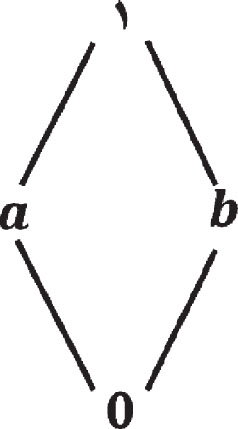
Example 3.2. Let be a lattice whose Hasse diagram is shown in Fig. 1 and the operations ⊕ and ∼ on be defined as shown in Table 1. Routine calculations show that is a basic algebra. It is not difficult to check that is a topology on and is a topological basic algebra.
⊕
0
a
b
1
x
∼x
→
0
a
b
1
0
0
a
b
1
0
1
0
1
1
1
1
a
a
a
1
1
a
b
a
b
1
b
1
b
b
1
b
1
b
a
b
a
a
1
1
1
1
1
1
1
1
0
1
0
a
b
1
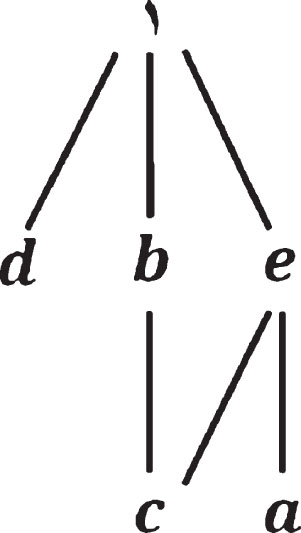
Example 3.3. Let be a lattice whose Hasse diagram is shown in Fig. 2 and the operations ⊕ and ∼ on be defined as shown in Table 2. Routine calculations show that is a basic algebra.
⊕
0
a
b
c
d
e
f
1
x
∼x
→
0
a
b
c
d
e
f
1
0
0
a
b
c
d
e
f
1
0
1
0
1
1
1
1
1
1
1
1
a
a
a
d
f
d
e
1
1
a
f
a
f
1
f
e
1
1
f
1
b
b
d
b
e
d
1
f
1
b
e
b
e
e
1
f
1
e
1
1
c
c
e
f
c
1
e
f
1
c
d
c
d
d
d
1
d
1
1
1
d
d
d
d
1
d
1
1
1
d
c
d
c
e
f
c
1
e
f
1
e
e
e
1
f
1
e
1
1
e
b
e
b
d
b
e
d
1
f
1
f
f
1
f
e
1
1
f
1
f
a
f
a
a
d
f
d
e
1
1
1
1
1
1
1
1
1
1
1
1
0
1
0
a
b
c
d
e
f
1
Let {0, c, b, f} , {0, c, d, 1} , {a, e, b, f} , {0, c, a, e, b, f} , {b, f, d, 1} , {a, e, d, 1} , {0, c, b, f, d, 1} , {0, c, a, e, d, . It is not difficult to check that is a left topological basic algebra.
Proposition 3.4. Let be a topology on . If →(or ⇝) is left continuous, then for all , the negation map S (x) = ∼ x is a ∼-homeomorphism on .
Proof. Let , where . Since ∼x = x → 0 and → is left continuous, there is a such that x ∈ V and ∼V = V → 0 ⊆ U and so S is continuous. We observe that S is an involution, which implies that S-1 is continuous. From ∼∼ x = x, it is obvious that S is onto and one to one, which implies that S is a ∼-homeomorphism.
The proof of the operation ⇝ is similar.□
Corollary 3.5.Let be a topology on . If ø(or ⊖) is right continuous, then for all , the negation map S (x) = ∼ x is a ∼-homeomorphism on .
Proof. By considering ∼x = 1 ø x (=1 ⊖ x) and right continuity of ø (⊖), the proof is similar to that of Proposition 3.4.□
Remark 3.6. If the negation map ∼ is continuous, then the maps n, nl and nr from to are defined by n (x, y) : = (∼ x, ∼ y) , nl (x, y) : = (∼ x, y) and nr (x, y) : = (x, ∼ y) are continuous.
Proposition 3.7.Let be a topology on . Then the following statements are equivalent:
is a topological basic algebra,
∼ is continuous and ∗ is continuous, where ∗ ∈ {⊕ , ⊙},
∗ is continuous, where ∗ ∈ {ø , ⊖ , ⇝}.
Proof. From (B5) - (B9) we have,
Now, the proof follows from Proposition 3.4, Corollary 3.5 and Remark 3.6.□
Proposition 3.8.Let be a topology on . Then the following statements are equivalent:
is a semitopological basic algebra,
∼ is continuous and ∗ is semicontinuous, where ∗ ∈ {⊕ , ⊙},
∗ is semicontinuous, where ∗ ∈ {ø , ⊖ , ⇝}.
Proof. (i) ⇒ (ii) Assume that is a semitopological basic algebra. By Proposition 3.4, ∼ is continuous. Let and such that x ⊕ a = ∼ x → a ∈ U. Since → is left continuous, there is such that ∼x ∈ V and V → a ⊆ U. By continuity of ∼, there is a W ∈ T such that x ∈ W and ∼W ⊆ V. Then W ⊕ a = ∼ W → a ⊆ V → a ⊆ U, proving ⊕ is left continuous. Now, let and such that ∼a → x = a ⊕ x ∈ U. Since → is right continuous, there is a such that x ∈ V and ∼a → V = a ⊕ V ⊆ U. Hence ⊕ is right continuous and so ⊕ is semicontinuous. By the similar way, we can prove that ⊙ and ⊖ are semicontinuous. (ii) ⇒ (iii) Assume that ⊕ is semicontinuous and let and U ∈ T such that x ø a = ∼ (a ⊕ ∼ x) ∈ U. Since ∼ is continuous there is V ∈ T such that a ⊕ ∼ x ∈ V and ∼V ⊆ U. Since ⊕ is right continuous there is V1 ∈ T such that ∼x ∈ V1 and a ⊕ V1 ⊆ V. By continuity of ∼, there is V2 ∈ T such that x ∈ V2 and ∼V2 ⊆ V1. Then V2 ø a = ∼ (a ⊕ ∼ V2) ⊆ ∼ (a ⊕ V1) ⊆ ∼ V ⊆ U and so ø is left continuous. Now, let and U ∈ T such that a ø x = ∼ (x ⊕ ∼ a) ∈ U. Since ∼ is continuous, there is V ∈ T such that x ⊕ ∼ a ∈ V and ∼V ⊆ U. Since ⊕ is left continuous there is V1 ∈ T such that x ∈ V1 and V1 ⊕ ∼ a ⊆ V. Then a ø V1 = ∼ (V1 ⊕ ∼ a) ⊆ ∼ V ⊆ U. Hence ø is right continuous and so ø is semicontinuous. If ⊙ is semicontinuous, then by (B5) - (B9), we can prove that ø, ⊖ and ⇝ are semicontinuous. (iii) ⇒ (i) Assume that ⇝ is semicontinuous. By Proposition 3.4, ∼ is continuous. Let and such that x → a = ∼ a ⇝ ∼ x ∈ U. By the right continuity of ⇝, there is such that ∼x ∈ V and ∼a ⇝ V ⊆ U. By continuity of ∼, there is V1 ∈ T such that x ∈ V1 and ∼V1 ⊆ V. Then V1 → ∼ a = ∼ a ⇝ ∼ V1 ⊆ ∼ a ⇝ V ⊆ U. Hence → is left continuous. By the similar way, we can prove that → is right continuous. Then is a semitopological basic algebra.□
Corollary 3.9.Let be a topology on . If ∗ is right (left) continuous, where ∗ ∈ {ø , ⊖ , ⇝}, then → is left (right) continuous.
Proof. The proof is similar to the proof of Proposition 3.8 (iii) ⇒ (i).□
Proposition 3.10.Let be a (semi) topological basic algebra. Then ∨ is (semi) continuous.
Proof. Suppose that is a topological basic algebra, , and x ∨ y = (x → y) → y ∈U. Since → is continuous, then there are two neighborhoods U1 and U2 of x → y and y respectively, such that U1 → U2 ⊆ U. Also, there are two neighborhoods V1 and V2 of x and y, respectively, such that V1 → V2 ⊆ U1. Let V = V2 ∩ U2. Then V1 → V ⊆ V1 → V2 ⊆ U1 and so V1 ∨ V = (V1 → V) → V ⊆ U1 → V ⊆ U1 → U2 ⊆ U. Thus, ∨ is continuous. Now, suppose that is a semitopological basic algebra. Since the operation ∨ is commutative, it is sufficient to prove that ∨ is left continuous. Let and x ∨ y ∈ U. Since → is right continuous, there is a neighborhood U1 of x → y such that U1 → y ⊆ U and there is a neighborhood V1 of x such that V1 → y ⊆ U1. Then V1 ∨ y = (V1 → y) → y ⊆ U1 → y ⊆ U. Hence, ∨ is left continuous on and so ∨ is semicontinuous.□
Proposition 3.11.Let be a (semi) topological basic algebra. Then ∧ is (semi) continuous.
Proof. Suppose that is a topological basic algebra. By Propositions 3.4 and 3.10, the mapping V (x, y) : = x ∨ y from into and the negation map S are continuous. So, by (BA9) and Remark 3.6, S∘ V ∘ n = ∧ is continuous.
Now, let be a semitopological basic algebra, , and x ∧ y = ∼ (∼ x ∨ ∼ y) ∈ U. By Proposition 3.4, the negation map ∼ is continuous. Then there is a neighborhood W of ∼x ∨ ∼ y such that ∼W ⊆ U. By Proposition 3.10, since ∨ is left continuous, there is a neighborhood U1 of ∼x such that U1 ∨ ∼ y ⊆ W. Moreover, there is an open neighborhood U2 of x such that ∼U2 ⊆ U1. Now, for any z ∈ U2, we have
So, U2 ∧ y ⊆ U. Hence ∧ is left continuous. Since ∧ is commutative, it is right continuous. Therefore, ∧ is semicontinuous.□
Theorem 3.12.There is a topology on such that ∗ is continuous for ∗ ∈ {∨ , ∧}.
Proof. For , let . Obviously, for all and . Let . If , then . Hence is a base for the topology on where members of is the unions of members of B. For proof of continuity ∗ ∈ {∧ , ∨}, suppose that and such that a ∗ b ∈ U. Since for each , is the smallest neighborhood of x, . By (BA6), it is easily to prove that . Therefore, ∗ is continuous.□
The following example shows that there is a topology on such that ∨, ∧ are continuous but is not a (semi) topological basic algebra.
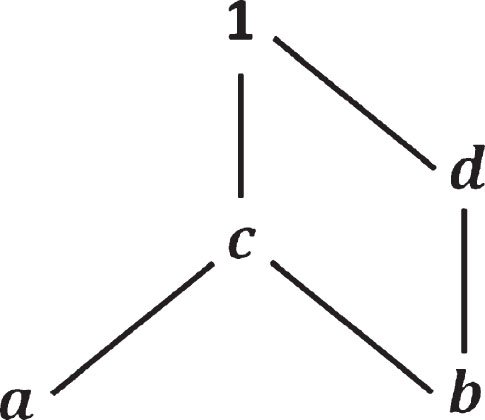
Example 3.13. Let be a lattice whose Hasse diagram is shown in Fig. 3. We define the operations ⊕ and ∼ on as shown in Table 3. Routine calculations show that is a basic algebra. Moreover, , , , and , then by Theorem 3.12, is a base for the topology on and ∨ and ∧ are continuous. Now, we show that is not a left topological basic algebra. For this, consider c → 0 = a ∈ {a, c, 1}. Then {c, 1} →0 = {0, a} ⊈ {a, c, 1}, {a, c, 1} →0 = {0, a, c} ⊈ {a, c, 1}, {b, c, 1} →0 = {0, a, b} ⊈ {a, c, 1} and {a, b, c, 1} →0 = {0, a, b, c} ⊈ {a, c, 1}, which imply that → is not left continuous. Hence is not a (semi) topological basic algebra.
⊕
0
a
b
c
1
x
∼x
→
0
a
b
c
1
0
0
a
b
c
1
0
1
0
1
1
1
1
1
a
a
c
b
1
1
a
c
a
c
1
b
1
1
b
b
a
1
c
1
b
b
b
b
a
1
c
1
c
c
1
b
1
1
c
a
c
a
c
b
1
1
1
1
1
1
1
1
1
0
1
0
a
b
c
1
Separation axioms on (semi) topological basic algebras
In this section, we get some conditions on (semi) topological basic algebras, which imply that they become a Ti-space.
Proposition 4.1.Let be a semitopological basic algebra. Then is a T0-space if and only if it is a T1-space.
Proof. Obviously, any T1-space is a T0-space. Let be a T0-space and x ≠ y for . Then either x → y ≠ 1 or y → x ≠ 1. Assume that x → y ≠ 1. Then there exists an open set U such that x → y ∈ U and 1 ∉ U or x → y ∉ U and 1 ∈ U. First, suppose that x → y ∉ U and 1 ∈ U. Since x → x = y → y = 1, there exist two neighborhoods V1 and V2 of x and y, respectively such that x → V1 ⊆ U and V2 → y ⊆ U. We claim that x ∉ V2 and y ∉ V1. If x or y belongs to V1 ∩ V2, then x → y ∈ U, which is a contradiction. By the similar way, the proof of other case is clear.□
Proposition 4.2.Let be a topological basic algebra. Then is a T1-space if and only if it is a Hausdorff space.
Proof. Let be a T1-space and x ≠ y for . Then either x → y ≠ 1 or y → x ≠ 1. Assume that x → y ≠ 1. Since is a T1-space, there exist two neighborhoods U and V of x → y and 1, respectively, such that x → y ∉ V and 1 ∉ U. Since → is continuous, there exist two neighborhoods V1 and V2 of x and y, respectively, such that V1 → V2 ⊆ U. We claim that V1∩ V2 = ∅. If z ∈ V1 ∩ V2, then 1 = z → z ∈ V1 → V2 ⊆ U, which is a contradiction. Thus is a Hausdorff space. The converse is obvious.□
Corollary 4.3.Let be a topological basic algebra. Then is a Ti-space if and only if it is a Tj-space, where i, j ∈ {0, 1, 2}.
Proof. It follows from Propositions 4.1 and 4.2.□
Proposition 4.4.Let F be a nonempty subset of . Then F is a (weak) filter of if and only if ∼F is an (a weak) ideal of .
Proof. Let F be a filter of . We show that ∼F satisfies (I1)-(I3). (I1) Let x ø y ∈ ∼ F and y ∈ ∼ F, for . Then ∼y → ∼ x = ∼ (x ø y) ∈ F and ∼y ∈ F, thus, ∼x ∈ F. (I2) Let ∼ (∼ y → ∼ x) = x ø y ∈ ∼ F, y ≤ x and . Since ∼y → ∼ x ∈ F, ∼x ≤ ∼ y and F is a filter, by (F2), for ∼c, we have (∼ x → ∼ c) → (∼ y → ∼ c) ∈ F. Thus we can conclude that (c ø y) ø (c ø x) = ∼ (∼ (c ø x) → ∼ (c ø y)) ∈ ∼ F. (I3) Let x ø y ∈ ∼ F, y ø x ∈ ∼ F and . Since ∼ (∼ y → ∼ x) = x ø y ∈ ∼ F, ∼ (∼ x → ∼ y) = y ø x ∈ ∼ F, then ∼x → ∼ y ∈ F, ∼ y → ∼ x ∈ F, and so (∼ c → ∼ y) → (∼ c → ∼ x) ∈ F. Therefore, (x ø c) ø (y ø c) = ∼ (∼ (y ø c) → ∼ (x ø c)) ∈ ∼ F. Hence ∼F is an ideal of .
By the similar way, the proof of other side is clear.□
Theorem 4.5.Let be a semitopological basic algebra. If the ideal {0} (the filter {1}) is an open set, then is a discrete topology and so is a topological basic algebra.
Proof. Let . We know that x ø x = 0. Since ø is left and right continuous and {0} is an open set, there exist two neighborhoods U1 and U2 of x such that U1 ø x = {0} = x ø U2. For U = U1 ∩ U2 we have x ø U = U ø x = {0}. We claim that U = {x}. Suppose that y ∈ U. Then y ø x = x ø y = 0. Hence, by (BA4), x = y and so is a discrete topology on , thus is a topological basic algebra. The proof for filter {1} follows from Proposition 4.4 and the first part of this theorem.□
Theorem 4.6.Let be a topology on , and for each , (resp. be an open map. If there exists containing 1 (resp. 0), then is a T0-space.
Proof. Let x ≠ y and U be an open set containing 1. Since and are open maps, we have and are open sets containing x and y because x = 1 → x ∈ U → x and y = 1 → y ∈ U → y. We claim that x ∉ U → y or y ∉ U → x. Suppose that x ∈ U → y and y ∈ U → x. Then for some , we have x = a → y and y = b → x, thus, by (BA8) we get that x ≤ y and y ≤ x. Hence x = y, which is a contradiction. Then is a T0-space. Now, let x ≠ y and U be an open set containing 0. Since and are open maps, we have and are open sets containing x and y, because x = x ø 0 ∈ x ø U and y = y ø 0 ∈ y ø U. We claim that x ∉ y ø U or y ∉ x ø U. Suppose that x ∈ y ø U and y ∈ x ø U. Then for some , we have x = y ø a, y = x ø b, and by (BA8), x ≤ y and y ≤ x. Then x = y, which is a contradiction. Hence is a T0-space.□
Proposition 4.7.Let F be a filter (an ideal) of topological basic algebra . Then the following statements hold:
If 1 (resp. 0) is an interior point of F, then F is a closed set.
If F is an open set, then F is a closed set.
If is connected, then has no open proper filter (ideal).
Proof. (i) Let 1 be an interior point of filter F. It is sufficient to prove that Fc, the complement of F, is an open set. By assumption, there is a neighborhood U of 1 such that U ⊆ F. Since x → x = 1, for x ∈ Fc, there exist two neighborhoods V1 and V2 of x such that V1 → V2 ⊆ U. Let V = V1 ∩ V2. Then V → V ⊆ V1 → V2 ⊆ U. Now, we show that V ⊆ Fc. Suppose that V ⊈ Fc. Then for y ∈ V ∩ F and arbitrary element z ∈ V, we have y → z ∈ V → V ⊆ F, and so z ∈ F. This implies that V ⊆ F, which is a contradiction. Thus x ∈ V ⊆ Fc. Hence, Fc is an open set.
(ii) Let F be an open set of and x ∈ Fc. Since x → x = 1 ∈ F and is a topological basic algebra, there are two neighborhoods U1, U2 of x such that U1 → U2 ⊆ F. Consider U = U1 ∩ U2, then U → U ⊆ U1 → U2 ⊆ F. We claim that U ⊆ Fc. If U∩ F ≠ ∅, then there is y ∈ U ∩ F and for any z ∈ U, y → z ∈ U → U ⊆ F. Since y ∈ F, by (F1), z ∈ F, (U ⊆ F), which is a contradiction. Then U ⊆ Fc and Fc is an open set. Therefore, F is closed.
(iii) Let F be an open set. Then by (ii), F is closed set. Since is connected, and it is not proper filter of .
When F is an ideal of , the proof follows from Propositions 3.4 and 4.4.□
Proposition 4.8.Let be a topological basic algebra. If either of {1} or {0} is closed, then is a Hausdorff space.
Proof. Let be a topological basic algebra. Suppose that {1} is a closed set. Let and x ≠ y. Then x → y ≠ 1 or y → x ≠ 1. Without the lost of generality, assume that x → y ≠ 1. Since {1} is closed, is an open set containing x → y. Since is a topological basic algebra, there exist two neighborhoods U1 and U2 of x and y such that . We claim that U1∩ U2 = ∅. If y ∈ U1 ∩ U2, then , which is a contradiction. Hence is a Hausdorff space.
Conversely, assume that is a Hausdorff space. We show that is open. If x ≠ 1, then there exist two disjoint neighborhoods U1, U2 of x and 1, respectively. Thus 1 ∉ U1 and , which implies that is an open set. In the above proof, if we replace {1} by {0} and → by ø, then, by a similar manner we can prove that if {0} is close. Hence, is a Hausdorff space.□
Proposition 4.9.Let be a topology on and assume that {0} is a closed set. Then the following statements hold:
if ø is semicontinuous, then is a T1-space.
if ø is right or left continuous, then is a T0-space.
Proof. (i) Let x ≠ y. Then x ø y ≠ 0 or y ø x ≠ 0. Suppose that x ø y ≠ 0. By assumption, there is a neighborhood U of x ø y such that 0 ∉ U. Since ø is semicontinuous, there exist two neighborhoods V1 and V2 of x and y, respectively, such that V1 ø y ⊆ U and x ø V2 ⊆ U. We claim that x ∉ V2 and y ∉ V1. Otherwise 0 = x ø x = y ø y ∈ U, which is a contradiction. Thus is a T1-space.
(ii) Assume that ø is left continuous. Let such that x ≠ y. Then x ø y ≠ 0 or y ø x ≠ 0. Suppose that x ø y ≠ 0. By assumption there is a neighborhood U of x ø y such that 0 ∉ U. On the other hand, there is a neighborhood V1 of x such that V1 ø y ⊆ U. We claim that y ∉ V1. If y ∈ V, then 0 = y ø y ∈ U, which is a contradiction. Thus is a T0-space.
The proof of the other case is similar.□
Induced (semi) topological basic algebras
In this section, we show that in every basic algebra , any arbitrary family of filters (ideals) induce a topology on , which is completely regular, normal and locally compact. In Theorem 5.31, it is shown that for any n ≥ 3, there exists a nontrivial topological implication basic algebra, which is normal and regular.
Definition 5.1. [12] Let Θ be an equivalence relation on .
Θ is called a weak congruence if for all , (CW) (a, b) ∈ Θ ⇒ (c ø a, c ø b) ∈ Θ.
Θ is called a congruence if it is a weak congruence and satisfies (a, b) ∈ Θ ⇒ (a ø c, b ø c) ∈ Θ.
Theorem 5.2.Let Θ be an equivalence relation on . Then θ is a weak congruence if and only if it satisfiesProof. If Θ satisfies (CW) or (CC) and (a, b) ∈ Θ, then (∼ a, ∼ b) ∈ Θ. Now, suppose (CC) is satisfied. For , we get (∼ a → ∼ c, ∼ b → ∼ c) ∈ Θ. This means that (∼ (c ø a) , ∼ (c ø b)) ∈ Θ, which implies that (c ø a, c ø b) ∈ Θ. Conversely assume that (CW) is satisfied. Let (a, b) ∈ Θ, then (∼ a, ∼ b) ∈ Θ. For , we get (∼ c ø ∼ a, ∼ c ø ∼ b) = (∼ (a → c) , ∼ (b → c)) ∈ Θ, which implies that (a → c, b → c) ∈ Θ. □
Theorem 5.3. [7, 12] (i) Let Θ be a (weak) congruence on . Then [1] Θ and [0] Θ are a (weak) filter and an (a weak) ideal of , respectively.
(ii) Let Θ be a congruence on . Then [1] Θ is a filter of .
(iii) Let F be a (weak) filter of . Then the relation ΘF is defined byis a (weak) congruence on such that [1] ΘF = F.
If F is a filter of , then the relation ΘF is a congruence relation on such that [1] ΘF = F.
(iv) Let I be an (a weak) ideal of . Then the relation ΘI is defined byis a (weak) congruence relation on such that [0] ΘI = I.
Lemma 5.4.Let I (F) be an ideal (resp. filter) of . Then the following conditions hold:
If x ∈ I and , then x ø y ∈ I,
If and y ∈ F, then x → y ∈ F, x ∨ y ∈ F .
If x, y ∈ I (F), then xΘIy (xΘFy).
Proof. (i) Let x ∈ I and . Then by (BA7), (x ø y) ø x = 0 ∈ I, thus by (I1), we get that x ø y ∈ I. (ii) Let and y ∈ F. Then by (BA8), y → (x → y) =1 ∈ F, thus, by (F1) we get that x → y ∈ F. Also, since y ∈ F, by (F1), x ∨ y = (x → y) → y ∈ F. (iii) Let I be an ideal (filter) of and x, y ∈ I (resp. F). By (i) and (ii), x ø y ∈ I and y ø x ∈ I. Hence xΘIy. If F is a filter,then by the similar way, we can prove that xΘFy. □
Theorem 5.5.Let I be an (a weak) ideal of and F = ∼ I. Then, for all , we get that,
Proof. Let (a, b) ∈ ΘI. Then ∼ (∼ b → ∼ a) = a ø b ∈ I and ∼ (∼ a → ∼ b) = b ø a ∈ I. Hence ∼a → ∼ b ∈ F and ∼b → ∼ a ∈ F. By Proposition 4.4, F is a (weak) filter. Then by (F2), if c = 0, then a → b ∈ F and b → a ∈ F. The converse is obvious. □
Definition 5.6. For an arbitrary element and a nonempty subset U of , the set U [x] is defined by
for any ∗ ∈ {→ , ø} (resp. ∗ ∈ {→}).
Remark 5.7. In Definition 5.6, if I is a (weak)ideal of , then I [x] is obviously the equivalence class . It is satisfied for any (weak) filter of and , too.
Theorem 5.8.Let be an arbitrary family of ideals of which is closed under finite intersections. Thenis a topology on with the base and is a topological basic algebra and is called the induced topology by .
Proof. It is easy to prove that is closed under arbitrary unions. is a nontrivial topology because for any and (at least, there is a trivial ideal ). Note that for any , I [x] is the smallest neighborhood of x and is called the induced topology by .
Suppose that is a family of ideals of . Let and such that x ø y ∈ U. Then there exists an ideal I such that I [x ø y] ⊆ U. Since ΘI is a congruence relation and I [x] is a class of ΘI, we have I [x] ø I [y] ⊆ I [x ø y] ⊆ U. Hence by Proposition 3.7, is a topological basic algebra. Clearly, β is a base for .□
Theorem 5.9.Let be an arbitrary family of filters of which is closed under finite intersections. Then is a topology on with the base and is a topological basic algebra and is called the induced topology by .
Proof. The proof is similar to the proof of Theorem 5.8. □
In the rest of paper, if and , then and are presented by and , respectively.
Example 5.10. Consider be the basic algebra as in Example 3.2. Routine calculations, show that the set of ideals of is .
Now, consider which I0 = {0}, I1 = {0, a} and I2 = {0, b} are ideals of . Then I0 [x] = {0}, for all and
Thus β = {{0} , {1} , {a} , {b} , {a, 0} , {b, 0}} is a base for and is a topological basic algebra.
Theorem 5.11.Let be an arbitrary family of weak ideals of which is closed under finite intersections. Then is a left topological basic algebra which is the base of .
Proof. Suppose that is a family of weak ideals of . Let and such that a ø y ∈ U. Then there exists such that I [a ø y] ⊆ U. We prove that a ø I [y] ⊆ I [a ø y]. Let b ∈ I [y]. Then bΘIy, where ΘI is a weak congruence. By (CW), a ø bΘIa ø y. Now, a ø b ∈ a ø I [y] ⊆ I [a ø y] ⊆ U. Thus ø is right continuous. Hence, by Corollary 3.9, the operation → is left continuous and is a left topological basic algebra. □
Corollary 5.12.Let be an arbitrary family of weak filters of which is closed under finite intersections. Then () is a left topological basic algebra which is the base of .
Theorem 5.13.If I is an (a weak) ideal of , then the induced topology by I is equal to induced topology by the (weak) filter F = ∼ I.
Proof. By Theorem 5.5, the proof is clear. □
Example 5.14. Consider be the basic algebra as in Example 3.3. Routine calculations, show that I = {0, c} is a weak ideal of . Then,
Thus β = {{0, c} , {a, e} , {b, f} , {d, 1}} is a base for and is a left topological basic algebra. Easily, we can see that F = {1, d} is a weak filter of and the induced topology by weak filter F is equal to induced topology by weak ideal I.
Proposition 5.15.If F is a nontrivial filter of , then ∼F∩ F = ∅.
Proof. Let F be a filter of and x ∈ ∼ F ∩ F. Then ∼x = (x → 0) ∈ F and x ∈ F. Thus, by (F1), 0 ∈ F and , which is a contradiction. Now, let I be an ideal of . Then by Proposition 4.4, ∼I is a filter and then ∼I∩ I = F ∩ ∼ F = ∅. □
Corollary 5.16.If I is a nontrivial ideal of , then ∼I∩ I = ∅.
Proof. Let I be an ideal of . Then by Proposition 4.4, ∼I = F is a filter of and so ∼I ∩ I = ∼F∩ F = ∅. □
Definition 5.17. Let I be an ideal of . I is called supermaximal if .
Remark 5.18. By Proposition 4.4, I is an ideal of , if and only if ∼I is a filter of . Then, the dual notion of supermaximal filters can be introduced such as supermaximal ideal.
Theorem 5.19.Let I be an ideal of . Then the following statements are equivalent:
I is a supermaximal ideal of ,
,
.
Proof. (i) ⇒ (ii) Let I be a supermaximal ideal of and . If a ∈ I, a/I = 0/I = I and if a ∈ ∼ I, a/(∼ I) =1/(∼ I) = (∼ I). So, is a base for topology . Hence . (ii) ⇒ (iii) It is straightforward. (iii) ⇒ (i) Let I be an ideal of . Then . By Proposition 4.4 and Corollary 5.16, β = {I, ∼ I} is a base of and . Hence, I is a supermaximal ideal of . □
Example 5.20. Let j, 1} be the lattice that Hasse diagram is shown in Fig. 4 and the operations ⊕, ∼ and ø on are defined as shown in Table 4. Routine calculations show that (B ; ⊕ , ∼) is a basic algebra. Moreover, it is not difficult to check that I1 = {0, a} is a weak ideal and I = {0, b, d, f, h, j} is a supermaximal ideal of . Now, let .
Then {{0, b, d, f, h, j} , {a, c, e, g, i, 1}} is a base for . Hence is a topological basic algebra.
.
The Cayley tables of the operations on
⊕
0
a
b
c
d
e
f
g
h
i
j
1
x
∼x
0
0
a
b
c
d
e
f
g
h
i
j
1
0
1
a
a
a
1
c
g
e
i
g
c
i
e
1
a
b
b
b
1
b
1
b
1
b
1
b
1
b
1
b
a
c
c
i
1
c
1
e
i
1
c
i
e
1
c
d
d
d
e
b
1
d
e
f
g
b
i
j
1
d
c
e
e
g
1
c
g
e
1
g
c
1
e
1
e
f
f
f
c
b
c
d
1
f
g
h
i
b
1
f
e
g
g
e
1
1
g
e
i
g
1
i
e
1
g
h
h
h
i
b
c
b
e
f
1
h
i
j
1
h
g
i
i
c
1
c
g
1
i
g
c
i
1
1
i
j
j
j
g
b
c
d
e
b
g
h
1
j
1
j
i
1
1
1
1
1
1
1
1
1
1
1
1
1
1
0
(a)
ø
0
a
b
c
d
e
f
g
h
i
j
1
0
0
0
0
0
0
0
0
0
0
0
0
0
a
a
0
a
0
a
0
a
0
a
0
a
0
b
b
b
0
j
f
h
d
f
j
d
h
0
c
c
h
a
0
c
h
c
h
a
h
c
0
d
d
d
0
d
0
d
d
0
d
d
d
0
e
e
j
a
j
e
0
e
j
e
j
a
0
f
f
f
0
f
f
f
0
f
f
0
f
0
g
g
d
a
d
a
d
g
0
g
d
g
0
h
h
h
0
0
h
h
h
h
0
h
h
0
i
i
f
a
f
i
f
a
f
i
0
i
0
j
j
j
0
j
j
0
j
j
j
j
0
0
1
1
b
a
d
c
f
e
h
g
j
i
0
(b)
Now, consider the weak ideal I1 = {0, a}. Then
Hence {{0, a} , {1, b} , {c, h} , {d, g} , {e, j} , {f, i}} is a base for . Therefore, is a left topological basic algebra.
Proposition 5.21.Let I be a proper ideal (filter) of . In the topological space , the following properties hold:
For each x ∈ I, I [x] = I.
For each , I and I [x] are clopen subsets of .
For each , I and I [x] are compact subsets of .
is zero dimensional, disconnected, locally compact, completely regular and normal.
Proof. (i) The proof is clear.
(ii) Let . Then I [x] is an open set. It is sufficient to prove that (I [x]) c is an open set, too. Let y ∈ I [x] c. Then I [x]∩ I [y] = ∅, which yields I [y] ⊆ (I [x]) c. Since I [y] is an open set, I [x] c is an open set. Therefore, I [x] (and so I = I [0]) is a clopen subset of .
(iii) Suppose that is an arbitrary open covering of I [x]. Then there exists an open set containing x and thus I [x] ⊆ V, because I [x] is the smallest neighborhood of x in this topology. Therefore, I [x] and I [0] = I (I [1] = I) are compact.
(iv) By (ii), I is a proper clopen subset of , then is disconnected and it is zero dimensional, because is a clopen base for topology . Since for any , I [x] is a compact neighborhood of x, is a locally compact space. Now, let and V be a neighborhood of x. Then by (ii), there is a closed neighborhood I [x] of x which I [x] ⊆ V. Therefore is regular. Since is locally compact, is completely regular. Now, let C and O be a closed and open set, respectively, such that C ⊆ O. Since for x ∈ C, I [x] is the smallest neighborhood of x, then I [x] ⊆ O. By (ii), I [x] is a clopen subset of . Then H = ⋃ x∈CI [x] is a clopen subset of . Therefore , which implies that is a normal space. □
Now, in the following, we present the notion of quotient basic algebras and study the interaction of topological basic algebras and topological quotient basic algebras and find their properties.
Let be a basic algebra and F be a filter of . We define ⊕, → and ∼ on by
It is easy to check that quotient algebra is a basic algebra. Let be a topology on and be a canonical projection. Suppose is a topology on and U is a subset of . Then U is an open subset of if and only if π-1 (U) is an open subset of . Now, consider
is the topology on which is called the quotient topology induced by πF. It is well known that it is the greatest topology on making πF continuous.
If we consider and , then it is easy to show that for each , πF ∘ La = La/F ∘ πF and πF ∘ Ra = Ra/F ∘ πF.
In the following, we give some conditions that becomes a topological basic algebra.
Proposition 5.22.Let be a topological basic algebra and F be a filter of . If natural projection is an open map, then the quotient basic algebra with quotient topology is a topological basic algebra.
Proof. It is sufficient to prove that → is continuous to quotient topology. Let V be an open neighborhoods of (x → y)/F = x/F → y/F. Then is an open subset of and . Since is a topological basic algebra, there exist open neighborhoods U1, U2 of x and y, respectively, such that . Then V1 = πF (U1) and V2 = πF (U2) are open sets in and x/F ∈ V1 and y/F ∈ V2, because πF is an open map. Hence V1 → V2 ⊆ πF (U1 → U2) ⊆ U. Therefore → is continuous. □
Proposition 5.23.Let be a topological basic algebra induced by and F be a filter of . If , then is an open map.
Proof. Let be an arbitrary family of filters of which is closed under finite intersection and F be a filter of . By Theorem 5.9, is a base for . So, it is sufficient to show that for all [x] Fi ∈ β, πF ([x] Fi) is an open set or . Let [x] Fi ∈ β, for and . Suppose . Then a/F = πF (a) ∈ πF ([x] Fi). Hence, there exists b ∈ [x] Fi such that a/F ∈ πF (b) = b/F and aΘFb. Since aΘFb and F ⊆ Fi, we get that aΘFib and bΘFix. By transitivity condition, aΘFix i.e, a ∈ [x] Fi. So . Clearly, . Therefore, and π is an open map. □
Corollary 5.24.Let be a topological basic algebra induced by and F be a filter of . If , then the quotient basic algebra with quotient topology is a topological basic algebra.
Proof. By Propositions 5.22 and 5.23, the proof is clear. □
Proposition 5.25.Let be a semitopological basic algebra induced by and F be a filter of . Then the following statements hold:
F is open if and only if x/F is open for any
F is open if and only if πF is open and the quotient topology on is discrete.
If F is open, then is a Hausdorff topological basic algebra.
Proof. (i) Let F be an open set. It is easy to prove that for each , . Since F is open, then by continuity Lx and Rx, x/F is open. Now, if for all , x/F is open in , then 1/F = F is open in . (ii) Let F be an open set. Then by (i), for each , x/F is open. It is easy to see that for each , is open in . Hence πF is open in and for each , πF (x/F) = {x/F} is open in . Conversely, let the quotient topology on be a discrete topology and πF be an open map. Since {x/F} is an open in , is an open subset of . (iii) Let F be an open set. Then by (ii), is discrete and it is clear that is a Hausdorff topological basic algebra. □
Now, we investigate the topological implication basic algebras and prove that, there exists at least one nontrivial regular and normal topological implication basic algebra of cardinality n.
Theorem 5.26.Let be an arbitrary family of (weak) filters of which is closed under finite intersections. Then is a topology on with the base and is a (left) topological implication basic algebra and is called the induced topology by .
Proof. The proof is similar to the proof of Theorem 5.9 and Corollary 5.12. □
Example 5.27. Let be the join semilattice that Hasse diagram is shown in Fig. 5 and the operation → on is defined as shown in Table 6. Routine calculations show that is an implication basic algebra. Moreover, it is not difficult to check that {{1} , {b, 1} , {b, d, 1} , is the set of filters of . Now, by setting which f1 = {a, e, 1}, f2 = {a, b, c, e, 1} and f3 = {a, d, e, 1} are filters of , we have
and
Then β = {{d} , {b, c} , {a, e, 1} , {a, b, c, e, 1} , {a, d, e, 1}} is a base for and is a topological implication basic algebra.
→
a
b
c
d
e
1
a
1
b
b
d
1
1
b
a
1
e
d
e
1
c
e
1
1
d
1
1
d
a
b
c
1
e
1
e
e
b
b
d
1
1
1
a
b
c
d
e
1
Induced implication basic algebra
→
a
b
c
d
1
⇀
z∗
a
b
c
d
1
a
1
d
1
d
1
z∗
1
a
b
c
d
1
b
c
1
1
1
1
a
z∗
1
d
1
d
1
c
c
d
1
d
1
b
z∗
c
1
1
1
1
d
a
c
c
1
1
c
z∗
c
d
1
d
1
1
a
b
c
d
1
d
z∗
a
c
c
1
1
1
z∗
a
b
c
d
1
(a)
(b) (
Theorem 5.28.Let F be a proper (weak) filter of . Then, the topological space is zero-dimensional, disconnected, locally compact, completely regular and normal and for each , F and F [x] are clopen and compact subsets of .
Proof. The proof is similar to the proof of Proposition 5.21.□
Theorem 5.29.Let be an implication basic algebra and . Then there is an operation ⇀ on such that is an implication basic algebra. Moreover, if F is a filter of , then F∗ = F ∪ {z∗} is a filter of .
Proof. We define ⇀ on as follows:
It is not difficult to see that all conditions (IB1)-(IB3) are satisfied. Let F be a filter of . We prove that F∗ = F ∪ {z∗} satisfies (F1)-(F3). (F1) Suppose that a ∈ F∗, a ⇀ b ∈ F∗. If a ∈ F, a ⇀ b ∈ F or a ⇀ b = z∗, then b ∈ F or b = z∗, respectively and so b ∈ F∗. If a = z∗ and a ⇀ b ∈ F, then b = z∗ ∈ F∗ or b = z∗ ⇀ b ∈ F ⊆ F∗. (F2) Suppose a ⇀ b ∈ F∗, b ≤ a and . We will have following cases:
Case 1. Let a ⇀ b ∈ F, b ≤ a and . If , then by (F2), (b ⇀ c) ⇀ (a ⇀ c) ∈ F ⊆ F∗ and if c = z∗, then (b ⇀ z∗) ⇀ (a ⇀ z∗) = z∗ ⇀ z∗ = 1 ∈ F ⊆ F∗.
Case 2. Let a ⇀ b ∈ F, b ≤ a and . Then a ⇀ b = z∗ ⇀ b = b ∈ F. If , then by Lemma 5.4 (ii), (b ⇀ c) ⇀ (z∗ ⇀ c) = (b ⇀ c) ⇀ c = b ∨ c ∈ F ⊆ F∗ and if c = z∗, (b ⇀ z∗) ⇀ (z∗ ⇀ z∗) = z∗ ⇀ 1 =1 ∈ F∗.
Case 3. Let a ⇀ b ∈ F, b ≤ a and a = b = z∗. If or c = z∗, then (z∗ ⇀ c) ⇀ (z∗ ⇀ c) =1 ∈ F∗.
Case 4. Let a ⇀ b = z∗. Then b = z∗ and . For , by (IBA3), (z∗ ⇀ c) ⇀ (a ⇀ c) = c ⇀ (a ⇀ c) =1 ∈ F∗ and for c = z∗, (z∗ ⇀ z∗) ⇀ (a ⇀ z∗) = z∗ ⇀ z∗ = 1 ∈ F∗. (F3) Suppose a ⇀ b ∈ F∗, b ⇀ a ∈ F∗ and c ∈ IB∗. We consider the following cases:
Case 1. Let a ⇀ b ∈ F, b ⇀ a ∈ F. If , then by (F3), (c ⇀ a) ⇀ (c ⇀ b) ∈ F ⊆ F∗. Now, if c = z∗, then (z∗ ⇀ a) ⇀ (z∗ ⇀ b) = a ⇀ b ∈ F ⊆ F∗.
Case 2. Let a ⇀ b ∈ F, b ⇀ a = z∗. Then a = z∗ and b ∈ F. If , then (c ⇀ z∗) ⇀ (c ⇀ b) = z∗ ⇀ (c ⇀ b) = c ⇀ b. Since b ∈ F, by Lemma 5.4(ii), we have c ⇀ b ∈ F ⊆ F∗. Now, if c = z∗, then (z∗ ⇀ z∗) ⇀ (z∗ ⇀ b) =1 ⇀ b = b ∈ F ⊆ F∗.
Case 3. Let a ⇀ b = z∗, b ⇀ a ∈ F. In this case, proof is similar to the proof of Case 2. We observe that if a ⇀ b = b ⇀ a = z∗, then a = b = z∗, and so 1 = z∗ ⇀ z∗ = a ⇀ b = z∗, which is a contradiction. □
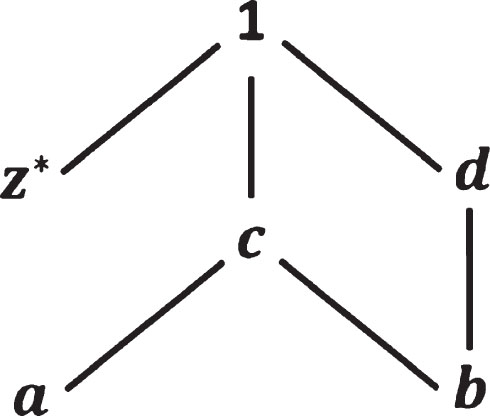
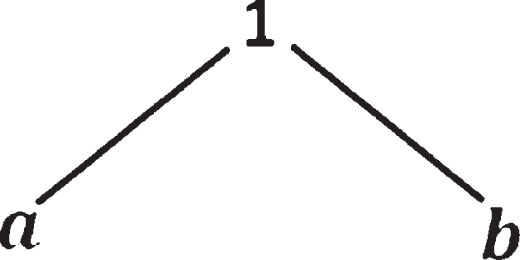
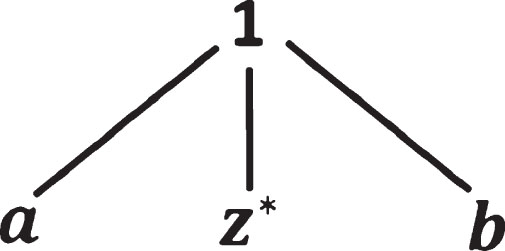
Example 5.30. Let be the join-semilattice whose Hasse diagram is below (see Fig. 6). We define an operation → on as shown in Table 6(a). Then is an implication basic algebra in which F = {a, c, 1} is a filter. Now, by Theorem 5.29, (see Fig. 7) together with the operation ⇀ which is shown in Table 6(b) is an implication basic algebra of order 6 with filter F∗ = {z∗, a, c, 1}.
.
.
Theorem 5.31.For any n ≥ 3, there is a nontrivial topological implication basic algebra of cardinality n such that is regular and normal.
Proof. Let be the join-semilattice which Hasse diagram is shown in Fig. 8 and let the operation → be defined by Table 7(a). Then is an implication basic algebra and F = {a, 1} is a filter of . By Corollary 5.28, is a topology on and is a normal and regular topological implication basic algebra. Now, suppose that , where . By Theorem 5.29, is an implication basic algebra (see Fig. 9 and Table 7(b)) in which F∗ = {z∗, a, 1} is a filter. By Corollary 5.28, is a topology on and is a normal and regular topological implication basic algebra. By the similar way, for each n ≥ 3, we can construct a normal and regular topological implication basic algebra of order n.□
.
.
Induced topological implication basic algebra of any order
→
a
b
1
⇀
z∗
a
b
1
a
1
b
1
z∗
1
a
b
1
b
a
1
1
a
z∗
1
b
1
1
a
b
1
b
z∗
a
1
1
1
z∗
a
b
1
(a)
(b)
In the following example, we construct an implication basic algebra of order 9, by the basic algebra of order 8, as shown in Example 3.3 and by using the it’s weak filter, we make the left topological implication basic algebra.
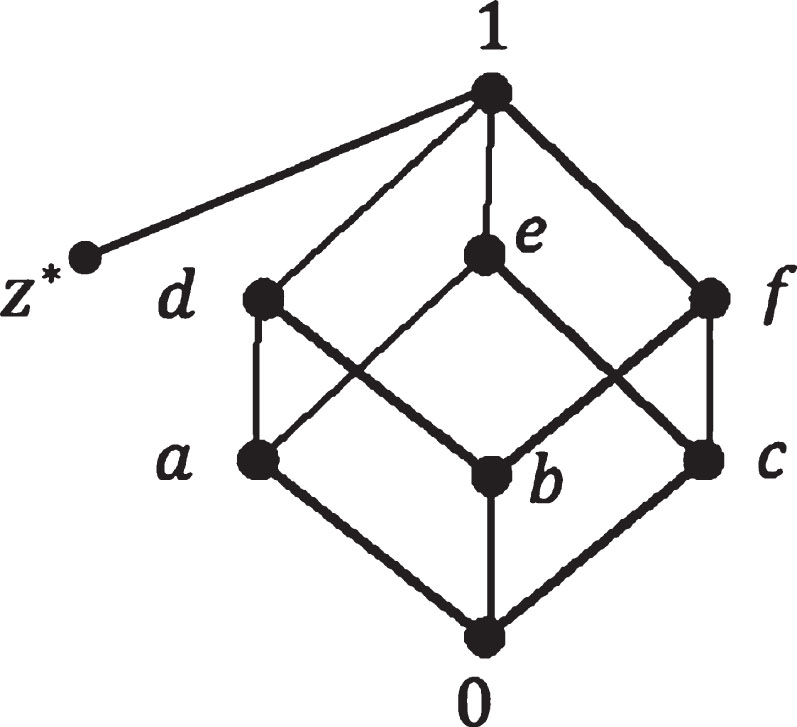
Example 5.32. Consider be the basic algebra as in Example 3.3. By Theorem 5.29, we construct the implication basic algebra of order 9 which Hasse diagram is shown in Fig. 10 and the operation → is defined as shown in Table 8. Since F = {d, 1} is a weak filter of , F* = {d, z*, 1} is a weak filter of . Now, let .
Table8
→
0
a
b
c
d
e
f
z*
1
0
1
1
1
1
1
1
1
z*
1
a
f
1
f
e
1
1
f
z*
1
b
e
e
1
f
1
e
1
z*
1
c
d
d
d
1
d
1
1
z*
1
d
c
e
f
c
1
e
f
z*
1
e
b
d
b
e
d
1
f
z*
1
f
a
a
d
f
d
e
1
z*
1
z*
0
a
b
c
d
e
f
1
1
1
0
a
b
c
d
e
f
z*
1
Then,
Hence, β = {{0, c} , {a, e} , {b, f} , {d, z*, 1}} is a base of and is the left topological implication basic algebra.
Conclusions and future works
In this paper, we defined the notions of (semi) topological basic algebra and (semi) topological implication basic algebra by (semi) continuity → on (implication) basic algebras. We found the relations between (semi) continuity operations due to the existence of some various operations on basic algebras. Further, any operations * ∈ {⊕ , ⊙ , ⊖ , ø , ⇝ , ∧ , ∨} are (semi) continuous if → is (semi) continuous. In addition, there is a topology on such that ∨, ∧ are continuous, but is not a topological basic algebra.
Then, we evaluated separation axioms on (semi) topological basic algebras and proved that topological basic algebra is a Ti-space if and only if is a Tj-space, for i, j ∈ {0, 1, 2}. In addition, some conditions were provided to make to a Ti-space, for i ∈ {0, 1, 2}.
In the sequel, by using a family of ideals (filters) of basic algebras, we introduced topological basic algebras and investigated some topological properties of topological basic algebras and topological quotient basic algebras.
Currently, studying topologies of logic algebras based on MV-algebras, are mainly through (filters) ideals of corresponding algebra, which are (pre-filters) pre-ideals corresponding to basic algebras. In basic algebras, pre-ideals of can not induce a topology on such that every operation on is continuous with respect to this topology. In basic algebras, the family of weak ideals(weak filters) makes a weak congruence(not congruence) and we used them to induce left topological basic algebras , which are zero dimensional, normal, disconnected, locally compact and completely regular left topological space.
Further, by using an implication basic algebra of cardinality n with filter F, we constructed an implication basic algebra of cardinality n + 1 with filter F* = F ∪ {z*}, which and proved that, there exists at least one nontrivial regular and normal topological implication basic algebra of cardinality n. In future research, the notions of prime filters and spectrum topology on implication basic algebras can be considered, along with the conditions these topological spaces can be a Ti-space, for i ∈ {0, 1, 2}.
Footnotes
Acknowledgments
The authors would like to express their sincere gratitude to the referees for their valuable suggestions and comments.
References
1.
AbbottJ.C., Orthoimplication algebras, Studia Logica35 (1976), 173–177.
2.
BorzooeiR.A., KouhestaniN. and RezaeiG.R., Metrizability on (semi) topological BL-algebras, Soft Computing16(10) (2012), 1681–1690.
3.
BorzooeiR.A., RezaeiG.R. and KouhestaniN., Separation axioms in (semi) topological quotient BL-algebras, Soft Computing16 (2012), 1219–1227.
4.
BorzooeiR.A., RezaeiG.R. and KouhestaniN., On (semi) topological BL-algebra, Iranian Journal of Mathematical Sciences and Informatics6(1) (2001), 59–77.
5.
BoturM., ChajdaI. and HalasR., Are basic algebras residuated structures?Soft Computing14 (2010), 251–255.
6.
BourbakiN., Elements of mathematics general topology, Addison-Wesley Publishing Company, 1966.
7.
ChajdaI., Filters of implication reducts of basic algebras, Soft Computing18 (2014), 849–852.
8.
ChajdaI., Basic algebras, logics, trends and applications, Asian European Journal of Mathematic08 (2015), 1550040 [46 pages].
9.
ChajdaI. and HalašR., On varieties of basic algebras, Soft Computing19 (2015), 261–267.
10.
ChajdaI. and KolǎríkM., Independence of axiom system of basic algebras, Soft Computing13 (2009), 41–43.
11.
ChajdaI., KolǎríkM. and Sv̌rčekF., Implication and equivalential reducts of basic algebras, Acta Universitatis Palackianae Olomucensis Facultas Rerum Naturalium Mathematica49 (2010), 21–36.
12.
ChajdaI. and KührJ., Ideals and congruences of basic algebras, Soft Computing17 (2013), 401–410.
13.
HaveshkiA., BorumandS. and EslamiE., A topology induced by uniformity on BL-algebras, Mathematical Logic Quarterly (2007), 162–169.
14.
HooC.S., Topological MV-algebras, Topology and Applications81 (1997), 103–121.
15.
KrňávekJ. and KührJ., Pre-ideals of basic algebras, International Journal of Theoretical Physics50 (2011), 3828–3843.
16.
LuoQ.J. and WangG.J., Weakly algebraic ideal topology of effect algebras, Acta Mathematica Sinica31(5) (2015), 787–796.
17.
NajafiM., RezaeiG.R. and KouhestaniN., On (para, quasi) topological MV-algebras, Fuzzy Sets and Systems313 (2017), 93–104.
18.
ZahiriO. and BorzooeiR.A., Topology on BL-algebras, Fuzzy Sets and Systems289 (2016), 137–150.