The main purpose of this paper is to introduce and examine the concepts of deferred statistical convergence of order β and strong r-deferred Cesáro summability of order β for sequences of fuzzy numbers and give some relations between deferred statistical convergence sequences of order β and strongly r-deferred Cesáro summable sequences of order β, where β ∈ (0, 1] and
In the first edition of his monograph puplished in Warsaw in 1935, Zygmund [43] mentioned the idea of statistical convergence and after then the notion was introduced by Steinhaus [36] and Fast [19] and later on reintroduced by Schoenberg [34]. Recently many mathematicians such as Salat [33], Fridy [20] and Connor [10] have linked the concept with summability theory. Nowadays statistical convergence have been studied by Altın et al. [2], Altınok et al. [3, 4], Çınar et al. [8], Et et al. [15–18], Işıket al. [22–25], Mursaleen [31], Nuray [32], Şengül and Et [35] and many others. As a generalization of statistical convergence, statistical convergence of order was generalized by Gadjiev and Orhan [21] and then Çolak [9] generalized the statistical convergence by ordering the interval [0, 1] and defined the statistical convergence of order β and strong p-Cesáro summability of order β for β ∈ (0, 1] and . Altinok et al. [4] introduced the concepts of statistical convergence of order β and strong p-Cesáro summability of order β for sequences of fuzzy numbers, where β ∈ (0, 1] and
The purpose of this paper is to generalize the study of Altinok et al. [4] so as to fill up the existing gaps in the summability theory of fuzzy numbers. For a detailed account of many more interesting investigations concerning spaces of fuzzy numbers, one may refer to [5–7, 39–42].
The deferred Cesáro mean of sequences of real numbers was introduced by Agnew [1] such as:
where {p (n)} and {q (n)} are sequences of non-negative integers satisfying
The concepts of deferred density and deferred statistical convergence for real sequences were given by Küçükaslan and Yılmaztürk [27, 37] such as:
Let K be a subset of and denote the set {k: p (n)< k ≤ q (n), k ∈ K } by Kd (n). Then deferred density of K is defined by
The vertical bars in (2) represents the cardinality of the set Kd (n). If q (n) = n and p (n) = 0, then deferred density coincides natural density of K.
Let {p (n)} and {q (n)} be two sequences as above and 0 < β ≤ 1 be given. We define deferredβ-density of subset K of by
Deferred β-density reduces to natural density δ (K) in the special cases β = 1 and q (n) = n, p (n) = 0. It can be clearly seen that every finite subset of has zero β-deferred density. Besides, it does not need to hold for 0 < β < 1 in general. It can be shown that for β, γ ∈ (0, 1] such that β ≤ γ.
A fuzzy set u on is called a fuzzy number if it has the following properties:
i) u is normal, that is, there exists an such that u (x0) =1;
ii) u is fuzzy convex, that is, for and 0 ≤ λ ≤ 1, u (λx+ (1 - λ) y) ≥ min [u (x), u (y)];
iii) u is upper semi-continuous;
iv) or denoted by [u] 0, is compact.
α-level set [u] α of a fuzzy number u is defined by
If , then u is called a fuzzy number.
Let and the α-level sets of fuzzy numbers u and v be and α ∈ (0, 1]. Then, a partial ordering " ≤ " in is defined by and for all α ∈ (0, 1]. Some arithmetic operations for α-level sets are defined as follows:
In order to calculate the distance between two fuzzy numbers u and v, we use the metric
where dH is the Hausdorff metric defined as
It is known that d is a metric on and is a complete metric space (for detail see [11, 38]).
By ℓ∞ (F) and c (F) we denote the set of all bounded sequences and all convergent sequences of fuzzy numbers, respectively.
Main Results
In this section, we define and examine the concepts of deferred statistical convergence of order β and strong r-deferred Cesáro summability of order β for sequences of fuzzy numbers, where β is any real number such that 0 < β ≤ 1.
Definition 1. Let {p (n)} and {q (n)} be two sequences as above and β ∈ (0, 1] be given. A sequence X = (Xk) of fuzzy numbers is called to be deferred statistically convergent of order β if
In this case we write . By we denote the set of all deferred statistically convergent sequences of fuzzy numbers of order β. If q (n) = n and p (n) = 0, then deferred statistical convergence of order β coincides statistical convergence of order β of sequences of fuzzy numbers which was introduced by Altinoket al. [4], and also in the special cases q (n) = n, p (n) = 0 and β = 1 deferred statistical convergence of order β coincides usual statistical convergence of sequences of fuzzy numbers.
Remark. Let {p (n)} and {q (n)} be sequences of natural numbers as above and β be any real number such that 0 < β ≤ 1. Let us define
Since [q (n)] β - [p (n)] β ≤ (q (n) - p (n)) β we have for β ∈ (0, 1], where { [p (n)] β} = { [p (1)] β, [p (2)] β,… } and { [q (n)] β } = { [q (1)] β, [q (2)] β,… }.
The set contains some deferred statistically convergent sequences of order β for β ∈ (0, 1]. For this consider a sequence X = (Xk) defined by
Then, we calculate α-level set of this sequence as follows:
and so we have for q (n) = n and p (n) = 0
Thus, X = (Xk) is statistically convergent of order β, to fuzzy number X0, where [X0] α = [1 + α, 3 - α] for .
Theorem 1. Let β be any real number such that 0 < β ≤ 1. Every statistically convergent sequence of fuzzy numbers is deferred statistically convergent of order β, but the converse is not true.
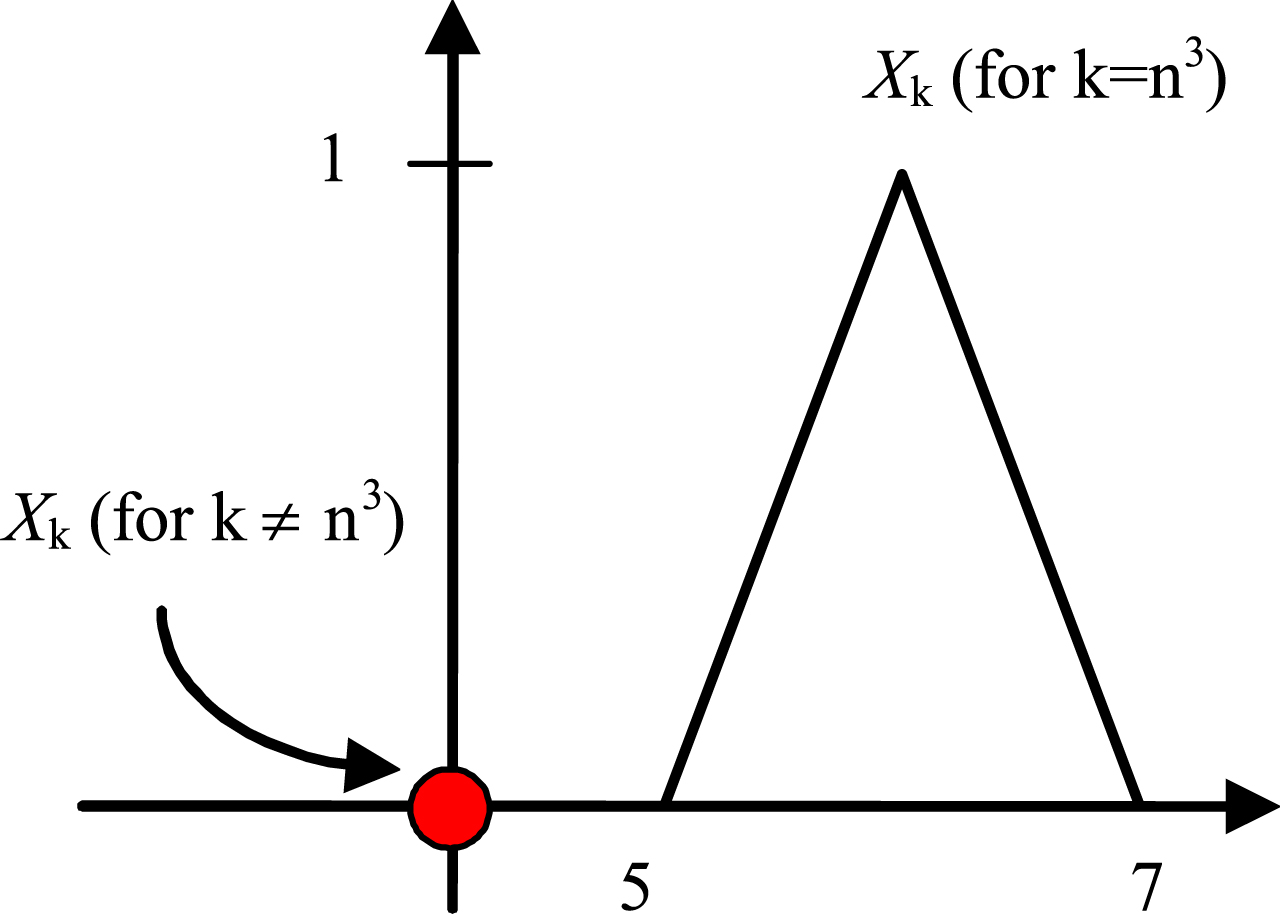
Proof. The first part of proof is easy. To show the strictness of the inclusion let us define a sequence of fuzzy numbes X = (Xk) by
then we can easily calculate α-level set of X such as
So we have
and so X = (Xk) is deferred statistically convergent of order β with for but it is not statistically convergent (See Fig. 1).
(Xk) is deferred statistically convergent of order β, but not statistically convergent.
The deferred statistical convergence of order β is well defined for 0 < β ≤ 1, but it is not well defined for β > 1 in general. For this X = (Xk) be defined as follows:
then we calculate α-level set as:
Then both
and
for β > 1 and q (n) = 4n, p (n) = 3n. So we have and but this is impossible.
Definition 2. Let {p (n)} and {q (n)} be two sequences as above, β and r be two positive real numbers. A sequence X = (Xk) is said to be strongly r-deferred Cesáro summable of order β if
By we denote the set of all strongly r-deferred Cesáro summable sequences of order β. If q (n) = n, p (n) = 0, then strong r-deferred Cesáro summability of order β coincides strong r-Cesáro summability of order β of sequences of fuzzy numbers which was introduced by Altinok et al. [4], and also in the special cases q (n) = n, p (n) = 0 and β = 1 strong r-deferred Cesáro summability of order β coincides strong r-Cesáro summability of order β of sequences of fuzzy numbers.
The set contains some strongly r-deferred Cesáro summable sequences of order β for β ∈ (0, 1]. For this, consider the sequence X = (Xk) of fuzzy numbers as follows:
Then, the α-level set of sequence (Xk) is
Then, it is easy to see that
for r = 1 and q (n) = n, p (n) = 0. So X = (Xk) is strongly r-deferred Cesáro summable of order β, to fuzzy number X0 for where [X0] α = [α, 2 - α].
The following result can be established using standard techniques, so we state the result without proof.
Theorem 2. Let X = (Xk), Y = (Yk) be sequences of fuzzy numbers.
Let 0 < β ≤ 1, then
(i) If and then
(ii) If and then ,
Let β and r be two positive real numbers, then
(iii) If and then
(iv) If and then
Theorem 3. Let β, γ ∈ (0, 1] such that β < γ. If a sequence X = (Xk) is deferred statistically convergent of order β, then it is deferred statistically convergent of order γ, i.e. and the inclusion is strict.
Proof. The first part of proof is easy.
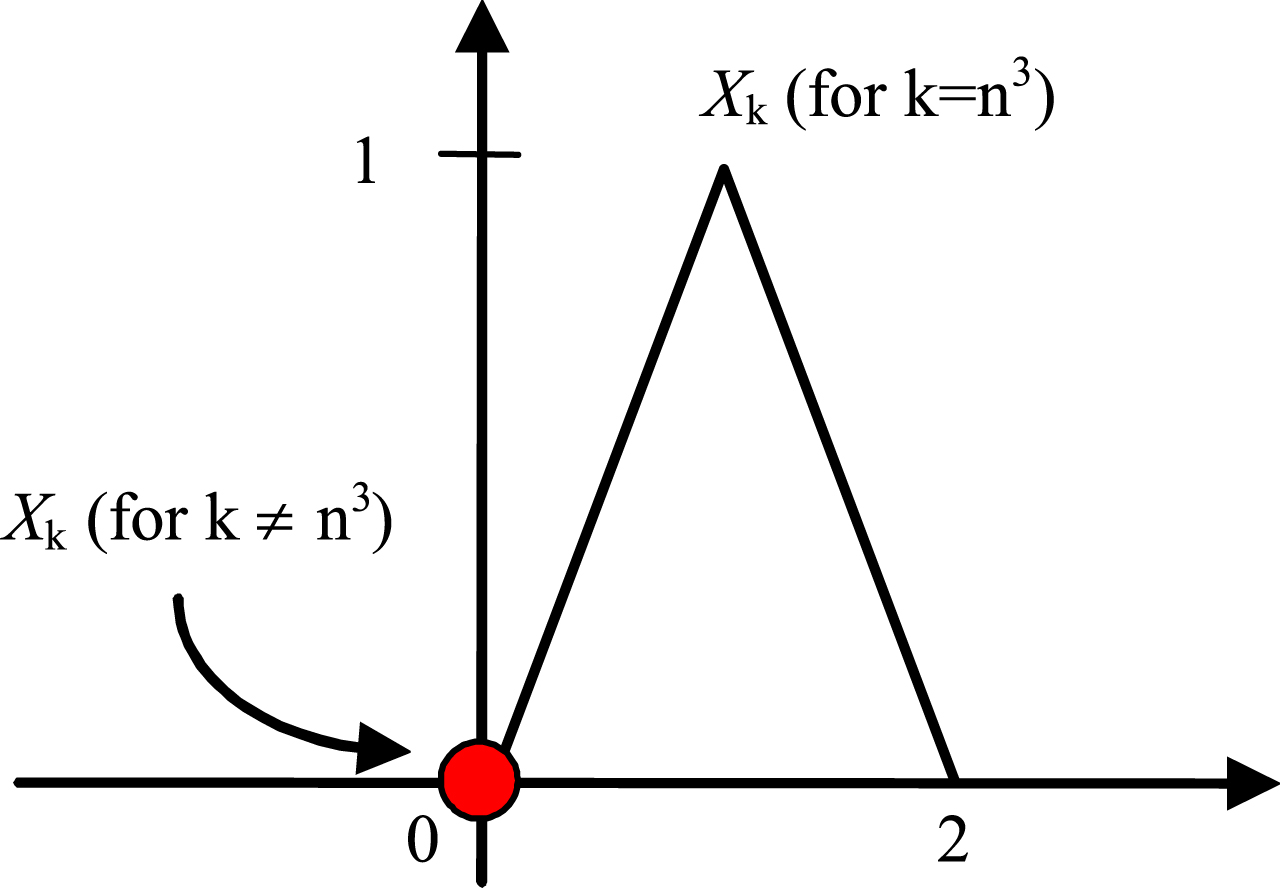
Now, we show that the inclusion is strict. For this, consider a sequence X = (Xk) of fuzzy numbers as follows:
Then, the α-level set of sequence (Xk) is
It can be easily seen that X = (Xk) is deferred statistically convergent of order γ for but not deferred statistically convergent of order β for and q (n) = 3n - 1, p (n) = 2n - 1. (See Fig. 2)
(Xk) is deferred statistically convergent of order γ, but not deferred statistically convergent of order β.
Now as a result of Theorem 3 we have the following.
Corollary 1. The inclusion is strict for β ∈ (0, 1].
Theorem 4. Let 0 < β ≤ γ ≤ 1 and r be a positive real number. If X = (Xk) is strongly r-deferred Cesáro summable of order β to X0, then it is strongly r-deferred Cesáro summable of order γ to X0, i.e. and the inclusion is strict.
Proof. The first part of proof is easy.
To show the inclusion is strict consider a sequence X = (Xk) of fuzzy numbers as follows:
Then, the α-level set of sequence (Xk) is
Then we have
for and so we have , but since
for .
Theorem 4 yields the following corollary.
Corollary 2. The inclusion is strict for β ∈ (0, 1].
Theorem 5. Let 0 < β ≤ γ ≤ 1 and r be a positive real number. If X = (Xk) is strongly r-Cesáro summable of order β, then it is statistically convergent of order γ, i.e.
Proof.Omitted.
Even if X = (Xk) is a bounded sequence of fuzzy numbers, the converse of Theorem 5 doesn’t hold, in general. To show this we must find a sequence of fuzzy numbers that bounded and deferred statistically convergent of order β, but need not to be strongly r-deferred Cesáro summable of order γ. To show this let p (n) =0 and q (n) = n for all and X = (Xk) be defined as follows:
Then, the α-level set of sequence (Xk) is
It can be shown that X bounded and deferred statistically convergent of order β for First of all, recall that the inequality is satisfied for n ≥ 2. Define Hn ={ p (n) < k ≤ q (n): k ≠ m3, m = 1, 2, 3,… } and take r = 1. Since
we have
for So for and therefore for (See Fig. 3)
(Xk) is statistically convergent of order γ, but not strongly r-Cesàro summable of order β.
The following result is easily derivable from Theorem 5.
Corollary 3. The inclusion holds for β ∈ (0, 1]
Theorem 6. Let {p (n)}, { q (n) } be given as above, β and γ be two real numbers such that 0 < β ≤ γ ≤ 1 and suppose that If a sequence of fuzzy numbers is deferred statistically convergent of order β then it is deferred statistically convergent of order γ.
Proof.Let X = (Xk) be statistically convergent of order β and For a given ɛ > 0, we have
and so
Taking limit as n→ ∞ and using the fact that we get X = (Xk) is deferred statistically convergent of order γ.
Theorem 6 yields the following corollary.
Corollary 4. Let {p (n)}, { q (n) } be given as above, β be a real number such that 0 < β ≤ 1 and suppose that If a sequence of fuzzy numbers is deferred statistically convergent of order β then it is deferred statistically convergent.
Theorem 7. Let {p (n)}, { q (n) } be given as above, β and γ be two real numbers such that 0 < β ≤ γ ≤ 1 and suppose that the sequence is bounded. If a sequence of fuzzy numbers is strong r-Cesáro convergent of order β then it is strong r-deferred Cesáro convergent of order γ.
Proof.Since the sequence is bounded there exists a number K such that Let us assume that the sequence X = (Xk) of fuzzy numbers strong r-Cesáro convergent of order β, then we have
This yields the proof.
The following result is easily derivable from Theorem 7.
Corollary 5. Under the conditions of Theorem 7 if a sequence of fuzzy numbers is strong r-Cesáro convergent of order β then it is strong r-deferred Cesáro convergent.
In the following theorem, by changing the conditions on the sequences {p (n)} and {q (n)} we give the same relation with Theorem 7.
Theorem 8. Let {p (n)}, { q (n) } be given as above, β and γ be two real numbers such that 0 < β ≤ γ ≤ 1 and suppose tha the sequence is bounded, If a sequence of fuzzy numbers is strong r-Cesáro convergent of order β then it is strong r-deferred Cesáro convergent of order γ.
Proof.Proof follows from the following inequality and Theorem 7
Conclusion
The sequences of fuzzy numbers were introduced and studied by Matloka [30] and Altinok et al. [4] introduced the concepts of statistical convergence of order β and strong p-Cesáro summability of order β for sequences of fuzzy numbers. Now in this paper we study the concepts of deferred statistical convergence of order β and strong r-Cesáro summability of order β for sequences of fuzzy numbers, where β is any real number such that 0 < β ≤ 1. To do this we introduce some of fairly wide classes of sequences of fuzzy numbers using two sequences of non-negative integers {p (n)} and {q (n)} satisfying
Statistical convergence has many applications in mathematics such as: rough convergence and rough continuity. The theory of soft rough sets and soft rough hemirings studied by Zhan et al. [39–42] and Ma et al. [29]. Future time, rough statistical convergence of order α can be studied. This is an open problem to work for researchers.
Footnotes
Acknowledgements
The authors would like to thank the Management Union of the Scientific Research Projects of Firat University for its financial support under a grant with number FF.17.04. Also the authors wish to thank the referees for their careful reading of the manuscript and valuable suggestions.
References
1.
AgnewR.P., On deferred Cesáro means, Ann of Math (2)33(3) (1932), 413–421.
2.
AltınY., M.Et
and R.Çolak, Lacunary statistical and lacunary strongly convergence of generalized difference sequences of fuzzy numbers, Comput Math Appl52(6-7) (2006), 1011–1020.
3.
AltinokH., Statistical convergence of order β for generalized difference sequences of fuzzy numbers, J Intell Fuzzy Systems26 (2014), 847–856.
4.
AltinokH., AltınY., and M.Işık, Statistical convergence and strong p-Cesáro summability of order β in sequences of fuzzy numbers, Iran J Fuzzy Syst9(2) (2012), 63–73, 169.
5.
AltinokH., On λ-statistical convergence of order βof sequences of fuzzy numbers, Internat J Uncertain Fuzziness Knowledge-Based Systems20(2) (2012), 303–314.
6.
AltinokH. and MursaleenM., Δ-statistical boundedness for sequences of fuzzy numbers, Taiwanese J Math15(5) (2011), 2081–2093.
7.
AltinokH. and KasapM., f-Statistical Convergence of order β for Sequences of Fuzzy Numbers, J Intell Fuzzy Systems33 (2017), 705–712.
8.
CınarM., M.Karakaş
and M.Et, On pointwise and uniform statistical convergence of order β for sequences of functions, Fixed Point Theory Appl 201333 (2013), 11 pp.
9.
ÇolakR.Statistical convergence of order α, Modern Methods in Analysis and Its Applications, New Delhi, India: Anamaya Pub, 2010, pp. 121–129.
10.
ConnorJ.S., The statistical and strong p-Cesáro convergence of sequences, Analysis8 (1988), 47–63.
11.
DiamondP. and KloedenP., Metric spaces of fuzzy sets, Fuzzy Sets and Systems35(2) (1990), 241–249.
12.
QiuD., LuC., ZhangW. and LanY., Algebraic properties and topological properties of the quotient space of fuzzy numbers based on Mares equivalence relation, Fuzzy Sets and Systems245 (2014), 63–82.
13.
QiuD. and ZhangW., Symmetric fuzzy numbers and additive equivalence of fuzzy numbers, Soft Computing17 (2013), 1471–1477.
14.
QiuD., ZhangW. and LuC., On fuzzy differential equations in the quotient space of fuzzy numbers, Fuzzy Sets and Systems295 (2016), 72–98.
15.
EtM., AltınokH. and Y.Altın,
On some generalized sequence spaces, Appl Math Comput154(1) (2004), 167–173.
16.
EtM., AlotaibiA. and MohiuddineS.A., On (Δm, I)-statistical convergence of order α, The Scientific World Journal (2014), 535419. 10.1155/2014/535419.
17.
EtM., MursaleenM. and IsıkM., On a class of fuzzy sets defined by Orlicz functions, Filomat27(5) (2013), 789–796.
18.
EtM., CınarM.
and M.Karakaş, On λ-statistical convergence of order α of sequences of function, J Inequal Appl2013 (2013), 204, 8 pp.
19.
FastH., Sur la convergence statistique, Colloq Math2 (1951), 241–244.
20.
FridyJ., On statistical convergence, Analysis5 (1985), 301–313.
21.
GadjievA.D. and OrhanC., Some approximation theorems via statistical convergence, Rocky Mountain J Math32(1) (2002), 129–138.
22.
IsıkM.
and K.E.Akbaş, On asymptotically lacunary statistical equivalent sequences of order α in probability, ITM Web of Conferences 1301024 (2017) 10.1051/itmconf/20171301024.
23.
IsıkM.
and M.Et, Almost λr-statistical and strongly almost λr-convergence of order β of sequences of fuzzy numbers, J Funct Spaces, Art. ID 451050, 6 pp.
24.
IsıkM.
and K.E.Akbaş, On λ-statistical convergence of order α in probability, J Inequal Spec Funct8(4) (2017), 57–64.
25.
IsıkM.
and K.E.Et, On lacunary statistical convergence of order α in probability, AIP Conference Proceedings1676(020045) (2015). 10.1063/1.4930471.
26.
KelavaO. and SeikkalaS., On fuzzy metric spaces, Fuzzy Sets and Systems12(3) (1984), 215–229.
27.
KücükaslanM.
and M.Yılmaztürk, On deferred statistical convergence of sequences, Kyungpook Math J56 (2016), 357–366.
28.
LakshmikanthamV., MohapatraR.N.Theory of Fuzzy Differential Equations and Inclusions, Taylor and Francis, New York, 2003.
29.
MaX., ZhanJ., AliM.I. and MehmoodN., A survey of decision making methods based on two classes of hybrid soft set models, Artificial Intelligence Review49(4) (2018), 511–529.
30.
MatlokaM., Sequences of fuzzy numbers, BUSEFAL28 (1986), 28–37.
31.
MursaleenM., λ-statistical convergence, Math Slovaca50(1) (2000), 111–115.
32.
NurayF., Lacunary statistical convergence of sequences of fuzzy numbers, (Fuzzy Sets and Systems)99(3) (1998), 353–356.
33.
SalatT., On statistically convergent sequences of real numbers, Math Slovaca30 (1980), 139–150.
34.
SchoenbergI.J., The integrability of certain functions and related summability methods, Amer Math Monthly66 (1959), 361–375.
35.
SengülH.
and M.Et, On lacunary statistical convergence of order α, Acta Math Sci Ser B Engl Ed34(2) (2014), 473–482.
36.
SteinhausH., Sur la convergence ordinaire et la convergence asymptotique, Colloquium Mathematicum2 (1951), 73–74.
37.
YılmaztürkM.
and M.Küçükaslan, On strongly deferred Cesáro summability and deferred statistical convergence of the sequences, Bitlis Eren Univ J Sci and Technol3 (2011), 22–25.
38.
ZadehL.A., Fuzzy sets, Information and Control8 (1965), 338–353.
39.
ZhangL. and ZhanJ., Fuzzy soft β-covering based fuzzy rough sets and corresponding decision-making applications, Int J Mach Learn Cybern (2018) 10.1007/s13042-018-0828-3.
40.
ZhanJ. and WangQ., Certain types of soft coverings based rough sets with applications, Int J Mach Learn Cybern (2018). 10.1007/s13042-018-0785-x.
41.
ZhanJ. and AlcantudJ.C.R., A novel type of soft rough covering and its application to multicriteria group decision making, Artificial Intelligence Review (2018). 10.1007/s10462-018-9617-3.
42.
ZhanJ. and AlcantudJ.C.R., A survey of parameter reduction of soft sets and corresponding algorithms, Artificial Intelligence Review (2018). 10.1007/s10462-017-9592-0.
43.
ZygmundA., Trigonometric Series, Cambridge University Press, Cambridge, UK, 1979.