The purpose of this article is to study deferred Cesrào statistical convergence of order (ξ, ω) associated with a modulus function involving the concept of difference sequences of fuzzy numbers. The study reveals that the statistical convergence of these newly formed sequence spaces behave well for ξ ≤ ω and convergence is not possible for ξ > ω. We also define p-deferred Cesàro summability and establish several interesting results. In addition, we provide some examples which explain the validity of the theoretical results and the effectiveness of constructed sequence spaces. Finally, with the help of MATLAB software, we examine that if the sequence of fuzzy numbers is bounded and deferred Cesàro statistical convergent of order (ξ, ω) in (Δ, F, f), then it need not be strongly p-deferred Cesàro summable of order (ξ, ω) in general for 0 < ξ ≤ ω ≤ 1.
The perception of statistical convergence was introduced by Fast [18] which was further studied by Schoenberg [32]. Later on, the idea of statistical convergence was investigated from the sequence spaces point of view and linked with summability theory by many mathematicians such as Salat [34], Fridy [19], Connor [11], Hazarika et al. [21] and Edely et al. [13]. The order of statistical convergence for a sequence of numbers was introduced by Gadjiev and Orhan [20]. The statistical convergence of order β was studied by Altinok [3]. Recently, Altinok and M. Et [4] generalized the results of [3] by introducing statistical convergence of order (β, γ) for sequences of fuzzy numbers. The statistical convergence and Cesàro summability in sequences of fuzzy numbers are very important topics in fuzzy mathematics. In recent years, there has been an increasing interest in focusing on summability methods of sequences of fuzzy numbers. İ. Çanak et al. [8] have established some Tauberian theorems for statistical Cesàro summability methods of sequences of fuzzy numbers. Statistical σ-convergence of double sequences was given by Mursaleen et al. [26]. The notion of statistical convergence is an effective tool to resolve many problems in Ergodic theory, Fuzzy set theory, Trigonometric series, Fourier analysis and number theory. Statistical convergence is also found in random graph theory (see [36]) in the sense that almost convergence, which is same as the statistical convergence, which means convergence with a probability of 1, whereas in usual statistical convergence the probability is not necessarily 1. The generalization of statistical convergence developed the study of strong integral summability and the structure of bounded continuous functions on locally compact spaces. For a detailed study on statistical convergence (see [33] and [35]).
The concept of fuzzy set theory was introduced by Zadeh [39]. Matloka [28] extended the study of Zadeh by introducing the notion of fuzzy sequences. The idea of fuzzy set corresponding to unexplained physical situations gives useful applications on many topics such as statistics, data processing and linguistics. Recently, the notion of fuzzy sequences through difference operator together with weighted mean has been defined by Mohiuddine et al. [27]. Later on, several authors have discussed various aspects of fuzzy set theory and its applications such as topological spaces, similarity relations, fuzzy ordering, fuzzy measures of fuzzy events and fuzzy mathematical programming. In [25] F. Maturo and Š. Hoškovà-Mayerovà used alternative operations to solve some problems of addition and multiplication between fuzzy numbers in fuzzy regression models. Sequences of fuzzy numbers have been studied by Altinok [7] and İ. Çanak et al. [9]. By using fuzzy numbers, Tauberian theorem for double sequences was presented by Z. Önder et al. in [30].
A fuzzy set is a mapping Z: which satisfies the following criteria:
(i) Z is normal, i.e. there exists an such that Z (u) =1,
(ii) Z is fuzzy convex, i.e. Z [λm + (1 - λ) n] ≥ min {Z (m), Z (n)} for all and for all λ ∈ [0, 1],
(iii) Z is upper semi-continuous, i.e. for every ɛ > 0, Z-1 ([0, a + ɛ)) is open in usual topology of , where a ∈ [0, 1],
(iv) suppZ = is compact.
For a fuzzy number Z, the α-level set is given as
It is clear that Z is a fuzzy number if and only if [Z] α is a closed interval for each α ∈ (0, 1] and [Z] 1 ≠ φ. Throughout the paper, denotes the space of all fuzzy numbers.
For any two fuzzy numbers Z1 and Z2, the distance between Z1 and Z2 can be evaluated as:
The Hausdorff metric is represented by dM and is defined as
where and are the upper and lower bounds of α-level cut.
The concept of difference sequence spaces was introduced by Kizmaz [23] and then it was further generalized by Altinok et al. [6], Et [15], Et and Colak [17]. This concept of Δ was also used by Hüseyin et al. in [10] to define Δ-quasi-slowly oscillating continuity. It is known that there are many applications of sequences and difference sequences of fuzzy numbers. For instance, sequences of numbers have practical applications in areas of science and engineering. Let Ω (F) be set of all sequence spaces, then the operator Δ : Ω (F) → Ω (F) is given by:
Let Z = (Zr) be a sequence of fuzzy numbers, then it is called Δ-convergent to fuzzy number Z0 if there exists a positive integer r0 such that d (ΔZr, Z0) < ɛ, for every ɛ > 0, r > r0. A sequence Z = (Zr) is Δ-bounded if the set of fuzzy numbers is bounded.
Suppose Z = (Zr) be a sequence of fuzzy numbers. Then (Zr) is said to be statistical convergent to fuzzy number Z0 if for each ɛ > 0
where the vertical bars represent the cardinality of the enclosed set. In this case, we write S (F) - lim Zr = Z0. For more details of fuzzy sequence spaces one may refer ([22, 38]).
As defined by Agnew [1], let (an) and (bn) be sequences of non-negative integers. Then the deferred Cesàro mean of sequences of real numbers is given by
where the sequences (an), (bn) satisfies an < bn and
In [24] Küçükaslan and Yılmaztürk defined deferred density and deferred statistical convergence for sequences of real numbers. Let Kd (n) be the representation of the set {r : an < r ≤ bn, r ∈ K}, where K is subset of Then the deferred density of K is defined by
provided that the limit exists. Consider a mapping f : [0, ∞) → [0, ∞), then f is said to be modulus function if
(i) f (z) =0 iff z = 0,
(ii) f (z + y) ≤ f (z) + f (y) for z, y ≥ 0,
(iii)f is increasing,
(iv) f is right continuous at 0.
From above definition it is clear that f is continuous everywhere on (0, ∞]. For more details (see [5, 37]).
H. Altinok studied Δm-statistical convergence of order β for sequences of fuzzy numbers in [3]. Later on, in [4], Altinok introduced statistical convergence of order (β, γ) and strong p-Cesaro summability of order (β, γ) for sequences of fuzzy numbers.
Essentially motivated by the aforementioned investigations and outcomes defined above, our aim is to manifest some new results related to (Δ, F, f)-deferred Cesàro statistically convergence and strongly p-deferred Cesàro summability of order (ξ, ω). We extend the study of Altinok [4] by using (Δ, F, f)-deferred Cesàro statistical convergence with the help of parameters ξ and ω. Further, some of the results are also presented graphically with the help of MATLAB software. It is well known that boundedness and statistical convergence of a sequence of fuzzy numbers leads to strongly p-Cesàro summable but we have demonstrated that this is not valid in our case when ξ and ω are used.
Main results
Definition 2.1. A sequence Z = (Zr) of fuzzy numbers is said to be (Δ, F, f)-convergent if for ɛ > 0, there exists a positive integer r0 such that
for r > r0 and it is called (Δ, F, f)-bounded if the set of fuzzy numbers is bounded.
Definition 2.2. Let Z = (Zr) be a sequence of fuzzy numbers, then it is said to be (Δ, F, f)-deferred Cesàro statistical convergent of order (ξ, ω) for 0 < ξ ≤ ω ≤ 1 (or convergent) to a fuzzy number Z0 if for every ɛ > 0,
where f is any modulus function. If is convergent to Z0, then it can be written as
Definition 2.3. Let 0 < ξ ≤ ω ≤ 1, 0< p < ∞ and Z = (Zr) be sequence of fuzzy numbers. A sequence Z = (Zr) is said to be strongly (Δ, F, f, p)-deferred Cesàro summable of order (ξ, ω) if there exists a fuzzy real number Z0 such that
or we can write it as summable to Z0.
Theorem 2.4.Every (Δ, F, f)-convergent sequence is convergent for 0 < ξ ≤ ω ≤ 1. But the converse is not true as shown in the following example.
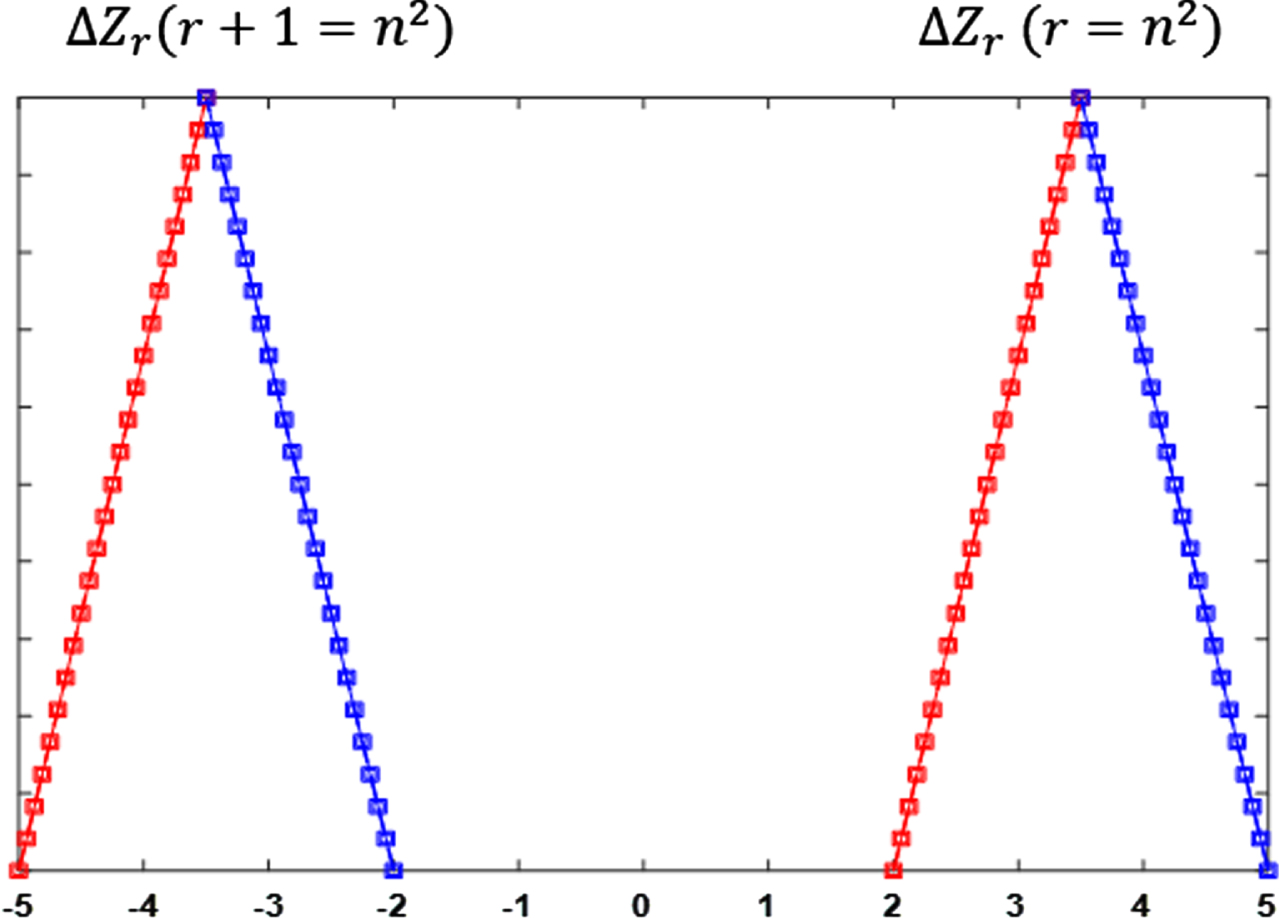
Example 2.5. Define the sequence of fuzzy numbers as follows
If r ≠ n2,
and if r = n2
for n = 1, 2, 3, ⋯. Take modulus function f (z) = z. Then, we can find α-level set of sequence (Zr) and (ΔZr) as follows
and
Thus, we have
Then, Z = (Zr) is (Δ, F, f)-deferred Cesàro statistical convergent of order (ξ, ω) for , but it is not convergent.
Z = (Zr) is (Δ, F, f)-statistical convergent of order (ξ, ω), but not convergent.
Remark 2.6.Sd (Δ, F, f)-convergent of order (ξ, ω) is well defined for ξ ≤ ω, but it is not well defined for ω < ξ. To show this, consider the sequence
if r is odd and
if r is even.
Now, the α-level set of (Zr) and (ΔZr) are given as
and
Then, we can write
and
for ξ > ω, bn = 7n, an = 6n and ∀ ɛ > 0 using the property Here, and Therefore, the sequence Z = (Zr) of fuzzy numbers is convergent to both Z′ and Z″ of order (ξ, ω), which is not possible.
Theorem 2.7.Let f be an unbounded modulus function and 0 < ξ ≤ ω ≤ 1.
(i) If and then
(ii) If and then
Proof. The Proof (i) follows from the inequality,
Proof of (ii) follows from inequality
Remark 2.8. Let f be unbounded modulus function and 0 < ξ ≤ ω ≤ 1, we have This means that if then but converse is not true.
For converse we give the example as shown below.
Example 2.9. Define the sequence of fuzzy numbers as follows
If r = n6
and if r ≠ n6
Now, the α-level set of (Zr) and (ΔZr) are given as
and
After some routine verification, , where [Z0] α = [3α - 3, - 3α + 3] for and , but not deferred Cesàro statistically convergent for
Another example for Remark 2.8 is given below.
Define the sequence of fuzzy numbers as follows
If r = n2
and if r ≠ n2
Now, the α-level set of (Zr) and (ΔZr) are given as
and
Then it can easily seen that , where [Z0] α = [2α - 2, - 2α + 2] for and , but not deferred Cesàro statistically convergent for
Theorem 2.10.If , then for 0 < ξ1 ≤ ξ2 ≤ ω1 ≤ ω2 ≤ 1, but converse need not true.
Proof. Suppose Let ω1 ≤ ω2 and ξ1 ≤ ξ2, then
for every ɛ > 0, so To show inclusion is strict consider a sequence Z = (Zr) as follows
for r = n7
and for r ≠ n7
Then,
and
For r > 1, bn = 2n, an = n and by taking f (z) = zs where s ∈ (0, 1]. We have for and but for and .
Corollary 2.11.Let 0 < ξ1 ≤ ξ2 ≤ ω1 ≤ ω2 ≤ 1.
(i) If ξ1 = ξ2 and ω1 = ω2, then (ii) If ξ1 = ξ2 and ω1 = ω2 = 1, then
(iii) If ξ2 = 1 and ω1 = ω2 = 1, then
(iv) If ω2 = 1 then
Theorem 2.12.For 0 < ξ1 ≤ ξ2 ≤ ω1 ≤ ω2 ≤ 1. If then but converse is not true.
Proof. Suppose that for 0 < ξ1 ≤ ξ2 ≤ ω1 ≤ ω2 ≤ 1 and 0 < p < ∞. Then
But converse is not true as given below.
If r ≠ n4, then
and if r = n4, then
Now, the α-level set of (Zr) and (ΔZr) are given as
and
Then, we can write
and so for , p = 1, f (z) = z and , but since
and . So, (Zr) is not strongly p-deferred Cesàro summable of order (ξ1, ω2) for and
Corollary 2.13.Suppose 0 < ξ1 ≤ ξ2 ≤ ω1 ≤ ω2 ≤ 1, 0< p < ∞ and f be any unbounded modulus function. Then following results hold.
(i) If ξ1 = ξ2 and ω1 = ω2, then
(ii) if ξ1 = ξ2 and ω1 = ω2 = 1, then
(iii) if for each 0 < ξ1 ≤ 1,
(iv) if for each 0 < ω1 ≤ 1.
Theorem 2.14.Consider 0 < ξ1 ≤ ξ2 ≤ ω1 ≤ ω2 ≤ 1, 0< p < ∞ and f be any unbounded modulus function. If then and inclusion is strict.
Proof. Suppose and for given ɛ > 0. So,
≥ ɛpω1f (| {an < r ≤ bn : d (ΔZr, Z0) ≥ ɛ} |ω1)
and
To show strictness of relation, consider the sequence Z = (Zr) as defined in the Theorem 2.9. By taking f (z) = z, bn = 3n - 1 and an = 2n - 1 we have
when and but
when and Therefore, Z = (Zr) is not strongly p-deferred Cesàro summable of order (ξ1, ω2).
Remark 2.15. It is well known that if the sequence Z = (Zr) of fuzzy numbers is (Δ, F, f)-bounded and (Δ, F, f)-statistical convergent, then the sequence is strongly -summable. But this is not possible for our case. Let us prove this by an example.
Example 2.16. Let f be modulus function such that f (z) = z, bn = 5n, an = 4n.
For r ≠ n3, we have
and for r = n3, the fuzzy sequence is defined as
Then for n = 1, 2, 3, ⋯, we find the respective α-level set of sequences (Zr) and (ΔZr) as
and
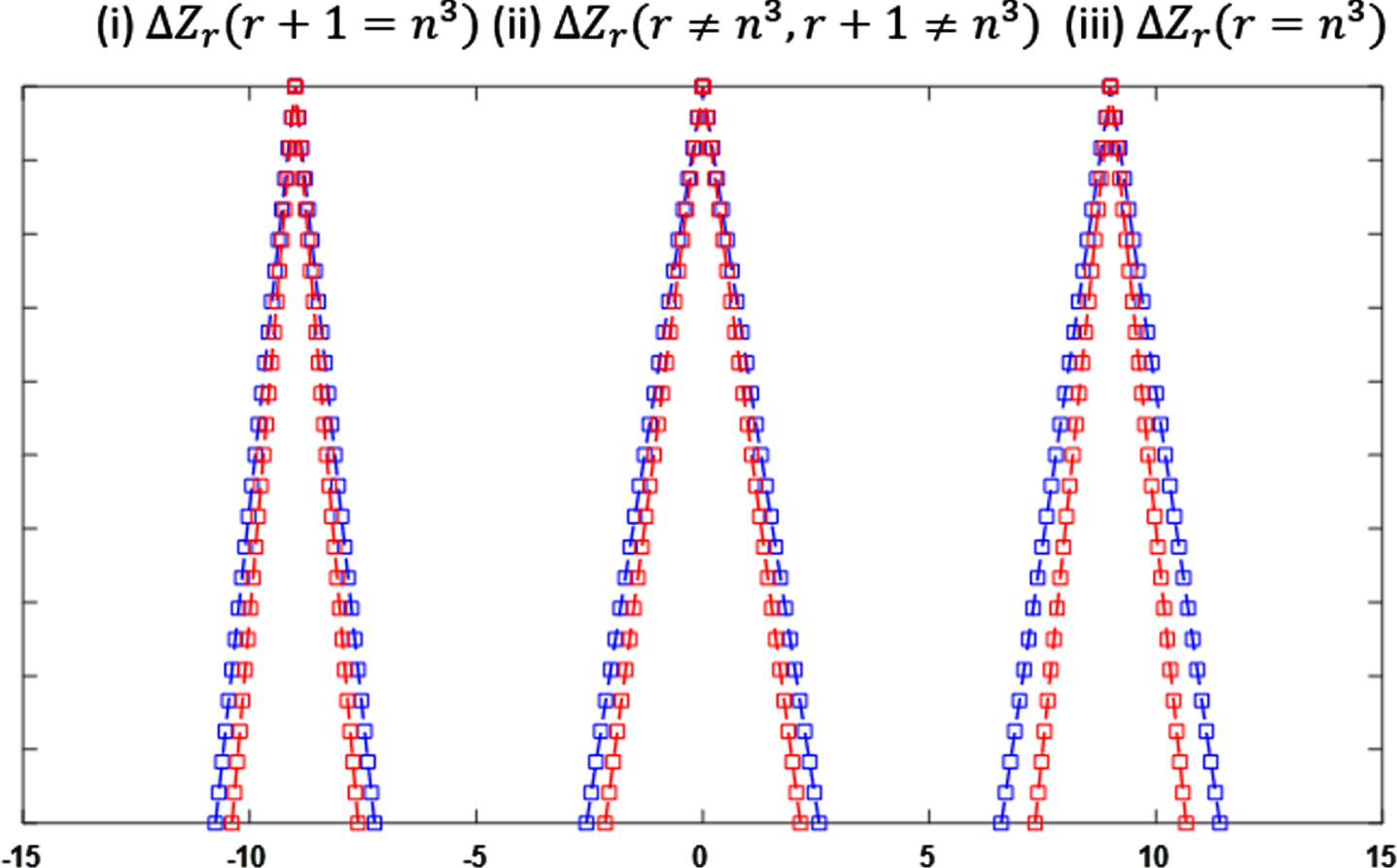
Here, we see that (Zr) is (Δ, F, f)-bounded and statistical convergent to Z0 = [0, 0] for , But (Zr) is not strongly p-deferred Cesàro summable defined by modulus function. To show this, let and
The blue lines in the graph (i), (ii), (iii) represents for particular values of r, i.e. for r = 7, 2, 1, respectively whereas the red lines in the graph (i), (ii), (iii) shows when the value of r + 1 = n3 i.e. when r = 26, 63, ⋯, when neither s ≠ n3 nor s + 1 = n3 i.e. for 3, 4, ⋯, and when s = n3 i.e. for 8, 27, ⋯, respectively.
Now, we have
Thus, for p = 1 and f (z) = z, (Zr) is not strongly -summable for ,
Conclusion
Over years, many authors have widely focused on statistically convergence of sequence of fuzzy numbers. Statistical convergence has many applications in different fields of mathematics such as in rough convergence, rough continuity and rough statistical convergence. Since the fuzzy approximation theory is the theoretical approach to solve numerical approximation in the field of mathematical analysis. Also approximation theory is applied in computer simulation. In [2] Anastassiou and Duman explore the application of statistical convergence of fuzzy numbers through approximation theory. As our work is concerned with statistical convergence of fuzzy numbers so we can expect applications of presented work in the field of approximation theory also. Our results are applicable on pointwise and uniform statistical convergence for sequence of functions. The work presented in this paper give a new direction to previous work done by several authors. Regarding the topic of rough statistical convergence, one can obtain the corresponding results of present paper by using Δm-rough statistical convergence of order (ξ, ω).
Compliance with ethical standards
Availability of data and material
Not applicable.
Conflict of interest
The authors declare that they have no conflict of interest.
Ethical approval
This article does not contain any studies with human participants or animals performed by any of the authors.
Footnotes
Acknowledgment
The corresponding author thanks the Council of Scientific and Industrial Research (CSIR), India for partial support under Grant No. 25(0288)/18/EMR-II, dated 24/05/2018.
References
1.
AgnewR.P., On deferred Cesàro means, Annals of Mathathematics33(3) (1932), 413–421.
2.
AnastassiouG.A. and DumanO., Statistical fuzzy approximation by fuzzy positive linear operator, Computers and Mathematics with Applications55(3) (2008), 573–580.
3.
AltinokH., Statistical convergence of order β for generalized difference sequences of fuzzy numbers, Journal of Intelligent & Fuzzy Systems26 (2014), 847–856.
4.
AltinokH. and Et.M., Statistical convergence of order (β, γ) for sequences of fuzzy numbers, Soft Computing23 (2019), 6017–6022.
5.
AltinokH. and DenizD., (Δm ; f)-statistical convergence for sequences of fuzzy numbers, Journal of Intelligent & Fuzzy Systems36 (2019), 3525–3533.
6.
AltinokH., AltinY. and IşıkM., Statistical convergence and strong p—Cesàro summability of order beta in sequences of fuzzy numbers, Iranian Journal of Fuzzy Systems9(2) (2012), 63–73.
7.
AltinokH. and MursaleenM., Δ-statistical boundedness for sequences of fuzzy numbers, Taiwanese Journal of Mathematics15(5) (2011), 2081–2093.
8.
Çanakİ.,
ÖnderZ. and
ToturÜ., Statistical extension of some classical Tauberian theorems for Cesàro summability of triple sequences, Results in Mathematics70(3) (2016), 457–473.
9.
Çanakİ.,
ToturÜ. and
ÖnderZ., A Tauberian theorem for (C, 1, 1) summable double sequences of fuzzy numbers, Iranian Journal of Fuzzy System14(1) (2017), 61–75.
10.
ÇakallıH.,
Çanakİ. and
DikM., Δ—quasi-slowly oscillating continuity, Applied Mathematics and Computation216 (2010), 2865–2868.
11.
ConnorJ.S., The statistical and strong p-Cesàro convergence of sequences, Analysis8 (1988), 47–63.
12.
CakanÜ. and AltinY., Some classes of statistically convergent sequences of fuzzy numbers generated by a modulus function, Iranian Journal of Fuzzy System12(3) (2015), 47–55.
13.
Edely,
OsamaH.H. and
MursaleenM.,
On statistically Cauchy and statistical summability via ideal, Journal of Inequalities and Applications2021(1) (2021), 1–11.
14.
EtM., Strongly almost summable difference sequences of order m defined by a modulus, Studia Scientiarum Mathematicarum Hungarica40(4) (2003), 463–476.
15.
EtM., Spaces of cesàro difference sequences of order r defined by a modulus function in a locally convex space, Taiwanese Journal of Mathematics10(4) (2006), 865–879.
16.
EtM. and ErolY., On deferred statistical convergence of order β of sequences of fuzzy numbers, Journal of Intelligent & Fuzzy Systems35 (2018), 3747–3755.
17.
EtM. and ColakR., On some generalized difference sequence spaces, Soochow Journal of Mathematics21(4) (1995), 377–386.
18.
FastH., Sur la convergence statistique, Colloquium Mathematicae2 (1951), 241–244.
19.
FridyJ.A., On statistical convergence, Analysis5(4) (1985), 301–314.
20.
GadjievA.D. and OrhanC., Some approximation theorems via statistical convergence, Rocky Mountain Journal of Mathematics32(1) (2002), 129–138.
21.
HazarikaB., SubramanianN. and MursaleenM., Korovkintype approximation theorem for Bernstein operator of rough statistical convergence of triple sequences, Advances in Operator Theory5(2) (2020), 324–335.
22.
JasrotiaS., SinghU.P. and RajK., Application of statistacial convergence of order (η, δ + γ) in difference sequence spaces of fuzzy numbers, J Intell Fuzzy Systems40(3) (2021), 1–9.
23.
KizmazH., On certain sequence spaces, Canadian Mathematical Bulletin24 (1981), 169–176.
24.
KüçükaslanM. and YılmaztürkM., On deferred statistical convergence of sequences, Kyungpook Mathematical Journal56(2) (2016), 357–366.
25.
MaturoF.and
Hoškovà-MayerovàŠ., Fuzzy regression models and alternative operations for Economic and Social Sciences, Recent Trends in Social Systems: Quantitative Theories and Quantitative Models66 (2017), 235–247.
26.
MursaleenM., BelenC. and Syed RizviM.H., Statistical σ-convergence of double sequences with applications, Filomat32(8) (2018), 2783–2792.
27.
MohiuddineS.A., AsiriA. and HazarikaB., Weighted statistical convergence through difference operator of sequences of fuzzy numbers with its application to fuzzy approximation theorems, International Journal of General Systems48(5) (2019), 492–506.
28.
MatlokaM., Sequences of fuzzy numbers, BUSEFAL28 (1986), 28–37.
29.
MursaleenM. and MohiuddineS.A., Statistical convergence of double sequences in intuitionistic fuzzy normed spaces, Chaos Solitons and Fractals41(5) (2009), 2414–2421.
30.
ÖnderZ., Çanakİ. and
ToturÜ., Tauberian theorems for statistically (C; 1; 1) summable double sequences of fuzzy numbers, Open Mathematics15(1) (2017), 157–178.
31.
RajK. and PandohS., On some spaces of Cesàro sequences of fuzzy numbers associated with λ-convergence and Orlicz function, Acta Universitatis Sapientiae, Mathematica11 (2019), 156–171.
32.
SchoenbergI.J., The integrability of certain functions and related summability methods, The American Mathematical Monthly66 (1959), 361–775.
33.
SavasE., On statistically convergent double sequences of fuzzy numbers, Information Sciences162 (2004), 183–192.
34.
SalatT., On statistical Convergent sequences of fuzzy real numbers, Mathematica Slovaca45(3) (1980), 269–273.
35.
SrivastavaP.D. and OjhaS., λ-Statistical convergence of fuzzy numbers and fuzzy functions of order θ, Soft Computing18 (2014), 1027–1032.
36.
SrivastavaH.M., JenaB.B. and MisraU.K., Statistically and relatively modular deferred-weighted summability and Korovkintype approximation theorems, Symmetry11 (2019), 448.
37.
SarmaB., On a class of sequences of fuzzy numbers defined by modulus function, International Journal of Science & Technology2(1) (2007), 25–28.
38.
TripathyB.C. and NandaS., Absolute value of fuzzy real numbers and fuzzy sequence spaces, The Journal of Fuzzy Mathematics8 (2000), 883–892.