




Abstract
A novel high accuracy numerical method for a singularly perturbed convection-diffusion problem with two small parameters is presented. At first, the given problem is discretized by using a rational spectral collocation method in barycentric form with sinh transformation. By sinh transform, the original Chebyshev points are mapped into the transformed ones clustered near to the boundary layers of the domain. Them, a nonlinear unconstrained optimization problem is designed to determine the widths of boundary layers in sinh transform. Finally, a dual mutation differential evolution (DMDE) algorithm is proposed to solve the nonlinear unconstrained optimization problem, and a comparison of the DMDE algorithm with other algorithms has been made, which shows that DMDE algorithm can get fast convergence and find better results.
Keywords
Introduction
Singularly perturbed problems arise in various branches of engineering and applied mathematics such as geophysical fluid dynamics, astrophysics, oceanography, meteorology, pollutant and sediment transport, and chemical reactor, etc. These problems described by differential equations contain one or more small positive parameters. Due to the presence of these parameters, the solutions of these problems possess boundary layers which are basically thin regions in the neighborhood of the boundary of the domain. The numerical methods of singularly perturbed problems with a small parameter have attracted much attention over the past decades, see the monographs [1, 2].
In recent years, there has been tremendous interest in developing numerical methods for singularly perturbed convection-diffusion problems with two small parameters, which is given by
Under these assumptions, the problem (1) has a unique solution, which exhibits boundary layers at both ends of the interval [0, 1]. As a consequence, standard finite difference or finite element methods with uniform meshes applied to (1) may yield inaccurate results. One effective technique to obtain accurate numerical results is to use some suitable nonuniform meshes that are very fine where layers appear in the solution. Such nonuniform meshes can be divided into two classes. One is the use of highly non-uniform layer-adapted meshes (called Shishkin mesh and Bakhvalov mesh), see, e.g., [3–7]. Another is the use of adaptive mesh generated by equidistributing a monitor function over the domain of the problem, see, e.g., [8, 9]. It should be pointed out that these methods used to solve (1) only obtain first-order or second order rate of convergence, independent of perturbation parameters. Thus, it is very necessary to design a high accuracy numerical method to solve problem (1).
Compared with finite difference and finite element methods, spectral collocation methods are more suitable to solve singularly perturbed boundary layer problems due to the fact that spectral collocation points are naturally well-adapted to the representation of boundary layers. Take the example of Chebyshev-Gauss-Lobatto points x
k
= cos(kπ/N), we have
The purpose of this paper is to study a new rational spectral collocation method in barycentric form for the above singularly perturbed convection-diffusion problems with two small parameters (1). Obviously, for different parameters ɛ and μ, the solution of problem (1) have two boundary layers near the boundary of the domain. Furthermore, the widths of these boundary layers are different. Therefore, in order to solve the problem (1) by using rational spectral collocation method, we shall define a modified sinh transform as follows:
As far as we know, research community has implemented a variety of evolutionary intelligence algorithms for finding accurate and reliable solution of singularly perturbed problems and two point boundary value problems. For instance, singularly perturbed problems with Robin boundary conditions [16], two-point boundary value problems [17], singularly perturbed convection-diffusion problem with two small parameters [18].
It is well known that DE algorithm is a fast and simple yet powerful population-based stochastic search technique, which is an efficient and effective global optimizer in the continuous search domain. It is a relatively new nonlinear search and optimization method, which is suitable to solve complicate optimization problems. Recently, optimization technique of DE has been used in a number of optimization problems in various fields such as mechanical engineering [19], signal processing [20], pattern recognition [21], parameter estimation problems [22, 23].
In this paper, a dual mutation differential evolution algorithm is proposed to solve the singularly perturbed convection-diffusion problems with two small parameters. Firstly, the given problem will be discretized by using rational spectral collocation method in barycentric form with sinh transform (3). Then, the original problem (1) is posed as an optimization problem, where the goal is to minimize the fitness function about absolute error of the numerical solution, which is solved by using the dual mutation differential evolution. Finally, we can obtain the optimal parameters θ i , i = 1, 2, and the corresponding numerical solution of problem (1).
The barycentric form of rational interpolation
Assume that v (x) is a sufficiently smooth in the interval [-1, 1]. Let p
N
(x) be a rational function in barycentric form which interpolates v (x) at N + 1 distinct points
By simple calculation, the nth order derivatives of p
N
(x) at the point x
i
can be given as
First, by introducing the transformation
Obviously, it follows from Lemma 1 of literature [9] that the problem (1) have two boundary layers at x = 0 and x = 1. Thus, the solution of above Equation (8) also have two boundary layers at y = -1 and y = 1.
As is stated in [12, 13], the rational spectral collocation method based on Chebyshev-Gauss-Lobatto points y
k
= cos(kπ/N) can’t obtain satisfactory numerical results for very small ɛ and μ. Therefore, we utilize the sinh transform given in Equation (3) to obtain the following transformed Chebyshev points
Next, let S
N
(y) be a rational function in barycentric form which interpolates exact solution
Substituting Equation (10) into Equation (8), we get
where
Let
where
By defining K = -4ɛD(2) - 2ωPD(1) + Q, we have
Given two row vectors with length N + 1: e1 = (1, 0, ⋯ , 0) , eN+1 = (0, 0, ⋯ , 1) and replaced the first and last rows of matrix K with e1 and eN+1, respectively, we can obtained the new matrix
Here, for given parameters θ i , i = 1, 2, by using conjugate gradient method to solve the above linear system (14), we can obtain the numerical results of problem (8). Obviously, for different parameters θ i , we can get different numerical solution of problem (8). Therefore, in order to obtain the optimal parameters θ i , we construct a fitness function about parameters θ i as follows:
To give the absolute error formula, we first define two grids
DE is good at exploring the search space and locating the region of global minimum. However, it is slow exploiting of the solution [24]. In order to balance the exploration and the exploitation of DE, we propose a dual mutation differential evolution (DMDE) algorithm, which combines two different mutation operators in one algorithm. Our proposed DMDE algorithm is described as follows:
A. Mutation
For each target vector Xi,g, two kinds of mutation operations are generated. The first mutation is focused on exploration. The mutant vector Vi,g is generated according to
The second mutation is focused on exploration. The mutant vector
B. Crossover
The target vector is mixed with the mutated vector, using the following scheme, to yield the trial vector
C. Selection
If, and only if, the trial vector Ui,g+1 yields a better cost function value than Xi,g, then Xi,g+1 is set to Ui,g+1; otherwise, the old value Xi,g is retained.
According to Storn et al. [26], DE algorithm is very sensitive to the choice of F and CR. The crossover rate plays a very important role on the performance of DMDE algorithm and using it dynamically makes the algorithm more reliable in exploring and exploiting the search space. The general equation for dynamic switch probability CR used here is given by:
Besides, to keep the diversity of the population, a strategy is used here, which is the same as one in the artificial bee colony (ABC) algorithm [28]. In DMDE algorithm, if the fitness value of a individual keeps unchanged for at least limit times, this individual is considered to be abandoned, and a new individual is generated to replace it as follows.
Test example and error evaluation approach
In this section, we consider the following test example to demonstrate the effectiveness of the proposed method
Let U
N
and U2N be the optimal numerical solutions to (24)-(25) calculated on meshes
All algorithms are implemented in Matlab2014a to program a m-file for implementing the algorithms on a PC with a 32-bit windows 8 operating system, a 8GB RAM, and a 3.10 GHz-core (TM) i5-based processor.
The DMDE algorithm is validated by comparing it with five optimization algorithms, namely, flower pollination algorithm(FPA) [25], differential evolution (DE) [26], particle swarm optimization (PSO) [27], artificial bee colony (ABC) [28], covariance matrix adaption evolution strategy (CMA-ES) algorithm [29]. For the sake of fairness, we use a fixed population size for all algorithm: n = 20 individuals; all algorithms are executed in 30 independent runs; the number of iterations in each run for each algorithm equals 100 iterations; the range of parameters θ i are [1, 100]. The details about parameters settings are listed as follows:
DMDE: F = 0.5, γ = 0.5,limit=10;
DE: F = 0.5, CR = 0.8;
FPA: switch probability P = 0.8, γ = 0.5, λ = 1.5;
PSO: learning factors c1 = c2 = 2, inertia factor dropped from 0.9 to 0.4;
ABC: limit=10;
CMA-ES: standard deviation sigma=0.5.
Experimental results and analyses
Numerical results by using different algorithms (N = 8)
Numerical results by using different algorithms (N = 8)
Numerical results by using different algorithms(N = 16).
Numerical results by using different algorithms(N = 32).
Numerical results by using different algorithms(N = 64).
Numerical results by using different algorithms(N = 128).
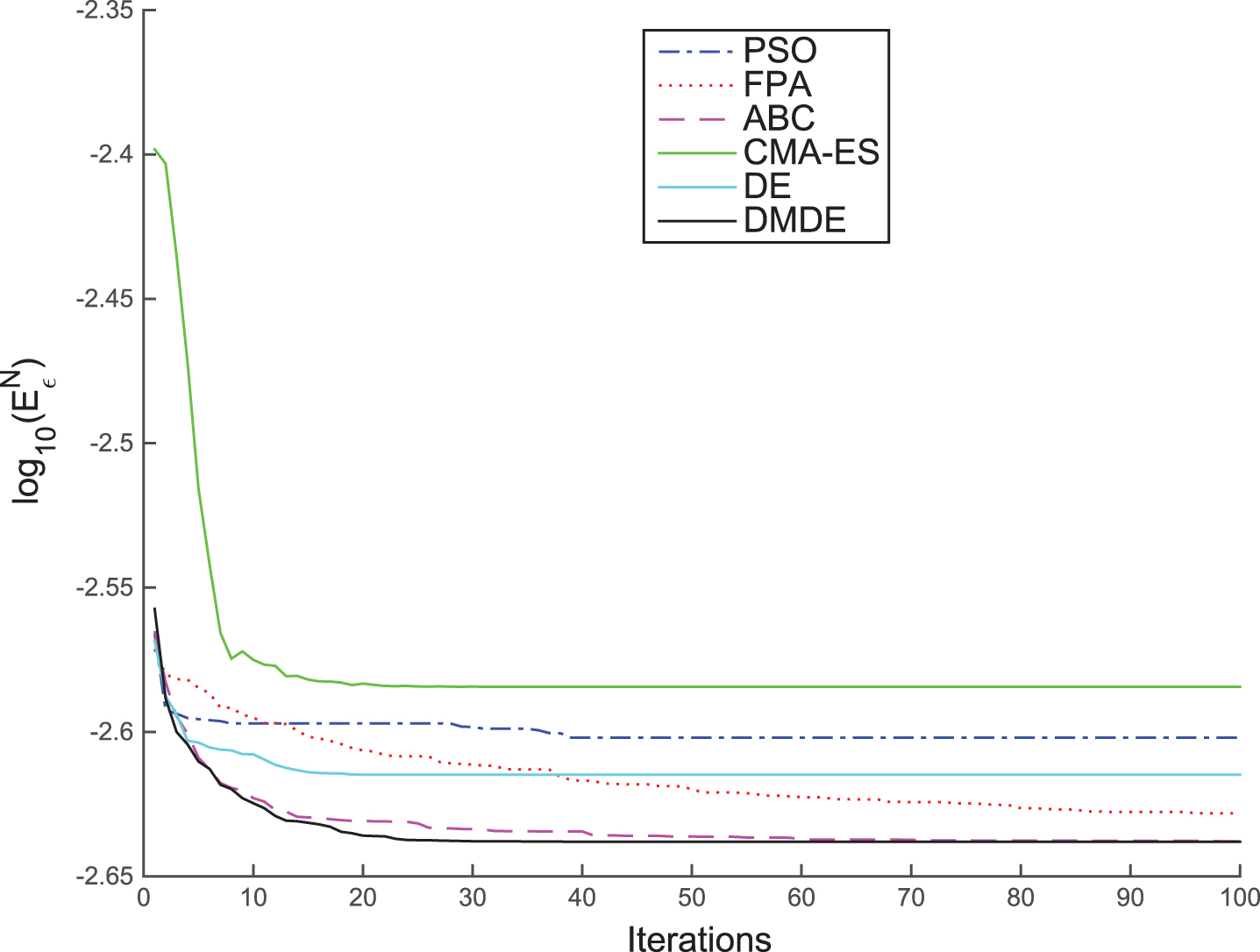
In addition, to test the convergence speed of the presented DMDE algorithm, the convergence profiles are given in Figs. 1 and 2. These Figures show the superior performance of DMDE algorithm as compared to other algorithms.
Convergence profiles of various algorithms with ɛ = 10-10, μ = 10-8 and N = 16. Convergence profiles of various algorithms with ɛ = 10-10, μ = 10-8 and N = 32.
In this paper, a new high accuracy numerical method based on the rational spectral collocation method and a dual mutation differential evolution (DMDE) algorithm have been developed for solving singularly perturbed convection-diffusion problems with two small parameters. The key to the success of this approach is that the DMDE algorithm is presented to determine the widths of boundary layers in the sinh transform of the rational spectral collocation method in barycentric form. For this reason, we first construct a nonlinear unconstrained optimization problem based on minimum absolute error. Then, the DMDE algorithm is proposed to solve the presented optimization problem. The details of the new presented method is easy to implement on a computer. It is noted that the method presented in this paper can be extend to other type of singularly perturbed problems.
Footnotes
Acknowledgments
This work is supported by National Science Foundation of China (11761015), the National Natural Science Foundation Mathematics Tianyuan Foundation of China (11826211, 11826212), the Natural Science Foundation of Guangxi (2017GXNSFBA198183), the key project of Guangxi Natural Science Foundation (2017GXNSFDA198014), the key pro-ject of Anhui natural science research (KJ2016A514), the Natural Science Foundation of Anhui (1708085QA13), and the key Natural Science Projects of Chizhou University (CZ2018ZRZ06).