



Abstract
Attribute reduction is an important issue in knowledge discovery and data mining. Applying rough set theory, information systems based on crisp (or explicit) features can be easily done attribute reductions, but there exists rarely deeper discussion about attribute reduction in fuzzy information systems (i.e. information systems based on vague or undefinable features). A fully fuzzy information system is an information system where each of its attributes determines a fuzzy set on the object set, this paper investigates cc-reduction in this information system. The concept of class-consistent is first introduced. Then, the class-consistent relation cc(P) induced by the given attribute subset P in a fully fuzzy information system is proposed. Next, the class-consistent reduction (for short, cc-reduction) in a fully fuzzy information system is proposed and studied along with its corresponding algorithm. Moreover, considering that homomorphism is a kind of tools to study relationships between two fully fuzzy information systems, invariant characterizations of fully fuzzy information systems under homomorphisms are obtained. Finally, a numerical experiment is employed to illustrate the practical significance and possible applications of cc-reduction in a fully fuzzy information system.
Keywords
Introduction
In 1982, Pawlak [11] proposed rough set theory. This theory is an important tool for the study of intelligent systems described by uncertain and incomplete information. The main idea is to make decision or classification rules through knowledge reduction under the condition of keeping the classification ability unchanged. So far, rough set theory has been applied to machine learning, decision analysis, process control, pattern recognition, inductive reasoning and data mining [12–15].
Information systems based on rough set theory was also introduced by Pawlak. They may reveal large databases and knowledge discovery process mathematically. It is well known that attributes in the same information system are not equally important, even some of them are redundant. Attribute reductions in of a given information system mean deleting irrelevant or unimportant attributes under the condition of keeping the classification ability of this information system. As one of the core contents of rough set theory, attribute reduction has attracted a great deal of attention.
In real life, fuzziness is a universal phenomenon. Thus, various kinds of fuzzy information systems have been studied by many scholars. For example, Zhang et al. [4] studied knowledge reduction with fuzzy decision information systems, Guan et al. [4] gave knowledge reduction methods in fuzzy objective information systems, Huang [5] investigated graded dominance interval-based fuzzy objective information systems, Huang et al. [7] proposed dominance-based rough set model in intuitionistic fuzzy information systems, Sun et al. [17] presented fuzzy rough set theory for interval-valued fuzzy information systems, Huang et al. [6] introduced a dominance relation in an interval-valued intuitionistic fuzzy information system and established a dominance-based rough set model for this fuzzy information system, Cheng et al. [1] considered rule extraction based on granulation order in interval-valued fuzzy information system, Feng et al. [2] studied belief functions on general intuitionistic fuzzy information systems, Lang et al. [9] researched homomorphisms-based attribute reduction of dynamic fuzzy covering information systems, Zhang et al. [20] obtained generalized dominance rough set models for the dominance intuitionistic fuzzy information systems. Zhang et al. [21] considered information structures and uncertainty measures in a fully fuzzy information system.
Fuzzy set was proposed by Zadeh [19] as an extension of classical set to depict fuzziness. A fully fuzzy information system is an information system where each of its attributes determines a fuzzy set on the object set. So far, however, attribute reduction in a fully fuzzy information system has not been reported. This paper will address this topic.
Given a fully fuzzy information system (U, A). For a ∈ A and two objects x, y of U, a (x) and a (y) is the information function values of the objects x and y on the attribute a, respectively. But, a (x) and a (y) are also the membership degrees of x and y to the fuzzy set a, respectively. It should be noted that a (x) and a (y) are two numbers in [0, 1]. Then, “a (x) = a (y) " is actually difficult to be achieved. For this reason, we may consider the concept of “class-consistent" and then propose the class-consistent relation on the object set U. The aim of this paper is to give an attempt to study attribute reduction based on class-consistent relations (for short, cc-reduction) for a fully fuzzy information system. And the work process of the paper is displayed in Fig. 1.

The work process of the paper.
The remaining part of this paper is organized as follows. In Section 2, we recall some concepts about rough sets and fully fuzzy information systems, and propose class-consistent, class-preserving mappings, class-consistent relations and homomorphisms. In Section 3, we introduce cc-reduction in a fully fuzzy information system and give its properties. In Section 4, we put forward an algorithm on cc-reduction in a fully fuzzy information system. In Section 5, we obtain some invariant characterizations of fully fuzzy information systems under homomorphisms. In Section 6, we give a numerical experiment on the Yeast data set. In Section 7, we summarize this paper.
In this section, we briefly recall basic concepts about rough sets and fully fuzzy information systems, introduce class-consistent, class-preserving mappings, class-consistent relations and homomorphisms, and give the related properties.
Throughout this paper, U and V denote two non-empty finite sets, 2 U expresses the family of all subsets of U and |X| means the cardinality of X ∈ 2 U .
Put
Rough sets
Rough set theory was initiated by Pawlak [11, 12] for dealing with vagueness and granularity in information systems.
Given that R is an equivalence relation on U. Then the pair (U, R) is called a Pawlak approximation space. For each subset X of U, one can define the following rough approximations:
The Pawlak boundary region Bnd
R
(X) of X is defined as the difference set
A set is Pawlak rough if its boundary region is not empty; otherwise, it is definable. Thus, X is Pawlak rough if
Let (U, A) be an information system. If A = C ∪ D where C is a set of conditional attributes and D is a set of decision attributes, then (U, A) is called a decision information system.
Let (U, A) be an information system. Given P ⊆ A. Then an equivalence relation (or indiscernibility relation) IND (P) can be defined by
It is noticed that the original study of information systems is based on this equivalence relation (or indiscernibility relation).
An information system about cars
An information system about cars
Pick P = {a3, a4}. It should be noted that
IND ({a3}) = ▵ ∪ {(x1, x2) , (x2, x1) , (x1, x4) , (x4, x1) , (x1, x5) , (x5, x1) , (x1, x6) , (x6, x1) , (x2, x4) , (x4, x2) , (x2, x5) , (x5, x2) , (x2, x6) , (x6, x2) , (x4, x5) , (x5, x4) , (x4, x6) , (x6, x4) , (x5, x6) , (x6, x5)},
IND ({a4}) = ▵ ∪ {(x1, x2) , (x2, x1) , (x1, x3) , (x3, x1) , (x2, x3) , (x3, x2) , (x4, x5) , (x5, x4)}.
Then IND (P) = ▵ ∪ {(x1, x2) , (x2, x1) , (x4, x5) , (x5, x4)}.
Fuzzy sets are extensions of classical sets [19]. A fuzzy set P on U is defined as a function assigning to a value P (x) ∈ [0, 1] for each element x ∈ U and P (x) is called the membership degree of x to the fuzzy set P.
If each attribute determines a fuzzy set on U, then (U, A) is called a fully fuzzy information system.
Here, a attribute is not naturally fuzzy. In fact, it originates from the information function values of objects under the attribute rather than a attribute itself that brings about the fuzzy indiscernibility.
Let (U, C ∪ D) be a decision information system. If each attribute of C is fuzzy, then (U, C ∪ D) is called a fuzzy condition information system; if each attribute of D is fuzzy, then (U, C ∪ D) is called a fuzzy objective information system; if each attribute of C ∪ D is fuzzy, then (U, C ∪ D) is called a fuzzy condition and fuzzy objective information system.
Obviously, a fuzzy condition and fuzzy objective information system is a fully fuzzy information system.
In this paper, we discuss fully fuzzy information systems whether they are decision information systems or non-decision information systems.
Given a fully fuzzy information system (U, A). Then every attribute a ∈ A determines a fuzzy set (which is still denoted by a) in the object set U. For two objects x, y of U, a (x) and a (y) are the information function values of the objects x and y on the attribute a, respectively. But a (x) and a (y) are also the membership degrees of the objects x and y to the fuzzy set a, respectively. It should be noted that a (x) and a (y) are two number in the unit interval [0, 1]. Then, “a (x) = a (y)" is actually very difficult to be achieved. Thus, we can not consider IND (P) in the fully fuzzy information system (U, A). As to a fuzzy objective information system, we usually deal with it by means of the inclusion degree (see [24]).
In this paper, we attempt to deal with fully fuzzy information systems from another viewpoint. More specifically, given a given fully fuzzy information system, since the range of values of every information function is the unit interval [0, 1], we may divide the unit interval into finitely many subinterval which are mutually disjoint and assume that the two information values in the same subinterval provide the same information. This reason leads to the following concept of “class-consistent".
In this paper, we pick k = 1.
In order to study “class-consistent" mentioned above, let us consider the following mapping.
It is worth mentioning that the purpose of the above definition is to deal with a fully fuzzy information system by using a discrete method.
Obviously, the class-consistent relation cc (P) is an equivalence relation on U, cc (P) = ⋂ a∈Pcc ({a}) .
In particular, if cc (P) = δ, then cc (P) is called a universal relation on U; if cc (P) =▵, then cc (P) is called an identity relation on U.
In this paper, we stipulate that cc (∅) = δ.
For P ⊆ A and x ∈ U, denote
The universe U may be divided into some disjoint classes by the equivalence relation cc (P), which is said to be a quotient set. This quotient set is namely U/cc (P).
For P ⊆ A, X ∈ 2
U
is characterized by
It is easy to prove that
It is worth mentioning that the partition or quotient set U/cc (P) of U induced by the equivalence relation cc (P) provides information granules for describing the concept X ∈ 2 U .
(1) cc (P) = cc (Q);
(2) ∀ i, [x i ] cc(P) = [x i ] cc(Q);
(3) U/cc (P) = U/cc (Q).
(1) cc (P) ⊆ cc (Q);
(2) ∀ i, [x i ] cc(P) ⊆ [x i ] cc(Q);
(3) U/cc (P) refines U/cc (Q), i.e., for each X ∈ U/cc (P), there exists Y ∈ U/cc (Q) such that X ⊆ Y.
(3) ⇒ (1). ∀ (x, y) ∈ cc (P), we have x, y ∈ [x] cc(P). Since U/cc (P) refines U/cc (Q), there exists Y ∈ U/cc (Q) such that [x] cc(P) ⊆ Y. Then x, y ∈ Y.
It should be noted that Y ∈ U/cc (Q). Then there exists x* ∈ U such that [x*] cc(Q) = Y. This implies x, y ∈ [x*] cc(Q).
Since cc (Q) is an equivalence relation on U, we have [x*] cc(Q) = [x] cc(Q) = [y] cc(Q). Obviously, y ∈ [y] cc(Q). This implies y ∈ [x] cc(Q). Then (x, y) ∈ cc (Q).
Thus cc (P) ⊆ cc (Q). □
U/cc (Q) = {D1, D2, ⋯ , D r } .
Then the following conditions are equivalent:
(1) cc (P) ⊆ cc (Q);
(2) ∀ j, D j ∈ σ (U/cc (P));
(3) ∀ j,
(4)
Thus D j = ⋃ x∈D j [x] cc(P) ∈ σ (U/cc (P)).
(2) ⇒ (3). Since D j ∈ σ (U/R), there exists X ∈ 2 U such that D j = ⋃ x∈X [x] cc(P).
Thus
(3) ⇒ (4). This is obvious.
(4) ⇒ (1). ∀ i, ∀ y ∈ [x
i
] cc(P). Since
So ∀ i, [x i ] cc(P) ⊆ [x i ] cc(Q).
By Theorem 2.9, cc (P) ⊆ cc (Q). □
Homomorphisms between fully fuzzyinformation systems
Communication between information systems is an important issue. In mathematics, it can be viewed as a mapping between information systems. The notion of homomorphisms between information systems as a kind of tools to study communication between information systems with rough sets was introduced by Grzymala-Busse in [3, 10]. As explained in [16], homomorphisms allow us to translate the information contained in one granular world into the granularity of another granular world, and thus a communication mechanism can be provided for exchanging information with other granular worlds. Li et al. [8] studied invariant characterizations of information systems under homomorphisms.
U* = {a (x) : x ∈ U, a ∈ A} ,
V* = {b (y) : y ∈ V, b ∈ B} .
Then the triple h = (h1, h2, h3) is called a homomorphism from (U, A) to (V, B), if for all x ∈ U and a ∈ A,
The above definition may also apply to fully fuzzy information systems.
U* = {a (x) : x ∈ U, a ∈ A} ⊊ [0, 1] ,
V* = {b (y) : y ∈ V, b ∈ B} ⊊ [0, 1] .
Then the triple h = (h1, h2, h3) is called a homomorphism from (U, A) to (V, B), if h3 is class-preserving and for any x ∈ U, a ∈ A,
cc-reduction in a fully fuzzy informationsystem
Given a fully fuzzy information system (U, A), each subset P of A determines the equivalence relation (or indiscernibility relation) cc (P). cc (P) or U/cc (P) represents the classification ability of the subsystem (U, P). If cc (P) = cc (A), then the subsystem (U, P) and the system (U, A) have the same classification abilities. A class-consistent reduction means reducing the number of the attributes in (U, A) to the minimum without distorting the classification ability of (U, A), which plays a vital role in saving expensive tests and time when addressing decision-making problems.
(1) P is called a class-consistent coordinate (for short, cc-coordinate) subset of A, if cc (A) = cc (P).
(2) a ∈ P is called cc-independent in P, if cc (P - {a}) ≠ cc (P); P is called a cc-independent subset of A, if for each a ∈ P, a is cc-independent in P.
(3) P is called a class-consistent reduction (for short, cc-reduction) of A, if P is both cc-coordinate and cc-independent.
In this paper, the family of all cc-coordinate subsets (resp., cc-reductions) of A is denoted by co cc (A) (resp., red cc (A)).
Obviously,
P ∈ red cc (A) ⇔ P ∈ co cc (A) and ∀ a ∈ P, P - {a} ∉ co cc (A) .
Suppose that ∃ a1 ∈ A, A - {a1} ∈ co cc (A). Then, we consider A - {a1}. Again suppose that ∀ a ∈ A - {a1}, (A - {a1}) - {a} ∉ co cc (A). Then A - {a1} ∈ red cc (A). Again suppose that ∃ a2 ∈ A - {a1}, (A - {a1}) - {a2} ∈ co cc (A). Then, we consider A - {a1, a2}. Repeat this process. Since A is finite, we can find a cc-reduction of A.
Thus, there always exists a cc-reduction of A. □
(1) D cc (x, y) is called the cc-discernibility set on x and y.
(2)
An information system about cars
An information system about cars
The cc-discernibility matrix
(1) D cc (x, x) =∅.
(2) D cc (x, y) = D cc (y, x).
(3) D cc (x, y) ⊆ D cc (x, z) ∪ D cc (z, y).
(3) Suppose that D
cc
(x, y) notsubseteqD
cc
(x, z) ∪ D
cc
(z, y). Then D
cc
(x, y) - D
cc
(x, z) ∪ D
cc
(z, y)≠∅. Pick
a ∈ D cc (x, y) implies (x, y) ∉ cc ({a}).
Since a ∉ D cc (x, z) ∪ D cc (z, y), we have a ∉ D cc (x, z) and a ∉ D cc (z, y). Then (x, z) ∈ cc ({a}) and (z, y) ∈ cc ({a}).
Thus D cc (x, y) ⊆ D cc (x, z) ∪ D cc (z, y). □
Thus P ∩ D cc (x, y) ≠ ∅ .
“⟸". Suppose P ∉ co
cc
(A). Then cc (P) ≠ cc (A) . This implies cc (P) - cc (A) ≠ ∅ . Pick
Since (x, y) ∉ cc (A), we have P ∩ D cc (x, y) ≠ ∅ .
It should be noted that (x, y) ∈ cc (P). Then for each a ∈ P, a (x) ≈ 1a (y). So a ∉ D cc (x, y) . Thus P ∩ D cc (x, y) = ∅ . This is a contradiction.
Hence P ∈ co cc (A). □
cc-discernibility sets can easily determine cc-reductions.
(ii) ∀ a ∈ P, ∃ (x a , y a ) ∈ cc (A), (P - {a})∩ D cc (x a , y a ) = ∅.
(1) a ∈ A is called a necessary cc-attribute, if a ∈ core cc (A).
(2) a ∈ A is called a relatively necessary cc-attribute, if a ∈ ⋃ P∈red cc (A)P - core cc (A).
(3) a ∈ A is called an unnecessary cc-attribute, if a ∈ A - ⋃ P∈red cc (A)P.
“⟸". Denote red cc (A) = {P k : 1 ≤ k ≤ n}. We only need to prove n = 1.
Suppose n ≥ 2. Since core
cc
(A) ∈ red
cc
(A), there exists i such that core
cc
(A) = P
i
. Pick j ≠ i. Then
Thus n = 1. □
cc-discernibility sets can easily determine the cc-core.
(1) a is a necessary cc-attribute;
(2) a is cc-independent in A;
(3) ∃ x, y ∈ U, D cc (x, y) = {a}.
(1) ⇒ (2). Let a be a necessary cc-attribute. Suppose that a is not cc-independent in A. Then
P ⊆ A - {a} implies a ∉ P. Then a is not a necessary cc-attribute. This is a contradiction.
(2) ⇒ (1). Let a be cc-independent in A. Suppose that a is not a necessary cc-attribute. Then ∃ P ∈ red
cc
(A), a ∉ P. So P ⊆ A - {a} ⊆ A. This implies
Since P ∈ red cc (A), we have cc (P) = cc (A). Then cc (A - {a}) = cc (A) . So a is not cc-independent in A. This is a contradiction.
(2) ⇒ (3). Since a is cc-independent in A, we have cc (A - {a}) ≠ cc (A). Then cc (A - {a}) - cc (A)≠ ∅. Pick
Then a j ∈ D cc (x, y), a i ∉ D cc (x, y) (i ≠ j) .
Thus D cc (x, y) = {a j } = {a}.
(3) ⇒ (2). Since ∃ x, y ∈ U, D
cc
(x, y) = {a}, we have
Then (x, y) ∈ cc (A - {a}). But (x, y) ∉ cc (A).
Thus cc (A - {a}) ≠ cc (A) . Hence a is cc-independent in A. □
(1) a is an unnecessary cc-attribute;
(2) ∀ P ∈ co cc (A), P - {a}∈ co cc (A) ;
(3) R (a) = cc (A);
(4) R (a) ⊆ cc ({a}).
It should be noted that P ∈ co cc (A) and C ∈ red cc (A). Then cc (P) = cc (A) = cc (C).
Thus cc (P - {a}) = cc (A) .
Hence P - {a} ∈ co cc (A) .
(2) ⇒ (3) ⇒ (4) are obvious.
(4) ⇒ (1). Suppose that a is not an unnecessary cc-attribute. Then ∃ P ∈ red
cc
(A), a ∈ P. This implies P - {a} ⊂ P. Since P ∈ red
cc
(A), we have P - {a} ∉ co
cc
(A). Then cc (P - {a}) - cc (A) ≠ ∅ . P ∈ red
cc
(A) implies cc (P) = cc (A). Then
Pick (x, y) ∈ cc (P - {a}) - cc (P). It should be noted that cc (P) = cc (P - {a}) ∩ cc ({a}). Then (x, y) ∉ cc ({a}).
Since P ∈ co cc (A) and R (a) ⊆ cc ({a}), we have cc (P - {a}) ⊆ cc ({a}). Then (x, y) ∈ cc ({a}). This is a contradiction. □
(1) a is a necessary cc-attribute ⇔ A - {a} ∉ co cc (A).
(2) a is a relatively necessary cc-attribute ⇔ A - {a} ∈ co cc (A) and R (a) notsubseteqcc ({a}).
(3) a is an unnecessary cc-attribute ⇔ ∀ P ∈ co cc (A), P - {a} ∈ co cc (A) .
(1) a2 is a necessary cc-attribute;
(2) a1 and a4 are two relatively necessary cc-attributes;
(3) a1, a3 and a4 are three unnecessary cc-attributes.
It is more convenient to calculate all cc-reductions and the cc-core in a fully fuzzy information system by using the following cc-discernibility function.
Below, we give an algorithm on cc-reduction in a fully fuzzy information system by using mathematical logic.
“⋁”(disjunction), “⋀”(conjunction), “⟶”(implication), “↔”(biimplication) are propositional connectives in mathematical logic. They are read as “or”, “and”, “if-then”, “if and only if”, respectively.
Let (U, A) be a fully fuzzy information system. ∀ a ∈ A, we specify a Boolean variable “a”. If D cc (x, y) = {a1, a2, ·· · , a k } with x, y ∈ U, then we specify a Boolean function a1 ∨ a2 ∨ ·· · ∨ a k .
Denote
We stipulate that ∨ ∅ =1 and ∧ ∅ =0 where 0 and 1 are two Boolean constants.
▵ (A) = a2 ∧ (a1 ∨ a2 ∨ a3 ∨ a4) ∧ (a1 ∨ a4) ∧ (a1 ∨ a3 ∨ a4) ∧ (a1 ∨ a2 ∨ a4) ∧ (a2 ∨ a3) .
Denote
A binary relation “≤” on L (A) is defined as follows:
For any ⋁d
ij
, ⋁ d
kl
∈ L (A), we denote
(2) Given ⋁d ij , ⋁ d kl ∈ L (A). Suppose that ⋁d ij ≤ ⋁ d kl and ⋁d kl ≤ ⋁ d ij . Then d ij ⊆ d kl and d kl ⊆ d ij . This implies that d ij = d kl . So ⋁d ij = ⋁ d kl .
(3) Given ⋁d ij , ⋁ d kl , ⋁ d hv ∈ L (A). Suppose that ⋁d ij ≤ ⋁ d kl and ⋁d kl ≤ ⋁ d hv . Then d ij ⊆ d kl and d kl ⊆ d hv . This implies that d ij ⊆ d hv . So ⋁d ij ≤ ⋁ d hv .
Thus (L (A) , ≤) is a poset. □
Thus (L (A) , ≤ , ⊔ , ⊓) is a lattice with top element and bottom element. □
Obviously,
Δ cc (A) = a2 ∧ (a1 ∨ a2 ∨ a3 ∨ a4) ∧ (a1 ∨ a4) ∧ (a1 ∨ a3 ∨ a4) ∧ (a1 ∨ a2 ∨ a4) ∧ (a2 ∨ a3)
= a2 ∧ (a1 ∨ a4)
= (a1 ∧ a2) ∨ (a2 ∧ a4) . Thus
(i) Clearly,
Since
Then ∀ x, y ∈ U, ⋀P k 0 ⟶ ⋁ D cc (x, y).
So ∀ (x, y) ∉ cc (A), ⋀P k 0 ⟶ ⋁ D cc (x, y).
Now ⋀P k 0 ⇔ a k 0 l for any l ≤ p k 0 and ⋁D cc (x, y) ↔ a for some a ∈ D cc (x, y). Then ∀ (x, y) ∉ cc (A), a k 0 l for any l ≤ p k 0 ⟶ a for some a ∈ D cc (x, y).
So ∀ (x, y) ∉ cc (A), there exists l0 ≤ p k 0 such that a = a k 0 l 0 , i.e., a ∈ P k 0 ∩ D cc (x, y).
Thus ∀ (x, y) ∉ cc (A), P k 0 ∩ D cc (x, y) ≠ ∅.
By Proposition 3.7, P k 0 ∈ co cc (A).
(ii) To prove P
k
0
∈ red
cc
(A), by Theorem 3.8, we only need to show that
Suppose that ∃ a0 ∈ P k 0 such that (P k 0 - {a0})∩ D cc (x, y) ≠ ∅ for any (x, y) ∉ cc (A). Pick a xy ∈ (P k 0 - {a0}) ∩ D cc (x, y). Then ⋀ (P k 0 - {a0}) ⟶ a xy and a xy ⟶ ⋁ D cc (x, y).
Thus ∀ (x, y) ∉ cc (A), ⋀ (P k 0 - {a0}) ⟶ ⋁ D cc (x, y) .
∀ (x, y) ∈ cc (A), we have D cc (x, y) =∅. Then ⋀ (P k 0 - {a0}) ⟶ ⋁ D cc (x, y) .
It follows that ∀ x, y ∈ U,
Since
(⋀ P k 0 ) ⋁ (⋀ (P k 0 - {a0}))
= ((⋀ (P k 0 - {a0})) ⋀ {a0}) ⋁ ((⋀ (P k 0 - {a0})) ⋀1)
= (⋀ (P k 0 - {a0})) ⋀ ({a0} ⋁1)
= (⋀ (P k 0 - {a0})) ⋀1
= ⋀ (P k 0 - {a0}).
So P k 0 ∉ {P k : k ≤ q}. This is a contradiction.
Thus P k 0 ∈ red cc (A). This shows that red cc (A) ⊇ {P k : k ≤ q}.
(2) Let P ∈ red cc (A). Then P ∈ co cc (A). By Proposition 3.7, P∩ D cc (x, y) ≠ ∅ for any (x, y) ∉ cc (A).
Similar to the proof of (1) (ii), we can show that P ∈ {P k : k ≤ q} .
Thus red cc (A) ⊆ {P k : k ≤ q}.
Hence red cc (A) = {P k : k ≤ q} . □
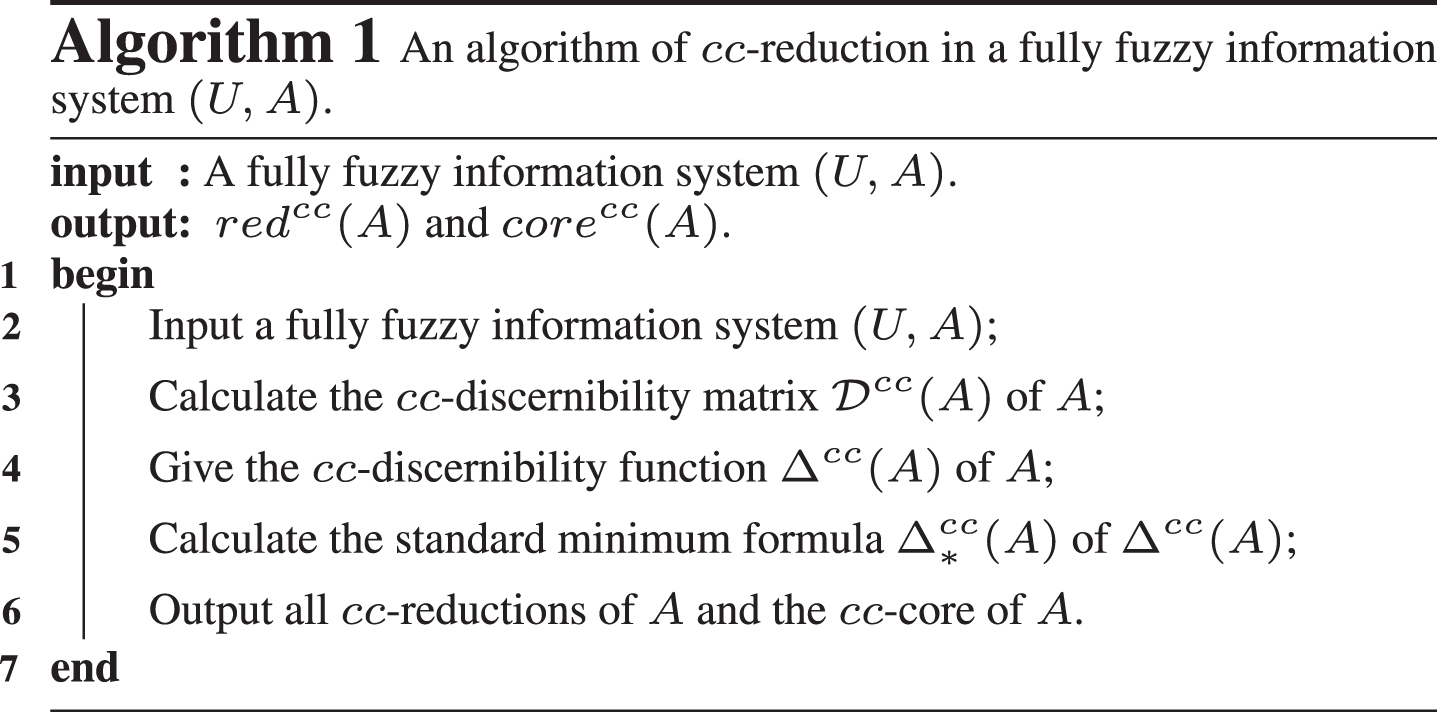
In Step 2, we give the cc-discernibility matrix
In Step 3, we get
Δ cc (A) = a2 ∧ (a1 ∨ a2 ∨ a3 ∨ a4) ∧ (a1 ∨ a4) ∧ (a1 ∨ a3 ∨ a4) ∧ (a1 ∨ a2 ∨ a4) ∧ (a2 ∨ a3) .
In Step 4, we gain
In Step 5, we obtain red cc (A) = {{a1, a2} , {a2, a4}} and core cc (A) = {a2}.
Invariant characterizations of fully fuzzyinformation systems underhomomorphisms
Suppose that v ∈ [h1 (x)] cc(h2(P)). Then ∀ a ∈ P, h2 (a) (h1 (x)) ≈ 1h2 (a) (v) . Let h1 (u) = v. Then ∀ a ∈ P, h2 (a) (h1 (x)) ≈ 1h2 (a) (h1 (u)).
It should be noted that (U, A) ∼
h
(V, B). Then ∀ a ∈ P,
So ∀ a ∈ P, h3 (a (x)) ≈ 1h3 (a (u)) .
Since h3 is class-preserving, ∀ a ∈ P, a (x) ≈ 1a (u). Then u ∈ [x] cc(P). This implies that v ∈ h1 ([x] cc(P)).
Conversely, suppose that v ∈ h1 ([x] cc(P)). Then ∃ u ∈ U, v = h1 (u), u ∈ [x] cc(P). So ∀ a ∈ P, a (x) ≈ 1a (u). Since h3 is class-preserving, ∀ a ∈ P, h3 (a (x)) ≈ 1h3 (a (u)) .
It should be noted that (U, A) ∼
h
(V, B). Then ∀ a ∈ P,
Then ∀ a ∈ P, h2 (a) (h1 (x)) ≈ 1h2 (a) (h1 (u)) = h2 (a) (v). This implies that v ∈ [h1 (x)] cc(h2(P)).
Therefore, [h1 (x)] cc(h2(P)) = h1 ([x] cc(P)). □
(1) If P ∈ co cc (A), then h2 (P) ∈ co cc (B).
(2) If h1 is injective, h2 (P) ∈ co cc (B), then P ∈ co cc (A).
By Theorem 2.8, cc (h2 (P)) = cc (B).
Therefore, h2 (P) ∈ co cc (B).
(2) ∀ i, let y
j
= h1 (x
i
). Since h2 (P) ∈ co
cc
(B), we have
This implies [y
j
] cc(h2(P)) = [y
j
] cc(h2(A)), i.e.,
By Proposition 5.1,
Since h1 is injective, ∀ i, [x i ] cc(P) = [x i ] cc(A).
By Theorem 2.8, cc (P) = cc (A).
Therefore, P ∈ co cc (A). □
(1) P ∈ co cc (A) ⇔ h2 (P) ∈ co cc (B) .
(2) h2 (co cc (A)) = co cc (B) , where h2 (co cc (A)) = {h2 (P) : P ∈ co cc (A)} .
(2) This follows from (1). □
∀ b ∈ h2 (P), let h2 (a) = b. Since P ∈ red cc (A), we have P - {a} ∉ co cc (A).
By Corollary 5.3, h2 (P - {a}) ∉ co
cc
(B) . Since h2 is injective, we have
Then h2 (P) - {b} ∉ co cc (B) .
Hence, h2 (P) ∈ red cc (B).
“⟸". Since h2 (P) ∈ red cc (B), we have h2 (P) ∈ co cc (B). By Corollary 5.3, P ∈ co cc (A).
∀ a ∈ P, let b = h2 (a). Then b ∈ h2 (P). Since h2 (P) ∈ red cc (B), we have h2 (P) - {b} ∉ co cc (B).
It should be noted that h2 is injective. Then
This implies h2 (P - {a}) ∉ co cc (B) .
By Corollary 5.3, P - {a} ∉ co cc (A) .
Hence P ∈ red cc (A). □
By Corollary 5.3, h2 (A - {a}) ∉ co cc (B).
Since h2 is injective, we have
Then B - {h2 (a)} ∉ co cc (B) .
By Theorem 3.13, h2 (a) ∈ core cc (B).
“ ⟸ ". Since h2 (a) ∈ core cc (B), by Theorem 3.13, B - {h2 (a)} ∉ co cc (B), i.e., h2 (A) - {h2 (a)} ∉ co cc (B).
It should be noted that h2 is injective. Then
By Corollary 5.3, A - {a} ∉ co cc (A).
by Theorem 3.13, a ∈ core cc (A). □
a is an unnecessary cc - attribute ⇔ h2 (a) is an unnecessary cc - attribute .
Since a is an unnecessary cc-attribute, by Theorem 3.13(3), P - {a} ∈ co cc (A). By Theorem 5.2(1), h2 (P - {a}) ∈ co cc (B).
Since h2 is injective, we have
Then Q - {h2 (a)} ∈ co cc (B).
By Theorem 3.13(3), h2 (a) is an unnecessary cc-attribute.
“ ⟸ ". ∀ P ∈ co cc (A), By Theorem 5.2(1), h2 (P) ∈ co cc (B).
Since h2 (a) is an unnecessary cc-attribute, by Theorem 3.13(3), h2 (P) - {h2 (a)} ∈ co cc (A).
Since h2 is injective, we have
Then h2 (P - {a}) ∈ co cc (B). By Theorem 5.2(2), P - {a} ∈ co cc (A).
By Theorem 3.13(3), a is an unnecessary cc-attribute.
□
a is a relatively necessary cc-attribute ⇔ h2 (a) is a relatively necessary cc-attribute.
A numerical experiment
In order to illustrate the practical significance and possible applications for cc-reduction in a fully fuzzy information system, we present a numerical experiment in this section.
Yeast.
The information system (U, A) of Yeast
The cc-discernibility matrix
Obviously, core cc (A) = {a8} .
It should be noted that
Δ cc (A) = a8 ∧ (a1 ∨ a4) ∧ (a1 ∨ a5) ∧ (a1 ∨ a7) ∧ (a2 ∨ a3) ∧ (a3 ∨ a4) ∧ (a3 ∨ a7) ∧ (a2 ∨ a4 ∨ a5) ∧ (a2 ∨ a4 ∨ a7) ∧ (a2 ∨ a5 ∨ a7) . Then the number of cc-reductions of A is as much as 1728 (contains duplicates). Here, we do not make a detailed list. But it is easy to be obtained.
In this paper, we have given cc-reduction in a fully fuzzy information system and divided attributes in a full fuzzy information system into three categories (i.e., necessary cc-attributes, relatively necessary cc-attributes, unnecessary cc-attributes) according to their importance. Moreover, we have obtained some invariant characterizations of fully fuzzy information systems under homomorphisms, which sheds light on the relationship between a fully fuzzy information system and its image fully fuzzy information system. This may have potential applications in knowledge discovery, decision making and reasoning about data. In the future, we will consider concrete applications of the proposed results.
Footnotes
Acknowledgments
The authors would like to thank the editors and the anonymous reviewers for their valuable comments and suggestions which have helped immensely in improving the quality of the paper. This work is supported by High Level Innovation Team Program from Guangxi Higher Education Institutions of China (Document No. [2018] 35), Natural Science Foundation of Guangxi (2018GXNSFDA294003, 2018GXNSFDA281028, 2018GXNSFAA294134), Key Laboratory of Software Engineering in Guangxi University for Nationalities (2018-18XJSY-03) and Engineering Project of Undergraduate Teaching Reform of Higher Education in Guangxi (2017JGA179).