



Abstract
Fundraising is one of the most critical issues for non-governmental organizations (NGOs) to carry out their projects. In this paper, a search engine project which aims to find additional financial sources and increase donations for NGOs is proposed. The proposed search engine project is analyzed using fuzzy cognitive maps (FCMs) to define and manage factor influences on the success of the project. FCMs are useful tools to define long term effects of important factors for a system. First casual relations of the factors are determined and then using sigmoid function for learning algorithm, the equilibrium state for the system is obtained. It is found that the factors generating monetary values are the most important ones for the project to be successful in long term.
Introduction
Non-governmental organizations are independent organizations from private sectors and the government, which are operating in the fields of education, health, political, social, cultural, legal and environmental and helping to meet the needs. These organizations continue to work to find solutions to various problems and achieve a common objective with the contributions of volunteers. As stated by Nadira et al. [1], NGOs that respond to local needs are flexible organizations; that’s why, they can develop complex projects. These institutions, which voluntarily take their members and employees, generate income through donations and members. Having a completely voluntary system is the most specific feature that distinguishes NGOs from other organizations. Without any pressure, all individuals can come together with their own desires at any time and leave any time. In this respect, every resource and beneficiary that can be used in NGOs by implementing a participatory approach is included in the development process [2]. Unlike other institutions, individuals working in NGOs are highly motivated due to fewer restrictions [1]. Further, membership is not necessary to support NGOs, and assistance also can be provided without membership. The main goal of NGOs is to contribute to society by providing things. Activities in the service delivery of NGOs include promoting volunteering, evaluating people’s needs, providing new services, evaluating results.
Nowadays, the voluntary sector has a significant place in terms of size and importance [3]. With the increase in the number of charitable organizations seeking donors’ support, the existing competition has increased more [4]. In this context, the issue of fundraising has become dominant issue and NGOs are undergoing more challenging processes than ever before to become a charity in order to ensure the welfare of society [5]. While most charitable organizations rely on additional external funding, many of them cover at least portion of their costs through revenue. In many countries, until recently, a significant proportion of these external funds was obtained from public funds [6]. NGOs play a role in facilitating organizations’ transformation of financial and ideopolitical resources into organizational goals. In the case of fund donors, NGOs close the gap between expectations and monetary insufficiencies [7]. Foundations and independent organizations support NGOs in many other ways. Sometimes this support can be a project-based grant to be a partner or collaborate on the organization’s projects, does not have to be directly. In addition, embassies and consulates support NGOs in line with their foreign policy objectives in their countries. Within the scope of corporate social responsibility, there are companies that run their own projects and raise funds, and private companies that carry out social responsibility projects and provide resources. As a result, NGOs detect opportunities for project financing and find innovative ways to achieve this funding [7]. It is also possible to use alternative methods to search for resources. For instance, donations can be made over the Internet.
Viewed from a different point, the interest in NGOs has gradually decreased in recent years, and considering this situation, the study aims to fulfill the gap experienced by NGOs and turn these into new opportunities. This paper aims to evaluate a new business model that supports fundraising of NGOs. In addition to providing financial support to NGOs with this business model, it is aimed to raise social awareness and satisfy people by bringing with it the moral benefits of social assistance. This model, which has emerged to help people in need, includes many NGOs working in different fields. The ability to make donations without taking any money out of the donor’s pocket makes the importance and ease of use of this project even more obvious.
In this paper, proposed search engine project is analyzed using fuzzy cognitive maps to understand the dynamics of the factors which are the main concepts that the system has. Long term success of the proposed project is investigated using the factor influences.
The rest of the paper is constructed as follows: In Sec. 2, dynamics of NGOs is given with a detailed literature review. The basic information on search engine working principles are given in Sec. 3. In Sec. 4, the proposed search engine project is determined. In Sec. 5, required information on methodology (fuzzy cognitive maps) is defined. And finally the application is done in Sec. 6. The paper is completed with a conclusion.
Non-governmental organizations
This section highlights the major insights that have been captured regarding NGOs. Due to the NGOs having an important role on development of governments, they are generally powered by society and have a good place. Awareness of people is increasing throughout worldwide. Several articles are indicated that NGOs are beneficial to society and the environment in many ways.
Lewis [8] explained the term of NGO that operates in a variety of areas that do not earn financial gain and are not part of the government sector. It is also expressed that while NGOs, which mean “non-profit” and “voluntary” based organizations working on welfare issues in Western industrialized countries, express institutions that are trying to help develop in non-industrialized countries. Hudock [9] referred that non-profit and NGOs are independent organizations from private sectors and the government and work to achieve a common objective with the contributions of volunteers. Johnson and Prakash [10] expressed that NGOs are different from governments and firms. People living in a particular region are not expected to legally comply with the laws and rules of NGOs. The profit is not distributed to the right holders, hence NGOs are non-profit. Martens [11] described NGOs as whose main goal is to develop common objectives in national or international areas, are formal and independent social organizations. Lewis and Wallace [12] and Vakil [2] pointed out that NGOs are corporations in which individuals come together to achieve common goals. Keck and Sikkink [13] disclosed that NGOs follow normative goals, different from the companies that pursue instrumental targets.
Some researches [14–16] concluded that today, most companies cooperate with NGOs within the scope of corporate social responsibility to create value. Delisle et al. [17] mentioned that NGOs can run as a mediator in providing feedback to societies and in planning, implementing and monitoring of fresh interferences, policies or other activities. Akkucuk and Sekercioglu [18] stated that the importance of voluntary organizations which are contributing environment is increasing all over the world and Turkey. NGOs, which have a large volume in this area, are able to reach broad masses by using traditional and social media channels effectively.
Zukin et al. [19] expressed that civil participation is voluntary movement focused on helping the people in need, providing a public good or solving a social problem. Thus, encouraging civil participation plays an important role in achieving the NGOs’ objectives. According to Goksel and Gunes [20], NGOs attach importance to principles and values such as participatory democracy, rule of law, human rights and responsibilities, ethics, transparency, and accountability. Besides, NGOs in the development of Turkey’s pace of globalization and integration has great influence. According to Johnson and Prakash [10], scientists and popular press highlight the role of civil society organizations in maintaining democratic governance. International organizations like the WB and the UN state that civil society plays an important role for good administration and economic growing. Further, Delisle et al. [17] state that NGO actions can be local, national or even international. NGOs might contribute to the growing of societies all over the World and are independent of governments, but are important partners of many governments.
NGOs, which are now referred to as the third sector, have a vital role for society and the state. The fact that the state is insufficient to meet the needs of the society and to solve its problems and that the NGOs are concerned and able to solve the problems at all levels has caused a rapid increase in the number of NGOs and their fields of activity.
Activity fields
There are NGOs involved in different professional activities and working areas such as humanitarian aid, health, education, child welfare, nutrition, human rights, sustainable development, and entrepreneurship etc. [21].
In a globalized world, education is necessary, especially in order to enable technological skills and knowledge to be included in the economy and to reach social mobility and economic stability. For this reason, there are many NGOs to ensure that everyone benefits equally from education. According to Gokler and Bademci [22], social responsibility projects are integrated into undergraduate programs, based on the idea that students learn better if a practicable and problem-based, society-oriented active learning process is engaged. Yang and Alpermann [23] indicated that NGOs play an important role in the education of disadvantaged groups and have a major impact on the chances of life for young people. Additionally, Xiong and Li [24] uttered that NGO in China aims to empower students in raising awareness and activism related to citizenship. Moreover; according to Kallioniemi et al. [25], universities serve as a bridge reflecting civil society needs in the curriculum.
Laszlo and Cescau [26] proposed that environmental protection is one of the main areas in which civil society organizations operate. The importance of the concept of sustainable value increases year by year. It is advantageous for the companies to have reciprocal relations with the organizations which work for benefit of environment. According to Gemmill and Bamidele-Izu [27], NGOs in environmental management with diverse missions for environmental protection, sustainable development, poverty reduction, animal welfare and other issues are diverse, including local, national, regional and international groups.
NGOs, which work to protect all natural assets such as water, forest, biodiversity, and the creation of policies and social awareness on human-induced climate change, and also draw attention to the environmental problems that threaten the country and contribute to the development of this struggle as a state policy.
The NGOs are working in the field of social meet, the social and cultural needs of the society and are active in activating and developing cultural and social activities; besides, they operate in additional artistic and sportive areas.
NGOs that help people provide the opportunity to trust each other and the capacity to work together towards common goals increase “social capital”. Becerikli and Armatlı Koroglu [28] stated that the development of social capital and human capital, maintaining local resources and values, strengthening social-cultural and physical structure can be determined as the activity areas of NGOs through projects.
Nathan et al. [29] emphasized that an activity that will develop in terms of health, well-being, equity and people’s development plays a key role for NGOs. Piotrowicz and Cianciara [30] mentioned that the fields of activity of NGOs are in the whole area of the health system. The main tasks of NGOs in the health system are service provision and health advocacy.
From another perspective, especially in recent years, NGOs, generally seen as sign of democratization, have indicated rapid development in Turkey [31]. The number of nongovernmental organizations which stand the responsibilities of the society voluntarily, is increasing every day. In addition, the vast majority of these organizations establish relations with similar-minded international or foreign organizations.
Project management in the field of NGOs plays an important role in the development of civil society in many different areas such as health, education, governance, gender equality, agriculture and economic development [32].
Fundraising of NGOs
NGOs have an emphasis on the unity, solidarity and cooperation of society. Different segments of society come together to help, to get help, to exhibit an example of unity and solidarity. People can become a member of NGOs and participate in their activities and make material and moral contributions to the works.
There are national and international institutions and organizations that provide resources to improve the activities of civil society organizations.
Types of Donations to NGOs
In this section, two ways of donation are considered. These are unplanned and planned donations.
In unplanned donation, there is no need to establish a formal structure or open a separate organization. If it is not preferable to place the donations on a plan, the control of donations will be easy and flexible. Individuals can support any subject or organization. The amount of donations and focused areas in time can be changed. Further, donations can be made at any time during the year. The type of donation providing direct financial resources to an NGO is so simple.
Despite these comforts, unplanned donations have some disadvantages. It may not be possible to see the impact of the contributions made with unplanned donations. The contributions to different projects or organizations are so fragmented that it becomes difficult to understand which one contributes to which result.
Volunteering is one of the most common ways to support an NGO. The donor is satisfied by involving directly in any activity at the NGO. NGOs may need to train volunteers to participate in some of their activities. Besides, NGOs sometimes need volunteers with special skills and expertise. Volunteers can provide support to the organization with the knowledge and experience in a wide range of areas, ranging from the preparation of business plan to management, from information technologies to accounting, to which an NGO normally has difficulty to meet and where human resources are limited. In brief, NGOs act as trigger that make connections easier between donors and local actors [7].
Research conducted by Varon et al. [33] shows that the majority of the NGOs try to survive with revenue less than 10.000 TL per year. Most organizations don’t even have enough resources to be a professional employee. The majority of the income of NGOs is composed of membership fees. After that, the project revenues are coming but these projects include support from one to three years. Volunteer support plays an important role in the activities like planning, resource management and development, information technologies, human resource management, change management and legal expertise. According to data from 2014, only 13% of the population of Turkey is the member of an organization and so, one association is for every 747 people. Further, it is noteworthy that 1,5% of the associations and 0,5% of the new foundations operate in the fields of human rights and advocacy.
Donation from individual to individual is the oldest and most common type of donation. It is difficult to ensure whether this person is really in need where the recipient is not known. In general, the solution is to fund NGOs that support individuals and families in need. For example, a donor who wishes to provide support in the field of education may choose to rely on an NGO working in this field instead of trying to reach the individuals.
Crowdsourcing is a resource development tool for NGOs to collect donations to their projects easily. These platforms provide a connection for meeting NGOs and the individuals who want to support social issues. In this case, the supporters can both provide financial support to the growth of the social movement they care about and contribute to the awareness of the movement by including others in the support activity.
Using web applications, the donors are actively involved in the campaign they support and make donation more interactive. While donors are donating their time or money, they are able to follow up information and reports about the development of the project they support. Thus, NGOs can easily reach a large number of supporters in many different profiles, collect donations, find volunteers and increase the visibility of their activities without any cost of resource development.
On the other hand, there are many options and tools for planned donation. Planned donation gives a formal structure to donations. In this way, donations are carried out in a continuous manner, independent of the activities. In addition, it is possible following the effect of the donations and getting the results.
When a new NGO such as association, foundation or cooperative is to be established, firstly, it is examined whether there are other actors working in the field of study. If the needs in this area are already met, resources and activities should not be used unnecessarily. Therefore, the best starting point would be to conduct a feasibility study or any other research to determine whether the services of the organization are needed, whether these services are met by others, and whether there is a potential for adequate resources to survive.
As examined in [10], individuals can establish or participate in environmental NGOs instead of acting alone to protect the environment. Further; citizens can establish NGOs and this is the basic story of the emergence of NGOs. It thus fills the lacks of the public and private sectors.
Many foundations have been established to grant grants to other NGOs. They serve as a legal tool for transferring some of the assets of a person, family or company to voluntary organizations. Investments are made through the funds, and the grant is allocated by the proceeds from the investment. The focus of these foundations is to support certain types of organizations, a specific geographical region or objective. Foundations also act as intermediaries. They collect donations from public or other donors and grant grants to other NGOs.
Donors can also identify social entrepreneurs who work in areas of interest and invest in their work. Even though investing in a social entrepreneur is seen as more risky than donating to a known NGO, it might be said that the impact it creates is greater. Donors can support social entrepreneurs either directly or indirectly by providing long-term support like providing mentorship.
One more view is that the term of social entrepreneurship is gaining popularity day by day. Social entrepreneurship is the area where entrepreneurship activities are carried out with the aim of creating social value [34]. Social entrepreneurship aims at reaching wider social, cultural and environmental goals, often focusing on areas related to the voluntary sector, such as poverty reduction and community development [35].
Search engines
To understand how the project works, first need to learn how search engines work and how they generate revenue. Most of the internet search engines work similarly. Search engines deliver proper results through some special words called “keywords”. When the user types the question or term in the search bar, the search query begins. The search engine enters the index to find the most relevant answer to the users query. Certain “keywords”, how often users search the browser, and many other factors, such as these, affect the process of searching for appropriate answers. In addition, for specific searches up-to-date content might be considered more relevant. The likelihood of content being appropriate and reliable is more likely than ever if recommended by many. The user’s location and language need to be taken into consideration for the efficiency of the search results. If the factors specified in the search settings are specified, it will have a positive impact on the search results. The search algorithm is defined as the piece of code responsible for finding information about specific features such as language, relevance, and so on. For all search engines, the search results are presented probably in the same way. At the end of the search, the most relevant results will appear at the top, while the less relevant results will be listed below. Advertisements are shown alongside the search results in most search engines. When a user clicks on any of these advertisements, the search engine receives a payment, because the user is redirected to the advertiser’s site. The amount gained per click on an advertisement differs depending on the competition and popularity of the “keyword” and which advertisement is being made. Clicking on one of the more profitable “keyword” advertisements may result in higher revenue at a time than others give. Besides, revenue per search is lower than expected, given that not every user has to click on advertisements while searching.
Proposed business model to fundraise NGOs
In recent years, with the widespread use of the internet, the computer science and the information technology have started to enter our lives and the way of doing businesses has been changing dramatically. In this time, the channels of reaching and obtaining information have been also evolving. Formerly, people used to go to the library or skim encyclopedias to find what they were looking for. In course of time, thanks to search engines, the information have become much more accessible without exerting effort.
From another perspective, the interest in NGOs has gradually decreased in recent years, and considering this situation, the study aims to fulfill the gap experienced by NGOs and turn these into new opportunities. To create this opportunity, a new business model that serves to make a free donation, which is focused on NGOs and its projects in Turkey, has been developed.
The proposed social business model is basically provides a search engine service which fundraise NGOs whose strive for the development of society in any field [36]. It includes many NGOs that serve a specific purpose and work in different fields such as social, education, environment and health that solve specific problems inherent to society. This fund will be derived from the revenue generated by sponsored clicks from future users.
In the process, the project gets search results from search engine providers and develops the received data with its own algorithms and displays them to the user. The most important source of income in the project is advertisement display, and in this field, a revenue-sharing agreement is made with the collaborated search engine provider. The search engine shows ads next to its search results and payment is charged whenever a user is directed to an advertiser through a sponsored link.
In detail, search engine providers place ads on sites that they consider reliable and suitable for their algorithms, for a fee per call from sites. From the providers’ perspective, it is aimed to reach the number of sponsored link searches that providers should deliver within a certain period of time. In this case, where the mutual gain is provided, since any search result targeted from the site will be covered by the same search engine provider, it needs to share a certain part of the earnings to be obtained. This income system is valid only for clicks on sponsored links.
The search engine project will provide accurate and fast search results to people who want to find what they are looking for on the internet in a timely manner collaborating with a built-in search engine providers such as Google and Bing. One lovelier feature is that users can choose the specific NGO that they want to donate according to their number of searches. In order to keep users sustainably, the financial reports showing the amount of donations made to NGOs in order to show transparency of the social enterprise will be shared, and motivation and effective marketing techniques designed for users will be implemented.
In order to create a more livable society for the present and future generations, this model is a social enterprise dedicated to delivering excellent service, giving superior value to people and providing fair and equal returns. It is highly committed to creating and delivering assistance in a variety of different areas.
The search engine project, which aims to fulfill the shortage of funds of NGOs, is called as a social business model. In other words, this search engine project is a completely non-profit organization due to its social business model, and it is also a fully profitable organization, since it aims to achieve higher incomes in order to maximize support for NGOs. The gap between donor and NGO is filled by extending helping a hand to NGOs with this model. Eventually, it helps to achieve a society consciousness that is extremely sensitive to public problems and to also spread this awareness.
The main point that the project will be distinguished from the search engines already in the market is that the awareness of helpness, and the social consciousness will be developed through that business solution by adding value to any web search. Besides enhancing social consciousness, the project also provides a new fund collection platform for NGOs to reach the potential donors faster, and creates new interactions between donors and NGOs.
Search results are served to users either at the website that includes search bar, or with installation of as extension to browsers such as Google Chrome, Safari, Firefox, Opera, Internet Explorer, and Edge, or via applications on smart phones which conduct the operation systems iOS or Android.
In addition to giving accurate result for searching, this platform is designed to collect the points from users’ each search and to donate these points they accumulated to the NGO or NGOs which are also the users’ choices. With these collected points, the user will be able to support NGOs in any time, to use for shopping environmental items available on the project’s online shop, or to save the points for later use.
The strategy is mainly based on delivering a strong and agile customer value proposition in market. This project is looking to offer the people who are eager to do goodwill or want to receive accrued and fast search results a new choice for making donations with no cost.
The marketing infrastructure is built so that the search engine project can eventually reach more customers and users with the same service offering. In this way, it focuses on meeting the needs of each internet users in Turkey, and each NGO in need of fund or whose is open to collaboration.
Considered by some factors, the project seems to have a good profile that is widely regarded as respected business model. In the recent years, the use of social media has increased steeply. Increased use of mobile devices is also an uptrend having positive implications. The increased awareness of NGOs and social businesses will also lead to increase the use of proposed search engine. Demographic changes and changing user attitudes towards online services might have positive impacts.
In brief, the proposed search engine project distinguishes itself from other search engines by providing proper search results, and not only focusing on one functionality such as giving result or advertising something, but also including numerous NGOs that are operating in many fields. The fact that the ability to make donations at no charge makes the importance and ease of use of this project even more evident.
Methodology
In this section first a detailed literature review on FCM is given then FCM methodology is explained.
Literature review
Fuzzy cognitive maps (FCMs) are used to define long term effects of important factors for a system. FCM is introduced to represent casual reasoning by Kosko in 1986 [37]. Since then it is used in 5866 papers according to Scopus database. The distribution of the papers according to years is shown in Fig. 1. As it is seen from the figure, the usage of FCM method is getting more popular since it shows the effects of factors among others in a visual way and discovers long term results of the casual relationships among factors.
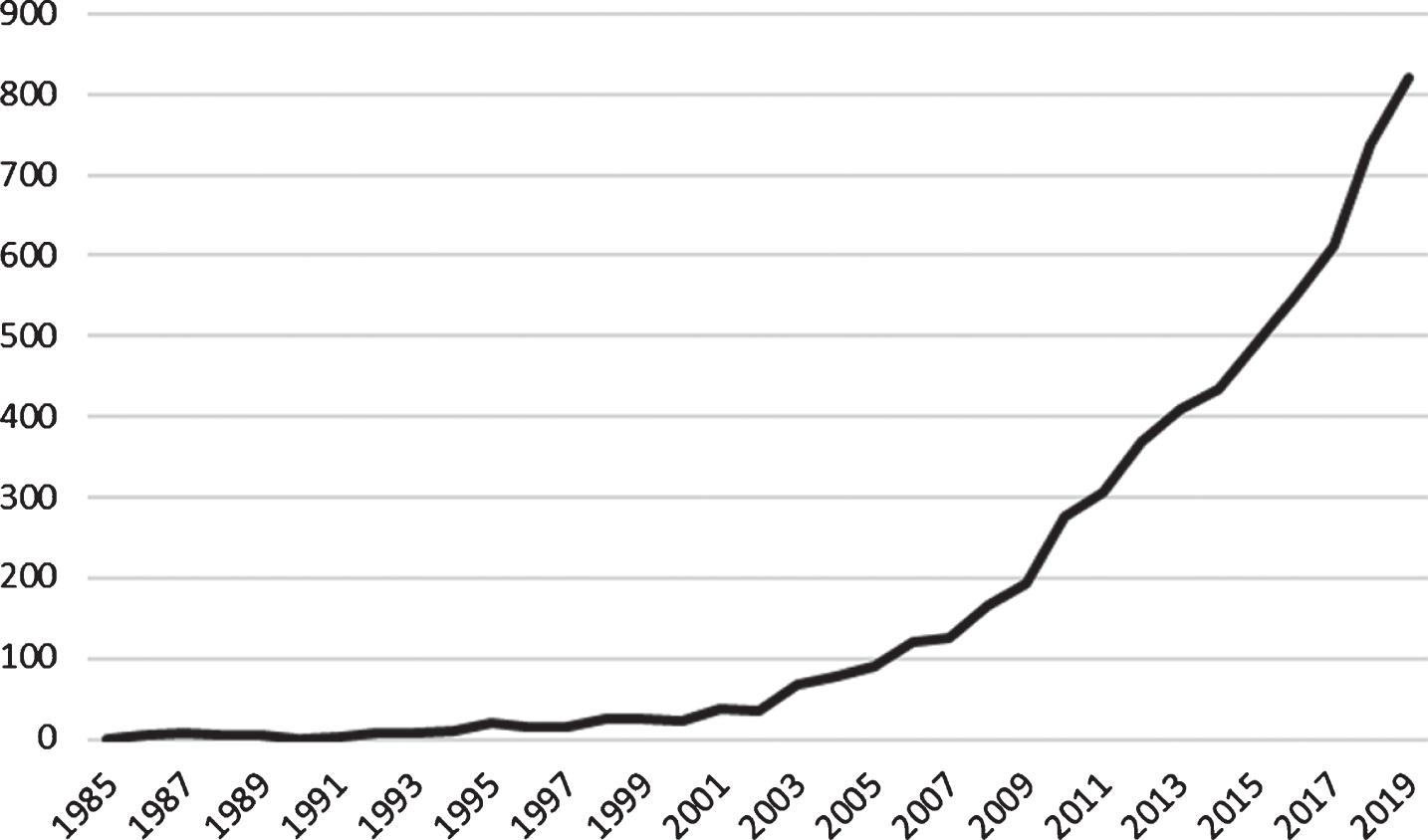
Studies on fuzzy cognitive maps.
In literature review it is seen that FCM has a widespread application area. Some of the papers used FCM for risk management. Shojaei and Haeri [38] proposed a comprehensive supply chain risk management approach for construction projects that uses, grounded theory, fuzzy cognitive mapping, and grey relational analysis. Rezaee et al. [39] identified and prioritized potential failures of the production process in the food industry by using an approach based on the multi-stage FCM method and Process Failure Mode and Effects Analysis technique. Chehbi-Gamoura et al. [40] discussed a generic approach based on Fuzzy Cognitive Maps (FCM) for cross-management of Disaster Recovery Plans.
There are also a lot of papers that used FCM on e-commerce applications. Barroso et al. [41] showed that entrepreneur profile, market, operational management, marketing and promotions, website and digital platform, and products present the highest centrality indices as determinants of SME e-commerce using fuzzy cognitive maps. Shukla et al. [42] used fuzzy cognitive maps to explore and evaluate the sustainability perspectives in e-commerce channels for additive manufacturing. Mohammadian [43] used fuzzy cognitive maps (FCMs) to provide facilities to capture and represent complex relationships in a customer satisfaction management and modelling to improve the understanding of managers and product developers about their customers and associated risks related to products and services that are offered online using e-commerce sites.
Although the papers mentioned above focus on risk management or e-commerce, FCM can be applied any area in which factors have influences on each other. Healthcare systems [44, 45], software development [46–48] and product design [49, 50] are the other areas in which FCM applications are used widely.
Also, it is found that some papers focus on the extensions of the FCM methodology. Dursun et al. [51] introduced an intuitionistic fuzzy cognitive map (IFCM) technique to assess the importance degrees of success factors of leans six sigma project management. Krishna et al. [52] developed a differential evolution trained FCM for predicting the bank efficiency. Coban and Onar [53] developed hesitant linguistic cognitive map method that is an extension of hesitant fuzzy sets and fuzzy cognitive map and applied for modelling renewable energy usage. Papageorgiou et al. [54] proposed a learning procedure for training FCMs which utilizes unsupervised Hebbian algorithm to nonlinear units.
Step 1: Determination of casual relationships:
In FCM, the casual relationships between factors are determined by experts using linguistic statements that include sign and size of the influence. These causal relationships among the factors are represented in a directed graph with feedback and weighted in the interval [–1, 1] by fuzzy numbers. Nodes are representing factors and weighted edges are representing relationships among the factors in Fig. 2 for a hypothetical FCM with six factors (C1, C2, C3, C4, C5, C6) and seven directed weighted edges.

A hypothetical FCM.
The linguistic variables that is used in this study are defined as “very very high”, “very high”, “high”, “medium”, “low”, very low”, and “very very low” both for negative and positive directions. Triangular fuzzy membership functions for these linguistic variables are shown in Fig. 3 [55].
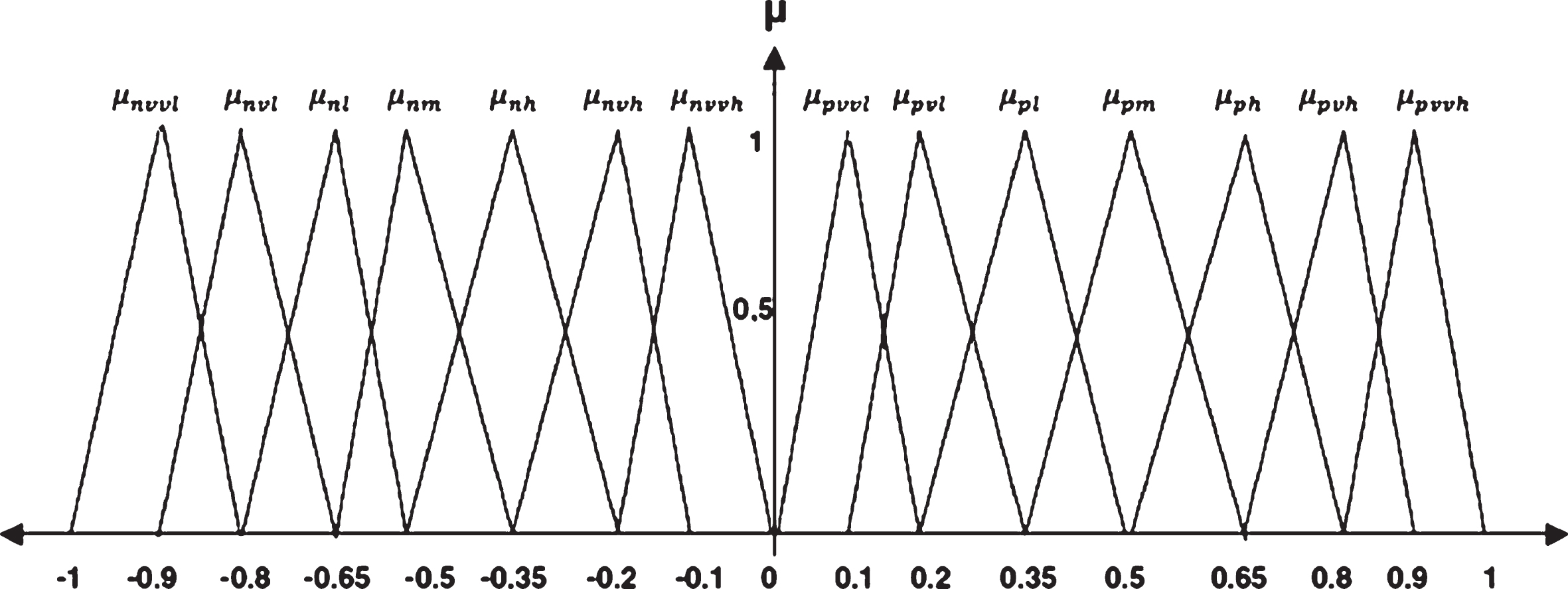
Membership functions of linguistic variables.
Step 2: Obtaining adjacency matrix:
The weight of the relations among factors are used to obtain adjacency matrix. The adjacency matrix for hypothetical FCM shown in Fig. 2 is given in Table 1.
Adjacency matrix of hypothetical FCM
At this stage, an appropriate defuzzification method is used to defuzzify linguistic variables. In this study, the graded mean integration approach is used. According to the graded mean integration approach, a fuzzy number
Step 3: Determination of Activation Vector and Activation Function
Activation vector is also known as initial statement vector represents current situation of the factors and is denoted by
The most commonly used activation functions are detailed below [57]:
Bivalent (step) function transforms the activation level of each factor to 1 (activated) or 0 (inactivated) and obtained a binary FCMs.
Trivalent function defines the activation levels in three part as –1, 0, and 1 and these values refer the decreasing, remain stable and increasing of the factor respectively.
Sigmoid function is commonly used function in the FCM that transforms the sum of the weights in the interval [0, 1].
Hyperbolic Tangent function: This function transforms the sum of the weights in the interval [- 1, 1] whose initial state vector can include the negative state.
Step 4. Determination of long term state/steady state vector
Interactions among factors, so the iterations of FCM, continue until an equilibrium point is found or a limit cycle behavior is reached [58]. To avoid from unnecessary iterations, a specific value (ɛ) can be determined for the change in the state value of factors. In this case, when the changes in the state value of all factors are less than the determined (ɛ) value, iteration stops.
In this section, FCM is used to determine the relations among the critical success factors of the proposed search engine. Six factors are determined by the managers and engineers of the project, which are taking advertisements, giving advertisements, number of clicks to the sponsored links, number of searches and customer loyalty. These factors are determined focusing on the cost and revenue parameters of the project through the goal of having maximum profit that will be used to fundraise NGOs. Besides the monetary factors customer loyalty is also determined as a factor to involve its important effect on revenues.
Taking advertisements (TA): Taking advertisements on the interface of the search engine increases the direct revenue of the system. The revenue coming from advertisements is independent from the search and click numbers of the sponsored links. There could be two types of advertisements. In one of them appearance number of the advertisements will count and it will be charged to the company. In the second type, number of clicks to the advertisements will count and charged to the company. Both of them will generate additional income to the proposed search engine project.
Giving advertisements (GA): At first, advertisements will be used to announce the search engine project to the users. This will also help to have commitments with NGOs to be in the system.
Number of clicks to the sponsored links (CSL): Main revenue of the system comes from these clicks on the sponsored links in each search.
Number of searches(S): Number of searches determines the total amount that should be paid to the search engine provider. This is the main cost parameter of the proposed search engine project.
Customer loyalty (CL): It is important to increase customer loyalty, to achieve a continuous stable income.
Number of NGOs in the system (NGO): Having several numbers of NGOs in the system brings a strategic importance to the search engine project. Well known NGOs increase the trust of the users to the system. Users want to distribute the value they earned by using the system to different NGOS with different goals such as education, safety or public health.
Selling additional items (SI) on the website: This tool brings additional income to the system which can be directly distributed to the NGOs that provide the sold items.
Linguistic statements for casual relationships among these six factors are determined by the managers of the project and given in Table 2.
Linguistic statements
Linguistic statements
These linguistic statements for the factor influences in the proposed search engine project can be represented as in Fig. 4.

Fuzzy Cognitive Map of the Proposed Business Model.
Using casual relations and graded mean integration approach adjacency matrix is obtained as shown in Table 3.
Adjacency matrix
As it is seen in Fig. 4, all influences in the system are positive influences. This is why sigmoid function is preferred for activation function in FCM methodology.
Managers of the new search engine project decide to start with aggressive strategy on giving advertisements to increase the recognition level as soon as possible. Therefore, activation vector is determined as A0 = [0, 1, 0, 0, 0, 0, 0]. System achieves steady state after 6th iteration. The final values of the factors are given in Table 4.
Steady state values of factors
The FCM results show that in long term, the factors that generate monetary value will be more important for the success of the system. Although, giving advertisements is one of the most important factor for the current situation to make the search engine project known in the market, owners of the search engine project should focus on the factors which increase the wealth of the system to be successful in the long term. Also, the results show that the main cost factor of the project which is the number of searches has the third highest steady state score. This information shows that there should be a limitation for the number of searches which do not bring any revenues. The managers decided to set an obligation to the users such as to continue use the interface they should click to sponsored links at least one in each 10 searches. Figure 5 provides a visualization of system behavior during iterations.
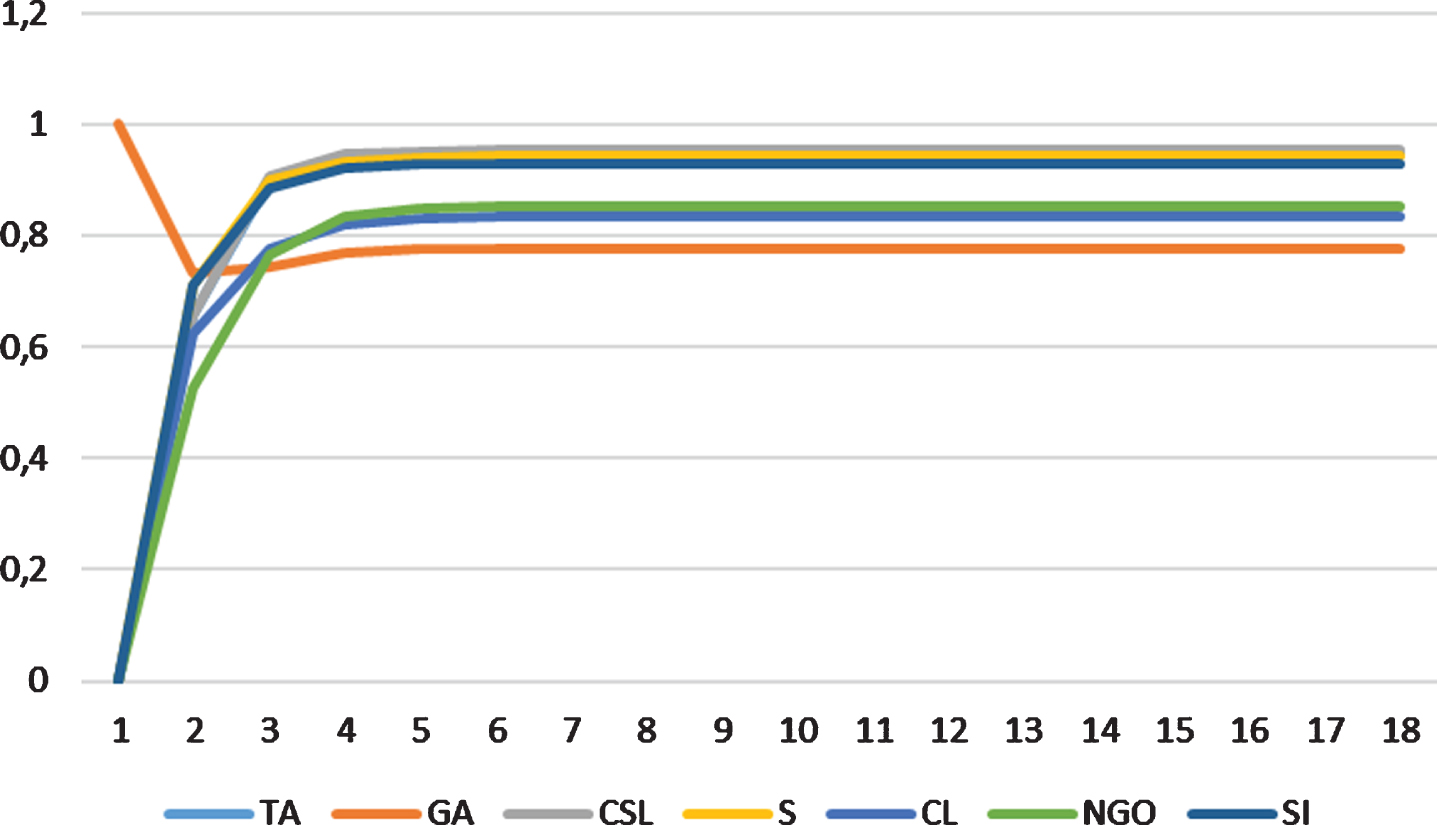
Behavior of the system.
Additionally, to understand the effects of different activation strategies, the calculations are done for all combinations. Minimum number of iterations required to achieve steady state is 4 for activation vector of A0 = [1, 1, 1, 1, 1, 1, 1] and the maximum is 7 for the activation vector of A0 = [0, 0, 0, 0, 0, 0, 0]. Among the aggressive strategies minimum iterations required is found as 6 for the activation vectors A0 = [1, 0, 0, 0, 0, 0, 0] A0 = [0, 1, 0, 0, 0, 0, 0], A0 = [0, 0, 0, 1, 0, 0, 0] and A0 = [0, 0, 0, 0, 1, 0, 0]. With this information, managers choose to focus on the factors CL and NGO which do not cause an extra cost to the company. It is decided to increase the number of NGOs that have different working areas before starting the project. Also, to increase the click number on sponsored links, a detailed information will be provided during registration about how the donation amount could be increased.
NGOs support lots of projects which fill different deficiencies and they need continuous funds to be able to carry out these projects. Therefore, there is a need for a platform that brings the donators, members and NGOs together to increase the donations. In this paper, a new search engine project is proposed that uses the advertising incomes through user searches to fundraise several NGOs.
To determine the long term state of the proposed search engine project, critical factors on the success of proposed project are determined by managers that are taking advertisements, giving advertisements, click number on the sponsored links, number of searches, customer loyalty, number of NGOs in the system and direct sales on the user interface and analyzed using FCMs. The results of the FCM used to determine initial strategies at the implementation phase of the project.
The approach used in this paper shows that factors which create direct income have more important role on the long term success of the proposed project. Taking advertisements and the number of clicks to the sponsored links are the main revenue sources of the proposed project which have the highest steady state scores. With this information as further researches, new implementations should be investigated which can bring additional revenues such as making special events, membership activities, etc. to increase the donations for NGOs.
In addition, the aggressive strategies for the initial phase are compared according to their achievements to steady states. The results of the comparison could be used as inputs for the financial analysis of the aggressive strategies in the further researches.