



Abstract
In the past two decades, research on tourism or destination competitiveness has increased exponentially. The concept of improving the performance of a destination to deliver goods and services considered important for tourists is highly appealing for policy and decision-makers. Therefore, analyzing the relation between some identified causes of destination competitiveness and the effects they exert on touristic variables of a specific territory may have relevant results. The present work applies the theory of forgotten effects to identify the direct, and indirect cause-effect relationships of the identified variables. Results show that the highest indirect effect is given by the variables hospitality and sustainable development, some other interesting results are those found in causes, destination management, and accessibility; in effects, economic growth, and profitability. This work tries to shed light on the identification and initial measurement of the relevance that competitive variables have on touristic destinations.
Introduction
Competitiveness has become a major topic in tourism research since the 1990s, Ritchie and Crouch [1] for example, have developed a theoretical and conceptual framework that explains how a tourist destination manages its competitiveness. The concept has evolved from focusing on tourist attraction to the strategic development of the tourism industry in a more holistic way, this evolution proposes a number of advantages in the study of competitiveness [2]. To make tourism an element of economic development, tourism competitiveness is shown as a necessary and key tool [3–5] additionally giving countries the possibility to retain their position as leader in tourism activity [6] or as the case may be, gain a favourable position [7].
Tourism competitiveness has been defined as the ability of a destination to increase tourism spending, attract visitors more and more, as well as to provide them with satisfactory and memorable experiences, all in a cost-effective way, seeking to improve the well-being of the residents of the destination and preserving the natural capital of it for future generations [1]. A shorter concept is that proposed by Acerenza [8] which defines tourist competitiveness as the ability of a destination to attract tourists. Tourism competitiveness was recently conceptualized as the ability of a place to optimize its appeal to residents and non-residents, offer quality, innovative and attractive tourist services (offer good quality – price, for example) to gain market shares at a national and global level, as well as to ensure that the available resources which support tourism are used efficiently and sustainably [9].
Tourist competitiveness is a construct involving multiple factors, both tangible and intangible, although it is only on a few, the critics, where fundamentally the greatest options of success or competitive failure reside [10], is a collective improvement (of all organizations or institutions) for the benefit of strengthening the tourism sector, contributing to a growing tourism and job flow [11] is also the capacity of a destination to create, integrate and offer tourist experiences, including high value-added goods and services that tourists consider important [12]. Tourism competitiveness is characterized for two orientations: the first one focuses on internal attributes and abilities, aiming at enhancing residents’ well-being, and the second orientation links tourism to market position revealing larger number of tourist arrivals or overnights compared to those of competing destinations. [13]. The study of destination competitiveness allows to identify the relative competitive positions of different destinations [14]
On the other hand, the theory of forgotten effects is an extension of the applications based on fuzzy logic of Zadeh [15]. t suggests that all the events, phenomena and facts that surround people in an organization, start from some kind of system or subsystem, therefore, virtually all activity is subject to some kind of cause-effect incidence, however, there is the possibility of voluntarily or unintentionally leaving some causal relationships that are not always explicit, obvious or visible, which are generally not directly perceived [16]. Thus, allowing an approach to the objective of globalizing the direct and indirect incidences between a group of causes and effects [17]. While incidence is a complicated subjective concept to measure, its incorporation into the process of analysis and problem solving allows for a better appreciation of the causes and effects that occur in a phenomenon, as well as strengthening and supporting more efficient and effective decision-making [18].
The theory of the forgotten effects has proven to be effective for identifying the incidences that are not so evident between variables, but that they are fundamental for decision making. Some research works in which the forgotten effects theory has been applied are: studying the competitiveness of MSMEs in a specific region of Mexico and the variables that affect them to establish a strategic improvement plan [19], developing a model of city congestion management deploying the possibilities offered by some disruptive technologies such as the Internet of things, blockchain/distributed ledger technology, and token economy, combined with a human capital aspects such as a reinforcement theory [20], the quantification of the impact of the forgotten effects on innovation pillars to foster innovation capabilities of enterprises [21], determining the principal worth-creating activities in social economy entities of service sector of the Balearic Islands [22], forecasting exchange rate using experton, forgotten effects and heavy moving averages operators, based on purchasing power parity model [23]; on the other hand, Blanco-Mesa et al. [24] elaborated a bibliometric analysis in the field of fuzzy decision-making.
The objective of this study is to identify the relationship between causes and effects of some variables that, based on the theory of competitiveness, play an essential role in a touristic destination, applying the theory of forgotten effects to clearly identify the direct and indirect incidences surrounding the phenomena. By using this methodology, it can be observed which factors of the tourism competitiveness exert a higher multiplicative effect in the touristic destinations. The structure of this work is as follows, the second section describes the methodology used to carry out the study; the third section summarizes our main findings using tables and graphs; the fourth section presents a discussion of those findings and finally, the concluding comments of the study are presented in section 5.
Methodology
According to Kaufmann and Gil-Aluja [25] all the phenomena surrounding us is part, in some degree, of a system or a subsystem, a cause-effect relation between these events and activities is therefore implied. Nonetheless, these causal relations are not always evident or explicit [26] and in some cases are consciously left aside when designing a descriptive model [21]. However, these hidden or ommited incidence degrees are in some cases key for an accurate assessment of the analyzed phenomena. These ideas constitute the theory of forgotten effects [17] and have proven to be an effective approach when aiming to maximize the retrieved information of the complex relations between variables and minimizing the errors that may occur in such processes [27].
When aiming to evaluate the forgotten effects, we must firstly establish two sets of elements: A ={ a i |i = 1, 2, …, n } and B ={ b i |j = 1, 2, …, linebreak m }, causes and effects, correspondingly. From here, an incidence degree of ai over bj is estimated with a value in [0,1] in the next way ∀ (a i , b j ) linebreak ⇒ μ (a i , b j ) ɛ [0, 1]. These values establish a direct incidence relationship M matrix following:
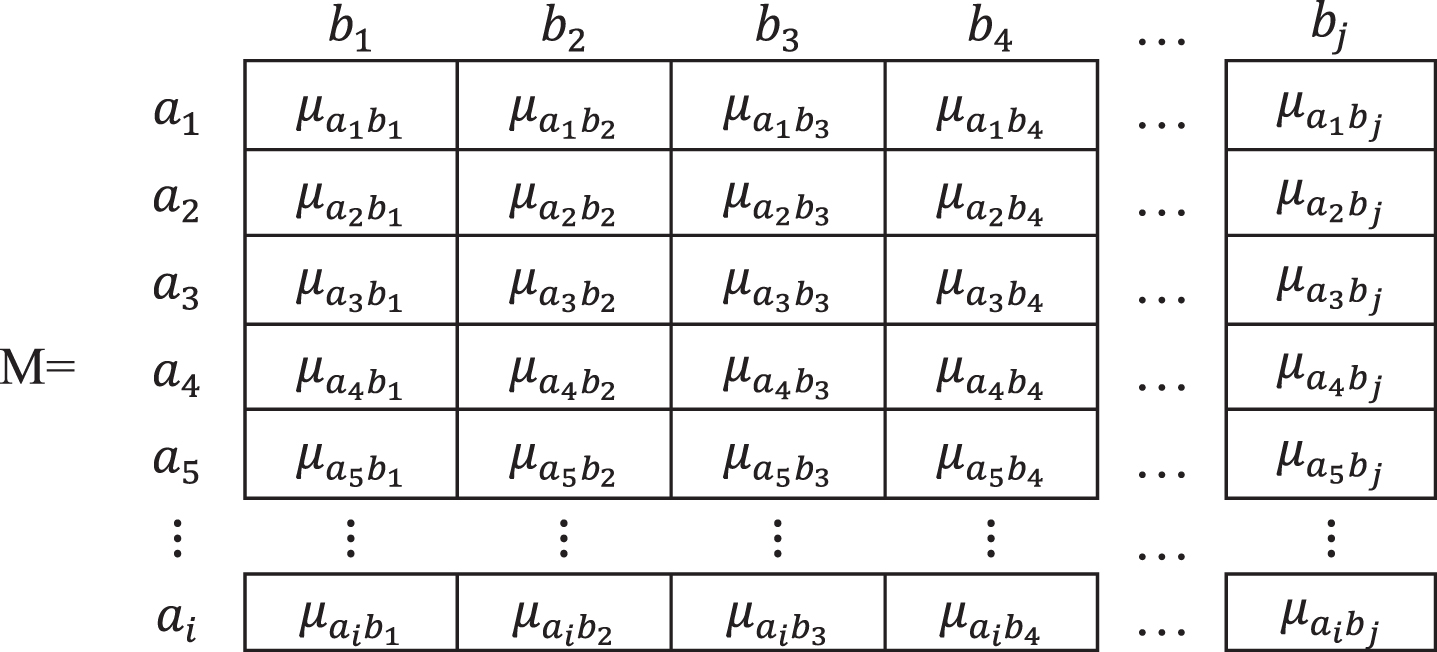
Suppose a third set of elements C, such that C ={ c k |k = 1, 2, …, z }, here a new matrix N appears:
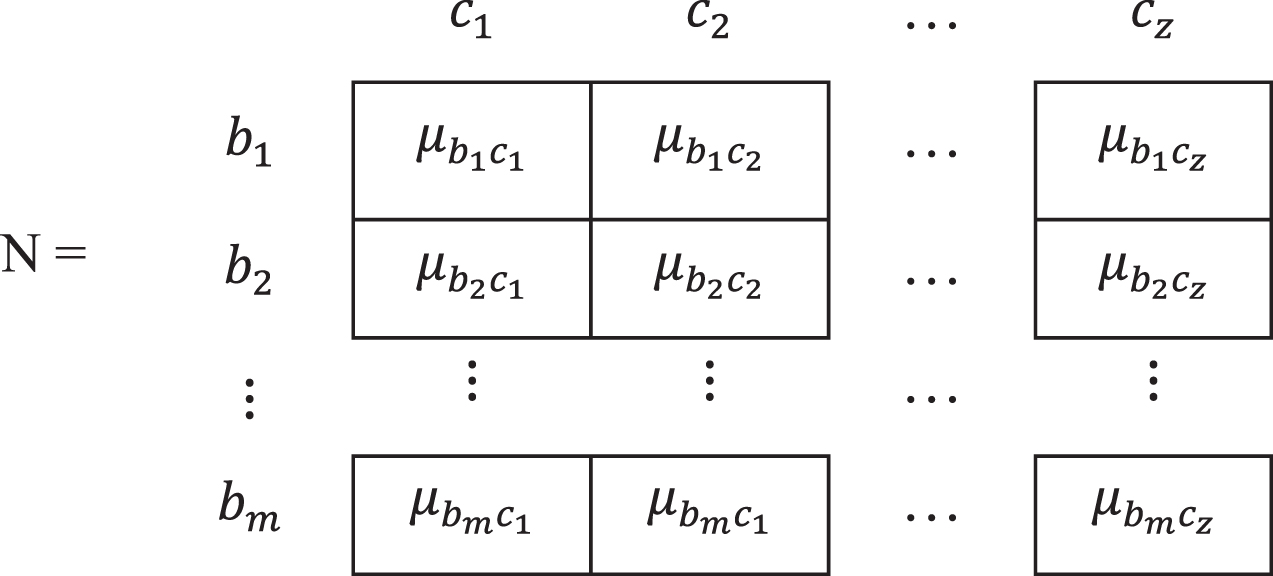
Please note the connection with set B. The theory of forgotten effects allows the composition of matrices using M ∘ N = P [28], here the max-min convolution operator is represented by:
This operation defines the P degree causal incidence between A, B and C sets. In this study, we propose three direct incidence matrices M (cause -effect), A (cause-cause) and B (effect-effect), to be convoluted in the next way: A ∘ M = AM and AM ∘ B = M*. Please note that the M* matrix is also known as the matrix of accumulated effects. Finally, we calculate for M* - M = O, thus obtaining the forgotten effects matrix.
To obtain the direct incidence matrices we firstly perform a literature review on the subject of tourist competitiveness. The aim is to identify the causes that give rise to this phenomenon and the effects it causes in a tourist destination. The characteristic models in our study follow the ideas proposed by Poon [29], Crouch and Ritchie [30], Hassan [31], Kim [32], Health [33], Ritchie and Crouch [1], Dwyer and Kim [34], Acerenza [8], Wei-Chiang [12], Alonso [10], and Jiménez and Aquino [35]. The resulting variables taken from the literature review are presented in Table 1 for causes and Table 2 for effects.
Causes of tourism competitiveness
Causes of tourism competitiveness
Source: own elaboration from the literature review.
Effects of tourism competitiveness
Source: own elaboration from the literature review.
Once the variables are established, a panel of 8 experts in the area of study was selected. The members were asked to include the direct relations between the set causes and effects. This process follows the methods proposed and the endecadary scale shown in Table 3 proposed by Kaufmann and Gil-Aluja [17].
Endecadary scale
Source: Kaufmann y Gil-Aluja (1988).
The present section shows the main results of the application of the forgotten effects theory. To clearly dimension the obtained information from the model, let us review the results of the methodological approach. The valuation of the relationship between causes and effects presented in Tables 2 and 3 respectively. Table 4 shows the incidence matrix “M”, in which the cause-based relationships obtained through the expert evaluation and through the expert-assessment process can be observed. A total value of the ratio of causes to effects of 94.58 was obtained. We make the sum of all valuations in order to show the global value of the relationships evaluated by experts. We consider this data like general indicative or a way to measure the total effect of relationships between causes and effects of tourism competitiveness. This value will be used later to obtain the accumulated data of the forgotten effects. On the other hand, the percentage of the forgotten effect in the analysis could be calculated using this value.
Incidences estimated by experts between causes and effects – Matrix M
Incidences estimated by experts between causes and effects – Matrix M
Source: own elaboration. Abbreviations: C, Causes; E, Effects.
The direct effects among phenomena are not enough to make an in-depth analysis given that causes are conditioned by themselves, and effects are affected not only by the direct causes but also by other crossed effects [21]. For this reason, it was necessary to construct matrices that reflect the incidence of causes on themselves, and of effects on themselves. Tables 5 and 6 present the matrices “A” and “B” showing the result of the relationships of additional or indirect incidences, which reflect the possible effects arising from the relationships cause – cause and effect – effect, respectively. These matrices were also obtained from the opinion of the experts. To notice that each cause is totally related to herself, however, with the rest of the causes the relationships are varied; the same is true with the effects. Furthermore, it is possible to observe the cause-cause and effect-effect incidence presented in Tables 5 and 6 is not symmetric, for example, the incidence that exists in cause g (row) and cause b (column) is 0.48, while the incidence that exists between cause b (row) and cause g (column) is 0.52.
Incidences estimated by experts between causes and causes – Matrix A
Source: own elaboration. Abbreviations: C, Causes; E, Effects.
Incidences estimated by experts between effects and effects - Matrix B
Source: own elaboration. Abbreviations: E, Effects.
Starting from the 3 tables mentioned previously, we proceeded to generate the first order incidences by convolving cause-effect and cause-cause matrices. Table 7 shows the results of the first convolution or max -min composition, which corresponds to matrices A and M. Next, we performed the max-min composition of the first-order relationship matrix (Table 7) with the effect-effect incidence matrix (Table 6). Table 8 then shows the AM and B convolution, which presents the cumulative effects or second order incidences, obtaining a total value of 104.85, from which it is observed that the total forgotten effect is 10.27. Please observe that this value is informative and seeks to compare the accumulated forgotten effect between variables.
Max – Min convolution between matrices A ° M
Source: own elaboration. Abbreviations: C, Causes; E, Effects.
Max – Min convolution between matrices AM ° B
Source: own elaboration. Abbreviations: C, Causes; E, Effects.
In Table 9, the matrix “O” is presented, obtained from the difference of the matrix AMB and M, in that matrix you can observe the degree to which some relationships by chance have been forgotten. The maximum forgotten effect has a value of 0.26. We consider that the before value is low, due to studies have been found with a maximum value of the forgotten effect of 0.9 at work done by Flores-Romero and González-Santoyo [19] about competitiveness of MSME's in Michocán, México; 0.8 at work of Mulet-Forteza et al. [22] in the social economy of companies of the Balearic Islands; 0.7 at study done by Ferrán et al. [20] about urban congestion; 0.6 at study of Alfaro-Calderón et al. [21] about the components of innovation capabilities and innovation systems, and finally, the closest to ours is 0.4 at work done by Aviles et al. [23] in exchange rate forecasting. It is worth to comment that the aforementioned studies have been carried out in areas other than tourism and only the study carried out by Flores-Romero and González-Santoyo [19] analyses the topic of competitiveness.
Forgotten effects – Matrix O
Source: own elaboration. Abbreviations: C, Causes; E, Effects.
We can also observe in Table 9, the accumulated forgotten effects by cause, and by effect; in this way, we identified that the causes with the greatest cumulative effect are hospitality (CFE = 1.16), destination management (CFE = 1.09), and accessibility (CFE = 1.05); and the effects are sustainable development (CFE = 1.92), economic growth (CFE = 1.53), and profitability (CFE = 1.15). Each of the above-mentioned forgotten effects will be explained below:
The relationship between hospitality (a) and sustainable development (A) with a forgotten effect of 0.26; this relationship indicates that, although initially a ratio of 0.47 had been valued, in reality the relationship between them is 0.73, this is possible through the interaction with hospitality itself, and tourist spending as can be seen in Fig. 1.

Cause - effect relationships between hospitality and sustainable development.
The relationship between hospitality (g) and profitability (F), as well as destination management (h) and economic growth (I) with a forgotten effect of 0.25 each. In the relationship between hospitality and profitability it had been assigned an initial value of 0.6, in fact that value should be 0.85, in this case the element brought is the quality in the service, as shown in Fig. 2. For the relationship between destination management and economic growth, the value of the relationship assigned at first was 0.56, which must actually be 0.81, due to the interposed security element, as shown in Fig. 3.
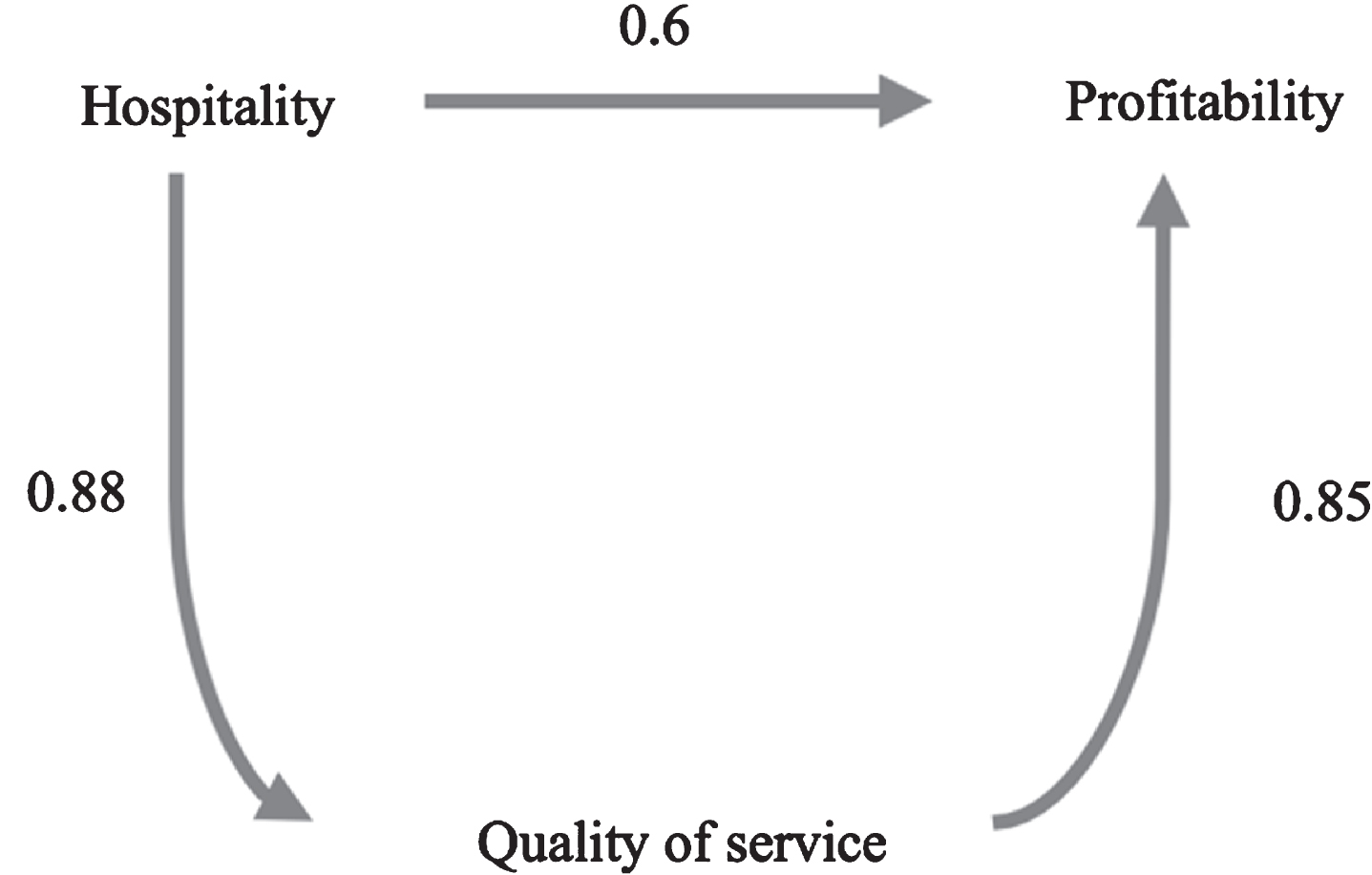
Cause - effect relationships between hospitality and profitability.

Cause - effect relationships between destination management and economic growth.
The relationship between price (l) and sustainable development (A), in which initially a value of 0.51 was estimated and in reality, this ratio is 0.73, then a forgotten effect is 0.22. The element brought is the price itself, and tourist spending, as shown in Fig. 4.
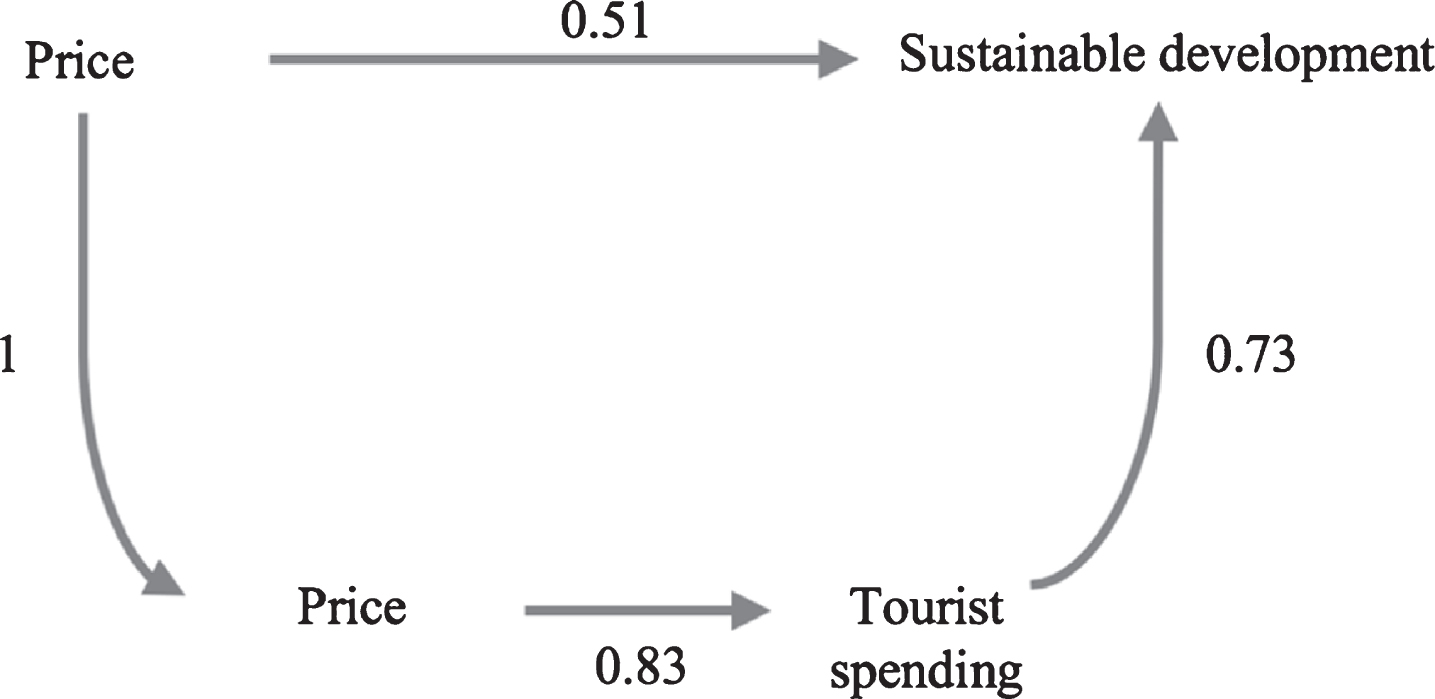
Cause - effect relationships between price and sustainable development.
The relationship between demand conditions (o) and economic growth (I) with a forgotten effect of 0.20; this relationship indicates that, although initially a ratio of 0.58 had been valued, in reality the relationship between them is 0.78, this is posibble through security, and economic growth itself, as can be seen in Fig. 5.

Cause - effect relationships between demand conditions and economic growth.
The relationship between accessibility (f) and sustainable development (A), in which initially a value of 0.55 was estimated and in reality, this ratio is 0.73 through accessibility itself, and tourism spending, then the forgotten effect have a value of 0.18, which is noted in Fig. 6.
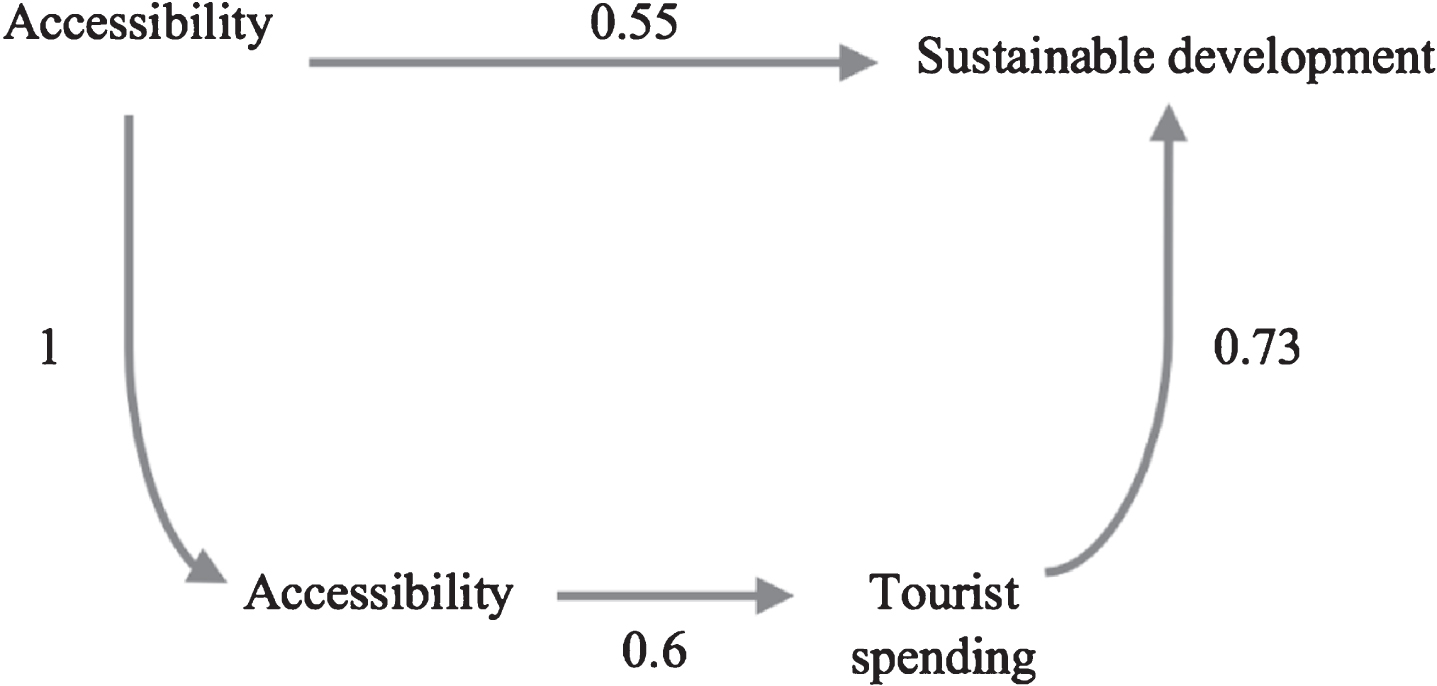
Cause - effect relationships between accessibility and sustainable development.
The theory of forgotten effects allowed us to analyze the direct and indirect incidence of the causes and effects of tourism competitiveness. In this work, Table 4 shows the direct incidences, also known as first-order relationships, Table 8 shows the indirect incidents, also known as second-order relationships. Finally, Table 9 shows the differences between direct and indirect incidences; as well as the accumulated forgotten effect. In this way, it was evident that sustainable development, economic growth, and profitability are the effects that were little recognized by the experts who participated in this study, but actually they have an important relationship with the causes of tourism competitiveness.
The result we obtained firm up the recent work of Salas et al. [45] who raise the need for integration in the management of a sustainable tourism model in its three dimensions (economic, social and environmental). In the same way, Ehigiamusoe [46] reveals that the tourism diminishes environmental degradation at early stage, but aggravates it as tourism increases, on the other hand, shows that tourism adversely moderates the impact of economic growth on environmental degradation.
Conclusions
Our aim with the present work was to identify the relationship between causes and effects of some variables that, based on the theory of competitiveness, play an essential role in a touristic destination, and clearly identify the direct and indirect incidences. The application of the theory of forgotten effects to the theory of tourist competitiveness has made it possible to determine the direct and indirect incidences between the elements, making visible that hospitality, destination management, accessibility, sustainable development, economic growth, and profitability are important elements when it comes to the design of strategies and decision-making, since through them the value of the relationship between some causes and effects is increased.
In particular, the effect of sustainable development stood out for to present the greatest individually forgotten effect with 7 causes: quality of service, accessibility, hospitality, location, security, price and micro environment. The aforementioned, leads us to think that regardless of where improvement strategies are proposed, such strategies must carry implicitly awareness of care and preservation of the environment. As Ehigiamusoe [46] mentions, tourism is a significant determinant of environmental degradation, hence, effort to mitigate it should incorporate tourism.
In the beginning, direct incidence was mostly correctly calculated, however, there was some important differences, which shows two things, the first is that the direct study was done well, and the second is that indirect forgotten effects can became to play an important paper in some aspects that were obviated in the study.
Competitiveness is a challenge currently faced by the various tourist destinations to preserve their position in the market, for that reason, it is necessary to take actions rightly aimed at the causes that origin it, for which the theory of forgotten effects becomes a useful tool, by showing cause-effect relationships which are not so simple to identify and that complement the opinion of the experts.
The main contribution of this study is to bring the theory of forgotten effects to the field of tourist competitiveness, being a first analysis from this perspective that has allowed to know the elements that that would have to be improved for to impulse the competitiveness in the sector. One of the limitations presented by this work is on the number of experts, it is necessary to consider a wider pool of experts. As future research, we consider that this study could be taken to specific tourist destinations or by type of tourism.
Footnotes
Acknowledgments
The authors thank the Michoacana University of San Nicolás de Hidalgo and the Mexican National Council of Science and Technology CONACYT, for the scholarship of doctoral studies awarded to the first author. The third author would also like to thank CONACYT for its support of this work with the scholarship number 740762.