



Abstract
The world’s population has increased exponentially in recent decades, and the rising demand for resources presents crucial challenges that need to be addressed to ensure humanity’s current pace of development without compromising the means of future generations. The purpose of the present study is to quantify the first- and second-order cause-effect degree of incidence that drives consumer behavior when selecting a sustainable product based on the opinions of academic experts in the field. The forgotten effects theory is employed for the treatment of information. The main advantage of this methodology is the combination of expert opinions with a robust mathematical procedure that allows obtaining not only the direct but also the indirect or hidden degree of incidence. The selected experts are academic leaders in the field of sustainability in Mexico. The results show a high direct incidence of variables such as education, income and culture and a strong indirect incidence of sustainable knowledge, environmental awareness and recommendations. The present study attempts to shed light on quantifying the direct and indirect elements that encourage consumers’ choice of sustainable food products and to understand the in-depth reasons for the discrepancy between the will and actions of consumers.
Introduction
Today, humanity faces many challenges in food production, distribution and consumption. The fact that a quarter of the world’s population presents with obesity, another quarter suffers from famine and malnutrition, and 1.3 billion tons of food are discarded without being consumed [1] are clear symptoms of the problem. Food inequality highlights the inefficiencies in the food production system, reflecting the prioritizing of profit over the natural limits of waste and food production [2]. Currently, the food industry demands require 70% of the available drinking water on the planet [3], which exerts a hydric and environmental pressure that is hard to sustain [4]. These circumstances demand a considerable change in the current food production and consumption system to a more sustainable model [5].
These challenges and changes require technical developments along with the highest of willpowers [2]. The sole development of the productive processes does not assure sustainability, as the use and disposal of products in many cases generates greater implications than their production [6]; here, the consumption choices of the consumer play an essential role.
The importance of consumer behavior and the reason why it has become an inseparable part of the sustainable development goals and business strategy is that purchase decisions determine the demand for raw materials, logistics, and production in all industries from services to finance [7, 8].
Recent surveys and studies highlight the fact that consumers are increasingly concerned about the environmental crisis and seek to make informed consumption decisions [7, 9– 11]. These studies also emphasize that environmental knowledge and concern are key factors that drive sustainable consumer behavior [12–14].
The public expression in Mexico does not differ; figures from the 2017 census of the National Institute of Statistics and Geography show that over 80% of Mexicans above 18 years old express concern for environmental protection and climate change [15]. However, although the population expresses being increasingly concerned with environmental problems, it is puzzling that citizens do not exhibit adequate sustainable consumption behavior [16], as stated by Jacobsson et al., [17] in their study on consumer attitudes and the purchase of sustainable products: “Why don’t they do what they say?”.
In its survey of consumers in the United States of America and the United Kingdom in 2018, Futerra, an international strategic sustainability agency, found that despite the desire to lead a more responsible and healthy life, 44% of sustainable product consumers said that “brands presented as sustainable not only did not help them to make a difference, they even made it more difficult” [6]. Considering this discernment of the consumer, companies that are in the segment of sustainable food products generate unsuccessful strategies because of misunderstandings of the factors that actually affect the behavior of sustainable consumers [7, 8].
Every good offered on the market that is designed to satisfy a desire or a need [18] is considered a product; if the aforementioned good also generates a positive social and economic environmental impact along its value chain, it can be considered a sustainable product [19].
Figure 1 compiles some of the theories representing the multifactorial reasons influencing consumer behavior and can be divided into rational reasons, i.e., the chosen evaluated options that yield greater satisfaction in the value-for money ratio [8], and, conversely, nonrational reasons, such as impulse and affective or social-cognitive selected choices [16].

Given the complexity and uncertainty generated in the purchasing process and the implicit consumer behavior, authors such as Gil-Lafuente [23] point out that the classic models, despite their broad interpretation of the phenomenon, are not always sufficient when trying to understand the mechanisms that drive persons to efficient consumption. Thus, there is a need to employ alternative tools, such as the theory of forgotten effects [24], which has been useful in the treatment of subjectivity and uncertainty and development in the purchasing process.
Kauffmann and Gil-Aluja [25] mention that estimating the degree of the forgotten effect in a process that involves previously identified causes and effects allows us to know the mistake made in the initial forecast, thus being able to redirect the carried decisions [25]. Other studies that have successfully applied the forgotten effects theory are, e.g., the valuation of attributes of a product or service [26], the segmentation of markets [27], regional economic analysis and the welfare of the population [28], growth strategies in the hospitality sector [29], exchange rate forecasting [30], and the social economy of companies [31].
The objective of this study is the application of the forgotten effects theory in the field of sustainability. The aim is to systematically treat the opinion of leading experts in this research field to calculate the direct and indirect incidence relation between the cultural, personal, social and psychological causes and the effect of product, promotion, price and place on a consumer when selecting a sustainable product.
The forgotten effects theory has proven to be effective when maximizing the total understanding of phenomena [24]. The application of this model in the present study allows a robust exploration of the highly complex decision-making process of sustainable consumer behavior. Moreover, it allows the identification of important connections that can be left aside when a traditional direct quantification of the variables is performed. The results indicate that the highest forgotten effect incidence concentrates on sustainable knowledge, environmental awareness and recommendations.
The structure of the article is as follows. Section 2 presents the methodology section, where the composition of the cause and effect matrices is described. Section 3 shows the main results retrieved from the experts’ opinion by the analysis of the forgotten effects. In Section 4, the reader can find a detailed discussion of the main findings. Finally, Section 5 presents the concluding comments of the study.
The forgotten effects theory will first be introduced. [25]. The theory is a composition of models designed to obtain the complete incidence relation [32, 33] between sets of elements without fully or partially omitting or overlooking initial information [34].
The model presents a series of rectangular matrix operations that can be described as follows: Let A be a set of causes such that A ={ a
i
/i = 1, 2, …, n } and B a set of effects defined by B ={ b
j
/j = 1, 2, …, n }. Please note that B could be the same set as A. The composition of both elements in a v (a
i
, b
j
) matrix results in the “direct incidence matrix”. This arrangement named
The composition
The present study considers elements from the theory on consumer behavior [8, 19–21] to generate the set
Causes of consumer behavior of sustainable food products
Acronyms: Id, Identification symbol; ACC, acronym.
Effects of consumer behavior on sustainable food products
An essential issue for the correct implementation and interpretation of a forgotten effects analysis is the collection of information. In the present analysis, we follow previous works such as [28, 38] to gather information. To evaluate the degree of incidence, the experts were asked to employ a usual scale for these types of studies [39], the linguistic endecadary scale. Table 3 presents the classic version of an endecadary scale.
Endecadary scale
The objective is obtaining the views of experts in the field of sustainability on the analyzed phenomena. To achieve this goal, the experts were asked to give their valuations for the expression: the degree of incidence that element a1 presents over element b1 is X. X is a linguistic valuation from the endecadary scale. This process is repeated for all the elements in
The software Fuzzylog [40] was used to process the aggregated information retrieved from the experts. The objective was to create a robust model that shows the direct and indirect incidence degree in a methodical and reproducible way.
Average experts’ incidence degree valuations
Tables 4–6 present the resulting matrices of the average experts’ incidence degree valuations.
direct incidence matrix
In general, the experts consider culture, education, income and social class to be the most relevant and influential causes of the general established qualities for a sustainable food product. On the other hand, the causes with the lowest average incidence are sustainable knowledge and environmental awareness, with valuations of 0.52 and 0.56, respectively. As mentioned above, “risks are not always explicit, visible or immediately perceived, sometimes these are hidden and are nothing more than the effects of effects, or an accumulation of causes”.
Following the theory of forgotten effects, the experts were asked to give their opinion regarding the relation between the causes and the relation between the effects. Tables 5 and 6 present the concentrated average opinions of the experts in these subjects.
Table 5 shows the average valuation given by the experts regarding the cause-cause incidence relationship. Please note that the main diagonal shows the incidence degree of an element over itself; therefore, it will always be 1. In general, education is the cause with the highest incidence degree of all of the causes (0.72). Gender, with an average of 0.5, and social acceptance, with 0.52, are the lowest-valued causes. Please note the overall high valuation between causes, in general; all of the cause-cause valuations have an average degree of 0.5 or higher, i.e., from intermediate to high incidence.
Table 6 presents the experts’ average valuated incidence degree for the effects-effects relation; for the specific case of this study, the qualities of a sustainable product were considered. For example, as shown in Table 5, the main diagonal of the matrix presents 1, meaning the highest incidence degree of the considered elements. Certifications, with an average of 0.74, are the highest average valuated effects, followed by price 0.72; on the other hand, payment methods, with an average of 0.55, present the lowest valuation.
Tables 7–9 present the resulting convoluting matrices obtained from applying Equation 1 and following the Forgotten Effects methodology [25].
convolution matrix
The absolute indirect incidence matrix shows that the elements with the highest forgotten effects are sustainable knowledge (28%), environmental awareness (25%), and recommendations (11%). On the other hand, the variables displaying the lowest forgotten effects, and therefore the most well-known, are education 7% and social class 8%.
Please note that Table 9 displays the absolute indirect incidence degree; here, a value of 0 represents a null forgotten effect, implying a complete initial understanding of the indirect effect that could be generated by the systemic behavior of the model. The highest forgotten effects registered in Table 9 are 6 binomial elements, all with a forgotten effect of 0.5, meaning that the direct valuation is equally relevant to the partial or omitted initial information.
The results show diverse interesting implications that are worth noting. First, sustainable knowledge and environmental awareness are conventionally some of the most obvious general causes that affect, to some degree, sustainable consumer behavior [12, 41–43]; however, the results show that not all the product conditions present a strong direct incidence, e.g., a high direct value (DV) incidence (0.81) is established between sustainable knowledge and certificates, but little direct incidence (0.35) is found between sustainable knowledge and payment methods. These differences generate a higher accumulation or accumulated value (AV) of forgotten effects (see Table 9).
Environmental awareness
Environmental awareness is the condition with the second highest amount of forgotten effects accumulation. In contrast with sustainable knowledge, this binomial shows a higher dispersion between diverse cause-effects elements, including services, brand, package, quality and ecolabel.
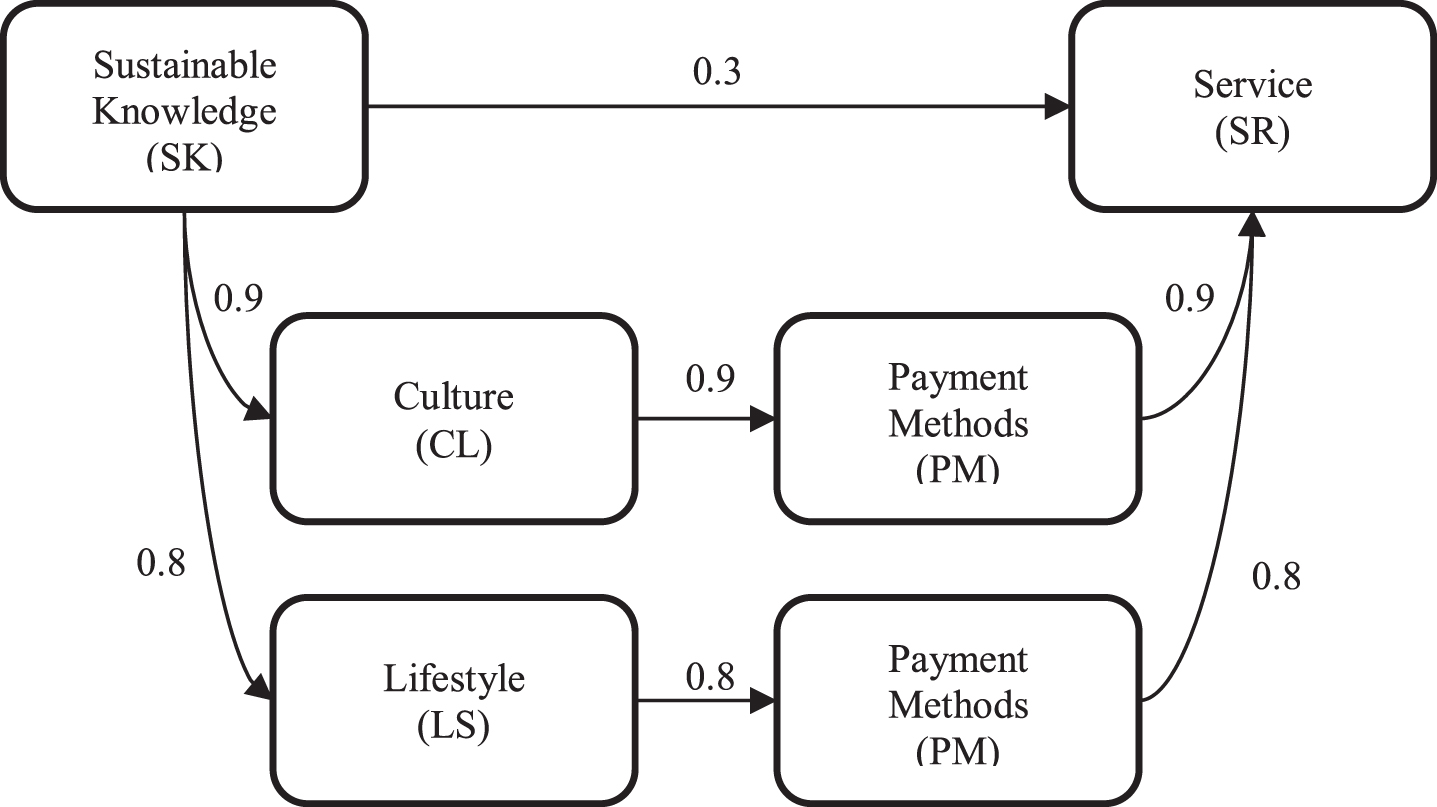
From the initial 0.3 direct incidence given by the experts, there is at least 0.5 total indirect incidence that has not been considered. The interposed relationship of 0.8 between culture and payment methods generates a 40% increment in the original effect.
The overall forgotten effects calculations present a symmetric causality in the differences between the direct incidence valuations and the accumulated valuations of environmental awareness and brand, ecolabel, quality and package. Figure 4 presents the interposed relations between culture, sustainable knowledge and certifications, with the latter initially being the highest valued direct incidence among all causes.
Interposed key relationship between sustainable knowledge and service.

Interposed key relationship between environmental awareness and service.

Interposed key relationship between environmental awareness and brand, ecolabel, packaging and quality.
One case of a higher forgotten effect is the relation between sustainable knowledge and services. In general, the experts underestimated by a value of 0.3 the incidence that the sustainable knowledge of a consumer has over the preferences of services when selecting a product.
An in-depth analysis of the causal relation between the selected elements shows a forgotten effect of at least 0.5. The interposed relations affecting this result are culture and lifestyle. These factors directly impact the effect element payment method, which presents a high direct incidence with service.
Recommendation
The highest forgotten effect for recommendation is quality, and the initial direct value given by the experts is 0.5 (intermediate incidence); however, the interposed relationship given by certificate (0.9) generates an absolute indirect incidence of 0.4. Ultimately, this forgotten effect generates a very strong incidence between recommendations and quality. Figure 5 presents the interposed key relationship between the mentioned elements.

Interposed key relationship between recommendations and quality.
The present study applies forgotten effects theory to consumer behavior when selecting a sustainable product. The aim is to quantify the direct and indirect relationship that variables in the field of sustainability hold based on experts’ opinions.
The results conclude that the highest forgotten effect is accumulated in the consumer behavior variables: sustainable knowledge, environmental awareness and recommendations.
An interesting and noteworthy phenomenon of the results is the strong linkage given by the indirect effects among environmental awareness, sustainable knowledge, and culture, as key conditions and determinants of the consumer behavior of sustainable food products. This synergy between culture and environmental concern is defined by Iris Vermeir & Wim Verbeke [44] as a tendency to reflect on postmodern society, its individuals, and their existing cultural norms. Likewise, sustainable knowledge is strongly linked to emotional and sociocultural attitudes. Bamberg & Möser [45] allude that this condition of the consumer does not act on decision-making directly but rather has an indirect effect that is generated through reflection, guilt, sociocultural norms and feelings of concern and responsibility.
In the particular case of feeding, such reflective behavior plays an important role in the decision about what a person is willing to eat or not eat to maintain a healthy body [46]. However, safety is an attribute that cannot be observed by the consumer, either before or after, so it must be guaranteed [47]. A recurring element for consumers is certifications, which the consumer perceives to indicate a reduction in risk, an increase in quality and the credibility of the process and product [48]; the importance of certification in the consumer behavior of sustainable foods matches with the results of this research, where “certificates” serve as the generator of accumulated value between the conditions of the consumer’s “environmental concern” and the qualities of the product’s “quality’’, “brand’’, “ecolabel” and “packaging” (See Fig. 4).
The theory of forgotten effects has been successfully applied in numerous studies; for our specific case, the implications regarding knowing the initially omitted settings that generate an overall indirect effect vary, e.g., visualizing a general picture of the elements that experts classify as vital for a sustainable consumer when selecting a product. In this case, the elements in the study that have 0 degrees of forgotten effect can be considered fully understood; however, deeper insight must be obtained for those elements where a higher forgotten effect is shown. The fact that some of the most initially obvious elements are not fully understood is both interesting and challenging, as these elements concern the complex attitudinal conduct of consumers. It should be noted that while the conventional qualities of a product such as price or quality are important decision-making factors, in a specialized market niche such as the sustainable food sector, consumers tend to have a more specific profile [44] with more developed ethical considerations and are identified as having above-average incomes and education levels [11, 41].
Regarding the key interposed element of “payment methods” and its indirect relationship with environmental concern and sustainable knowledge, Foscht et al. [49] indicate that the preference of an individual for a payment method depends on the personal characteristics of itself. The level of income and education are decisive in choosing a payment method [50–52]. In accordance with the results presented, given the consumer profile, this provides a first approximation to understand the strong incidence of the “payment methods” factor as an indirect-forgotten element; however, it will be necessary to address a deeper analysis to confirm this association.
The present research has some limitations: first, the number of experts considered for the analysis, and second, the possible omitted dimensions included in the model. Further research is needed, both to tackle the present limitations and to advance the understanding of the indirect incidence degree that affects consumer behavior when selecting a sustainable product. This study presents an initial step for the research on consumer behavior regarding sustainable products by applying the theory of forgotten effects. Nonetheless, an expansion of this study is suggested in order to consider not only academic experts in the field of sustainability but also experts in the industry and sustainable product consumers, thus obtaining a global picture of the principal stakeholders in the phenomena, visualizing discrepancies and creating strategies for decreasing the possible differences identified.
Acknowledgments
The authors would like to thank the experts that kindly responded the survey for this study. Especial thanks to Dr. Medardo Serna for his responses and advice throughout this research. The First and second author would like to thank the Mexican Council of Science and Technology (CONACYT) for the support given through the scholarships number 741832 and 740762.