



Abstract
College physical education is too one-sided, which makes the teaching process evaluation meaningless. Based on this, based on neural network technology, this article combines artificial intelligence teaching system to build an artificial intelligence sports teaching evaluation model based on neural network. The artificial intelligence model starts from the process evaluation and the final evaluation. Moreover, it uses a recurrent neural network for data training and analysis, and introduces a new decoder to perform data processing, and introduces a simplified gated neural network internal structure diagram to build the internal structure of the model.In addition, this study designs a control experiment to evaluate the performance of the model constructed in this study. The research results show that the artificial intelligence model constructed in this paper has a good effect in the performance prediction and evaluation of college sports students.
Introduction
College physical education is of great significance to students’ physique and future development. In the era of artificial intelligence, how to construct a college physical education evaluation system through artificial intelligence is an important aspect of the development of modern intelligent education. From the actual situation, the artificial intelligence prediction and evaluation system has entered the application stage. Compared with other subjects, physical education has certain deficiencies, and the difficulty of quantification is high, so it is necessary to analyze its artificial intelligence system separately [1].
The progress and development of a country cannot be separated from the support of education. Today, with the continuous development of science and technology, education plays an increasingly important role. Xiaoping Deng proposed that education should face modernization, the world, and the future. In the course of nearly 40 years of reform and opening up, my country’s education has been changing with each passing day, and education reform is steadily progressing and advancing, and it has now entered the deep water zone of education reform. In the report of the “Nineteenth National Congress”, it further emphasized the importance of giving priority to the development of education and proposed to give priority to the development of education, accelerate the construction of first-class universities and first-class disciplines, and further promote the connotative development of higher education reform. This shows that education has played an increasingly important role in the development of the entire country. Physical education is an educational undertaking and should also be developed. As an important part of physical education, physical education environment should be further improved. Therefore, the study of physical education environment in this paper is in line with reality. Educator Locke believed that sports is the foundation of all education. The importance of the physical education environment in physical education is self-evident. With the in-depth reform of my country’s education and the arrival of a new era, the importance of physical education environment has become increasingly prominent. However, judging from the current research results in my country, the PE teaching system has not been paid enough attention by relevant scholars, and the PE teaching environment evaluation system has not been systematic, rationalized and perfected [2].
As far as the current research status of physical education teaching environment in my country is concerned, the research focuses on the following aspects: research on the components of physical education environment; research on the design and optimization of physical education environment; research on the evaluation system of physical education environment. The research results have played a different role in creating a good physical education environment. However, in the study of physical education teaching environment evaluation, the structure of school physical education teaching environment evaluation is a little confusing, the definition of various indicators in school physical education teaching environment evaluation is a little messy, and the systematic and uniformity of the school physical education teaching environment evaluation is a little insufficient. In view of this, in order to optimize the school physical education environment and achieve a reasonable layout of the various resources in the school physical education environment, it is necessary to promote the benefits of physical education in schools and to harmonize the physical and mental development of the participating groups, and to build a scientific and systematic evaluation system for the school physical education environment [3].
Related work
The physical education teaching environment is an important part of the school teaching environment, and the two sides promote and influence each other. The literature [4] put forward the concept of physical education environment: physical education environment is the sum of the conditions that affect “teaching” and “learning” in the process of physical education. This sum mainly includes system, collective, atmosphere, material and other conditions. The literature [5] pointed out that the physical education teaching environment has a significant role in optimizing the construction of school classroom information exchanges, thereby defining the practical significance of the physical education teaching environment in the school classroom, that is, the synthesis of the objective conditions and forces necessary for school physical education activities. The literature [6] classified the physical education environment, that is, it divided the physical education environment into two categories: material environment (facility environment, natural environment, space-time environment) and social psychological environment (interpersonal psychological environment, organizational environment, emotional environment, cultural psychological environment).The literature [7] summarized the physical education teaching environment from the perspective of informatization as: comprehensive factors that can affect all conditions of teaching activities in the physical education teaching process, which explains the function and structure of the physical education teaching environment from the perspective of the information age. In summary, by collecting and sorting out the different opinions of experts and scholars on the physical education teaching environment, this article summarizes and combs their views. The concept of sports teaching environment is summarized as: the conditions that can affect the teaching process of teachers’ teaching and students’ learning. The physical education teaching environment is indispensable in the process of physical education in colleges and universities, and it is also irreplaceable, and students use the physical education teaching environment to learn to achieve the purpose of physical exercise or competition. From the perspective of the classification of physical education teaching environment, it can be summarized as a broad social and human psychological environment and a narrow material environment.
The literature [8] pointed out that the physical education teaching environment, as the carrier of physical education teaching activities, occupies an important proportion in physical education teaching activities and has a direct or indirect impact on the effect of physical education teaching. Therefore, the most urgent task of studying physical education is to study its constituent elements, and optimizing it is to provide a good guarantee for better physical education activities in the future. In the literature [9], the research on the elements of constructing the innovation environment of physical education in the University City showed that the innovation environment of physical education supports the realization of the innovation goals of physical education in the university city.
The literature [10] discusses the relationship between the two: the relationship between the two is closely related, complementary and mutually restrictive. The benign physical education environment can naturally produce beneficial effects on the physical education system and actively promote the teaching system.
The literature [11] studied the relationship between the physical education environment and the physical education system, and the research shows that the relationship between the two needs to maintain a “dynamic balance.” On the basis of “dynamic balance”, the role of the overall function can be fully exerted. In the study of the literature, the necessity of teaching reform is also mentioned. Teaching reform can make education better adapt to the needs of the social environment and can make the teaching system develop more rationally and scientifically.
The literature [12] has shown through research that the physical education teaching environment affects classroom information exchange, and believed that the impact on classroom information exchange mainly includes the following aspects: teaching methods, that is, objective hardware conditions can make teachers’ teaching methods more diverse; environmental factors, such as venues, indoor lighting, lighting, noise, etc.; The arrangement of the formation and the number of students in the classroom, that is, the position of the students standing in the course and the number of students in the classroom; Classroom psychological environment factors, that is, the interaction between teachers and students, which make the classroom atmosphere more active. The research in the literature [15] focuses on the effect of campus physical education. Physical education environment has irreplaceable effects on physical education and physical exercise. The study in the literature [16] pointed out that a good sports environment can enable students to obtain a sense of safety in physical education and exercise, so that students can learn and exercise in this environment to achieve the best results. The literature [17] showed that the teaching environment has the effect of increasing and decreasing efficiency in physical education, and it is of great help to the improvement of teaching quality and better exploration of educational laws. Moreover, the physical education environment has a profound influence on the internal mechanism of students’ physical and mental development.
Existing deep learning methods
Recurrent Neural Network (RNN)
The full name of RNN is a recurrent neural network, which allows information to pass from one step of the network to the next step of the network, as shown in Fig. 1. This chain-like structure has a natural advantage over data that has a certain temporal connection. It can be seen from the figure that the output at the current moment can be affected by all the moments before. If we think of it as a problem of reading comprehension, it can be expressed as the understanding of this article when reading the current position is affected by the previous segment. This structure can show this effect [18].
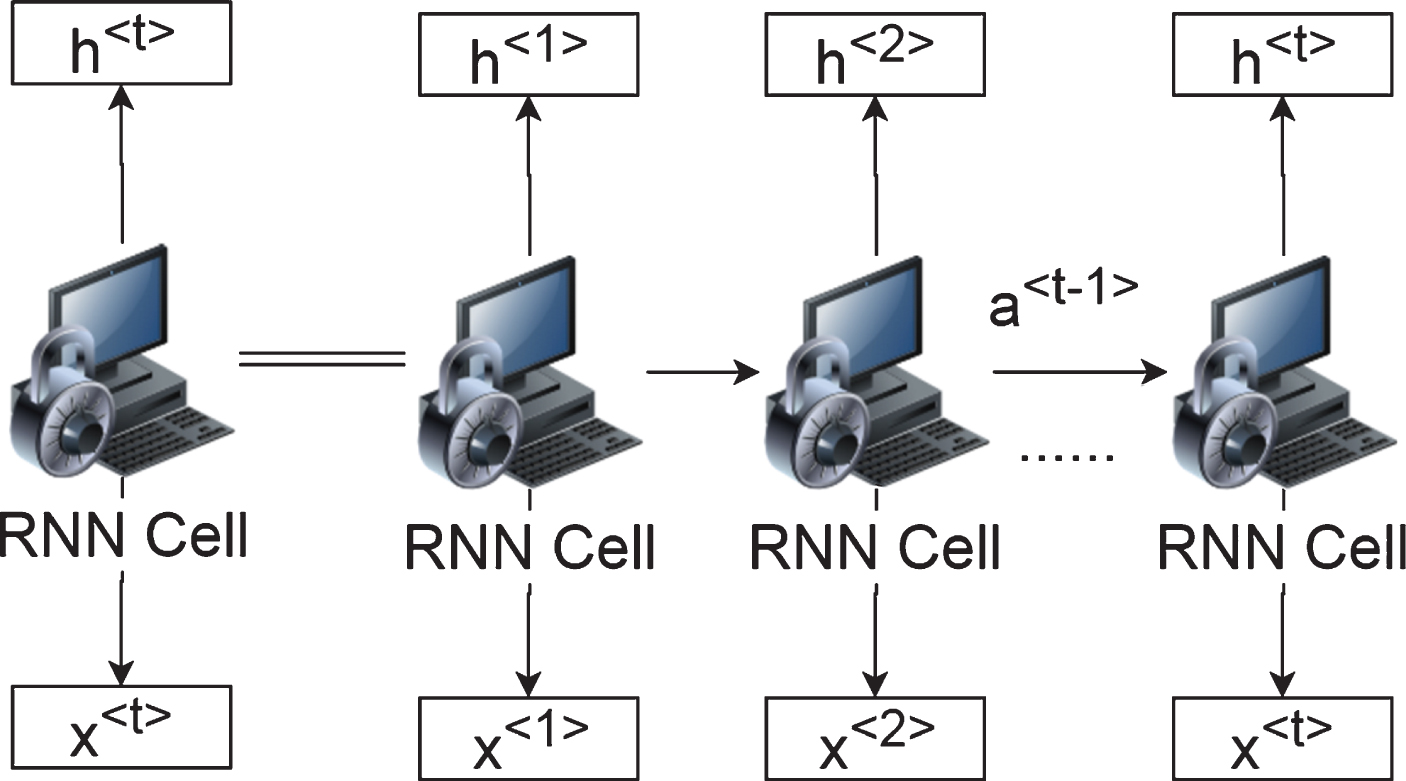
Structure diagram of recurrent neural network.
Recurrent neural networks can be applied to many scenarios, such as one-to-many, that is, inputting a vector to obtain multiple results; many-to-one, that is, the input is a vector sequence, and the output is a value, such as the classification problem of movies, many-to-many, that is, the input is a vector sequence, and the output also is a vector sequence, such as the problem of machine translation. In each case, there is no pre-specified constraint on the length sequence, but a recurrent neural network, which solves the obvious limitations of traditional neural networks.
The recurrent neural network scans data from left to right, and the parameters of each time step are also shared. The parameters will be described in detail next. The formula of recurrent neural network is (1), which defines the forward propagation of recurrent neural network. As shown in Fig. 2, forward propagation is completed from left to right [19].

Internal structure diagram of recurrent neural network.
The above formula
The activation functions commonly used in recurrent neural networks are tanh and ReLU. Which activation function to choose depends on the output. If it is a dichotomy problem, then the sigmoid function will be used as the activation function. If it is a multi-category classification problem, the softmax activation function will generally be used [20].
Although the recurrent neural network has a good performance for the sequence model, there is still a big problem with the recurrent neural network, that is, the problem of the disappearance of the gradient. When we use sigmoid or tanh as the activation function and the derivative range of sigmoid and tanh are not greater than 1, as time goes on, the multiplication of decimals will cause the gradient to become smaller and smaller until it approaches zero.
There are two solutions for solving the problem of gradient disappearance. One is to choose a better activation function. For example, ReLU is selected as the activation function, the left derivative of the ReLU function is 0, and the right reciprocal is always 1.However, this activation function will easily cause gradient explosion, so a suitable threshold can be set to avoid the problem of gradient explosion. The second is to change the propagation structure within RNN [21–26].
GRU is evolved by RNN changing its internal propagation structure. The purpose of the proposed is to solve the problem of gradient disappearance so that the model can have long-term memory. Gated circulation unit is to improve the problem of gradient disappearance by changing the cell structure of RNN. As shown in the figure, it is a visual presentation of the GRU unit. The GRU unit introduces a new variable c. The meaning of this variable is the memory cell, which is used to provide the memory capacity of the model. The core idea of GRU is to have an update gate. The output of the update gate uses the sigmoid activation function, and the output value is a value between 0-1, and the probability that the value is close to 0 or close to 1 is greater.
Therefore, Γ
u
is like a gate to decide whether the current input needs to be remembered, that is, whether to remember the new information or discard the information to maintain the original memory.
The internal structure of the simplified gated neural network is shown in Fig. 3. It can be seen from the figure that if Γ u approaches 1, the previous memory information is completely updated by the current input, and the previously memorized information is completely forgotten. Conversely, if Γ u approaches 0, it means that the current input is not important to the result, the original memory information is not updated, and the original memory information is retained. For example, taking the word lady as an example, for the previous example, although the lady is far away from the person’s word, the middle input did not make the lady’s information forgotten but kept it until more important information appeared.
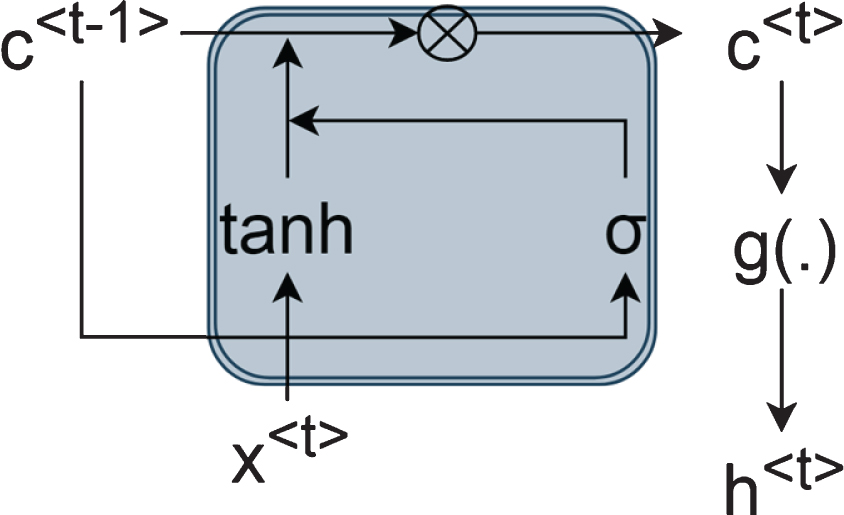
Internal structure diagram of the simplified gated neural network.
For the complete GRU unit, it is necessary to add another gate Γ
r
, r represents how much
Both of the above are GRUs and a common variant of RNN. By using this structure, the dependence in a longer range can be better captured, which makes the RNN more effective.
LSTM is another relatively common recurrent neural network, and it is a more powerful and versatile version than GRU. In LSTM, there is still an update gate Γ
u
and Γ
u
= σ (W
u
[a〈t-1〉, x〈t〉] + b
u
). The new feature of LSTM is that there is more than one update gate to control. LSTM adds a new forget gate, denoted by Γ
f
, and Γ
f
= σ (W
f
[a〈t-1〉, x〈t〉] + b
f
), then adds a new output gate Γ
o
= σ (W
o
[a〈t-1〉, x〈t〉] + > b
o
). At this time, the updated value of the memory cell is changed to

Internal structure diagram of long and short termmemory network.
In the history of deep learning, LSTM appeared earlier, and GRU was invented after LSTM.GRU stems from simplification on the more complex LSTM. The advantage of GRU is that it has a simple structure and it is easier to build a larger network. However, LSTM is more powerful and flexible, and it is also the gating structure that is first considered in recent deep learning task research.
The RNN encoding and decoding model consists of two recurrent neural networks. One RNN encodes the symbol sequence into a fixed-length vector representation, and the other RNN decodes the vector representation obtained by the encoder into another sequence. Moreover, the encoder and decoder of the model are jointly trained. The model first encodes a variable-length sequence into a fixed-length vector representation, and then decodes the fixed-length vector representation into a variable-length sequence. From the perspective of probability, the encoder decoder structure learns p (y〈1〉, ⋯ , y〈T′〉|x〈1〉, ⋯ , x〈T〉), that is, the input and output are both variable length, and the length of the input T and the length of the output m can be inconsistent.
For the encoder-decoder model, the most common is to obtain a fixed-dimensional vector c through the input sequence x = (x〈1〉, ⋯ , x〈T〉), and the formula is as follows:
Among them,
The encoder stage is an RNN. The RNN reads the input sequence in sequence, and the state of the hidden layer is updated each time the current input is read. When the end of the input sequence is read, the hidden layer of the RNN finally encodes the entire input sequence into a c vector. The decoder proposed in this article is another recurrent neural network. y〈t〉 and h〈t〉 are determined not only by yt-1, but also by the final output c of the encoder. Therefore, the hidden layer calculation formula of the decoder at time t is as follows:
Correspondingly, the conditional distribution probability when the result y
t
is obtained in the decoding stage is:
Where f and g are activation functions, and the output of the g activation function is a probability value, such as the softmax activation function.
As shown in Fig. 5, the cell unit in the figure uses the RNN unit. However, when the encoder and decoder are specifically used or implemented, the neural network used by the encoder and decoder is optional and does not need to be the same. For example, the encoder uses the LSTM structure and the decoder uses the GRU structure, or the encoder uses the RNN cell unit and the decoder uses the LSTM. We only need to choose according to the specific situation.
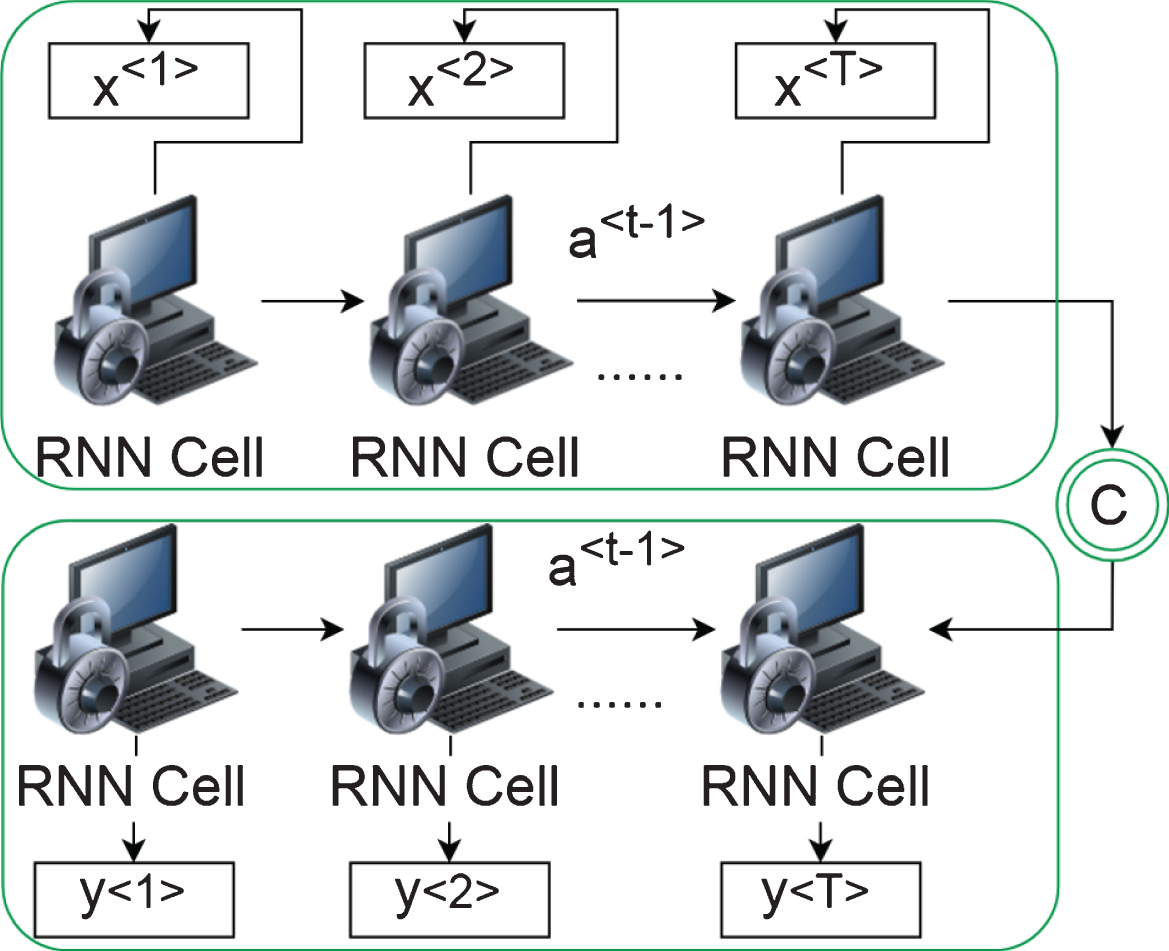
Model diagram of the encoder and decoder.
The model of the encoder decoder solves the problem that the input and output are not fixed-length, and is widely used in machine translation. However, as a model, it still has its own drawbacks. As mentioned above, the encoder encodes all inputs as c vectors, but the length of the c vector is fixed length, that is, the encoder compresses the entire input sequence into a c vector. This means that there will be a certain part of the information missing during the compression process. This part of the lack of information is not helpful in the decoding stage, that is, to obtain the final result. That is to say, in the decoding stage, the decoding sequence did not get enough information from the beginning. Therefore, the accuracy rate will also be affected. In order to reduce this effect, the attention mechanism is introduced.
The model constructed in this paper is shown in Fig. 6.
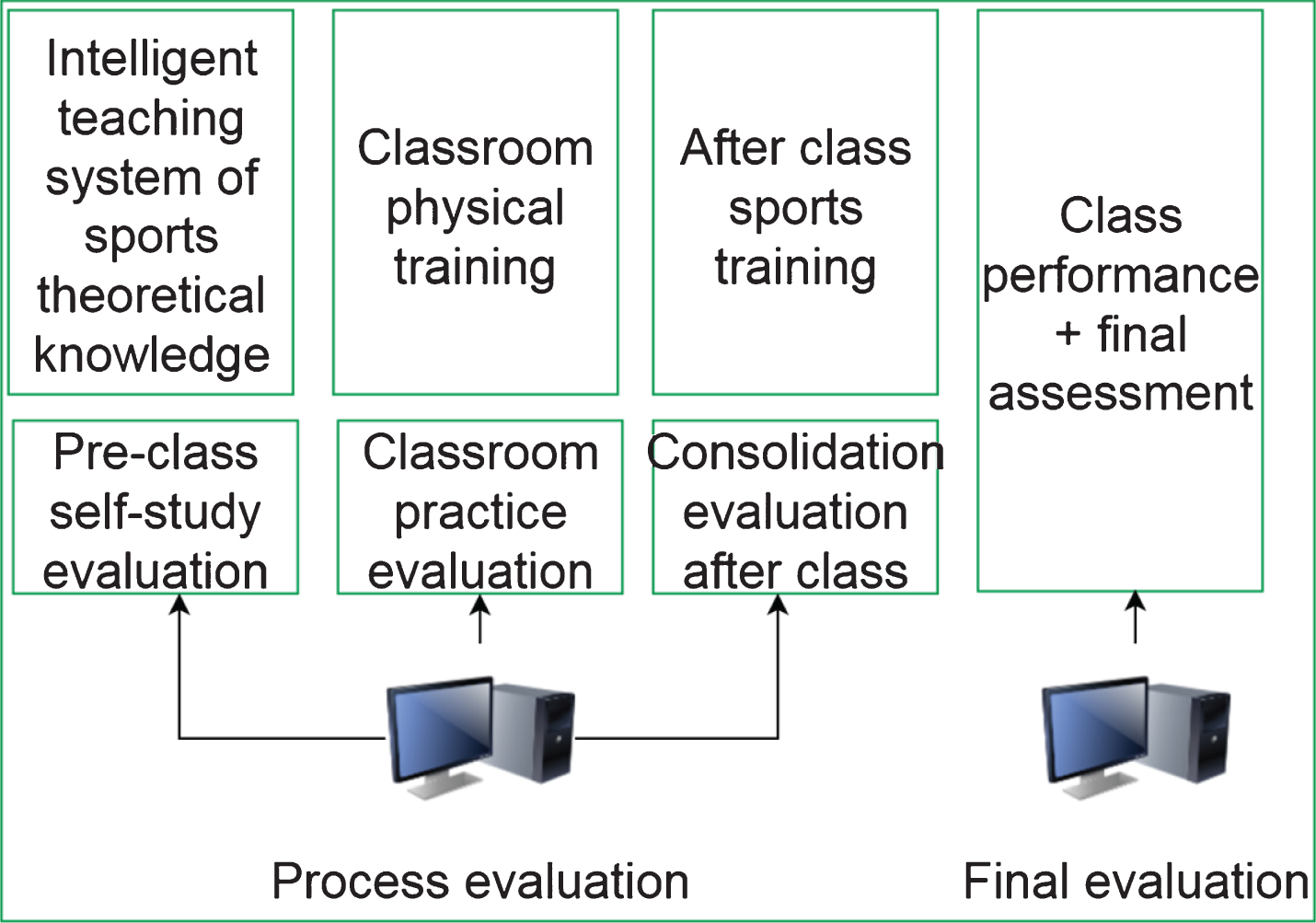
System model.
In previous teaching, most of the evaluation methods for student achievements used final evaluations, that is, final exams. This evaluation method cannot truly reflect the students’ true learning ability, and the evaluations made are not objective.In mixed teaching, evaluation methods include not only final evaluation, but also process evaluation. The process evaluation includes three parts: the evaluation of self-study before class, the evaluation of classroom practice and the evaluation of consolidation after class. The final evaluation is composed of the sports standard test, sports technical standard evaluation and classroom attendance rate.
Based on the construction of the above model, the performance of the model is analyzed, and the results of the classroom process evaluation are simulated first. The results obtained are shown in Table 1 and Fig. 7.
Statistical table of scores of process evaluation
Statistical table of final evaluation
As can be seen from Figs 7 and 8, the artificial intelligence model constructed in this paper has a good effect in the prediction and evaluation of college sports students’ performance, so it can be seen that the algorithm in this paper has a certain effect.
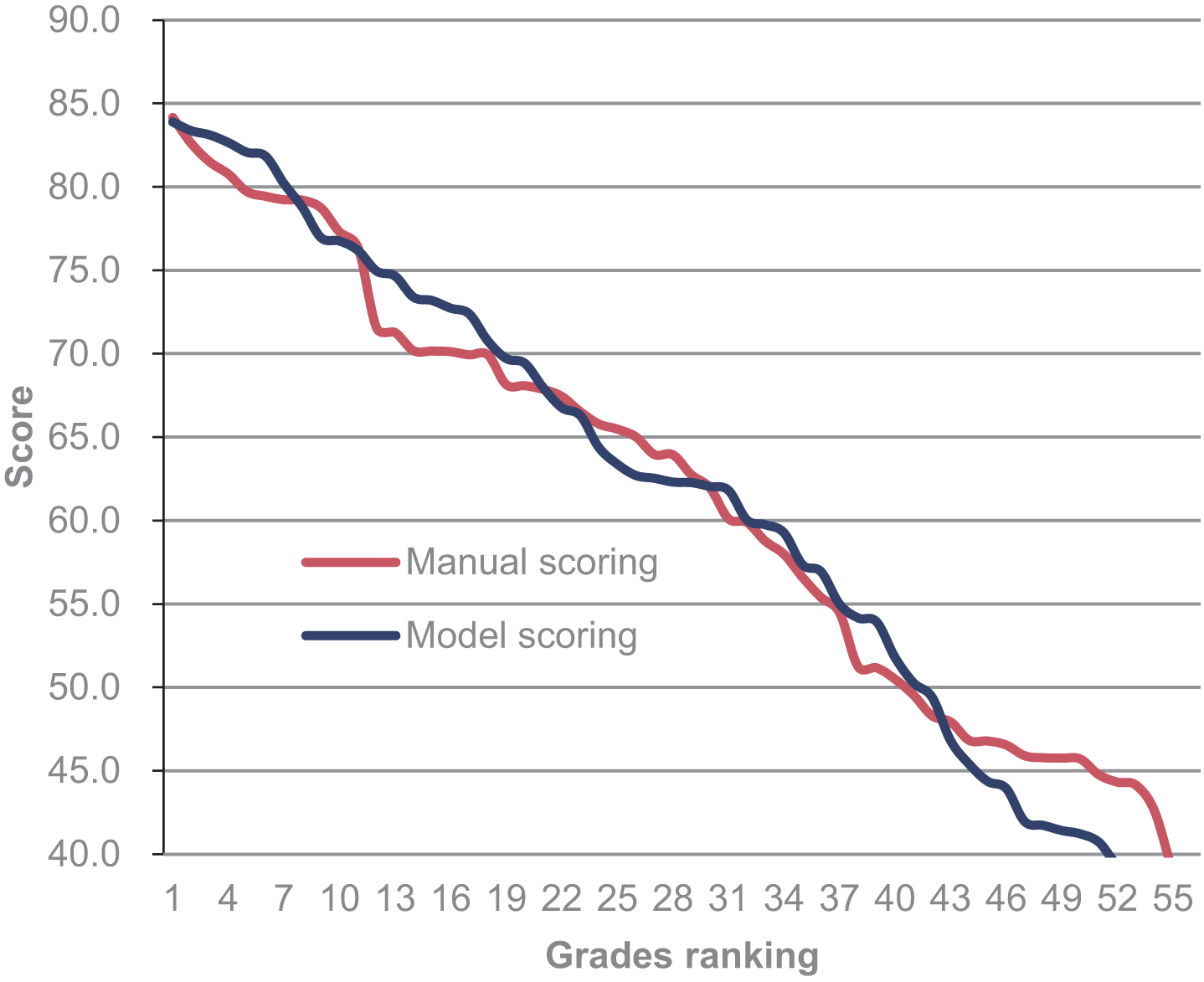
Statistical diagram of process evaluation.
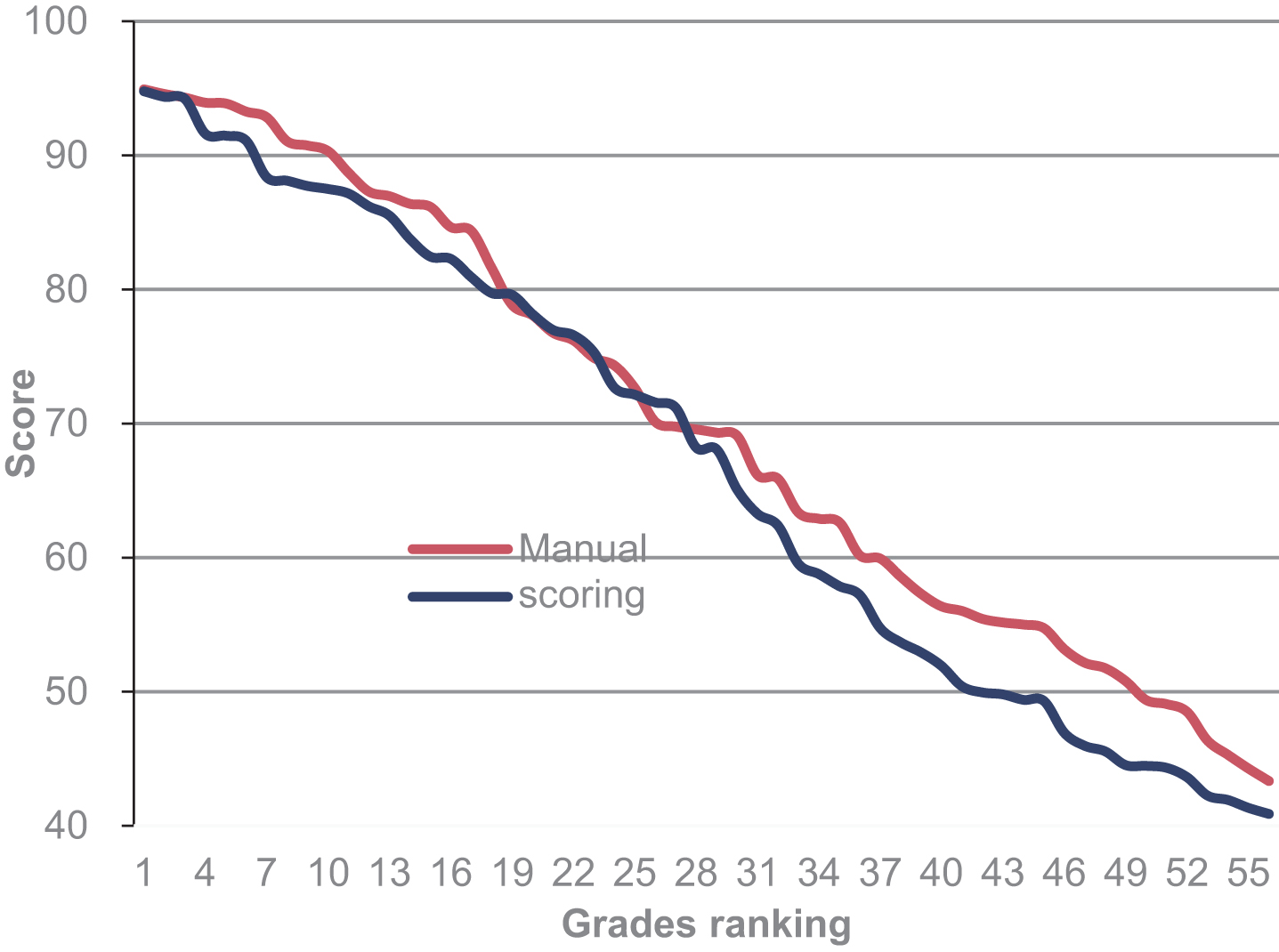
Statistical diagram of final evaluation.
In the era of artificial intelligence, physical education needs to keep pace with the times. In order to optimize the school physical education environment and achieve a reasonable layout of the various resources in the school physical education environment, it is necessary to promote the benefits of physical education in schools and to harmonize the physical and mental development of the participating groups, and to build a scientific and systematic evaluation system for the school physical education environment. In this study, the newly constructed artificial intelligence model is used to evaluate college physical education to verify the feasibility and effectiveness of the evaluation system. Moreover, the artificial intelligence model in this paper is developed from two aspects: process evaluation and final evaluation. Among them, the process evaluation includes three parts: the evaluation of self-study before class, the evaluation of classroom practice and the evaluation of consolidation after class. The final evaluation is composed of the sports standard test, sports technical standard evaluation and classroom attendance rate. After the model construction is completed, the performance of the model constructed in this paper is analyzed. The research results show that the model proposed in this paper has good performance.