



Abstract
Artificial intelligence technology has been widely used in all aspects of our life. Similarly, the application of artificial intelligence in the field of construction engineering is a necessary trend in the development of engineering industry, especially in the traditional construction engineering department. Under the background of the times, from the perspective of knowledge, artificial intelligence technology has appeared a huge development, which may have an impact on the employment of Chinese labor force, may create new jobs, or replace traditional jobs. This effect on employment is essential. From the perspective of machine learning and artificial intelligence, this paper reviews the transformation prospects of engineering industry and the development of agricultural industry in construction industry, and examines the intellectual transformation of individual human capital in Chinese labor force.
Introduction
Since the beginning of the 21st century, the field of artificial intelligence has been continuously strengthened as a comprehensive science. It involves the research and development of “artificial” systems used by various methods, theories and applied technologies to simulate and expand human intelligence, with the aim of developing “artificial intelligence with a cognitive, ideological and logical reasoning and judgment ability.” Strong artificial intelligence, refers to artificial intelligence customized to solve problems that have not been encountered before, is now difficult to obtain artificial intelligence with real feelings of life, weak machines can rely on external equipment and data, and with the support of existing experience or database, has a certain ability of perception, understanding and reasoning, which is more common, and in the near future, it is most likely to apply to our life and work.
Artificial intelligence technology has been widely used in all aspects of our life. Similarly, the application of artificial intelligence in the field of construction engineering is an inherent trend in industrial development, especially in the traditional construction engineering department. Applications will promote the stable development of architectural design and maintain orderly management and experienced services. It can be said that there is unlimited potential to change the current situation of traditional sector development, so it is necessary to find appropriate application development penetration points to overcome the current obstacles in application development. The main content of learning in various departments is to study how machines acquire new knowledge or skills to simulate or implement human behavior in other aspects based on existing or previous experience. It is therefore essential that machines learn how to act as the primary means of deploying or supporting their intelligence and study how to apply in engineering.
In the era of knowledge, artificial intelligence technology has developed greatly, which may have an impact on the employment of Chinese labor force, create new jobs, or replace traditional jobs. The essence of this effect on employment is the process of adapting artificial intelligence technology to human capital structure, which is an integral part of human capital. From the point of view of machine learning and artificial intelligence, this paper examines the transformation prospects of industry and the development of construction industry and industry, and examines the intellectual transformation of human capital of individuals in Chinese labor force.
Related work
PLiterature [1] shows that ai systems can simulate human experts in a particular field to make decisions and propose solutions, while traditional software is mainly engaged in data processing, while ai systems are mainly concerned with the expression and processing of knowledge. therefore, in general, they use and judge knowledge rather than analyze problems. Literature [2] the initial use of neural networks was mainly used in high-level building systems, using a three-level network. the factors that affect high-rise buildings and structural systems were divided into 12 input units, which included 5 common high-rise structural systems (including frame structure, cut wall structure, wall structure) to realize the reverse transmission of neural networks. The results of frame cutting, frame and cylinder structure and cylinder structure selection coefficient, by learning more than 100 typical examples to form a model, further improve and develop reasoning based on gas discharge plant examples. For example, HIDE-3, look for relevant examples based on basic parameters to support preliminary design details, such as structural systems, floor plans, selection of structural components, and assembly structures. Document [3] the establishment of intelligent operation and maintenance management platform based on large biometric data, and the analysis of inefficient probability model by mechanical learning method, which can send out alarm signal in the early stage and provide a basis. In order to provide a decision basis for the response. Document [4] using the algorithm of “extreme learning machine” and using random neural network to detect the surface damage of reinforced concrete, the traditional way of test results is greatly changed.
A series of studies on safety management in agricultural work have been carried out [5] the literature. It is suggested that a high precision, high speed and widely used in-depth learning method be adopted according to the objectives of the selected fields. In order to determine whether construction workers wear anti-head helmets, this method is very accurate and fast. It can effectively detect the safety helmets of workers on site under different visual conditions and promote the safety inspection and supervision of buildings. A new approach to identifying risks faced by workers close to hazardous areas is proposed [6] the literature. first use the positioning grid to track workers and simulate their movements. The motion pattern learned from the track records of workers in the same industry reflects the sports hobbies of workers in different industries. The random model represents a random dynamic. By using the worker’s tracking position and movement mode, the next arrival location of the worker can be predicted, and then the risk can be calculated. operator authentication is verified according to image processing technology to identify possible accidents on site and simplify construction site data; literature [7] for site safety detection, divided into two groups, one group is unsafe behavior, the other group is unsafe state, based on: extracting object semantics from scene data, spatial semantics, background semantics and behavior semantics, based on semantic grade, according to building safety theory of panoramic data, the correspondence between image semantics and overall panoramic data is proportional.
Technological progress can reduce the demand for labor and help improve the level of labor. Literature [8] regards technological progress as a “destructive creation” of employment, that is, it is possible to destroy the existing employment order, but it is also possible to create new jobs. Some scholars view the impact of technological progress on employment from the perspective of economic growth, and believe that technological progress can improve unit labor productivity and market capacity, thus creating employment opportunities. Document [9] focuses on investment in higher education, which helps to increase human capital in the labour force, improve competitiveness in the labour market and increase employment opportunities [10]. Literature shows that investment in human capital can reduce the scattered phenomenon of employment of conquered farmers, and people with higher education can also be fully employed to reduce the occurrence of this scattered phenomenon [11]. The literature uses actual data from China, empirical analysis shows that technological changes in different regions and industries in China have different effects, and technological progress has a more positive impact on China’s economic and social development. The employment situation of the labour force in the central and eastern parts of the country has improved significantly, contributing significantly to employment in the industrial, mechanical and service sectors, with the construction sector being the most affected sector.
Model of construction behavior recognition and action capture of migrant workers
Monitoring the unsafe condition of workers can effectively prevent accidents in construction sites and solve the defects of behavior safety control in traditional building management. We suggest the establishment of a mobile phone-based activity identification and tracking system. Smart phones automatically generate mobile databases, using machine learning classification algorithms, and are currently building an action recognition model for intelligent reconnaissance and tracking of field staff operations.
Overview of conduct-based construction safety research
In recent years, the construction industry has suffered a large number of casualties, and the construction industry is one of the most dangerous sectors in the world, and its accident rate is far higher than that of other sectors. In the past few years, Governments and industry have made increasing efforts to control and invest in building safety, but substantial progress has not been made, nor has there been significant improvement in building safety. This situation is largely related to the insufficient strength of basic research, so new ideas and techniques are needed to study in depth the characteristics of accidents and injuries in the construction process in order to take reasonable and effective measures. Lay the foundation for strengthening building safety.
In general, physical and physical insecurity and their interaction are the direct causes of security incidents, while the number of temporary structures and facilities is large, the conditions on the ground have changed significantly, and physical insecurity (working environment) occurs frequently throughout the system. To a large extent, construction insecurity is also caused by the insecurity of people, especially managers, such as unsafe construction schemes, unreasonable safety management methods or safety measures. Therefore, monitoring and investigating workers’ dangerous behavior is crucial.
In order to reduce accidents and improve safety management, it is absolutely necessary to strengthen behavior management and control, and eliminate people’s insecurity, which is a problem behavior based on computer security research. The criteria include the following steps: first, list the relevant unsafe behavior; then observe the behavior of workers and record their frequency, which often requires close attention in the field, and some special places where auxiliary equipment can be used; provide feedback and intervention strategies to solve unsafe problems.
Through statistics, the main research focuses on:(1) organizational-level management mechanisms that affect individual behavior;(2) cognitive analysis and simulation of the causes of worker insecurity;(3) characteristics and patterns of worker insecurity (4) research on early warning systems for controlling responses and unsafe behaviors.
In fact, the BBC research results have been implemented in some projects, but there are still shortcomings, such as excessive reliance on the opinions of workers, the cost of a lot of money and time, and the difficulty of proving unsafe behavior in inappropriate samples. Automation of monitoring or certification processes is therefore critical. However, all vision-based technologies require cost input to install a number of relatively large cameras on site to identify faces. At the same time, image processing technology is sensitive to changes in light and environment, and the complexity of field conditions makes information processing very difficult. It is noted that not all buildings or workplaces are suitable for installing cameras, such as some temporary buildings or ancillary facilities, it is difficult to ensure that the camera covers the whole area, and this approach is not widely used due to various factors.
Relatively speaking, collecting worker flow information using internal sensors of portable devices (e.g. smart phones) can effectively reduce the disadvantages of such activities. For example, smart phones do not require additional costs, and the stability of internal sensors is more robust, accurate and effective than magnetic resonance imaging sensors. At the same time, the data storage, transmission and processing function of mobile phone is more powerful, which greatly increases the convenience of work identification automation.
Design of a worker behavior identification system
An intelligent identification system for construction workers based on unsafe behavior (IRSUD) is designed in this paper, which operates in three stages: Model development phase: First, mobile phones should be fixed at the staff member’s waist, using highly integrated sensors to collect information about the speed and angle of the staff member at work. By collecting a large number of staff action samples, as shown in step 1 and step 2 of Fig. 1, a behavior recognition or action capture model is established according to the algorithm of mechanical learning separator (auxiliary vector and BP neural network used in this paper), which is saved in smart phone. Execution phase: an identification module within a smart phone that analyzes the worker’s mobile signal based on the identification results and then determines it to be “safe” or “unsafe” status. The center receives the notice and sends out the warning in time. In the event of behavior, the mobile phone reminds both parties of unsafe behavior, evaluates the risk of site workers’ work according to the information provided by the site, and formulates a systematic management strategy, as shown in step 3–5 of Fig. 1. Model update phase: As shown in step 6 of Fig. 1, the typical error behavior is fed into the training sample database by concentrating the data in the implementation phase and then the classification model is updated for gradual optimization, see Fig. 1 for details.
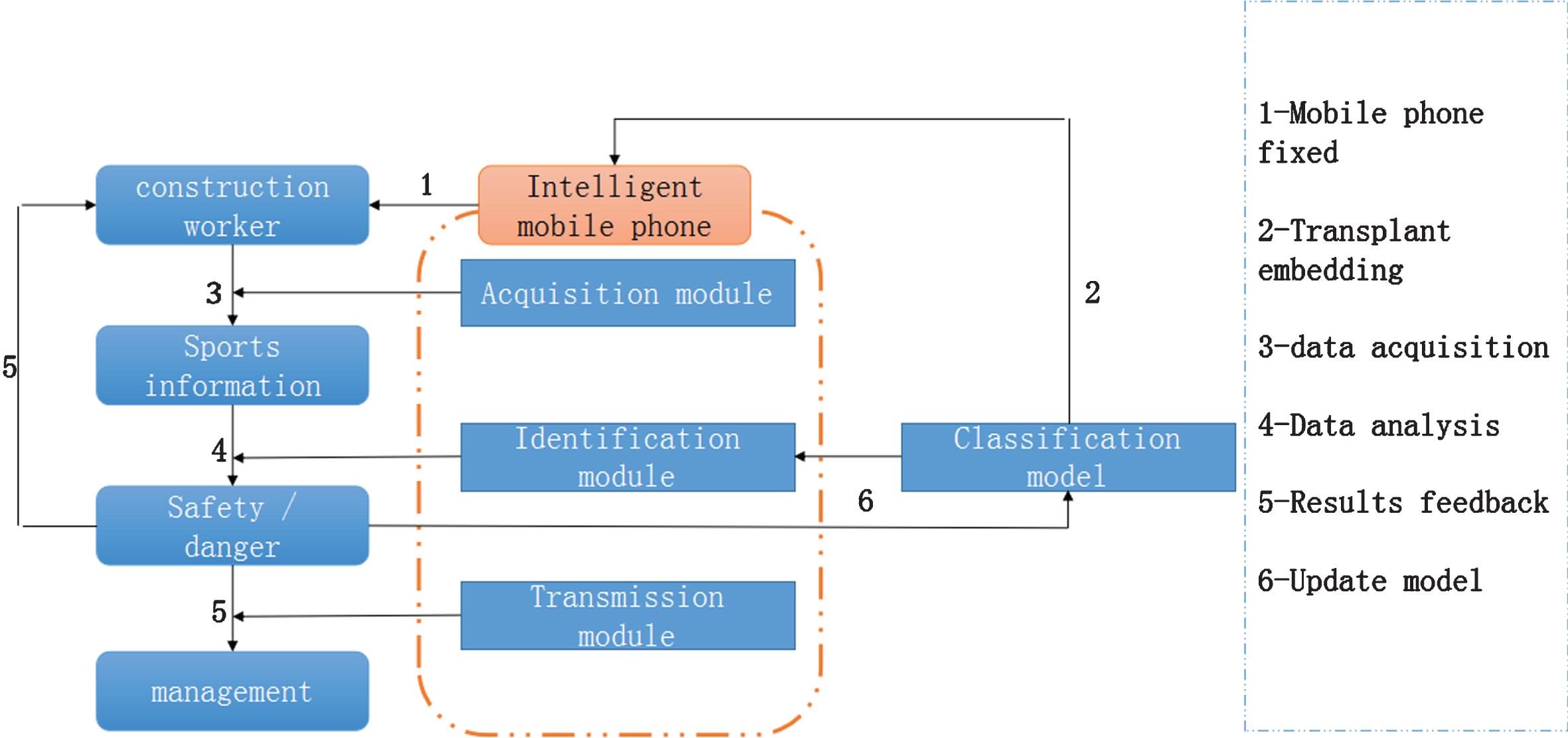
Intelligent Identification System for Unsafe Behavior of Workers.
The main features of the system are: “Crowdsourcing “means publishing an online (mobile) task on the Internet, in cooperation with the public, often through a network-based mechanism, based on the local area network or Bluetooth of a smart phone, which allows for the provision of tagged training samples to all builders with smart phones, thereby creating a database of large training samples. Builders can download models from the server to mobile phones and share them. Make full use of smart phones for real-time data acquisition and monitoring to achieve low-cost automation. The methodology is broad enough to cover similar situations or areas, such as the construction conditions of inspectors or supervisors during construction, the structure of the site and the machinery.
Selection and modelling
The study is divided into two parts: behavior recognition and capture motion. In this case, the identification of activities can distinguish whether workers use seat belts properly during their work and produce “dangerous” or “safe” marks. According to workers’ information, capture campaigns collect specific actions from a series of workers’ actions. Table 1 presents information on scenarios and equipment selected for the experiment, see Table 1 for details.
Information on the use of seat belts
Information on the use of seat belts
This study extracted 21 features from six signals, i.e., a total of 135 attribute values, as shown in Table 2. Table 1 treats each feature of a signal as an “attribute “, while defining the same feature belongs to an attribute. For example X the maximum value of the acceleration signal on the axis is treated as an attribute, while the maximum value of the acceleration or angle signal on different axes is treated as a “maximum value “, see Table 2 for details.
Types and serial numbers of typical mining
BP neural network and SVM are selected as recognition algorithms in this experiment.
The classification intervals of interface (w·x) + b = 0 are:
Finishing available
In terms of linear division, the hyperplane problem with the largest classification range is reduced to two programming problems (the objective function is a secondary function and a mathematical programming problem involving linear functions):
The constraint condition is inequality:
The Lagrange multiplier definition function is introduced as follows:
Depending on the alpha multiplication, the solution to the planning problem is determined by the lagrangian function, where the following conditions must be satisfied:
αiFor Lagrangian multipliers corresponding to each sample, only a portion of the solution αiNot 0, the corresponding sample is a support vector.
The classification rule based on the optimal hyperplane is the following indicator function:
Concrete measures actually implemented are:(1) procurement of a training sample (X,YI);(2) selection of a function for nonlinear transformations and identification of a penalty factor for misclassification;(3) manufacturing of a secondary optimization problem;(4) understanding of the secondary optimization problem;(5) procurement and acquisition of auxiliary vectors; and (6) input of samples into the auxiliary vector test to obtain results.
BP neural network consists of positive propagation and reverse positive transmission, its principle is relatively simple, because the loss value of the input data corresponds to the current network parameters. The reverse transmission of the nervous system is based on the external chain gradient. According to the first weight parameter W1 in the four binary neural layers of a neural network, the W1 reverse transmission is calculated as follows:
If the learning rate is 1, this backpropagation w1 The updates are as follows:
The rapid development of computer equipment, especially GPS acceleration technology, which has been continuously updated since the 21st century, provides more support for large data acquisition technology. The database greatly enriches the training process and enables people to better identify the network models used. At the same time, many in-depth learning business platforms and learning tools have emerged, such as the African Family Development Fund, Tensorflow, CNTK, Theano, Torch, Keras, Mxnet and so on, which enable in-depth learning in different contexts.
In-depth learning of the convection and adaptation processes as shown in the figure (using the highest value of strategic sampling), see Figs. 2 and 3 for details.

Picture convolution process.

Pooling process.
The typical convolutional neural network structural layers corresponding to the melting and joint processes are mainly two structural layers, the melting layer (COV) and the polymerization layer (POOL), plus the complete junction layer (FC), the activation layer (LUL) and the polymerization layer (POL). the loss (here is the whole Softmax layer) and some additional layers, including the local standard reaction layer (LRN) and the random active layer, constitute the complete neural network. this basis produces the main indicators of the evaluation counter algorithm. Accuracy (Precision), indicating how many of the predicted positive samples are correct, is calculated as follows:
Recall rate (Recall), indicating how many positive examples in the sample have been predicted correctly. The formula is as follows:
Accuracy (Accuracy), representing the correct proportion predicted in all samples, calculated as follows:
F1 value, in order to be able to evaluate the advantages and disadvantages of different algorithms more comprehensively, the concept of F1 value is put forward on the basis of Precision and Recall, which is used to synthesize the indicators that reflect the whole. The formula is as follows:
The ROC curve and AUC: first need to understand the concepts of negative positive rate and true rate.
The proportion of negative instances of positive classes to all negative instances is calculated. ROC two coordinates of the curve:
The AUC value is the area of the area covered by the Roc curve. Obviously, the higher the AUC value, the greater the impact of the classification table.
In order to establish the best attribute matrix, minimize the scale of the attribute matrix, and reduce the memory consumption while ensuring the best classification, the experiment uses the main component analysis and the high correlation filter to compare and analyze, respectively. Select the ideal attribute group. The frequency distribution shown in Fig. 4, is the best characteristic of the selection. As shown in Table 3, we propose four combinations, see Fig. 4 and Table 3 for details.
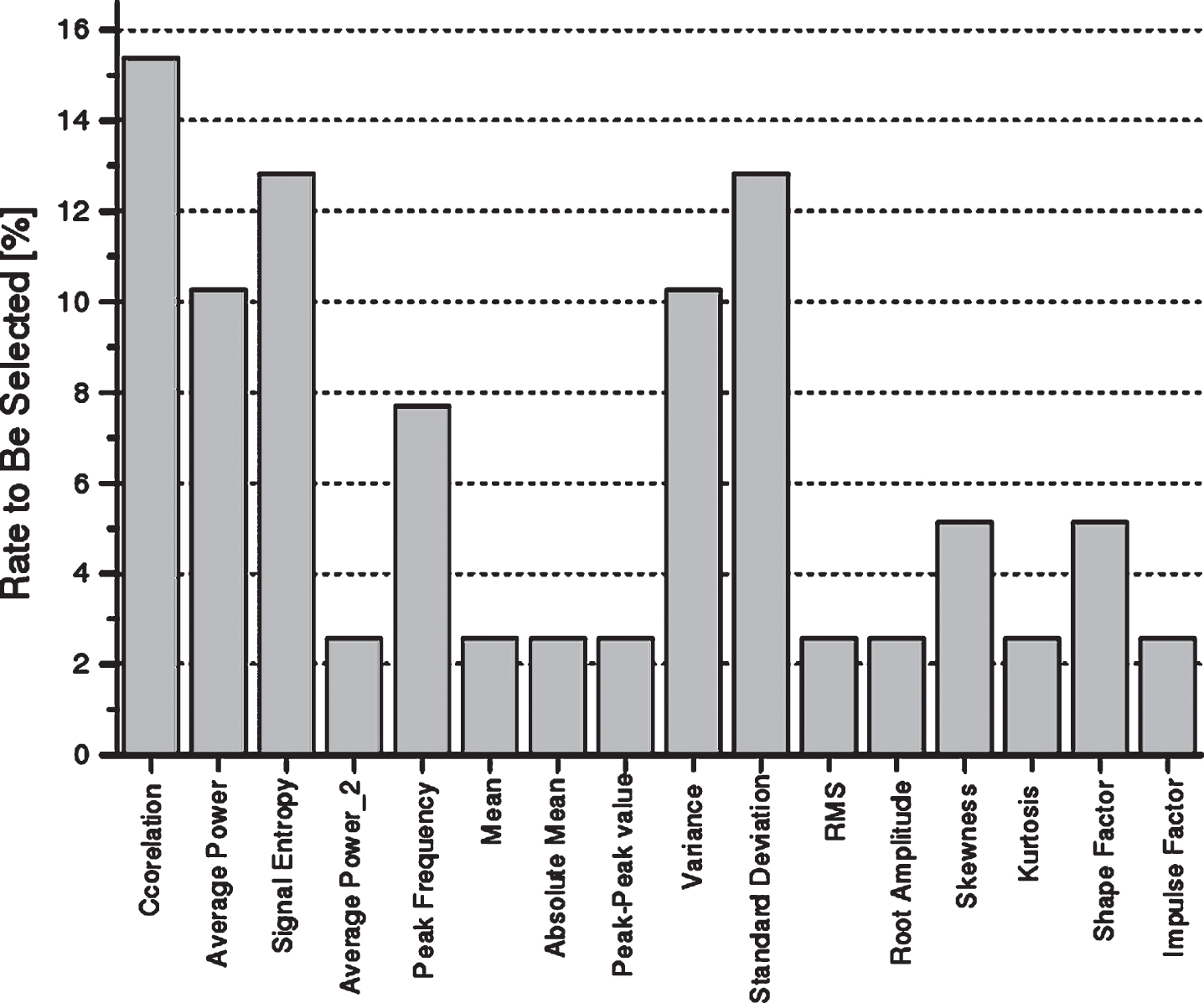
Frequency distribution of the best features selected by the property selector.
Best Feature Combination
The indexes in different models change nonlinearly with the change of attribute matrix. Therefore, in order to look at and evaluate the performance of all classification models more intuitively, we propose an index. All five composite indicators take the same weight, eliminate the impact of different indicator units of measurement, and achieve comparability by combining data, such as those in formula 20:
x is the original value of the performance indicator, x* the standard value of the performance indicator. In formula 20, all performance index values are reflected in the range of 0-1, and then evaluation indicators are formulated. This method is based on the calculation of various classification models of vertical climbing test and the comprehensive evaluation index. The results are shown in Fig. 5, see Fig. 5 for details.

Calculation results of comprehensive index of longitudinal climbing test classification model.
We can see that the performance of SVM classification patterns based on BF combination is better, and the model combination using the first property combination (BF15) is the best.
As shown in Fig. 6, as in the vertical climbing experiment, the transverse motion classification test model and the comprehensive evaluation index are calculated, see Fig. 6 for details.
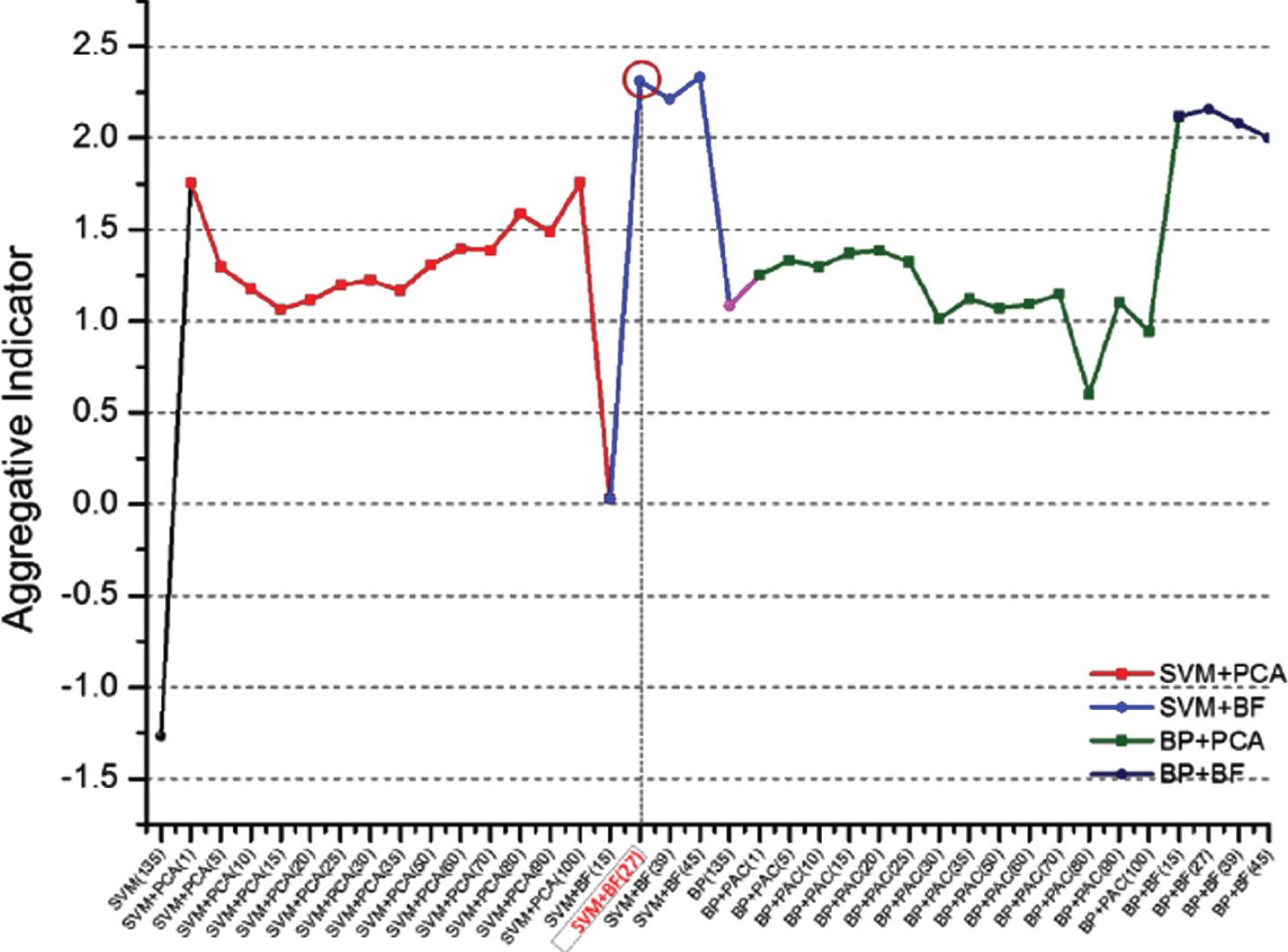
Results of incorporating various indicators into different classification patterns of lateral motion tests.
Finally, the best behavior recognition model is selected for longitudinal upgrading and lateral movement, and its performance parameters are summarized in Table 4, see Table 4 for details.
List of Performance Parameters for Best Behavior Recognition Model
The emphasis of this chapter is to test the feasibility of monitoring workers’ unsafe condition by telephone, and to carry out a preliminary study. The performance of the classification model obtained from the behavior identification part meets the objective requirements, and the result satisfaction is in line with the expectation. Relatively speaking, the implementation of the capture components of the movements is not satisfactory. However, in general, the proposed method of monitoring worker insecurity by smart phone solves some traditional problems, such as the unbalanced proportion of positive and negative samples in the training sample bank, the automation of sample collection and identification, the great reduction of construction risk, the effective control of cost and the improvement of efficiency.
Fixed effect model for employment impact analysis of artificial intelligence
In order to prove the impact of artificial intelligence on the employment of migrant workers in the construction industry, this chapter will use the data of China Statistical Yearbook 2016–2019 and China Provincial Statistical Yearbook. There are administrative divisions in 31 provinces in China, which are responsible for managing other variables that are not related between different provinces. Using the fixed effect model, the fixed effect model is shown in formula 21.
As a secondary industry, the construction industry has a significant positive correlation between employment and the level of artificial intelligence development. The employment rate of the secondary industry has increased by 1% and 0.28%, which indicates that the substitution effect of the secondary industry using artificial intelligence has increased. The application of artificial intelligence technology in the secondary sector will inject vitality into the development of the secondary sector, because China is a world-class industrial power, with a significant increase in automation, more types of industries that dominate the national economy, greater resistance to technology shocks by employment, and increased employment opportunities as a result of technology promotion and production efficiency, which will also bring new creativity to employment.
The secondary industry includes more types of employment, mainly physical or intellectual labor managed at the grass-roots level, but also irregular intellectual labor managed or developed in part. China’s secondary industry is more economically dynamic and has a higher GDP. According to the artificial intelligence employment creation mechanism, its employment creation potential is unlimited. Combined with the experience results, the employment opportunities of the secondary industry are obviously reduced, while the employment opportunities of the tertiary industry are increased. Because of the substitution effect, the impact of artificial intelligence substitution on secondary sector employment is still considerable, and not so. To adapt to the age of wisdom, the labor force of the secondary industry must be transferred to irregular work.
It needs to be proved that the mitigation effect mainly involves the reverse relationship between labor force, human capital change and intellectual substitution effect. At present, there are few data on the substitution of artificial intelligence, the human capital variable is the micro data at the national level, and there are some regional differences in each region (the difference of human capital of provincial governments). In this paper, a fixed method model of least square method is established, as described below.
Among them, autoiAn explanatory variable that indicates that the occupation of the labor force may be replaced by artificial intelligence, that is, the possibility of changing jobs, with a value range of 0-1, RiThe value represents the interpretation of the individual human capital variable, which is a control variable.
The family factors in the control variables may affect the human capital level of the labor force, because the educational level of the parents indirectly affects the human capital level of the children or the behavior of capital investment. The virtual variable of the provincial government where the labor force is located may affect the level of human capital of the labor force, because the level of education and health varies from region to region, so the virtual variable of the provincial government where the labor force is located may also affect the level of human capital of the labor force. On the other hand, the reference regression analysis in this chapter puts forward three models: the first model only considers the individual human capital of the labor force; the second model includes the family factor according to the first model. As shown in Table 5, the third variable is based on the second variable and incorporates the province’s virtual variable, see Table 5 for details.
Human capital return to artificial intelligence employment substitution effect
Human capital return to artificial intelligence employment substitution effect
The first stage- the selection model: using the Poibt model, adding another variable on the basis of the first three models -whether there is wage income (gz), if there is wage income, then the gz value is 1, if there is no wage income, The value is 0. Poibt models are as follows:
Among them, JobiA worker is employed, R or notiIs the explanatory variable, the human capital of the individual labor force. XiFor control variables.
According to ——regression model of the second stage, the inverse Mills ratio of the first stage is added to the metrological Equation 23, and the new metrological equation 25 is obtained as a control variable:
Results of selective deviation regression model IV in sampling
The regression analysis of these four models shows that the number of years of education, professional qualifications, age, political status and annual household income variables are very important to reduce the effect of artificial intelligence replacement work, especially the age of education, which represents the human capital of the labor force and the change of professional qualifications.
In addition to non-existent human capital, highly educated people are more capable and can take advantage of the advantages of human intelligence in innovation, adaptability, emotion and expression of human society, thus exerting the advantages of human intelligence. The labor force with professional qualification not only has “deep” experience in its profession, but also has a clear understanding of its working condition and future planning, expertise and cognitive ability, not only at the practical level, but also in other non-intellectual activities, It also reflects extraordinary learning and innovation ability. If the ability of professional knowledge is strong, artificial intelligence can not replace their work in the short term, and in the long run, the stronger the individual’s professional intelligence ability, the less likely it is to be replaced by artificial intelligence on a large scale. The substitution process also takes longer.
In addition, there is less pressure to replace young people’s employment in the field of artificial intelligence, because the human capital of the young labor force is closer to the intellectual age, and the link between the young labor force is closer and smarter. Young labor is more innovative and flexible than young labor. The labor force with more social capital or higher family income is not easy to be replaced by artificial intelligence. The labor force with more social capital tends to social exchange, more emotional labor force and higher family income labor force. Human capital can be improved by education or becoming an employer, thus promoting employment transition. Governments should pay more attention to the transition from employment to the age of labour intelligence.
In the past technological changes, some changes have taken place in the employment mode of labor force. The influence of technology on labor force employment includes the change of employment type and quantity, as well as the change of human capital in labor force, including the change of labor market. Now entering a period of rapid development, a new generation of technological revolution has arrived, people’s production and life will show the new characteristics of the age of wisdom, the demand of construction labor market will change, construction workers must adapt to the new changes in the information age by changing their human capital, and then they must play a role as employment security systems to reduce unemployment, reduce negative social impact and better protect the important interests of construction workers. regarding building safety management, this paper is based on the internal sensor of smart phone, which uses machine learning algorithm to classify workers’ activities and identify dangerous behaviors under certain conditions. In difficult work, the development of behavior recognition and action capture model can provide accurate recognition. Workers should use seat belts correctly in aerial work, so as to realize automatic monitoring, early warning, reduce the occurrence of high altitude crash accidents, and provide safety and security for migrant workers.
Footnotes
Acknowledgments
This research has been financed by The Science and Technology Research Project in 2016 of the Ministry of Housing and Urban-Rural Development “Research on the Cultivation of New Generation of Skilled Workers in Construction Industry” (2016-R2-055).