



Abstract
As we enter the 21st century, with the rapid development of information technology and advanced manufacturing technology and the rapid development of intelligent manufacturing in China, the national investment in intelligent manufacturing research has increased greatly. And in this field to establish research projects; our intelligent manufacturing has been in-depth development of the moment. Assessing the financial performance of a company is to assess the profitability, sustainability and growth ability of a listed company and plays an important role in reducing investment risk, safety and security. This document assesses the financial performance of intelligent manufacturing enterprises by studying and analyzing the improvement of financial management model in intelligent manufacturing model and the optimization of cost involved. Based on fuzzy neural network and data generation technology, this helps to improve the competitive advantage of enterprises and achieve sustainable development and change.
Keywords
Introduction
In recent years, China’s manufacturing industry has developed from traditional to modern, and major changes have taken place in this sector. The combination of intelligent manufacturing, computerization and industrialization innovation has attracted great attention from all countries and people. The development of intelligent manufacturing meets the needs of the development of manufacturing sector in China. It is an important step to improve our country’s economic ability. Therefore, when we entered the 21st century, with the rapid development of information technology and advanced manufacturing technology, and the rapid development of intelligent manufacturing industry in China, China’s investment in intelligent manufacturing research has increased greatly. And in this field to establish research projects, intelligent manufacturing in China has been in-depth development. Today, the developed countries are speeding up the process of revitalizing the manufacturing industry, while the developing countries are taking over industrial transfer at a lower cost, and our country is facing “double pressure”. Therefore, the pace of research and development of intelligent manufacturing technology needs to be accelerated to deal with the erosion of low-cost advantages. The adoption of advanced intelligent manufacturing technology and new and more environmentally friendly energy saving equipment can also fundamentallysolve the problem of reducing energy efficiency in China’s traditional manufacturing industry.
Intelligent product manufacturing, intelligent production and intelligent services supported by tangible network systems have become an important choice for countries in restructuring global value chains and restructuring the International Finance and Development Division. The production mode of intelligent manufacturing will have a deeper impact on the organization and management of enterprise cost, as well as manufacturing technology, daily operation and so on. This in turn leads to changes in the financial structure. assessing the financial performance of a company is assessing the profitability, sustainability and growth ability of a listed company and plays an important role in reducing investment risk. financial security and profit expectations this document assesses the financial performance of an intelligent manufacturing enterprise by studying and analyzing improvements to the financial management model in the smart manufacturing model and optimizing the costs involved. Based on fuzzy neural network and dual data generation technology, this helps to improve the competitive advantage of enterprises and achieve sustainable development and change.
Related work
According to the literature [1] the essence of intelligent manufacturing is to use the basic concepts and methods of artificial intelligence to solve the problems in the actual manufacturing process. Literature [2] the concept of intelligent manufacturing system has been developed, pointing out that this is a flexible manufacturing system, which is combined with manual. According to [3] literature, intelligent manufacturing is a very intelligent and computerized combination of manufacturing industry, which can predict, analyze and solve life production problems. Literature [4] analysis of the promulgation of “China Intelligence system 2025” summarizes the challenges faced by China in the field of intelligent manufacturing, that is, it is necessary to improve the environment of manufacturing development and improve production efficiency. But it basically does not answer the “where” and “how” questions of Chinese manufacturing [5]. Literature points out that intelligent manufacturing industry is an important technology for China’s industrial development. In order to solve our backward problem in developing intelligent manufacturing, the government has formulated a two-stage development strategy. The first envisaged expanding the scope of digitalization of manufacturing within and among enterprises and its practical application among enterprises; the second envisaged the introduction of widespread application of computerization of manufacturing. According to the literature [6], knowledge manufacturing is in the early stage of development, and there are still differences with the situation of developed countries.
As for evaluating the financial performance of the company, foreign experts began to study the financial performance of the company as early as the beginning of the last century, and DuPont’s Dolsonbrown company developed a research-based financial analysis system for the company. Called Dupont financial analysis system, the system is mainly based on the return rate of net assets of the company system and is used as a financial performance survey method. The basis of decomposition is the factors that affect the ability of the enterprise, and analyze the change of the net assets of the enterprise and the change of different decomposition indexes, so as to analyze the factors that affect the ability of the enterprise and study the reasons in depth. Document [7] Based on the theory and knowledge of applicable financial, accounting, economic and management disciplines, a comprehensive analysis of the financial results system of internal management of the company is carried out, and the results of the research on the financial performance of western countries over the past 100 years are streamlined and summarized. This is a performance appraisal and academic research. Analysis of enterprise performance evaluation [8] literature shows that concept and structure are very important to guide enterprise performance evaluation, and enterprises can change and adjust their status and development strategy according to standardized model. At the literature [9] meeting, the importance of financial performance evaluation in business management is discussed, and it is pointed out that enterprises can find out the defects in the process of performance evaluation in time, correct the defects in time, and promote the sustainable development of enterprises. Document [10] report summarizes the difficulties and shortcomings of enterprises in adopting traditional financial performance evaluation methods, and puts forward some suggestions to improve the financial performance evaluation system through specific case analysis. Literature [11] This study focuses on 40 enterprises, calculates financial data related to enterprises, analyzes the factors that affect the development of enterprises, and infer the relationship between enterprise development and capital structure, business scale and corporate social responsibility.
In general, national researchers do not pay enough attention to the theory of financial performance assessment itself, which is often based on foreign research theories and combines the establishment of evaluation systems with national reality and empirical analysis. evaluation systems are designed for research purposes and have no practical value for smart manufacturing companies; although smart manufacturing companies have indications that they have no value. The importance of the objectives of the Ministry of Finance is gradually recognized, but the relevant criteria for selecting non-financial indicators have not been determined, and if enterprises choose more indicators, the cost of evaluation will increase, which requires enterprises to invest a lot of material and human resources. In addition, no quantitative criteria for non-financial indicators have been established, so a more comprehensive evaluation system has been established. Results-based assessments are often not objective; many country studies are conducted from a macroeconomic perspective, analysing the performance of the processing industry, and relatively few in-depth analysis and research on the financial performance evaluation of specific types of companies or enterprises. Therefore, recommendations based on these recommendations play a limited guiding role in assessing the performance of smart manufacturing enterprises.
Analysis on financial performance evaluation of intelligent manufacturing enterprises
Evaluation model construction
Using existing resources and data in the business process can help enterprises improve their conceptual framework and improve the structure and knowledge accuracy of enterprise analysis. it should be noted that the AHP method is not perfect, and there are some shortcomings in its application. therefore, this paper ensures the objectivity of the data by combining quantitative and qualitative, while improving the practicability and legitimacy of the research results. In calculating the final results, a broad and vague assessment method was used to make it more accurate, and a comprehensive review of the financial performance assessment method used not only quality indicators, but also quality indicators. The difficulties encountered in developing possible evaluation criteria should be compared with quantitative indicators. Although more accurate values can be obtained, more scholars have proposed that enterprise comparison methods with historical benchmarks and comparisons can be used. But in practice, the development of different enterprises is different; quality indicators can not get specific value. This will reduce the accuracy of the evaluation results. The above analysis shows that the characteristics of the financial performance evaluation process are relatively vague, highly complex and multifaceted. basic consequences, this document uses the fuzzy neural network evaluation model and the AHP evaluation model. the aim is to show more objectively and concretely the quantitative and qualitative indicators studied and to improve the authenticity, reliability and objectivity of the evaluation results.
This document is mainly divided into three stages to develop the evaluation model.
The first step is to establish an evaluation index system and classification model to classify the indicators.
The second step is to establish a diagnostic matrix and classify the importance of the index by measuring the elements of the matrix.
A typical value of different elements is calculated to obtain the weight of different indexes, and the consistency of the matrix is tested after calculating the typical maximum value of the Lambda Max.
C.I. is the t CR < 0.10 standard, the calculation result can adopt consistency standard, but not consistency, which needs to be recalculated or adjusted.
Finally, the data is processed by comprehensive evaluation of neural networks. First, establish a set of commentaries to translate different calculations into different results. Second, enterprises should specify their own securities, quality indicators should be determined by expert scoring method, and quantitative indicators should be calculated by fuzzy function calculation method. Third, the weights of different indexes of ranking submatrix are processed by a fuzzy transformation method and finally evaluated.
In this study, the author based on the relevant knowledge theory, and to the greatest extent based on theory and practice, and established a system of evaluation indicators of results. This paper collects more data by distributing questionnaires, and this study reviews a large amount of literature to finalize the results of previous studies. Obtain appropriate financial assessment indicators for theoretical and methodological analysis of these indicators. This document selects 50 specific indicators based on relevant theoretical and developmental characteristics and raises questions in the questionnaire. These indicators have been incorporated and a significant amount of data has been collected. By combining the collected data and eliminating the substandard indicators in time, a relatively sound financial performance evaluation index system has been established, see Tables 1 and 2 for details.
Category I indicators
Category I indicators
Category II indicators
As can be seen from Figs. 1 and 2 above, the analysis of the data in Table 2 shows that the difference and standard average of this index is high and the polarization is intensified. Therefore, on this basis, a new survey was carried out and new indicators were introduced. As shown in survey 2, it can be seen that the standard of indicators in the table is not different and the values are very similar, which indicates that the views on these indicators are relatively consistent. The above analysis of respondents shows that this indicator is one of the issues that enterprises need to address, and the importance of this issue is recognized. indicator comparison shows that there are some conceptual similarities between the total utilization rate of assets and the activity rate, liquidity rate and speed. therefore, the data in the tables of these two aspects should not be repeated to show that the training level and motivation of employees are low, which means that there is a greater internal gap in the human resource level of S companies. Develop professional and basic skills of employees and incorporate relevant human resources data into the corporate performance appraisal system for analytical evaluation.
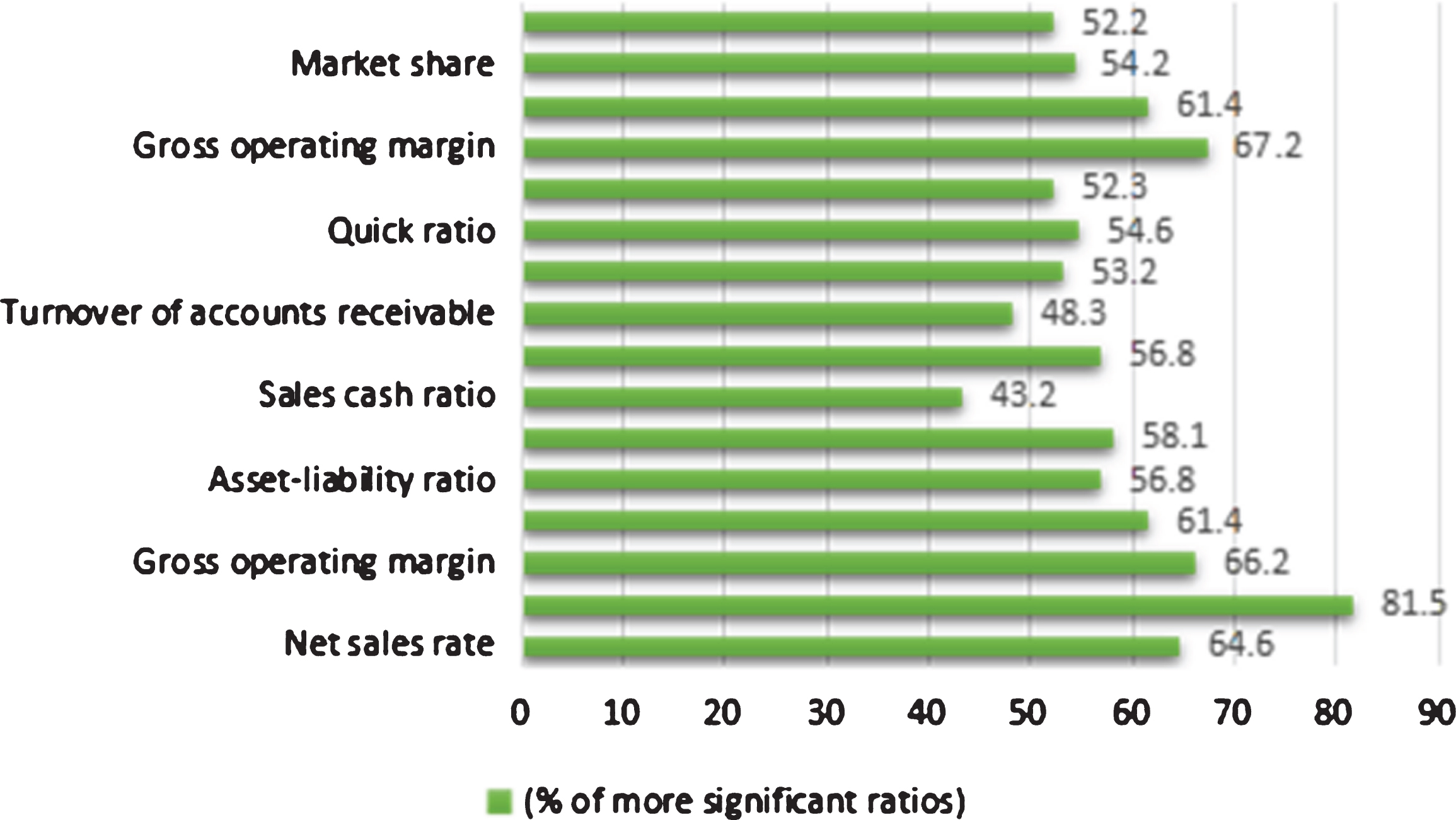
More significant(%).
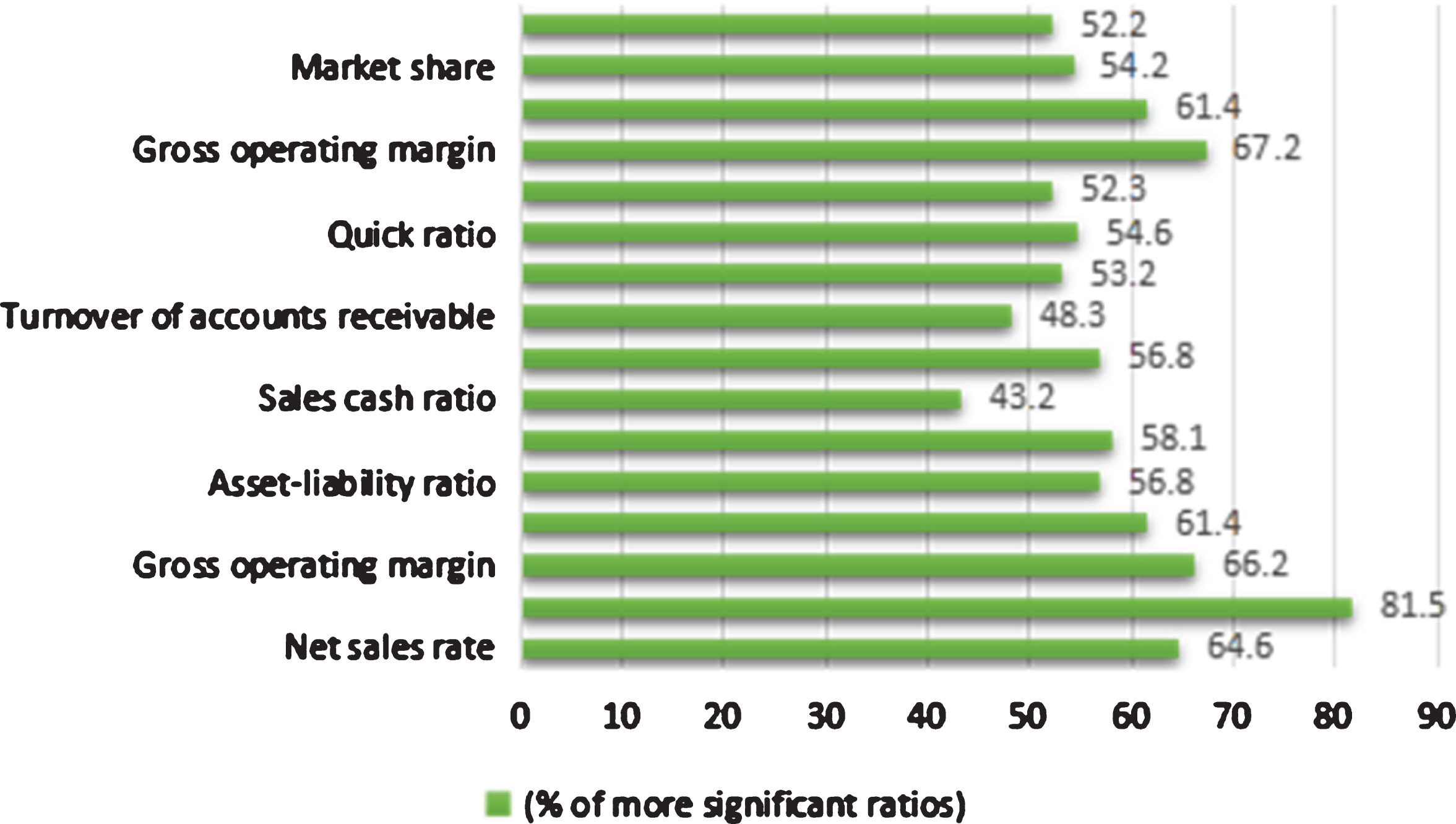
Importance and proportion.
According to the in-depth study and research of the literature,25 tertiary indicators (5 quality indicators and 20 quantitative indicators) were selected as the evaluation criteria, taking into account the current situation of enterprise development. As shown in Table 3, quality indicators are more easily available and can be studied through questionnaires, while quantitative indicators need to be calculated to obtain information.
S Corporate Financial Performance Evaluation Index System
By weight calculation, we can know the relevant data indicators of S company, the specific indicators are shown in the following Table 4:
S Weight of corporate financial performance evaluation indicators
First, the results of the attribution criteria and quantitative indicators are derived from the calculation formula, as shown in Table 5, in which the interest guarantee multiplier is usually not calculated, Because the company report does not provide information on the following: according to the definition and content of the multiple of security interests, the value in the research and analysis process is unlimited in this paper. An internal statistical report was extracted from the area of disclosure of S.A. financial statements after careful collection, review and analysis of relevant documents, see Table 5 for details.
Numerical results of quantitative indicators and criteria for judging membership
Numerical results of quantitative indicators and criteria for judging membership
Step 2, Based on the data in the table above, Take a certain calculation, Using relevant formulas, Determine the process of calculating the membership value of the enterprise. For positive indicators, Ensure that its minimum value is controlled at a, Equalize the distance within the b], Add three d2,d3,d4, points d1 = b, Order d2 = 3(b-a)/4 + a, d3 = (b-a)/2 + a, d4 = (b-a)/4 + a, d5 = b. Find out the comment set U = 1, 2,3, 4,5 = excellent, Good, In general, Poor, Difference corresponding index standard value: d1, d2, d3, d4, d5. For the relevant negative indicators, and shall be monitored within [B,A], which should include three values. the same calculation results as above are listed in the Table 6 below.
Numerical distribution of quantitative indicators
The third step is to calculate the membership value of the enterprise based on the above data and according to the relevant formula of trigonometric function. The following table shows the results of the calculation, see Table 7 for details.
Membership of quantitative indicators
By solving a small set of problems, two nonparallel superclassifications are studied, but SVM contain reverse matrix operations, which require a large amount of memory and computational resources to process a large number of data sets. For the framework of neural network, this paper uses the concept of non-parallel boundary to realize the structure of neural network based on a two-pronged strategy.
Figure 1 shows the structure diagram of the tertiary neural network (foam-layered-output layer), which contains X input vectors, neural resolution (X) for X conversion to ramp, processed seal layer, and output layer learned from a subclass. samples of the test array are projected onto a plane higher than the meter.
An unbalanced data set classification problem trains two neural networks whose error functions are set as E respectively +1 and E–1 defined a
Formula: yi∈–1,+1 is the class label of the lassi = +1 A corresponding b to find the partial derivative, and the rule of minimizing error is obtained. Error bias to weight w is:
Formula (6) item 1 is set as EMSE +1, subparagraph 2 is set as E; andtwin +1E, IMSE +1 For oi = f. Neti), o, etciFor the output of the neural network, f(·) is the activation function. The following relationships are available:
EMSE +1b Yes +1The partial derivative is:
Eitem 2twin +1A partial derag equations can be summar
In summary, the following equations can be summarized:
The steps of predicting sample x class abel are as follows: first, the x is mapped to space by hidden layer φ(· n the output er determines the x class label y: according to the following formula
Exte g the neural mirror network to the largest data set is called yi∈ the rror network is implemented by training an independent K neural network. each network is cost-effectively determined. if the sample falls into this category, Fig. 2 shows the overall structure of the system, where each category first involves a number of giants and then a number of neuronal subclasses, where the output label of A class of neurons is z. a1Az, I2Az, z.3pA. The number of neurons may vary from category to category, and each output neuron of a category is hyperspectral, predicting whether new samples fall into this category. Suppose a sample of a A class, TWN will have to look for or be closer to A class, and the U must be more than 1 apart from the other categories. Structure of Twin Neural Network as show in Fig. 3. General Structure of Multi-Twin Neural Networks as show in Fig. 4.
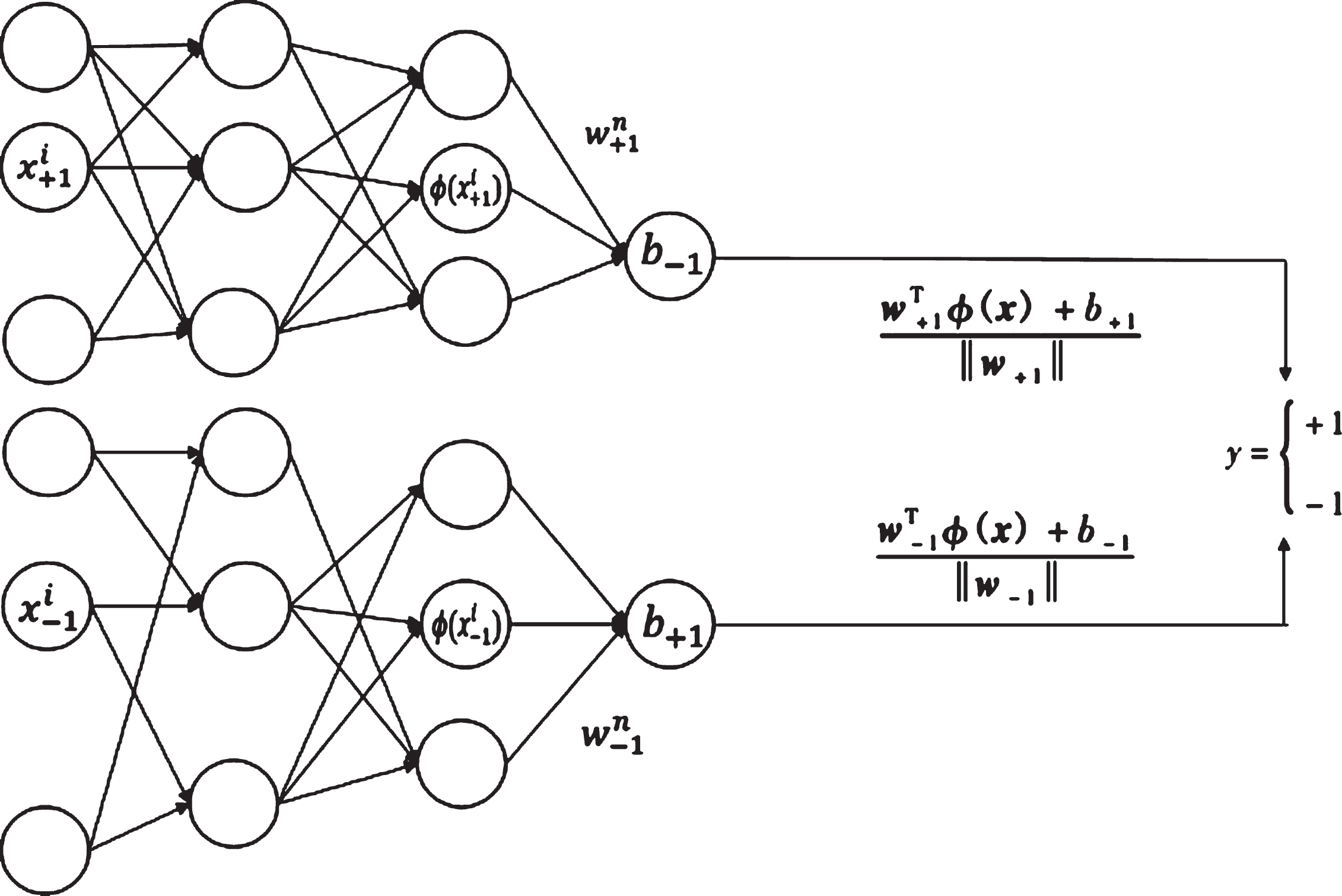
Structure of Twin Neural Network.
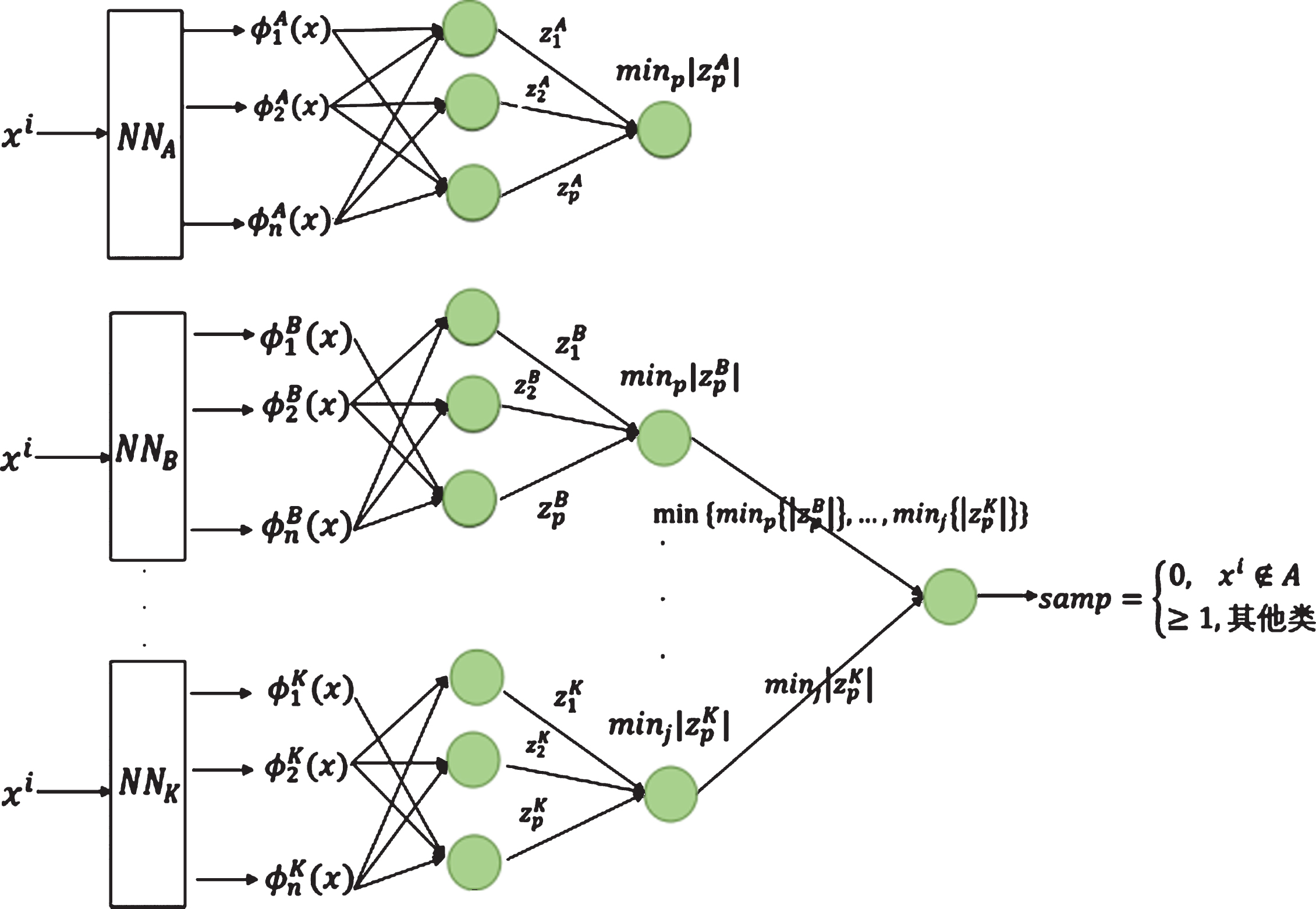
General Structure of Multi-Twin Neural Networks.
Because the loss function of the dual neural network does not contain hyperparameters, the multi-level neural network does not need to adjust the hyperparameters of the model, but only predicts the number of hidden neural networks connected to the network. h is the error transmitted to the first feature map1 h are the errors transmitted to the additional graph2 h; and3 h; and4 h; and5The element of the error matrix is set to M×N. E, size of the graph The error of the relevant filter is calculated as:
Type: M > i > 1, NM > i > jM > i > 1.
The errors transmitted to the neurons at the top of the feature map are:
The er ons of the fe e map is:
This study uses a fuzz ural network method to analyze the results of company pe nce manag and multiply the previous data to get the results. Ideal 5. The calculation results show that the enterprise indicators are as follows:
A members ctor A11 the company’s profitability
The rest o the rele nt data e calcul ed in the same way, so it is not described too much in this paper. Attribution Vector A1 Realistic Financial Perform ce Indic ors
A embers p vector 2 the en rise’s potential development capability index
By or ally co ning t above c lation results with the comment set, the financial performance re lts of t company an be obtain a ows:
Evaluation f profit ility A1 results
The other related data calculation results are the same, in this pap no lo abor ion. As shown in Table 8, the following is the final evaluation of the company’s financial performance:
S Corporate financial performance evaluation results
According to the analysis, S company has 78.90 points of financial performance evaluation, which can reflect its good financial performance at present. As can be seen from the results, the relatively poor performance of S company’s financial performance at present is that of development ability (72.5664 points), innovation ability (72.8453 points) and operation ability (73.4523 points). The above evaluation, we can draw a conclusion, relying on the calculation of secondary indicators can be clear, enterprises in the development capacity of the three indicators there are great differences.
Analysis of the development ability of the enterprise shows that the total assets of the S company are relatively weak and the growth of main business activities is slow, which indicates that the profit margin of the company is low and even negative growth trend has appeared in the past two years.
Innovation capacity outcome analysis
With the further development of our socialist market economy, the traditional financial performance management methods no longer meet the needs of modern enterprises and current economic markets. Enterprises should not look for business problems in the old financial system. They should focus on innovation and scientific research, taking due account of the sustainability of enterprise development. Generally speaking, there is an obvious positive correlation between R & D ability and enterprise competitiveness, that is, the higher the scientific research level of the company, the greater the competitiveness of the company, but it is believed that S company’s innovation ability is relatively weak.
Operational capacity outcome analysis
The analysis of the business ability of the enterprise shows that the business ability of the enterprise is very limited, the flow rate of accounts receivable and the overall liquidity ratio of the enterprise are relatively high. Low data show that the company’s liquidity ratio and working capital ratio play an important role in the development of enterprises.
Conclusion
This document uses fuzzy neural networks and dual data models to analyze indicators such as market performance, management level, innovation ability, solvency, enterprise development and profit margin of intelligent manufacturing enterprises to determine financial indicators, and to analyze these indicators, which accurately reflect the company’s specific situation, scientifically design and use the weight of these indicators of non-financial entity decisions. The discrete matrix model identifies two main problems faced by S companies: this paper holds that in order for S companies to achieve rapid development, they must focus on evaluating financial performance. A scientific financial performance evaluation system must be based on S company’s development strategy. Analysis S the actual situation of the company’s current development, which leads to a reasonable approach to performance management, analysis of the challenges faced by the company in the performance management process, and put forward corresponding suggestions and improvement measures according to the shortcomings, in addition, it also makes the performance appraisal system more perfect. The evaluation indicators developed in this document are more feasible, scientific, in line with the reality of enterprise development, and incorporate diversified indicators such as innovation performance into the enterprise evaluation system, although they are not financial indicators. They can have a significant impact on the performance and development of enterprises.