



Abstract
In order to improve the effect of the teaching method evaluation model, based on the grid model, this paper constructs an artificial intelligence model based on the grid model. Moreover, this paper proposes a hexahedral grid structure simplification method based on weighted sorting, which comprehensively sorts the elimination order of candidate base complexes in the grid with three sets of sorting items of width, deformation and price improvement. At the same time, for the elimination order of basic complex strings, this paper also proposes a corresponding priority sorting algorithm. In addition, this paper proposes a smoothing regularization method based on the local parameterization method of the improved SLIM algorithm, which uses the regularized unit as the reference unit in the local mapping in the SLIM algorithm. Furthermore, this paper proposes an adaptive refinement method that maintains the uniformity of the grid and reduces the surface error, which can better slow down the occurrence of geometric constraints caused by insufficient number of elements in the process of grid simplification. Finally, this paper designs experiments to study the performance of the model. The research results show that the model constructed in this paper is effective.
Introduction
The development of higher education reflects my country’s technological innovation ability and the overall strength of higher education. Since China proposed the strategy of popularization of higher education and implemented the policy of higher education expansion, higher education in my country has developed rapidly. However, it cannot be ignored that the rapid expansion of the number of college students has caused education quality problems and attracted the attention of government departments. In order to promote the development of higher education, the National Academic Degrees Committee convened relevant meetings to further emphasize the important role of degree-granting responsibilities and functional institutions in ensuring quality and improving quality, and pointed out related requirements in detail. The six tasks of higher education reform and development are as follows [1]: The first is to dynamically adjust and optimize the structure of higher education to conform to the current social development; the second is to deepen the reform of training methods, and effectively promote the innovation ability of college students; the third is to optimize the quality evaluation system to ensure the effective improvement of teaching quality; the fourth is to promote the development of higher education, further strengthen international exchanges, and promote influence; the fifth is to promote the overall construction of “double first-class” in universities and improve the comprehensive education level of college students; the sixth is to actively encourage relevant education units and departments to improve their systems and innovate mechanisms. Moreover, it clearly pointed out that the following points should be done in the future [2]: First, the theory of educational modernization evolves from 1.0 to 2.0; second, the evaluation index system achieves precision and internationalization; third, the quality of teaching achieves high-level modernization. From the above information, we can see that the state attaches great importance to the management of higher education, but the government will not directly participate in the evaluation process, but will hand over autonomy to universities. These policies not only stimulate the sense of responsibility of colleges and universities, but to a large extent endow teachers and schools with autonomy, which makes it easier for them to accept the terms of education responsibility, thereby promoting the improvement of college students’ teaching quality. With the implementation of these policies, how to scientifically and reasonably evaluate the teaching quality of college students has become a research hotspot in the field of education.
Constructing the evaluation system of college students’ teaching quality is a significant research. First of all, most of our country’s college students’ teaching evaluation theories are based on and learn from foreign theories, and in most cases, they are not consistent with the actual situation of our colleges and universities. Therefore, research on the evaluation system of college students’ teaching quality can help colleges and universities enrich relevant education theories and form a set of evaluation systems that highlight their own characteristics. Secondly, teaching quality evaluation can scientifically and effectively measure the pros and cons of a course, and help managers have a systematic understanding of course teaching and make decisions. At the same time, school administrators can carry out curriculum reform according to the evaluation results, promote curriculum construction, and promote the improvement of college students’ teaching quality [3].
Related work
The literature [4] believed that after teaching, the level of students’ mastery of subject teaching content and the ability to apply knowledge to solve practical problems is the quality of teaching. The literature [5] pointed out that teaching quality should not only reflect the quality of teaching “products”, but also the quality of the teaching process. The literature [6] believes that the combination of the degree of knowledge granted by teachers to students, the degree of knowledge that students master through learning, and the degree of teacher’s interest in students’ learning can reflect the quality of teaching.
The literature [7] believed that the comprehensive evaluation of university teaching quality is a multi-level evaluation. Moreover, it used the fuzzy comprehensive evaluation method to comprehensively evaluate the teaching quality, and at the same time constructed a teaching quality evaluation model based on the B/S model. The literature [8] adopted the method of combining analytic hierarchy process and fuzzy comprehensive evaluation to establish a teaching quality assurance system based on multi-level fuzzy comprehensive evaluation, which avoids the mathematical model of rough single definite evaluation, and finally obtained the evaluation result. The literature [9] regarded students as the main body of evaluation, respectively used the analytic hierarchy model and TOPSIS analysis model to evaluate the teaching quality of college teachers, and finally analyzed the results obtained by the two methods, and ranks teachers according to the results. The literature [10] believed that the weighted TOPSIS method of interval intuitionistic fuzzy sets can better solve the problem of a large amount of fuzzy and uncertain information in multi-attribute decision-making. Moreover, by defining the concept of the interval between the interval intuitionistic fuzzy set and the distance between two interval intuitionistic fuzzy sets, it combined the weighted TOPSIS principle to calculate the comprehensive index value of the distance and tightness of each scheme to the positive and negative ideal solutions.
The literature [11] pointed out that the traditional teaching quality management system is too modular, and the related management system is too rigid and biased towards formalism. The literature [12] proposed that many higher vocational colleges are upgraded from technical secondary schools, and the once rigid management model still has a certain impact on school management, and this “paternalistic” management method interferes with the positioning of managers and teachers on current education. The literature [13] mentioned that the construction of management team is closely related to the improvement of teaching quality management. The literature [14] analyzed the teaching quality management team and pointed out that in order to break through the bottleneck of teaching quality management, it is urgent to build a high-level management team. The relevant research on the teaching quality management evaluation system is as follows. The literature [15] mentioned that the form of supervision and evaluation remains unchanged and requires a breakthrough. The literature [16] pointed out that theoretical teaching and practical teaching have their own characteristics but are equally important, and it is necessary to find the weak points of practical teaching for monitoring, and pay attention to the overall impact of practical teaching on teaching quality management. The literature [17] pointed out that practical teaching should strive to achieve the goal of talent training, and should be close to the needs of professional positions in the assessment of practical ability. The research on ways to improve teaching quality is as follows. The literature [18] pointed out that the training of talents and the implementation of the education and teaching process should establish the concept of total quality management, and the evaluation, analysis and improvement of teaching are an important part of total quality management. The literature [19 pointed out that in order to improve teaching quality, it is necessary to conduct overall management of teaching quality, and for my country’s education and teaching, it is necessary and urgent to establish a teaching management quality system. The literature 20] pointed out that in the investigation and research on the classroom teaching quality of applied undergraduate colleges, the following problems were found in applied undergraduate colleges: the teaching goal deviates from the direction of application-oriented talent training; the classroom content is out of touch with the needs of social development; the teaching evaluation does not reflect the inspection of students’ theory and practice; the teachers who have enriched the professional experience of industry enterprises are lacking; the teaching effect is not ideal. The literature [21] believed that there are still problems in applied undergraduate colleges that textbooks have no characteristics and outdated content. The survey results of 4 application-oriented local undergraduate colleges and universities show that students are not satisfied with the quality of “quiet” classroom teaching, students think the classroom vitality is insufficient, there is little teacher-student interaction in the classroom teaching process, and the teaching method is backward [22]. It can be seen from this that there are many problems in the classroom teaching of applied undergraduate colleges, and the teaching objectives, teaching content, teaching methods and teaching effects all need to be reformed.
Literature [23] believes that there are many factors that affect the quality of classroom teaching, mainly including the lack of pertinence of professional curriculum settings, the lack of attention to classroom teaching links, and the low level of students. The literature [24] proposed that in order to improve the level of running a school, the newly built undergraduate course heavily encourages teachers to engage in scientific research, which makes teachers less motivated to teach, and less time investment naturally affects the quality of classroom teaching. In addition, under the pressure of evaluation, academic administrators neglected teaching management.
SLIM parameterization method
Since the method in this paper proposes an improved form of the SLIM method, the specific steps and calculations involved in the SLIM method are introduced here.
The overall framework of the SLIM method uses the local/global calculation framework proposed in, and its minimum deformation energy function is expressed as follows:
An input tetrahedral mesh or triangle mesh is represented as:
V is the point set, F is the unit set, and formula (1) is the energy function to be solved globally. The energy function is the deformation energy in the grid mapping process. As shown in formula (2), it is expressed as the Frobenius norm of the difference between the actual transformation of the unit in the original grid and the corresponding grid unit on the mapped grid and the nearest rotated Jacobian matrix. The Jacobian matrix is used to represent the linear part of the affine transformation between cells. Among them, A f is the area of a triangular element or the volume of a tetrahedral element.
This paper uses formula (1) and formula (2) to establish the solution goal of the global calculation stage, but it is difficult to directly calculate the energy minimization problem. Therefore, this paper establishes a local/global framework to iteratively solve the problem. The iterative calculation is divided into two steps. First, the local step is performed, as shown in the following formula, the signed singular value decomposition (Signed SVD) is performed on the Jacobian matrix of each unit. The two rotation matrices (both standard rotation matrices) obtained after singular value decomposition constitute the closest rotation corresponding to the unit mapping. After that, the rotation matrix is fixed, and the Frobenius norm of the difference between the Jacobian matrix and it is taken as the deformation measure of this unit. Subsequently, in the global step, the closest rotation obtained in the local step is integrated, and the locally determined rotation matrix result is loaded into the global solution formula to obtain the iterative calculation result Xk+1.
Based on the above process, the solution of grid parameterization can be realized. In the SLIM algorithm, the stability and reliability of the global step solution are strengthened by adjusting the gradient. Combining the Stiffening idea used in the quadrilateral mesh generation method based on mixed integers, a weight parameter is added to the calculation of each unit in each iteration, so that the value of the quadratic energy function can be decreased in the ideal direction. Since the degree of freedom of the scalar value weight is very small, it is not enough to strictly guarantee the convergence of the calculation. Therefore, in the SLIM method, a high-degree-of-freedom weighted matrix is used in the calculation of the global step to ensure that the falling direction of the quadratic energy function is adjusted to the ideal falling direction. The weighted matrix can be directly calculated under the premise of satisfying certain conditions, which ensures the convergence of the calculation method.
Another major contribution of the SLIM method is to realize the versatility of the algorithm, and expand the above-mentioned calculation parameterized framework to be applicable to the calculation of multiple deformation measures. In addition to using the Symmetric Dirchlet deformation metric in the original method, the SLIM method SLIM method can be applied to the classic deformation measurement functions of Exponential Symmetric Dirchlet, Hencky strain, AMIPS (an improved form of the MIPS method), and Conformal AMIPS 2D/ 3D, so that it can be applied to various grid parameterization requirements by replacing different deformation metrics.
The calculation speed and versatility of the SLIM method are excellent. Figure 1 shows the speed comparison of the SLIM method and the other two numerical calculation methods. Although the SLIM method is applicable to a wide range and can be applied to the calculation of large-scale deformation like the ABF++method, there are still some limitations. The SLIM method uses the local/global framework to minimize ARPR energy, which leads to extremely slow convergence when the calculation proceeds to some local minimum. This problem stems from the slow propagation of rotation in the local step, so it is difficult to recover some small rotation changes in the parameterized calculation results of most grid cells in the global step. When the grid is parameterized, the above problems may cause local grid inhomogeneity. However, the improved method proposed in this paper can effectively solve this problem and produce a uniform grid result.
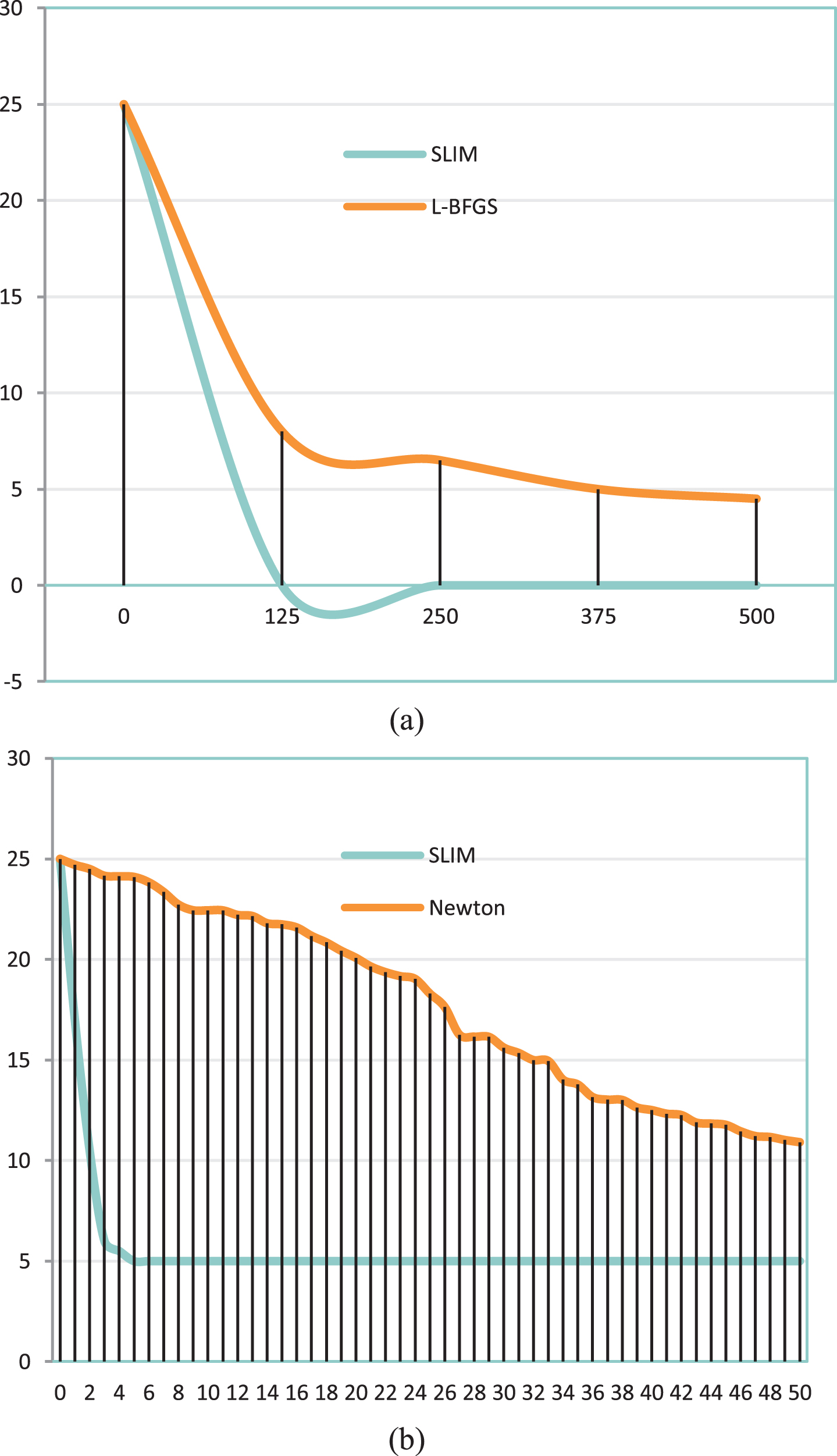
Comparison of time and iteration steps between SLIM and L-BFGS method and Newton iteration method.
In the geometric quality measurement method of unstructured grids, a series of quality metrics for hexahedral elements are proposed. The establishment of most of these quality metrics combines the properties of the element and the analysis of its Jacobian matrix. The following first briefly describes the Jacobian matrix of the hexahedral mesh element. For the hexahedral element H, there are 8 vertices and the coordinates are:
Because triangular and tetrahedral elements can easily establish quality metrics through Jacobian matrix, hexahedral elements are not easy to express directly due to their complex structure. Therefore, the Jacobian matrix of the hexahedral unit can be indirectly replaced by the Jacobian matrix of the tetrahedral unit located on 8 vertices, and the three edges that each vertex intersects can form a tetrahedron. The Jacobian matrix of each tetrahedron is expressed as follows:
Among them, k + 1, k + 2, k + 3 are the three vertices adjacent to vertex k in the hexahedral unit, respectively.
g is the volume of the tetrahedron at the k-th vertex. The above Jacobian matrix is used to construct α
k
,
f shape is the shape metric of the hexahedral grid unit, which is a metric that has nothing to do with the physical scale, and the value is in the range of [0, 1]. When it is 1, the hexahedral unit is a cube, and when it is 0, the unit is a degenerate (volume 0) unit. f skew is the tilt measure of the hexahedral unit, which indicates the degree of skewness of adjacent faces in the grid unit according to the mean ratio of the unit skew matrix. It is also a measure independent of the physical scale, and the value range is [0, 1]. When it is 1, the opposite faces of the hexahedral element are parallel (cuboids). When it is 0, the element is a degenerate element. Since the four vertices on the hexahedral element surface may not be on the same plane, this measurement is not very accurate in some cases.
Introduce the Jacobian determinant of the quality measurement unit of the grid, as shown in the following formula:
In the above formula,
The simplification method proposed in this paper is based on the elimination of the two objects of the base complex and the string, which is called the collapse operation. Figure 2 shows the effect diagram of the basic complex sheet and chord collapse operation on the actual grid. Among them, the pictures from left to right are the base complex structure before the operation and the base complex structure after the operation. The black arrow indicates the direction of merging on both sides, and the green area is the part of the grid eliminated during the collapse operation. The two operations will be described in sequence below.

Collapse operation of base complex sheet: ((a) is a schematic diagram of the operation, (b) a two-dimensional cross-sectional schematic diagram of an abnormal collapse operation).
The operation of the base complex sheet is shown in Fig. 2(a). First, the corresponding relationship between F
L
and F
R
on both sides of the base complex sheet is determined. When the base complex sheet is not self-intersecting, the elements on both sides can directly determine the one-to-one correspondence. The corresponding base complex points, edges, and faces will be merged into a new element, and the remaining topological elements in the base complex sheet will be deleted directly. After the above treatment, one collapse operation ends. During this operation, the base complex edges on both sides will change. For this, a price prediction calculation is proposed to accurately predict the price of the new edge after the collapse operation, as follows:
In the above formula, v(e) is the valence of base complex edge e. When p(e l , e r ) is 0, the base complex plane connecting base complex edges e l and e r is located on the grid boundary, otherwise p(e l , e r ) is 1. Through the above formula, the price of the new edge can be calculated in advance before the collapse operation.
The collapse operation of the base complex string is shown in Fig. 3(a). First, the elements corresponding to F L and F R are found along the main diagonal. If the number of units on both sides cannot be aligned, the extra unit layers will be deleted first by means of sheet collapse, then the aligned elements on both sides will be merged into new topological elements one by one, and finally the internal contained units will be completely removed. Due to the particularity of the base complex string structure, the valence changes of elements in the main diagonal direction and the sub-diagonal direction are not the same. Therefore, the selection of the main and sub-diagonal directions is very important. In order to measure which direction is more advantageous as the main diagonal direction, the price prediction formula shown in the following formula is established. This formula can effectively measure the price difference between the new edge and the regular edge generated after the collapse operation of the base complex string. Moreover, it can choose the direction of the smaller price prediction calculation value as the main diagonal direction, so that after the base complex string is removed, the high-priced singular edges are introduced as little as possible, and the number of singular edges is effectively reduced.

Collapse operation of base complex string: ((a) Schematic diagram of collapse operation, (b) Two-dimensional cross-sectional diagram of abnormal collapse operation).
In the above formula, k is the number of components in the base complex string, and ep1i and ep2i are the opposite sides of the i-th group of base complex edge in the sub-diagonal direction. e li and e ri are respectively the i-th group of base complex edges located in the direction of the main diagonal, E surface is the set of boundary edges, and E inner is the set of internal edges.
The collapse operation used in the iterative simplified process is described in detail above. Before the collapse operation, the two structures need to be simply screened to prevent the occurrence of mirror configuration (the situation where two hexahedral units share multiple faces) and topological discontinuity. This abnormal situation will seriously affect the shape and structure of the grid, and may also produce invalid grids. There are two filtering rules for base complex sheet as follows:
(1) The base complex sheet with sharp features in the E M set will not be removed; (2) When the new edge generated is inside and the calculation result of the price prediction m is less than 3, the base complex sheet will not be removed.
For base complex string, the same two filtering rules are followed: (1) The base complex string whose calculated value of D(c)/ - 3k is less than 0.9 is not allowed to be removed to prevent the introduction of high-priced singular edges; (2) When the base complex string is non-closed (closed type may be completely inside the grid) and there are sharp feature points on the boundary surface at both ends of it, it is not allowed to remove it.
In the grid structure simplification method, iterative collapse operation is needed to reduce the number of singular structures in the grid. Since the base complex sheet is a structure that penetrates the global grid, it also contains some base complex sheets that form self-intersections, tangents, or closed-loop configurations. Operating on them will cause large-scale changes in the singular structure of the grid. Moreover, using different simplification sequences will produce significantly different results. Therefore, this article proposes a reasonable sorting algorithm for the elimination of base complex sheet, which is of great significance to the entire simplified operation process. In this section, we propose a weighted sorting algorithm for base complex sheet, which makes the reduction speed of the number of singular structures in the entire simplified method greatly increased compared with the original method, and effectively maintains the mesh quality, as shown in Fig. 5.
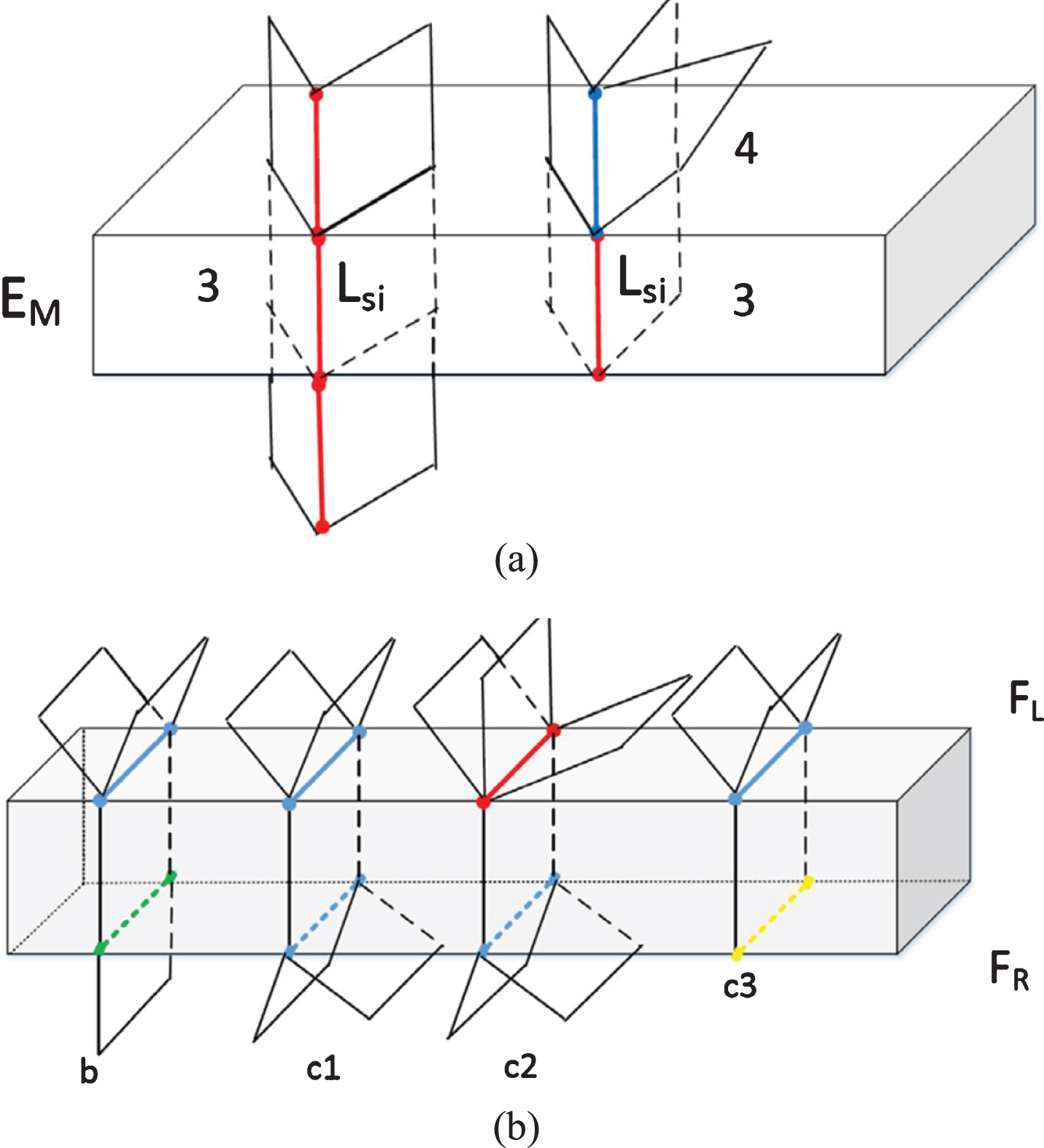
Singular edge distribution in base complex sheet: ((a) The distribution of singular edges in E M , where the blue edges are regular edges, (b) the distribution of singular edges on F L and F R , where the green edges are regular edges).
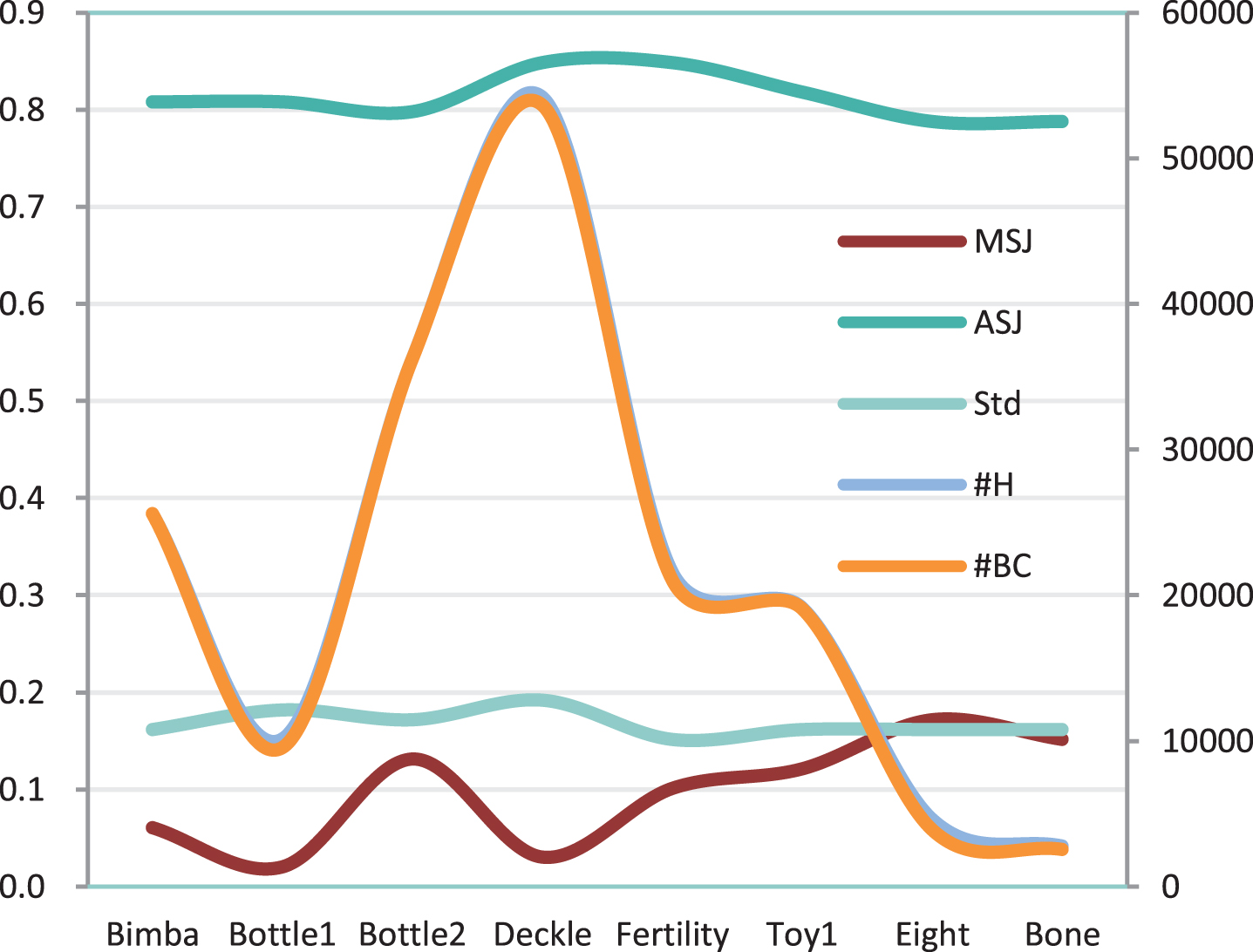
Statistical diagram of the original grid.
The weighted sorting algorithm of the base complex sheet preferentially eliminates the candidates that make the singular structure improved, the width smaller, and the deformation greater. Moreover, in order to achieve the above three objectives, three ranking items were established respectively, which are price improvement item E sv , width item E sd , and deformation error item E sq . The normalized weighted comprehensive sorting method reduces the influence of the actual grid size on the comprehensive sorting. The following is the base complex sheet weighted sorting formula:
In the above formula, the weight parameters k sq , k sd , and k sv are 0.2, 0.6, 0.4, respectively.
The establishment and specific functions of the three sorting items will be described in sequence below. First, the width term is introduced. The width term is used to measure the width of a base complex sheet in the grid. The weighted sum of the average length and the minimum length of the base complex edge set in E
M
is selected. Due to the need to maintain the surface features of the grid, the minimum length is given a higher weight. After experiments, it is found that the average length and the minimum length weights are 0.7 and 0.3 respectively for better feature retention. The width term is shown in the following formula:
In the above formula,
Price improvement items. This item predicts the impact of a certain base complex sheet on the surrounding strange structure after the collapse operation. It is measured by the change of the valence of the singular edge in the singular structure, and the valence of a point and edge is defined here as the number of adjacent hexahedral units. Before introducing this item, first, the energy function for calculating the singular side valence is introduced in the simplification process. The energy function specifically calculates the difference between the price of the singular edge and the price of the regular edge in the grid. When the energy function value converges to 0, all edges in the grid are regular edges, and a singular structure simplification rate of 100% is reached. For the input grid m, it has a set of singular edges:
The energy function can be expressed as:
The energy function combined with the change of the edge price during the grid simplification operation can establish a specific discrete expression form.In the base complex sheet, all singular edges exist in the three sets of F
L
, F
R
and F
M
, and the other edges parallel to the dual plane through the sheet are regular edges. Therefore, a partial expression form can be established on the base complex sheet for the above formula:
Among them, n is the number of base complex sheets that can be extracted in the grid, S i is the i-th base complex sheet, and k is the new edge generated by the merge of both sides e lr during the collapse operation. The above formula can be used to calculate the overall price change by eliminating the price change caused by the partial elimination. With the above energy function, a priority ordering function based on the degree of price improvement can be established, so as to eliminate as many singular edges as possible in the grid and optimize the price of some high-priced singular edges in a single collapse operation.
In the simplified process, the collapse operation is used to iteratively simplify the grid structure. Therefore, the number of grids is continuously reduced while the singular structure in the grid is reduced. The existence of sufficient number of cells in a grid with a complex shape is the primary condition for maintaining the surface shape of the grid and maintaining the average quality of the grid. Therefore, this paper uses the refinement operation of the base com-plex sheet proposed in the original method and a series of adaptive refinement rules proposed in this method to effectively maintain the target mesh element number, which can maintain the surface shape error of the grid (that is, the Hausdorff distance ratio), improve the uniformity of the grid, and minimize the occurrence of topological and geometric constraints in the simplification process through the refinement rule. Moreover, based on this step, the success rate of local parameterization after the collapse operation is improved, and a higher grid structure simplification rate is achieved.
This paper conducts a series of experiments on the grids generated by various generation methods. The simplified results of the octree generated grids in the pictures shown in this article are shown in Tables 1 and 2, Figs. 5 and 6. Among them, #H, #BC, Std, HR, R are the number of units, the number of components, the variance of the unitized Jacobian, the Hausdorff distance ratio, and the structure simplification rate, respectively.
Statistical table of the original grid
Statistical table of the original grid
Statistical table of simplified results of this method
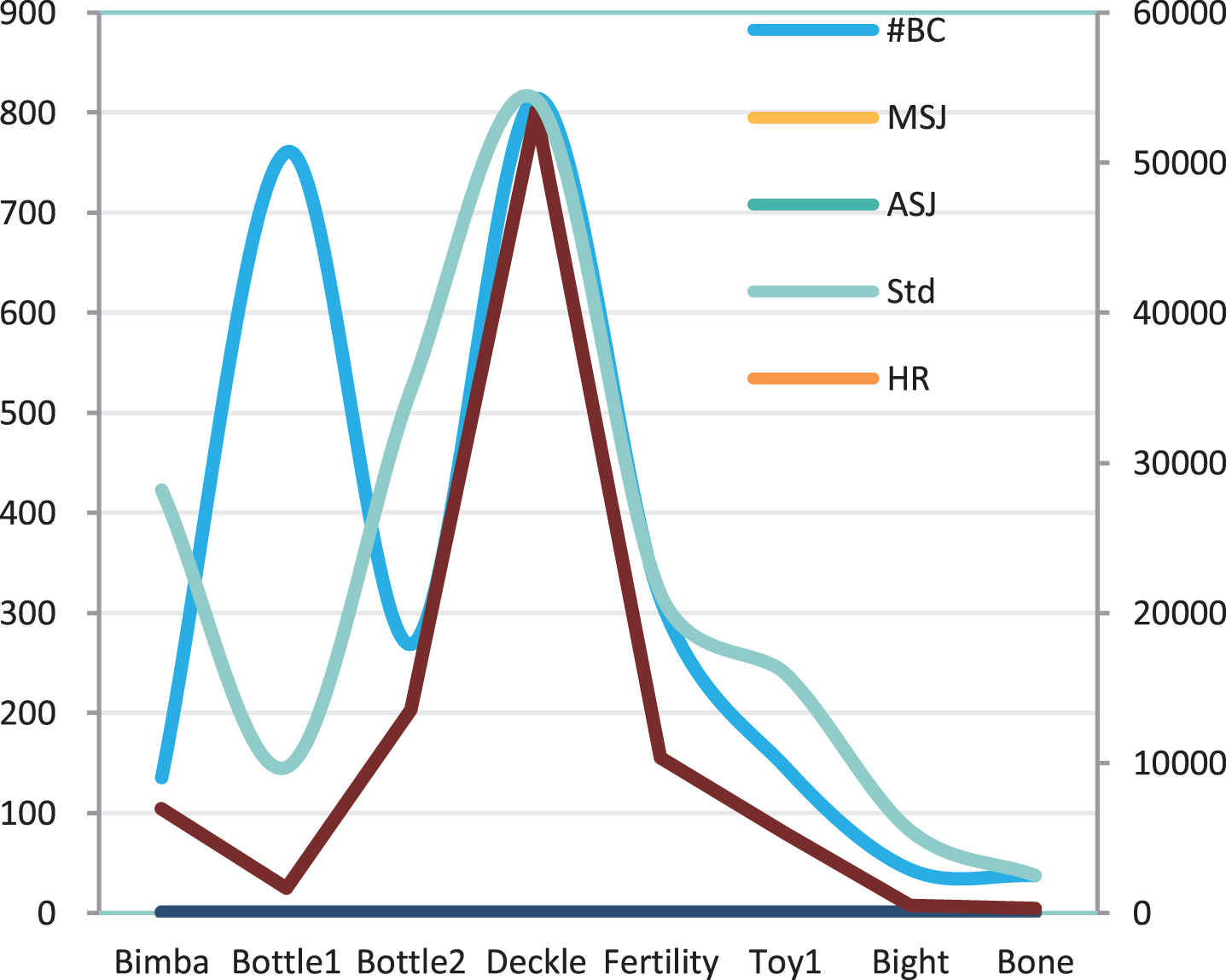
Statistical diagram of simplified results of this method.
It can be seen from the above comparison that the model constructed in this paper has better performance. Next, this article uses teaching effect recognition to study the model practice effect, and this article sets a total of 74 sets of data. The results are shown in Table 3 and Figure 7.
Statistical table of teaching effect evaluation
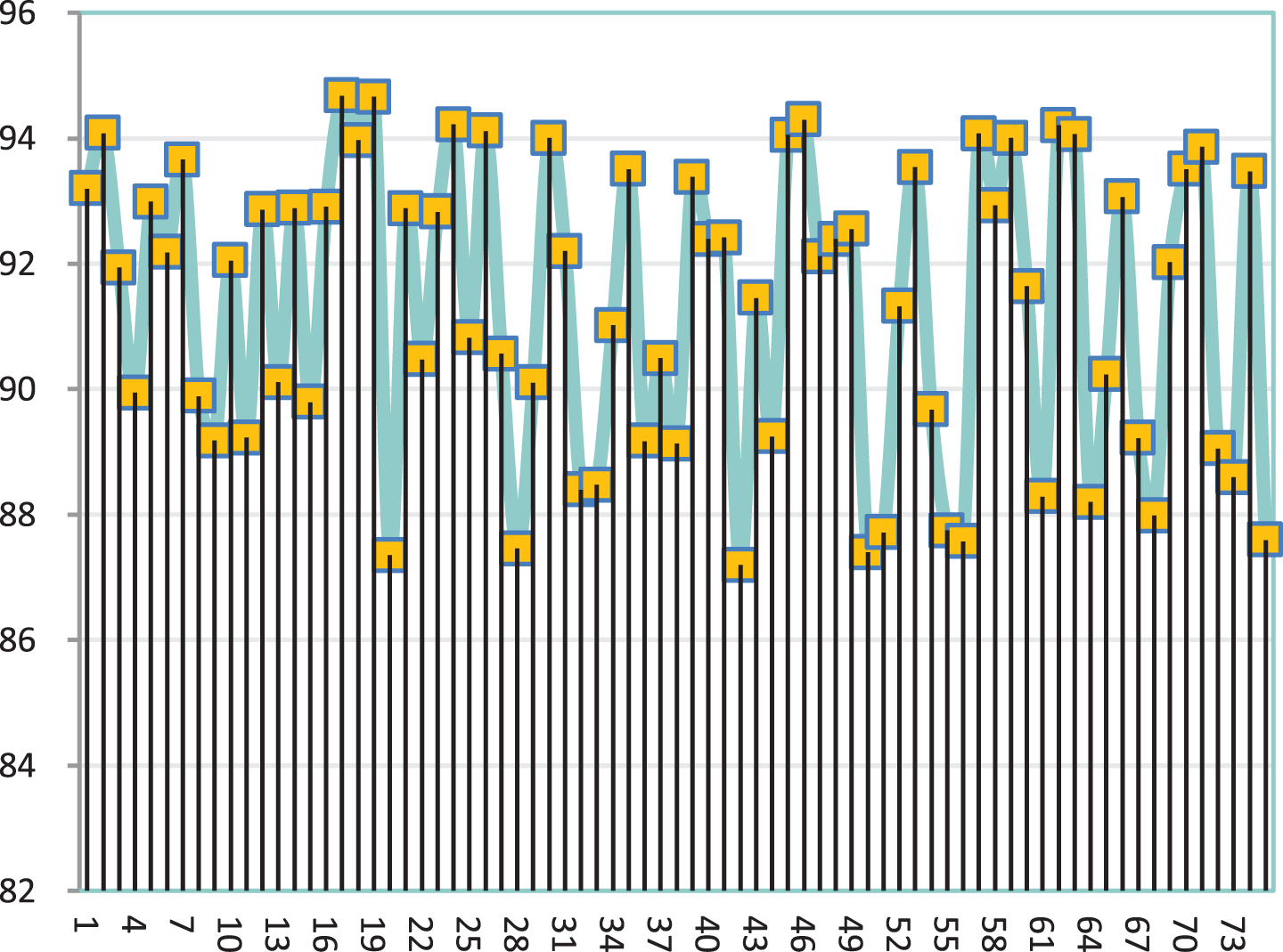
Statistical diagram of teaching effect evaluation.
It can be seen from the above figure and table that the model constructed in this article performs well in the evaluation of teaching methods, and the model has a certain degree of intelligence, so it can meet actual teaching needs.
This article mainly analyzes the effect recognition of artificial intelligence model in teaching methods. In view of the slow convergence speed of the current hexahedral mesh structure simplification method, the early termination of the simplification process and the poor mesh uniformity, this paper proposes a hexahedral mesh structure simplification method based on weighted sorting. Moreover, this paper comprehensively sorts the elimination order of the candidate base complex sheet in the grid with three sets of sorting items of width, deformation and price improvement. For the elimination order of base complex string, this paper also proposes a corresponding priority sorting algorithm, which aims to simplify the operation, so that the reduction rate and the convergence speed of the reduction of the number of singular structures in the grid are improved. In addition, this paper proposes a smoothing regularization method for local parameterization based on improved SLIM algorithm. Using the smoothed regularized unit as the reference unit in the local mapping in the SLIM algorithm can better maintain the mesh quality while maintaining uniformity. Finally, through experimental research in this paper, we can know that applying the methods proposed in this paper to practice can effectively improve the effect of teaching effect evaluation.