



Abstract
Stimulated by the “Belt and Road” Initiative (BRI), Chinese enterprises are participating in the markets of Central and Eastern European Countries (CEECs). With the Chinese local SOEs from 2007 to 2017 as samples, this paper empirically verified the impact of the introduction of foreign-invested shares (foreign shares for short) on the international competitiveness of these enterprises, as well as the mediation effect of the BRI strategy. In this paper, we propose neuro -fuzzy network based correlation analysis and empirical analysis found that there’s a significant positive correlation between the introduction of foreign shares and the international competitiveness of Chinese local SOEs, that is, compared with local SOEs without foreign shares, those with foreign shares enjoy stronger international competitiveness when participating in the Central and Eastern European market; after the mediation effect of BRI has been taken into consideration, the introduction of foreign shares further strengthened the positive impact on the international competitiveness of these enterprises. This is because the BRI has significantly promoted the participation of Chinese SOEs in the Central and Eastern European market.
Keywords
Introduction
Since the Chinese government put forward the “Going Global” strategy in 2000, China has developed rapidly and become an important direct investor country in the world, which has brought more opportunities and challenges for Chinese enterprises [13]. Especially as China is further promoting and implementing its export-oriented economic development strategies, such as the BRI strategy and the international production capacity cooperation strategy, more and more Chinese enterprises have entered the international market. Figure 1 shows the direct investment volume of China in international market from 2002 to 2017, the data present an overall upward trend, indicating that the implementation of these strategies have enabled Chinese capital to better participate in the international market, and it has also laid a good foundation for Chinses enterprises to enhance their own international competitiveness. In recent years, China has strengthened its cooperation with the CEECs. From a political perspective, the estrangement between China and CEECs caused by the traditional ideologies of both parties has already been removed; in addition, the political situation in CEECs has become more stable in recent years, so the political cooperation between the two sides is increasing [12], since 2012, the “China-CEEC Leaders Meeting” has been held every year; from an economic perspective, the level of economic and trade cooperation between China and CEECs has been improved continuously; on the one hand, the trade volume has increased constantly, the trade volume of China and 16 CEECs reached $82.23 billion US dollars in 2018, with an year-on-year growth of 21%; on the other hand, Chinese enterprises’ investment in CEECs has also increased continuously, and the investment volume has exceeded $10 billion US dollars, involving many fields such as machinery manufacturing, auto parts, chemicals, finance, environmental protection, aviation, and medicine, etc. It can be seen that CEECs have become an important choice for Chinese enterprises to participate in the international market and enhance their international competitiveness [2]; moreover, since there are also obvious differences in the investment of Chinese enterprises in different CEECs (Fig. 2), there is still a huge market space for Chinese enterprises in these countries.

2002–2017 China’s direct foreign invest flow between 2002 and 2017.
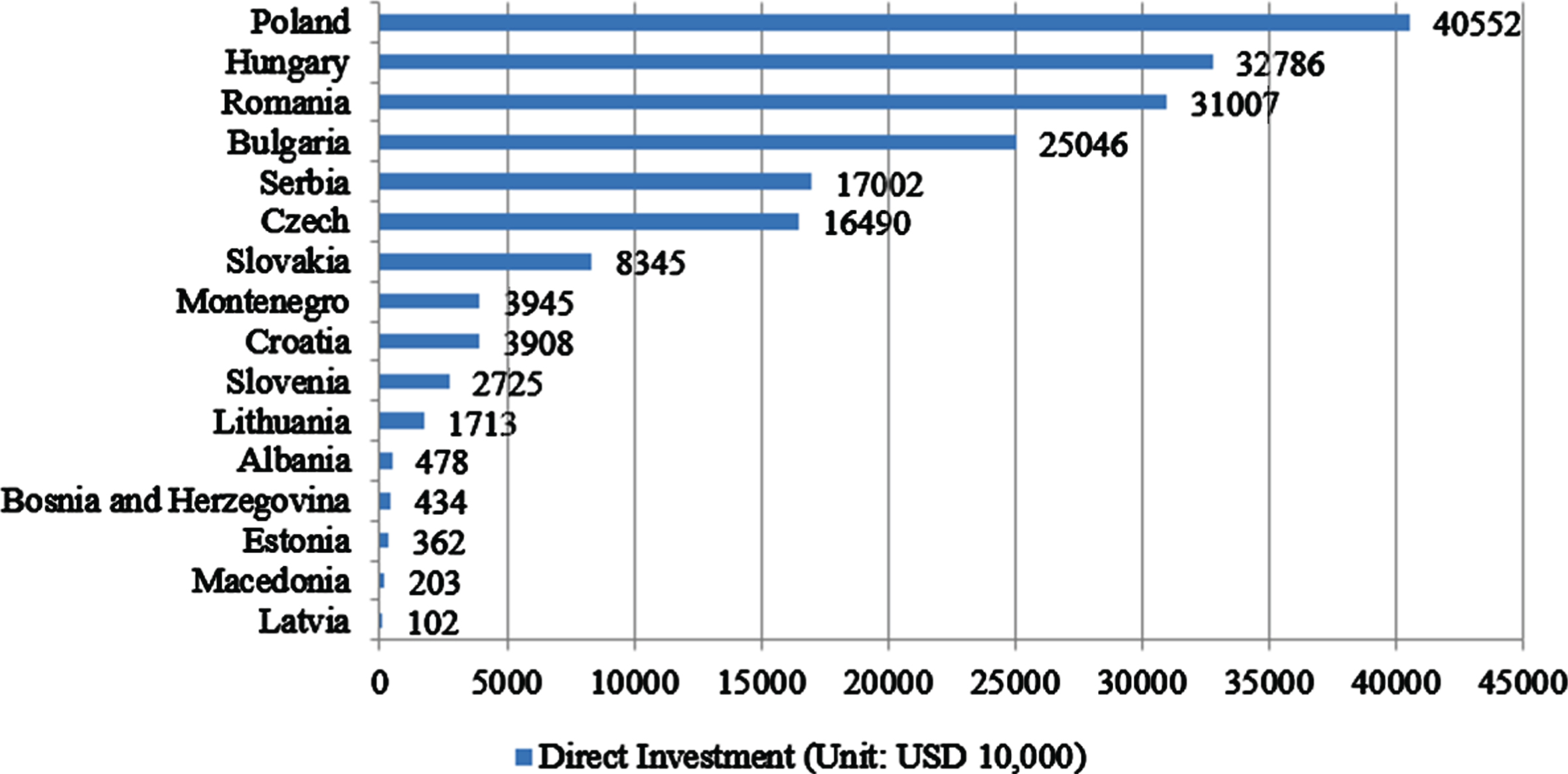
Distribution of China’s direct investment CEECs in 2017.
Since China’s reform and opening up, the Chinese SOEs have begun a continuous reform process in order to better adapt to the environment of market-oriented economy and enhance their own competitiveness. After nearly 30 years of transformation from planned economy to market economy, and from the “Bringing In” strategy to the “Going Global” strategy, the Chinese SOEs have strengthened their international competitiveness through industrial upgrading, technological progress, and innovation breakthroughs [19]. Of the 129 Chinese enterprises listed on the Top 500 enterprises in the world in 2019, 48 are Chinese SOEs. In 2015, after the State-owned Assets Supervision and Administration Commission of the State Council of China issued the Opinions on the Development of Mixed Ownership Economy of SOEs, many Chinese SOEs, especially local SOEs have enhanced the vitality, the quality, and the comprehensive benefits of the enterprise by introducing foreign-invested shares and taking the advantages of foreign shares in terms of capital, resources, technology, and management, etc. In addition, since the Chinese government is promoting the BRI strategy in recent years, it also needs a number of local SOEs with high international reputation and strong international competitiveness to promote the development of non-SOEs and local economies [15]. Therefore, it is particularly important for Chinese local SOEs to enhance their international competitiveness by introducing foreign shares through the reform of mixed ownership.
Therefore, based on the background of the mixed ownership reform of Chinese SOEs, this paper discusses how the strategy of introducing foreign-invested shares influences the international competitiveness; the paper introduces the BRI, one of the most important influencing factors in the reform and opening up of China, into the research framework, in the hopes of providing an experience evidence for the impact of the macro factor BRI on the micro behaviors of Chinese local SOEs. Compared with existing research, the contributions of this paper are as follows: first, it further promotes the reform of Chinese SOEs, especially the reform of mixed ownership from the perspective of scientific research; it studies the behavior of foreign investment introduction during the reform of mixed ownership of Chinese SOEs, which is different from the traditional thinking of existing research that are mostly conducted from the perspective of private capital; second, this paper further enriches the research content of the impact of macro-economic factors on the micro behaviors of enterprises. Moreover, this paper designs indicators for BRI and provides experience evidence for the impact of BRI on the micro behaviors of Chinese local SOEs, which is an issue that has been neglected by current literatures. Third, determine correlation between the introduction of foreign shares and the international competitiveness of Chinese local SOEs using neuro-fuzzy network. Finally, this paper provides an empirical evidence for the Chinese local SOEs to enhance their international competitiveness, which has a positive reference value for both SOEs and the policy makers.
The rest of the paper is organized as follows: section 2 present background study and research hypothesis. In section 3 we present research design idea and correlation analysis framework based on neuro fuzzy system. Section 4 represent empirical finding and result analysis. Section 5 demonstrate the summary of proposed study with result findings.
Introduction of foreign shares and international competitiveness
The introduction of foreign shares has a positive spillover effect on local enterprises, this is a conclusion drawn by many existing literatures [16]. On the one hand, the introduced foreign shares usually have certain resources and competitiveness such as capital, market, and technology, etc., and these resources can attract the attention of local enterprises, and enhance their comprehensive strength; moreover, the good management of local enterprises would attract foreign shares to actively participate in the operation of the enterprises as well [9]. On the other hand, since local enterprises have certain absorptive capacity and willingness to learn, they are capable of actively acquiring the resource advantages of foreign shares and learning from and imitating the characteristics of foreign shares, especially motivating the enterprises to innovate and develop [6], which has enabled the enterprises to obtain the benefits from spillover effect caused by the introduction of foreign shares [8].
Similarly, the introduction of foreign shares also has an impact on the improvement of the international competitiveness of Chinese SOEs, especially for local SOEs that have the attributes of SOEs and need to make profits and satisfy the requirements of the development of local economy through their enterprise attributes, thereby having a stronger absorption capacity for the spillover effect of foreign shares [20]. On the one hand, the introduction of foreign shares has strengthened the impetus and ability of Chinese local SOEs to participate in the international market. Due to the strong capital strength, global-level management capacity, sound international marketing network and rich international market experience possessed by these foreign shares, they can not only meet the capital needs of local SOEs and reduce the corporate debt ratio, but also bring them new development ideas, advanced management experience and international market information, which is conducive to local SOEs to better participate in the international market and enhance their own international competitiveness [1]. On the other hand, the introduction of foreign shares has also increased the investment efficiency of Chinese local SOEs; moreover, the introduction of foreign shares can play a role in the reform of mixed ownership of local SOEs in terms of diversity, depth, and checks and balances of the enterprises, thereby improving the investment efficiency of enterprises in the international market, and enhancing the international competitiveness of these enterprises [18].
H1: There is a significant positive correlation between the introduction of foreign shares and the international competitiveness of the Chinese local SOEs.
The introduction of foreign shares, the BRI, and the international competitiveness
On March 28, 2015, the Development and Reform Commission, the Ministry of Foreign Affairs, and the Ministry of Commerce jointly issued the Vision and Actions on Jointly Building Belt and Road (hereinafter referred to as the Vision and Action), this has marked the official launch of the BRI. Although the BRI is led by the Chinese government, it should be implemented by the enterprises. The proposal of BRI has also further reduced the cost of Chinese enterprises to participate in the international market, such as the cost for the business development of international market, and the cost for the trade barriers of business transactions [14], and these would also enhance the management efficiency and the international competitiveness of the enterprises [7]. As for the CEECs along the route of the “Belt and Road”, the Chinese government has built good political relationships with CEECs, therefore, after the BRI strategy has been proposed, the CEECs have become the first choice for the foreign investment of more and more Chinese enterprises, and it provides more opportunities for enterprises participating in the market of these countries [3]. In addition, in the context of Sino-US trade friction, it also brings more opportunities for Chinese enterprises to participate in the market of CEECs and expend the international market space.
Therefore, the proposed BRI strategy will further enhance the international competitiveness of Chinese local SOEs, and increase the degree of the introduction of foreign shares. On the one hand, after the Vision and Action was put forward, various provinces and cities in China have actively promoted the development of export-oriented economy, which provided a good opportunity for companies within the their respective jurisdictions to introduce foreign shares, making more local SOEs willing to gain the attention of local governments and complement the their own strength via the form of the introduction of foreign shares. On the other hand, the BRI has brought more potential benefits for both Chinese and foreign enterprises [17], the foreign-invested shares entering the Chinese market and the Chinese enterprises via BRI can better exert their roles; while having a benign effect on Chinese enterprises, they can also obtain corresponding benefits, thereby achieving a “win-win” situation.
H2: BRI has a mediation effect on the positive correlation between the introduction of foreign shares and the international competitiveness of Chinese local SOEs, that is, after BRI is taken into consideration, the positive influence of the introduction of foreign shares on the international competitiveness of Chinese local SOEs is more obvious.
In summary, the research model for the theoretical analysis in this paper is shown in Fig. 3.

Logical structure.
Data selection and description
Considering that in recent years, more local Chinese SOEs have conducted the reform of mixed ownership through the introduction of foreign shares, and they are actively participating in the international market of CEECs, this paper takes the Chinese local SOEs listed on the Shanghai and Shenzhen A-shares from 2007 to 2017 as samples, and screens the original samples according to the following principles: first, exclude special sample companies; second, exclude sample companies in the financial and insurance industries; third, exclude sample companies that just become listed companies in the current year; fourth, exclude sample companies with missing data and the data cannot be supplemented. Finally, a total of 2,397 Chinese local SOE samples from 2007 to 2017 were obtained.
Variables and model design
Explained variable, International Competitiveness (IC): by referring to the Taggart and Taggart [11], based on 7 aspects of the Chinese local SOEs’ business income, average return on assets, net interest rate on total assets, return on invested capital, growth rate of net interest rate, main business income growth rate, and capital maintenance growth rate in terms of their international business in the Central and Eastern Europe district, this paper constructs the enterprise international competitiveness indices through the weighted summation method.
Explanatory variable, Introduction of Foreign Shares (IFS): measured by the dummy variable of whether there are foreign shares in the top ten shareholders of the sample enterprises, if there are foreign shares, then IFS = 1, otherwise IFS = 0.
The BRI (OBOR): by referring to Luo et al. [5], this paper respectively chooses to use annual dummy variable and the regional dummy variable for the measurement. There, in this paper, the annual dummy variable is defined as follows: since the Vision and Action of BRI was proposed in early 2014, if the year of a sample is before year 2014, then OBOR1 = 1, otherwise OBOR1 = 0; the regional dummy variable is defined as follows: although the BRI is a macro strategy of the Chinese government, it is different according to the different areas of China mainland [10], therefore, the Vision and Action of BRI delineated 18 key provinces in mainland China, namely Xinjiang, Shaanxi, Gansu, Ningxia, Qinghai, Inner Mongolia in the northwest, Heilongjiang, Jilin, Liaoning in the northeast, Guangxi, Yunnan, Tibet in the southwest, Chongqing in the interior, and Shanghai, Fujian, Guangdong, Zhejiang, and Hainan; these provinces are the key provinces of the BRI, therefore, in this paper, if the location of a sample enterprise is among the 18 listed provinces, then OBOR2 = 1, otherwise OBOR2 = 0.
Control variable (Control_variable). According to existing literatures, this paper adds total assets (Size), asset-liability ratio (Debt), return on assets (Roa), and equity concentration (H10) as control variables, and controls the sample industry factor (Idu).
Model design. In order to examine the impact of the introduction of foreign shares on the international competitiveness of Chinese local SOEs and the mediation effect generated by the BRI, this paper constructs the following models:
Through the advancement of smart technologies, analysis based on neuro-fuzzy have achieved remarkable success in respective fields. In this paper correlation analysis is carried out using neuro-fuzzy network that automatically constructs a set of rules and optimizes controls through self-learning [21–23]. It protects such a constraint that rules are mainly based on expert’s perceptions. Neuro-Fuzzy network has improved self-learning, robustness and adaptability compared with the analytical network, while estimation of every nonlinear function is feasible.
Figure 4 illustrates the Neuro-fuzzy network Architecture for Correlation Analysis that consists of five levels of the analysis. It presumes in this case that correlation analysis has n inputs (x1, … . . x m ), output (k). M Sets are available. Assume that the rule base includes M- rules. In this paper we consider eight inputs including IC, IFS, OBOR1, OBOR2, Size, Debt, Roa, H10
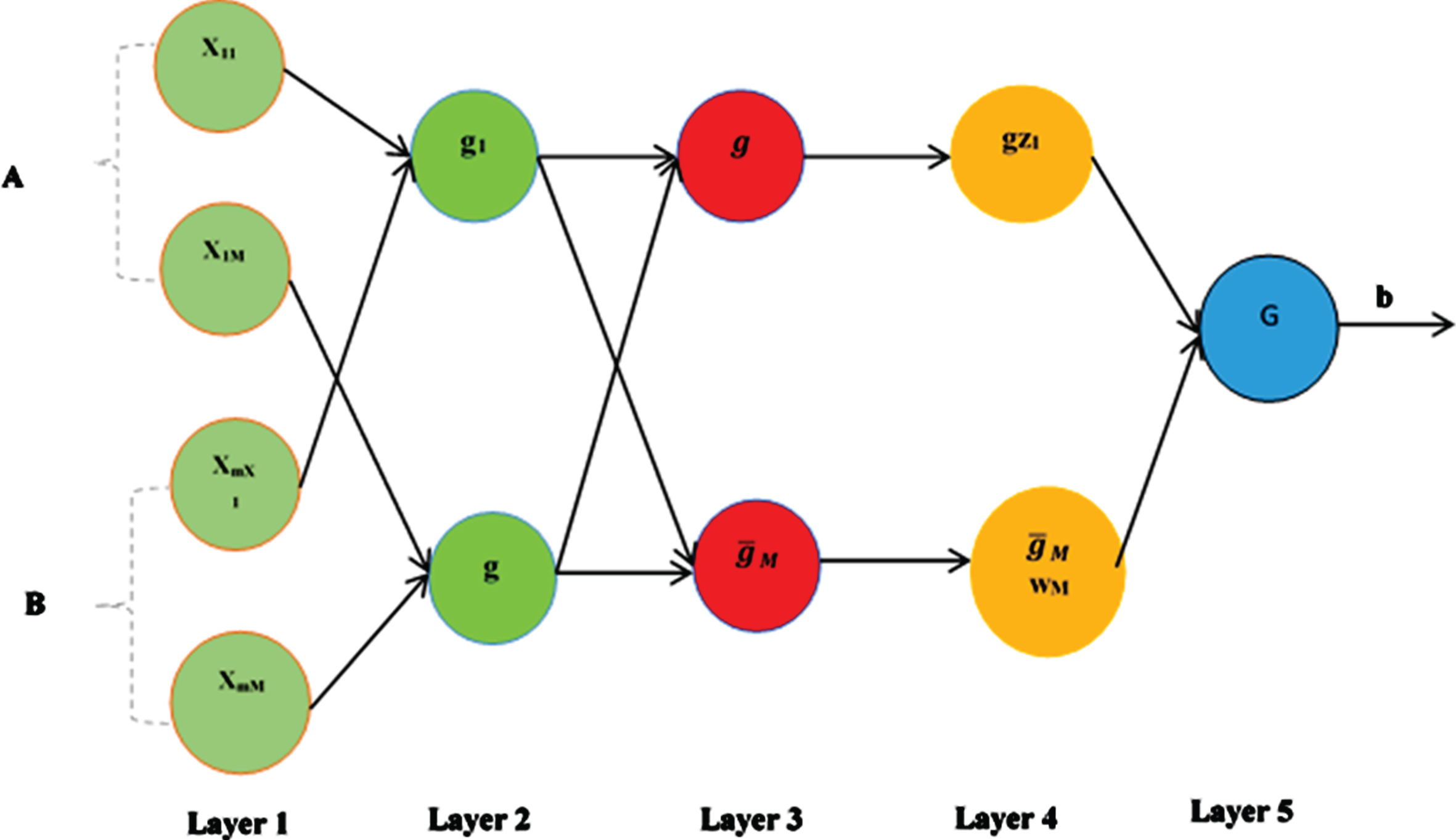
Neuro-fuzzy network Architecture for Correlation Analysis.
Fuzzification Layer 1 is a layer of analysis that first convert crisp input into fuzzy linguistic variable using Gaussian function. This layer determines the node function. The role is typically a Gaussian function: as in (4).
Where c
ab
and b, respectively, are an excepted Gaussian function value and standard deviation. Fuzzy interference Engine Layer 2 is a layer of the rule. Each node multiplies those inputs and generates the following outputs as in (4):
The outputs of this layer represent the firing strength of a rule. The standard layer is layer 3.
Layer 3 node produces the following weight (5):
Layer 4 is the form of interactive analytics. Nodes throughout this layer are calculated by (6):
The output level is Layer 5. The node reflects the output, and the number of layer outputs is determined as shown in (7).
Because of the combination of the layers, neuro-fuzzy network achieves stable output with fast learning speed in data analysis.
Descriptive statistical analysis
From the Panel A in Table 1 we can see that, the average value of variable IC is 0.001, indicating that the competency level of the international competitiveness of Chinese local SOEs participating in the Central and Eastern European market is not high. The average value of variable IFS is 0.211, only 21.1%of sample enterprises have introduced foreign shares, most of the local SOEs haven’t introduced foreign shares. The variable OBOR1 has an average value of 0.384, indicating that nearly 40%of the samples belong to the BRI years; the variable OBOR2 has an average value of 0.197, only less than 20%of the samples belong to the BRI districts. From the Panel B in Table 1 we can see that, in group IFS = 1, the mean value of variable IC is higher than that in group IFS = 0, and it can pass the significance test with conventional confidence level, and it can be preliminary judged that the Chinese local SOEs with introduced foreign shares have stronger international competitiveness.
Descriptive statistics
Descriptive statistics
Note: Panel A shows the summary statistic on all variables. Panel B shows the classification analysis on international competitiveness and introduction of foreign shares by dividing firm-years into difference groups. The p-values for the differences in means are based on t-tests. *, **, and *** indicate statistical significance at the 10%, 5%, and 1%levels, respectively.
According to the results in Table 2, the correlation coefficient between the explained variable IC and the explanatory variable IFS is positive, which indicates that compared with that before the introduction of foreign shares, after the Chinese local SOEs doing international businesses in CEECs have introduced the foreign shares, their international competitiveness becomes stronger, which has preliminarily verified the hypotheses in previous paragraph. Furthermore, the values of the correlation coefficients between the variables are not high, which indicates that there is no collinearity problem among the variables.
Correlations
Correlations
Note: The correlations between the introduction of foreign shares, the “OBOR”, the international competitiveness, and the control variables. *, **, and *** indicate statistical significance at the 10%, 5%, and 1%levels, respectively.
From the results of the multiple regression test in Table 3 we can see that, there is a positive correlation between the explanatory variable IFS and the explained variable IC, and it can pass the 5%confidence-level significance test, which indicates that compared with the local SOEs that did not introduce foreign shares, those with foreign shares have stronger international competitiveness when participating in the Central and Eastern European market, the introduction of foreign shares has brought more resources for these Chinese local SOEs, enabling them to better participate in the market competition in the Central and Eastern European markets, thereby their international competitiveness has been improved, which has verified H1 in the previous paragraph. There is also a positive correlation between the variable OBOR1 and the explained variable, which can pass the 1%confidence-level significance test, and there is also a positive correlation between the variable OBOR2 and the explained variable, which can pass the 10%confidence-level significance test, and this indicates that, compared with the situation before, after the BRI has been proposed, the international competitiveness of Chinese local SOEs participating in the Central and Eastern European market has been further improved. In terms of the mediation effect of the variable OBOR, in the regression results (4) and (5), the coefficient values of the interaction terms are both positive, and both can pass the 1%confidence-level significance test, which shows that, after the influence of BRI is taken into consideration, the foreign-invested shares have played a role in enhancing the international competitiveness of Chinese local SOEs. It can be seen that, as the BRI is a manifestation of China’s economy opening to the outside world under the new normal, the new era, and the new situation, a development pattern that gives consideration to both the land and the sea, the east and the west, and the inside and the outside, is being built in the country; especially, the Chinese local SOEs are the direct beneficiaries of the BRI strategy, and the shareholders of these enterprises can use the benefits they gain from the BRI to better exert their roles, thereby enhancing the international competitiveness of these enterprises, which has verified H2 mentioned in above paragraph.
Multiple regression test results: OLS estimation
Multiple regression test results: OLS estimation
Note: The ordinary least squares regression results of the impact of introduction of foreign shares on international competitiveness and ‘OBOR”s mediation effect. The standard error reported in parentheses. *, **, and *** indicate statistical significance at the 10%, 5%, and 1%levels, respectively.
Further, according to Bowerman and O’Connell [4], this paper uses graphs to show the influence of foreign shares on the international competitiveness of Chinese local SOEs participating in the Central and Eastern European market, as well as the mediation effect of the BRI.
First, the mean values of variables in Table 1 and the coefficient values in Table 3 were substituted into Formula (2), and the following two formulas were obtained as shown below:
In order to more clearly observe the influence of foreign shares on the enhancement of the international competitiveness of Chinese local SOEs when participating in the Central and Eastern European market before and after the proposition of BRI, formulas (4) were divided into two parts: one part is the international competitiveness of the local SOEs before the proposition of BRI; the other is the international competitiveness of the local SOEs after the proposition of BRI. Therefore, before BRI, the international competitiveness of the Chinese local SOEs participating in the Central and Eastern European market is OBOR = 0, then formulas (4) became:
After the proposition of BRI, the international competitiveness of the Chinese local SOEs participating in the Central and Eastern European market is OBOR = 1, then formulas (4) became:
Therefore, in this paper, formulas (7), and formulas (8) are shown in Fig. 5 respectively.
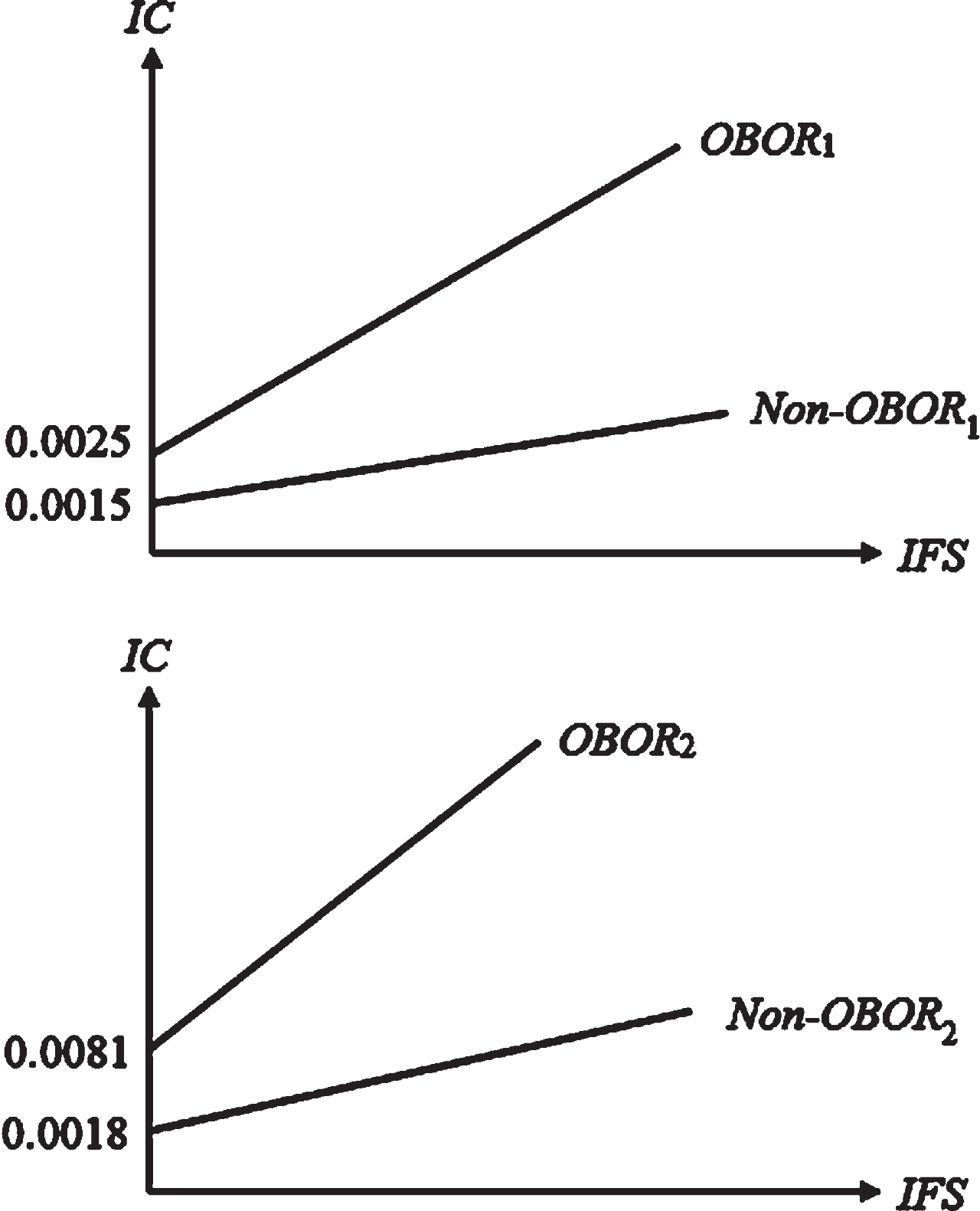
Influence of foreign shares on international competitiveness before and after the proposition of BRI.
According to Fig. 4, after the proposition of BRI, in terms of the influence of foreign-invested shares on the international competitiveness of the Chinese local SOEs participating in the Central and Eastern European market, both the basic resources (the intercept) and the strength of the influence (the slope) are stronger.
Among the control variables of the regression results in Table 3, there are significant positive correlations between the variables Debt, Roa and the explained variable, local SOEs with higher debt ratio and stronger profitability have stronger international competitiveness; there are significant negative correlations between the variables Size, H10 and the explained variable, indicating that the local SOEs with smaller asset size and lower concentration of equity have stronger international competitiveness.
Further, this study conducted a robustness test. First, considering the problem of the strong correlation between variables in the regression model caused due to the addition of interaction terms, the regression test was adopted; second, considering that for local SOEs in different regions of China, their participation degrees in the international market have large differences, therefore, the samples were divided into eastern part samples, central part samples, and western part samples before the tests; moreover, considering that this paper used the dummy variable of whether the sample company introduces foreign shares for the measurement, it further used the ratio of foreign shares in the sample enterprises to measure the post-test of variable IFS, the robustness test results were not substantially different from the previous paragraphs.
Although this paper controls the variables that affect the international competitiveness, there may still be an endogenous issue between the introduction of foreign shares and the international competitiveness. An existing situation is that, the behavior of introducing foreign shares is not a proactive action of the Chinese local SOEs, but an action of passively catering to the requirement of the policy. Therefore, in order to solve the endogenous problem, this paper adopts a two-stage regression method and takes the ratio of foreign shares (LIFS) of other peer enterprises in the previous year as the tool variable. According to the endogenous test results of Table 4, the Sargan test shown by the J statistic had not past the significance test, indicating that the choice of tool variable was correct, and this is consistent with theoretical expectations. In the second stage regression results, there’s still a significant positive correlation between the variable IFS and the explained variable, and the coefficient of the interaction term was also significantly positive, indicating that after controlling the endogenous impact, the introduction of foreign shares would still have a positive impact on the international competitiveness of the Chinese local SOEs in the Central and Eastern European market, and the proposition of BRI would further promote this positive impact.
Endogenous test results: 2SLS estimation
Endogenous test results: 2SLS estimation
Note: The first-stage regression models are about introduction of foreign shares and additional instrumental variables is LIFS. The standard error reported in parentheses. *, **, and *** indicate statistical significance at the 10%, 5%, and 1%levels, respectively.
In recent years, with the implementation of the Chinese government’s export-oriented economic strategy, more and more Chinese SOEs have begun to “introduce foreign shares” and “go out to the global market”, so as to enhance their own international competitiveness. Especially after the implementation of the BRI strategy, the Chinese government has strengthened its cooperation with CEECs, allowing more Chinese companies to start to enter the Central and Eastern European market. Therefore, this paper took Chinese local SOEs participating in the Central and Eastern European market from 2007 to 2017 as samples to empirically test the impact of the introduction of foreign shares on the international competitiveness of these enterprises, and it analyzed the mediation effect of the BRI strategy. In this paper, we propose neuro -fuzzy network based correlation analysis and empirical analysis found that the introduction of foreign shares has enhanced the international competitiveness of Chinese local SOEs in the Central and Eastern European market. That is, compared with local SOEs that did not introduce foreign shares, those that introduced foreign shares have stronger international competitiveness; after the role of BRI was taken into consideration, the introduction of foreign shares had further enhanced the positive impact on the international competitiveness of the enterprises. This is because the BRI has obviously stimulated the motivation of local Chinese SOEs to participate in the Central and Eastern European market.
The BRI is both an opportunity and a challenge for Chinese enterprises. However, only by seizing this opportunity can the Chinese enterprises meet more challenges and use the broader overseas market to obtain more profits. On the one hand, relying on the international impact of the BRI, Chinese enterprises should seize the benefit of the policy of BRI strategy, and carry out relevant cooperation with countries along the route of BRI, especially the CEECs with strong market potential, so as to strengthen the connection with different types of market in these countries. On the other hand, the Chinese government should pay more attention to the impact of BRI on the local SOEs. The empirical evidence in this paper also shows that Chinese local SOEs have strong willingness and motivation to participate in international market via the BRI strategy, therefore, we should actively play the role of local SOEs and provide better services for them during the process of “Going Global”.
Footnotes
Acknowledgment
The authors acknowledge funding from the key project of Ministry of education of Humanities and Social Science Project of China (18YJC630087), Humanities and Social Science Foundation of Chongqing Education Committee (18SKGH086), Science and Technology Project of Chongqing Education Commission (KJQN201900902)and Sichuan International Studies University Non-Common Language Research Team Project, as well as the contributions from all partners of the mentioned projects.