



Abstract
In 2020, the Regional Comprehensive Economic Partnership (RCEP) initiated by the Association of Southeast Asian Nations (ASEAN) was officially signed; the RCEP is the largest free trade agreement in the world. As both Vietnam and China are important member countries of this agreement, the close trade cooperation that exists between Vietnam and China has important economic and political implications, and its development has been further improved by the Belt and Road Initiative (BRI). The vast majority of this trade is done through intermodal container transport, so efficient multimodal container transport has become necessary to enable cross-border trade. With the rapid development of China’s transportation infrastructure, Chongqing has become an emerging logistics hub in inland China. Hai Phong is the largest port city in Vietnam, and it has extensive multimodal transport infrastructure. In this paper, we scientifically evaluate the competing routes for the multimodal container transport supporting China-Vietnam trade, analyse eight transport routes from Chongqing to Hai Phong, and evaluate these routes with the Delphi and CFPR methods. This study can inform Chinese and Vietnamese trade enterprises in terms of selecting their preferred multimodal transport route strategies and the governmental authorities of both countries in making management decisions.
Keywords
Introduction
The Regional Comprehensive Economic Partner-ship (RCEP) initiated by the ten ASEAN countries was signed on November 15, 2020; this agreement involves a population of approximately 2.3 billion people with a combined GDP of more than $256,000 and accounts for approximately 25% of global trade. As Vietnam is one of the initiating countries of this agreement and China is its largest member, the close trade cooperation that exists between China and Vietnam has important economic and political implications for the world. Since the trade disputes between China and the US began, Vietnam’s international trade position has changed dramatically. Additionally, Vietnam’s geographical proximity to China makes China-Vietnamese trade have particular development advantages within the framework of the Belt and Road Initiative (BRI). From 1999 to 2018, the total import and export volume between China and Vietnam increased from $1.218 billion to $147.8 billion, expanding the scale of this trade by approximately 120 times [5]. Trade between these countries has especially increased since the BRI was launched in 2013; according to the Vietnam Customs Report [27], the bilateral trade volume reached $116.9 billion in 2019, and the top products in terms of trade volume are mainly electronic products [23]. Especially with the tax rebate policy included in the RCEP, China-Vietnam trade will continue to prosper, and the volume of transportation will increase. Efficient multimodal container transport has become a necessary condition for cross-border trade; therefore, it is urgent and of practical significance to evaluate the multimodal container transport routes between China and Vietnam.
Cross-border trade between China and Vietnam involves the multimodal transport of containers, and Vietnam’s multimodal transport is currently characterized by an unbalanced development of infrastructure and coordination difficulties involving various transport modes and large container throughput. Most importantly, Vietnam’s current infrastructure has been developed primarily along north-south connections with no focus on east-west connections. If Vietnam is not connected to new infrastructure points, it will not be able to take full advantage of the opportunities presented by the BRI and RCEP, and Vietnam’s strategic position in the region will fade away. Furthermore, there are few independent freight highways in Vietnam, and the state of the bridges across the river limits waterway connections; thus, neither the efficiency of transporting goods to seaports nor the related freight costs are optimized in a timely manner. Thus, since the BRI, the container throughput has skyrocketed. During the first six months of 2019, the cargo throughput of Vietnam’s seaports reached 308.8 million tons, an increase of 13% year-on-year. During the same period, the volume of containerized cargo reached 9.1 million TEU, an increase of 3% year-on-year. According to a report given at the 9th Asia-Europe Forum, Vietnam’s cargo transport capacity is expected to double (114 million tons) by 2020 [27]. As the largest port city in Vietnam, Hai Phong Port is the only port connected to the country’s railroads, and its cargo volume accounts for the vast majority of Vietnam’s seaport cargo volume.
During recent years, China has constructed extensive logistics infrastructure for the land, sea and air. Beijing Daxing International Airport, which is positioned as a mega international aviation-integrated transportation hub, was officially opened on September 25, 2019. According to reports, China will have seven of the world’s top 10 ports by 2020 [19]. By the same year, China have built 2,000 kilometres of collector and distributor railroads, and 70% of the country’s railroads will have access to coastal ports, ushering in a new stage of development for combined rail-water transport [16]. In 2018, an international train service was launched, and it runs from Unity Village in Chongqing to Hanoi, Vietnam. Many new international logistics centres have emerged in China’s interior, such as Chongqing, Zhengzhou, and Ningbo. In particular, Chongqing is at the nexus of the “Belt and Road” and the Yangtze River Economic Belt, is the core hub of the land and sea corridor, and is a typical representation of the implementation of the BRI; additionally, the total trade volume between Chongqing and Vietnam accounts for 77.08% of the total trade volume between Chongqing and ASEAN countries [30]. The trade volume of electronic products among these countries has been increasing year by year and has become a mainstream product of the new generation of China-Vietnam trade. The cities of Chongqing and Hai Phong, as the economic centres of these two countries, are geographically located; additionally, Chongqing and Hai Phong are the main logistics centres of China and Vietnam, respectively. And they have excellent multimodal transportation facilities, allowing trade to be conducted by all the major modes of transportation, namely, sea, air, and road. Therefore, it is of great practical significance to evaluate the trade and transportation routes between Chongqing and Hai Phong.
Cross-border multimodal transport mainly comprises the following four types of operational modes: highway-railway multimodal container transport, seaway-railway multimodal container transport, airway-railway multimodal container transport, and seaway-airway multimodal container transport. As different decision makers have different decision-making needs, they have different starting points when choosing a multimodal transport route; for example, logistics companies and both of the countries’ governments have different preferences regarding transport time, transport costs, and transport safety. To help decision makers choose a scientific and reasonable multimodal transport mix strategy, this study adopts the Delphi and CFPR methods to analyse the factors influencing the cross-border multimodal container transport between China and Vietnam, establishes an evaluation index system, provides route possibilities that fit the different preferences of the various decision makers, and finally analyses each competing route to provide decision makers with a basis for choosing a suitable transport route.
This paper is structured as follows: Section 2 reviews the literature. Section 3 presents the methods employed in this work. Section 4 describes the empirical analysis of the transportation route of electronic products between China and Vietnam. Section 5 discusses the results obtained help select the transportation route and Section 6 conclude this paper.
Literature review
Research on cross-border multimodal transport
Some studies have assessed the performance of the transport corridors between Northeast and Central Asia [3] and between Southeast Asia and the east-west economic corridors [1, 4]. Kengpol et al. (2014) assessed a cross-border transportation project involving a new freight transportation corridor from the Black Sea to the southeastern Mediterranean region [36]. Wang and Yeo (2016) aimed to deter-mine the optimal transport network for exporting used vehicles from Korea to Central Asian countries by examining experts’ opinions and real data from the existing transport networks. [20] Du et al. (2017) investigated the freight delivery performance of the Mackenzie River Corridor with a focus on its river route, considering how variations in the river water conditions could impact the network’s operations and operational costs [38]. Wan et al. (2018) explained how different factors impact shipping costs and examined the economic viability of the Northern Sea Route between Asia and Europe [18]. Pizzol (2019) assessed the environmental performance of 66 intermodal truck-ferry and road-only routes within eight transport corridors in Scandinavia in terms of their carbon footprint using methods, databases, and software from the Life Cycle Assessment domain [11]. Alam et al. (2019) analysed the effect of the China-Pakistan Economic Corridor on trade in terms of transport cost and travel time and compared the existing routes with new China-Pakistan Economic Corridor route [33]. Jiang et al. (2020) ana-lysed the impacts of The New International Land-Sea Trade Corridor on the freight market structures of West China and Central Asia.
Currently, most of the existing research is con-ducted from the geographical perspective of North-east Asia, Central Asia, and Southeast Asia; however, there is a lack of country-to-country trade and transportation research. This is especially the case with countries such as China and Vietnam, where the political and military environment is stable, the economy is developing rapidly, and intercountry trade exchanges are positive and stable. It is necessary to study multimodal transport between China and Vietnam. With the advancement of the BRI and the signing of the RCEP, China-Vietnam trade has exploded, and the logistics and transportation environment in China has changed dramatically; additionally, many new logistics hubs have emerged, such as Chongqing, Zhengzhou, and Ningbo. The current research on the multimodal transport routes between China and Vietnam do not meet the needs of China-Vietnam trade; therefore, this study focuses on evaluating the multimodal transport routes between these countries and empirically analysing the multimodal transport between Chongqing, China and Hai Phong, Vietnam.
Research on the evaluation of multimodal transport routes
There are many factors that influence the selection of a multimodal transportation route; the existing research on this topic considers the impact of different factors on transportation routes when evaluating and selecting multimodal routes, and the exact factors that are considered depend on the specific problem.
[36] Wang and Yeo (2016) used the fuzzy Delphi method and the factors of total cost, total time, reliability, safety, and transportation capacity from the multimodal transport networks of Central Asian countries to establish an evaluation system [37]. Wang and Yeo (2018) established an evaluation system based on total cost, total time, reliability, safety, and transport capacity that can select a freight transport route from Korea to Central Asia through China’s Silk Road Economic Belt [7]. Salehian et al. (2018) found that logistics cost, logistics infrastructure, connections between logistical components, institutional frameworks and human resources are the main factors affecting the improvement of Vietnam’s transportation system [17]. Kar et al. (2018) developed a fuzzy mathematical model that employed transportation cost and time parameters as fuzzy variables to study optimal transportation strategies [22]. Fazayeli et al. (2018) compared the total annual costs of four feasible transportation routes from Korea to the United States using an inventory theory model [25]. Vilke et al. (2018) evaluated and selected a route between Jelsane and Postojna, taking into account economic, transport, urban planning, and constructional-technical factors [21]. Sarraf and Mcguire (2020) considered distance, time, and safe-ty to help decision makers choose the most appropriate path [28]. Zhang (2020) established an uncertain multiobjective programming model for the de-sign of a water-rail-road intermodal transport net-work that took into account cost, time and reliability objectives [9]. Perez mesa et al. (2020) studied the feasibility of the intermodal transportation of horticultural products from southeast Spain to the rest of Europe, believing that transportation costs and the environment are its main influencing factors [10]. Kim et al. (2020) proposed the most economical transportation route for transporting Korean American intermodal automobile parts to the southeast of the United States by comparing seven different transportation routes, and they concluded that transportation cost, commodity value and inventory cost were the main influencing factors in this context [12]. Yang et al. (2020) found that reliability is an important factor affecting highway-railway multimodal transport systems [35]. Sun et al. (2020) discussed the door-to-door transportation path of dangerous goods in the context of road-rail multimodal transport and identified economic type, risk and reliability as its influencing factors through sensitivity analysis.
The factors that are usually considered in the studies on multimodal routes include transit time, transportation costs, safety, reliability, and geopolitics. The main difference among these studies is that their weightings of each factor vary considerably, and they utilize different weights for each indicator according to the specific problem context and objective being addressed.
The issue of evaluating multimodal transportation routes is categorized as the Multi Criteria Decision Making (MCDM) problem, and the existing studies on this topic use TOPSIS [6, 8], a hybrid method combining the fuzzy Delphi Electre I method [36], the PROMETHEE II technique [25], the Delphi method [34, 36], the CFPR method [2, 36], the analytic network process (ANP) method [7, 31], the CFPR/DEA method [15] and the Analytic Hierarchy Process (AHP) method [8, 31], as well as other methods used to establish evaluation index systems.
The Delphi method is one of the more common methods used for selecting influencing factors. This method is an improved expert opinion method that avoids the predominance of important people and is widely representative when selecting influencing factors. The quantification of the weights of qualitative indicators always poses a difficult problem in this kind of research due to the uncertainty, ambiguity and imprecision in the judgement process. In contrast, the consistent fuzzy preference relations method (CFPR) is more suitable for expressing the uncertainty and vagueness of thoughts and preferences. Therefore, this study combines the Delphi and CFPR methods to establish an evaluation index system, and it uses CFPR to evaluate and rank competing routes.
Methodology
First, to solve the MCDM problem involving the evaluation of the multimodal container transport routes between China and Vietnam, the Delphi method was employed to identify a hierarchy of criteria. Then, the CFPR method was used to calculate the weights of the influencing factors and rank them. The CPFR was used to evaluate and rank the routes that had been listed. The evaluation flow chart used is as follows (Fig. 1).
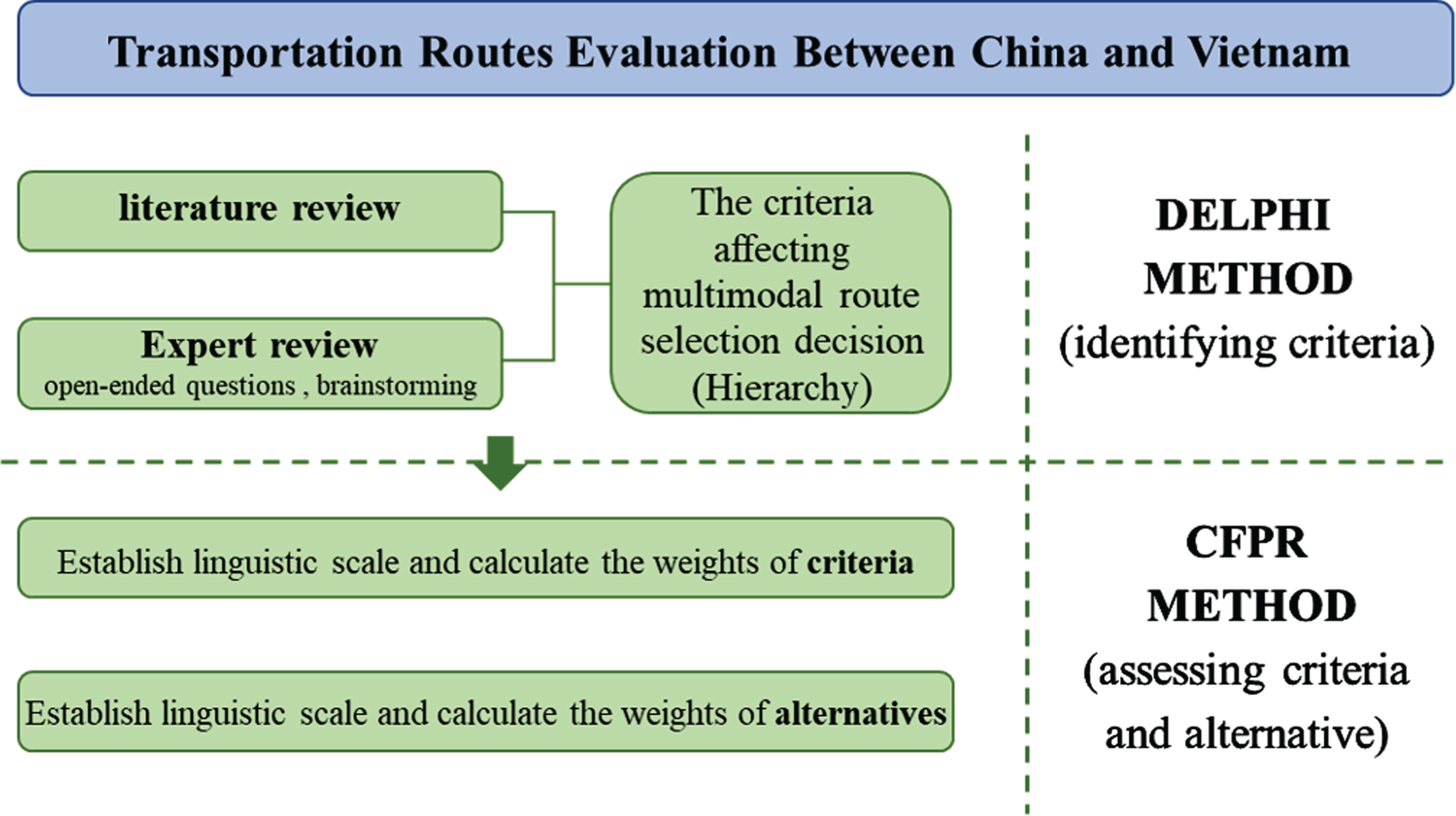
Flowchart of evaluation.
This research applied the CFPR method developed by [29] Herra-Viedma et al. (2004) to calculate the weights of the influencing factors and rank them; subsequently, the method was used to evaluate the selection of the multimodal transport routes from China to Vietnam [26]. Chang et al. (2009) proved the applicability and feasibility of CFPR in dealing with complex, multi-attribute decision making.
The advantages of using CFPR for this study are as follows: (1) it significantly shortened the length of the questionnaire by reducing the number of questions needed to compare (n-1) for a group of n criteria, leading to an increased possibility of receiving reliable responses; (2) it enabled the avoidance of inconsistent responses and responses in need of reevaluation, not only saving time but also facilitating greater effectiveness.
The study applied the important definitions and recommendations proposed by [31] Chen and Chao (2012) with some modifications that enabled methodological improvements: (1) the relative im-portance scale was reduced from 9 points to 5 points to allow for simpler judgements; and (2) the evaluation criteria included quantitative and qualitative factors.
Preference relations
First, we establish the preference relations by in-structing the participating experts to rank a set of criteria and a set of alternatives (Table 1). The values indicated illustrate the experts’ preference rates of each set of two criteria or alternatives. This process applies two preference relations: (1) the multiplicative preference relation and (2) the fuzzy preference relation. The process is as follows: For the multiplicative preference relation A, experts express their preferences for a set of alternatives X, which is denoted by the preference relation matrix A⊂ X × X, R = (a
ij
) , ∀ i, j ∈ { 1, …, n }, in which aij indicates the preference ratio of alternative x
i
to x
j
. For the fuzzy preference relation, the ratio of the preference intensity of alternative x
i
to that of x
j
is indicated by the expert assessments through a set of alternatives in which X is indicated by the positive preference relation matrix P ⊂ X × X with the membership function μ
p
(x
i
, x
j
) = p
ij
. When
Linguistic terms for the importance weighting of the criteria
The problem of inconsistency can be solved by the construction of decision matrices comprising pairwise comparisons that are based on three propositions as follows:
log 5a ij is utilized because a ij is between 1/5 and 5.
Proposition 3. The reciprocal additive fuzzy pref-erence relation is P = (p
ij
) thus, the following statements are equivalent:
If the preference matrix has values that are not in the interval [0, 1] but are in [- a, 1 + a], a linear transformation is required to preserve its reciprocity and additive transitivity, namely, f : [- a, 1 + a] → [0, 1]. Then, the transformation function is denoted as follows:
The evaluations of m experts are integrated by ob-taining their average value using the following nota-tion.
The aggregated fuzzy preference relations matrices r
ij
are normalized to illustrate the normalized fuzzy preference value of each considered criterion as follows:
Using w
i
, which denotes the average priority weight of considered criteria i, the priority of each criterion can be obtained as follows:
Where n is the number of criteria considered
The main purpose of this study is to determine the factors influencing a transporter’s choice regarding the different China-Vietnam multimodal transport routes and to evaluate and analyse several selected possible routes. This study was conducted using 40 ft containers as transport carriers.
China’s Chongqing is at the nexus of the “Belt and Road” and the Yangtze River Economic Belt; additionally, as the heart of a major land and sea corridor, it is a typical representation of the implementation of the BRI. Chongqing and Hai Phong are the main logistics centres of China and Vietnam, respectively. These cities are strategically located economic hubs, and the main modes of transportation used in these hubs are sea, inland waterways, railroads, and high-ways. Therefore, we selected a competitive multi-modal route, namely, from Chongqing, China, to Haiphong, Vietnam, to evaluate in this study and propose eight possible transportation options for this route, as shown in Fig. 2.
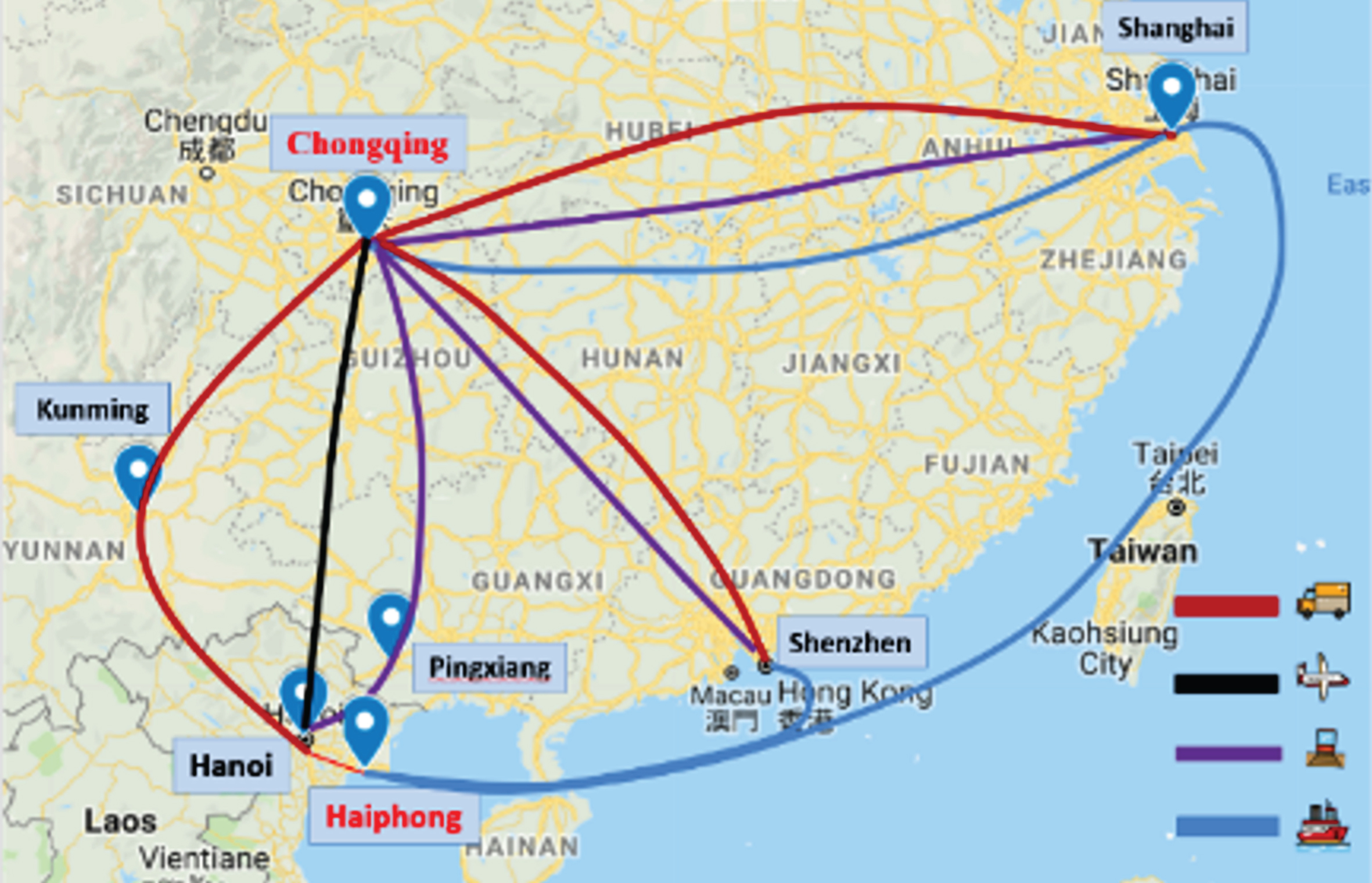
Alternative routes for transporting containers from Chongqing to Hai Phong.
Alternative 1: Chongqing - Hanoi - Hai Phong (Airway) - R1
Alternative 2: Chongqing - Shanghai - Hai Phong (Road + Ocean) - R2
Alternative 3: Chongqing - Shanghai - Hai Phong (Rail + Ocean) - R3
Alternative 4: Chongqing - Shanghai - Hai Phong (Inland waterway + Ocean) - R4
Alternative 5: Chongqing - Shenzhen - Hai Phong (Road + Ocean) - R5
Alternative 6: Chongqing - Shenzhen - Hai Phong (Rail + Ocean) - R6
Alternative 7: Chongqing - Hai Phong (Road) - R7
Alternative 8: Chongqing - Hanoi - Hai Phong (Rail + Road) - R8
To reach the goals of this study, two methodology steps were designed (Fig. 3).

The two-step methodology procedure.
Initially, the Delphi method was used to obtain the main factors and subfactors that influence the choice of multimodal transport routes and to select the probable solutions for the problem regarding Chongqing-Hai Phong multimodal transport route for electronic products. Subsequently, this study applied the CFPR method to evaluate and rank these influencing factors and probable solutions. From the experience of the participating experts, the main factors and sub-factors were identified with a Likert scale. Then, the alternatives were compared to identify the optimal option.
In the first step of this study, the factors influencing multimodal route selection were compiled from the literature on route selection and transportation modes; this step was followed by five rounds of discussion among experts in the field to obtain the final results. A group of seven experts were invited to answer this study’s questionnaire. More specifically, all of the participating experts were from large enterprises (including C&D enterprises, Yangming, Evergreen, Wanhai lines, ONE line, COSCO, and APL). The work experience of these experts in fields related to this study’s topic ranged from 5 to 20 years. In addition, these experts held diverse positions, and they included purchasing staff, operation staff, operation managers, and customer service staff. The surveys were collected over a one-month period from May 2019 to June 2019 through emails, cell phone calls and face-to-face interviews.
During the interviews, calls, etc., each expert would answer questions regarding the factors influencing multimodal route selection as identified in the review of relevant literature. To be more specific, these experts were asked to determine whether each factor was necessary and whether any factors over-lapped by answering open-ended questions. After this step, a system of eight primary factors and 25 secondary factors was identified, along with eight multimodal route alternatives. (Fig. 4).
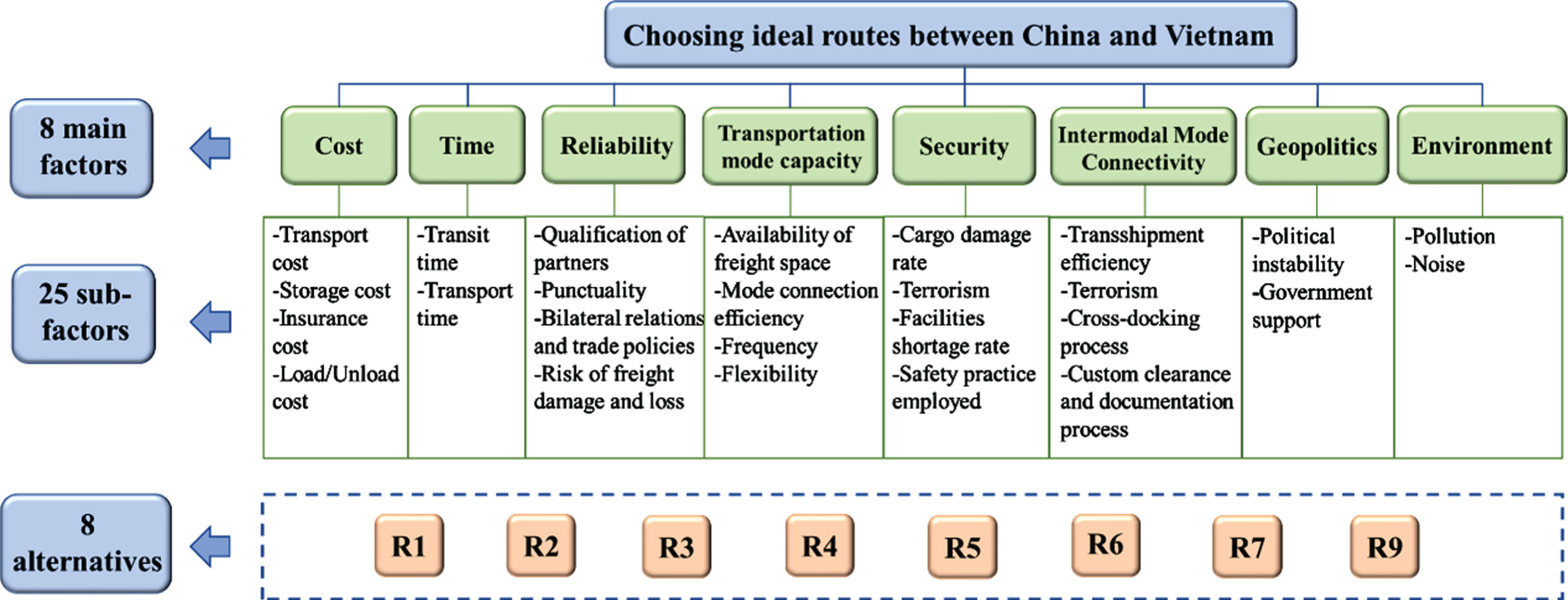
The structure of the multiple criteria for route selection from China to Vietnam.
In this step, the experts evaluated the main factors and subfactors identified in the first step. More specifically, the seven experts who had participated in the first round of the survey continued to participate in the second round, and eight additional experts from electronics manufacturers, such as C&D enterprises, Changhong enterprises, and Yonghan enterprises, were also invited to answer the questionnaire utilized in this step. In total, there were 15 respondents with 3 to 20 years of expert experience in related fields. The number of respondents was enabled in-depth interviews with these experienced experts. The second survey was conducted over a period of 50 days from July 2019 to September 2019.
Evaluation of the criteria and the alternative routes from Chongqing to Hai Phong
Weighting calculations and criteria evaluation
First, in this paper, the CFPR method is used to pairwise compare the eight main factors and 25 sub-factors that influence the choice of the Chongqing-Hai Phong transport route (Fig. 4).
The results illustrated that among the eight main factors, transportation cost is prioritized when considering the Chongqing-Hai Phong transport routes for containers; this factor is followed by reliability, transportation time and security. The least prioritized factor is geopolitics. Furthermore, of the 25 subfactors, transport time is the most important fac-tor. In contrast, the least important subfactor is flexibility. Therefore, the airway route is preferred over the seven other alternatives for shipments from Chongqing to Hai Phong.
More specifically, with respect to the main factors, the results for the eight main factors indicated that transportation cost ranked first with 17.3% (Fig. 5). According to logistics enterprises and shippers in China and Vietnam, transportation cost is the most important factor when determining the multimodal transportation route of electronic products. This finding is consistent with the requirements of most products that prioritize minimizing cost. However, reliability is also a crucial determinant when selecting transportation modes. This factor may be the most important for high-value cargoes (e.g., electronic products), which primarily require safety; thus, the qualifications of partners, punctuality, bilateral relations and trade policies, freight damage risk and loss are subfactors. Furthermore, to ensure seamless transport, transportation time and security are also vital factors that must be considered, including transport time, transit time, cargo damage rate, terrorism, facility shortage rate, and safety practices.

The weights of the main criteria.
Of the subfactors, transportation time is the most important (Fig. 6). When transporting high-value cargo, it is essential to be fast because the prices of many high-value products, such as electronics, change daily. Of the costs involved, transport cost, storage cost, and transshipment efficiency-related costs have gained the most attention. Indeed, that would be consistent with the fact that on average, transportation costs account for 20% of manufacturing companies’ total production costs; additionally, more than 50% of these costs represent the logistics costs involved in transportation. Additionally, political instability and risks involving freight damage and loss are ranked sixth and seventh, respectively, as international transport depends on more than one country’s administration (Table 3). Thus, the involved governmental departments, trade policies, and political relationships directly and indirectly influence the development of routes. In addition, transit time is a pivotal manufacturing input due to the importance of time in transporting electronic products, as discussed above. Similarly, due to the characteristics of transported cargo, the cross-docking process is an important factor. Frequency is also a vital factor for transport selection. The more frequently transport services are provided, the lower the required inventory level is for shippers, resulting in lower total costs. If more flexibility is provided by these services, the losses suffered if there are changes or delays due to uncertainty in the supply chain can be minimized.
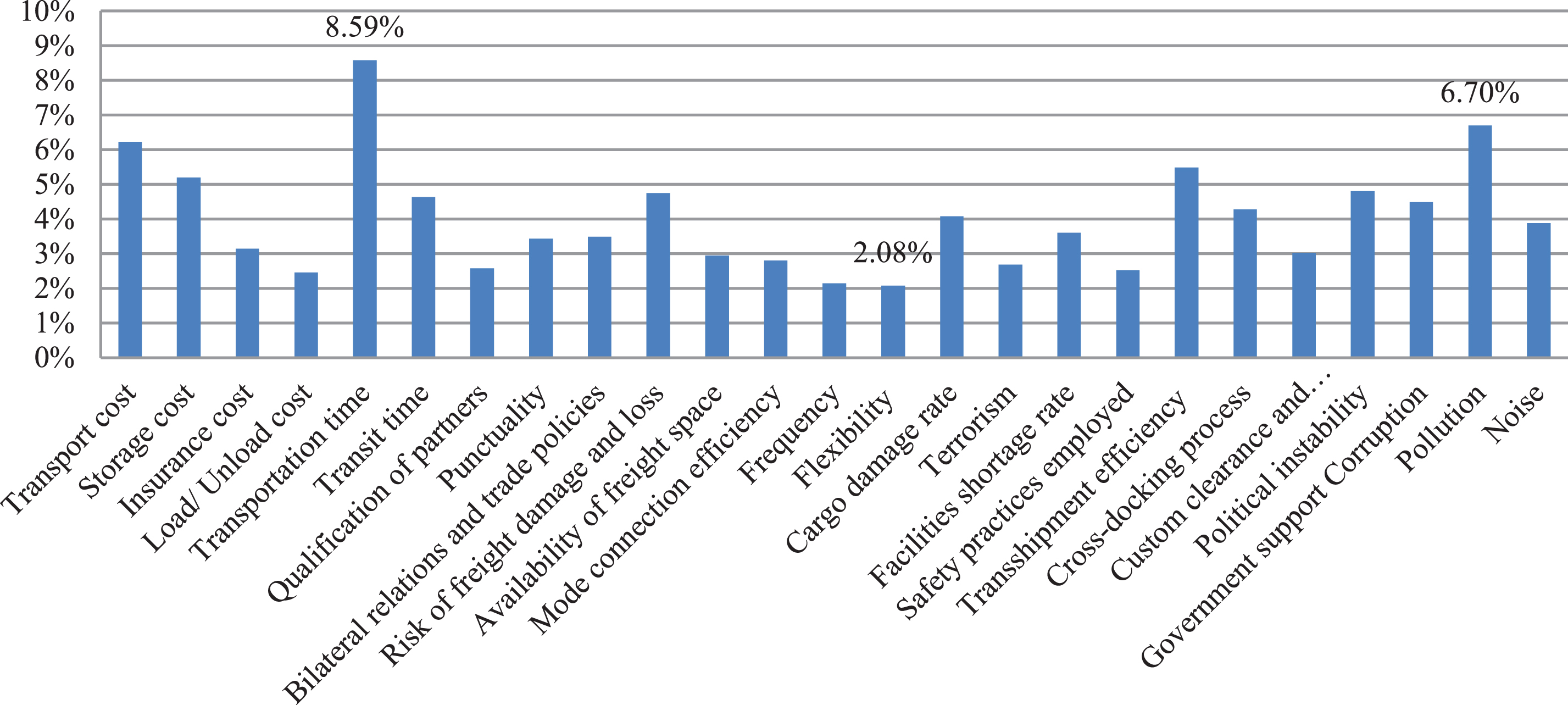
The weights of the sub criteria.
The weights and ranks of the main and sub criteria
In this research, eight possible scenarios for a multimodal route for electronic products from Chongqing to Hai Phong were evaluated by examining eight main factors. These factors were divided into two main groups: six qualitative factors and two quantitative factors. The two quantitative factors (transportation cost and transportation time) were used to calculate the objective factors (Table 4), while the subjective factors were collected through the experts’ opinions via the second questionnaire.
Data of the objective factors
Data of the objective factors
Regarding the objective factors, the collected data with different units were transformed into dimensionless indices so that they were compatible with the linguistic variables of the subjective factors. Regarding the quantitative factors, a higher value indicated a lower level of competitiveness (cost, time and distance). The higher the benefit (or lower the cost) was, the higher the score was as well.
In summary, the ranking of the eight multimodal routes from Chongqing to Hai Phong according to the given evaluation index system is R1, R3, R6, R4, R2, R7, R5, and R8, as shown in Fig. 7.

Competitiveness of the routes considering both the quantitative and qualitative methods.
Table 5 illustrates the evaluation of the eight al-ternatives, and it indicates that the airway route was preferable to the transport route from Chongqing to Hai Phong, and these are followed by the rail and ocean route through Shanghai port and finally by the rail and ocean route through Shenzhen port. The least preferable route is the combined rail and road route, as it had a weight of only 0.112. In summary, according to the shippers, transport by airway is preferred. Although airways are the most expensive option among the eight alternatives, their outstanding advantages are their high levels of reliability, speed, and security, especially in the context of high-value products.
The scores and ranks of the alternatives with respect to each main factor
After a thorough examination of the quantitative factors in the table, it was determined that the air-way alternatives have time-related advantages. These alternatives take only about one day to travel. In contrast, the fourth alternative (Chongqing- Shanghai - Hai Phong by Inland waterway and Ocean) requires 20 days to complete a journey. However, with respect to transportation cost, the most inexpensive method is route 4, while the most expensive alternative is the airway.
More specifically, the airway route clearly has the advantage with respect to security, followed by route 3 (rail + ocean through Shanghai port) and route 7 (roadway). However, with respect to transport mode capacity, route 3 ranks first. Clearly, Shanghai Port was the busiest port in the world during 2019. Hence, the capacity of Shanghai port is larger than that of other ports. Furthermore, with respect to security, the airway routes obviously rank first, while the roadway alternatives and the alternatives that combine railways and roadways rank last. The intermodal mode connectivity and geopolitics factors show the same trend, with the highest position belonging to route 1 and the lowest belonging to route 8. Finally, with respect to the environment factor, the combined railway and ocean route through Shenzhen Port is the most environmentally friendly and green choice. However, the worst choice in terms of the environment is the combined road and ocean route through Shanghai Port. Hopefully, with the devel-opment of technology and green port strategies in Shanghai, this situation will be improved soon.
In this study, eight route scenarios are presented for the multimodal transport of Sino-Vietnamese containers, and an evaluation index system consisting of 8 main factors and 25 subfactors that uses the Delphi and CFPR methods to evaluate and analyse the eight routes is established.
The results show that of the eight main factors examined with the evaluation index system, transportation cost has the highest weight, followed by reliability, transportation time, and safety, while the factor with the lowest weight is geopolitics. Thus, the political, military and social environments of China and Vietnam are stable, and the economy and trade between the two countries are developing rapidly. The cost of transportation is the most important criterion for developing a strategy to choose a route from Chongqing to Hai Phong for electronics transportation. In addition, among the 25 subfactors, transportation time is the most important, and it is followed by the pollution factors. This illustrates that when choosing a multimodal transport strategy, in addition to the transportation time, the governments and trading companies of the two countries pay more attention to environmental protection when choosing the multimodal transport strategy. In summary, the ranking of the eight transport routes from Chongqing to Hai Phong according to the given evaluation index system is R1, R3, R6, R4, R2, R7, R5, and R8. Therefore, considering that different decision makers have different needs and preferences when choosing multimodal transport routes (e.g., logistics companies and the two governments involved have different preferences regarding transport time, transport cost, transport safety, etc.). The route evaluation index system and methodology in this paper can give clear guidance to support the decisions of route selectors with different preferences.
Conclusion
With the signing of the RCEP and the ongoing progress of the BRI, China-Vietnam trade will develop rapidly. Specifically, multimodal container transport will play an important role in cross-border trade. During recent years, China has carried out infrastructure construction on a large scale, and Chongqing, as an emerging international logistics hub, is the core of the land and sea corridor. Additionally, Haiphong is the largest port city in Vietnam, and as the economic and logistics centre of Vietnam, it enjoys a favourable geographical location and extensive infrastructure. Therefore, this paper takes Chongqing, China and Haiphong, Vietnam as its context to evaluate and study the competing routes for Chongqing-Haiphong multimodal transport.
A possible multimodal route between Chongqing, China, and Hai Phong, Vietnam, is identified and analysed, an evaluation index system based on the Delphi and CFPR methods is established, and the route is evaluated. The authors of this paper are both experienced researchers in the field of intermodal container transport, especially the Vietnamese author, who is employed by ZIM in Hai Phong, Vietnam (the world’s largest container shipping company). In addition, the CFPR method is a fuzzy and consistent preference relationship method that is especially suitable for expressing the uncertainty and vagueness of the participating experts’ thoughts and preferences; thus, this paper is representative in terms of both data and methodology.
The research results of this paper enable the trading enterprises and government departments of both countries to have a deeper understanding of the Chongqing-Haiphong multimodal transport route, and it can clearly support the decision making of route selectors with different preferences. Therefore, this study will provide a useful reference for the logistics enterprises and government departments of both countries and play a key role in promoting the development of transport routes that will improve the efficiency of the cross-border transport between these two countries.
This paper combines theory and practice to analyse the factors influencing the choice of a multimodal transport strategy and provides a decision basis for route selection. In the future, the scope of this study can be extended to other provinces and cities in Vietnam and China increase its generalizability.
Footnotes
Acknowledgments
This work is supported by EU-Asia Research Network on Integration of Global and Local Agri-Food Supply Chains Towards Sustainable Food Security (AMD no.777742-56). This work is partly supported under GCRF (GCRF Covid19 02 FET, funded by Liverpool John Moores university, UK); partly supported from the China Postdoctoral Science Foundation Funded Project (2019M661085); partly supported from the Fundamental Research Funds for the Central Universities (3132020237); partly supported from the Ministry of Education of Humanities and Social Science Project (18YJC630061); partly supported from Natural Science Foundation of Liaoning Province (2020-BS-068).