



Abstract
Nowadays, Biometric systems are prevalent for personal recognition. But due to pandemic COVID 19, it is difficult to pursue a touch-based biometric system. To encourage a touchless biometric system, a less constrained multimodal personal identification system using palmprint and dorsal hand vein is presented. Hand based Touchless recognition system gives a higher user-friendly system and avoids the spread of coronavirus. A method using Convolution Neural Networks(CNN) to extract discriminative features from the data samples is proposed. A pre-trained function PCANeT is used in the experiments to show the performance of the system in fusion scheme. This method doesn’t require keeping the palm in a specific position or at a certain distance like most other papers. Different patches of ROI are used at two different layers of CNN. Fusion of palmprint and dorsal hand vein is done for final result matching. Both Feature level and score level fusion methods are compared. Results shows the accuracy of upto 98.55% and 98.86% and Equal error rate (EER) of upto 1.22% and 0.93% for score level fusion and feature level fusion, respectively. Our method gives higher accurate results in a less constrained environment.
Introduction
We have many physiological and behavioral ways to recognize an individual like iris, fingerprint, voice, signature, etc [1]. But palmprint has been more researched from the recent few years due to its inherited abilities of user-friendliness and stress-free environment. There are many palmprint based algorithms like texture-based [2], line-based [3], subspace learning based [4], correlational filter based [5] etc. Recently, deep learning-based techniques have also shown positive research in this field because this approach is more scalable as its architecture resembles the human brain. In Deep-Learning, CNN is stimulated by deep belief networks(DBN) 6 an unsupervised learning method intended by the University of Toronto has shown a rise in this area. A lot of research paper has shown that CNN has worked excellently in palmprint recognition. Traditionally, in biometric systems user should be cooperative and agreeable to exhibit his biometric characteristics to the sensor. In many instances, specific controlled methods or contact between the biometric features and the sensor are required by biometric acquisition. For example, while collecting data for biometric acquisition user must be in a definite pose, place his biometric characteristics immovable. These systems are not advisable after the rise of COVID-19. To develop the application of approved biometric behaviors to the novel software and the revolution in the security methods, we will use a less constrained environment. These methods that have smaller processing and computation times, and upgraded usability, and more social acknowledgment. For example, better recognition accuracy in monitoring applications, cell phone, and biometric gates with the less-constrained iris recognition [7].
A 15 years study of palmprint recognition methods can be found in [26]. In various terms, biometric behaviors have been akin to fingerprints, so the binge growth in palmprint recognition research. On the contrary, because we can extract many features and in so much of details so the palmprint recognition systems need low-cost acquisition devices by which we can succeed to get good outcomes even if the palm surface is not in good condition (for example, in elders or laborers). Nowadays, most of the new methods suggested in the literature that touch-based 2-D acquisitions do the recognition with flatbed scanners or CCD- based devices. [8]. In the touch-based techniques, there are many drawbacks. (For example, distortion, dirt, and user acceptability) If we compared previously stated touch-based methods, then we have two main advantages (a) for acquisition, there is no requirement of fixed placement of pegs, surfaces, or guides to keep the hand in the exact condition, and (b) dirt, distortion, sweat, or hidden impressions problems have discarded a result of palm contact with the sensor [9].
Highlights of the paper:
Due to pandemic COVID 19, a touchless biometric system is encouraged here, with a less constrained hand based multimodal personal identification system using palmprint and dorsal hand vein is presented which gives a higher user-friendly system and avoids the spread of coronavirus. A Convolution Neural Networks(CNN) is used to extract discriminative features from the images. A pre-trained function PCANeT is used in the experiments to show the performance of the system in fusion scheme. This method is independent of inter-sample positional variations. Both Feature level and score level fusion methods are compared. Results shows the accuracy of upto 98.55% and 98.86% and Equal error rate (EER) of upto 1.22% and 0.93% for score level fusion and feature level fusion, respectively.
The paper is organized as follows. Section 1 introduces the need for and importance of the proposed work. Section 2 gives its recent study, and section 3 presents the primary methodology of the current work with CNN training, pre-processing feature extraction, and fusion. Section 4 provides the result and simulations. Finally, section 5 concludes the paper.
Recent works
The approaches using deep learning for palmprint recognition generally use CNN for feature extraction from images and then use a classifier or distance measure to check biometric outcomes. These approaches can be classified into three classes: 1) using pre-trained networks, 2) using networks trained on palmprint, 3) using networks with fixed filters. In [12], pre-trained networks such as AlexNet, VGG-16, and VGG19 are used for feature extraction. It is shown in the results that VGG-16 and VGG-19 gives a better result than AlexNet. However, classification was done using SVM. In [10], the palmprint of newborns was recognized using AlexNet with SVM classifier, and no other comparison was made. In [15] a CNN based approach is proposed on the ALEXNET [16] network in which palmprint images are trained by checking the productivity of the loss function. An extensive comparison is made with coding-based methods, but no comparison is made with texture-based descriptors. In [12], a method based on PCANet is proposed, and it uses the PCA-based procedure presented in [11]. For feature extraction, PCANet is used, and then SVM is used for classification purposes. The results achieved in this method are similar to the previous methods. In [13] deep scattering, the network is presented, which passes the images through fixed filters that are based on scattering transform [14]. It also uses SVM to classify the images. The drawback of the above procedures is that these are mainly combined with supervised procedures such as SVM for classification.
In [18], the use of base vectors, Discrete Fourier Transformation analysis, and wavelet analysis vectors are used for selection in place of PCA. The use of these vectors no more needs optimization techniques. In [19], PCANet is applied on both the biometric modality, palmprint, and Inner finger texture, and again, feature level fusion has been applied to the resultant feature vector. In this paper [20], PCANet is compared with RANDNet and LDANet, which shares the same topology as the PCANet. The maximum experimental results show that PCANet beats RANDNet and LDANet as PCANet do not require very accurate aligned images, and it also eliminates the anomalies. This paper [21] proposed a multimodal biometric system by which images of finger-knuckle-print (FKP) of four fingers extracted by the use of PCANet and SVM have been used classifiers of extracted features of FKP and succeeds to obtain excellent recognition results. In [22], PCANet is used to extract both Major and Minor finger dorsal knuckles, and SVM is used as a classifier to match the stage of both the modals and the two modalities combined by score level fusion. In [23], a deep scattering network is used for palmprint recognition where the dimensionality of the extracted scattering features comprises high-frequency information lessened by the PCA to reduce the computation and recognition is performed by the multi-class SVM and minimum-distance classifier. In [24], PCANet is used to extract the information from the texture of the palms’ images, and the proposed method is tested on two multispectral databases with very high accuracy.
Methodology
In this approach, an innovative method is applied for the hand based biometric system by fusion methodology (feature level and score level both) using the Deep Learning model. Specifically, we consider the PCANet in this work, We applied palmprint, and DHV image data of a single hand to a CNN trained unsupervised method which is built on PCA. Because it is successfully applied for biometric behaviors so we ponder PCA -based filters on different biometric behaviors (for example, palmprint and finger-knuckle) [11, 12]. We applied the PCANet in this work on both biometric behaviors, consisting of palmprint and the DHV extract from the hand. The output of the PCANet for each biometric behavior is a dimensional feature vector, which represents the biometric model. This is followed by the processing the feature-level fusion results in the form of feature vector to find the output in terms of a single biometric model. And in the last by the use of a k-Nearest-Neighbors(k-NN)classifier based on the Euclidean distance, we classify the found model. However, we can put on distance measures and different classifiers.
For the proposed method, we have first applied to pre-process to extract ROI, then CNN training is performed to form a dimensional feature vector. Fusion techniques are applied to incorporate both the hand-based biometric modality’s advantages and to ensure a touch-less system. Finally, classification and matching are performed, as shown in Fig. 1.

Block diagram of the proposed work.
In this step, the ROI of the palmprint and the DHV extracted in the method. Extracts of ROIs from a hand acquisition presented in Fig. 2. We alter the image into grayscale and calculate the hand’s binary mask using Otsu’s Thresholding to extract the ROI of both the biometrics.

Method of Pre-processing for extracting ROI.
After that, by using methods given in Section 3.2, we extricate the valleys points. Last, we compute the ROI. Palmprint Region Of Interest shown in Fig. 2. A similar approach is applied to extricate the ROI of DHV.
In this step, to withdraw the same set of information, the data samples angle must be the same. After capturing the image from the camera, the palmprint and DHV ROI is extracted from the image. It is divided into three individual tasks 1) hand segmentation, 2) centroid and valley points extraction 3) ROI computation. After converting the image to grayscale, we extract the hand’s contour using a method based on Otsu thresholding by removing the background [17], as shown in Fig. 2. Firstly, a grayscale’s binary mask is drafted using Ostu’s thresholding for binarizing the palm images. This is Mathematically equivalent to apply a low pass filter with a threshold τ over 2-D smaple. The binarized output ROI
bin
(x, y) =1, If ROI (m, n)⊗ ξ
filter
(m, n) ≥ τ, otherwise ROI
bin
(m, n) =0, where ROI
bin
is binarized image, ROI (m, n) is test sample and ξ
filter
is low pass filter. Then binarized images’ boundary is obtained. Next from each pixel’s center of gravity line has been built and the centroid is obtained as To get a hand framework, we then applied the thinning operation on the mask. Using the logic of crossing numbers, the coordinates of endpoints thinned skeleton images previously obtained have been computed. Then fingertips and finger valleys are calculated for extract the ROI. Masking of the original bounded image has been done after finding the fingertips and centroid. By doing rounded traversal with centroid, the ordering of fingertips has been done, the first coordinates are little finger, and the last coordinates are of thumb as the center of hand in the clockwise direction. The coordinates of all the fingertips are obtained in this way. The lines become horizontal by connecting the tips of the index and ring finger as we rotated the image, and in this way, we obtained the coordinates of all the fingertips. Then, finger valleys are calculated by the use of change in the slope of the finger’s boundary. Next, by using the coordinates of the finger valleys region of interest (ROI) has been cropped for each palm. And we can easily apply on both of the hands by the change of the indexing of fingers. This is shown in Fig. 2.
CNN training
In this step, for each distinct biometric feature, we prepare a distinct PCANet, which is mined in the segmentation step. The PCANet training set is mainly divided into three common parts: i) gathering the information from the local parts of the Region of Interests, ii) computing the total filters using PCA applied for the CNN, iii) then multiple layers are evaluated for the CNN. The method of CNN training used in the proposed approach is shown in Fig. 3. It is done in two layers; both the ROI-Palmprint and ROI-DHV images are sent to the 1st layer of PCANet as input one by one. ROI-Palmprint is of 150 × 150 and ROI-DHV are of 150 × 150. On the 1st layers, eight filters of PCANet are used, so we get 8 ROI-Palmprint and 8 ROI-DHV of 150 × 150 and 150 × 150 size respectively. These images are then passed to the 2nd layer with 16 PCANet[12] filters which gives 8 × 16 ROI-Palmprint and 8 × 16 ROI-DHV of 150 × 150 and 150 × 150 respectively.

Method of CNN training.
Step i- Extricate the local section si,j of dimensions m1 × m2 centered in each pixel of ROI, to train the PCANet using the N ROI samples. Then convert, 2-D m1 × m2 → 1-D Step ii- Extricating the L1 principal eigenvectors from the matrix Step iii- in a similar way, a 2nd layer of CNN is obtained by filtering the ROI with estimated filters Ψ1,i, getting L1 images Φ
i
. Follow steps i) - ii) on the samples Φ
i
and apply the filters Ψ2,j of the 2nd layer by extricating the L2 principal eigenvectors of the PCA, with j = 1, 2, . . . ., L2. The trained PCANet is obtained as the collective of the computed filters: PCANet={ Ψ1,i, Ψ2,j } from all the outputs. Fig. 3 shows the structure of the PCANet.
In this step, for each vector, we find a 1-dimensional feature vector by applying expert PCANet on the related biometric properties. The feature extraction step divided into three parts for better understanding: i) filtering of images by using PCANet, ii) image encryption, iii) execution on the prototype.
Foremost, we achieve L1 images Φ i , then 1st layer of the PCANet is obtained by filtering with the help of Ψ1,i filters. After this, 2nd layer of the PCANet is obtained with the help of Ψ2,j filters to samples Φ i getting the L1 . L2 images G k , with k = 1, 2, . . . ., L1 . L2. In particular, after filtering the output of the one of the L1 images of the first layer, we achieved the output of the second layer of each set of L2 images. In PCANet processing, image sizes are in a constant state.
Second step is binarization of the G k images using the following function:
In third step, a 1-Dimensional vector H is obtained by appending the block-wise histograms performed for each of the n B nonoverlapping blocks, with size b1 × b2, in the images D i . We perform the feature vector for both the biometric. Properties in the hand image, attaining two feature vectors: i) H - PP, ii) H - DHV
In this step, foremost, we compute the normalization of the feature vectors H relative to the distinct Region of interests. Next, we compute distinct fusion methods.
Feature-level fusion
In feature-level fusion, various features from various biometrics fused to improve the identification. We are using two types of feature-level fusion.
In first feature -level fusion, matrices (column wise or row wise) explicitly formed by combining the two distinct features groups. If we concatenated two feature groups
In the second feature-level fusion method, Principal Component Analysis uses statistical to the orthogonal conversion of annotations of a group of associated variables into a group of values of linearly unrelated variables. The Principal Component Analysis is employed on feature vector to decrease the feature measurement and converting them to other feature subspace if
F fused feature will be:
Second Feature attained is given by
The importance of Score level Fusion rules lies in its simplicity, easy controlling of scores, which exist generous information and allow easy mathematical valuation. In the literature, there are several variants score level fusion rules and their applications are presented. Prefaces of t-norms can be found in [25]. The scaling method is called to be normalized if the several modalities scores converted into conventional state and their combinations confirmed to be significant. 0 and 1 are equated for minimum and maximum scores, respectively. There are several normalization methods in literature. In this study, all the normalizations are performed using Min-Max score Normalization which can be evaluated as .
Score fusion rules
Let Δ
i
be the matching score attained from i
th
technique and Δ denotes the fused score or the mixed score and N be the number of techniques. For simplicity, we are using only two T-norm based rules. Hamacher t-norm: Frank t-norm:
where ′p′ is a real number which is total number of spans in the space of t-norms.
Classification and matching
To compute the scores of the training and test template, Euclidean distance is computed and features obtained from each biometric technique. Finally, for the classification of the features, we use the K-nearest neighbor (KNN) classifier. In verification, here, each person is verified with its samples, which was already taken by the system. While in classification, a person is verified by all the registered persons. In the identification technique, we used the matching procedure based on the Euclidean distance to evaluate the distances between the different models. As the error measure, we pondered the Equal Error Rate (EER).
Result and simulations
In this section, we evaluate the experiments on the database, and we generate the report about depicting the error measures, explaining the appropriate parameters, and the accuracy in our proposed method. For accuracy, we implemented a technology calculation and matched our procedure’s recognition functioning in contradiction of other procedures in the literature based on CNNs.
Database
For our approach, we have taken IIT Delhi palmprint database version 1.0 which includes a database of left and right frontal template of 230 persons in the age group of 14-56 years as shown in Fig. 4. And the database consists of 5 to 6 samples of each hand. Therefore, 200 people have been chosen for experiments and collected 6 samples from each person. The database is collected by using a digital CMOS camera that assists the contact-free type of scanning system. It very environment friendly and very easy to use as the samples can be collected without the use of peg placement.
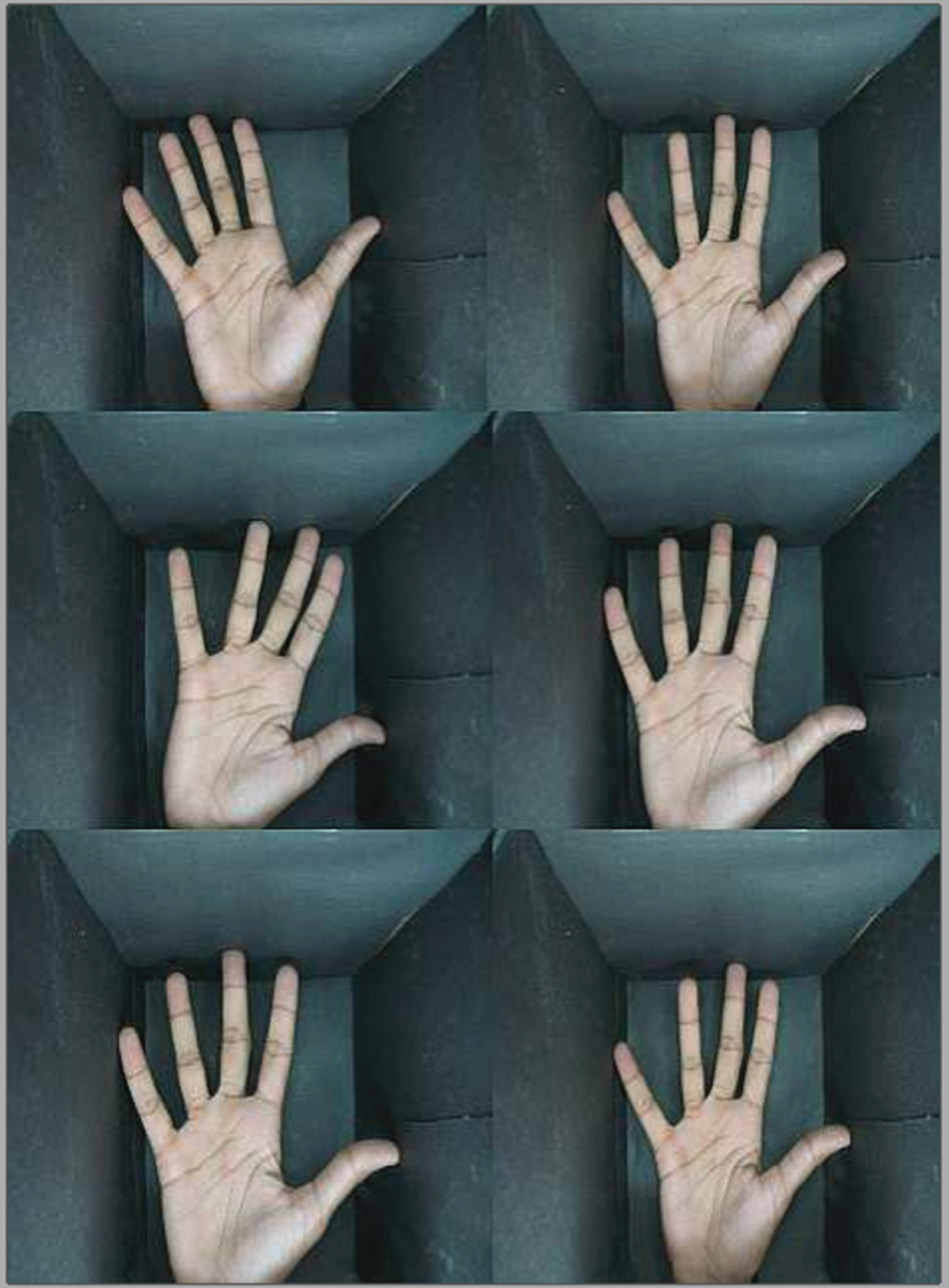
Samples of IITD palmprint database.
In the case of dorsal hand vein, Bosphorus Hand Vein Database is acquired from [27].
First, the outcomes of the number of filters is shown on both the layers. For stage one networks, we alter 2 to 12 number of filters in the first stage L1. We first examine the impact of the number of filters of these networks. The number of filters in the first stage L1 are varied from 2 to 12 for one-stage networks. Then it is evaluated for L2 = 8 and vary L1 from 4 to 24 for stage two networks. The results are shown in Figs. 5 and 6. We can easily see the best performance of PCANet-1 for L1 ≥ 4 and PCANet-2 is the best for all L1 under test.
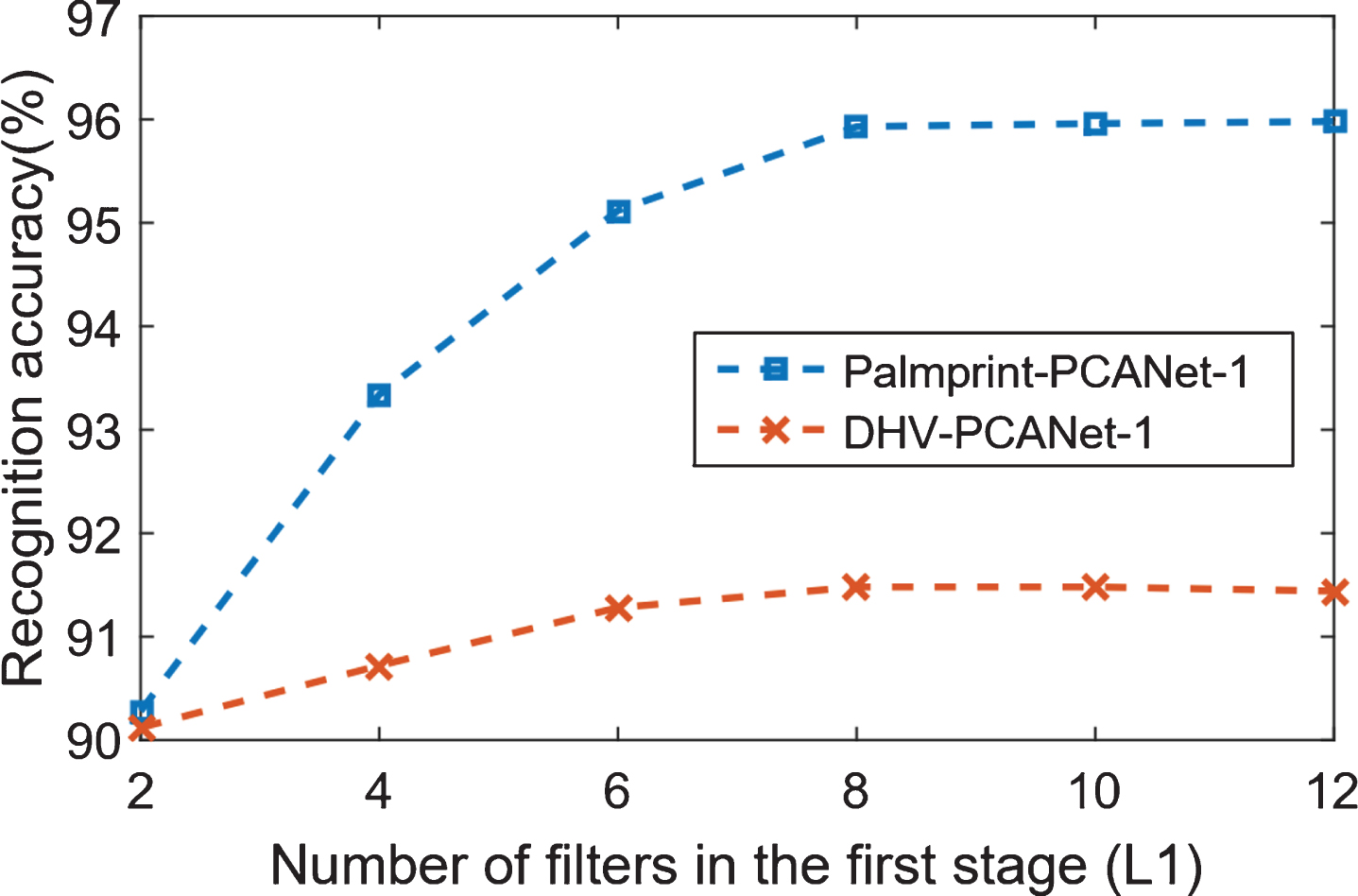
The recognition accuracy of different number of filters of PCANet-1 (First Stage).

The recognition accuracy of different number of filters of PCANet-1 (Second Stage with L2=16).
By using the feature extractors the performance of our suggested algorithm is compared with the performance of already trained CNNs. For comparison, we pondered already trained CNNs i.e VGG-19, AlexNet, and VGG-16 with sixth fully connected convolution layer. Foremost, we apply PCANet on the palmprint and Dorsal Hand Vein individually and without the fusion step, we obtained the recognition accuracy of the suggested algorithm. In case of palmprint recognition, it is evident from the results that accuracy achieved by AlexNet is 84.05%, VGG-16 is 71.94%, VGG-19 is 71.72%, and for PCANet, it is 95.93%. While, in case of dorsal hand vein, accuracy is 79.32%, 66.89%, 67.68% and 91.48% for AlexNet, VGG-16, VGG-19, and PCANet, respectively. From this, we can easily observe that the performance of the Dorsal Hand Vein is superior to the palmprint for the identification for some template. So we can easily observe that Dorsal Hand Vein enhance the recognition performance. This is shown in Tables 1 and 2.
Performance of proposed method with state-of-art methods in the terms of classification accuracy (%)
Performance of proposed method with state-of-art methods in the terms of classification accuracy (%)
Performance of proposed method with state-of-art methods in the terms of EER (%)
In this, we examined the accuracy with the use of fusion step: Feature Level Fusion and Score level fusion for our suggested algorithm.
Particularly, we examined the performances of two different Feature Level fusions: Feature-Level Fusion 1: ConC {H - PP + H - DHV} and Feature-Level Fusion 2: PCA {H - PP + H - DHV}. From Table 3, Here we can easily observe that if we use feature fusion step separately on the palm and the Dorsal Hand Vein the recognition accuracy increases. While Table 4 shows the performance comparison with both the score level fusion technique. Both score level and feature level fusion methods have shown good performance. It is evident from the results that fusion increased the performance of the system with the accuracy of upto 98.55% and 98.86% and Equal error rate (EER) of upto 1.22% and 0.93% for score level fusion and feature level fusion, respectively.
Result obtained from both the feature-level fusion methods
Result obtained from both the feature-level fusion methods
Result obtained from both the score-level fusion methods
This paper presented a PCAnet based Biometric System with Fusion of Palmprint and Dorsal hand vein. This method showed its importance in the time of COVID-19 and promote touchless system. We proposed a method using Convolution Neural Networks(CNN) to extract discriminative features from the hand based biometric system. We have used pre-trained function PCANET and the experiments showed that this method provides a better result than any other function. Also, fusion of palmprint and dorsal hand vein used show the user friendly hand based biometric system. Both score level and feature level fusion methods have shown good performance. In future, this principle of this fusion method with deep learning can be applied to other biometric traits such as face and gait.