



Abstract
The Public-Private Partnership (PPP mode) has been widely used in the field of transportation infrastructure. It can relieve the debt pressure of local governments and improve the efficiency of resource allocation. However, due to the long life cycle of urban rail transit PPP projects and numerous participants, the potential risks arising from the coordination of multi-party relations have become a major obstacle to the development of urban rail transit PPP mode. Based on the perspective of the PPP project company (SPV), this paper adopts the method of fuzzy analytic hierarchy process, takes Shenzhen Metro Line 4 project as the research object and constructs the risk index system from nine dimensions to evaluate the risks of PPP project. Political risk, legal risk and project promotion risk are the most important risk indicators, while relationship risk and force majeure risk take the lowest proportion. According to the above results, the risk management system, risk sharing scheme and countermeasures in key risk areas are proposed. The study not only applies the fuzzy analytic hierarchy process to the research of urban rail transit risks, but also provides a systematic risk assessment basis and prevention and control reference for the smooth implementation of PPP projects.
Introduction
The 14th Five-Year Plan for economic and social development proposed that China should accelerate the construction of a country with strong transportation network, vigorously develop urban rail transit, accelerate the network of rail transit in urban agglomerations and metropolitan areas, and build a new type of city clusters and urbanization. Urban rail transit, as an intensive and compound mode of transportation, has the advantages of large passenger transport volume, environmental friendliness and convenience [9, 13]. It is of great significance to improve the urban traffic network, strengthen the exchange of economic regions, and promote the process of urbanization.
However, the investment in urban rail transit construction is huge, and the cost in the operation stage can be as high as 2–6 times of the construction investment [36]. The government is faced with the double financial burden of construction investment and operation subsidies and bears huge debt pressure, which provides a feasible soil for the implementation of PPP mode in the field of urban rail transit. Transportation has also become the largest industry of PPP project construction investment, with an accumulated investment of 5.04 trillion yuan, accounting for one third of the total PPP investment.
The PPP mode is a multi-party cooperation mode established by government departments and social capital based on public infrastructure and service projects [12, 25]. By introducing social capital, the government can avoid the establishment of vertically integrated infrastructure construction and operation organization. At the same time, by virtue of the social capital’s advantages in technology and management, it can not only improve the supply efficiency of the project and ensure the reasonable profit of social capital, but also force the government to promote functional transformation, thus achieving a win-win situation of risk sharing, benefit sharing, and mutual benefit [16, 34]. Since 2013, China’s National Development and Reform Commission and the Ministry of Finance began to issue and improve relevant policies and regulations to guide the development of PPP projects. The PPP mode has entered a new era of rapid development in China. By August 2020, China PPP Comprehensive Information Platform has managed 9746 projects with an investment of 15.1 trillion yuan. As an important starting point of supply side reform, PPP mode has fully played the role of encouraging competition, breaking monopoly, relaxing access, and encouraging all kinds of social capital to actively participate in infrastructure construction. However, in the construction and operation of PPP projects, there are always practical problems such as low landing rate and low participation of private capital.
The PPP projects have many stakeholders and complex relationship between rights and responsibilities, leading to various potential risks in the whole life cycle of the project [43]. Due to the huge investment and long franchise period, urban rail transit PPP project further aggravates the uncertainty of project implementation, which in turn affects the enthusiasm of social capital to participate in PPP projects and the quality of public services provided by the government. Therefore, how to effectively identify, evaluate and control the risks of PPP projects has become the key to promote the sustainable development of PPP mode.
In PPP projects, the government and the social capital jointly establish a PPP project company responsible for the construction and operation of the project, namely special purpose vehicle (SPV). Based on the perspective of PPP project company (SPV), according to the risk characteristics of urban rail transit PPP project, this paper uses the method of fuzzy analytic hierarchy process to construct the whole life cycle risk index system of PPP project, identifies and evaluates the risks in the construction and operation process of the project, and puts forward risk response measures for the important risk areas. The possible research contributions of this paper are as follows: (a) Clarify the subject of PPP project risk assessment, and enrich the research in the field of PPP project risk. Based on the perspective of SPV, this article establishes a risk indicator system for the entire life cycle to evaluate PPP project risks, which helps to comprehensively identify and evaluate potential risks. (b) Taking Shenzhen Metro Line 4 project as research object, the risk index system is applied to practice. According to the risk characteristics and evaluation results, the risk bearers are divided, and the specific coping strategies are proposed, which responds to the practical concerns of the regulatory authorities on the implementation rate of PPP projects and the participation of social capital.
Literature review
According to the characteristics of PPP project risks, risk management is a long and complex process, including risk identification, risk assessment, risk sharing and risk response [30].
Risk identification is the basis of PPP project risk management. By collecting a large amount of project data, systematically identify project-related risk factors, analyze the source and characteristics of risks [41]. Through the summary of the literature, risks can be classified in the following ways: according to the source of risk, Li et al. [21] divide the risk into three levels: micro, medium and macro; according to whether the risk is controllable, the risk is divided into system risk and non-system risk [28]; according to the theory of the whole life cycle, the risk can be divided into negotiation period, construction period and operation period Risk [3]; according to the relevance of the risk to the project subject, it can be divided into project risk and general risk [2]; according to risk characteristics, it can be divided into nine categories: technical risk, construction risk, recovery risk and financial risk [5]. Risk evaluation is the analysis and judgment of PPP project risks that have been identified. It is the basis for project risk quantification and effective risk management measures [22]. The existing literature uses questionnaire survey, analytic hierarchy process factor analysis, fuzzy comprehensive evaluation and Monte Carlo simulation to evaluate risks [1, 38].
Risk sharing is based on the principle of matching control power, the lowest cost and the risk-return equivalence to allocate risks to the party who is more suitable to bear [35, 39]. There are two main ideas: one is the study of quantitative risk sharing mechanism based on game theory [7, 42]; another is qualitative risk sharing based on contract negotiation [8, 21]. Risk response is to prevent foreseeable risks by analyzing the probability of occurrence of risks and the degree of its influence, which includes risk aversion, risk acceptance, risk reduction and risk transfer [40].
Specific to the field of urban rail transit, the PPP projects have the characteristics of a longer franchise period, larger investment, higher technical standards and a more complex construction environment than general engineering projects [13]. As a result, it faces more uncertainties and potential risks in the process of risk identification, evaluation, sharing, and response. Previous studies have analyzed the financing risk, debt risk and economic risk of urban rail transit projects from qualitative and quantitative perspectives respectively, and put forward the mechanism of financing risk transmission and the method of dynamic evaluation, the preventive measures of debt risk and the effective ways to control economic risk [10, 32].
Although some scholars have used the analytic hierarchy process or fuzzy evaluation method to assess the risks of PPP projects, the existing literature lacks the identification of the whole life cycle risk of urban rail transit PPP project, and there is a problem that the risk assessment subject is not clearly defined in the risk assessment process. The definition of risk assessment subjects is particularly important, which will directly affect the results of risk identification and assessment. Therefore, this article starts from the perspective of SPV Company, systematically identifies and evaluates the risks that exist in the full life cycle of PPP projects. And further proposed the risk sharing and response system of metro PPP projects in the Chinese context.
Research methodology
Due to the characteristics of long-term, variability and complexity of PPP projects, the risks are more difficult to control than general projects. Therefore, it is necessary to establish a comprehensive risk management system, which can effectively prevent and control the occurrence of risks, accurately evaluate the risk factors, and provide guarantee for risk management. In this paper, the analytic hierarchy process (AHP) and fuzzy comprehensive evaluation method (FCE) are combined to analyze the risk of PPP projects more accurately.
Urban rail transit PPP project risk assessment and analysis system
Based on literature and expert interviews, combined with the characteristics of the project, the paper establishes the risk index system of urban rail transit PPP project. It includes 9 level-I risk factor indicators at the national, market and project levels, which are further subdivided into 27 level-II risk factor indicators, as shown in Table 1.
Urban rail transit PPP project risk assessment and analysis system
Urban rail transit PPP project risk assessment and analysis system
Fuzzy analytic hierarchy process (FAHP) is composed of analytic hierarchy process and fuzzy comprehensive evaluation [17, 26]. Among them, fuzzy comprehensive evaluation is carried out on the basis of analytic hierarchy process. The combination of the two improves the reliability and effectiveness of the evaluation [14, 26]. The specific steps are as follows:
–Step 1: Establish a hierarchical structure
According to the attribute characteristics of PPP risk, the risk is divided into the highest objective level reflecting the overall objective, the middle level reflecting the specific criteria and the bottom level of the planned implementation scheme [33]. The hierarchy is shown in Fig. 1.

The hierarchical sub-graph.
–Step 2: Construct the judgment matrix
The construction of judgment matrix is to compare the risk elements of the same level in the established risk index system, by using Saaty’s 1 ∼ 9 scale method (as shown in Table 2) to judge the importance proportion of each risk element in the target evaluation [27]. In the overall evaluation system, different risk indicators account for different proportions.
The meaning of size scale of aij value
The judgment matrix A satisfies: (a) aij>0 (b) aij = 1/aij (i, j = 1,2,...n)
–Step 3: Consistency check
There are subjective factors in the scoring of experts. In order to reduce the influence of subjective factors on the judgment matrix, a consistency test is used to ensure that the weights of indicators at all levels are reasonable and logical. The steps to check the consistency of the judgment matrix are as follows:
(a) Calculate the consistency index (CI)
Among them: n is the number of rows or columns of the judgment matrix. If CI = 0, the judgment matrix has complete consistency, otherwise it needs to be judged according to the consistency ratio CR.
(b) Find the corresponding average random consistency index RI. The RI values for n = 1, 2 ... ... 9 are shown in Table 3.
The value of the RI
(c) Calculate the consistency ratio CR
When CR < 0.10, it is considered that the consistency of judgment matrix is acceptable, otherwise the judgment matrix should be modified appropriately.
–Step 4: Determine the evaluation factor set U = {U1, U2...Un}. U = U1, U2...Un is the evaluation factor, n is the number of single factors at the same level, and this set constitutes the evaluation framework.
–Step 5: Determine the evaluation grade area V, V = {V1, V2... Vm}
In this paper, the risk index system evaluation is divided into five levels: V = {extreme high, high, general, low, extreme low}.
–Step 6: Single-level fuzzy comprehensive evaluation.
A single index evaluation is carried out for each evaluation index in the evaluation factor set, and the evaluation indexes of each index layer are established for various evaluation membership degrees rij of evaluation set V, and the fuzzy relation matrix R is obtained.
–Step 7: Fuzzy comprehensive evaluation.
The above-mentioned index weights W obtained through the analysis of the analytic hierarchy process are combined with the fuzzy relationship matrix R of the evaluated object, and then the overall evaluation vector of the index is obtained.
Case introduction
Shenzhen Metro Line 4 in China adopts BOT mode. SPV Company was jointly funded by Shenzhen Municipal Government and MTR Corporation, which is specially responsible for the investment, construction, financing and operation of Shenzhen Metro Line 4 [15]. According to the contract, the MTR Corporation will operate for 30 years after the completion of the project, and will transfer the ownership of Shenzhen Metro Line 4 to the Shenzhen Municipal Government in 2040. The BOT mode of Shenzhen Metro Line 4 is shown in Fig. 2. The BOT mode can effectively reduce the risks of government agencies, mainly because of the signing of concession agreements. Because of the signing of franchise agreement, BOT mode can effectively reduce the risk of government agencies. The project company can carry out the financing, design, construction and supervision of the second phase of Shenzhen Metro Line 4 in accordance with the agreement, and the government departments can supervise and manage it. Its income mode adopts the comprehensive development model of “metro + property”, and carries out commercial development on the land around the metro. By taking advantage of the positive externalities brought by the metro, it obtains income by making the commercial real estate appreciate or collecting rent.

Shenzhen Metro Line 4 BOT mode.
This paper uses the Delphi Method to evaluate the risk elements of PPP projects [6], conducts online and offline surveys of government department personnel, SPV company personnel, and university scientific research personnel. 100 questionnaires are issued and 81 questionnaires are returned, of which 75 are valid questionnaires. Using YAAHP software to filter and calculate the expert data, obtain the weight of each layer of risk indicators, as shown in Table 4, and the weights of primary and all secondary indicators are as follows.
Weights of risk assessment analysis system for urban rail transit PPP projects
Weights of risk assessment analysis system for urban rail transit PPP projects
W = [0.2542, 0.1206, 0.1953, 0.0517, 0.0926, 0.0680, 0.1469, 0.0404, 0.0303]
W1 = [0.4168, 0.1928, 0.2695, 0.1209]
W2 = [0.3333, 0.6667]
W3 = [0.2605, 0.1062, 0.6333]
W4 = [0.2000, 0.8000]
W5 = [0.1638, 0.5389, 0.2973]
W6 = [0.2500, 0.7500]
W7 = [0.3054, 0.0563, 0.0774, 0.2419, 0.0369, 0.1720, 0.1101]
W8 = [0.6667, 0.3333]
W9 = [0.1667, 0.8333]
Political risk, legal risk and project promotion risk account for the largest proportion in the risk index system. Because PPP project is based on the national strategy of promoting rail transit to lead urban development, the government plays a key role in promoting and developing PPP projects. The change of tax system related laws will directly affect the amount of project income, and the laws and regulations related to transportation and PPP are very important to the project risk. The risk of project promotion includes all risks in the whole process of implementing PPP project. PPP mode makes the project adopt the mode of modular and professional operation, and the risk of project promotion takes up a high proportion in the overall index.
According to the secondary indicators of the evaluation index system, the evaluation set is selected as “extreme high, high, general, low, extreme low". The corresponding grade value is assigned as E = [90, 70, 50, 30, 10]. In view of the risk of Shenzhen Metro PPP project, experts were invited to conduct a questionnaire survey. A total of 220 questionnaires were distributed online and offline. 207 questionnaires could be recovered, including 200 valid questionnaires. According to the results of the questionnaire, the risk of PPP project is evaluated. The proportion of five evaluation levels in each secondary index forms a fuzzy judgment matrix R.
Use Matlab7.0 programming to calculate the comprehensive evaluation result B of the first-level index.
B1 = W1*R1 = [0.0528, 0.1241, 0.1298, 0.2430, 0.4503]
B2 = W2*R2 = [0.2000, 0.2733, 0.3400, 0.1333, 0.0533]
B3 = W3*R3 = [0.0368, 0.2047, 0.1920, 0.3321, 0.2344]
B4 = W4*R4 = [0.0640, 0.0600, 0.3640, 0.3140, 0.1980]
B5 = W5*R5 = [0.1173, 0.3611, 0.3393, 0.1231, 0.0592]
B6 = W6*R6 = [0.0400, 0.1125, 0.3300, 0.3625, 0.1550]
B7 = W7*R7 = [0.2349, 0.4066, 0.2559, 0.0798, 0.0228]
B8 = W8*R8 = [0.1067, 0.1333, 0.3533, 0.3733, 0.0333]
B9 = W9*R9 = [0.0000, 0.0800, 0.3017, 0.3183, 0.3000]
The fuzzy evaluation matrix of the target layer is R.
Therefore, the comprehensive evaluation results and assignments of the Shenzhen Metro PPP project are as follows:
According to the calculation, the risk score of Shenzhen Metro Line 4 is 46.8725, which belongs to the general risk level. According to the principle of maximum degree of membership, the risk assessment results of each first-level indicator and project general evaluation are shown in Table 5. Among them, market risk and project promotion risk belong to high-risk areas.
Risk assessment results of Shenzhen Metro Line 4
Risk assessment results of Shenzhen Metro Line 4
According to the annual report data of MTR Corporation, the passenger volume growth rate of Shenzhen Metro Line 4 from 2015 to 2019 was 12%, 5%, 5.4%, 11% and 3%, respectively. Due to the continuous development of other competitive public transportation vehicles in Shenzhen, the passenger growth rate of Metro Line 4 showed a fluctuating decline. Although the Shenzhen municipal government is implementing the ticket adjustment mechanism, the project has not benefited from the shadow fare compensation mechanism since its operation in 2010. And its subway fares have never been raised, which will affect the financial sustainability of the Shenzhen Metro Line 4 project. Since Shenzhen Metro Line 4 adopts BOT mode, the project will be handed over to the Shenzhen Municipal Government after the operation period, which will lead to a high possibility of handover risk. December 31, 2019 and June 12, 2020, Shenzhen Metro Line 4 experienced multiple failures and outages, which reflected the high operational risks of the project.
Based on the results of the risk assessment, a centralized risk control plan is proposed. First, a comprehensive risk management system is established, and the risks are analyzed layer by layer to propose corresponding solutions. Second, distinguish the risk-bearers. Different risks should have the main bearer or be shared by both parties. Finally, design key risk control measures for the important risk areas.
Risk management system
When conducting risk management of PPP projects, a comprehensive risk management system is established based on the identification and evaluation of risk elements. First, the type and degree of risk must be analyzed and determined. Second, choose effective risk management measures. Furthermore, negotiate on the sharing of related risks and improve contract terms. Fourth, determine a reasonable risk-sharing contract. Finally, the corresponding risk response plan was adopted to implement the PPP project. The risk management system is shown in Fig. 3.
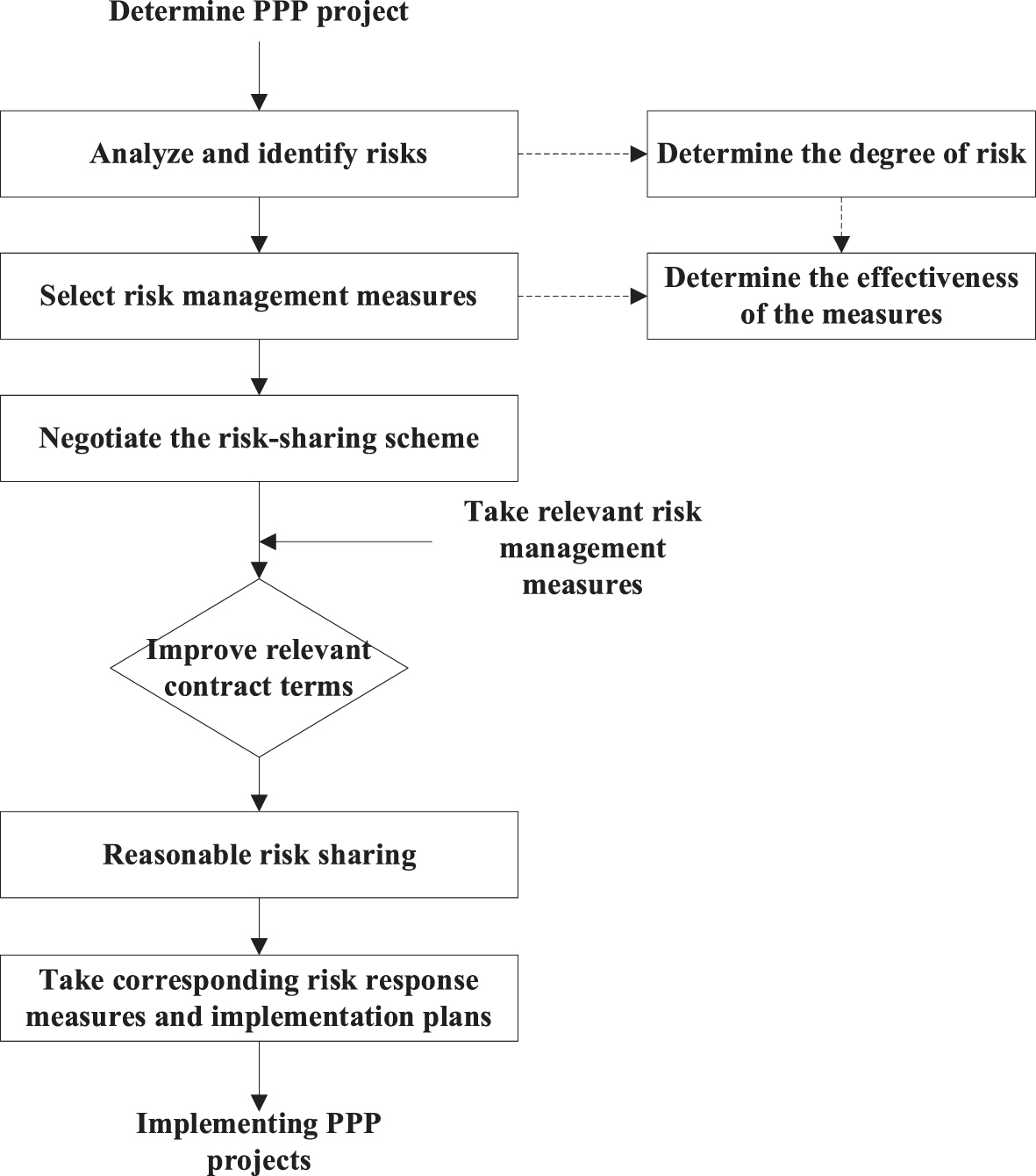
Risk Management System Diagram.
The sharing of risk factors at different levels has a certain tendency. Among them, most national-level risks tend to be borne by the government, while market-level and project-level risks tend to be borne by social capital. According to the principle of risk control ability, the text further divides the risk sharing methods into five categories: government only sharing, government sharing mainly, joint sharing, social capital only sharing, and social capital sharing mainly, as shown in Table 6.
Division of risk sharing subjects
Division of risk sharing subjects
According to the characteristics of the risk and the difference of the sharing subjects, corresponding risk response measures should be taken. This article analyzes the key risk areas: political risk, economic risk, market risk and project promotion risk, and proposes corresponding risk response behaviors and residual risks. The specific risk response process is shown in Figs. 4–7.
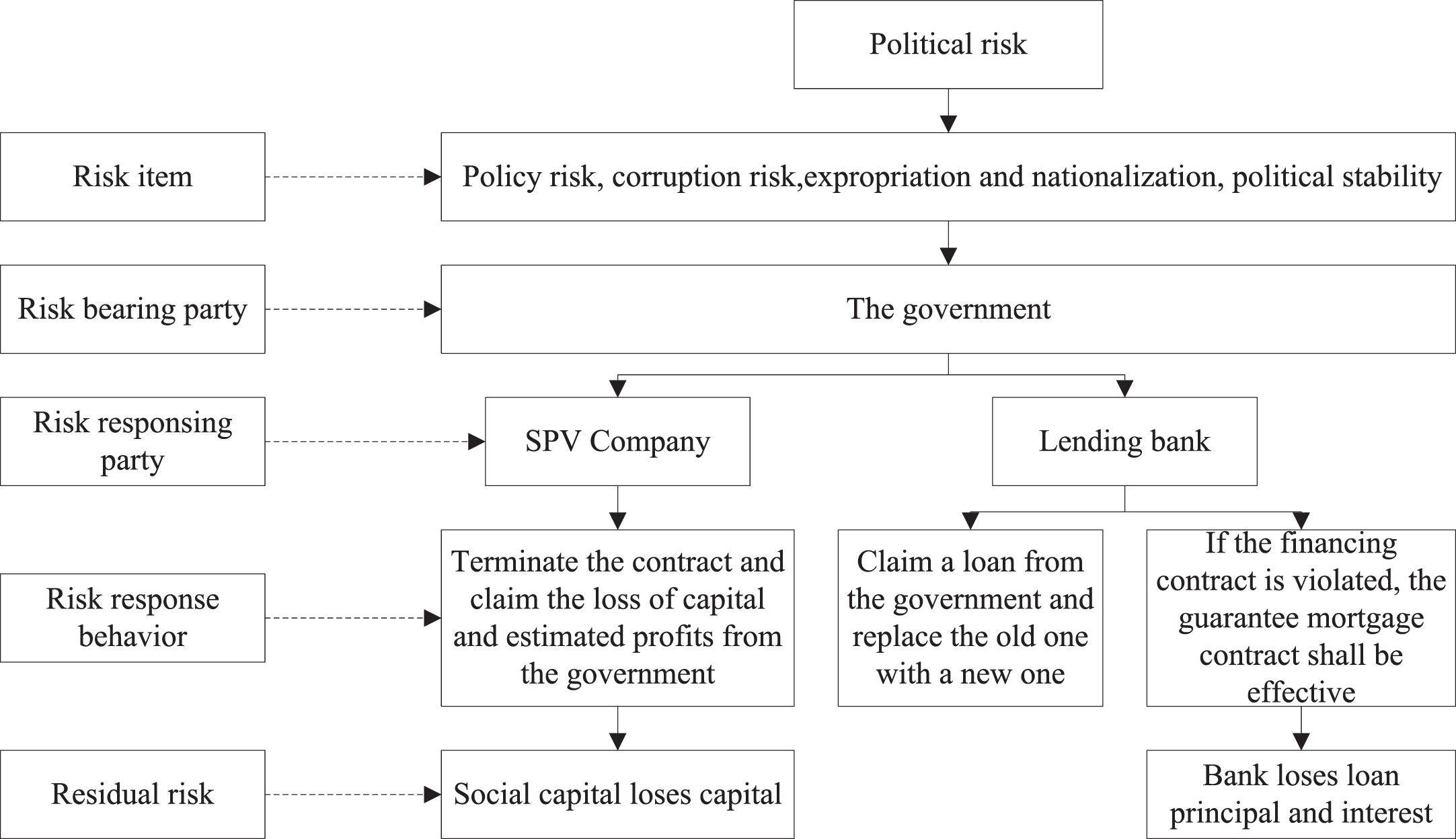
Political risk response path.
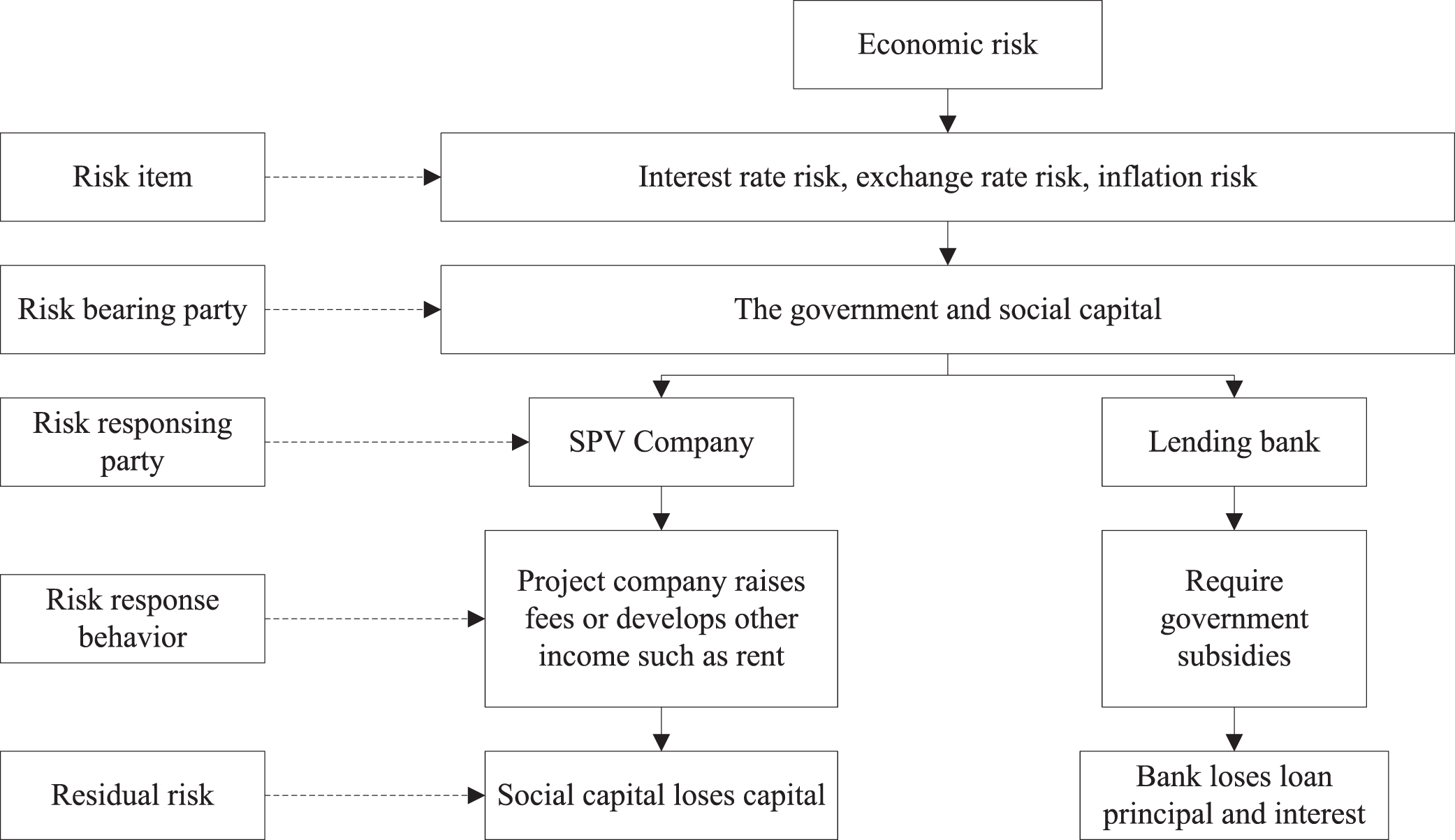
Economic risk response path.

Market risk response path.
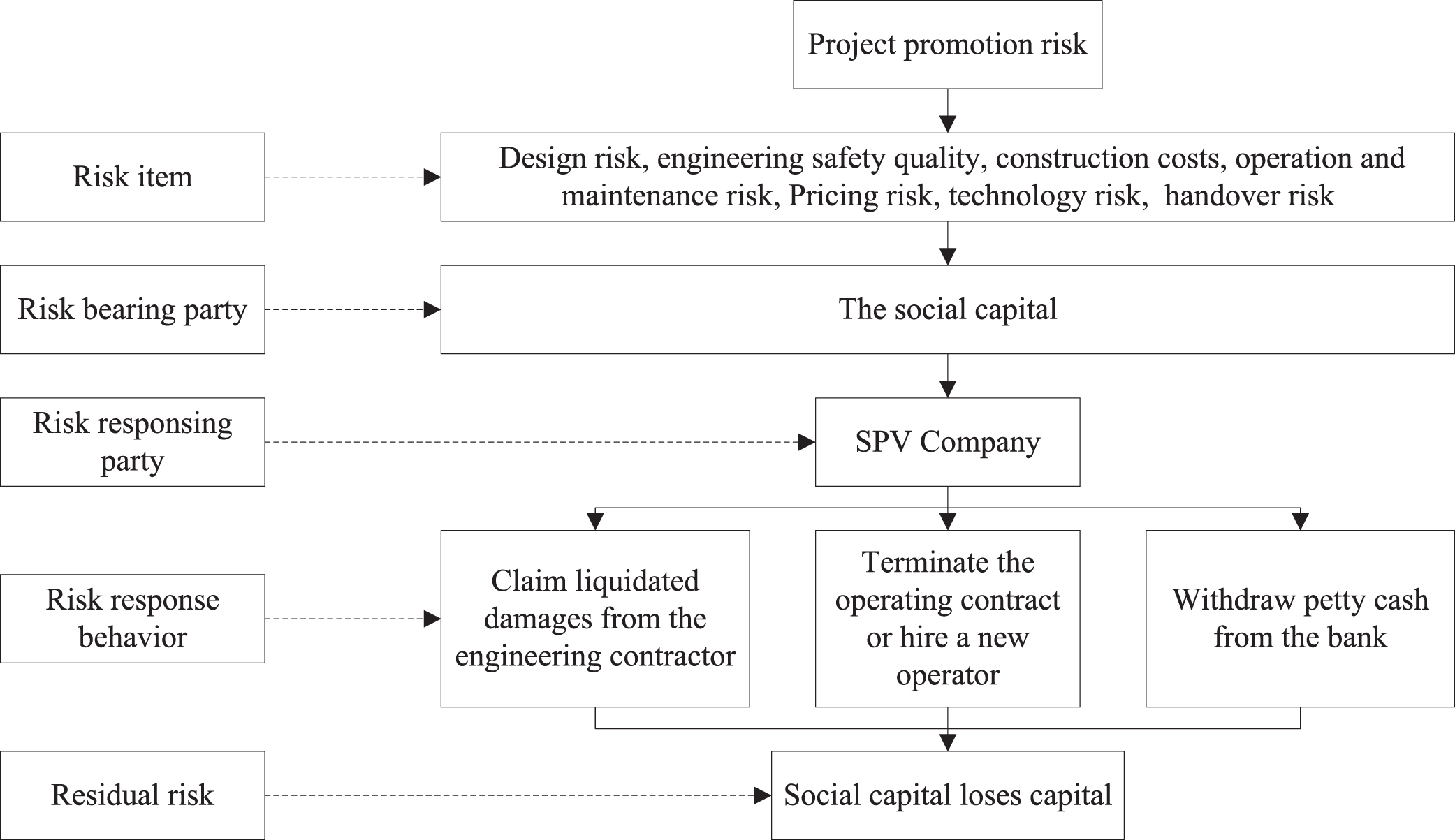
Project promotion risk response path.
From the perspective of SPV Company, based on the existing theoretical research results, combined with the risk characteristics of metro PPP project, this paper uses the method of fuzzy hierarchical analysis to construct the metro PPP project risk assessment framework system from nine dimensions. Political risk, legal risk and project promotion risk are the most important three risk indicators, while environmental risk, relationship risk and force majeure risk take the lowest proportion. Based on the case study of Shenzhen Metro Line 4 project, the risk sharing scheme and countermeasures in key risk areas are put forward. The aim is to provide systematic risk assessment basis for stakeholders of PPP projects, provide theoretical path guidance for regulatory authorities to improve the implementation rate of PPP projects, promote the steady development of urban rail transit PPP projects, and realize the PPP concept of risk sharing and benefit sharing.
For further research, methods such as TOPSIS, Monte Carlo simulation, BP neural network or game theory model can be used to compare results [18, 29], or a combination of qualitative data and quantitative indicators can be used in the model to effectively avoid the influence of subjective factors on the results.
Footnotes
Acknowledgments
The authors thank Fundamental Research Funds for the Central Universities (2020YJS047). The research was also supported by the National Natural Science Foundation of China (71973009, 71902004).