



Abstract
Different from the traditional supply chain, there are more uncertainty in the supply chain of social commerce (SCOSC), which brings new risk. As a fundamental stage in the supply chain risk management (SCRM), risk assessment can effectively control risks in supply chain. To address risk preference of decision makers (DMs) and the criteria ambiguity, this paper proposes an extended generalized TODIM (an acronym in Portuguese of interactive and multi-criteria decision making) method within interval type-2 fuzzy sets (IT2FSs) to evaluate the risk of the SCOSC. First, the generalized TODIM is extended with two different value functions based on two types of criteria, cost and benefit, and the alternatives are ranked according to the distance to the ideal solution and the negative-ideal solution. Second, the IT2FSs is applied to deal with the linguistics ambiguity with the generalized TODIM method. Furthermore, the risk assessment of SCOSC based on the extended generalized TODIM within IT2FSs is proposed. Finally, a case of the risk assessment in SCOSC is presented to validate the effectiveness of the proposed method.
Introduction
Supply chain risk management (SCRM) has always been a key issue in both academia and industry for controlling and mitigating the negative effect caused by risks such as economic crises, strikes, and so on [1]. There is a significant amount of work in the area of SCRM. Chopra and Sodhi [2] consider several risk factors, including supply, transportation, information, and so on. Tummala and Schoenherr [3] present a clear meaning framework of supply chain risk assessment, offering structure and decision support for managers. Wu, Blackhurst [4] create a hierarchical risk factor classification structure, including sudden shoot-up demand, quality, Internet security, and so on. Venkatesh, Rathi [5] identify the controllable risks including supplier uncertainty, employees’ behavior, risks related to infrastructure and so on.
Social commerce (s-commerce) is a new evolution of e-commerce that combines the commercial with social activities by deploying social technologies into e-commerce sites [6, 7]. Greater demands are being placed on the supply chain by s-commerce [8]. Different from the traditional supply chain in e-commerce, the supply chain of s-commerce (SCOSC) is customer-centric [9], social and informational. This kind of supply chain has more uncertainty and complexity which brings new risks to the SCOSC. Risk assessment is a fundamental stage in the supply chain risk management (SCRM) process as it is “needed to be able to choose suitable management actions for the identified risk factors” [10]. However, to our best knowledge, risk assessment of the SCOSC has not been thoroughly studied before and needs more systematic research. Therefore, this paper aims to evaluate the risk of SCOSC, so as to effectively control risks.
The risk assessment of supply chain can be regarded as a multiple criteria decision making (MCDM) problem and a large number of methods have been developed, such as analytic hierarchy process orders-of-magnitude (AHP), order preference by similarity to ideal solution (TOPSIS), the decision-making trial and assessment laboratory (DEMATEL). In fact, the behavior of decision makers (DMs) [11] in the MCDM are often influenced by their cognitive abilities, experience, and emotions, making it difficult to make completely rational decisions. In risk assessment of SCOSC, the risk preference of decision makers has a great impact on supply chain performance. Therefore, the risk preference of DMs need to be considered in the supply chain risk assessment. Actually, there have been many researches on risk preference. TODIM (an acronym in Portuguese of interactive and multi-criteria decision making), proposed by Gomes and Lima [12], is a MCDM method based on the prospect theory to calculate the dominance of one alternative over another considering the DM’s behavior. The TODIM method has widely been used in MCDM problems. Gomesab [13] presented an assessment study of residential properties using the TODIM method to order properties with different characteristics. Gonçalves, Ferreira [14] created an idiosyncratic decision support system using the TODIM method in the assessment of SME credit risk (SME) credit risk. However, some scholars have questioned the value function of TODIM [15]. Gomes and Gomes and González [16] proposed a generalized TODIM method with a more general parametric form of the value function in prospect theory. Llamazares [17] proposed a generalization of the TODIM method and established the conditions under which the previous paradoxes that affecting the weights of the model can be avoided. There are few scholars consider the applicability of value function between benefit and cost criteria. Lee and Shih [18] proposed a generalized TODIM method by incremental analysis using different gains/losses value functions.
Actually, human judgments are often vague and cannot estimate his preference with an exact numerical value [19]. In addition, for supply chain risk assessment problems some criteria are usually not known precisely [20]. As a result, there are already a lot of studies that have applied fuzzy to risk assessment [21–25]. Type-2 fuzzy, as an extension of type-1 fuzzy [26], is more advantageous than characterization of ambiguity and uncertainty. Chen and Lee [27] proposed a new method for solving fuzzy multi-attribute group decision problems based on arithmetic operations of ranking values and interval type-2 fuzzy sets (IT2FSs). Wang, Yu [28] presented a new approach for solving multi-criteria group decision-making (MCGDM) problems based on interval type-2 trapezoidal fuzzy numbers (IT2TrFNs). Abdullah and Najib [29] proposed a new fuzzy AHP (FAHP) method based on the IT2FSs environment, and conducted a feasibility test on the proposed model through the case. Wang, Liu [30] fused the weighted arithmetic average operator into the interval type-2 environment to propose a group decision method. Sang and Liu [31] used a new distance calculation method for IT2FSs to help process the gains/losses function and calculate the green supplier of the car manufacturer.
Although a number of MCDM methods have been applied with fuzzy in traditional supply chain risk assessment, there are few studies on the risk assessment of the SCOSC which has more uncertainty and complexity with the feature of customer-centric, social and informational. Meanwhile, the risk preference of DMs in supply chain can influence the risk assessment performance significantly and suitable MCDM methods need to be developed. In addition, the linguistic ambiguity of DMs needs to be considered for more accurate assessment. For above reasons, this paper proposed a generalized TODIM method for the risk preference of DMs, and extended the model with IT2FSs to deal with the linguistic ambiguity in the SCOSC. The contribution of this paper is threefold. Firstly, considering the risk preference of DMs, we extend the generalized TODIM by using two different gains/losses functions for benefit and cost respectively and ranking the alternatives according to the distance from the ideal solution and the negative-ideal solution. Secondly, considering the ambiguity of criteria, we combine IT2FSs and the generalized TODIM method to deal with the linguistics uncertainty in risk assessment of the SCOSC. Thirdly, a case study of SCOSC is illustrated to validate the effectiveness of the proposed method.
The rest of the paper is organized as follows. Section 2 introduces the preliminaries of IT2FSs and the generalized TODIM method. Section 3 describes the extended generalized TODIM based on IT2FSs. Section 4 presents the risk assessment of the SCOSC. Section 5 illustrates an application in the SCOSC risk assessment. Finally, research result is summarized in section 6.
Preliminaries
In this section, we will introduce the basic concepts of IT2FSs and the generalized TODIM method.
Interval type-2 fuzzy sets
It is obvious that the IT2FSs
An example of IT2FSs
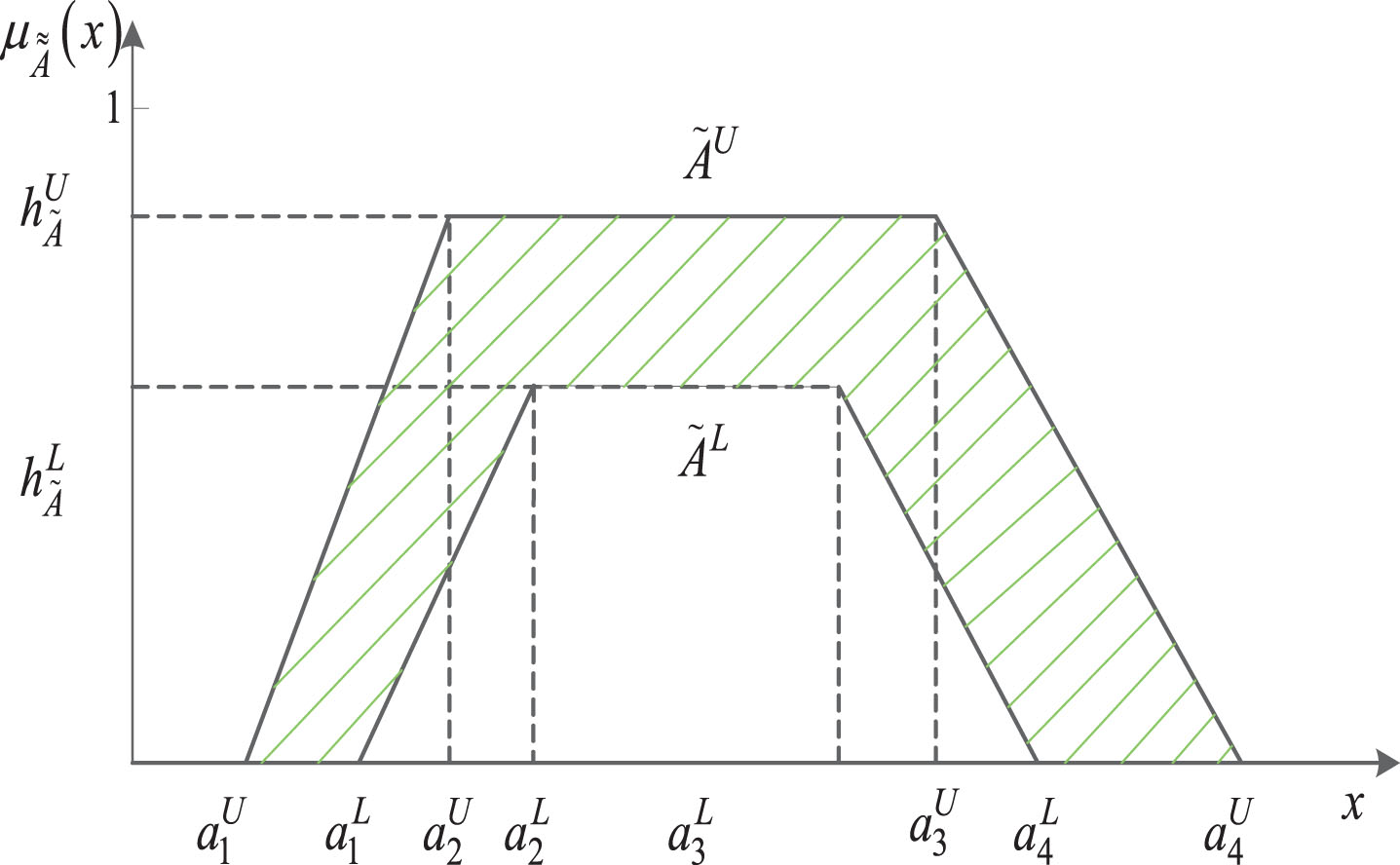
An example of IT2FSs
Then, the arithmetic operations between Addition operation
Subtraction operation
Multiplication operation
Multiplication by crisp number operation
Power operation
Distance between
The ranking of two IT2FSs If If If The single ranking of
The classical TODIM uses the prospect function to calculate the dominance of one alternative over another. Gomes and González [16] proposed a generalized TODIM method by introducing a more general parametric form of the dominance degree function φ k (A i , A j ) in the classical TODIM method. Now many scholars have combined the generalized TODIM with the value function of prospect theory.
Suppose the MCDM problem has m alternatives A ={ A1, …, A
m
} and n decision criteria C ={ C1, …, C
n
}, x
ik
is the rating of the alternative A
i
with respect to criterion C
k
, and w = (w1, …, w
n
)
T
is the weight vector associated with the set of criteria satisfying 0 ⩽ w
k
⩽ 1 and
where w r = max{ w j }.
where α, β are estimable coefficient determining the convexity/concavity of the function, λ is the loss aversion coefficient, and 0 < α, β < 1, λ > 1.
Description of the linguistic under interval type-2 fuzzy sets
In this study, we assume that the DMs expect to form linguistic terms [31] (See Table 1) to assign linguistic value to express their decision preference with interval type-2 trapezoid fuzzy information.
Linguistic variables and corresponding IT2TrFNs
Linguistic variables and corresponding IT2TrFNs
The generalized TODIM with IT2FSs can be expressed as follows:
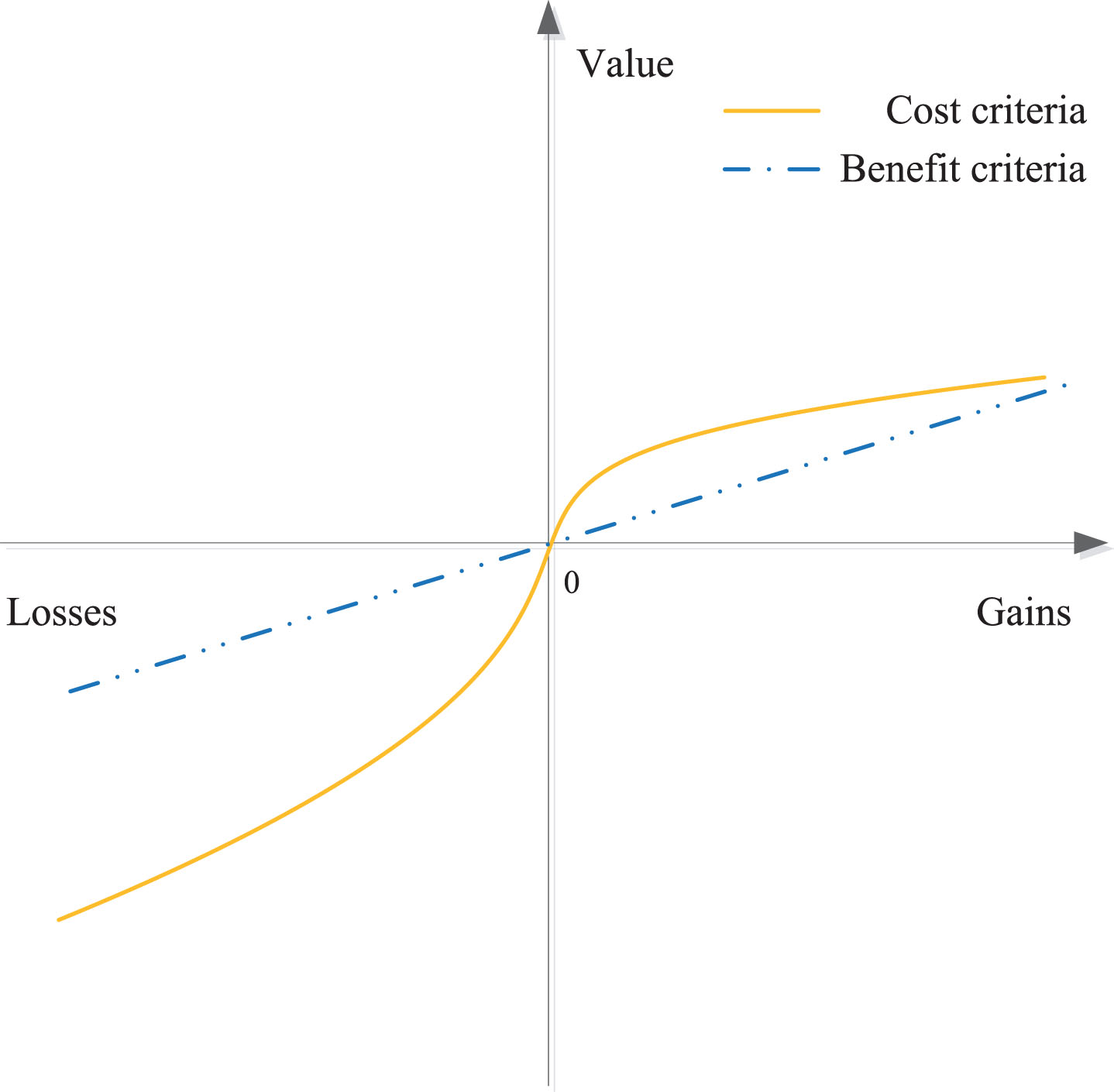
Value function in generalized TODIM.
Although the generalized TODIM uses a more general parametric form of the value function, the different risk preferences of decision maker under the benefit and cost criteria are seldom considered. Therefore, we analyze the different preference under the benefit and cost criteria respectively. And then we rank all alternatives by the distance to ideal and negative-ideal solutions of benefit and cost criteria.
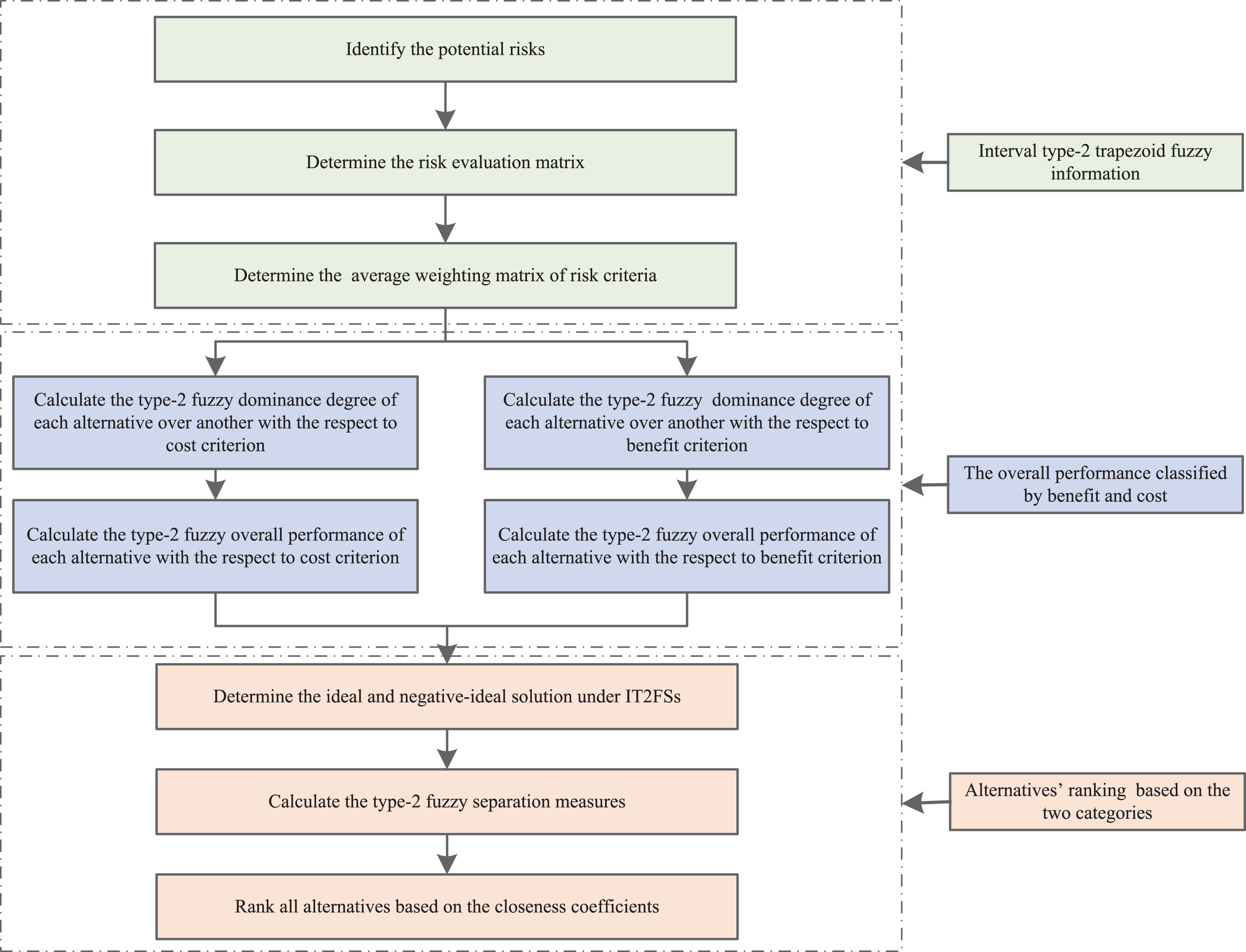
The flowchart of risk assessment in the SCOSC based on extended generalized TODIM under IT2FSs.
(1) Determine the fuzzy assessment matrix and fuzzy average weighting matrix.
Drawing the experience of literature [37], then we get the weighted collective matrix
where
(2) Calculate the overall performance classified by benefit and cost criteria.
The value function of the prospect theory is evaluated in an uncertain risk environment. Due to the multi-attribute characteristics of the assessment object, the criteria not only contains risk criteria, but also contains some positive criteria that do not have risk preference characteristics. Therefore, it is necessary to classify the assessment criteria based on cost and benefit. For the two types of criteria, different value functions are used in the TODIM methods, then the dominance degree for the alternative in Equation (3) can be correspondingly revised as the following two equations, Equations (19 and 20).
For the cost criteria c
c
, the dominance degree φ
c
k
of alternative A
i
over A
k
is
where α = β = 0.88 and λ = 2.25.
For the benefit criteria c
b
, the dominance degree φ
c
b
of alternative A
i
over A
k
is
where α = β = 1 and λ = 1.
Considering the computation complexity of IT2FSs, we use the distance computation methods [35] for IT2FSs to calculate the dominance degree φ
c
c
(A
i
, A
k
) and φ
c
b
(A
i
, A
k
) of each alternative A
i
over each alternative A
k
with respect to cost criteria C
c
and benefit criteria C
b
, then Equations (19 and 20) can be transformed as follows:
where the distance of each alternative A i over each alternative A k is using Equation (15) and Equation (16). And the parameter of cost criteria α = β = 0.88, λ = 2.25, benefit criteria α = β = 1, λ = 1.
And then we get the IT2F overall performance ξ
c
(A
i
), ξ
b
(A
i
) of the alternative A
i
in cost and benefit criteria using Equation (17). Rank alternatives based on the distance to ideal and negative-ideal solution.
In order to avoid the loss of assessment information and obtain the reasonable ordering alternatives, alternatives are rearranged by the distance to both the ideal solution and the negative-ideal solution simultaneously.
The ranking method of two IT2FSs proposed by Qin, Liu [35] (see Definition 3) is used to determine the ideal solution and negative-ideal solution of the IT2F prospect value ξ
c
(A
i
), ξ
b
(A
i
). Then we have
where ξ+ (A) is the ideal solution, ξ- (A) is the negative-ideal solution, i = 1, 2, …, n.
And the distance calculation using IT2FSs distance function are shown as follows:
Identify the risk factors of the SCOSC
Based on the traditional e-commerce supply chain risk assessment [3], we add social indicators such as social platforms [38] and customer relationship [39] to build an indicator system (See Table 2). The indicators are: Stock-out rate (C1), On time delivery (C2), Growth rate of total assets (C3), Total assets turnover ratio (C4), Policy of the law (C5), User-generated content (C6), Timeliness of information transmission (C7), Social media risk (C8), Customer relationship (C9), Customer information confidentiality (C10).
Criteria for risk assessment of SCOSC
Criteria for risk assessment of SCOSC
Notes: C- Cost criteria; B- Benefit criteria.
Let us consider the risk assessment in the SCOSC as a decision making problem within IT2FSs. This section proposes the risk assessment in the SCOSC based on the extended generalized TODIM under IT2FSs environment. And the procedure is shown in Fig. 3, which involves the following steps:
Calculate the type-2 fuzzy dominance degree φ
c
c
(A
i
, A
k
) of each alternative A
i
over each alternative A
k
with respect to cost criteria C
c
using Equation (24). Calculate the type-2 fuzzy overall performance ξ
c
(A
i
) of alternative A
i
of cost criteria using Equation (17).
The application of risk assessment in the supply chain of social commerce
In this section, an illustrative example is provided to present the application of the proposed method for risk assessment in the SCOSC.
Problem description and computing process
Four social commerce (A1, A2, A3, A4) are considered in the risk assessment problem so as to get the risk ranking of social commerce. Three experts are invited to evaluate the four alternatives, and the assessment and weight are described by the IT2FSs linguistics terms. The decision matrix are shown in Table 3. The weights of the criteria are derived from there DMs based on Table 1 and are presented in Table 4.
Decision makers’ assessment of the four alternatives
Decision makers’ assessment of the four alternatives
The weight preference matrix by DMs
The weighted decision matrix for alternatives
Calculate the ranking value and distance of the dominance degree between alternatives using Equations (11 and 13). The type-2 fuzzy dominance degree of each alternative A
i
to each alternative A
k
with respect to cost criteria C
c
(C1, C5, C8) can be calculated using Equation (24), which is shown in Tables 6–8. Calculate the fuzzy overall performance of each alternative using Equation (17). The result is shown in Table 9.
The dominance degree of alternatives with the respect to cost criterion C1
The dominance degree of alternatives with the respect to cost criterion C5
The dominance degree of alternatives with the respect to cost criterion C8
The overall performance of alternatives with the respect to cost criterion
The overall performance of alternatives with the respect to benefit criterion
The fuzzy overall performance of benefit/cost for alternatives
The closeness coefficients of alternatives along with final ranking
The global performance of alternatives along with final ranking
The dominance degree of alternatives with the respect to benefit criterion C2
The dominance degree of alternatives with the respect to benefit criterion C3
The dominance degree of alternatives with the respect to benefit criterion C4
The dominance degree of alternatives with the respect to benefit criterion C6
The dominance degree of alternatives with the respect to benefit criterion C7
The dominance degree of alternatives with the respect to benefit criterion C9
The dominance degree of alternatives with the respect to benefit criterion C10
In the risk assessment of the SCOSC, the more the sample assessment result is closer to the negative ideal solution, the greater the risk it faces. Therefore, in the Table 18, A3 has the highest score, indicating that A3 has the highest risk; A4 has the lowest score, indicating that A4 faces the least risk. Therefore, for the four social e-commerce platforms, A4 has the best stability. Then we have
In order to verify the validity of the developed method for risk assessment in SCOSC, we complete its comparative analysis with the interval type-2 fuzzy TODIM, which was proposed by Sang and Liu [31]. The obtained result is discussed as follows:
For the weighted normalized fuzzy decision matrix, we calculate the dominance degree of each alternative A
i
over each alternative A
k
with respect to criteria C
j
using the following expression: For benefit criteria
For cost criteria

The comparison result of these two methods.
Finally, the global performance of each alternative and their rank presented in Table 13 in descending order as A4 ≻ A2 ≻ A3 ≻ A1.
Figure 4 shows the ranking results of alternatives with traditional fuzzy TODIM and our method respectively. From Fig. 4, we clearly know that the ranking orders of alternatives obtained by these two approaches are different. For our method, the ranking result is A4 ≻ A2 ≻ A1 ≻ A3 while the result of traditional TODIM is A4 ≻ A2 ≻ A3 ≻ A1. The most risky alternative is A3 in our method while A1 is the most risky alternative in traditional TODIM. The main reason for the difference is that our method uses different value functions for benefit and cost criteria in the supply chain risk preference of DMs, which decreases the scaling effect caused by the square root gains/losses function. Therefore, our proposed method is more reasonable and can also obtain a better final decision result in the SCOSC than traditional TODIM.
The generalized TODIM method is extended under IT2FSs environment to evaluate risks of the SCOSC. Concretely, considering some indicators such as socialization and customer relationship cannot be evaluated by people with exact numerical value, this paper extends the generalized TODIM method to the IT2FSs environment, converting the linguistic variables into IT2TrFNs. To deal with the risk preference of different criteria types, two different value functions of generalized TODIM are used to calculate the fuzzy overall performance of the cost and benefit criteria respectively. Based on the distance function of the IT2FSs, all the alternatives are ranked according to the distance to the ideal solution and the negative-ideal solution. A case study of SCOSC risk assessment has validated the effectiveness of the proposed mothed.
Future research can consider construct a more comprehensive SCOSC risk assessment indicator system based on big data and linguistic variables. In addition, the generalized TODIM method can be further extended by combining IT2FS with other cost-benefit sorting methods.
Footnotes
Acknowledgments
The work is supported by the National Science Foundation of China (NSFC) (71771051, 71371049).