



Abstract
ELECTRE TRI, a family of multi-criteria methods used to sort alternatives into preference-ordered categories, defines an outranking function to measure the membership degree of an alternative to a category, whenever imprecise evaluations are available. Recent extensions use Hesitant Fuzzy Sets (HFS) to consider uncertain evaluations. However, deterministic parameters are considered, which avoids the application to cases in which non-fuzzy scores and unstable parameters are available. In this study, an approach is proposed for: 1) modeling hesitant outranking functions originated from unstable parameters provided by several DMs; 2) using the HFS to calculate the ELECTRE TRI-C indices; 3) reducing the DMs cognitive effort when they are asked to provide information. An application to supplier development is presented by using ELECTRE TRI-C. Results are compared by using different HFS aggregation operators and sensitivity analysis shows that a robust conclusion can be obtained. Future lines of research are also suggested.
Introduction
ELECTRE TRI is family of MCDA methods designed to aid the decision analyst in problems where a set of alternatives need to be sorted in preference-ordered categories. Each category is defined a priori by upper and lower reference alternatives (ELECTRE TRI-B, ELECTRE TRI-nB [15]), or central reference alternatives (ELECTRE TRI-C, ELECTRE TRI-nC [3]). Using two rules, each alternative a is successively compared to boundaries (or central reference actions) b in terms of a global outranking relation such that it may be assigned to one or several categories. ELECTRE TRI-C, one these sorting methods, has been applied in different domains [16, 26] for cases where defining boundaries is difficult or the concept of boundary remains vague for the DM, then central reference actions are used to characterize categories. When restricted to a single criterion, a fuzzy number, called the outranking function, is built to evaluate the credibility that any alternative be assigned to a category represented by its reference action. The outranking function is built according to the scores of the alternative, the reference action and two parameters representing the imprecision on evaluations.
ELECTRE methods have been extended to consider situations in which evaluations of alternatives may be expressed as fuzzy sets, but membership degrees are uncertain. Extensions of ELECTRE methods that consider uncertain fuzzy sets [22, 39], interval-valued fuzzy sets [43], interval-valued intuitionistic fuzzy sets [48], and intuitionistic fuzzy numbers [20] have been proposed. [32] propose neutrosophic logic to model outranking relations based on non-transitive strong and weak dominance relations, and a transitive indifference relation, built by the pairwise comparison of simplified neutrosophic numbers (scores). In this study, however, non-transitive relations are taken into account in order to deal with several types of outranking functions. Recently, Hesitant Fuzzy Sets (HFS) have been introduced for contexts where DMs cannot precisely express a fuzzy value [9, 46]. HFS provides a useful tool because it allows a membership degree to have different values in the interval [0, 1] [41]. HFSs for quantitative criteria, and hesitant fuzzy linguistic term sets (HFLTS) for qualitative criteria, have received great attention in MCDA research and multiple applications have been reported with extensions for classical methods [11–13, 51].
HFS extensions for ELECTRE methods have been also introduced. For instance, [18] propose the use of HFS to model the DMs’ judgements regarding the evaluation of alternatives and weights of criteria. HFSs are aggregated to present as input for the ELECTRE TRI method. [9] define an hesitant fuzzy decision matrix to model uncertain information regarding the evaluation of alternatives. A score and a deviation functions are used to compare hesitant evaluations among pair of alternatives on each criterion. These are the base for constructing the ELECTRE II concordance and discordance indices. However, the remaining steps of the outranking-based method are applied as usual. [31] consider multiple hesitant fuzzy sets (MHFS) for cases where the same hesitant value regarding a preference or data is repeatedly proposed by a decision maker. These authors define the ELECTRE III concordance and discordance indices as functions of evaluations of alternatives, expressed as MHFSs. [23] also uses HFS evaluation of alternatives to calculate concordance and discordance indices in ELECTRE I. In all cases, the outranking concordance and discordance indices are calculated as prescribed in ELECTRE methods.
Given that ELECTRE methods are most applied in decision problems where evaluations correspond to scores, ELECTRE HFS extensions build the outranking functions modeling the concordance and discordance indexes as aggregations of hesitant scores, by introducing deterministic preference and indifference thresholds parameters. However, if the focus is placed on the DM’s preferences, instead of concentrating on hesitant scores, then uncertain preferences could be modeled as hesitant outranking functions. In recent years, researchers have proposed this kind of approach. [55], for instance, define hesitant fuzzy preference relations (HFPR), and hesitant multiplicative preference relations (HMPR), as squared matrices where each entry is an hesitant fuzzy element modeling a preference relation between a pair of alternatives, a set of possible values in [0, 1]. [52] extends the analysis of two cases of incomplete HFPRs and propose a method to calculate consistent priority weights of alternatives for group decision-making (GDM) situations. [53] focus on the computation of additive consistency indices for an HFPR and [54] extends the calculation to the case of incomplete HFPRs in order to propose a new procedure for group analytic hierarchy process. Outranking preference relations, however, are less restrictive than HFPRs and some transitivity desired properties could not be satisfied [8, 37].
Uncertain parameters due to one single DM with unstable preferences, or several DMs with divergent preferences, have not be considered in the HFS extensions of outranking-based methods. In order to fill this gap, we concentrate on the following research question: how to use HFS to model uncertain parameters such that the ELECTRE TRI-C’s rationale be preserved. Thus, we focus on situations of imprecise, but deterministic, evaluations and unstable parameters (thresholds). An indirect method to model parameters is proposed, by assuming that several DMs are asked to provide information about the outranking relation functions, and not directly about the parameter values. In this sense, we adopt a framework similar to that proposed by the HFPR literature, eliciting outranking preference relations, but without imposing specific properties to the respective functions.
ELECTRE TRI-C has been chosen because the proposed approach can be applied in sorting processes where each outranking function may be elicited as a canonical trapezoidal fuzzy number (TrFN), which models the preference relation between an alternative and a central reference action. This means to consider uncertain thresholds, which has not be considered in other contributions found in the literature. Thus, main contributions proposed in this study are: 1) modeling hesitant outranking functions to deal with uncertainty originated from unstable parameters provided by several DMs; 2) using HFS to build the outranking indices, when deterministic scores and uncertain thresholds are considered; 3) introducing an approach that reduces the DMs cognitive effort when they are asked to provide preferential information, as compared to other ELECTRE extensions using HFS.
An application to the supplier development problem (SDP) is introduced to show the potential of this approach. SDP is essentially a MCDA problem and traditional or hybrid approaches could be used to solve it [6, 44].
The article is organized as follows. In Section 2, the basic notation and definitions are presented, and two ELECTRE TRI-C outranking functions are introduced. The model applying HFS within ELECTRE TRI-C is introduced in Section 3. The application to the supplier development problem is presented in Section 4. Section 5 presents the conclusions of this article and makes some suggestions for future lines of research.
Notation and basic definitions
Hesitant fuzzy sets
As an example, let us consider X = {x1, x2} to be a set such that h E (x1) = {0.3, 0.2} and h E (x2) = {0.1, 0.3, 0.4}, then an HFS can be written as follows: ξ E = {〈x1, {0.3, 0.2} 〉, 〈x2, {0.1, 0.3, 0.4} 〉}.
For h1 and h2, if s (h1) > s (h2) ⇒ h1 ≻ h2 (superior), and s (h1) = s (h2) ⇒ h1 ∼ h2 (indifferent).
ELECTRE TRI-C
Let A = {a1, a2, …, a n } be a set of actions (alternatives) to be assigned into categories; let C h , (h = 1, …, H ; H ≥ 2) be a set of ordered categories; let B = {b1, …, b H } be the set of fictitious or realistic actions, called the central reference actions, such that each b h represents the category C h ; and let F = {g1, g2, …, g m } be a coherent family of criteria used to evaluate each action. The vector of performances of an action a ∈ A ∪ B, i.e., (g1 (a) , g2 (a) , …, g m (a)) is called the evaluation profile. Categories are ordered in terms of preferences from the category of actions having the worst profiles, C0, to the best ones, C H .
The outranking relation, interpreted as the assertion “a is at least as good as a′”, can be measured on each criterion in terms of the partial concordance index, defined as follows:
Let b be a reference alternative and define the following fuzzy number:
Although the ELECTRE methods consider an effect which measures the power of veto from some criteria against the outranking relation, In this study, a simplified version is considered. Indeed, the discordance effect in a criterion is also measured through membership functions, then the approach proposed is not greatly altered.
In Section 2.2 it has been shown that μ
j
(a, b) is a TrFN that help to measure the degree of membership of a to the category represented by b. Whenever imprecision is observed, the parameters
In cases above, an HFS can be considered such that the respective HFE is the set {μ
j
(a, b) ∣ a ∈ A, b ∈ B, g
j
∈ F}. For instance, let us suppose DM1 with parameters
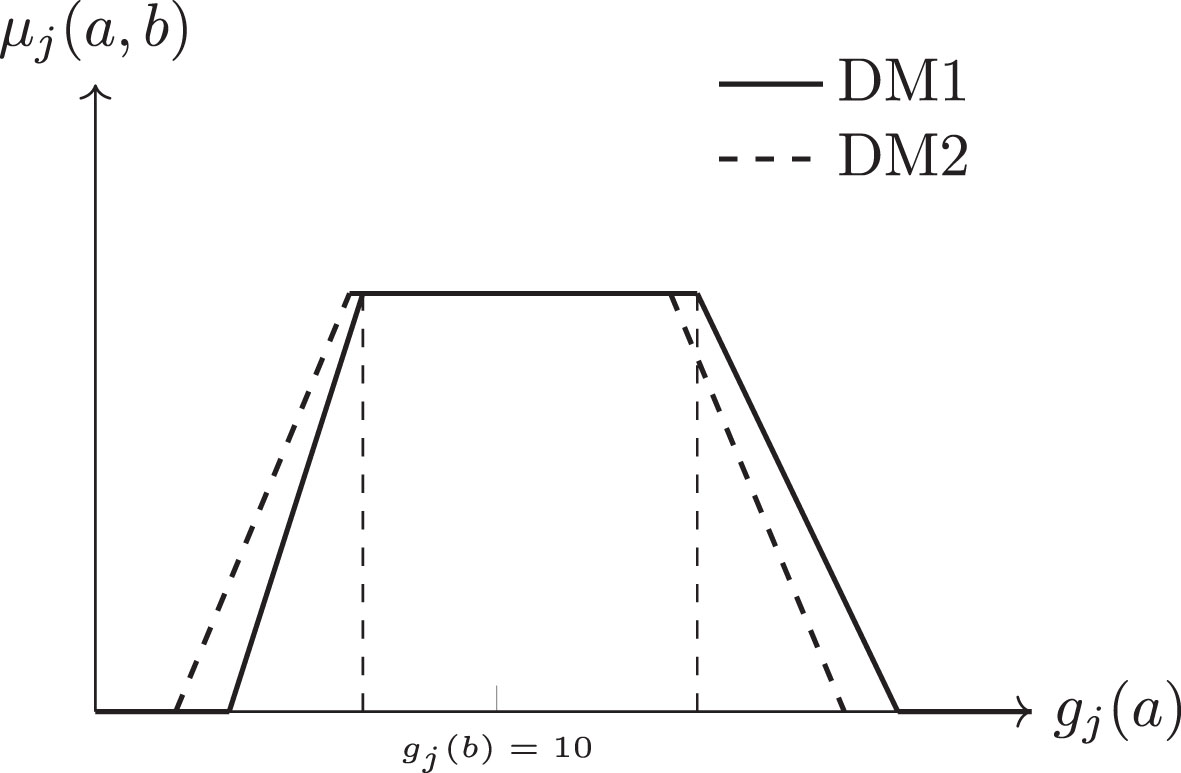
Outranking functions for two DMs.
Note that thresholds in ELECTRE methods have been defined as a mean to take into account the lack of precision in instrumental and procedural measurement, or when the entity to be measured is ill-defined [36]. Thresholds exist to consider that most of time accuracy is illusory. In general, HFS extensions of ELECTRE methods have considered hesitancy in evaluations of alternatives on each criterion, while thresholds remain deterministic. In our approach, however, we will assume that uncertainty does not exist neither in g j (a) nor in p j , q j when a single DM is considered. Thus, hesitancy in μ j (a, b) appears ex post, due to the variety of DMs’ preferences. We assume that a DM is able to propose a single function or value for a parameter, but different DMs may potentially propose distinct functions or values for the same parameter. Thus, it may be considered that uncertainty exists. In such case, differences may be due to a variety of reasons: value systems, objectives, knowledge, experience. All these shape the DMs’ preferences.
The model proposed to use HFS in ELECTRE TRI-C assumes that the alternatives are already defined and evaluated on a set of criteria, but thresholds parameters are not defined and, consequently, the outranking functions are not built yet. Thus, an HFS provides a suitable means to express uncertain information coming from different DMs within the decision analysis process [9]. Several DMs involved in the decision process must provide information to built the membership functions, one for each central reference action. The outranking functions are used to compute the global credibility indices, that are the input to the assignment rules. From this step, the sorting process is developed as prescribed in ELECTRE TRI-C.
The steps to apply this model are as follows:
In Fig. 2 the process is shown. Note that the steps in dashed boxes correspond to the regular steps in an MCDA method, which are not modified by the proposed model.
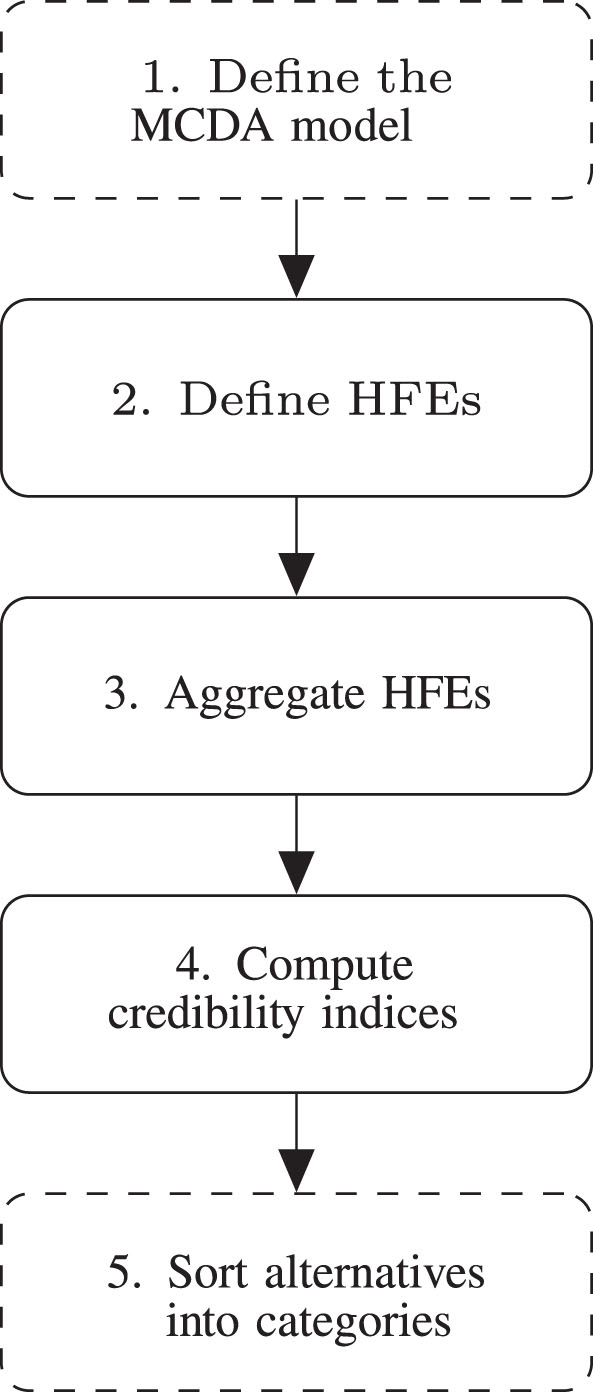
Model for integrating HFS into ELECTRE TRI-C.
A number of HFE aggregation operators have been proposed in the literature. A detailed presentation of different aggregation operators and their properties is provided by [14]. In this study, to illustrate the approach, one of the operators used before to extend ELECTRE methods with HFS is proposed to aggregate information in (5) and (6) [9, 23]:
Using (7) and (8), the global credibility indices can be computed. It is observed that the sets Hdir (b
h
, a) = {sdir
j
(b
h
, a) ∣ j = 1, …, n} and Hdinv (b
h
, a) = {sinv
j
(b
h
, a) ∣ j = 1, …, n} satisfy the definition of an HFE since they denote the possible membership degree of the element a to the category represented by b
h
. Therefore, (9) and (10) can be defined as weighted sum scores, computed from HFEs in Hdir (b
h
, a) and Hdinv (b
h
, a).
Given that TrFNs are proposed to model the outranking functions, in this study, a light modification of the standard assignment rules is introduced:
If t = H + 1, assign a to C
H
. If t = 0, assign a to C1. For 0 < t < H + 1, if min {σ
I
(a, b
t
) , σ
D
(b
t
, a)}> min {σ
I
(a, bt+1) , σ
D
(bt+1, a)} then assign a to C
t
; otherwise, assign a to Ct+1.
If t = 1, assign a to C1. If t = H + 1, assign a to C
H
. For 0 < t < H + 1, if min {σ
I
(a, b
t
) , σ
D
(b
t
, a)},> min {σ
I
(a, bt-1) , σ
D
(bt-1, a)} then assign a to C
t
; otherwise, assign a to Ct-1.
In this section, the model proposed above is applied to the supplier development problem (SDP) [21, 24]. SDP is an integral part of a supplier development program, to be implemented by a buyer firm, which includes identifying what suppliers are candidate to improvement activities. An improvement program involves the intensive use of financial and human resources. Thus, SDP is an strategic endeavor where uncertain, imprecise and incomplete information may be available in which regards: demand requirements; capacity, which restricts the delivery time, manufacturing time and costs; criteria, which impacts on their relative importance and evaluation; in the presence of several DMs, each of whom has her/his own value system, knowledge and priorities [10, 49].
Although different MCDA approaches exist to deal with uncertain and imprecise information [30], we are interested on the outranking-based methods. [50] present a review of MCDA methods applied to supplier selection and SDP. These authors propose that most hybrid approaches involving MCDA methods and fuzzy sets have been reported, including methods as Analytical Hierarchic Process (AHP), TOPSIS, SMART, QFD, Dempster Shafer theory of evidence, multi-objective programming. These methods can be classified as compensatory, which implies that bad performance on some criteria can be offset by good performance on others. ELECTRE methods, instead, are non-compensatory since the preference thresholds and the aggregation rules eliminate alternatives that perform very bad in one or several criteria. This is a desirable property, but at the cost of complexity in computations and a difficult process to elicit the threshold parameters.
MCDA methods based on the outranking preference to sort alternatives, applied to deal with SDP, are rather scarce. [4] propose a supplier segmentation process using a method based on PROMETHEE, called PROMSORT. [38] propose FlowSort, a sorting method based on PROMETHEE, to classify suppliers according to a set of criteria. [42] develop a hybrid method, which uses the PROMETHEE’s preference function. [34] use a revised version of ELECTRE TRI [2] to sort suppliers. [18] propose the use of HFS to model the DMs’ judgements regarding the evaluation of alternatives and weights of criteria, which is used as input to the ELECTRE TRI sortingmethod.
Numerical example
In this section, an application is presented which is adapted from a previous study by [5], where a model of criteria to evaluate strategic suppliers in Mexican sectors is developed. Table 1 shows the criteria and weights in one of the sectors, as reported by these authors.
Family of criteria
Family of criteria
Experts coming from several buying firms were invited to complete a questionnaire in order to provide information about the performance of suppliers in these criteria. The scale [0, 10] was chosen to evaluate alternatives. It is worth noticing that the original evaluations were obtained in a context of poor information. [5] provide a detailed explanation of scales used in the original case study. Table 2 shows the matrix of supplier evaluations.
Evaluations of suppliers
Three categories are considered in this model: C3, the best ones, which do not need a buyer firm (BF) to assist them to improve performance; C2, the candidates for development; and C1, the suppliers that are not worth assisting because the costs involved and the resources required to improve them are too high. Therefore, the evaluations of three reference alternatives -b1, b2 and b3- are defined, and also shown in the Table 2. These are fictitious profiles and are defined to illustrate the process.
Three DMs are involved in the decision process. Thus, it is supposed that the outranking functions in this problem are elicited from information provided by them, in the form of TrFNs, having the following form
Categories and reference profiles of criteria
Note that a TrFN is a canonical fuzzy set [7], but also degenerated TrFNs are included in this example. For instance, (4.5, 7, 7, 7.5) is a triangular fuzzy set, such that a2 = a3 in (11). Equally, left and right open fuzzy sets are shown, for instance, (0, 0, 4.5, 5) and (7, 8, 10, 10), where a1 = a2 and a3 = a4, respectively.
In order to compare results using different aggregation rules, three procedures are considered to determine the global outranking indices: A score function is used to aggregate HFEs (5) and (6):
A max function is used to aggregate HFEs (5) and (6):
Instead of aggregating HFEs, the average value of thresholds is used as input to calculate the concordance indices, that is:
The first and second aggregating operators are monotonic non-decreasing operators and fulfill boundary conditions [14]. The first property states that given l-long HFEs where membership degrees are increasing ordered, H = {hσ(1), …, hσ(l)} and H′ = {hσ(1)′, …, hσ(l)′}, then hσ(1) ≤ hσ(1)′, …, hσ(l) ≤ hσ(l)′ implies s (H) ≤ s (H′). This means that the HFEs scores can be compared. The second property states that, given H = {0} and H′ = {1}, then S (H) =0, S (H′) =1.
The third procedure says that uncertainty is observed whenever a threshold has several values, due to DMs having different preference systems. In this case, the procedure does not consider hesitancy, but the average value is calculated which assumes that each threshold is a stochastic variable.
Let us illustrate the computation process. First, let us consider the category b1 and e4, with g1 (e4) =4.0 and g1 (b1) =3.5, in Table 2. Next, by (11), any TrFN elicited from DM
k
has the form
Assignment of suppliers according to three procedures
Observe that the descending and the ascending rules may assign an alternative to different categories, which has been already observed in other applications of ELECTRE TRI-C method [2]. In all cases, the average score and the max score agree in the assignments. The average threshold procedure, however, assigns the alternatives to a category equal or superior. This procedure could be said optimistic.
Sensitivity analysis has an important status in MCDA [28]. Although different definitions have been proposed, we propose to analyze robustness, which can be conveniently referred as the ability of a solution to cope with uncertainties [45]. Different sources of uncertainty interact in a decision problem, some reflecting more or less arbitrary choices of the decision analyst and others concerning external uncertainties. In this sense, it has been proposed that the “robustness concern” needs to be explicitly stated in a problem such that the analysis be driven by a specific aim [1], defining the uncertainty dimensions that are to be dealt with.
In this study, two sources of uncertainty are considered: the unstable thresholds and the weights of criteria. Above, HFS have been proposed to deal with the unstable thresholds. In order to analyze the second source of uncertainty, we are going to consider unknown but stochastic weights. We assume that DMs are not able to provide any information to model a specific form of their probability distributions, then a uniformly probability distribution is assumed for each weight.
Let
Sensitivity analysis results (L = 10000)
Sensitivity analysis results (L = 10000)
The analysis of results shows that in 22 out of 27 cases the descending and the ascending rules agree in the assignments. However, it can be observed that: (1) e4 and e9 in the cases of HFS operators may be assigned into C3 or C2; (2) these operators give C2 for e3 and e8; (3) according to the mean threshold operator, it can be also verified that e8 and e9 are clearly assigned into C3, and e3 into C2.
If results obtained in these three operators are compared each other, a robust assignment can be identified, except in case of e4 and e9, where the HFS operators assign them into C3 or C2, while the mean operator assigns it into C3. Finally, the following categories are concluded:
Few methods have been proposed in the literature to deal with ELECTRE sorting methods, in cases where thresholds are uncertain and scores are imprecise. SMAA-TRI [40], for instance, may support cases in which thresholds can be modeled as stochastic variables, even if scores are deterministic. Uncertainty included in the application above, due to the DMs’ different preference systems, may be attributed to different objectives, knowledge systems and experiences and not to some condition establishing their ignorance about the “true” value of a threshold. Thus, instability of parameters is not attributed to stochastic uncertainty. Extensions of ELECTRE methods, using HFS, have all considered stable and unique parameters, whatever the group of DMs in the process. One of the main contributions of this study consists of using HFSs to model uncertainty without restrictive assumptions regarding the probability distribution of threshold values. Instead, stochastic uncertainty of criteria weights has been chosen to undertake robustness analysis. This needs to be investigated in a future research such that a “full HFS” approach be proposed.
Extensions to ELECTRE methods use HFS to model evaluations of alternatives. In such case, the number of fuzzy sets to be elicited for each DM is n × m, which even for small problems supposes a lot of effort demanded to the analyst and/or the DMs. Moreover, this also supposes that scores representing evaluations of alternatives can be modeles as HFSs. We have considered a kind of situation in which scores are imprecise, but not uncertain. In addition, due to uncertain thresholds, the outranking functions are hesitant. Thus, the number of fuzzy sets to be elicited is greatly reduced to H × m, because usually H << n. In the example, the extensions of ELECTRE methods need to elicit 63 HFSs, against 21 in our model, for each DM. This advantage can be obtained whenever uncertainty in thresholds is considered. Nevertheless, a limitation could appear if DMs are not available to provide information used to build the outranking functions. If the DMs are able to provide information, the cognitive effort that our approach requires to elicit outranking functions is quite lower than the effort required to elicit uncertain scores proposed in other approaches.
Several types of trapezoidal fuzzy numbers have been considered in this example, which have been supposed to be the result of the respective elicitation processes run with the DMs. In particular, left and right open fuzzy sets have been used. This suggests that the approach proposed in this study, i.e. modeling outranking functions as HFSs, can be easily extended to other ELECTRE methods where direct indifference and preference thresholds are considered.
Conclusions
In this study, an approach that considers hesitant ELECTRE outranking functions is proposed. Hesitancy is due to unstable thresholds modeling imprecision in evaluations on each criterion in the family of criteria in the decision problem. Differently from other approaches incorporating hesitant fuzzy sets in ELECTRE methods, deterministic scores are considered. This is a new kind of situation, which has not been considered in HFS extensions of ELECTRE methods. The approach provides an alternative way to consider uncertain parameters in ELECTRE, complementary to other models proposed in the literature.
An application, regarding a supplier development problem, is presented using ELECTRE TRI-C and HFS, to assign a set of nine alternatives into three categories. Sensitivity analysis, considering stochastic weights of criteria, is proposed to elaborate conclusions. A robust conclusion emerged from the results obtained in the analysis process, which shows the feasibility of our approach. We think that this extension and the proposed approach could be applied in other areas in which non-compensatory methods are appropriate.
A future work will consider the use of HFS in other ELECTRE TRI methods. Future work also consists of modeling the discordance effect, which for the sake of simplicity we have not included in this paper. In addition, we evaluate to consider the extension to mixed problems, using both quantitative and qualitative criteria.
Footnotes
Acknowledgment
The authors are grateful for the support from FACEPE (PRONEX) and for the partial support of CNPq, Brazil.