In this paper, some low-level separation axioms of L-convex spaces are introduced, including S-1, sub-S0, S0, S1 and S2 separation axioms. Some relevant properties of these separation axioms are discussed. In particular, the relationships between convex spaces and induced L-convex spaces on some separation axioms are investigated.
Introduction
As we all know, convexity theory plays an important role in solving extremum problems. It has been widely used in many fields of applied mathematics [2]. The study of convexity can be traced back to the mid-18th century or earlier. Initially, the concept of convexity was mainly studied in in the pioneering works of Newton, Minkowski and others as described in [2, 8]. In fact, convexities also exist in many different mathematical research areas, such as vector spaces [36], graphs [34], lattices[35, 37], metric spaces [11], median algebras [3] and so on. However, the concept of convex sets have different forms in different mathematical structures. That is to say, in a particular object of study, a convex set has its own characterization. In order to study the generality of convexities in various mathematical structures, three basic axioms of convexities are obtained by means of axiomatic method. This leads to the concept of abstract convexities. More concretely, an abstract convexity on a set X is a collection of subsets of X which contains both X itself and the empty ∅ and which is closed under arbitrary intersections and nested unions [36].
Since Zadeh put forward the concept of fuzzy sets [48], many scholars have applied fuzzy theory to different mathematical structures and obtained many important results, such as fuzzy algebras [16, 49], fuzzy topologies [5, 38], fuzzy orders [47], fuzzy convergence structures [10, 19] and so on. As a new direction of fuzzy theory, the theory of fuzzy convexities have developed rapidly in the past two decades. In 1994, Rosa [27] firstly introduced the concept of fuzzy convex spaces ([0,1]-fuzzy convex spaces). In a [0,1]-fuzzy convex space, the convex sets are fuzzy, but the convexity is crisp. Later, Maruyama [17] generalized the notion of [0,1]-fuzzy convex spaces to L-lattice valued case, where L denotes a completely distributive lattice. Both of fuzzy convex spaces in sense of Rosa and Maruyama are called L-convex spaces nowadays. Recently, L-convex spaces become a popular research direction. Pang and Zhao [25] provided several characterizations of L-convex spaces and discussed some properties of them. Jin and Li [9] investigated the relationships between convex spaces and stratified L-convex spaces from a categorical viewpoint. Specifically, in 2017, Pang and Shi [20] introduced several types L-convex spaces and investigated the categorical relations among these kinds of L-convex spaces. Afterwards, in 2019, Shen and Shi [29] provided some new characterizations of L-convex spaces by using the way-below relation in domain theory. Other studies of L-convex spaces can be found in [7, 50].
As another direction of fuzzy convex spaces, a new approach to fuzzification of convex spaces was provided by Shi and Xiu [32]. Nowadays, this kind of fuzzy convex spaces are called M-fuzzifying convex spaces, where M denotes a completely distributive lattice. In this situation, each subset of X can be regarded as a convex set to some degree. Since the notion of M-fuzzifying convex spaces was put forward, more and more scholars have studied it. Relevant results of M-fuzzifying convex spaces can be seen in [16, 43–46]. Further more, Shi and Xiu [33] proposed the notion of broader convex spaces, which is called (L, M)-fuzzy convex spaces. It contains L-convex spaces and M-fuzzifying convex spaces as special cases. In [13, 42], the authors have given the relevant research contents of (L, M)-fuzzy convex spaces and obtained many good results.
It is generally know that the separation axioms are very important contents in general topology. Many profound results are derived from a separable topological space. As we know, in the framework of L-topological spaces, many experts and scholars have studied the separation axioms in detail and obtained many beautiful results [38]. As a topology-like structure, convexity also have separation axioms associated with it. Similarly, the separations are important part of convex spaces. So far, many scholars have done significant work in this field (see [1, 6]). In the monograph of convex spaces [36], the author gives several definitions of separation axioms in detail and establishes their equivalent characterization. In addition, hereditary properties and productive properties of these separation axioms are also discussed in this monograph. Based on this idea, we consider the properties of separation axioms in L-convex spaces. The purpose of this paper is to discuss some low-level separation axioms in the framework of L-convex spaces.
This paper is organized as follows. In Section 2, we recall some preliminaries on fuzzy sets, lattices and convex spaces. In Section 3, we firstly define S-1, sub-S0 and S0 separation axioms in L-convex spaces, respectively. Then we discuss the relations of these axioms and study their related properties. In Section 4, the definitions of S1 and S2 are given. Then the hereditary properties and productive properties of them are discussed. In Section 5, the relations between convex spaces and induced L-convex spaces on some separation axioms are studied.
Preliminaries
In this section, we will recall some basic concepts and results on fuzzy sets, lattices and convexities. For undefined notions in this paper, the reader can refer to [36, 48].
Throughout this paper, (L, ∨ , ∧ , ′) is a completely distributive lattice with an order-reversing involution ′. The smallest element and the largest element in L are denoted by ⊥ and ⊤, respectively. For a, b ∈ L, we say that a is wedge below b in L, in symbols a ≺ b, if for every subset D ⊆ L, b ⩽ ⋁ D implies a ⩽ d for some d ∈ D. The set {a ∈ L ∣ a ≺ b} denoted by β (b) is called the greatest minimal family of b in the sense of [39].
For a non-empty set X, 2X denotes the powerset of X. For any nonempty subset A ∈ 2X, let χA denote the characteristic function of A. A family {Ai} i∈I ⊆ 2X is directed provided for each A1, A2 ∈ {Ai} i∈I there is an element A3 ∈ {Ai} i∈I such that A1 ⊆ A3 and A2 ⊆ A3, in symbols: .
LX is the set of all L-fuzzy sets (or L-sets for short) on X. For each a ∈ L, denotes the constant mapping X ⟶ L, x ↦ a, which is called constant L-set. LX is also a completely distributive lattice under the pointwise order. The smallest element and the largest element in LX are denoted by and , respectively. a ∈ L ∖ {⊥} is said to be a molecule [38] iff a ⩽ b ∨ c implies a ⩽ b or a ⩽ c. An L-fuzzy point, denoted by xλ (λ ≠ ⊥), is a special L-set which is defined by
We denote the set of all molecules of L (resp., LX) by J (L) (resp., by J (LX)). Obviously, xλ ∈ J (LX) if and only if x ∈ X and λ ∈ J (L).
Given a mapping f : X ⟶ Y, define and by
for all U ∈ LX, y ∈ Y and V ∈ LY, x ∈ X. It is easy to verify that and .
For a ∈ L and U ∈ LX, we use the following notations [30]
U[a] = {x ∈ X ∣ U (x) ⩾ a};
U(a) = {x ∈ X ∣ a ∈ β (U (x))};
U(a) = {x ∈ X ∣ U (x) ≰a}.
It is easy to prove that for any a ∈ L and any U ∈ LX, U(a) ⊆ U[a]. In particular, when L = [0, 1] , U(a) = U(a).
Lemma 2.1. ([30]). LetU ∈ LX and a ∈ L, then U(a) = ⋃ b≰aU[b].
Definition 2.2. ([38]). Let U ∈ LX and ∅ ≠ Y ⊆ X. The L-set U|Y ∈ LY is defined as follows: for any y ∈ Y, (U|Y) (y) = U (y). U|Y is called the restriction of U to Y.
Proposition 2.3. ([38]). For {Ut ∣ t ∈ T} ⊆ LX, U ∈ LX, ∅ ≠ Y ⊆ X. We have:
(1) (⋁ t∈TUt) |Y = ⋁ t∈T (Ut|Y);
(2) (⋀ t∈TUt) |Y = ⋀ t∈T (Ut|Y);
(3) U′|Y = (U|Y) ′.
Definition 2.4. ([38]) Let ∅ ≠ Y ⊆ X and U ∈ LY . The L-set U* ∈ LX is defined as follows:
U* is called the extension of U in X.
Especially, if xλ ∈ J (LY), then . Clearly, U*|Y = U.
Definition 2.5. ([36]). A subset of 2X is called a convexity on X if it satisfies the following conditions:
;
if is nonempty, then ;
if is nonempty and totally ordered by inclusion, then .
The pair is called a convex space. The members of are called convex sets and their complements are called concave sets.
Proposition 2.6. ([36]). Let be a closure system on X, that is, satisfies (C1) and (C2). Then the following statements are equivalent.
if is nonempty and totally ordered by inclusion, then ;
implies .
Definition 2.7. ([36]) Let be a convex space. A subset D of X is called a biconvex set provided D is both convex set and concave set.
Definition 2.8. ([14, 36]) A convex space is said to be
(1) S0 if for any x, y ∈ X, there exists such that x ∈ A, y ∉ A or such that y ∈ B, x ∉ B;
(2) S1 if all singletons in X are convex;
(3) S2 if for any x, y ∈ X with x ≠ y, there exists a biconvex set D of X with x ∈ D, y ∉ D.
In [17], the researcher generalized convex spaces to the concept of L-convex spaces as follows.
Definition 2.9. ([17]). A subset C of LX is called an L-convexity on X if it satisfies:
;
{Ui} i∈I ⊆ C implies ⋀i∈IUi ∈ C;
If {Ui} i∈I ⊆ C is totally ordered, then ⋁i∈IUi ∈ C.
The pair (X, C) is called an L-convex space. The members of C are called L-convex sets.
Definition 2.10. ([20]). An L-convexity C on X is called stratified if it satisfies:
For a stratified L-convexity on X, the pair (X, C) is called a stratified L-convex space.
Definition 2.11. ([28]). Let (X, C) be an L-convex space. For each U ∈ LX, define
that is, coL is the least element of C that contains U, called the L-convex hull of U.
Definition 2.12. ([20]). A mapping f : (X, C) ⟶ (Y, D) between two L-convex spaces is called L-convexity preserving (L-CP, for short) provided that V ∈ D implies .
Definition 2.13. ([33]). Let (X, C) be an L-convex space and ∅ ≠ Y ⊆ X. Then C|Y = {U|Y ∣ U ∈ C} is an L-convexity on Y. We call (Y, C|Y) an L-convex subspace of (X, C).
Definition 2.14. ([33]) Let {(Xt, Ct)} t∈T be a family of L-convex spaces. Let X be the product of the sets of Xt for t ∈ T, and let Pt : X ⟶ Xt denote the projection for each t ∈ T. X can be equipped with the L-convexity C generated by the family as a subbase. Then C is called the product L-convexity for X and (X, C) is called the product L-convex space.
Remark 2.15. From Definition 2 and Definition 2, we know that the mapping Pt : (X, C) ⟶ (Xt, Ct) is L-CP for each t ∈ T.
S-1, sub-S0 and S0 separation axioms
In this section, we introduce S-1, sub-S0 and S0 separation axioms in L-convex spaces. Some equivalent characterizations of them are given and some related properties are studied. In particular, we discuss the relationships between these separation axioms by some examples.
Definition 3.1. An L-convex space (X, C) is said to be
(1) S-1 if for any xλ, xμ ∈ J (LX) with μ≰λ, there exists U ∈ C such that xμ≰U, xλ ⩽ U;
(2) sub-S0 if for any x, y ∈ X with x ≠ y, there exists λ ∈ J (L), U ∈ C such that xλ≰U, yλ ⩽ U or V ∈ C such that yλ≰V, xλ ⩽ V;
(3) S0 if for any xλ, yμ ∈ J (LX) with xλ ≠ yμ, there exists U ∈ C such that xλ≰U, yμ ⩽ U or V ∈ C such that yμ≰V, xλ ⩽ V.
Example 3.2. (1) It is easy to check that a stratified L-convex space is S-1. Let R be the set of all real numbers and n be a natural number. An L-set U on Rn is called convex if and only if U (rx + (1 - r) y) ⩾ U (x) ∧ U (y) for all x, y ∈ Rn, r ∈ [0, 1] . Let CRn denote the family of all L-convex sets of Rn. Then CRn is a stratified L-convexity on Rn and (Rn, CRn) is a stratified L-convex space. Hence (Rn, CRn) is S-1. (2) Let X = {x, y} and L = [0, 1]. Take is defined as follows: Then (X, C) is an L-convex space. Obviously, (X, C) is sub-S0. (3) Let X = {x, y, z} and L = [0, 1]. Take is defined as follows: Then (X, C) is S0.
Next, we give the equivalent characterizations of sub-S0 and S0 respectively, which will be helpful in discussing their related properties later.
Theorem 3.3.AnL-convex space (X, C) is sub-S0 if and only if for any x, y ∈ X with x ≠ y, there exists C ∈ C such that C (x) ≠ C (y).
Proof. Necessity. Let x, y ∈ X with x ≠ y. Since (X, C) is sub-S0, there exists λ ∈ J (L), U ∈ C such that xλ≰U, yλ ⩽ U or V ∈ C such that yλ≰V, xλ ⩽ V. This means λ≰U (x) , λ ⩽ U (y) or λ≰V (y) , λ ⩽ V (x). It implies that U (y) ≰U (x) or V (x) ≰V (y). If U (y) ≰U (x), let C = U, then C (y) ≰C (x). If V (x) ≰V (y), let C = V, then C (x) ≰C (y). Therefore, there exists C ∈ C such that C (x) ≠ C (y).
Sufficiency. Take x, y ∈ X with x ≠ y. Then there exists C ∈ C such that C (x) ≠ C (y), implying that C (x) ≰C (y) or C (y) ≰C (x). If C (x) ≰C (y), then
This means there exists λ ∈ J (L) such that λ ⩽ C (x) and λ≰C (y). It implies that xλ ⩽ C and yλ≰C. Let U = C, then xλ ⩽ U, yλ≰U. If C (y) ≰C (x), in similar way, we can prove that there exists V ∈ C such that yλ ⩽ V and xλ≰V. Hence (X, C) is sub-S0. □
Theorem 3.4.AnL-convex space (X, C) is S0 if and only if for any xλ, yμ ∈ J (LX) with xλ ≠ yμ, coL (xλ) ≠ coL (yμ).
Proof. Necessity. Let xλ, yμ ∈ J (LX) with xλ ≠ yμ. Since (X, C) is S0, there exists U ∈ C such that xλ≰U, yμ ⩽ U or V ∈ C such that yμ≰V, xλ ⩽ V. Without loss of generality, we suppose the former case occurred. Since U ∈ C and xλ≰U, yμ ⩽ U, we have coL (yμ) ⩽ coL (U) = U. It follows that xλ≰coL (yμ). Thus coL (xλ) ≰coL (yμ). This means coL (xλ) ≠ coL (yμ).
Sufficiency. Take xλ, yμ ∈ J (LX) with xλ ≠ yμ, then coL (xλ) ≠ coL (yμ). This means coL (xλ) ≰coL (yμ) or coL (yμ) ≰coL (xλ). We suppose that coL (xλ) ≰coL (yμ). Then xλ≰coL (yμ) and yμ ⩽ coL (yμ). It implies that (X, C) is S0. □
The following proposition is obvious.
Proposition 3.5.AnS0 convex space is S-1 and sub-S0.
Remark 3.6. (1) In general, S-1 and sub-S0 need not be S0.
(2) There is no necessary connection between S-1 and sub-S0. That is to say, S-1 need not be sub-S0 and sub-S0 need not be S-1.
(3) In a special L-convex space, sub-S0 and S0 are equivalent. This fact will be discussed in Section 5.
We can illustrate the problems in Remark 3.6 (1) and (2) with the following examples.
Example 3.7. Let X = L = [0, 1]. An L-set U is defined as follows:
Let . It is easy to check that (X, C) is an S-1L-convex space. But it is not S0. Actually, for two fuzzy points and , where λ ∈ (0, 1]. Obviously, and . By Theorem 3, we know that (X, C) is not S0.
Example 3.8. Let X = {x, y, z} and L = [0, 1]. We define , where Then (X, C) is a sub-S0L-convex space. But it is not S0. In fact, for two fuzzy points xλ and yμ, where . Obviously, xλ ≠ yμ and coL (xλ) = coL (yμ) = U2. Hence (X, C) is not S0.
Example 3.9. For a stratified L-convex space (X, C), where . Apparently, (X, C) is S-1. By Theorem 3, we know that (X, C) is not sub-S0.
Example 3.10. Consider the L-convex space in Example 3 (2). It is easy to verify that (X, C) is sub-S0. For , it is impossible to have such an L-set U to make valid. Hence (X, C) is not S-1.
Now, we consider the hereditary property and productive property of S-1, sub-S0 and S0 separation axioms in L-convex spaces.
Theorem 3.11.If (X, C) is an S-1L-convex space and (Y, C|Y) is its subspace, then (Y, C|Y) is S-1.
Proof. Let (X, C) be S-1 and let xλ, xμ ∈ J (LY) with μ≰λ. Then . Since (X, C) is S-1, there exists U ∈ C such that , . By Definition 2, we know that U|Y ∈ C|Y and xμ≰U|Y, xλ ⩽ U|Y. Hence (Y, C|Y) is S-1. □
Theorem 3.12.Let (X, C) be the product space of {(Xt, Ct)} t∈T. If for each t ∈ T, (Xt, Ct) is S-1, then so is (X, C).
Proof. Suppose that for each t ∈ T, (Xt, Ct) is S-1. Let x = {xt} t∈T ∈ X and μ≰λ, where λ, μ ∈ J (L). Then xλ, xμ ∈ J (LX). For r ∈ T, since (Xr, Cr) is S-1, there exists Ur ∈ Cr such that (xr) μ≰Ur and (xr) λ ⩽ Ur. Then we have
and
Hence and . Since Pr : (X, C) → (Xr, Cr) is an L-CP mapping, we have . Therefore, (X, C) is S-1. □
The proof of the following theorem is obvious.
Theorem 3.13.If (X, C) is a sub-S0L-convex space and (Y, C|Y) is its subspace, then (Y, C|Y) is sub-S0.
Theorem 3.14.Let (X, C) be the product space of {(Xt, Ct)} t∈T. If for each t ∈ T, (Xt, Ct) is sub-S0, then so is (X, C).
Proof. Suppose that for each t ∈ T, (Xt, Ct) is sub-S0 and x, y ∈ X with x ≠ y, where x = {xt} t∈T, y = {yt} t∈T. Then there exists r ∈ T such that xr ≠ yr. Hence there exists an L-convex set Ur of Xr such that Ur (xr) ≠ Ur (yr). Since Pr : (X, C) → (Xr, Cr) is an L-CP mapping, we know that is an L-convex set of X. By
and
we have . Therefore, (X, C) is sub-S0. □
The proof of the following theorem is obvious.
Theorem 3.15.If (X, C) is an S0L-convex space and (Y, C|Y) is its subspace, then (Y, C|Y) is S0.
Theorem 3.16.Let (X, C) be the product space of {(Xt, Ct)} t∈T. If for each t ∈ T, (Xt, Ct) is S0, then so is (X, C).
Proof. Suppose that for each t ∈ T, (Xt, Ct) is S0 and xλ, yμ ∈ J (LX) with xλ ≠ yμ, where x = {xt} t∈T, y = {yt} t∈T. Then we have x ≠ y or λ ≠ μ. Case 1: If x ≠ y, then there exists r ∈ T such that xr ≠ yr. It implies (xr) λ ≠ (yr) μ. Case 2: If λ ≠ μ, then (xr) λ ≠ (yr) μ for all r ∈ T. Hence there exists r ∈ T such that (xr) λ ≠ (yr) μ. Since (Xr, Cr) is S0, there exists Ur ∈ Cr such that (xr) λ≰Ur, (yr) μ ⩽ Ur or Vr ∈ Cr such that (yr) μ≰Vr, (xr) λ ⩽ Vr. Without loss of generality, we suppose the former case occurred.
Since (xr) λ≰Ur, (yr) μ ⩽ Ur and Pr : (X, C) → (Xr, Cr) is an L-CP mapping, we have , and . Therefore, (X, C) is S0.
S1 and S2 separation axioms
In this section, we first introduce the relevant contents of S1 separation axiom in L-convex spaces. Then, we give the definition of L-biconvex sets. Based on this, the concept of S2 separation axiom is investigated and some properties of S2 are studied. Moreover, the relations between S1 and S2 are discussed.
Definition 4.1. An L-convex space (X, C) is said to be S1, if for any xλ, yμ ∈ J (LX) with xλ≰yμ, there exists U ∈ C such that xλ≰U, yμ ⩽ U.
Example 4.2. Let (X, ⩽) be a poset. An L-set U on X is called convex if and only if x ⩽ z ⩽ y implies U (z) ⩾ U (x) ∧ U (y) for all x, y, z ∈ X. Let C⩽ denote the family of all L-convex sets of X, then (X, C⩽) is an L-convex space. For any xλ ∈ J (LX), by Theorem 3.3 in [50], we have coL (xλ) = xλ. Hence (X, C⩽) is S1.
Theorem 4.3.Let (X, C) be an L-convex space, then (X, C) is S1 if and only if for any yμ ∈ J (LX) , coL (yμ) = yμ.
Proof. Necessity.yμ ⩽ coL (yμ) is obvious. We need to show coL (yμ) ⩽ yμ. Since (X, C) is S1, for any xλ, yμ ∈ J (LX) with xλ≰yμ, we know that there exists U ∈ C such that xλ≰U and yμ ⩽ U. Hence coL (yμ) ⩽ U and xλ≰coL (yμ). This means coL (yμ) ⩽ yμ.
Sufficiency. Suppose xλ, yμ ∈ J (LX) with xλ≰yμ. Let U = yμ. Then by assumption, U is an L-convex set such that xλ≰U and yμ ⩽ U. Hence (X, C) is S1. □
The following proposition is obvious.
Proposition 4.4.AnS1L-convex space is S0.
The following example shows that the converse of Proposition 2o is not true.
Example 4.5. Consider the L-convex space (X, C) in Example 3 (3). It is S0 but not S1. Let x ∈ X and let . Then we can not find U to satisfy μ ⩽ U (x) < λ. Hence (X, C) is not S1.
Theorem 4.6.If (X, C) is an S1L-convex space and (Y, C|Y) is its subspace, then (Y, C|Y) is S1.
Proof. Let (X, C) be an S1L-convex space and yμ ∈ J (LY). Then . Since (X, C) is S1, by Theorem 4, we have . Hence . This means yμ is an L-convex set of Y. Therefore, (Y, C|Y) is S1. □
Theorem 4.7.Let (X, C) be the product space of {(Xt, Ct)} t∈T. If for each t ∈ T, (Xt, Ct) is S1, then so is (X, C).
Proof. Suppose that for each t ∈ T, (Xt, Ct) is S1 and x, y ∈ X, λ, μ ∈ J (L) with xλ≰yμ, where x = {xt} t∈T, y = {yt} t∈T. Then we have x ≠ y or λ≰μ. Case 1: If x ≠ y, then there exists r ∈ T such that xr ≠ yr. It implies (xr) λ≰ (yr) μ. Case 2: If λ≰μ, then (xr) λ≰ (yr) μ for all r ∈ T. Hence there exists r ∈ T such that (xr) λ≰ (yr) μ. Since (Xr, Cr) is S1, there exists Ur ∈ Cr such that (xr) λ≰Ur and (yr) μ ⩽ Ur. By Pr : (X, C) → (Xr, Cr) is an L-CP mapping, we know that is an L-convex set of X. By
and
we have and . Therefore, (X, C) is S1. □
Definition 4.8. Let (X, C) be an L-convex space. An L-set H of X is called an L-biconvex set if H and H′ are L-convex sets.
Example 4.9. Let X = L = [0, 1]. Take is defined as follows:
Obviously, (X, C) is an L-convex space. For any U ∈ C, then U′ ∈ C. This means that all elements in C are L-biconvex sets.
Proposition 4.10.Iff : (X, C) ⟶ (Y, D) is an L-CP mapping between L-convex spaces and H is an L-biconvex set of Y, then f← (H) is an L-biconvex set of X.
Proof. Since f is an an L-CP mapping and H is an L-biconvex set of Y, we have f← (H) and f← (H′) are L-convex sets of X. For any x ∈ X, we know that
and
This means (f← (H)) ′ = f← (H′). Hence f← (H) is an L-biconvex set of X.
The following proposition is obvious.
Proposition 4.11.Let (X, C) be an L-convex space and (Y, C|Y) a subspace of (X, C). If H is an L-biconvex set of X, then H|Y is an L-biconvex set of Y.
Definition 4.12. An L-convex space (X, C) is said to be S2, if for any xλ, yμ ∈ J (LX) with xλ ⩽ (yμ) ′, there exists an L-biconvex set H such that xλ ⩽ H ⩽ (yμ) ′.
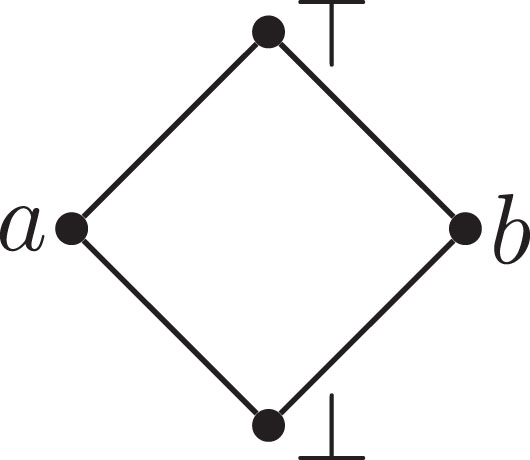
Example 4.13. Let X = {x, y} and L = {⊥ , a, b, ⊤} where a′ = b, b′ = a. The Hasse diagram of L is shown in the following figure:
Take is defined as follows: U1 (x) = a, U1 (y) = b; U2 (x) = b, U2 (y) = a; U3 (x)= a, U3 (y) =⊥; U4 (x) = ⊥ , U4 (y) = a; U5 (x) = ⊥ , U5 (y) = b; U6 (x) = b, U6 (y) =⊥.
By the constructions of L and C, we have J (L) = {a, b} and the set of all L-biconvex sets . It is verify that (X, C) is an S2L-convex space.
Remark 4.14. In [38], the author discusses in detail the related content of separation axioms (T-1, T0, sub-T0, T1 and T2) in L-topological spaces. The separation axioms (S-1, S0, sub-S0, S1 and S2) in L-convex spaces defined here are different from that of L-topological spaces. We use an example to illustrate the difference between T2 and S2. Similarly, the differences between other separation axioms can be illustrated by other examples.
In Example 4.13, take , where V1 and V2 are defined by: V1 (x) = a, V1 (y) =⊥; V2 (x) = a, V2 (y) = b. Then τ is an L-topology on X. (X, τ) is not T2. In fact, for xa, ya ∈ J (LX), there are no P and Q satisfying that x ≠ y with xa≰P and ya≰Q such that . But the L-convex space (X, C) is S2.
Proposition 4.15.AnS2L-convex space is S1.
Proof. Let (X, C) be an S2L-convex space and xλ, yμ ∈ J (LX) with xλ≰yμ. Then we have (yμ) ′≰ (xλ) ′ and (yμ) ′ ∈ LX. It follows that
This means there exists zγ ∈ J (LX) such that zγ ⩽ (yμ) ′ and zγ≰ (xλ) ′. Hence xλ≰ (zγ) ′. Since (X, C) is S2, there exists an L-biconvex set H such that zγ ⩽ H ⩽ (yμ) ′. Hence H′ ⩽ (zγ) ′ and yμ ⩽ H′. By xλ≰ (zγ) ′, we have xλ≰H′. Therefore, (X, C) is S1. □
The following example shows that the converse of Proposition 2o4 is not true.
Example 4.16. Let X = [0, 1] and L = [0, 1] [0,1]. Define U ∈ LX is a convex set if , or , or |supp (U) | < ω and for any x ∈ supp (U), |supp (U (x)) | < ω (considering U (x) ∈ L = [0, 1] [0,1] as a [0,1]-fuzzy set on [0,1]). Let C denote all this kind of convex sets, then C is closed to arbitrary meets and totally ordered joins, so C is an L-convexity on X. For any λ ∈ J (L) = J ([0, 1] [0,1]), λ is a [0,1]-fuzzy point on [0,1], so every xλ ∈ J (LX) is a convex set in (X, C) and (X, C) is S1. For the L-convex space (X, C), it has only two L-biconvex sets and . Therefore, for any xλ, yμ ∈ J (LX) with xλ ⩽ (yμ) ′, we can not find an L-biconvex set H to satisfy xλ ⩽ H ⩽ (yμ) ′. Hence (X, C) is not S2.
Theorem 4.17.If (X, C) is an S2L-convex space and (Y, C|Y) is its subspace, then (Y, C|Y) is S2.
Proof. Let (X, C) be S2 and let xλ, yμ ∈ J (LY) with xλ ⩽ (yμ) ′. Then and . Since (X, C) is S2, there exists an L-biconvex set H such that . It follows that
Hence xλ ⩽ H|Y ⩽ (yμ) ′. By Proposition 2o3, we know that H|Y is an L-biconvex set of Y. Therefore, (Y, C|Y) is S2. □
Theorem 4.18.Let (X, C) be the product space of {(Xt, Ct)} t∈T. If for each t ∈ T, (Xt, Ct) is S2, then so is (X, C).
Proof. Suppose that for each t ∈ T, (Xt, Ct) is S2 and xλ, yμ ∈ J (LX) with xλ ⩽ (yμ) ′, where x = {xt} t∈T, y = {yt} t∈T. Then we have x ≠ y or x = y, λ ⩽ μ′. Case 1: If x ≠ y, then there exists r ∈ T such that xr ≠ yr. It implies (xr) λ ⩽ ((yr) μ) ′. Case 2: If x = y, λ ⩽ μ′, then (xr) λ ⩽ ((yr) μ) ′ for all r ∈ T.
Hence there exists r ∈ T such that (xr) λ ⩽ ((yr) μ) ′. Since (Xr, Cr) is S2, there exists an L-biconvex set Hr such that (xr) λ ⩽ Hr ⩽ ((yr) μ) ′. It follows that
and
Hence and . Since , we have . Hence . By Proposition 2o2, we know that is an L-biconvex set of X. Therefore, (X, C) is S2.□
Next, we consider the problem of the above separation axioms preserved under L-isomorphisms. First, we give the concept of L-isomorphisms.
Definition 4.19. A mapping f : (X, C) ⟶ (Y, D) between two L-convex spaces is called an L-isomorphisms provided that f is an L-CP and L-CC bijection.
The following proposition is obvious.
Proposition 4.20.Letf : (X, C) ⟶ (Y, D) be an L-isomorphism between two L-convex spaces. If (X, C) is Si (sub-S0), then (Y, D) is Si (sub-S0), where (i = -1, 0, 1, 2).
Remark 4.21. The condition that f is an L-isomorphisms is necessary for maintaining the separation axioms between two L-convex spaces. That is to say, if f does not satisfy any of the conditions of L-CP, L-CC and bijection, then these separation axioms will not be maintained under f. We illustrate S0 by the following example. Other separation axioms can be similarly illustrated by examples.
Example 4.22. Let L = [0, 1] and X = {a, b, c}. Take , where U1 (a) =1, U1 (b) = U1 (c) =0; U2 (a) =0, U2 (b) =1, U2 (c) =0; . Then (X, C) is S0.
Consider Y = {m, n} and , where . Define f : X → Y as f (a) = f (b) = m and f (c) = n. It is easy to verify that f is L-CP and L-CC. But (Y, D) is not S0. Since co (mλ) = co (nμ) = V for 0 < λ ≤ 1 and .
Relations between convex spaces and induced L-convex spaces on separations
In [20], Pang and Shi proved that a convex space can induce a stratified L-convex space under the condition that β (a ∧ b) = β (a) ∩ β (b) for all a, b ∈ L. In this section, we discuss the relations between S0, S1, S2 separation axioms of a convex space and sub-S0, S0, S1, S2 separation axioms of the induced L-convex space.
Proposition 5.1. ([20]). Let be a convex space and define as follows:
Then is a stratified L-convexity on X and is a stratified L-convex space.
Theorem 5.2.is sub-S0 if and only if is S0.
Proof. Necessity. Let x, y ∈ X with x ≠ y. Since is sub-S0, there exists such that xλ≰U, yλ ⩽ U or such that yλ≰V, xλ ⩽ V. This means λ≰U (x) , λ ⩽ U (y) or λ≰V (y) , λ ⩽ V (x). Hence x ∉ U[λ], y ∈ U[λ] or y ∉ V[λ], x ∈ V[λ]. Obviously, . Therefore, is S0.
Sufficiency. Let x, y ∈ X with x ≠ y. Since is S0, there exists such that x ∈ P, y ∉ P or such that y ∈ Q, x ∉ Q. Let λ ∈ J (L), then (χP) [λ] = {z ∈ X ∣ (χP) (z) ⩾ λ} = P. This means . Similarly, . Hence xλ≰χQ, yλ ⩽ χQ or yλ≰χP, xλ ⩽ χP. Therefore, is sub-S0. □
Theorem 5.3. is S0 if and only if is S0.
Proof. Necessity. Let be S0 and let x, y ∈ X with x ≠ y. For any λ ∈ J (L), then xλ, yλ ∈ J (LX) and xλ ≠ yμ. Since is S0, it follows that there exists such that xλ≰U, yλ ⩽ U or such that yλ≰V, xλ ⩽ V. Case 1: If there exists such that xλ≰U, yλ ⩽ U, then and λ≰U (x) , λ ⩽ U (y). This means x ∉ U[λ], y ∈ U[λ] . Case 2: If there exists such that yλ≰V, xλ ⩽ V, then . This means x ∈ V[λ], y ∉ V[λ]. Hence is S0.
Sufficiency. Let be S0 and let xλ, yμ ∈ J (LX) with xλ ≠ yμ. Then we have x ≠ y or λ ≠ μ. Case 1: If x ≠ y, then there exists such that x ∈ P, y ∉ P or such that x ∉ Q, y ∈ Q. If the former holds, let U = χP. Then and xλ ⩽ U, yμ≰U. If the latter holds, let V = χQ. Then and xλ≰V, yμ ⩽ V. Hence is S0. Case 2: If λ ≠ μ, then μ≰λ or λ≰μ. Since is stratified, we have . This means or . Hence is S0. □
According to Theorem 5 and Theorem 5, we have the following fact.
Remark 5.4. In general L-convex spaces, S0 is stronger than sub-S0. But in the special L-convex space of Proposition 2ro, S0 and sub-S0 are equivalent.
Theorem 5.5. is S1 if and only if is S1.
Proof. Necessity. Let be S1. For any x ∈ X, λ ∈ J (L), then xλ ∈ J (LX) and we have coL (xλ) = xλ. Hence and . Since , it follows that is S1.
Sufficiency. Let be S1 and xλ ∈ J (LX). For any a ∈ L, since (x⊤) [a] = {y ∈ X| (x⊤) (y) ⩾ a} = {x} or ∅, it follows that . By Proposition 2ro, we know that is stratified, then . Hence . This means coL (xλ) = xλ. Therefore, is S1 .
Theorem 5.6.isS2 if and only if is S2.
Proof. Necessity. Let x, y ∈ X with x ≠ y and λ ∈ J (L). By ⊤ = ⋁ {γ ∣ γ ∈ J (L)} and λ≰⊥, we have λ≰ ⋀ {γ′ ∣ γ ∈ J (L)}. Then there exists μ ∈ J (L) such that λ≰μ′. Obviously, xλ ⩽ (yμ) ′. Since is S2, there exists an L-biconvex set H such that xλ ⩽ H ⩽ (yμ) ′. Hence λ ⩽ H (x) and H (y) ⩽ μ′. It follows from λ≰μ′ that λ≰H (y). This means x ∈ H[λ] and y ∉ H[λ]. For any a ∈ L, H[λ] ∈ C and . By Lemma 2, we have
It is easy to verify that {(H′) [a] ∣ a≰λ′, a ∈ L} is directed. Hence . This means H[λ] is a biconvex set of X. Therefore, is S2
Sufficiency. Let xλ, yμ ∈ J (LX) with xλ ⩽ (yμ) ′. Then x ≠ y or x = y, λ ⩽ μ′. Case 1: If x ≠ y, then there exists a biconvex set P such that x ∈ P and y ∉ P. For any a ∈ L, (χP) [a] = {z ∈ X ∣ (χP) (z) ⩾ a} = P or X and (χP′) [a] = {z ∈ X ∣ (χP′) (z) ⩾ a} = P′ or X. Hence . By χP′ = (χP) ′, we know that χP is an L-biconvex set of X. Hence xλ ⩽ χP ⩽ (yμ) ′. This means is S2.
Case 2: If x = y, λ ⩽ μ′. Since is a stratified L-convex space, it follows that is an L-biconvex set of X. Hence . Therefore, is S2. □
Conclusions
It is well know that separation plays an important role in the study of convex spaces. In the paper, we first introduced the definitions of some low-level separation axioms (S-1, sub-S0, S0, S1 and S2) of L-convex spaces, which is a generalization of the separability of classical convex spaces. Then we provided some characterizations of them and discussed the relationships among these separation axioms with the help of some examples. In addition, the hereditary properties and productive properties of them are also studied. Finally, with the idea that a convex space can induce a stratified L-convex space as mentioned in [20], we discussed the relationships between convex spaces and induced stratified L-convex spaces on some separation axioms. All the concepts and the relevant relationship in the framework of L-convex spaces are shown to be proper generalizations of those in the classical case. Following this paper, we will consider the following two problems in the future.
(1) In the case of L-convex spaces, we will consider the separation of S3 and S4 and study their related properties.
(2) Convex spaces have been generalized to (L, M)-fuzzy convex spaces [33], which can be seen as a broader form of L-convex spaces. Thus, we will consider the separation axioms of (L, M)-fuzzy convex spaces.
Footnotes
Acknowledgement
The authors would like to express their sincere thanks to the anonymous reviewers for their careful reading and constructive comments. This project is supported by the National Natural Science Foundation of China (11871097).
References
1.
BairJ., Separation of two convex sets in convexity spaces and in straight line spaces, J Math Anal Appl49 (1975), 696–704.
2.
BergerM., Convexity, Amer Math Monthly97 (1990), 650–678.
3.
BirkhoffG., KissS.A., A ternary operator in distributive lattices, Bull Amer Math Soc53 (1947), 749–752.
PangB., ZhaoY., XiuZ.-Y., A new definition of order relation for the introduction of algebraic fuzzy closure operators, Int J Approx Reason92 (2018), 87–96.
27.
RosaM.V., On fuzzy topology fuzzy convexity spaces and fuzzy local convexity, Fuzzy Sets Syst62 (1994), 97–100.
28.
ShenC., ShiF.-G., L-convex systems and the categorical isomorphism to Scott-hull operators, Iran J Fuzzy Syst15 (2018), 23–40.
29.
ShenC., ShiF.-G., Characterizations of L-convex spaces via domain theory, Fuzzy Sets Syst (2019). doi:10.1016/j.fss.2019.02.009
30.
ShiF.-G., Theory of Lβ-nested sets and Lα-nested sets and its applications, Fuzzy Syst Math4 (1995), 65–72 (in Chinese).
31.
ShiF.-G., LiE.-Q., The restricted hull operator of M-fuzzifying convex structures, J Intell Fuzzy Syst30 (2016), 409–421.
32.
ShiF.-G., XiuZ.-Y., A new approach to the fuzzification of convex structures, J Appl Math (2014), Article ID 249183.