



Abstract
In this paper, we consider the problem of determining the optimal production quantity under uncertainties. The treated problem has a critical effect on the achievement of business goals, which further propagates to the competitive advantage of manufacturing company. The considered problem is stated as the fuzzy linear programming task. The objective function is defined as the maximization of all profit over the time period. The set of constraints consists of constraints deriving from the enterprise (available capacities) and from the market (demand). The fuzzy rating coefficient values of objective function of each pair of the considered products are described by linguistic expressions which are modelled by triangular fuzzy numbers. Handling of uncertainties of the stated fuzzy pair-wise comparison matrix is performed by using the extent analysis. The right-hand-side values of the capacity constraints are determined by decision makers and modelled by the triangular fuzzy numbers. The market constraint values are given according to evidence data. Determination of the optimal quantities of considered products for each time period is based on the concept of equal possibilities. The proposed model is illustrated by an example with real-life data.
Introduction
In today’s highly changing and competitive business environment where manufacturing firms are operating, production managers are focused on defining new management strategies and enhancement of production processes. The most important prerequisite for defining an adequate improvement of management strategy is a clear understanding of production process quality [27]. The application of these strategies should enable sustainability in the long-time period, on one hand, and at the same time reduction of losses that may occur in the manufacturing process such as overproduction, inventory, unnecessary waiting, etc. Based on production management practice, it is well known that determining the optimal production plan is one of the most important management strategies. That is the reason why the considered problem has become an important research field for both industry and academia in the last decades.
The optimal production plan should be determined in such way that its accomplishment earns the largest profit respecting the constraints which include: fulfillment of customer demands and utilization of manufacturing equipment capacity. The type of objective function and the number of constraints determine the choice of the optimal production plan to be made by the production managers. The problem thus set can be solved by applying the exact optimization methods. A widely used method is Linear Programming (LP), analogous to [10].
The problem becomes significantly more complex if we introduce the assumption, a realistic one, that the considered parameters of LP task are not measurable. It seems as a more realistic approach to use linguistic assessments instead of numerical values. The uncertain and imprecise parameter values could be described by linguistic variables introduced by [24]. Modelling of uncertain and imprecise parameters and constraints could be based on fuzzy sets theory [12, 19].
Under conditions of rapid and permanent changes taking place in the environment it is realistic to introduce the assumption that some parameters are described by uncertain numbers. In these cases, a real-world problem should be formally stated as a fuzzy LP (FLP) with uncertain parameters. In the literature [3], the FLP models could be classified in the following six groups, with the FLP problems involving: (1) fuzzy numbers for the decision variables and the right-hand side of the constraints, (2) fuzzy numbers for the coefficients of the decision variables in the objective function, (3) fuzzy numbers for the coefficients of the decision variables in the constraints and the right-hand side of the constraints, (4) fuzzy numbers for the decision variables, the coefficients of the decision variables in the objective function and the right-hand side of the constraints, (5) fuzzy numbers for the coefficients of the decision variables in the objective function, the coefficients of the decision variables in the constraints and the right-hand side of the constraints, and (6) the so-called Fully FLP (FFLP) problems that involve fuzzy numbers for the decision variables, the coefficients of the decision variables in the objective function, the coefficients of the decision variables in the constraints and the right-hand side of the constraints. It is known that the crisp number can be presented as a fuzzy number [12], so it can be considered that the first five types of LP problems are special cases of FFLP.
Solving the FLP problem includes two main problems, feasibility and optimality, and therefore it is necessary to answer two questions: (1) How to define the feasibility of a decision vector x, when the constraints involve fuzzy numbers? (2) How to define the optimality for an objective function with fuzzy coefficients? Many new methods are introduced into the FLP model that allow the FLP to fit into the real world as much as possible.
This method is widely used to solve different problems in many research areas, for instance, in food industry [5], gas industry [9], recycling domain [14, 15], transportation domain [31], etc.
In this paper, an assessment of the parameters of objective function is stated by the fuzzy pair-wise comparison matrix (analogous to fuzzy Analytic Hierarhical Process) (FAHP). The FAHP method has been widely used in different research areas. The elements of this fuzzy matrix are described by type-1 triangular fuzzy numbers (TFNs), analogous to [37]. Handling of uncertainties of FAHP is performed by using the extent analysis method developed in [16].
Motivation for this research was inspired by the fact that there are no research papers that treat combining the FLP and some other method. In practice, the values of uncertain parameters should be obtained by using appropriate methods, such as experts’ opinion [21, 34], statistical methods [29], FAHP, etc. In this paper, the considered problem can be divided into two phases. In the first phase, the values of coefficients of the objective function are determined using the FAHP. In the second phase, the optimal solution of FLP is found. It can be assumed that the obtained solution given by applying mentioned methods is burdened to some extent by subjective opinions of decision makers.
The paper is organized in the following way. Section 2 gives an overview of the proposed FLP models. The methodology used is presented in Section 3. The proposed algorithm is described in Section 4. An illustrative example with real-life data is shown in Section 5. Conclusions are presented in Section 6.
Literature review
Determining the flow material in different domains should be stated as FLP which, according to the classification given in [3], can be arranged in the first five groups. These problems are solved using different methods. The papers are analyzed below.
Tadić et al. [15] considered the problem of determining the optimal flows of waste in the reverse supply chain. The objective function is maximization of the overall profit which is calculated as income generated by selling the recycled products reduced by costs driven by the waste storage, recycling itself and purchasing costs. Capacity availability of recycling equipment and availability of waste in the treated time period present the constraints of the proposed FLP. The coefficients of the objective function are assessed by decision makers and modelled by TFNs. The optimal flow of waste is obtained by applying the concept of equal possibilities and described by fuzzy numbers. The problem of determining the optimal production quantities in food industry [5] and poultry industry [9] is stated as FLP with uncertain right-hand sides. These authors suggest that all existing uncertainties should be adequately described by TFNs. The optimal solution is given using Zimmermann’s procedure [8]. The determination of the optimal flows in the reverse supply chain is formally described by bi-linear fuzzy model in [14] (analogous to [10]). The objective function is defined as maximization of the net profit before tax paying. The constructed constraints are related to market conditions and total recycling cost. The total cost incorporating bi-linear term is denoted as multiplication of the material flow and price transfer. The right-hand-side values of constraints are described by the TFNs. The reformulation of the proposed model is performed by approximation as suggested in Vidal and Goetschalckx [10]. The optimal flows are found applying the optimality principle [23]. In [1] the problem of assessment and optimization of natural supply chain is stated as a multi-objective multi-period FLP. The first and second objective function, respectively, is related to minimizing the economic costs in the entire supply chain and the costs of greenhouse emissions across the supply chain, respectively. The set of constraints consists of the percent of the constraints of fulfilling various customer demands, input/output balance and assurance of the continuity of gas flow in the supply chain. The coefficients of the objective function and righ-hand sides are described by type-1 TFNs. The FLP proposed in this paper is converted into LP in such way that all existing uncertainties were replaced by their extended values (analogous to probability approach). The optimal solution can be obtained using the simplex method. Ebrahimnejd and Tavana [3] analyzed FFLP with uncertain coefficients of the objective function and the values of the right-hand side are represented by symmetric trapezoidal fuzzy numbers, whereas the elements of the matrix are described by real numbers. Each fuzzy number in the considered FLP was replaced by its rank. In this way, the stated FLP is converted into equivalent crisp LP. Solving the obtained LP problem is based on a standard method. As it is known, the solution of LP problem is crisp. Authors used the relation between the crisp and fuzzy problems to obtain a fuzzy solution for the considered FLP. Jimènez et al. [25] propose a new method for finding the optimal solution of FLP with fuzzy parameters. The proposed method is realized through two steps. In the first step, all fuzzy coefficients of the objective function are replaced by their expected values and they are crisp. The constraints of the considered FLP with fuzzy coefficients matrix and fuzzy right-hand sides are transformed into linear inequalities by using the procedure for comparing two fuzzy numbers, as presented in [26]. In this way, the considered FLP is converted into LP with parameter α. By using the simplex method, the α acceptable optimal solution is found. The values of decision variables are crisps and the objective function value depends on the values of α and are described by TFNs. In the second step, the degree of satisfaction of the fuzzy goal by each α acceptable optimal solution is computed. A reasonable solution is the one that has the biggest membership degree to this fuzzy subset. Bhatia and Kumar [30] considered the FFLP problem with fuzzy parameters modelled by LR flat fuzzy numbers and crisp decision variables. The stated FLP is transformed into FLPA where decision variables are also modelled by non-negative LR flat fuzzy numbers. The objective function and the set of constraints of the FLPA are given according to the fuzzy algebra rules [12]. By using the ranking index [35], the FLPA is converted into LP. The optimal solution of given LP can be calculated using the simplex method. The fuzzy optimal solution of the FLP is found by applying the procedure developed in this paper.
Some papers introduce the assumption that all parametric and decision variables have imprecise values and should be described by fuzzy numbers. According to [3], such problems are referred to as fully FLP and are denoted as FFLP. Furthermore, some FFLPs will be described in brief. Lofti et al. [18] discuss FFLP of which all parameters and decision variables are the asymmetric fuzzy triangular numbers converted into crisp values by applying special defuzzicated procedure. When applying the lexicography rule, the considered problem is converted into two LP models. The objective function of the LP is defined as the maximization for the Center of the treated FFLP. The second LP problem has formal presentations as Fuzziness problems. By applying special ranking to fuzzy numbers, the stated FFLP transforms to MOLP. In [33] the treated FFLP problems, all uncertain parameters, as well as decision variables are described by type-1 TFNs. This model is transformed into the multi-objective linear programming model (MOLP) from the given FFLP. The constructed MOLP can serve decision makers by providing an appropriate best solution to a variety of LP models having fuzzy numbers and decision variables in a simple and effective manner. By using the procedure [32] an efficient solution of the MOLP can be produced. The author proved in this paper that the obtained solution of MOLP yields an optimal fuzzy solution to the FFLP. Najafi et al. [36] proposed a new method for solving FFLP with non-negative and unrestricted decision variables and uncertain parameters. All uncertainties are modelled by TFNs. The proposed procedure can be realized through the following steps briefly presented as follows. Firstly, FFLP is written according to recommendations given in [4, 36]. After that, all TFNs are represented by crisp values which are defined according to the ranking method [4, 36], so that the non-linear programming problem is obtained. The solution of the non-linear programming model presents lower, modal and upper bounds of decision variables. In other words, the optimal fuzzy values of decision variables can be formed. Integrating these values into the objective function, its optimal value is given and TFNs are described.
Many authors suggest that solving real problems should be based on making novel approaches that combine two or several conventional or modified methods [2, 39]. It should be noted that the conventional AHP method [38] is based on 4 axioms. Check for consistency is performed using the eigenvector method. In fuzzy pair-wise comparison matrix, the elements cannot be considered reciprocal relative to the main diagonal, nor is there a developed procedure for checking its consistency. Regardless of these shortcomings, when decision makers do not have enough information on the parameters considered, or information changes rapidly, many authors consider that known FAHP framework is very suitable to use. There are many papers [17] where mentioned shortcomings of the FAHP method are reduced in such way that improved FAHP method can be employed to determine priorities of the considered variables, which can be obtained using the extent analysis procedure [16].
The proposed model
This paper considers the problem of determining the optimal production quantity in the manufacturing company. Formally, all products can be represented by a set of indices ι ={ 1, . . . , i, . . , I } where I is the total number of products of the production program, and i is an index for product i, i = 1, . . , I. Final products are created through different technological processes that are realized in different organizational units. These organizational units are formally represented by a set of indices η ={ 1, . . . , j, . . , J }. The overall number of organizational units is denoted by J and j, j = 1, . . , J is an index for organizational unit. The demand for final products stemming from the market has considerable influence on determining the volume of production for each kind of product in the considered product range. In a general case, the overall number of organizational units stemming from the market can be formally represented by a set γ ={ 1, . . . , k, . . , K }. The overall number of market constraints is denoted by K and k, k = 1, . . , K is an index of market constraint.
The objective function is defined as maximization of the overall profit over the considered time-period. In practice, the overall profit depends on the values of unit profits of the considered products and their production range. Due to rapid and frequent changes in product demands, as well as changes developing in the enterprise, it is almost impossible to precisely determine the values of unit profits respecting evidence data.
Consequently, in this paper, the relative significance of the unit profits of each pair-wise product was determined based on decision makers’ assessments. It is much closer to human reasoning than direct assessment, analogous to the Analytic Hierarchy Process (AHP) framework. Handling of uncertainties in the fuzzy pair-wise comparison matrix of the relative values of the product unit profits can be performed in different ways [16, 22]. These approaches have some advantages and disadvantages that are presented in [7]. The approach developed by Chang [16] is easy to understand, is simple and does not require complex mathematical calculations. Also, the advantage of this approach is that it follows the steps of crisp AHP and does not involve additional operations. The main disadvantage of extent analysis method is that it allows use of triangular fuzzy numbers only. It can be said that when uncertainties can be well enough represented by TFNs, then Chang’s method can be used. In the literature, this method is most commonly applied. In this paper, the calculation of normalized unit profit value is based on the approach developed in [16]. Based on introduced assumptions, the objective function can be stated as a linear combination of normalized values of the unit profits and quantity of the product.
The available capacities of each organizational unit can be defined based on the predicted number of operational manufacturing equipment and engaged workers. On the basis of evidence data for the age of equipment, manner of equipment maintenance, conditions of working environment, as well as seasonal changes that may affect workers, decision makers assess the available manufacturing capacity. The second group of constraints stems from the market, The demand for each kind of product from the product range is monitored monthly.
Respecting all introduced assumptions, the problem considered can be set as a FLP problem with fuzzy coefficients of the right-hand sides. The optimal solution of this problem is obtained using the concept of equal possibilities. By applying the proposed model, the optimal production quantity of each kind of product can be determined. In this way, production manager can monitor change in the quantity of each kind of product manufacturing over the time period. In accordance with the obtained results, the manager should take appropriate measures to improve utilization of the capacities or take measures in the marketing domain that would lead to increased demand for product. Such measures would lead, at the same time, to increased overall profit of the manufacturing firm, which represents one of the most important business goals.
Notation
To make the reading of the proposed model easier, the notation is introduced:
I total number of considered products
i index of product, i = 1, . . , I
J total number of constraints stemming from manufacturing firm
j index of constraints stemming from manufacturing firm, j = 1, . . , J
K total number of constraints stemming from the market
k index of constraints stemming from the market, k = 1, . . , K
c i represents normalized unit profit value of the product i, i = 1, . . , I; this is crisp value of the coefficient of the objective function
a ij represents product processing unit time i, i = 1, . . , I in the organizational unit j, j = 1, . . , J; it is crisp value of the coefficient right next to a basic variable in the constraints of the first group.
Q k is the value of demand for the considered products; it is crisp number describing the value of right-hand side of the constraint k, k = 1, . . , K-.
Modelling of uncertainties
Uncertainties in the unit profit value and capacities value of the organizational unit were obtained based on decision makers’ assessments. Fuzzy sets theory [12, 19] allows the existence of thse uncertainties to be described quantitatively well enough. Improvement in the management of different meanings of words for different people can be achieved by using the type-2 fuzzy sets, hesitant fuzzy linguistic terms [6, 11]. The main disadvantage of using these types of fuzzy sets for modelling of uncertainties is that they require complex mathematical computing. On the other hand, uncertainties of words cannot be captured sufficiently well by using the type-1 fuzzy sets but, at the same time, their use is easy and simple.
Determination of normalized unit profit values
Unit profit values of the considered products are stated by fuzzy pair-wise comparison matrix. The elements of this matrix are defined according to the unit profit value of the product and according to the product i′, i, i′ = 1, .., I; i ≠ i′. These values are described using the pre-defined linguistic expressions, which are modelled by TFNs,
If product i′ has higher value of the unit profit over product i, it holds then that the pair-wise comparison scale can be represented by the fuzzy number
In this paper, the fuzzy rating of decision makers can be described by seven linguistic expressions: very low value (VL), low value (L), moderately low value (ML), medium value (M), moderately high value (MH), high value (H), and very high value (VH). These linguistic expressions are modelled by TFNs which are given as follows:
VL = (1, 1, 5.5), L = (1, 1, 9), ML = (1, 3, 5), M = (2.5, 5, 7.5), MH = (5, 7, 9), H = (1, 9, 9), and VH = (4.5, 9, 9).
Due to the turbulent changes taking place in the environment and the changes that can occur in the enterprise, decision makers are not able to make accurate assessments. Therefore, there are large overlaps of TFNs with which the pre-defined linguistic expressions were modelled. These TFNs are shown in Fig. 1.
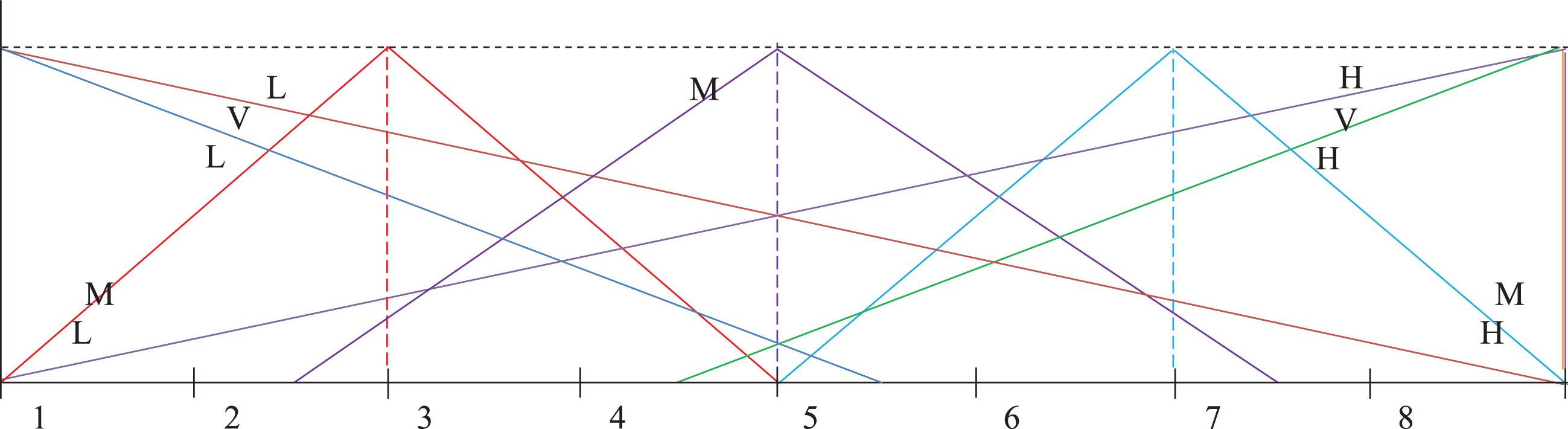
The TFNs describing the relative unit profit values.
Normalized unit profit value vector of the considered products is calculated by applying the concept of extent analysis [16].
The value of fuzzy synthetic extent with respect to the i-th product is defined as:
The degree of belief that unit profit of product i, i = 1, . . , I is greater than unit profits for the rest of products from the product range can be set as a task of determining the degree of belief that TFN
The unit profits vector is represented as:
After normalizing C
p
, we get the normalized weights vector C:
The vector C is a non-fuzzy number and the values of this vector represent normalized unit profit values of the considered products.
The values of available capacity are based on decision makers’ assessments. Formally, their assessments are modelled by TFNs,
The demand deriving from the market of the enterprise’s considered products was obtained based on evidence data and it is crisp.
The proposed algorithm
The proposed model can be realized through several steps presented as follows.
Step 1. Let the fuzzy pair-wise comparison matrix of the relative value of the unit profit,
Step 2. The fuzzy pair-wise comparison matrix is transformed into pair-wise comparison matrix, [V
ii
′
]
IxI
. The element values of this matrix present the representative scalars of the TFNs,
Step 3. The normalized unit profit values vector, C = (c1, . . , c i , . . . , c I ) is calculated by extent analysis [16].
Step 4. Capacity availability of each organizational unit was determined based on decision makers’ assessment and overall demand according to evidence data.
Step 5. The FLP is stated:
Objective function:
Subject to : : : x
i
⩾ 0, i = 1, . . , I
Step 6. The application of the concept of equal possibilities enables the determination of the optimal production quantity for each product, as well as the value of the objective function. For each α, the value of optimal solution is defined, applying the LINDO program.
Step 7. The optimal quantity of each considered product is crisp and presents representative scalars obtained in the preceding step. The defuzzification procedure is given by using the moment method [12].
Step 8. On the basis of obtained values, the management team makes a decision about which improvement measures should be taken.
Illustrative example
The problem dealt with in this paper involves determination of the optimal production quantity for six different types of water meters in one plant in the Republic of Serbia. Manufacturing of each type of water meter is accomplished through manufacturing operations, organized in different organizational units, such as: assembly of mechanical gears (j= 1), manufacturing of mechanism casing (j= 2), manufacturing of propeller casing (j= 3), propeller manufacturing (j= 4), mask casting (j= 5), assembly of water meter mechanism (j= 6), glass manufacturing (j= 7) and water meter assembly (j= 8). Unit time of each manufacturing operation duration is defined according to the designed technology.
By applying the proposed algorithm (Step 1), fuzzy rating of the unit profit relative value is given according to the proposed Algorithm:
The pair-wise comparison matrix of the relative value of the unit profit of product is given according to the proposed algorithm (Step 2).
According to the obtained coefficient of consistency, it can be said that mistakes made by decision makers in assessing the relative value of unit profit of the considered products are acceptable.
The procedure of determining the normalized unit profit values of products vector is further presented (Step 3 of the proposed algorithm).
Likewise, the value of fuzzy synthetic extent with respect to other products is given:
Unit profit values vector is presented as:
The normalized unit profit values vector W:
According to Step 4 of the proposed algorithm, the available capacity of each manufacturing operation is determined using evidence data and current information. In this example, the values of available capacities of each manufacturing operation are described by means of triangular fuzzy numbers:
Demand is monitored monthly. Values of demand for each kind of product in the previous time period is given in Table 1.
Number of orders for each type of water meter throughout previous year
Number of orders for each type of water meter throughout previous year
The fuzzy LP model is illustrated by real data from the first quarter (Step 5 to Step 7 of the proposed algorithm).
max 0.101x1 + 0.006x2 + 0.093x3 + 0.197x4 +
0.249x5 + 0.354x6
st
3.5x1 + 3.5x2 + 3.5x3 + 7x4 + 7x5 + 7x6< =
(23100,46200,92400)
0.66x1 + 0.66x2 + 0.66x3 + 1.5x4 + 2x5< =
(9240,18480,27720)
1.16x1 + 1.16x2 + 1.16x3 + 1.5x4 + 2x5 + 6x6< =
(9240,27729,27720)
0.66x1 + 0.66x2 + 0.66x3 + 1.5x4 + 1.5x5 + 2.5x
6< =(9240,18480,27720)
0.66x1 + 0.66x2 + 0.66x3 + 0.75x4 + 0.75x5 +
1.33x6< =(9240,18480,27720)
0.5x1 + 0.5x2 + 0.5x3 + x4 + x5 + x6< =(13860,
27720,55440)
x1 + x2 + x3 + x4 + x5x+3x6< =(9240,18480,
27720)
3.72x1 + 3.72x2 + 3.72x3 + 5.45x4 + 6.25x5 +
50x6< =(25344,31680,63360)
x1 + x2 + x3 + x4 + x5 + x6< =7745
The optimal product quantities of considered products for the first quarter is (0,0,0,0, 5608.9,46.7). At such manufacturing level the profit earned is 1400.8. By applying the proposed fuzzy LP model at the level of the rest of quarters, it can be said that the results obtained are analogous to those obtained at the first quarter level.
The obtained results lead to the conclusion that production plan contains only products p = 5 and p = 6. Optimal quantities of these types of water meters are shown in Figs. 2 and 3.

The optimal quantity for product p = 5 at the level of each quarter.
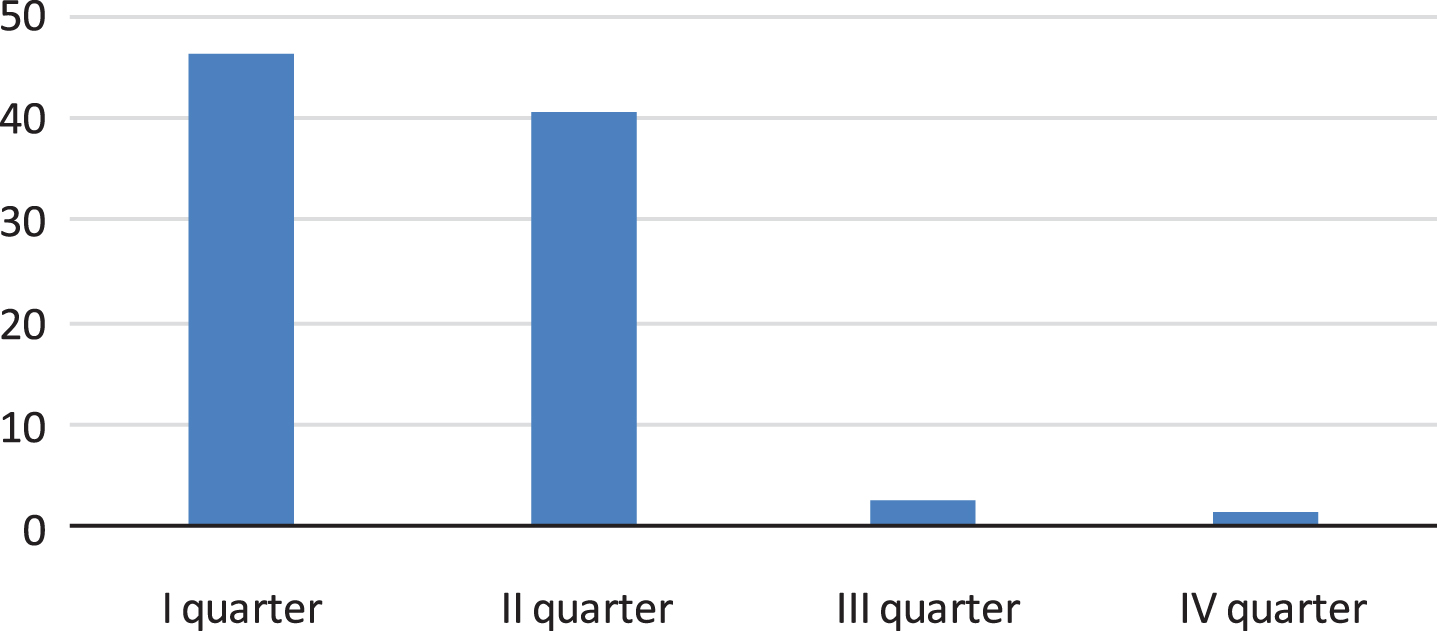
The optimal quantity for product p = 6 at the level of each quarter.
According to Step 8, summing up the results, it can be readily concluded that product (p = 5) is the most important for production and sales management of considered enterprise. The optimal quantity of the treated product is such in the first and fourth quarter. This information is significant for both production manager who should use it to make preparations for production and for sales manager who should make a sales plan. The obtained optimal quantity of this product is significantly smaller in the second and fourth quarter than in the analyzed quarters. Respecting the obtained results, production manager should take appropriate measures that will lead to the utilization of manufacturing equipment over those time periods. In this way, business operating costs are significantly reduced, while the enterprise’s profit and competitiveness are increased at the same time.
The optimal product quantity (p = 6) obtained by applying the developed FLP is significantly lower than for the product (p = 5). Based on the results (Fig. 3), it can be concluded that in the first two quarters a significantly larger quantity of this product should be manufactured than in the last two quarters. This result indicates that manufacturing equipment capacities and work force capacities will be significantly better utilized in the first two quarters. In case that the enterprise does not have enough capacities or work force the manager is required to take measures that would provide the accomplishment and continuity of product (p = 6) manufacturing. Some of the measures imply production re-engineering and better organization of workers at their work places (extension of work, job rotation, and the like).
The application of the proposed FLP allows for the product range in this enterprise’s production program to contain above analyzed products. According to the obtained results, the enterprise management should think whether to change the production program or to take measures for product quality improvement. The choice of measures is based on the cost-benefit analysis and can be considered as a task in itself.
The results presented in Fig. 4 indicate clearly that the enterprise earns the largest profit in the first quarter. Also, the profit earned in the second and third quarter is slightly smaller but not significantly smaller than the profit from the first quarter. In other words, it can be said that the profit of the enterprise is stable in the first three quarters. In the fourth quarter, the earned profit is significantly smaller than in the previous quarters. This information is of relevance for the enterprise management in planning investment projects.
In this paper, a fuzzy linear programming model for determination of the optimal production plan is proposed. The quantity of each kind of product from the production plan is defined as the decision variable. The objective function is defined as linear combination of decision variables. The coefficients of objective function are defined as the relative unit profit. As it is impossible to determine the value of unit profit precisely enough, the fuzzy pair-wise comparison matrix of the relative importance of the unit profits is stated. The coefficients of the objective function are given by extent analysis [16]. The constraints are stemming from available capacity of the enterprise and demand for treated products are deriving from the market. These constraints are defined by using linear inequality. The right-hand sides of defined linear inequality are described by uncertain or crisp numbers. The local solutions may be found by the procedure based on the concept of equal possibilities.
The main contributions of the proposed model are: (1) all existing uncertainties can be described by TFNs, and (2) all changes in a) number of products, b) numbers and/or values of constraints, c) relative importance of considered products unit profit can be easily incorporated into the model.
The main limitation of the proposed model is that it can define optimal product quantity to be manufactured in each time period but it cannot determine exactly how much profit will be earned with such production plan in effect. Another limitation of the proposed model is that it does not take into account non-monetary effects on the overall business of the enterprise such as relationship with stakeholders, partnership and interconnections with the environment. Sometimes, these non-monetary properties have very significant impact on decision making process.
The future research should focus on comparing the optimal production plans, which were obtained by applying various heuristic methods such as genetic algorithm, local search, etc.