



Abstract
The traditional Human Factor Analysis and Classification System (HFACS) model has been regarded as one of the most widely used and effective human error accident analysis approaches. However, current HFACS models are insufficient to address accident analysis problem with the high uncertain risk information and inconsistent behavioral preferences. The aim of this paper is to develop an extended HFACS based risk analysis method for human error accident based on interval type-2 fuzzy sets and prospect theory. Firstly, the interval type-2 fuzzy sets are used to express the uncertain evaluation information in the risk analysis process. Secondly, prospect theory is utilized to depict the different risk preferences of experts under uncertain environment. Next, the ordered weighted averaging (OWA) operator for interval type-2 fuzzy number is combined with prospect theory to calculate risk priorities of risk factors. Specially, a ranking method based on possibility mean and variation coefficient is proposed to compare interval type-2 fuzzy numbers. Finally, an illustrative example in marine industry is selected to demonstrate the application of the extended HFACS based risk analysis method. The comparison analysis indicates that the proposed model can achieve relatively reasonable and objective risk evaluation results.
Introduction
Human error accident is considered as one of the most frequent accidents in numerous fields [1]. Systematic analysis and evaluation of the potential influencing factors and cause mechanism of accidents are the critical ways to prevent and avoid similar human error accidents. Accordingly, a large number of accident analysis approaches have been proposed, such as AcciMap model [2, 3], Human Factors Analysis and Classification System (HFACS) method [4, 5], human reliability analysis method [6, 7] and human error assessment and reduction technique (HEART) [8, 9]. Among these approaches, HFACS model has been regarded as one of the most widely used and effective human error accident analysis tools since its high reliability and robustness [10–14]. Although the HFACS model is useful to conduct accident analysis, it is insufficient to address the risk analysis problem in potential human error accidents. However, risk analysis for potential accident cause is an important basis for potential accident prevention [2]. In such case, how to combine the risk analysis method with HFACS model to perform risk analysis of potential human error accidents is a key procedure for accident prevention.
In practice, the traditional HFACS model is insufficient to express high uncertain information in human error accident analysis because information about the accident factors (AFs) are rare crisp numbers in complex systems. Therefore, the fuzzy sets and their extended versions have been proposed to deal with the uncertain information, such as type-1 fuzzy sets [15], interval-valued fuzzy rough numbers [16], hesitant fuzzy numbers [17] and intuitionistic fuzzy numbers [18–20]. At present, the fuzzy HFACS models have been recognized as an effective method to improve the performance of traditional HFACS model (see, for instance, Celik and Cebi [15], Soner, et al. [21], Chiu and Hsieh [22], Zhan, et al. [23], Zarei, et al. [24]).
The type-1 fuzzy sets have been widely adopted to HFACS model. Nevertheless, these linguistic expressions with the help of the type-1 fuzzy sets are not sufficiently clear and precise. Compared with the type-1 fuzzy sets, the membership of type-2 fuzzy sets are type-1 fuzzy sets whereas the membership of the type-1 fuzzy sets are crisp numbers [25, 26]. Hence, the type-2 fuzzy sets involve more uncertainties and depict the uncertain information more sufficiently than the type-1 fuzzy sets. The type-2 fuzzy sets have been widely applied into many real fields [27–29]. However, no research combines type-2 fuzzy sets with HFACS model to address risk identification and evaluation problems. In addition, the interval type-2 trapezoidal fuzzy set, as a special kind of interval type-2 fuzzy set, is the most widely used style of type-2 fuzzy sets [30, 31].
In general, the key accident factors identification procedure in HFACS model includes multiple influence factors. Therefore, the factors identification process in HFACS method can be recognized as a multi-criteria decision making problem. In such case, a large number of multi-criteria decision making approaches have been introduced to extend the traditional HFACS model. For instance, Runkler, et al. [31] reported a new risk assessment framework in HFACS, in which the analytic hierarchy process and fuzzy TOPSIS were introduced to evaluate the importance of human factors. According to the reference [32], analytic hierarchy process method was combined with HFACS to investigate the influencing factors of coal mine accidents in China. Xia, et al. [33] extended the conventional HFACS framework by incorporating Bayesian-network to analyze the potential influencing factors and to evaluate safety performance in the construction projects. Meanwhile, Zhang, et al. [34] incorporated the fault tree analysis method into the HFACS model for the identification regarding the relevant risk factors of ship collision accidents in ice-covered waters.
On the other hand, the accident factors identification process should be conducted with the help of a group of experts. In addition, the preferences of each expert are always different, which should be considered in this process. According to the existing literature [35–37], the prospect theory has been recognized as an effective method to depict the behavior and preferences of decision makers. Hence, the prospect theory has been widely applied into risk evaluation problems. For instance, Qin, et al. [38] applied the prospect theory to capture the behavior factors of decision makers in a high-tech risk evaluation. Zhang, et al. [39] adopted the prospect theory to depict the psychological behaviors of decision makers in a barrier lake emergency decision process. Xu, et al. [40] utilized the prospect theory to describe the preference information of large-group members in a liquefied gas tanker explosion event. Song and Zhu [41] extended the prospect theory to model reference dependence of experts in multi-stage risk decision-making problems.
In light of the discussion mentioned above, we find that the existing research have the following deficiencies: Although, current HFACS models can be used to conduct accident analysis, it does not take the risk evaluation procedure into account. This may lead to an unreasonable analysis result. The interval type-2 fuzzy sets are not considered in the HFACS model for risk analysis of human error accident with the under high uncertain environment. Despite the prospect theory has been widely used in the risk assessment problem, the combination of prospect theory and HFACS model are not considered in the human error accident risk problems.
Therefore, we propose an extended HFACS based risk analysis method in human error accidents. The novelty and contributions of the proposed HFACS method can be summarized as follows: The proposed HFACS model not only can conduct accident analysis, but also can conduct risk analysis. The interval type-2 trapezoidal fuzzy numbers are applied in HFACS to depict the uncertain information for risk analysis in human error accident, which can avoid the loss of valid data. The prospect theory is incorporated into the HFACS model to reflect the different risk preferences and bounded rational characteristic of experts, which can utilize risk information sufficiently and obtain the realistic results. An information aggregation method is proposed to calculate risk priorities of risk factors, in which the ordered weighted averaging (OWA) operator for interval type-2 fuzzy number is combined with prospect theory, which can achieve a relatively reasonable and objective risk evaluation result.
The rest of this paper is organized as follows: Section 2 mainly introduces the basic concepts of the traditional HFACS model, interval type-2 trapezoidal fuzzy sets and prospect theory. Section 3 introduces the extended HFACS model and specific procedures. In Section 4, an illustrative example is utilized to verify the validity of the proposed HFACS model. Section 5 provides the conclusions and future research directions of this paper.
Preliminaries
In this section, we briefly recall some basic concepts of the traditional HFACS model, interval type-2 trapezoidal fuzzy sets and prospect theory, which will be utilized in the subsequent sections.
The traditional HFACS method
The traditional HFACS method, initially proposed as a schematic tool to investigate and analyze accident causes, is extended through incorporating human factors in Swiss cheese model. The HFACS model provides an organizational framework for accident analysis [4]. In the traditional HFACS framework, human errors are divided into four categories, unsafe acts, preconditions for unsafe acts, unsafe supervision, and organizational influence [5], is shown in Fig. 1. This framework also indicates the accident causation mechanism. According to Fig. 1, the category of “unsafe acts” mainly focuses on accidents. The behavior of operators that directly lead to errors in human error accident analysis processes are described. For example in decision errors, lack of valid information, professional knowledge, and experience may cause decision errors.
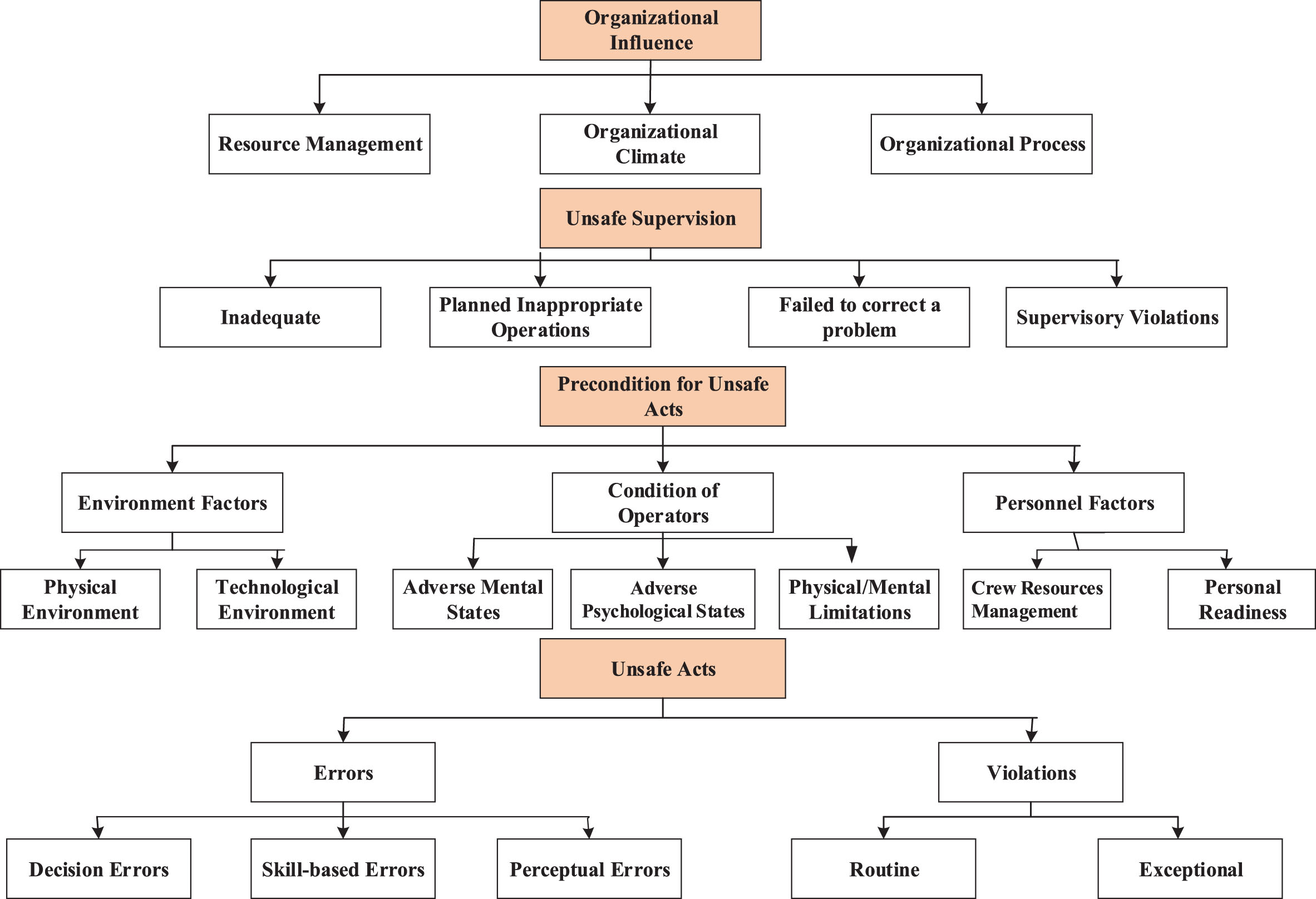
The framework of HFACS.
Where J
x
denotes an interval in [0, 1]. Moreover, the type-2 fuzzy set can also be expressed as follows:
Where J x ⊆ [0, 1] is the primary membership at x, and ∫u∈J x μ A (x, u)/u indicates the second membership at x. For discrete space, the symbol smallint is replaced by ∑.
In which, all of the numbers

The graphical representation of an interval type-2 fuzzy set.
Then, the arithmetic operations of Addition operation Subtraction operation Multiplication by crisp number operation
Prospect theory, initially proposed by Kahneman [35], is used to depict the behavioral preferences of decision makers under risk environment. In light of reference [45], the psychological behavior shows the risk-averse tendency to gain and the risk-seeking tendency to loss. Therefore, a value function is introduced in the prospect theory to measure the degree of gains and losses. The deviations from the reference points can be used to define the value function, which is expressed as concave and convex S-shape for gains and losses. It can be shown in Fig. 3.
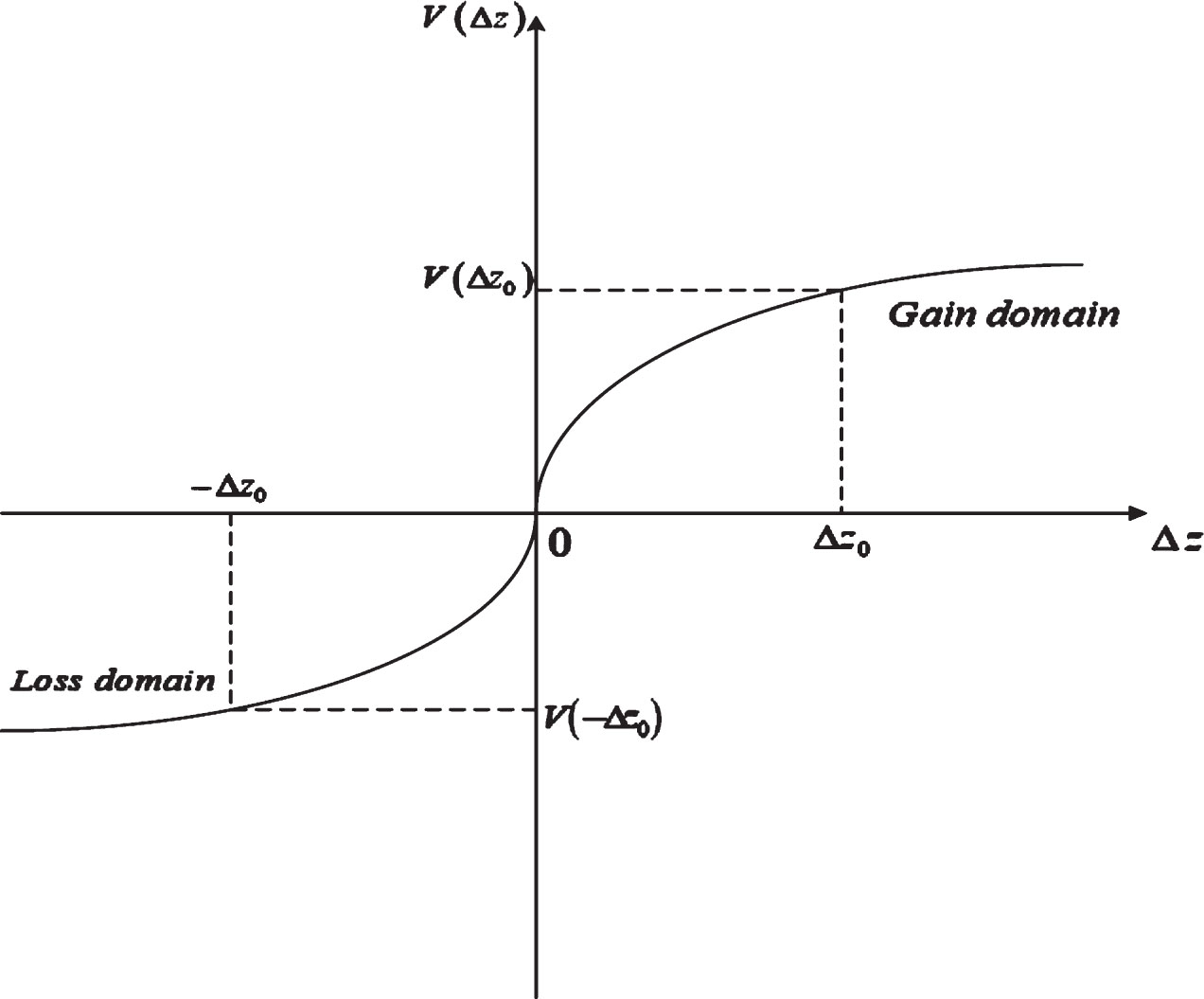
A value function of prospect theory.
From Fig. 3, Δz i = z i - z0 is utilized to express the value of gain or loss relative to the reference points. If Δz i ≥ 0, it stands for the gain relative to reference point. If Δz i < 0, it means the loss relative to reference point. The mathematical expression of the value function in prospect theory is denoted as follows.
In which, the parameters α and β reflect the risk attitude of decision makers, and 0 < α < 1, 0 < β < 1. The coefficient θ is the risk loss aversion coefficient of decision makers. If θ > 1, it indicates loss aversion. According to literature and experiments, the value of parameters can be set as α = β = 0.88 and θ = 2.25.
In this section, an extended HFACS method is developed to identify and rank risk factors. Firstly, risk factors are identified by HFACS model. Then, evaluation information of experts is expressed as linguistic terms, which is further transformed into interval type-2 trapezoidal fuzzy numbers. Secondly, prospect theory is utilized to depict the risk preferences of decision makers in the evaluation process. Finally, the final risk values are calculated by combining OWA operator with prospect values (PVs) of each risk factor. Moreover, risk priorities ranking order can be achieved based on final risk values. The flowchart of this hybrid framework is shown in Fig. 4.

The flow diagram of the proposed HFACS model.
In this subsection, firstly, accident factors can be identified by the traditional HFACS model. Then, risk scores of these accident factors under each risk factor are provided by experts in the form of linguistic terms. Next, linguistic terms are transformed into the interval type-2 trapezoidal fuzzy numbers. Finally, an aggregation matrix of evaluation information given by experts is constructed. The specific steps are shown as follows.
The first step of the proposed HFACS model is to recognize the potential accident factors of the human error accident. In this process, a group of related experts EE k (k = 1, 2, ⋯ , t) from different fields are invited to determine the accident factors by using the human errors analysis rule defined in HFACS model. After that, two risk factors, namely the frequency of occurrence (f) and the potential consequence (c), are selected to evaluate risk of accident factors.
According to the identified human error accident factors AF
i
(i = 1, 2, ⋯ , m), a group of experts is also invited to determine the risk rating of accident factors AF
i
(i = 1, 2, ⋯ , m) under each risk factor by using the linguistic terms, which are provided in Tables 1-2. After that, the linguistic risk evaluation from each expert can be transformed into interval type-2 fuzzy numbers based risk evaluation matrix
Linguistic variables for the frequency of occurrence [51]
Linguistic variables for the frequency of occurrence [51]
Linguistic variables for the consequence [52]
In the course of risk evaluation process, the experts may show different risk preferences towards the same risk parameters under each accident factor because of their different work experience and knowledge. In such case, the different importance degree of each expert should be considered in the construction of group risk evaluation matrix. In order to reflect the different importance degree of each expert, the experts are assigned different weights beforehand. Therefore, the weighted average operator of interval type-2 fuzzy numbers is adopted to fuse the individual risk evaluation information.
Let
Where each element of the matrix derived by Equation (12) is interval type-2 trapezoidal fuzzy numbers, which can be denoted as
In this subsection, the extended prospect theory based on OWA operator is proposed to calculate risk priority of each accident factor. In especial, the possibility mean and variation coefficient are introduced to compare the ranking order of interval type-2 trapezoidal fuzzy numbers in the application of OWA operator. Finally, the ranking order of accident factors is determined according to the prospect values. The specific steps are expressed as follows.
The comparison of risk rating of accident factor is a key procedure for OWA operator. In such case, the ranking method for interval type-2 trapezoidal fuzzy numbers proposed in reference [46] is introduced to conduct the comparison of risk rating of accident factors. The procedures of the possibility mean and variation coefficient method are presented as follows.
First, calculate the possibility mean value of risk rating
In which, the possibility mean values of the upper membership function
Where f (r) is an increasing function that obeying f (0) = 0, f (1) = 1 and
Then, the variation coefficient of the risk rating
Where the parameter ɛ can be used to present the
In which, the functions
According to the possibility mean and variation coefficient method, assume that If If If If If Else
Where “≻ ”means “larger than” in terms of ranking, “≺” means “smaller than” in terms of ranking and “∼” means the “same level” in terms of ranking.
The scope of this step is to determine the risk priority of accident factor AF i . First, we should calculate the prospect values P ij of accident factor AF i under each risk factor by using the prospect theory. Then, the OWA operator is utilized to determine risk priority of each accident factor by considering the different weights of risk factor under different accident factors [47, 48]. The specific calculation process is provided as follows.
First, calculate the prospect theory by the following form.
In which,
Then, the risk priority R
i
of each accident factor can be calculated by using OWA operator, which is expressed as follows.
Where
In this section, an illustrative example of human error accident analysis in maritime industry is applied to demonstrate the application and feasibility of the proposed HFACS model. Moreover, a comparison analysis is used to verify the validity of this model.
Problem description
It is of great significance to maintain marine safety in the maritime industry. However, as the investigations reveal that a large number of maritime accidents on the ship are caused by human errors, the number of maritime accidents does not decrease to the expected level. Hence, according to the determined risk factors of marine accident [50], only twenty accident factors in this study are selected for further risk evaluation, which are expressed as AF1, AF2, ⋯ , AF20, is provided in Table 3.
Marine accident causes
Marine accident causes
In this step, the proposed HFACS method is introduced to identify and rank the accident factors of marine industry, which includes the specific procedures.
Three evaluation experts EE k (k = 1, 2, 3) from different marine systems are invited to classify accident causes and perform the risk evaluation of each accident factor. The risk evaluation information of twenty accident factors are provided by three experts, which is shown in Table 4.
Evaluation information of accident factors by linguistic terms
Evaluation information of accident factors by linguistic terms
According to the linguistic terms in Tables 1-2, the linguistic risk evaluation provided by each expert can be transformed into the interval type-2 trapezoidal fuzzy numbers, which can be shown in Tables 5–7.
Evaluation information of accident factors from expert EE1
Evaluation information of accident factors from expert EE2
Evaluation information of accident factors from expert EE3
Let the important weights of each expert be w1 = 0.3, w2 = 0.5, w3 = 0.2. Based on Equation (11), the group evaluation information can be obtained, which is shown in Table 8.
The construction of group risk evaluation information
For example, for risk factor f under accident factor AF1, the group risk evaluation information is ((0.7,0.9,0.9,0.97;1), (0.8,0.9,0.9,0.94;0.9)). According to the Equations (13)–(15), the possibility mean value regarding risk factor f of AF1 can be calculated as follows:
Similarly, the other possibility mean values regarding risk factors can be obtained, which are shown in Table 9.
The possibility mean value of each risk factor
Let f′ = ((0.4,0.6,0.6,0.8;1), (0.5,0.6,0.6,0.7;0.9)) and c′ = ((0.3,0.5,0.5,0.7;1),(0.4,0.5,0.5,0.6;0.9)) be reference points of accident factors under each risk factor. According to the same method, we can obtain M (f′) = 0.543 and M (c′) = 0.453. Next, for risk factor f under accident factor AF1, based on the Equation (21), the deviation value of possibility mean value can be calculated as Δf = M (f) - M (f′) = 0.246 and Δc = M (c) - M (c′) = 0.181. Similarly, the other deviation values can be obtained, which are shown in Table 10.
The deviation values of each accident factor
Next, for risk factor f under accident factor AF1, according to Equation (20), the prospect values can be calculated as (0.246) 0.88 = 0.291. However, for risk factor f of AF2, the prospect value can be calculated as (- 2.25) * (0.045) 0.88 = -0.148. Similarly, the prospect values of other accident factors can be obtained, which are provided in Table 11.
The prospect value of each accident factor
According to basic unit interval monotonic function defined in Equation (23), in this case, the weighting vector to be used is shown in Table 12.
The weighting vector of each accident factor
Then, based on the OWA operator defined in Equation (22), the risk priority of each accident factor is calculated by combining OWA operator with prospect value, which is shown in Table 13.
The final prospect value of each accident factor
The risk priority ranking order of each accident factor can be obtained, which is shown in Table 14.
The risk priority ranking order of each accident factor
In order to further illustrate the effectiveness of the proposed risk priorization method in HFACS model (Method 1), the case mentioned above is adopted to analysis some similar risk priorization methods existing on the HFACS model, including the crisp HFACS method based on ANP method [50] (Method 2), the crisp HFACS method based on AHP method (Method 3), and the HFACS method based on existing PT method (Method 4). The comparison analysis is shown in Table 15.
The comparison analysis among four methods
The comparison analysis among four methods
As it can be seen from Table 15, in the proposed HFACS method (method 1) and the crisp HFACS based on ANP method (method 2), accident factors AF2, AF4, AF5, AF7, AF13, AF15 and AF17 have the same priorities. On the other hand, the inconsistent ranking results of accident factors obtained by the two models because they have different ranking principles in the ranking priorities determination process. Compared with method 1, the weight value of each accident factor obtained by method 2 has not taken uncertainty and risk factors into account. For example, in the proposed HFACS model, the accident factor AF12 has the highest priority and accident factor AF9 ranks the tenth. In the crisp HFACS based on ANP method, the accident factor AF12 ranks the fourth and accident factor AF9 has the highest ranking order.
The accident factors AF3 and AF9 have the same risk priority ranking order in the proposed HFACS method (method 1) and the crisp HFACS method based on AHP method (method 3). However, there are still some differences in the two methods. This difference is because the method 3 has not taken into account the risk factors and uncertain information. For example, in the proposed HFACS model, the accident factor AF13 has the lowest priority and accident factor AF19 ranks the eighth. In the crisp HFACS based on AHP method, the accident factor AF13 has the highest ranking order and accident factor AF19 has the lowest ranking order.
The accident factors AF6, AF8, AF11, AF15 and AF18 have the same ranking order in the proposed method (method 1) and the HFACS method based on existing PT method (method 4). This result is because of the same MCDM techniques applied in the two method. However, there are still some inconsistences between results obtained by the two methods. The proposed HFACS method can distinguish ranking results in detail by aggregating information in the combination of the prospect values with OWA operator, which can achieve a reasonable and objective result.
For example, in the proposed HFACS method (method 1), the accident factor AF12 has the highest ranking order and accident factor AF13 has the lowest ranking order. However, in method 4, the accident factor AF13 has the highest ranking order and accident factor AF20 has the lowest ranking order.
Therefore, the comparison analysis indicates that the risk priorities ranking order of our proposed HFACS model for risk evaluation is more reasonable. It also reveals that our proposed HFACS model has the following advantages: Compared with ANP-based HFACS model, our proposed HFACS has taken the risk factors into account, which has extended the applicability of HFACS model. The proposed HFACS model has the ability of aggregating risk evaluation information under high uncertain environment by using the prospect theory with OWA operator, which can avoid the loss of valid information. Compared with other risk evaluation methods, the proposed HFACS model not only can identify the critical accident factors, but also can distinguish ranking results in detail.
Human error is one of the most contributing factors in most accidents. The traditional HFACS model has been considered as one of the most useful method to analysis human error accidents. However, the current HFACS models have not taken the risk factors into account and are insufficient to conduct the risk analysis of human accidents. Therefore, an extended HFACS model has been proposed to perform risk analysis of potential human error accidents for accident prevention, in which the risk analysis method is combined with HFACS model.
In this paper, the extended HFACS based risk analysis method for human error accident is developed. Firstly, the interval type-2 trapezoidal fuzzy numbers are used to express the uncertain and fuzzy evaluation information of accident factors in the risk analysis process. Secondly, considering the bounded rational characteristic and different risk preferences towards evaluation objects, the prospect theory is utilized to depict the risk preferences of experts. Next, OWA is combined with the prospect theory to aggregation information effectively and calculate the risk priorities of accident factors. Specially, a ranking method based on possibility mean and variation coefficient is applied to compare the interval type-2 trapezoidal fuzzy numbers. Moreover, according to the obtained final prospect values, the risk priority ranking order of each accident factor can be achieved. Finally, an illustrative example of human error accident in marine industry is selected to verify the applicability and feasibility of the proposed HFACS method. The comparative analysis shows that the proposed HFACS method not also can identify the most critical accident factors by calculating risk priorities, but also can improve the effectiveness of the traditional HFACS method.
For future research, it is recommending to adopt more risk parameters to conduct the risk analysis of human error accident, which may improve the reasonableness of risk analysis result. Besides, for uncertain risk evaluation information, we can extend the proposed method to human error accident risk analysis with hesitant or intuitionistic fuzzy information [18–20]. In addition, the one concerning the two-stage aggregation paradigm for HFLTS possibility distribution [53] might be promising direction since it would be interesting to point out that the inputs of risk scores would be offered in the form of HFLTS and then be transformed into Interval type-2 trapezoidal fuzzy sets or other forms to foster linguistic decision-making under uncertainty.
Funding
The work was supported by the National Science Foundation of China (NSFC) (71771051 and 71371049) and the State Key Laboratory of Rail Traffic Control and Safety (RCS2019K004).
Footnotes
Acknowledgments
The authors wish to thank the editor and anonymous reviewers for the valuable suggestions and comments which improved the quality of this paper.