




Abstract
The variety of De Morgan residuated lattices includes important subvarieties of residuated lattices such as Boolean algebras, MV-algebras, BL-algebras, Stonean residuated lattices, MTL-algebras and involution residuated lattices (see L.C. Holdon [7]). X. Zhu, J. Yang and A. Borumand Saeid [16] used a special family of extreme fuzzy filters
Introduction
The concept of residuated lattice is a fundamental concept of ordered structures and categories with its origin in Mathematical Logic without contraction. The structural theory of a residuated lattice was given by Galatos et al. [5] in 2007. The concept of De Morgan residuated lattice was investigated from the viewpoint of ideal theory by L.C. Holdon [7] in 2017. The variety of De Morgan residuated lattices includes important subvarieties of residuated lattices such as Boolean algebras, MV-algebras, BL-algebras, Stonean residuated lattices, MTL-algebras and involution residuated lattices.
Ideals theory play an important rule in studying residuated lattices. From logical point of view, various ideals correspond to various sets of provable formula. From a purely algebraic point of view, the ideals have a proper meaning in residuated lattices. In particular, in [3, 17] some types of ideals in subclasses of residuated lattices were introduced, and some of their characterizations and relations were investigated. One conclusion is that the duality between ideals and filters does not hold in the variety of De Morgan residuated lattices (see [7]). The concept of fuzzy sets was introduced by Zadeh [15] in 1965. Fuzzification of special types of ideals and filters on several different algebras of many-valued logics has been popular in recent years (see [1, 16]). The concept of extreme fuzzy filter in a BL-algebra was defined by X. Zhu, J. Yang and A. Borumand Saeid [16] in 2017, with the reason to induce a fuzzified version of the uniform topology. As observed above, to induce uniform topology in their corresponding algebraic structure, authors used special family of filters which is closed under intersection.
In this paper, motivated by the previous research we think it will be interesting to give an answer to the following question: How to give a fuzzified version of the uniform topology for De Morgan residuated lattices (based on ideal theory)?
We show by examples that the notions of fuzzy ideals and fuzzy filters are not dual in residuated lattices, hence the concept of fuzzy ideals has a proper meaning and studies are required. We define the family of extreme fuzzy ideals
The paper is organized as follows: In Section 2, we review some basic definitions and results about ideals and filters in residuated lattices. In Section 3, we study some properties of fuzzy ideals in residuated lattices and introduce the concepts of extreme fuzzy ideal and extreme obstinate fuzzy ideal. The Section 3 consists of three subsections and it is organized as follows: in Subsection 3.1, we give some general informations on fuzzy filters and ideals in residuated lattices, in Theorem 3, we present a representation theorem. We note that fuzzy ideals and filters are dual notions in BL-algebras, but in the general case of residuated lattices they are not dual. In Subsection 3.2, we introduce the notion of an extreme fuzzy ideal of a residuated lattice L, we present some characterizations of extreme fuzzy ideals in Theorem 4. In Theorem 5, we present the expansion principal based on extreme ideals, and we show that the expansion of extreme fuzzy ideal is not unique. In Subsection 3.3, we define and study the notion of extreme obstinate fuzzy ideal.
In Section 4, as an application, we use extreme fuzzy ideals in order to induce an uniform topology on De Morgan residuated lattices and to study some interesting topological properties. The Section 4 consists of three subsections and it is organized as follows: in Subsection 41, we give some general informations on De Morgan residuated lattices and in Theorem 7 we show a congruence relation on L, based on extreme fuzzy ideals. After that, we present the direct product of residuated lattices and we construct the uniform topology in Theorem 9, Corollaries 5 and 6.
In Subsection 42, we present interesting topological properties of the space
Preliminaries
In this section, we present some preliminaries including the basic definitions, some results on ideals in residuated lattices, some examples of residuated lattices, rules of calculus and theorems that are needed in the sequel. All results with proofs are original.
(Lr1) (L, ∨ , ∧ , 0, 1) is a bounded lattice;
(Lr2) (L, ⊙ , 1) is a commutative monoid;
(Lr3) ⊙ and → form an adjoint pair, i.e., a ⊙ x ≤ b if and only if x ≤ a → b .
We call them simply residuated lattices. Usually, (Lr3) is called the residuation property. For examples of residuated lattices see Galatos et al. [5], Hájek [6], D. Buşneag et al. [3] and Iorgulescu [10]. If L is totally ordered, then L is called a chain.
We refer to Hájek [6], D. Buşneag et al. [3], Galatos et al. [5]- Turunen [14] for detailed proofs of these well-known results:
(c6) x ⊙ y = 0 ifandonlyif x≤ y* ;
(c7) x⊙ (y ∨ z) = (x ⊙ y) ∨ (x ⊙ z) ;
(c8) x∨ (y ⊙ z) ≥ (x ∨ y) ⊙ (x ∨ z) ;
(c9) x→ (y ∧ z) = (x → y) ∧ (x → z) ;
(c10) x⊙ (x → y) ≤ x ∧ y ;
(c11) (x∨ y) * = x* ∧ y* ;
(c12) x* ⊙ y* ≤ (x ⊙ y) *, x**⊙ y** ≤ (x ⊙ y) ** ;
(c13) (x→ y**) ** = x → y** ;
(c14) x → (y → z) = y → (x → z) = (x ⊙ y) → z, (x ⊙ y) * = x → y* = y → x* .
We consider the identities:
(i1) x ∧ y = x ⊙ (x → y) (divisibility) ;
(i2) (x* ∧ y*) * = [x* ⊙ (x* → y*)] * (semi - divisibility) ;
(i3) (x → y) ∨ (y → x) =1 (prelinearity) ;
(i4) x* ∨ x** = 1 (Stoneproperty) ;
(i5) x2 = x (idenpotence) ;
(i6) x = x** (involution) ;
(i7) (x2) * = x* ;
(i8) (x∧ y) * = x* ∨ y* ;
(i9) x ∨ x* = 1 .
Then the residuated lattice L is called:
(i) Divisible if L verifies (i1);
(ii) Semi-divisible if L verifies (i2);
(iii) MTL-algebra if L verifies (i3);
(iv) BL-algebra if L verifies (i1) and (i3);
(v) Stonean if L verifies (i4) ;
(v) G-algebra(Heyting algebra) if L verifies (i5) ;
(vi) Involution if L verifies (i6) ;
(vii) semi-G-algebra if L verifies (i7) ;
(viii) De Morgan if L verifies (i8) ;
(ix) Boolean algebra if L verifies (i9) .
A filter ([6]) is a non-empty subset F of L such that
(F1) if x ≤ y and x ∈ F, then y∈ F ;
(F2) if x, y ∈ F, then x ⊙ y ∈ F .
We denote by
For every x, y ∈ L, we define:
The operator x ⊕ y will be called strong addition.
(c15) x⊕ 0 = x**, x ⊕ 1 =1, x ⊕ x* = 1 ;
(c16) x⊕ y = y ⊕ x, x, y ≤ x ⊕ y ;
(c17) x⊕ (y ⊕ z) = (x ⊕ y) ⊕ z ;
(c18) if x ≤ y, then x⊕ z ≤ y ⊕ z ;
(c19) if x ≤ y, z ≤ t, then x ⊕ z ≤ y ⊕ t .
By Lemma 2, we conclude that the operator ⊕ is commutative, associative and compatible with the order relation.
(I1) if x ≤ y and y ∈ I, then x∈ I ;
(I2) if x, y ∈ I, then x ⊕ y ∈ I .
We denote by
It is known [3, 7] that every ideal is a lattice ideal in the lattice (L, ∧ , ∨ , 0, 1) , but the converse is not true. Moreover, the intersection of two ideals becomes an ideal, too.
We note that, in MV-algebras, the notions of ideals defined in Definition 1.2 [4] and Definition 2 coincide. Indeed, if A is an MV-algebra and x, y ∈ L, if we denote x* = a and y* = b, it follows that x = a* and y = b* . We obtain successively x ⊙ y = (x* ⊕ y*) *, a* ⊙ b* = (a** ⊕ b**) *, a* ⊙ b* = (a ⊕ b) *, (a* ⊙ b*) * = (a ⊕ b) **, (a* ⊙ b*) * = a ⊕ b . Therefore, the operator ⊕ used in both definitions coincide. However, in the general case of residuated lattices, the operator ⊕ (used in both definitions) has different meanings.
For x ∈ L and n ≥ 0, we define 0 · x = 0 and n · x = [(n - 1) · x] ⊕ x for n ≥ 1 . For simplicity, we denote nx : = n · x .
(i) (S] = {x∈ L : x ≤ s1 ⊕ . . . ⊕ s n , forsome n ≥ 1 and s1, . . . , s n ∈ S} ;
(ii) (a] = {x∈ L : x ≤ na forsome n ≥ 1} ;
(iii) I (a) = {x∈ L : x ≤ i ⊕ na forsome i ∈ I and n ≥ 1} ;
(iv)
{x ∈ L : x ≤ i1 ⊕ i2 with i1 ∈ I1 and i2 ∈ I2} .
At the end of this section, let us recall some basic notions of general topology which will be needed in the sequel.
Recall [8, 16] that a set X with a family τ of its subsets is called a topological space, denoted by (X, τ) , if:
(τ1) X, ∅ ∈ τ,
(τ2) the intersection of any finite members of τ is in τ,
(τ3) the arbitrary union of members of τ is in τ .
The members of τ are called open sets of X, and the complement of an open set U, that is, X \ U, is called a closed set. For Λ an index set, a subfamily {U
i
} i∈Λ of τ is called a base of τ if for each x ∈ U ∈ τ there is an i ∈ Λ such that x ∈ U
i
⊆ U . A subset W of X is a neighborhood of x ∈ X, if there exists an open set U such that x ∈ U ⊆ W . Let τ
x
denote the totality of all neighborhoods of x in X, then subfamily
A topological space (X, τ) is called a regular space if for any closed subset C of X and x ∈ X such that x ∉ C, then there exist disjoint open sets U, V such that x ∈ U and C ⊆ V, or equivalently, for any open subset U containing x, there exists open subset V such that x ∈ V ⊆ U . Let (X, τ1) and (Y, τ2) be two topological spaces, a mapping f : X → Y is continuous if f-1 (U) ∈ τ1 for any U ∈ τ2 .
A topological space (X, τ) is called a completely regular space, if for every x ∈ X and every closed set I ⊂ X such that x ∉ I there exists a continuous function f : X → [0, 1] such that f (x) =0 and f (y) =1 for y ∈ I .
The mapping f : (X, τ1) → (Y, τ2) is called a homeomorphism if f is bijective, and f and f-1 are continuous, or equivalently, if f is bijective, continuous and open(closed). The mapping f : (X, τ1) → (Y, τ2) is called a quotient map if f is surjective, and V ∈ τ2 if and only if f-1 (V) ∈ τ1 . A topological space (X, τ) is compact if each open cover of X is reducible to a finite open subcover. Let (X, τ) be a topological space. We have the following separation axioms in (X, τ) :
(T0) : For each x, y ∈ X and x ≠ y, there is at least one in an open neighborhood excluding the other.
(T1) : For each x, y ∈ X and x ≠ y, each has an open neighborhood not containing the other.
(T2) : For each x, y ∈ X and x ≠ y, both have disjoint open neighborhoods U, V such that x ∈ U and y ∈ V .
A topological space satisfying T i is called a T i -space for any i ∈ {0, 1, 2} . A T2-space is also known as a Hausdorff space.
In this section, we define the concept of fuzzy ideal in residuated lattices and we study their properties in details.
General information
We recall that [9, 16] a fuzzy set in X is a mapping f : X → [0, 1] . Let f be a fuzzy set in X, t ∈ [0, 1] , the sets
The proofs for the following results are similar as in the case of BL-algebras (see [13, 16]).
(i) f is a fuzzy filter of L ;
(ii) f is order-preserving and f (x ⊙ y) ≥ f (x) ∧ f (y) for any x, y∈ L ;
(iii) x ⊙ y ≤ z implies f (z) ≥ f (x) ∧ f (y) for all x, y, z∈ L ;
(iv) x → (y → z) =1 implies f (z) ≥ f (x) ∧ f (y) for all x, y, z ∈ L .
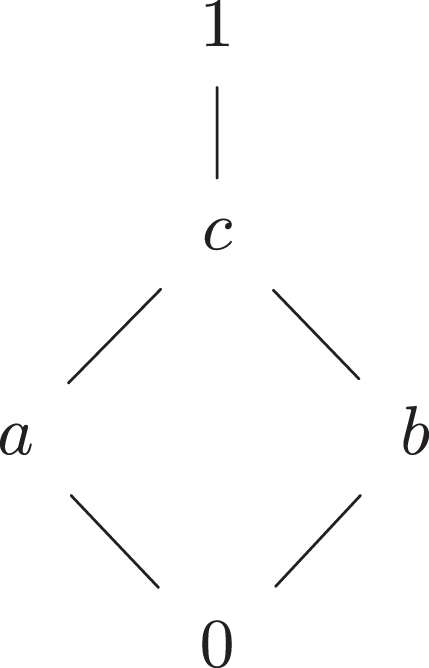
Then (L, ∧ , ∨ , ⊙ , → , 0, 1) is a residuated lattice ([10], page 187), where → and ⊙ are defined as in the tables:
It is easy to ascertain that I1 = {0, a} and I2 = {0, b} are proper ideals of L . We define f a fuzzy ideal of L by:
We define g a fuzzy ideal of L by:
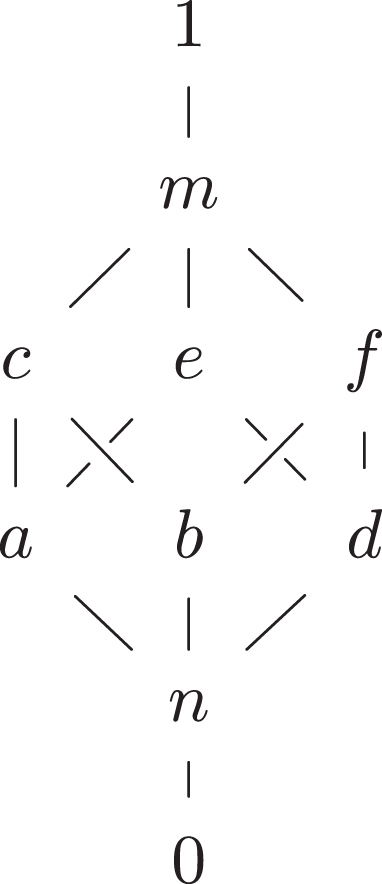
Then ([10], page 242) L is a residuated lattice with respect to the following operations:
It is easy to ascertain that the sets I1 = {0} , I2 = {0, n} are proper ideals of L . Define the fuzzy set f in L by f (0) =0.1, f (n) =0.2, f (a) = f (b) = f (c) = f (d) = f (e) = f (f) = f (m) = f (1) =0.9 . Then f is a fuzzy ideal of L .
Now, define the fuzzy set
(i) f is a fuzzy ideal of L ;
(ii) f is order-preserving and f (x ⊕ y) ≤ f (x) ∨ f (y) for any x, y∈ L ;
(iii) x ⊕ y ≥ z implies f (z) ≤ f (x) ∨ f (y) for all x, y, z ∈ L .
We note that fuzzy ideals and fuzzy filters are not dual notions. Indeed, if we consider the fuzzy ideal f defined in Example 2, for t = 0.2, we get that
Now, if we consider the fuzzy filter
We conclude that the notions of fuzzy ideals and fuzzy filters are not dual in residuated lattices, hence (from logic and algebraic point of view) the concept of fuzzy ideals has a proper meaning and studies are required.
By duality with Corollary 1, we have:
(i) X0 = L ;
(ii) if a, b ∈ [0, 1] are such that a ≤ b, then X b ⊆ X a .
It is clear that I is an ideal of a residuated lattice L iff λ I is a fuzzy ideal in L, where λ I is the complementary function of the characteristic function of I (that is, λ I (x) =0 if x ∈ I, and λ I (x) =1 if x ∉ I). Clearly, λ I is an EF-ideal if I is an ideal of L . We denote Id (L) , FId (L) and EFId (L) the sets of all ideals, fuzzy ideals and extreme fuzzy ideals of L, respectively. Then Card (Id (L)) ≤ Card (EFId (L)) ≤ Card (FId (L)) , where Card (X) is cardinality of the set of X .
(i) f is an extreme fuzzy ideal of L,
(ii) f t ≠ ∅ for all t ∈ [0, 1] ,
(iii) f0 ≠ ∅ ,
(iv) f0 is an ideal of L,
(v) f t is an ideal of L for all t ∈ [0, 1] .
(ii) ⇒ (iii) and (iii) ⇒ (iv) are straightforward.
(iv) ⇒ (v) . Assume that the item (iv) is satisfied. It follows that ∅ ≠ f0 ⊆ f t for all t ∈ [0, 1] . Since f is a fuzzy ideal, then f t is an ideal of L .
(v) ⇒ (i) . Assume that the item (v) is satisfied. Since f is a fuzzy ideal of L and 0 ∈ f0 . It follows that f0 = 0 . □
Interestingly, in residuated lattices every fuzzy ideal can be expanded into an extreme fuzzy ideal (Expansion principle).
Clearly,
The conclusion of Theorem 5 is that for every fuzzy ideal f there is an extreme fuzzy ideal
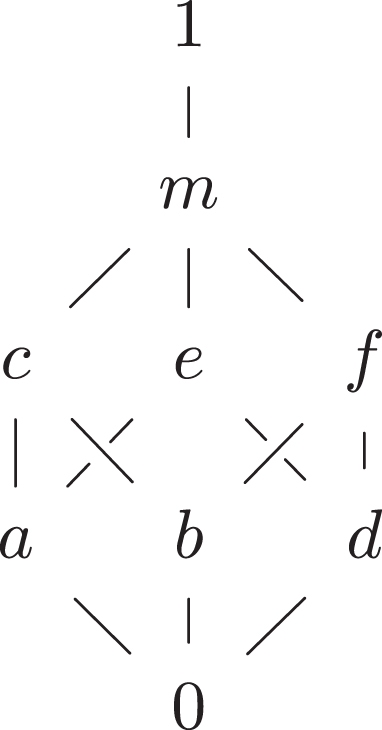
Then ([10], page 252) L is a residuated lattice with respect to the following operations:
Unfortunately, in general, the expansion of extreme fuzzy ideal is not unique.
In the residuated lattice L from Example 2, we have that I = {0, n, a, b, c} is an obstinate ideal of L .
In the residuated lattice L from Example 2, we have that I = {0} is not an obstinate ideal. If we define the fuzzy set f in L by f (0) =0, f (n) = f (a) = f (b) = f (c) = f (e) = f (f) = f (m) = f (1) =0.1, then f is a extreme fuzzy ideal of L, but it is not extreme obstinate fuzzy ideal because for t = 0.05 we have
Fuzzy ideals of a De Morgan residuated lattice
In this section, we study the concept of fuzzy ideal and extreme fuzzy ideals in De Morgan residuated lattices, in order to obtain some topological properties likewise the uniform topology and separability properties.
General information
In Theorem 9 from [7] was proved: If I is an ideal of a De Morgan residuated lattice L, then the binary relation θ
I
on L ((x, y) ∈ θ
I
iff x* ⊙ y ∈ I and x ⊙ y* ∈ I) is a congruence on the reduct (L, ⊙ , ∧ , ∨ , → , 0, 1) of the De Morgan residuated lattice L . For x ∈ L we denote by x/I the congruence class of x modulo θ
I
and L/I = {x/I : x ∈ L} . Define the binary operations ∨, ∧ , ⊙ and → on L/I by (x/I) ∨ (y/I) = (x ∨ y)/I, (x/I) ∧ (y/I) = (x ∧ y)/I, (x/I) ⊙ (y/I) = (x ⊙ y)/I and (x/I) → (y/I) = (x → y)/I for all x, y ∈ L . Then (L/I, ∨ , ∧ , ⊙ , → ,
Let f be an extreme fuzzy ideal of a De Morgan residuated lattice L . We define a binary relation ≡ f on L by: x ≡ f y iff f (x* ⊙ y) ∨ f (x ⊙ y*) =0 . Clearly, x ≡ f y iff f (x* ⊙ y) ∨ f (x ⊙ y*) =0 iff f (x* ⊙ y) =0 and f (x ⊙ y*) =0 iff x* ⊙ y = f-1 (0) and x ⊙ y* = f-1 (0) iff (x* ⊙ y) ∨ (x ⊙ y*) ∈ f-1 (0) . It is clear that ≡ f : = {(x, y) : x ≡ f y} .
Let L, L′ be residuated lattices. On L × L′ we consider the relation of order (x, y) ≤ (x′, y′) iff x ≤ x′ and y ≤ y′ and the operations
for all x, y ∈ L and
Then L × L′ with the above operations is a residuated lattice called direct product of L and L′.
We recall [7] that for any residuated lattices L, L′: K is an ideal of L × L′ iff there exist
If X is a non-empty set, U and V are subsets of X × X. Then
U ∘ V = {(x, y) ∈ X × X: (z, y) ∈ U and (x, z) ∈ V forsome z ∈ X} ,
U-1 = {(x, y) ∈ X × X: (y, x) ∈ U} ,
▵ = {(x, x) ∈ X × X: x ∈ X} .
In universal algebra if X is a non-empty set, then a non-empty collection K of subsets of X × X is called a uniformity on X if it satisfies the following conditions:
(U1) ▵ ⊆ U for any U ∈ K,
(U2) if U ∈ K, then U-1 ∈ K,
(U3) if U ∈ K, then there exists a set V ∈ K such that V ∘ V ⊆ U,
(U4) if U, V ∈ K, then U ∩ V ⊆ K,
(U5) if U ∈ K and U ⊆ V ⊆ X × X, then V ∈ K .
The pair (X, K) is called a uniform structure.
For the rest of this paper we always suppose that
(U2) . For any U f ∈ K*, we have (x, y) ∈ (U f ) -1 iff (y, x) ∈ U f iff y ≡ f x iff x ≡ f y iff (x, y) ∈ U f .
(U3) . For any U f ∈ K*, the transitivity of ≡ f implies that U f ∘ U f ⊆ U f .
(U4) . For any U
f
, U
g
∈ K*, we claim that U
f
∩ U
g
= Uf∩g . If (x, y) ∈ U
f
∩ U
g
, then f (x ⊙ y*) = f (x* ⊙ y) =0 and g (x ⊙ y*) = g (x* ⊙ y) =0 . It follows that (f ∩ g) (x ⊙ y*) = (f ∩ g) (x* ⊙ y) =0 . Hence (x, y) ∈ Uf∩g . Conversely, let (x, y) ∈ Uf∩g . Then (f ∩ g) (x ⊙ y*) = (f ∩ g) (x* ⊙ y) =0 . It follows that f (x* ⊙ y) ∧ g (x* ⊙ y) = f (x ⊙ y*) ∧ g (x ⊙ y*) =0 . We can get (f (x* ⊙ y) ∧ g (x* ⊙ y)) ∨ f (x* ⊙ y) = 0 ∨ f (x* ⊙ y) , this implies that f (x* ⊙ y) =0 . Using similar approach, we get f (x ⊙ y*) =0 . Hence (x, y) ∈ U
f
. Similarly, we can get (x, y) ∈ U
g
. Thus Uf∩g ⊆ U
f
∩ U
g
. Since
If W = U ∩ V, then W ∈ K . Also W [x] ⊆ U [x] ∩ V [x] and so W [x] ⊆ G ∩ H, hence G ∩ H ∈ τ . Thus τ is a topology on L . Note that for any x in L, U [x] is a neighborhood of x . □
Topological properties of the space
Note that from Corollary 6, giving
Let τ be a topology of L . Then (L, τ) is called a topological De Morgan residuated lattice (TDM residuated lattice for short) if the operations ∨, ∧ , ⊙ , → are continuous. Note that the operation * ∈ {∨ , ∧ , ⊙ , →} is continuous iff for any x, y ∈ L and any neighborhood W of x * y there exist two neighborhoods U and V of x and y, respectively, such that U * V ⊆ W .
A topological space X is connected if and only if X has only X and ∅ as clopen subsets. Therefore, by Theorem 11, we have the following result.
We recall that for any ideal I of L, λ I is a fuzzy ideal in L, where λ I is the complementary function of the characteristic function of I (that is, λ I (x) =0 if x ∈ I, and λ I (x) =1 if x ∉ I).
The following result is clear.
(i) By Theorem 4.8, we know that
(ii) For all x ∈ L, by (i) , we know that U g [x] is the smallest open neighborhood of x ;
(iii) Let β g = {U g [x] : x ∈ L} . By (i) and (ii) , it is easy to check that β g is a base of τ g ;
(iv) For all x ∈ L, {U g [x]} is a denumerable fundamental system of neighborhoods of x .
(i)
(ii) g0 = {0} , where g0 is a level subset.
(ii) ⇒ (i) . Let g0 = {0} . By Theorem 17, it suffices to show that U g [0] = {0} . Suppose x ∈ U g [0] , then g (x) =0 . It follows that x = 0 . Clearly, {0} ⊆ U g [0] . Therefore, U g [0] = {0} . □
We recall [6] that for two De Morgan residuated lattices L1 and L2, the map ψ : L1 → L2 is called a morphism (for short, DMRL-morphism) if and only if it satisfies the following conditions, for all x, y ∈ L1 :
(i) ψ (0) =0, ψ (1) =1 ;
(ii) ψ (x ⊙ y) = ψ (x)⊙ ψ (y) ;
(iii) ψ (x → y) = ψ (x) → ψ (y) .
Moreover, if I is an ideal of L2, then ψ-1 (I) is an ideal of L1 .
(i) if g is an extreme fuzzy ideal of L2, then g ∘ ψ is an extreme fuzzy ideal of L1,
(ii) if ψ is a DMRL-morphism and f is an extreme fuzzy ideal of L1, then f ∘ ψ-1 is an extreme fuzzy ideal of L2 .
(ii) By similar way, we prove (ii) holds. □
The following result is clear.
(i) if ψ is surjective, then ψ (Ug∘ψ [a]) = U g [ψ (a)] for all a ∈ L1,
(ii) if ψ is a DMRL-isomorphism, then ψ-1 (U g [b]) = Ug∘ψ [ψ-1 (b)] for all b ∈ L2 .
(ii) . We have successively a ∈ ψ-1 (U g [b]) iff ψ (a) ∈ U g [b] iff g (ψ* (a) ⊙ b) = g (ψ (a) ⊙ b*) =0 iff g (ψ* (a) ⊙ ψ (ψ-1 (b))) = g (ψ* (ψ-1 (b)) ⊙ ψ (a)) =0 iff (g ∘ ψ) (a* ⊙ ψ-1 (b)) = (g ∘ ψ) ((ψ-1) * (b) ⊙ a) =0 iff a ∈ Ug∘ψ [ψ-1 (b)] . □
The next follows from Theorem 22.
Conclusions
In this paper, we introduced the concepts of fuzzy ideals, fuzzy obstinate ideals and extreme fuzzy ideals in residuated lattices, we proposed some characterizations and we showed some important properties of those. The goal is to develop a study of fuzzy ideals in varieties of residuated lattices and to put in evidence their important role. Inspired by the study of X. Zhu, J. Yang and A. Borumand Saeid ([16]), after we defined the family of extreme fuzzy ideals
Some important issue for future work are:
(i) developing the properties of different types of fuzzy ideals and congruence relations in residuated lattices,
(ii) finding useful results on other structures;
(iii) introducing the new concepts of fuzzy ideals and investigating its applications on residuated lattices. For example, in [11] we found the notions of r-fuzzy ideal separation axioms, we think that based on these notions we can develop a study on residuated lattices;
(iv) taking as a guide line the work on Fuzzy Lie Algebras [1] we can find more properties for the classes of fuzzy ideal in (fuzzy) residuated lattices;
(v) constructing a topology based on these new concepts of fuzzy ideals in residuated lattices.
Footnotes
Acknowledgments
The author is extremely grateful to the editors and the anonymous reviewers for giving him many valuable comments and helpful suggestions which helps to improve the presentation of this paper.