



Abstract
In this article, we put forward the concepts of nodal and conodal ideals in a residuated lattice and study some properties. We state some examples and theorems. We investigate the inverse image of a nodal (conodal) ideal under a homomorphism. In addition, we pay attention to the relationships with the other types of ideals and special sets in varieties of residuated lattices. At the same time, we give a characterization of nodal ideals in terms of congruences and we show that if L is an MTL-algebra and I is a non-principal nodal ideal, then L/I is a chain. We propose a characterization for Boolean residuated lattices (L is a Boolean residuated lattice if and only if L is an involution semi-G-agebra) and we discuss briefly the applications of our results in varieties of residuated lattices. Finally, we introduce the concept of a fuzzy (nodal) ideal of a residuated lattice, and give some related results. After that we define the concept of fuzzy ideal of a residuated lattice with respect to a t-conorm briefly, S-fuzzy ideals and we prove Representation Theorem in residuated lattices.
Introduction
Residuation is a fundamental concept of ordered structures and categories. The origin of residuated lattices is in Mathematical Logic without contraction. The general definition of a residuated lattice was given by Galatos et al. [7]. They first developed the structural theory of this kind of algebra about residuated lattices.
Ideal theory plays an important rule in studying residuated lattices. From logical point of view, various ideals correspond to various sets of provable formula. In residuated lattices, the filters and ideals are not dual, in consequence, the ideals have a proper meaning in residuated lattices, from a purely algebraic point of view. In 2010, Y. Zhu et al. [21] presented interesting aspects of the theory of filters in residuated lattices. In 2013, C. Lele et al. [14] studied the relationship between ideals and filters in BL-algebras. In 2012, A. Borumand Saeid et al. [1, 8] studied the concept of obstinate filters and co-annihilators in residuated lattices. Soon after, in 2014, F. Forouzesh et al. [5] published a study on obstinate ideals in MV-algebras, they investigate some relationships between obstinate ideals and other ideals of an MV-algebra. In 2015, D. Buşneag et al. [4] investigated the variety of Stonean residuated lattices from the view of ideal theory and proved some theorems specific to distributive residuated lattices. In 2016, Yu Xi Zou et al. [23] studied ideals and annihilator ideals in BL-algebras. In 2017, L.C. Holdon [11] introduced a new class of residuated lattices called De Morgan residuated lattices (L is called De Morgan residuated lattice if the De Morgan law (x ∧ y) * = x* ∨ y*, for all x, y ∈ L hold) and investigated it from the view of ideal theory, the author proved that various notions of ideals presented in literature such as right ideals, left ideals [14, 23] and implicative ideals [4] coincide in residuated lattices. In 2018, L.C. Holdon [12] studied a new topology based on upsets in residuated lattices, in a dual sense, ideals are down-sets in residuated lattices, hence a new topology based on down-sets can be generated.
J.C. Varlet (1973) [19] presented the first study of nodal filters in semilattices. Recently, Raza Tayebi Khorami and Arsham Borumand Saeid [17] studied nodal elements and nodal filters in BL-algebras, and Arsham Borumand Saeid et al. [2] extend the research of nodal elements and nodal filters in residuated lattices. Soon after, in 2016, F. Forouzesh [6] studied nodal and conodal ideals in MV-algebras. However, in residuated lattices, the notions of nodal filters and nodal ideals are not dual. We can conclude that there is a great deal of interest on this subject, that because of its applications in fuzzy sets theory.
Since the notion of ideals in residuated lattices has been defined and investigated in papers [4, 23], we think it is a new direction to study the ideals by the concept of nodal (conodal) ideals, which will enrich and develop the theory of ideals in residuated lattices. We mention that, in residuated lattices, the notions of nodal filters and nodal ideals are not dual.
The paper is organized as follows: In Section 2, we review some basic definitions and results about residuated lattices. In Section 3, we introduce the concept of nodal ideal in residuated lattices. We note that the lattice nodal ideals and nodal ideals are not always the same. We state some examples and characterization theorems. We pay attention to the relationships between the nodal (conodal) ideals with other ideals, likeness Boolean ideals, prime ideals, maximal ideals, primary ideals, implicative ideals and ⊙-prime ideals. We conclude that the class of nodal (conodal) ideals is a new class of ideals in residuated lattices. We state the characterization theorems for nodal (conodal) ideals in Theorems 4 and 11. In Theorem 13, we show that for a MTL-algebra L, if I is a nodal ideal, then its quotient algebra L/I is a chain. Using nodal ideals, we define an equivalence relation denoted by R (the elements x and y of L are connected, in symbol (x, y) ∈ R) if there is no nodal ideal which separates them). In Theorem 9, we present some interesting properties of R-classes. In Theorem 12, we present a characterization for nodal ideals in term of congruences. In Section 4, we discuss briefly the applications of our results in varieties of residuated lattices. Finally, we propose a new characterization for Boolean residuated lattices and we present some applications. In conclusion, our results generalize some theorems regarding nodal (conodal) ideals from MV-algebras [6] in the general case of residuated lattices. This study has applications in fuzzy sets theory and, consequently, in decision-making theory and graph theory. In Section 5, we define the notion of fuzzy (nodal) ideal of a residuated lattice, we show that fuzzy ideals and fuzzy filters are not dual notions in residuated lattices. We pay attention to characterization theorems for fuzzy (nodal) filters and fuzzy (nodal) ideals, after that, we introduce the concept of a fuzzy (nodal) ideal of a residuated lattice, with respect to a t-conorm briefly, S-fuzzy ideals, and we prove the Representation Theorem in residuated lattices.
Preliminaries
In this section, we present some preliminaries including the basic definitions, some results on ideals in residuated lattices, some examples of residuated lattices, rules of calculus and theorems that are needed in the sequel. All results with proofs are original.
(Lr1) (L, ∨ , ∧ , 0, 1) is a bounded lattice;
(Lr2) (L, ⊙ , 1) is a commutative monoid;
(Lr3) ⊙ and → form an adjoint pair, i.e., a ⊙ x ≤ b if and only if x ≤ a → b .
We call them simply residuated lattices. Usually, (Lr3) is called the residuation property. For examples of residuated lattices see Galatos et al.(2007), Hájek (1998), D. Buşneag et al.(2013), Freytes (2004), Kowalski and Ono (2002), Iorgulescu (2008), Piciu (2007) and Turunen (1999). If L is totally ordered, then L is called a chain.
We refer to Hájek (1998), D. Buşneag et al.(2013), Piciu (2007)-Ward and Dilworth (1939) for detailed proofs of these well-known results:
(c1) x → x = 1, x → 1 =1, 1→ x = x ;
(c2) x ≤ y iff x→ y = 1 ;
(c3) if x ≤ y, then z ⊙ x ≤ z ⊙ y, z → x ≤ z → y, y→ z ≤ x → z ;
(c4) if x ≤ y, then y* ≤ x*, x**≤ y** ;
(c5) x ⊙ x* = 0, x ≤ x**, x*** = x*, 0* = 1, 1* = 0 ;
(c6) x ⊙ y = 0 if and only if x≤ y* ;
(c7) x⊙ (y ∨ z) = (x ⊙ y) ∨ (x ⊙ z) ;
(c8) x∨ (y ⊙ z) ≥ (x ∨ y) ⊙ (x ∨ z) ;
(c9) x→ (y ∧ z) = (x → y) ∧ (x → z) ;
(c10) x⊙ (x → y) ≤ x ∧ y ;
(c11) (x∨ y) * = x* ∧ y* ;
(c12) x* ⊙ y* ≤ (x ⊙ y) *, x**⊙ y** ≤ (x ⊙ y) ** ;
(c13) (x→ y**) ** = x → y** ;
(c14) x → (y → z) = y → (x → z) = (x ⊙ y) → z, (x ⊙ y) * = x → y* = y → x* .
We consider the identities:
(i1) x ∧ y = x ⊙ (x → y) (divisibility) ;
(i2) (x* ∧ y*) * = [x* ⊙ (x* → y*)] * (semi - divisibility) ;
(i3) (x → y) ∨ (y → x) =1 (prelinearity) ;
(i4) x* ∨ x** = 1 (Stoneproperty) ;
(i5) x2 = x (idenpotence) ;
(i6) x = x** (involution) ;
(i7) (x2) * = x* ;
(i8) (x∧ y) * = x* ∨ y* ;
(i9) x ∨ x* = 1 .
Then the residuated lattice L is called: Divisible if L verifies (i1); Semi-divisible if L verifies (i2); MTL-algebra if L verifies (i3); BL-algebra if L verifies (i1) and (i3); Stonean if L verifies (i4) ; G-algebra(Heyting algebra) if L verifies (i5) ; Involution if L verifies (i6) ; semi-G-algebra if L verifies (i7) ; De Morgan if L verifies (i8) ; Boolean algebra if L verifies (i9) .
(F1) if x ≤ y and x ∈ F, then y∈ F ;
(F2) if x, y ∈ F, then x ⊙ y ∈ F .
We denote by
Let G be an filter of L . Then we have either F ⊆ G or G⊆ F ;
F is a node of the lattice
Let x ∈ F and y ∉ F . Then x ≩ y .
For every x, y ∈ L, we define:
The operator x ⊕ y will be called strong addition.
(c15) x⊕ 0 = x**, x ⊕ 1 =1, x ⊕ x* = 1 ;
(c16) x⊕ y = y ⊕ x, x, y ≤ x ⊕ y ;
(c17) x⊕ (y ⊕ z) = (x ⊕ y) ⊕ z ;
(c18) if x ≤ y, then x⊕ z ≤ y ⊕ z ;
(c19) if x ≤ y, z ≤ t, then x ⊕ z ≤ y ⊕ t .
(I1) if x ≤ y and y ∈ I, then x∈ I ;
(I2) if x, y ∈ I, then x ⊕ y ∈ I .
We denote by
For an MV-algebra (A, ⊕ , * , 0) , we recall (Definition 1.2 [5]): an ideal of A is a nonempty subset I of A such that
(MV1) if x ≤ y and y ∈ I, then x∈ I ;
(MV2) if x, y ∈ I, then x ⊕ y ∈ I .
The operation ⊙ is defined as follow: x ⊙ y = (x* ⊕ y*) *, for all x, y ∈ A .
For x ∈ L and n ≥ 0, we define 0 · x = 0 and n · x = [(n - 1) · x] ⊕ x for n ≥ 1 . For simplicity, we denote nx : = n · x .
(S] = {x∈ L : x ≤ s1 ⊕ . . . ⊕ s
n
, forsome n ≥ 1 and s1, . . . , s
n
∈ S} ; (a] = {x∈ L : x ≤ na forsome n ≥ 1} ; I (a) = {x∈ L : x ≤ i ⊕ na forsome i ∈ I and n ≥ 1} ;
{x ∈ L : x ≤ i1 ⊕ i2 with i1 ∈ I1 and i2 ∈ I2} .
(x] = (x**] = (nx] , for all n≥ 1 ;
if L is a semi-G-algebra, then nx = x**, for all n≥ 1 ;
if L is a semi-G-algebra and x, y are incomparable element of L, then x ∉ (y] and y ∉ (x] .
For x ∈ L, (x] is an ideal of L . By Proposition 1, it follows that x ∈ (x] iff x** ∈ (x] iff nx ∈ (x] , for all n ≥ 1 . Let L be a semi-G-algebra (that is, (x2) * = x*, for all x ∈ G). Hence x ⊕ x = (x* ⊙ x*) * = [(x*) 2] * = x** . By the associativity of operator ⊕ and (c5) (x*** = x*, for all x ∈ L), it follows that nx = x**, for all n ≥ 1 . It follows from (i) and (ii) .□
Let X be a nonempty subset of L . The set of complemented elements (with respect to X) is defined by D (X) : = {x ∈ L : x* ∈ X} .
In what follows, we recall various types of ideals from literature (see [4–6, 23]).
A proper ideal An ideal An ideal I of L is called a Boolean ideal if x ∧ x* ∈ I, for all x∈ L ; P is a primary ideal of L if it is a proper ideal such that for every x, y ∈ L such that x ⊙ y ∈ P, there exists an integer n ≥ 1 such that x
n
∈ P or y
n
∈ P ; An ideal I of L is called an implicative ideal if for any x, y, z ∈ L such that z ⊙ (y* ⊙ x*) ∈ I and y ⊙ x* ∈ I, then z⊙ x* ∈ I ; An ideal I of L is called an ⊙-prime ideal, if for all x, y ∈ L, x ⊙ y ∈ I implies x ∈ I or y∈ I ; An ideal I of L is called an obstinate ideal, if for all x, y ∈ L \ I, x* ⊙ y ∈ I and x ⊙ y* ∈ I .
The ⊙-prime ideals were introduced in residuated lattices [11] in order to establish the relationship between ideals and filters.
In this section, we define the concept of nodal (conodal) ideals in residuated lattices and we study their properties in details. We recall that an element x of a poset X is called a node of X, if it is comparable with every element of X .
In Example 1, we have that Nod (L) = {0, m, 1} . If an element x ∈ L is not a node of L, it will be called conode of L . We denote by CoNod (L) the set of all conodes of L . In Example 1, the set of all conodes of L is CoNod (L) = {a, b, c, d, e, f} . In [2, 17], it proved that nodes are different elements than dense, nilpotent, boolean and regular elements. Also, in [16, 18] some interesting relationships have been shown between dense, nilpotent, boolean and regular elements. In what follows, we present some results on nodes in residuated lattices.
By (c2) , we note that an element a ∈ L is a node if and only if a → x = 1 or x→ a = 1 ; If a ∈ L is a node, then a* ⊙ x = 0 or a ⊙ x* = 0, for all x ∈ L . Indeed, if a ∈ L is a node, then a ≤ x or x ≤ a, for all x ∈ L . By (c3) , it follows that a ⊙ x* ≤ x ⊙ x* = 0 or a* ⊙ x ≤ a* ⊙ a = 0 . Hence a ⊙ x* = 0 or a* ⊙ x = 0 .
Let L = {0, a, b, c, d, e, f, m, 1} with the Hasse diagram:

Then ([13], page 252) L is a residuated lattice with respect to the following operations:
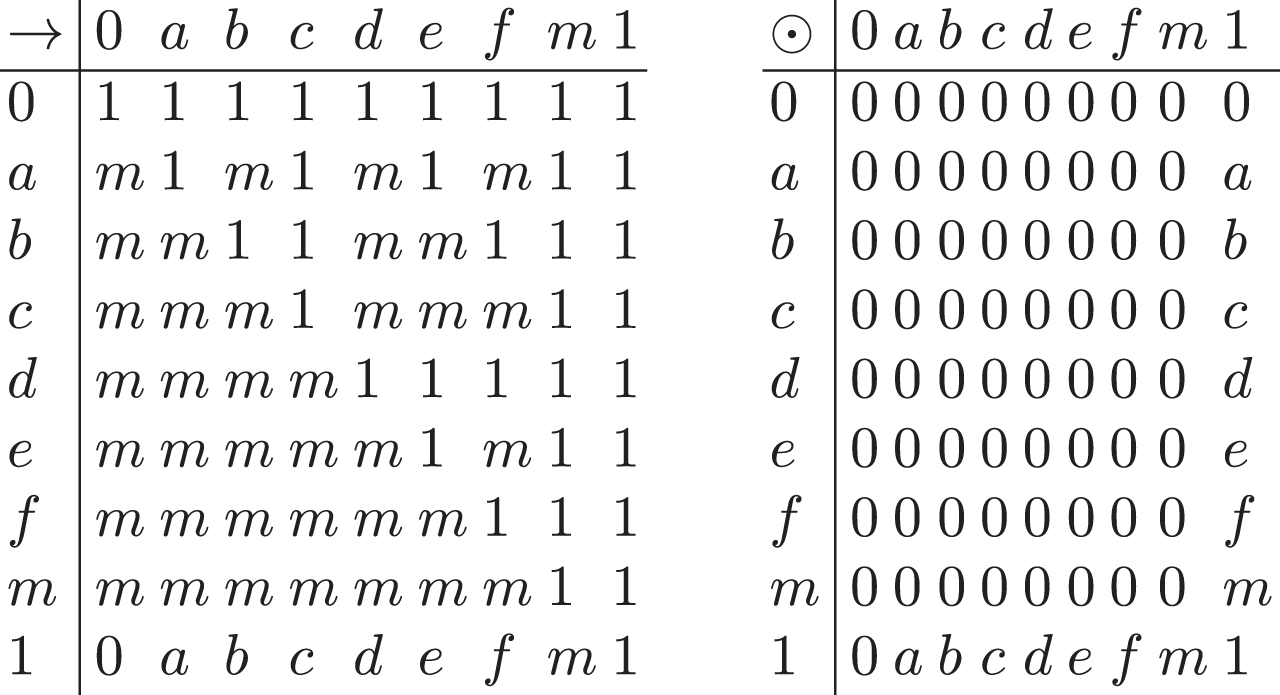
If we consider the element c fixed, then c* ⊙ x = 0 or c ⊙ x* = 0, for all x ∈ L, but c is not a node of L .
We consider L = {0, n, a, b, c, d, e, f, m, 1} with the Hasse diagram:
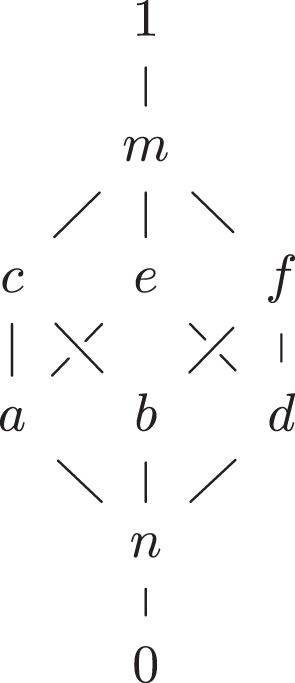
Then ([13], page 242) L is a residuated lattice with respect to the following operations:
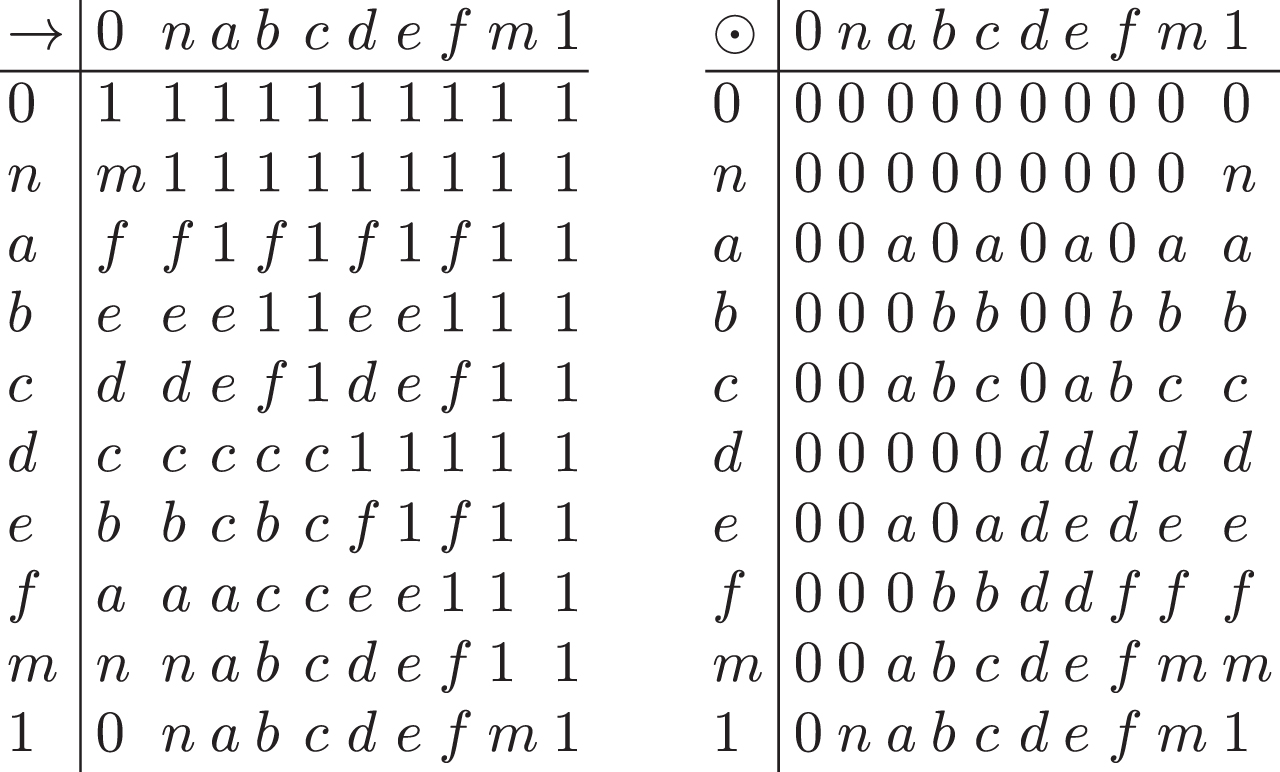
It is easy to ascertain that Nod (L) = {0, n, m, 1} and CoNod (L) = {a, b, c, d, e, f} . Moreover, L is an involution residuated lattice and the condition from Proposition 5 hold in L .
We recall [2, 17] that a filter F is called nodal filter of L if it is a node of the lattice
We recall (Definition 1.6 [5]) that a nonzero element m of a poset P with 0 is a molecule if whenever 0 < x, y < m, then {x, y} has a nonzero lower bound. Thus m ∈ L is a molecule if and only if whenever x, y ∈ L satisfy 0 < x, y < m . Hence x ∧ y > 0 . We denote by Mol (L) the set of all molecules of L . A residuated lattice is called totaly ordered (or simply, a chain) if every two elements are comparable.
We recall [9] that an element e ∈ L is boolean element if and only if e ∨ e* = 1 . We denote by B (L) the set of all boolean elements of L .
Clearly, {0} and L are nodal ideals.
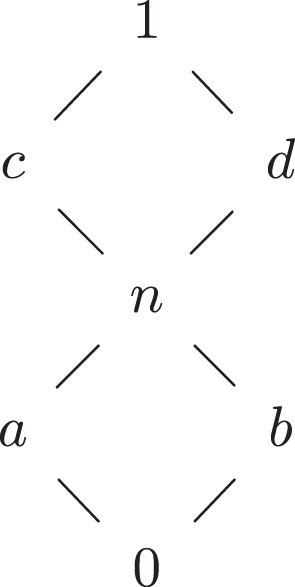
Then ([13], page 191) L is a distributive residuated lattice with respect to the following operations:

It easy to ascertain that I1 = {0, a} , I2 = {0, b} and I3 = {0} are all proper ideals of L . Since I1 and I2 are incomparable, we conclude that they are not nodal ideals of L . Clearly, n is a node of L . Moreover, the lattice ideal generated by element n is {0, a, b, n} , but the ideal generated by n is (n] = L . Hence the lattice ideal and the ideal generated by n are different. In conclusion, every ideal is a lattice ideal, but the converse may not always hold.
The next result is a characterization for nodal ideals in residuated lattices.
Let J be an ideal of L . Then we have either I ⊆ J or J⊆ I ;
I is a node of the lattice
Let x ∈ I and y ∉ I . Then x ≨ y .
⇒ (ii) . It follows immediate from the definition of a node. ⇒ (iii) . If I is a node of the lattice ⇒ (i) . Assume that there is an ideal J incomparable with I . Then there are elements x, y ∈ L such that x ∈ I \ J, y ∈ J \ I . By hypothesis, we have that x ≨ y or y ≨ x . Hence I ⊆ J or J ⊆ I .
We note that (iii) ⇒ (ii) follows from Proposition 7.□
Case 1. If P, Q ⊆ I, then P ∧ Q ⊆ I . We conclude that I ∨ (P ∧ Q) = I and (I ∨ P) ∧ (I ∨ Q) = I .
Case 2. If I ⊆ P, Q, then I ⊆ P ∧ Q . We conclude that I ∨ (P ∧ Q) = P ∧ Q and (I ∨ P) ∧ (I ∨ Q) = P ∧ Q .
Case 3. If P ⊆ I ⊆ Q, then I ∨ (P ∧ Q) = I and (I ∨ P) ∧ (I ∨ Q) = I ∧ Q = I .
Case 4. If Q ⊆ I ⊆ P, then I ∨ (P ∧ Q) = I ∨ Q = I and (I ∨ P) ∧ (I ∨ Q) = P ∧ I = I .□
We recall [9] that the lattice
We note that the class Nod Id (L) of all nodal ideals of a residuated lattice L is a totally ordered structure, consequently, the set of all nodal ideals of L, ordered by inclusion, is a chain with the greatest element L and smallest element {0} . If I is a nodal ideal of L, then I satisfies the intersection and union properties. If I and J are nodal ideals of L such that I ∩ J = {0} , then I = {0} or J = {0} . It is easy to ascertain that the lattice (Nod Id (L) , ∧ , ∨ , {0} , L) is a complete distributive Brouwerian lattice.
For every ideals I, J ∈ Nod Id (L) , we define the operator I → J : = {x ∈ L : I ∩ (x] ⊆ J} . We denote by I* : = I → {0} = {x ∈ L : I ∩ (x] ⊆ {0}} . Clearly, {0} * = L and L* = {0} .
Conversely, let x ∈ I ∧ J . Thus x ∈ I and x ∈ J . We assume that I ⊆ J → Q . Since I ⊆ J → Q, it follows that x ∈ J → Q, equivalently, (x] ∧ J ⊆ Q . Since x ∈ (x] and x ∈ J, it follows that x ∈ Q . Hence I ∧ J ⊆ Q . The rest of the residuation property follows in a similar manner. Since I2 = I ⊙ I = I ∧ I = I, it follows that (Nod Id (L) , ∧ , ∨ , → , ⊙ , {0} , L) is a G-algebra. □
We recall [9] that for two residuated lattices L1 and L2, the map f : L1 → L2 is called a homomorphism if and only if it satisfies the following conditions, for all x, y ∈ L1 : f (0) =0, f (1) =1 ; f (x ⊙ y) = f (x)⊙ f (y) ; f (x → y) = f (x) → f (y) .
Moreover, if I is an ideal of L2, then f-1 (I) is an ideal of L1 .
In what follows, we will provide some examples with the goal to establish the relationship between nodal ideals and other types of ideals in residuated lattices. The conclusion is that the class of nodal ideals in residuated lattices is a new class of ideals.
On the other hand, in Example 2, we have that J = {0, n, a, b, c} is a Boolean ideal, but it is not a nodal ideal because there are two ideals P = {0, n, b, d, f} and Q = {0, n, a, d, e} incomparable with I .
The converse of Theorem 8 may not always hold, indeed, in the residuated lattice from Example 2, we have I = {0} is a nodal prime ideal of L, but it is a principal ideal (because I = (0]).
On the other hand, in Example 2, we have that J = {0, n, a, b, c} is a prime ideal, but it is not a nodal ideal because there are two ideals P = {0, n, b, d, f} and Q = {0, n, a, d, e} incomparable with I .
On the other hand, in Example 2, we have that J = {0, n, a, b, c} , P = {0, n, b, d, f} and Q = {0, n, a, d, e} are three maximal ideals of L, but they are not nodal ideals because they are incomparable two-by-two.
On the other hand, in Example 2, we have that J = {0, n, a, b, c} , P = {0, n, b, d, f} and Q = {0, n, a, d, e} are three primary ideals of L, but they are not nodal ideals because they are incomparable two-by-two.
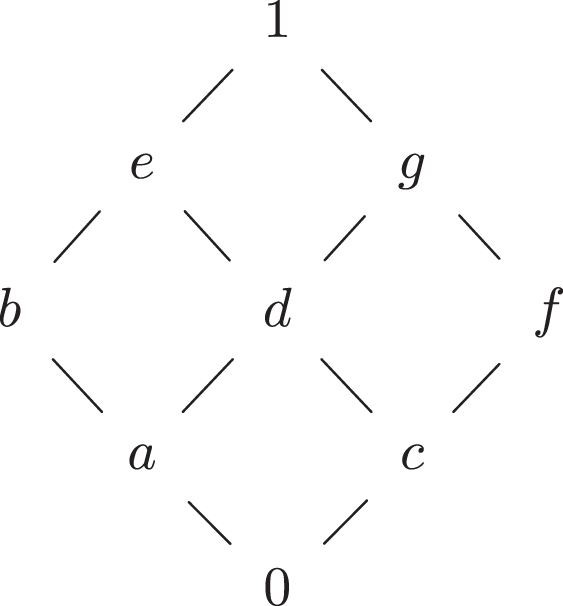
Then ([13], page 166) L is a residuated lattice with respect to the following operations:
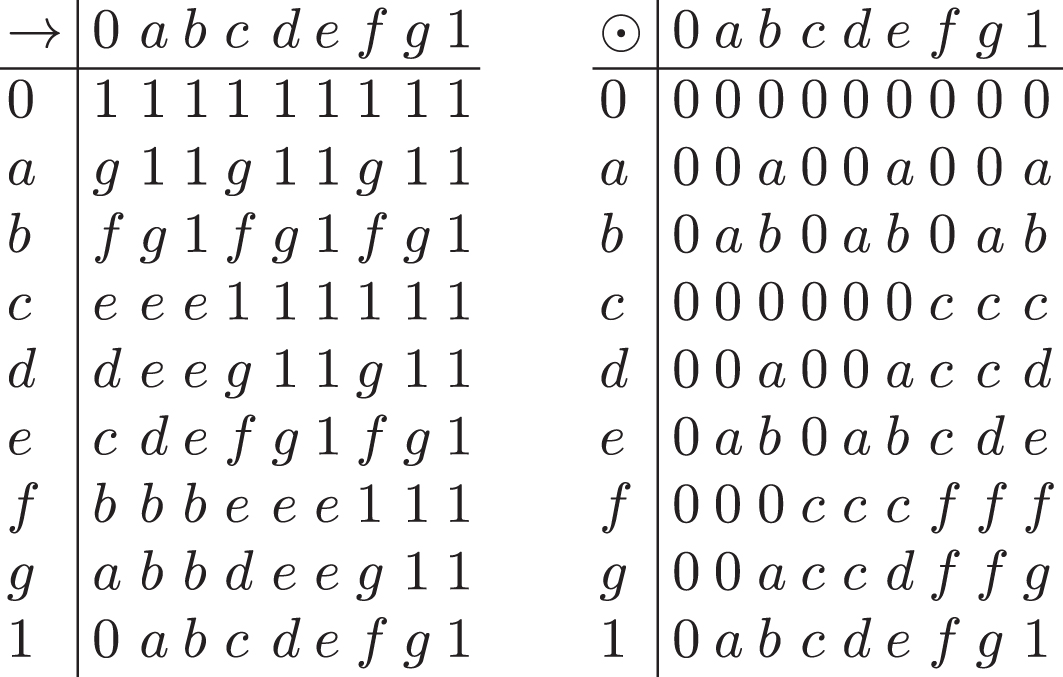
It is easy to ascertain that I1 = {0} , I2 = {0, a, b} and I3 = {0, c, f} are all proper ideals of L . We have that b ⊙ (a* ⊙ g*) = b ⊙ (g ⊙ a) = b ⊙ 0 =0 ∈ I1 and a ⊙ g* = a ⊙ a = 0 ∈ I1, but b ⊙ g* = b ⊙ a = a ∉ I1 . Hence I1 is a nodal ideal, but it is not an implicative ideal.

Then ([13], page 164) L is a residuated lattice with respect to the following operations:
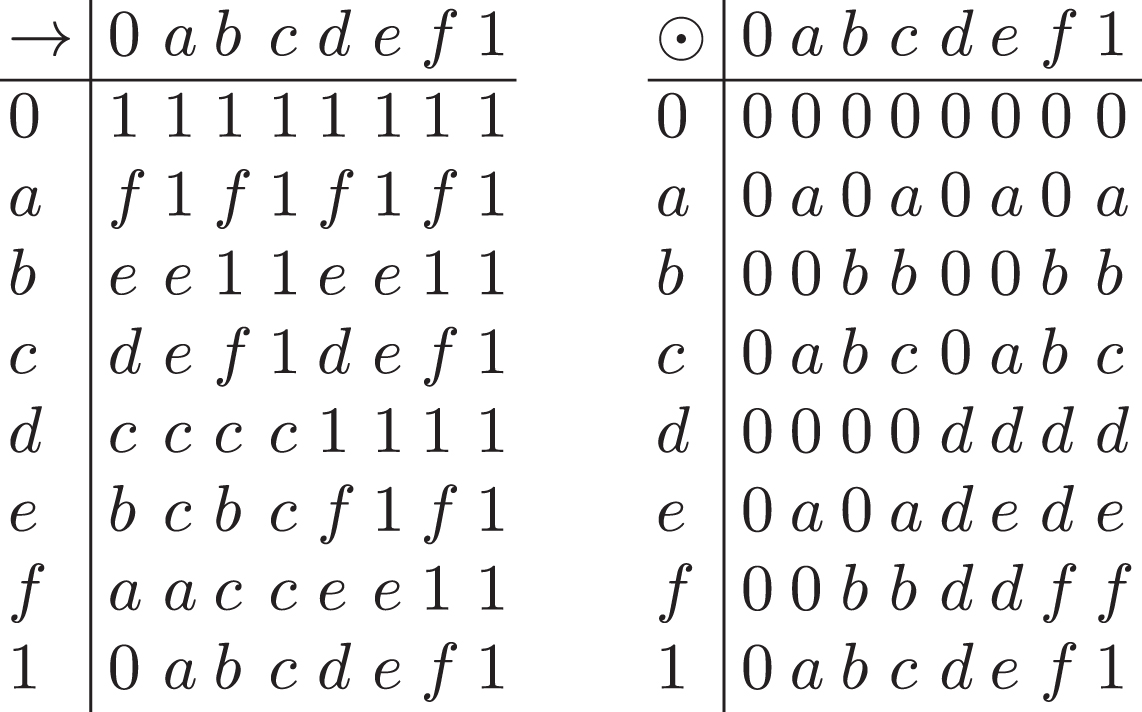
It is easy to ascertain that I1 = {0, b, d, f} , I2 = {0, a, b, c} and I3 = {0, a, d, e} are implicative ideals, but they are not nodal ideals because they are incomparable. Moreover, I1 = (f] , I2 = (c] and I3 = (e] are principal implicative ideals and L is a G-algebra, so the converse of Corollary 4 may not hold.
On the other hand, in Example 2, we have that J = {0, n, a, b, c} is an obstinate ideal, but it is not a nodal ideal.
On the other hand, in Example 5, we have that J = {0, a} is an ⊙-prime ideal, but it is not a nodal ideal.
An equivalence relation
Any R-class contains at most one node;
Any R-class is totally ordered if and only if it is a singleton;
L/R is a chain dually isomorphic to Nod
Id
(L) .
Let x and y be connected nodes of L . We have either x ≨ y or y ≨ x . By Proposition 8, we conclude that in the first case, x and y are separated by the nodal ideal (x] , and in the second case by (y] . We assume that (x] R (the R-class of x) is totally ordered and (y, x) ∈ R, x ≠ y . Any element a ∈ L is comparable with x and y . Hence both x and y are nodes of L, that is a contradiction. We define the mapping φ : L/R → Nod
Id
(L) by φ (t) = I
t
, where I
t
is a nodal ideal generated by the R-class t . In fact, I
t
= {x ∈ L : x ≤ y forsome y ∈ t} . Obviously, φ is bijective and in L/R if and only if in Nod
Id
(L) .□
The direct product
Let L1, L2 be residuated lattices. On L1 × L2 we consider the order relation (x, y) ≤ (x′, y′) iff x ≤ x′ and y ≤ y′ and the operations
(x, y) ∧ (x′, y′) = (x ∧ x′, y ∧ y′) ,
(x, y) ∨ (x′, y′) = (x ∨ x′, y ∨ y′) ,
(x, y) ⊙ (x′, y′) = (x ⊙ x′, y ⊙ y′) ,
(x, y) → (x′, y′) = (x → x′, y → y′) for all x, y ∈ L1 and x′, y′ ∈ L2 .
The L1 × L2 with the above operations is a residuated lattice called the direct product of L1 and L2 .
Clearly, Q = I × J . Since (0, 0) ∈ Q, it follows that 0 ∈ I . Let x, y ∈ I . Thus, there are x′, y′ ∈ L2 such that (x, x′) , (y, y′) ∈ Q . Hence (x, x′) ⊕ (y, y′) = (x ⊕ y, x′ ⊕ y′) ∈ Q . We conclude that x ⊕ y ∈ I .
Let x ≤ y and y ∈ I . Thus, there is x′ ∈ L2 such that (x, x′) ∈ Q . Since (x, x′) ≤ (y, x′) , it follows that x ∈ I . So
“⇐”. Let Q = I × J for some I ∈ Nod Id (L1) and J ∈ Nod Id (L2) . Clearly, Q ⊆ L1 × L2 . We consider (x, y) , (p, q) ∈ Q . Hence x, p ∈ I and y, q ∈ J, that is x ⊕ p ∈ I, y ⊕ q ∈ J . Therefore, (x, y) ⊕ (p, q) = (x ⊕ p, y ⊕ q) ∈ I × J = Q .
Now, let (p, q) ∈ Q be such that (x, y) ≤ (p, q) . Then x ≤ p with p ∈ I and y ≤ q with q ∈ J . Since I ∈ Nod Id (L1) and J ∈ Nod Id (L2) , it follows that x ∈ I and y ∈ J, that is (x, y) ∈ Q . Hence Q ∈ Nod Id (L1 × L2) . □
By mathematical induction relative to n we obtain the following result:
Conodal ideals in residuated lattices
We recall that an element a of a resiuated lattice L is called a conode of L, if there exist elements of L which are incomparable with a . We denote the set of all conodal elements of L by CoNod (L) . In the residuated lattice L from Example 2, the set of all conodes of L is CoNod (L) = {a, b, c, d, e, f} . Clearly, nodal and conodal elements of L are dual notions.
On the other hand, we show that if I is a conodal ideal of L, and x a conode of L, then I (x) may not be a conodal ideal of L . Indeed, in residuated lattice L from Example 5, we have that I = {0, a} and J = {0, b} are conodal ideals of L and d is a conode of L, but I (d) = L and J (d) = L are nodal ideals of L (because a ⊕ d = b ⊕ d = 1).
In what follows, we will provide some examples with the goal to establish the relationship between conodal ideals and other types of ideals in residuated lattices. The conclusion is that the class of conodal ideals in residuated lattices is a new class of ideals.
For the converse, we consider the lattice L = {0, n, a, b, c, d, 1} with the Hasse diagram:
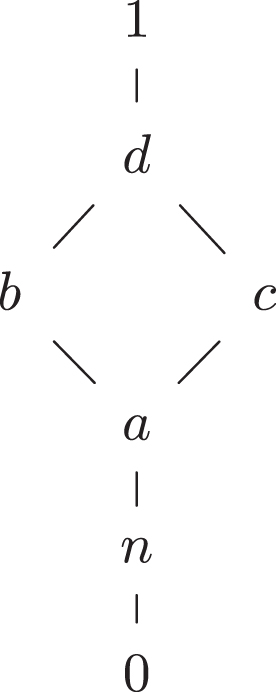
Then ([13], page 247) L is a residuated lattice with respect to the following operations:

It is easy to ascertain that I = {0} is a Boolean ideal, but it is not a conodal ideal.
On the other hand, in Example 2, we have that J = {0} is a prime ideal, but it is not a conodal ideal.
On the other hand, in Example 19, we have that J = {0, a} is a conodal ideal, but it is not maximal because there is Q = {0, a, b, c} an ideal such that J ⊂ Q .
On the other hand, in Example 19, we have that J = {0, a} is a conodal ideal, but it is not a primary ideal because c ⊙ d = 0 ∈ J and for all n ≥ 1, c n = c ∉ J and d n = d ∉ J .
On the other hand, in Example 18, we have that J = {0, a, b} is a conodal ideal, but it is not an implicative ideal because f ⊙ (c* ⊙ d*) = f ⊙ (e ⊙ d) = f ⊙ a = 0 ∈ J and c ⊙ d* = c ⊙ d = 0 ∈ J, but f ⊙ d* = f ⊙ d = c ∉ J .
On the other hand, in Example 25, we have that I = {0} is an obstinate ideal, but it is not a conodal ideal.
On the other hand, in Example 25, we have that I = {0} is an ⊙-prime ideal, but it is not a conodal ideal.
Applications
The variety of De Morgan residuated lattices includes important subvarieties of residuated lattices such as Boolean residuated lattices, MV-algebras, BL-algebras, Stonean residuated lattices, MTL-algebras and involution residuated lattices (see [11]).
In Theorem 9 from [11] is proved: If I is an ideal of a De Morgan residuated lattice L, then the binary relation θ
I
on L ((x, y) ∈ θ
I
if and only if x* ⊙ y ∈ I and x ⊙ y* ∈ I) is a congruence relation. For x ∈ L, we denote by [x]
θ
I
: = x/I the congruence class of x modulo θ
I
and L/I = {x/I : x ∈ L} . On L/I, we define the binary operations ∨, ∧ , ⊙ and → by (x/I) ∨ (y/I) = (x ∨ y)/I, (x/I) ∧ (y/I) = (x ∧ y)/I, (x/I) ⊙ (y/I) = (x ⊙ y)/I and (x/I) → (y/I) = (x → y)/I for all x, y ∈ L . Then (L/I, ∨ , ∧ , ⊙ , → ,
[0]
θ
is a nodal ideal of L;
θ is a node of con (L) , the congruence lattice of L .
(mx) ∧ (ny) ≤ (mn) (x ∧ y) , for all m, n≥ 1 ; (x]∩ (y] = (x ∧ y] ;
If I is a non-principal nodal ideal, then I is a prime ideal.
(ii) . Let x, y ∈ L . Since x ∧ y ≤ x, y, it follows that (x ∧ y] ⊆ (x] and (x ∧ y] ⊆ (y] , and so (x ∧ y] ⊆ (x] ∩ (y] . Conversely, by item (i) , we have (mx) ∧ (ny) ≤ (mn) (x ∧ y) , for all m, n ≥ 1 . We obtain successively (x] ∩ (y] = {a∈ L : a ≤ mx forsome m ≥ 1} ∩ {a∈ L : a ≤ ny forsome n ≥ 1} ⊆ {a∈ L : a ≤ (mx) ∧ (ny) forsome m, n ≥ 1} ⊆ {a ∈ L : a ≤ (mn) (x ∧ y) forsome n ≥ 1} = (x ∧ y] . Therefore, (x] ∩ (y] = (x ∧ y] .
(iii) . Let I be a non-principal nodal ideal of L, such that x ∧ y ∈ I and x ∉ I and y ∉ I . We have that (x ∧ y] ⊆ I . Since x ∉ I and y ∉ I, it follows that (x] ⊈ I and (y] ⊈ I, so I ⊂ (x] and I ⊂ (y] . By item (ii) , it follows that I ⊆ (x] ∩ (y] = (x ∧ y] . We conclude that I = (x ∧ y] , that is a contradiction. Therefore, x ∈ I or y ∈ I, that is, I is a prime ideal.□

Organized as a residuated lattice by natural ordering, with the operations → and ⊙ as in the following tables:
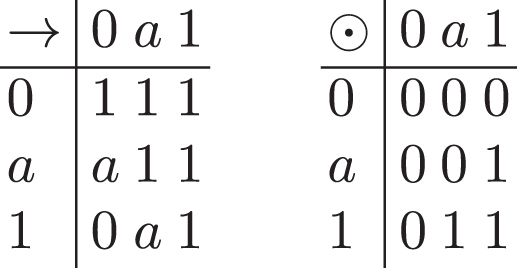
It is easy to ascertain that L is a MTL-algebra and I = {0} is the only proper ideal of L . We have successively 0/I ≤ a/I iff (0 → a) * = 0 ∈ I and a/I ≤ 1/I iff (a → 1) * = 0 ∈ I . Hence L/I = {0/I, a/I, 1/I} is a chain, but I is a principle nodal ideal of L .
Next, we study nodal (conodal) ideals in special classes of residuated lattices such as involution residuated lattices and semi-G-algebras. It is known that the classes of involution residuated lattices and semi-G-algebras are different [11]. We present a characterization for nodal ideals in involution residuated lattices. We propose a new characterization for Boolean residuated lattices, in this sense we prove that a residuated lattice L is a Boolean algebra if and only if L is an involution semi-G-algebra. That is, the class of Boolean residuated lattices is exactly the intersection between the classes of involution residuated lattices and semi-G-algebras. We consider this new characterization of Boolean residuated lattices because of its applications in Graph Theory.
In the next result, we present the relationship between ideals and filters in the case of involution residuated lattices (that is, x** = x for every x ∈ L). We recall that the set of complemented elements (with respect to X) is defined by D (X) : = {x ∈ L : x* ∈ X} .
⇐ . Let I be a subset of L such that D (I) is a filter of L . Since 0 ∉ D (I) , it follows that 0* = 1 ∉ I . Since 1 ∈ D (I) , it follows that 1* = 0 ∈ I . So I is nonempty. Let x, y ∈ L be such that x ≤ y and y ∈ I . We need to prove that x ∈ I . By Proposition 4, it follows that y ∈ I iff y* ∈ D (I) iff y** ∈ I . Hence y* ∈ D (I) . By (c4) , since x ≤ y, it follows that y* ≤ x* . Since D (I) is a filter of L, y* ∈ D (I) and y* ≤ x*, it follows that x* ∈ D (I) , and applying Proposition 4, we conclude that x* ∈ D (I) iff x ∈ I . Hence x ∈ I (that is, I is a down set). Now, let x, y ∈ I . We need to prove that x ⊕ y ∈ I . By Proposition 4, it follows that x* ∈ D (I) and y* ∈ D (I) . Since D (I) is a filter of L, x* ∈ D (I) , y* ∈ D (I) , it follows that x* ⊙ y* ∈ D (I) (as D (I) is a filter). Since x* ⊙ y* ∈ D (I) , by definition of D (I) , we conclude that x ⊕ y = (x* ⊙ y*) * ∈ I . Therefore, I is an ideal of L . □
By Lemma 4, there is a strong connection between ideals and filters in involution residuated lattices. An ideal
⇐ . Let I be a nonempty set of L and D (I) a nodal filter of L . By Lemma 4, I is an ideal of L . It remains to prove that I is a nodal ideal of L . Let x ∈ I and y ∉ I . By Proposition 4, x* ∈ D (I) and y* ∉ D (I) . We need to prove that x ≨ y, in order to apply Theorem 4. Since D (I) is a nodal filter of L, x* ∈ D (I) and y* ∉ D (I) , by Theorem 1(iii), it follows that x* ≩ y* . By (c5) , x** ≤ y**, so x ≤ y (as L is an involution residuated lattice). If x = y, then y ∈ I, that is a contradiction. Hence x ≨ y . We conclude that for all x ∈ I and for all y ∉ I, the relation x ≨ y is satisfied, and applying Theorem 4, we conclude that I is a nodal ideal of L . □
We recall [9] that an element x ∈ L is Boolean if and only if x ∨ x* = 1 .
⇐ . We assume that L is an involution semi-G-algebra. Let x ∈ L and t ∈ L be such that t ≤ x, t ≤ x* . Since L is a semi-G-algebra, it follows that (t2) * = t*, for all t ∈ L . We obtain successively t2 ≤ x ⊙ x* = 0, t2 = 0, (t2) * = 0* = 1, t* = 1, t** = 0, t ≤ t** = 0, t = 0 . Hence, x ∧ x* = 0 . Since L is an involution residuated lattice (x = x**, for all x ∈ L) and using (c11) , we obtain successively 1 = 0* = (x ∧ x*) * = (x** ∧ x*) * = [(x* ∨ x) *] * = (x* ∨ x) ** . Hence, (x* ∨ x) ** = 1 . By (c5) , we conclude that x* ∨ x = 1, that is, x ∈ B (L) . Therefore, L is a Boolean residuated lattice. □
The following result is a directly consequences of Theorem 15.
(a] = {x ∈ L : x ≤ a} and (a] ∩ (b] = (a ∧ b] , for all a, b∈ L ;
I is a nodal ideal of L if and only if for every x, y ∈ L such that x ∈ I and y ∉ I, the relation x < y is satisfied;
if x ∈ L and (x] is a nodal ideal of L, then x is a node of L ;
I is a nodal ideal if and only if D (I) is a nodal filter.
(ii) . Let I be a nodal ideal of L . Then for all x, y ∈ L such that x ∈ I and y ∉ I, we have that (x] ⊆ I and I ⊆ (y] . Hence, (x] ⊆ I ⊆ (y] , so x ∈ (y] . Since L is an Boolean residuated lattice, it follows that x < y . The converse follows from Proposition 7.
(iii) . Let (x] be a nodal ideal of L and x ∈ L . By contrary, we assume that the element x is not a node of L . Then there exists an element y ∈ L such that it is incomparable with x, that is, xnleqy and ynleqx . So x ∉ (y] and y ∉ (x] . We conclude that (x] ⊈ (y] and (y] ⊈ (x] , that is, (x] and (y] are incomparable, that is a contradiction. Therefore, x is a node of L .
(iv) . We need to prove that if L has n nodes, then it has at least n nodal ideals. Let a ∈ L be a node. By Proposition 8, we conclude that (a] is a nodal ideal of L . We conclude that (a] = {x ∈ L : x ≤ a} . We conclude that if L has n nodes, then it has at least n nodal ideals. Hence, if there are n nodal ideals, then there are at most n nodes. By Theorem 2, Nod (L) ∩ B (L) = {0, 1} . Therefore,
(v) . It follows from Theorem 14. □
Fuzzy nodal ideals and some applications
A fuzzy set in X is a mapping f : X → [0, 1] . Let f be a fuzzy set in X, t ∈ [0, 1] , the sets
The proofs for the following results are similar as in the case of BL-algebras (see [15, 22]).
f is a fuzzy filter of L ;
f is order-preserving and f (x ⊙ y) ≥ f (x) ∧ f (y) for any x, y∈ L ;
x ⊙ y ≤ z implies f (z) ≥ f (x) ∧ f (y) for all x, y, z∈ L ;
x → (y → z) =1 implies f (z) ≥ f (x) ∧ f (y) for all x, y, z ∈ L .
(i) f is a fuzzy nodal filter of L ;
(ii)
Now, define the fuzzy set
f is a fuzzy ideal of L ;
f is order-preserving and f (x ⊕ y) ≤ f (x) ∨ f (y) for any x, y∈ L ;
x ⊕ y ≥ z implies f (z) ≤ f (x) ∨ f (y) for all x, y, z ∈ L .
f is a fuzzy nodal ideal of L ;
Now, if we consider the fuzzy filter
Since the notions of fuzzy ideals and fuzzy filters are not dual in residuated lattices, from logic and algebraic point of view, we conclude that the concept of fuzzy ideals has a proper meaning and studies are required.
X0 = L ;
if a, b ∈ [0, 1] are such that a ≤ b, then X
b
⊆ X
a
.
A function S : [0, 1] × [0, 1] → [0, 1] satisfying the following properties is called a t-conorm: for all x, y, z ∈ [0, 1] , S (x, 0) = x ; if x ≤ y, then S (z, x)≤ S (z, y) ; S (x, y) = S (y, x) ; S (x, S (y, z)) = S (S (x, y) , z) .
The following three kinds of continuous t-conorms are customary in literature. The standard max operator, which is defined as S
M
(x, y) = x ∨ y . It is the smallest t-conorm. The probabilistic sum, which is defined as S
P
(x, y) = x + y - x * y . The bold sum, which is defined as S
L
(x, y) =1 ∨ (x + y) .
Now, following Theorem 17, we generalize the concept of fuzzy ideal in residuated lattices as follows.
Conversely, we assume that there exists a S-fuzzy ideal I of L such that for all t ∈ [0, 1] , I t = μ t . We prove the validity of (5.1) . For this, let M ⊆ [0, 1] and x ∈ I⋁a∈Ma . Then x ∈ μ⋁a∈Ma and so μ (x) ≤ a, for all a ∈ M . This implies that x ∈ μ a = I a , for all a ∈ M, and so x ∈ ⋂ a∈MI a . Therefore, I⋁a∈Ma ⊆ ⋂ a∈MI a .
The converse inequality is proved similarly. □
An interesting application on decision-making of the above results on fuzzy (nodal) ideals in residuated lattices can be obtained in a similar manner as in J. Zhan et al. [20]: if we replace the non-empty and finite set U by L (a residuated lattice, not necessarily finite) and the collection of non-empty subsets C = {C i ⊆ U : ⋃ C i ∈CC i = U} by the family of all nodal ideals of L, we get that the neighborhood of any x ∈ L denoted by NC(x) is exactly the principle nodal ideal (x] generated by element x . Moreover, for any subset X of L, the lower and upper approximations of X with respect to C are exactly the ideal generated by X, denoted by (X] , so X is an exact set (see Definition 2.1 [20]). By Definition 2.3 [20] we get that any fuzzy set A on L is definable. In conclusion, we can apply the study developed by J. Zhan et al. [20] with the previous assumption on residuated lattices and the results follow in a simple and particular way.
Conclusions
In this paper, we introduced the concepts of nodal and conodal ideals in residuated lattices, we proposed some characterizations and many important properties of nodal and conodal ideals in residuated lattice. In addition, we showed that if L is an MTL-algebra and I is a non-principal nodal ideal of L, then L/I is a chain. We investigated the relationships of nodal and conodal ideals with other types of ideals in residuated lattices, likeness Boolean ideals, primary ideals, prime ideals, implicative ideals, maximal ideals and ⊙-prime ideals. Based on nodal ideals we defined an equivalence relation: the elements x and y of L are connected (in symbol (x, y) ∈ R) if there is no nodal ideal which separates them) and we showed that L/R is dually isomorphic with Nod Id (L) (see Theorem 9). We studied the inverse image of a nodal (conodal) ideal under a homomorphism. Finally, we applied our theory on De Morgan, involution and Boolean residuated lattices in order to present some interesting results. As an application to fuzzy set theory, we pay attention to characterization theorems for fuzzy (nodal) filters and fuzzy (nodal) ideals, also, we introduced the concept of a fuzzy ideal of a residuated lattice, with respect to a t-conorm briefly, S-fuzzy ideals, and we proved the Representation Theorem in residuated lattices.
Some important issue for future work are: developing the properties of different types of ideals and congruence relations in residuated lattices, finding useful results on other structures, introducing the concept of extreme fuzzy (nodal) ideals and investigating its applications on residuated lattices (inspired by [22]), constructing a topology based on extreme fuzzy (nodal) ideals in residuated lattices.
Footnotes
Acknowledgments
The author is extremely grateful to the editors and the anonymous reviewers for giving him many valuable comments and helpful suggestions which helps to improve the presentation of this paper. This research work was supported by the Dept. of Systems Engineering-Automatic and Informatics Applied, Technical University of Civil Engineering, Bucharest, Romania.