



Abstract
Fuzzy Rule Interpolation (FRI) is an important technique for implementing inference with sparse fuzzy rule-bases. Even if a given observation has no overlap with the antecedent of any rule from the rule-base, FRI may still conclude a conclusion. This paper introduces a new method called “Incircle FRI” for fuzzy interpolation which is based on the incircle of a triangular fuzzy number. The suggested method is defined for triangular CNF fuzzy sets, for a single antecedent universe and two surrounding rules from the rule-base. The paper also extends the suggested “Incircle FRI” to trapezoidal, and hexagonal shaped fuzzy sets by decomposing their shapes to multiple triangulars. The generated conclusion is also a CNF fuzzy set. The performance of the suggested method is evaluated based on numerical examples and a comprehensive comparison to other current FRI methods.
Keywords
Introduction
Fuzzy Rule Interpolation (FRI) techniques have been proposed to permit inference in sparse fuzzy rule based systems, where the rule antecedents are not covering all the input universes. FRI reasoning is an important concept for permitting the fuzzy rule base size reduction. It may still obtain reasonable conclusions, and the reduced (and sparse) rule-base could be considered as a fuzzy model enhancement. One way of the fuzzy rule-base reduction is omitting the rules from the rule-base which could be approximated from their adjacent rules by the FRI methods.
In recent years, several FRI methods have been presented for sparse fuzzy rule based system [1–14].
Kóczy and Hirota [1–3] presented a fuzzy interpolation method (KH FRI) that can infer the fuzzy interpolative reasoning result based on linear interpolation of α-cuts of the fuzzy sets. Vass et al. [4] presented a fuzzy interpolative reasoning method that modifies the α-cut of the KH FRI method based on the distance of the center points and the widths of the α-cuts to avoid abnormal conclusions. Tikk et al. [5] presented a fuzzy interpolative stabilized KH (KHstab FRI) to handle and exclude the possible abnormal conclusion, that can infer the fuzzy interpolative reasoning result the reciprocal distance as weights between all the rule antecedents and the observation for all the α-cuts.
In [6] Tikk and Baranyi compared some modified α-cuts based fuzzy interpolation method [33] and [1], in [7] authors suggest a solution for avoiding the abnormality of the conclusion. In [8] Li et al. presented a weighted fuzzy interpolative reasoning method based on the center of gravity of the trapezoidal fuzzy sets. In [9] Marsala et al. presented a fuzzy interpolative reasoning method with multiple variable rules. Qiao et al. [10] suggested a similarity transfer reasoning model to improve Kóczy and Hirota fuzzy interpolative reasoning method in sparse fuzzy rule-based systems. Shi et al. [11] pointed out that the Kóczy and Hirota fuzzy interpolative reasoning method [1] does not always lead to convex conclusions. In [12] Hsiao et al. presented an interpolative reasoning method based on the slopes of triangular fuzzy sets. In [13] Huang and Shen introduced a fuzzy interpolative reasoning method based on the representative values of fuzzy sets, and a way for preserving its position by scale and move transformation operators during the reasoning. In [14] Chang et al. presented a fuzzy interpolative reasoning method (called the CCL method) that is based on the areas of fuzzy sets. The suggested method satisfies the logical consistency with respect to the ratio of fuzziness of the corresponding fuzzy sets.
Although many methods have been proposed to deal with fuzzy interpolative reasoning, there have been some drawbacks in these methods. Some methods cannot preserve the convexity of the fuzzy interpolative reasoning result [1, 15], while other methods are limited to deal with triangular or trapezoidal membership functions [8, 15], various methods cannot deal with the interpolation when the antecedents and the consequences of the given fuzzy rules are different kinds of membership functions [8, 15]; the method presented in [1] gets nonconvex fuzzy interpolative reasoning results in some situations and does not properly deal with fuzzy interpolative reasoning when the fuzzy sets of the antecedents and the consequences in fuzzy rules belong to different kinds of membership functions. In order to eliminate the non-convexity drawback in [1], A modification of the KH FRI was proposed in [4] and [7] to reduces the problem of non-convex conclusions, where the conclusion is computed based on the distance of the center points and the widths of the α-cuts, instead of their lower and upper end points. The method presented in [13] can not deal with the fuzzy interpolative reasoning where observations are rectangular membership functions. In [11], Shi et al. pointed out that Koczy-and-Hirota’s fuzzy interpolative reasoning method [1] does not always lead to convex conclusions.
In this paper, a new technique of fuzzy interpolation will be introduced based on the representation of the reference point and the expression of fuzziness of a triangular-shaped fuzzy number by its incircle (inscribed circle). The proposed “Incircle FRI” follows geometrical considerations for performing fuzzy interpolation. The proposed Incircle FRI can produce a Convex and Normal Fuzzy set (CNF) for all rules and observation configurations, the proposed Incircle FRI can deal with fuzzy interpolative reasoning with different membership functions (triangular, trapezoidal, singleton and hexagonal shaped fuzzy sets), it can deal with different kinds membership functions of antecedents and consequents fuzzy rules, it can deal with the similarity propagation of the fuzziness and core between the observation and conclusion, it can handle fuzzy interpolative reasoning with logically consistent properties with respect to the ratios of fuzziness. For demonstrating the performance of the suggested FRI method, some numerical examples and comparisons with some existing FRI methods (to KH FRI [1–3], KHstab FRI [5], VKK FRI [4], HCL FRI [12], HTY FRI [15], CCL FRI [14], and to HS FRI [13]) will be discussed briefly in the paper.
The rest of this paper is organized as follows. Section 2 introduces the background of fuzzy rule interpolative techniques, fuzzy numbers, and the suggested incircle concept for the generalized triangular fuzzy number. In Section 3, a new fuzzy interpolative reasoning method based on incircle of triangular fuzzy number is introduced. The experimental results of the proposed “Incircle FRI” with some of the existing FRI methods are presented in Section 4. Finally, the conclusion is summarised in Section 5.
Background of fuzzy rule interpolative techniques and fuzzy numbers
In this section, some basic concepts related to the complete and incomplete fuzzy rule bases of the interpolative reasoning techniques, the fuzzy numbers, and the suggested incircle concept of the triangular fuzzy number will be presented.
Complete and incomplete fuzzy rule bases
The FRI was originally introduced as an inference technique to handle sparse fuzzy rule bases. In case if the rule base is sparse, the antecedents of the fuzzy rules do not cover the whole input universe, the classical fuzzy reasoning methods can not produce conclusions for all the possible observations. On the other hand, the FRI techniques can perform interpolative approximate reasoning based on the existing rules even if there is no matching between the observation and the rule antecedents. The first FRI method (originally referred as “linear interpolation”, later called KH FRI) was proposed by Kóczy and Hirota [1–3].
Later several methods have been proposed to address the sparse fuzzy rule bases, where the KH method was the baseline to many of them. Besides, various conditions were suggested to unify the FRI techniques that aimed to classify the FRI methods [16–18]. For example, the conclusion fuzzy set must preserve a piece-wise linearity (see the benchmark set of piece-wise linearity in [32]), and also the conclusion fuzzy set must be a CNF set if all the rule antecedents and consequents are CNF sets.
Presuming that there are two linguistics variables X and Y, which are described on the universe R of real numbers, and F is a set in the fuzzy sets of R. We assume the fuzzy sets A
i
in F are defined, 1 ⩽ i ⩽ n, such that:
According to the definitions in [19, 20], the fuzzy functions are described by the fuzzy relations between the fuzzy sets of the inputs A i and outputs B i . The fuzzy rule base could be characterized and represented based on this relation. The classical reasoning methods, such as Mamdani and Sugeno [21, 22] follow that the fuzzy rule base relation requires to define all the fuzzy rule relations between the inputs and outputs.
Figure 1 demonstrates the antecedent space of the complete fuzzy rule bases having two dimensionals antecedents. It describes the observations (x1) and (x2) are matching with the fuzzy rules 1,2,4 and 5.
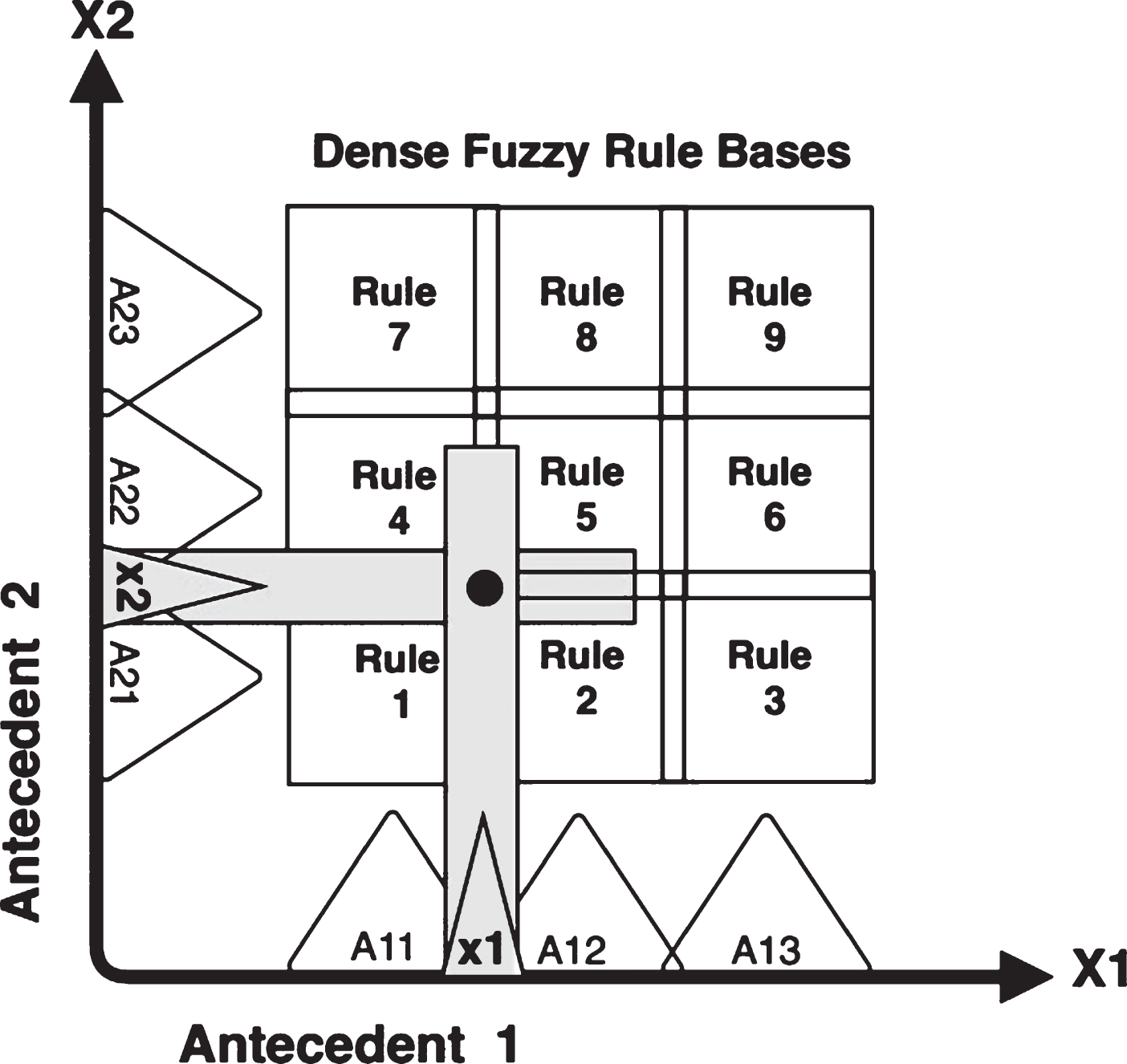
Complete fuzzy rule base [23].
Thus, the conclusion could be computed based on one of the classical fuzzy reasoning methods, like Zadeh- Mamdani “max-min” Compositional Rule of Inference (CRI).
The sparse fuzzy rule-base (incomplete rule-base) is a rule-base in which the union of the antecedents Ai of the fuzzy rules (Ri): “if X is Ai then Y is Bi” are not covering the antecedent universe. There is input A* such that it is not overlapping with any of the rule antecedents. The aim of a fuzzy interpolation method is to provide the corresponding conclusion to such an observation A* too. Figure 2 describes the issue, where the observations (x1.1, x2.1) and (x1.2, x2.2) refer to the two-dimensional inputs, which does not overlap with any of the rule antecedents. This case with classical fuzzy reasoning no conclusion can be obtained.
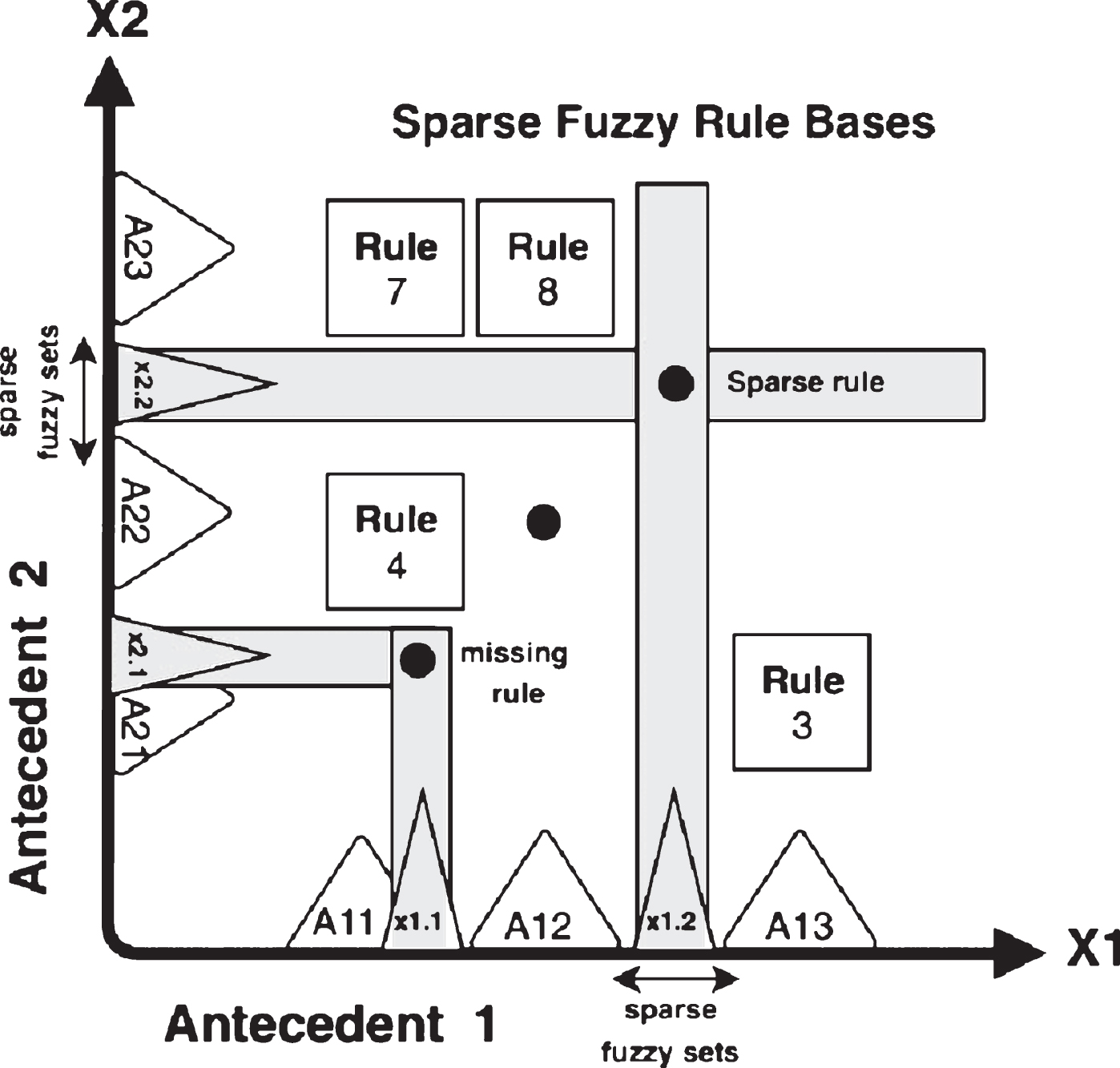
The incomplete (sparse) fuzzy rule base with a not overlapping observation [23].
A fuzzy set (A) defined on a universe of discourse X which holds total ordering, is a fuzzy number, i.e. a CNF set, if it is normal, its height is equal to one, and convex. It has a membership grade of any elements between two other elements greater than, or equal to the minimum membership degree of these two boundary elements. A convex fuzzy set can be defined by ∀x, y ∈ U, ∀ λ ∈ [0, 1] : μA (λ . x + (1 - λ . y)) ⩾ min(μA (x) , μA (y)). The support of a fuzzy set (A) is the set of all elements in the universe of discourse X with a membership degree μA (x) is greater than zero. Supp (A) : x ∈ U, μA (x) > 0.
The height of a fuzzy set is the maximum membership degree of all the elements of the universe, and it can be defined by Height (A) : max(x) ∈ U (μA (x)). A fuzzy set is said to be normal if at least one element of the universe has a membership degree equal to 1, ∃x ∈ U, μA (x) : Height (A) = 1. The α-cut and the strong α-cut of a fuzzy set is the crisp subset of the universe where the membership degrees are greater (strong α-cut), or greater, or equal (α-cut) than a specified α value. The α-cut can be represented by Aα : x ∈ U, μA (x) ⩾ α, α ∈ [0, 1] and Aα : x ∈ U, μA (x) > α, α ∈ [0, 1]. The kernel of a fuzzy set is the crisp subset of the universe where the membership degrees are equal to 1. Kernel (A) : x ∈ U, μA (x) = 1.
In case of a convex fuzzy set A on Rn, all of its α–cuts A
α
are convex sets for all α ∈ (0, 1], i.e. its α–cuts are intervals. In most cases particular types of the fuzzy numbers such as trapezoidal and triangular are used for real-life applications. A fuzzy number (A) is called a generalized trapezoidal fuzzy number if its membership function is given as follows:

Generalized trapezoidal and triangular fuzzy numbers.
The incircle of a triangular fuzzy number can be considered as an incircle of a triangle. The incircle of a triangle is that circle which touches all three main sides (AB, BC, and AC) of the triangle, and the points of tangency of the incircle of ΔABC (i.e. T A , T B , T C ) with its sides as shown in Fig. 4.
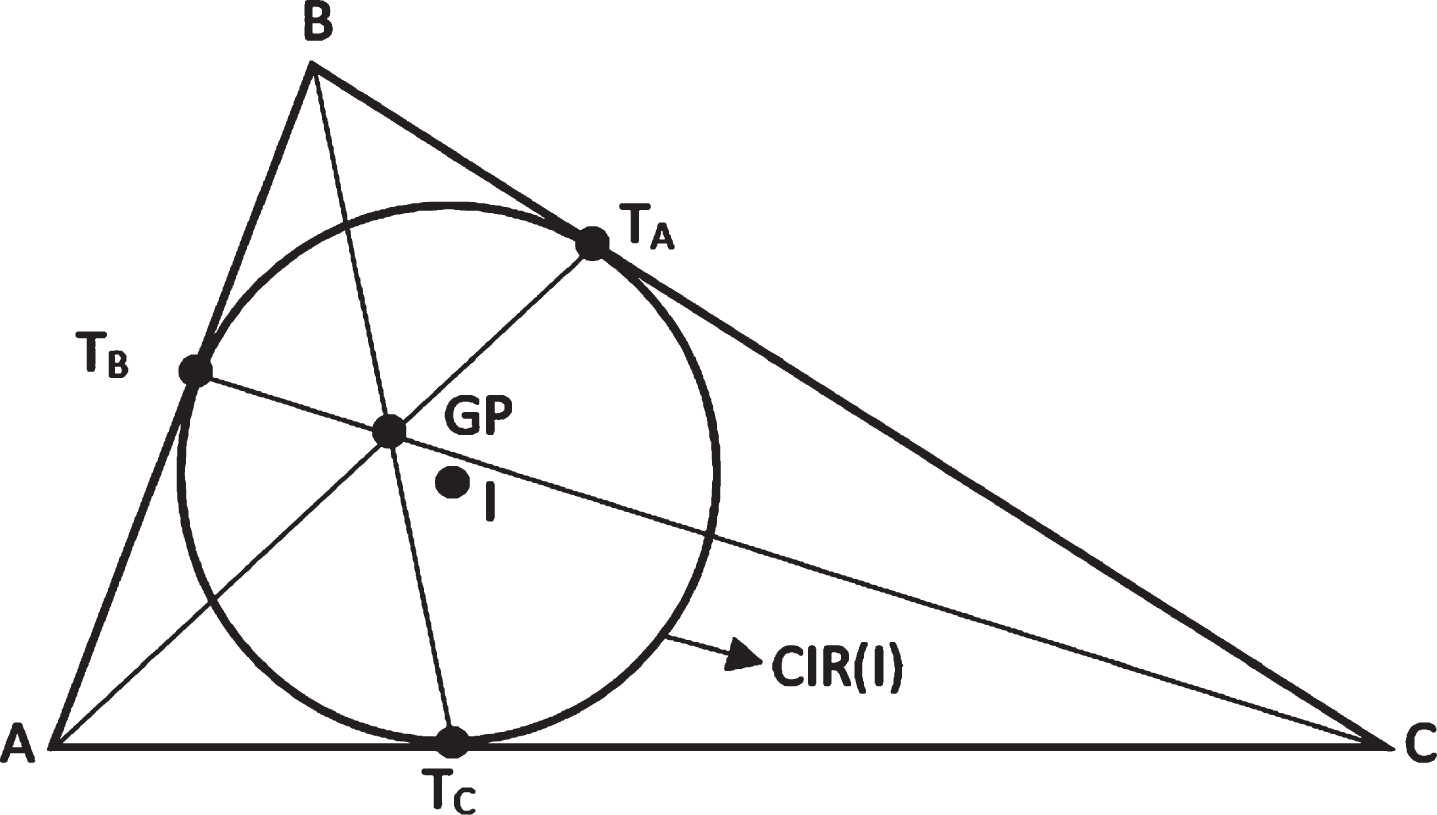
The Incircle CIR(I) with Gergonne Point in a triangle ABC.
Consequently, that follows the Cevasquos theorem directly (see theorem 1), where cevians of particular importance in the general triangle (medians, angle bisectors, etc.) are synchronous, and the fact that two tangents to a circle from a point outside the circle are equal. Furthermore, the common point of a triangle ABC that called a particular point of the triangle could be defined as the point of intersection of the cevians ATA, BTB and CTC. This point is called the Gergonne Point (GP) of the triangle [24], which is the concurrence point for the cevians from the vertices to the points of tangency on the opposite sides of the triangle as shown in Fig. 5.
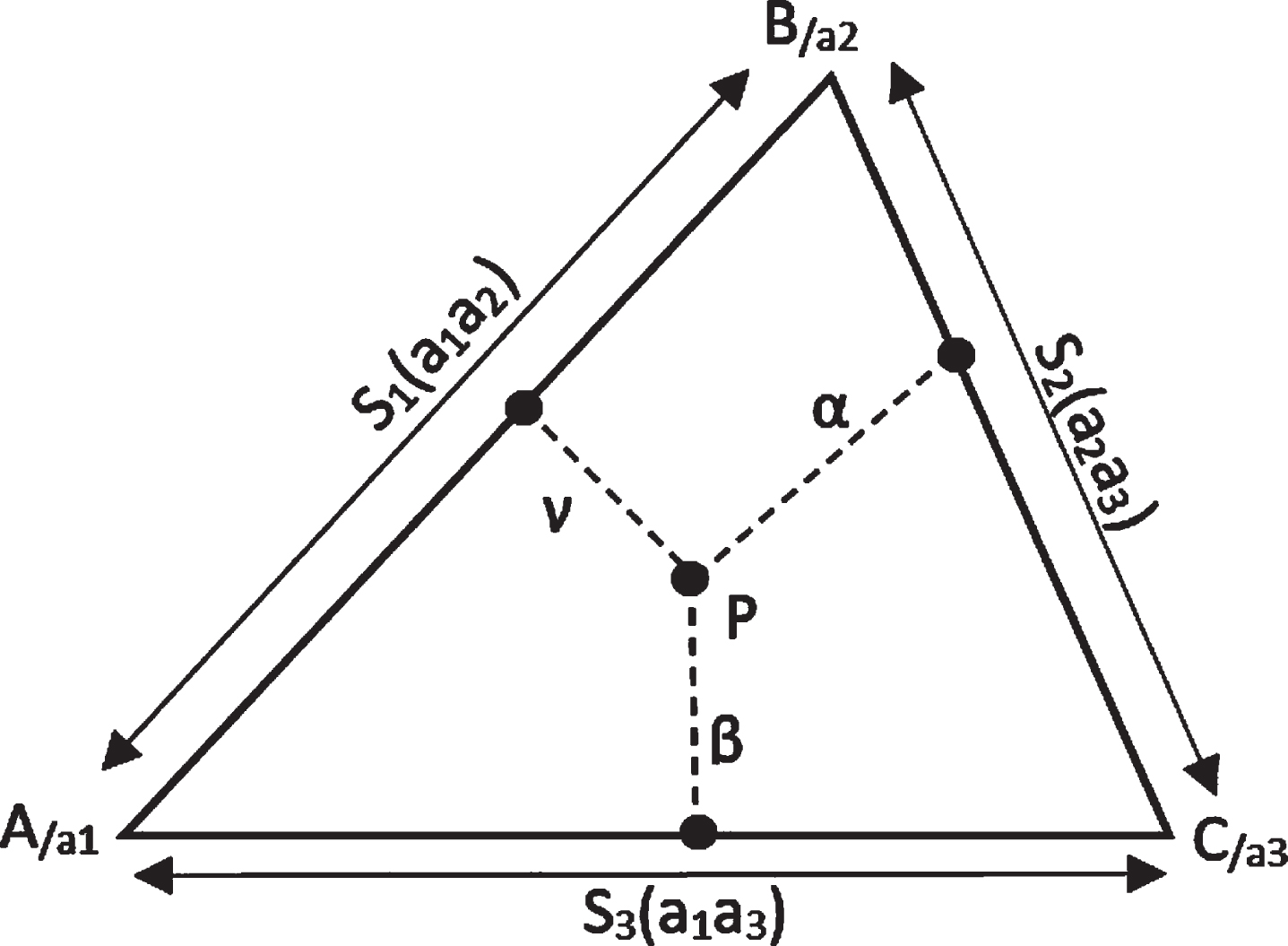
Trilinear Coordinates α β γ of point P.
By using Ceva’s Theorem, the following result could be got directly by the given the existence of a triangle with vertices A, B and C. The Trilinear Coordinates (TCs) of point P, which related to triangle ABC are three ordered numbers. Each corresponding to the distance from P to one of the sideline. TCs are generally referred via α:β:γ as shown in Fig. 5. If point P has TCs α:β:γ, then the Cartesian Coordinates of P are calculated as follows:
TCs of the GP are given as:
Based on the properties of the incircle triangular fuzzy number, some notations for the fuzzy rules and for the observation fuzzy sets could be determined. It will be used to perform the approximate conclusion. The “center” of the triangle could be denoted by the Gergonne Point (GP), and the main sides of the triangular are indicated as SD1, SD2 and SD3. Besides, the length of tangents and the vertices of the triangle can be determined to its incircle which denotes by PS1, PS2 and PS3 as shown in Fig. 6. In the followings these sides PS1, PS2 and PS3 will be referred as “fuzziness sides”.
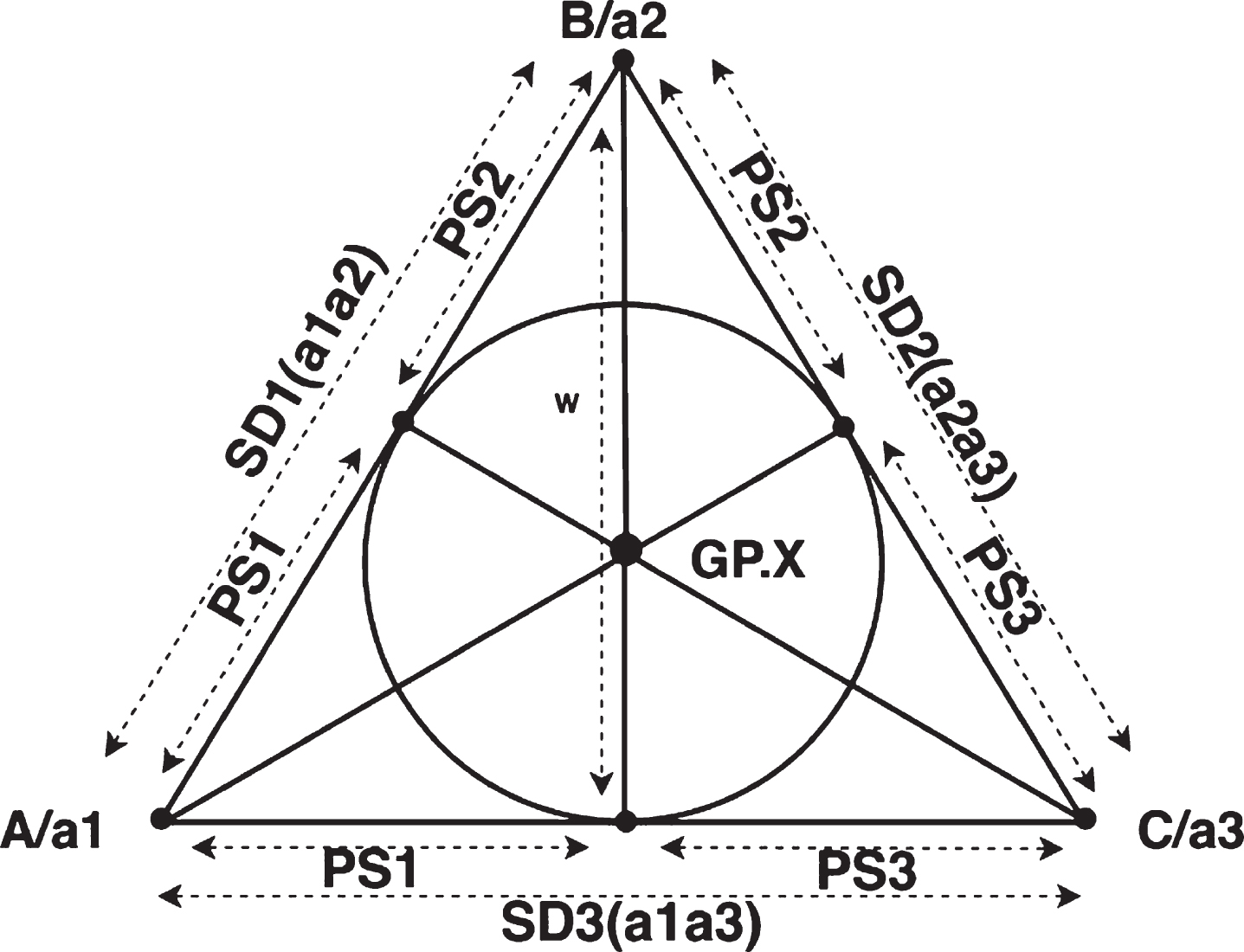
Notations of triangular fuzzy number.
Assuming that the triangular fuzzy set is A = (a1, a2, a3; H). Hence, a triangle with the coordinates of vertices could be got as following: A = (a1,0), B = (a2, H) and C = (a3,0) with H. If H is equal to 1, then the fuzzy number is normal. The trapezoidal fuzzy set can be represented by two triangular fuzzy numbers AL = (a1, a2, Mp; H) and AR = (Mp, a3, a4; H). In the following, some notations required for calculating the approximating conclusion of the proposed “Incircle FRI” are presented.
Supposing that there are a single dimensional antecedent space and two adjacent fuzzy rules to the observation (like in the original KH FRI) and triangular shaped fuzzy observation and rule antecedents.
Regarding the height property of the fuzzy set, a fuzzy set (A) is normal if there is at least one element on the universe of discourse has a membership degree equal to 1, ∃ x ∈ U, μA (x) : Height (A) = 1.
In this section, a new fuzzy interpolative reasoning method will be presented for sparse fuzzy rule based systems, which is based on the incircle of the triangular fuzzy set of the fuzzy rules and observation. To facilitate the discussion in our approach, the representative values of the approximating conclusion fuzzy set will be determined by the Gergonne Points (GP.x), left fuzziness (PS1) and right fuzziness (PS3). In the followings, the proposed “Incircle FRI” will be discussed in details.
Single antecedent variable with triangular fuzzy sets
The triangular membership function is a particular case of the fuzzy sets, which are vastly used in fuzzy rule-based systems because of its simplicity. A triangular membership function can be described by vertices (a1, a2, a3; H), where a1 refers to the left side of the support, a2 denotes the center point and a3 refers to the right side of the support, and H denotes the height of the fuzzy set.
Figure 7 describes the suggested reference point of the fuzzy set, which is the Gergonne Point (GPx.A) of fuzzy set A, the main left, right and base sides of triangle ABC, which indicate by SD1, SD2 and SD3, respectively. The left PS1 and right PS3 fuzziness sides of triangular membership function can be described, where PS1 refers to the left fuzziness and PS3 refers to the right fuzziness.

The main notations of the triangular fuzzy number represented by GP.x, SD1, SD3, SD3, PS1, PS2 and PS3.
For simplicity, in the initial version of the suggested reasoning method, the two adjacent fuzzy rules A1 ⇒ B1 and A2 ⇒ B2 to the observation will be taken into consideration from the rule-base only. A1, A2, B1 and B2 denote the fuzzy sets of the antecedents and consequents, respectively. Considering that the observation fuzzy set A* occurs between the fuzzy sets A1 and A2. The conclusion B* fuzzy set denotes the fuzzy interpolative reasoning result as shown in Fig. 8. The scheme of the fuzzy interpolative reasoning of the two fuzzy-rules and observation using triangular fuzzy sets can be defined as follows:
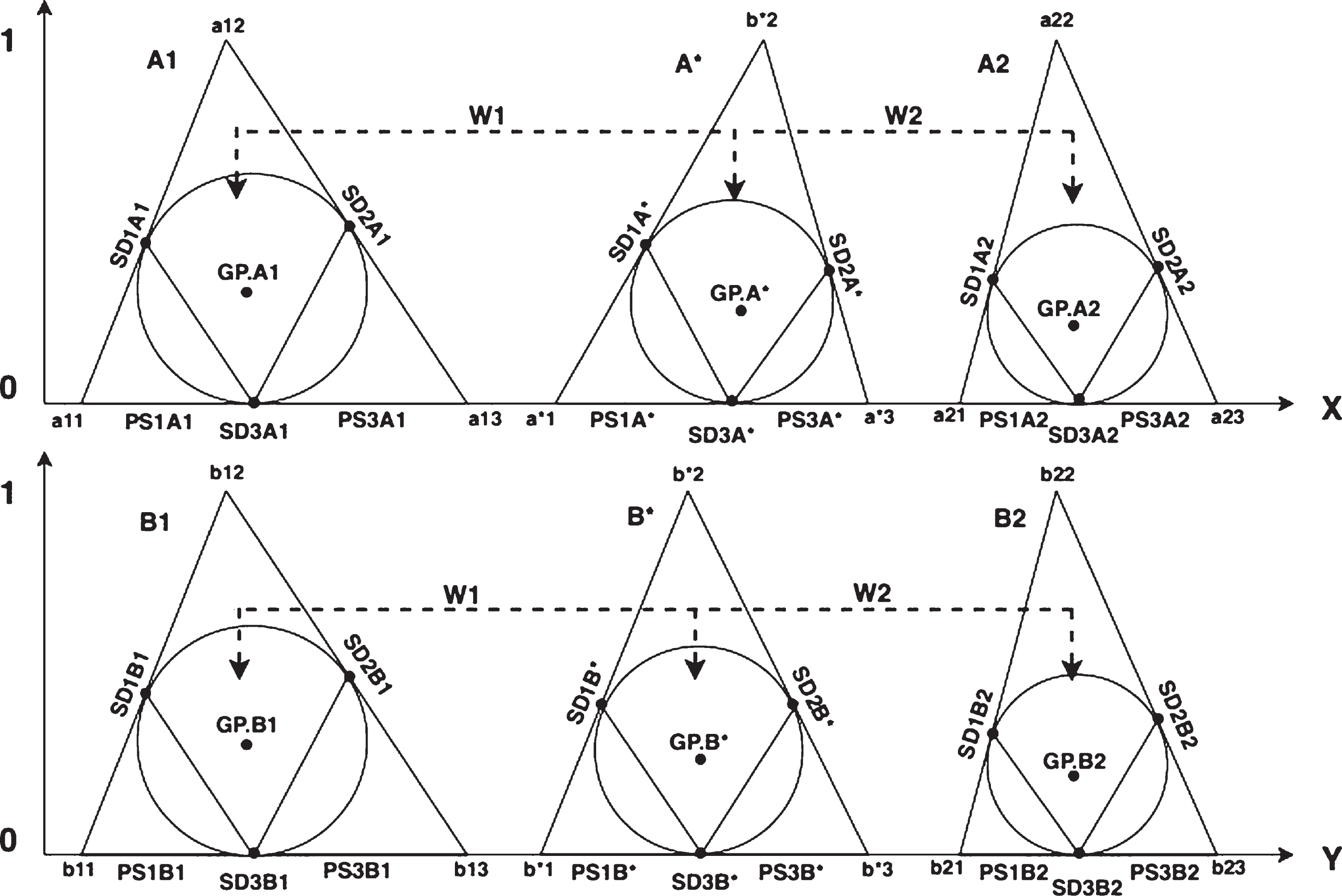
Fuzzy interpolative reasoning using triangular membership functions.
First, GP . X refers to the Gergonne Point of the fuzzy sets. It could be calculated by Equation (4). Second, W i denotes the weight of Rule i , 0 ⩽ W i ⩽ 1, 1 ⩽ i ⩽ m, where i = 1, 2 that represents the individual fuzzy rules as given in Fig. 8 holding the property of W1 + W2 = 1.
The required Gergonne Points GP x . B1 and GP x . B2 can be calculated by Equation (4).
Where M ∈ [PS1, PS3], PS1 refers to the left fuzziness side and PS3 denotes the right fuzziness side of triangular fuzzy set. If one of the antecedents fuzzy sets A1 and A2, the left PS1 or right PS3 are great than zero, the top part of the Equation (9) is implemented to conclude the left and right fuzziness sides PS1 and PS3 of the fuzzy set B*. Otherwise, if both antecedents fuzzy sets A1 and A2 are found, the left PS1 and right PS3 are zero. I.e. in case of singleton fuzzy sets, the bottom part of the Equation (9) could be used.
In general, the result of the proposed “Incircle FRI” is satisfied with logically consistent properties and with respect to the ratios of fuzziness sides based on the two-fuzzy-rules interpolative reasoning technique, which obtained by Equation (9). The top equation of (9) is used to infer the fuzziness sides of the interpolated conclusion fuzzy set B* if there exists a fuzzy rule whose fuzziness sides of the antecedent part is larger than zero. Otherwise, the bottom equation of (9) is used when the fuzziness sides of the antecedent part of the given fuzzy rules are zero. That means the larger the fuzziness of the membership function of a fuzzy set is the more fuzziness the fuzzy set has. Therefore, the ratio R(A, B) of the Left-Right fuzziness sides (A) fuzzy set to the Left-Right fuzziness sides (B) fuzzy set is defined in [14] as follows:
It is evident that Property 1 and Property 2 are logically consistent with regard to the left and right ratios of fuzziness (RF . PS1 and RF . PS3) based on the two fuzzy rules. Based on (9), the weight W i of RF.PS m (A i ,B i ) contributing to RF.PS m (A*, B*) is determined by the distance of the Gergonne Points between A i and A*. That is, the closer the Gergonne Point of A* to the Gergonne Point of A i , the larger the weight of RF.PS m (A i , B i ), where i = 1, 2 and m ∈ PS1, PS3.
The incircle concept of triangular fuzzy numbers can be extended to trapezoidal fuzzy set. A trapezoidal fuzzy set can be represented through two triangular fuzzy sets AL = (a1, a2, Mp; H) and AR = (Mp, a3, a4; H). Thus, the notations in Equations (3), (4) and (5) will be used to calculate AL and AR separately.
Figure 9 describes left and right Gergonne Points of the trapezoidal fuzzy set that are denoted by GP x .A L and GP x .A R . The main sides of the left triangle AL are described by SDL1, SDL2 and SDL3, respectively. And the fuzziness sides of AL can be described by the left PS1A L and the right PS3A L . For the right triangle AR, the main sides are described by SDR1, SDR2 and SDR3, respectively. Besides, the fuzziness sides of AR can be represented by the left PS1A R and the right PS3A R . The fuzziness sides PS1A L and PS3A R will be used to describe the left fuzziness and the right fuzziness of the trapezoidal membership function to determine the conclusion.

The main notations of the trapezoidal fuzzy number represented by notations of two triangular fuzzy sets AL and AR.
An example for the suggested fuzzy interpolative reasoning using trapezoidal fuzzy sets is shown in Fig. 10. The main steps of the suggested incircle fuzzy interpolative reasoning method with trapezoidal fuzzy sets (represented by two AL and AR triangular fuzzy sets) could be determined as follows:
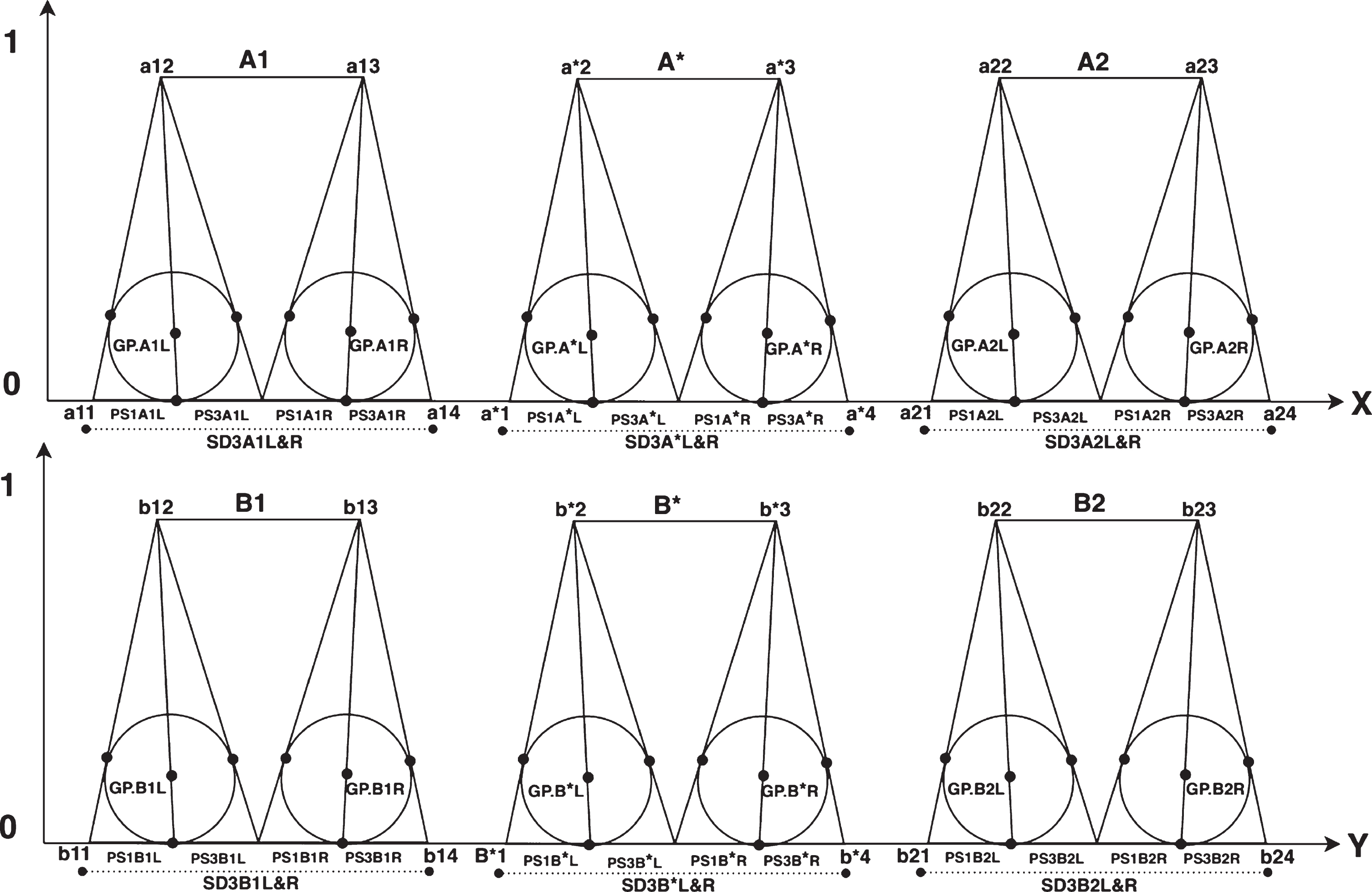
Fuzzy interpolative reasoning using trapezoidal membership functions.
Thus, the closest fuzzy rules can be determined by using the average of two Gergonne Points GP.xAL and GP.xAR of the trapezoidal fuzzy sets via AVG.GPX = (GPX.AL and GPX.AR)/2. Then, distances can be computed using Equation (12):
Regarding the main point (MP) of the trapezoidal fuzzy set can be calculated by MP.B* = AVG.GPX.B1 + (((AVG.GPX.A*- AVG.GPX.A1) × (AVG.GPX.B2- AVG.GPX.B1))/(AVG.GPX.A2- AVG.GPX.A1))).
M ∈ [PS1, PS3], PS1 refers to the left fuzziness side and PS3 denotes the right fuzziness side for the two triangles fuzzy sets AL and AR.
The top part of Equations (15) and (16) is performed to conclude the left fuzziness side PS1 and the right fuzziness side PS3 of the fuzziness of B* fuzzy set. If one of the antecedents A1 and A2 fuzzy sets exits, PS1 or PS3 is bigger than zero, if both PS1 or PS3 of A1 and A2 fuzzy sets are zero, the bottom part of Equations (15) and (16) could be used.
The first case: The results of AL and AR triangular fuzzy sets have the same values, then the conclusion can be determined as follows:
The second case: The result of the left triangular AL has the same values, and the right triangular AR has the same values too, but both left and right values are not the same. The conclusion values will be defined by GPx1x2 = (GPx.B*L + GPx.B*R)/2 as follows:
The third case: Because we are working with two triangular separately, in case the Left triangular has the same values, we will use B1*, but in case the Right one has the same values, we will use B2*, then, the conclusion can be determined as follows:
The fourth case: When all values results of the left and the right triangles are different. The conclusion can be determined as follows:
Because B*1≤B*2≤B*3≤B*4, we can see that the proposed method can preserve the convexity of the fuzzy interpolative reasoning result with trapezoidal fuzzy set, add to that the value of the left point (B*1) is smaller than or equal to the values of the reference point (GPX. B*L and GPX. B*R), which are also smaller than or equal to the value of the right point (B*4).
The incircle concept of triangular and trapezoidal fuzzy numbers can be further extended to hexagonal, or any complex polygonal fuzzy membership functions. In the followings the extension of the suggested incircle fuzzy interpolation method to hexagonal fuzzy sets will be discussed.
A Hexagonal fuzzy set can be represented by two triangular fuzzy sets AL = (a1, a2, a3) and AR = (a4, a5, a6). Figure 11 describes the representative values of a hexagonal fuzzy set, which is denoted by (a1, a2, a3, a4, a5, a6). The Gergonne Points (left and right) denotes by a3 and a4, respectively. a1 and a6 are the left and the right side of the support points, respectively, and a2 and a5 are the intermediate points. Thus, the Equations (3), (4) and (5) can be used to calculate AL and AR separately.
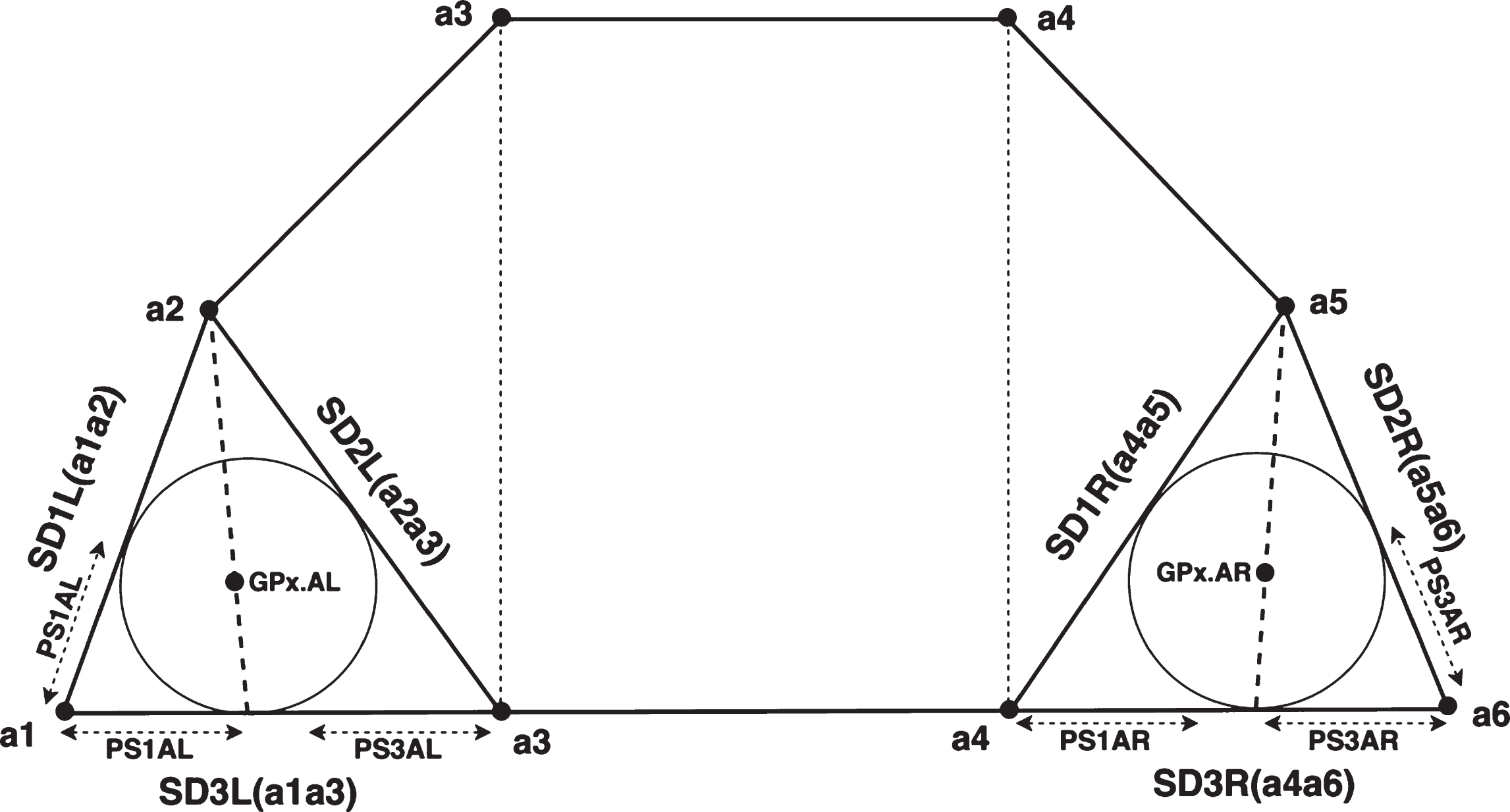
The main notations of the hexagonal fuzzy number represented by notations of two triangular fuzzy sets AL and AR.
An example of the suggested incircle fuzzy interpolative reasoning using hexagonal fuzzy sets is shown in Fig. 12. The main steps of the suggested incircle fuzzy interpolative reasoning method with hexagonal fuzzy sets (represented by two AL and AR triangular fuzzy sets) are the followings:
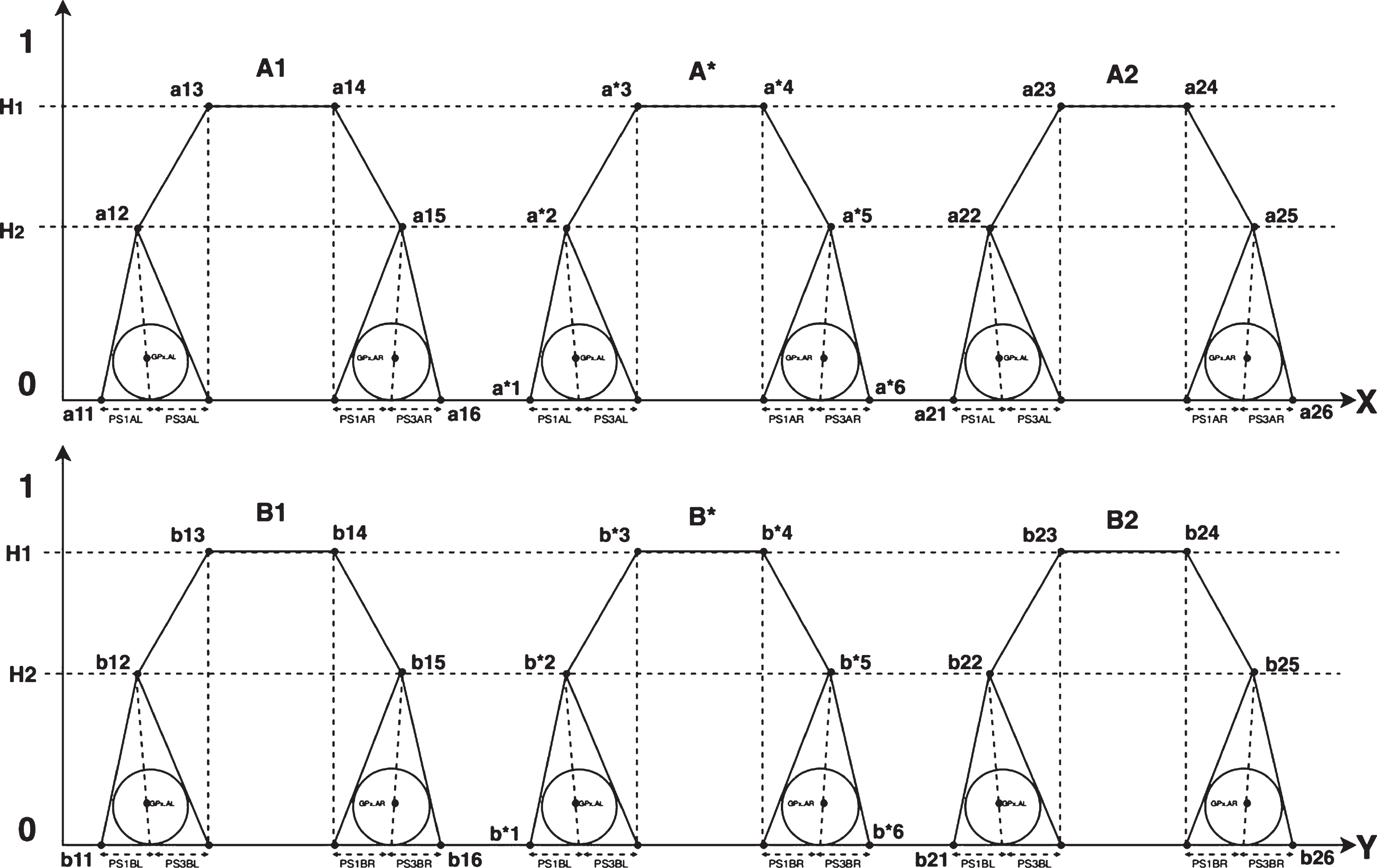
Fuzzy interpolative reasoning using hexagonal membership functions.
In this section, we discuss the performance of the proposed “Incircle FRI” method, some numerical examples in [13, 27–29] will be compared with the results of KH FRI [1–3], KHstab FRI [5], VKK FRI [4], CCL FRI [14], HS FRI [13], HTY FRI [15], and HCL FRI [12]. The KH FRI, the KHstab FRI, and the VKK FRI methods were tested by using the Matlab FRI toolbox [30, 31]. In addition, we present a comparison summary of the seven FRI methods and Incircle FRI based on five evaluation criteria (i.e., CNF property”, “different membership functions,” “different kinds membership functions of the antecedents and the consequents fuzzy rules”, “the similarity propagation of the fuzziness and core between the observation and conclusion”, and “logically consistent with respect to the ratios of fuzziness”).
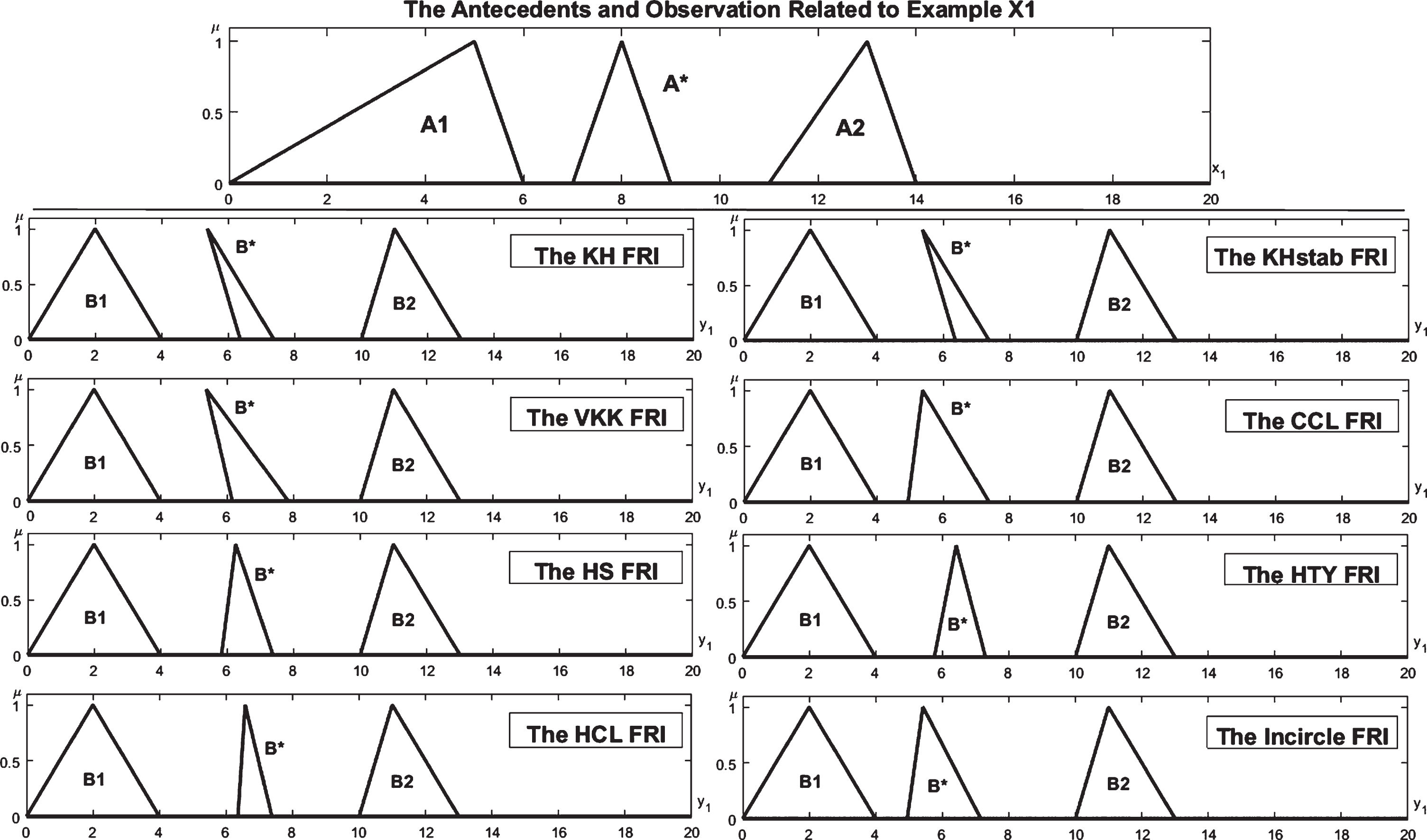
A comparison of FRI results of Example X1 for several methods.
Based on Equations (10) and (11) and Table 1, the logically consistent properties and the respect to ratios of the fuzziness two adjacent Rules (A1 ⇒ B1) and (A2 ⇒ B2), the left ratio fuzziness RF.PS 1 (A1, B1) = 0.4 and the ratio RF.PS 1 (A2, B2) = 0.5, and the left ratio fuzziness RF.PS 1 (A*, B*) of the proposed Incircle FRI, CCL FRI, the HCL FRI, the HTY FRI and HS FRI methods are 0.44, 0.44, 0.22, 0.66 and 0.43, therefore, the proposed Incircle FRI, CCL FRI and HS FRI satisfy property 1, where MIN (RF.PS 1 (A1, B1), RF.PS 1 (A2, B2)) = 0.4≤RF.PS 1 (A*, B*) = [Incircle(0.44), CCL(0.44), HS(0.43)]≤MAX (RF.PS 1 (A1, B1), RF.PS 1 (A2, B2)) = 0.5. The right ratio fuzziness of Rules ((A1 ⇒ B1 and A2 ⇒ B2) RF.PS 3 (A1, B1) = RF.PS 3 (A2, B2) = 2, and the right ratio fuzziness RF.PS 3 (A*, B*) of the proposed Incircle FRI, CCL FRI, the HCL FRI, the HTY FRI, HS FRI, KHstab FRI, and KH FRI methods are 2, 2, 0.8, 0.88, 1.12, 2, and 2, respectively. Thus, the right ratio fuzziness RF.PS 3 (A*, B*) of the proposed Incircle FRI, CCL FRI, KHstab FRI, and KH FRI satisfy Property 2, where MIN (RF.PS 3 (A1, B1), RF.PS 3 (A2, B2)) = MAX (RF.PS 3 (A1, B1), RF.PS 3 (A2, B2)) = RF.PS 3 (A*,B*) = 2.
Fuzzy interpolative reasoning results of Example X1
Therefore, the fuzzy interpolative reasoning result of the proposed Incircle FRI is logically consistent in terms of Property 1 and Property 2.
Fuzzy interpolative reasoning results of Example X2
Note: the sign (-) indicates no clear evidence for the method to handle the case in the example.
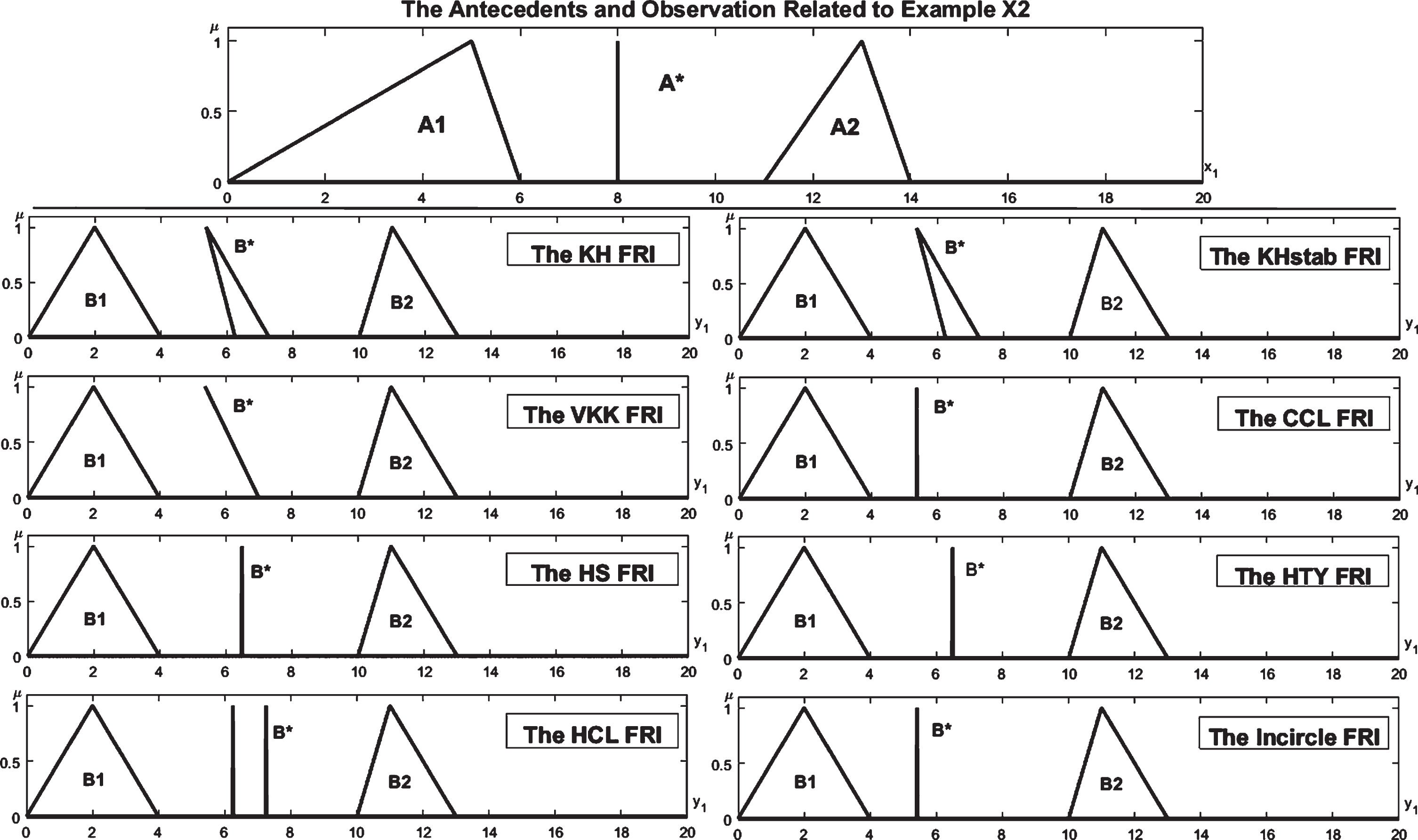
A comparison of FRI results of Example X2 for several methods.
Based on Equations (10) and (11) and Table 2, the left ratio fuzziness and the right ratio fuzziness of this example have the same results in Example X1. The results of the proposed Incircle FRI, CCL FRI satisfy property 1 for the left ratio fuzziness RF.PS 1 (A*, B*), where MIN (RF.PS 1 (A1, B1), RF.PS 1 (A2, B2)) = 0.4≤RF.PS 1 (A*, B*) = [Incircle(0.44), CCL(0.44)]≤MAX (RF.PS 1 (A1, B1), RF.PS 1 (A2, B2)) = 0.5. While, the right ratio fuzziness RF.PS 3 (A1, B1) = RF.PS 3 (A2, B2) = 2, and the results of the right ratio fuzziness RF.PS 3 (A*, B*) of the proposed Incircle FRI and CCL FRI satisfy Property 2, which are 2. Therefore, the fuzzy interpolative reasoning result of the proposed Incircle FRI is logically consistent in terms of Property 1 and Property 2 for the left and right ratio fuzziness, respectively.
Fuzzy interpolative reasoning results of Example X3
Note: the sign (-) indicates no clear evidence for the method to handle the case in the example.

A comparison of FRI results of Example X3 for several methods.
The left fuzziness of the left triangular TR L PS1 = 0 and the right fuzziness of the right triangular TR R PS3 = 1.05 could be obtained based on Equations (5), (13), (15), and (16). Consequently, the Incircle FRI gets conclusion as trapezoidal fuzzy set B* = [4.54 4.54 7.47 8.53] according to Equation (19). Figure 16 shows the results of the FRI methods. The HCL FRI [12] is unable to generate a conclusion in this case. The KH FRI [1–3], the KHstab FRI [5], the VKK FRI [4], and the HTY FRI [15] generate an abnormal trapezoidal fuzzy set. In contrast, the CCL FRI [14], the HS FRI [13], and the proposed Incircle FRI generate CNF trapezoidal fuzzy sets.
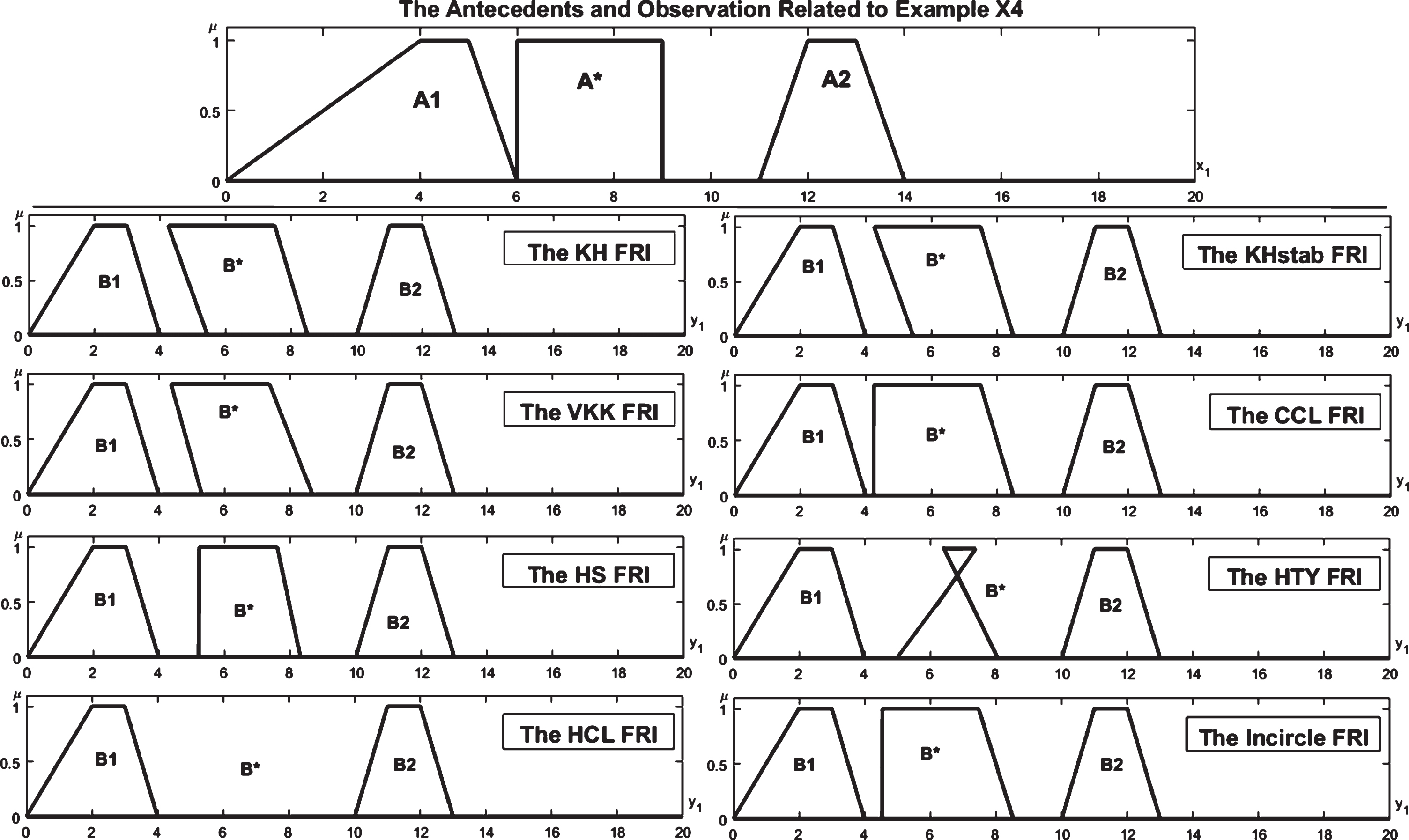
A comparison of FRI results of Example X4 for several methods.
Concerning ratios of the fuzziness of the two Rules (A1 ⇒ B1) and (A2 ⇒ B2) obtained by Equations (10) and (11) and Table 4, the left ratio fuzziness RF.PS 1 (A1, B1) = 0.5, RF.PS 1 (A2, B2) = 1, therefore, the left ratio fuzziness RF.PS 1 (A*, B*) of the proposed Incircle FRI and CCL FRI are 0.64 and 0.69, therefore, the proposed Incircle FRI and CCL FRI methods satisfy property 1, where MIN (RF.PS 1 (A, B))≤RF.PS 1 (A*, B*)≤MAX (RF.PS 1 the (A, B)) is equal 0.5≤[Incircle (0.64), CCL (0.69)]≤1. For the right ratio fuzziness, the ratio RF.PS 3 (A1, B1) = RF.PS 3 (A2, B2) = 1, and RF.PS 3 (A*, B*) of the proposed Incircle FRI, HTY FRI, HS FRI, CCL FRI, KHstab FRI, and KH FRI methods are 1, 1.62, 0.71, 1, 1, and 1, respectively. Hence, the right ratio fuzziness RF.PS 3 (A*, B*) of the proposed Incircle FRI, CCL FRI, KHstab FRI, and KH FRI satisfy Property 2. Therefore, the fuzzy interpolative reasoning results of the proposed method are logically consistent in terms of Property 1 and Property 2.
Fuzzy interpolative reasoning results of Example X4
Note: the sign (-) indicates no clear evidence for the method to handle the case in the example.
Fuzzy interpolative reasoning results of Example X5
Note: the sign (-) indicates no clear evidence for the method to handle the case in the example.
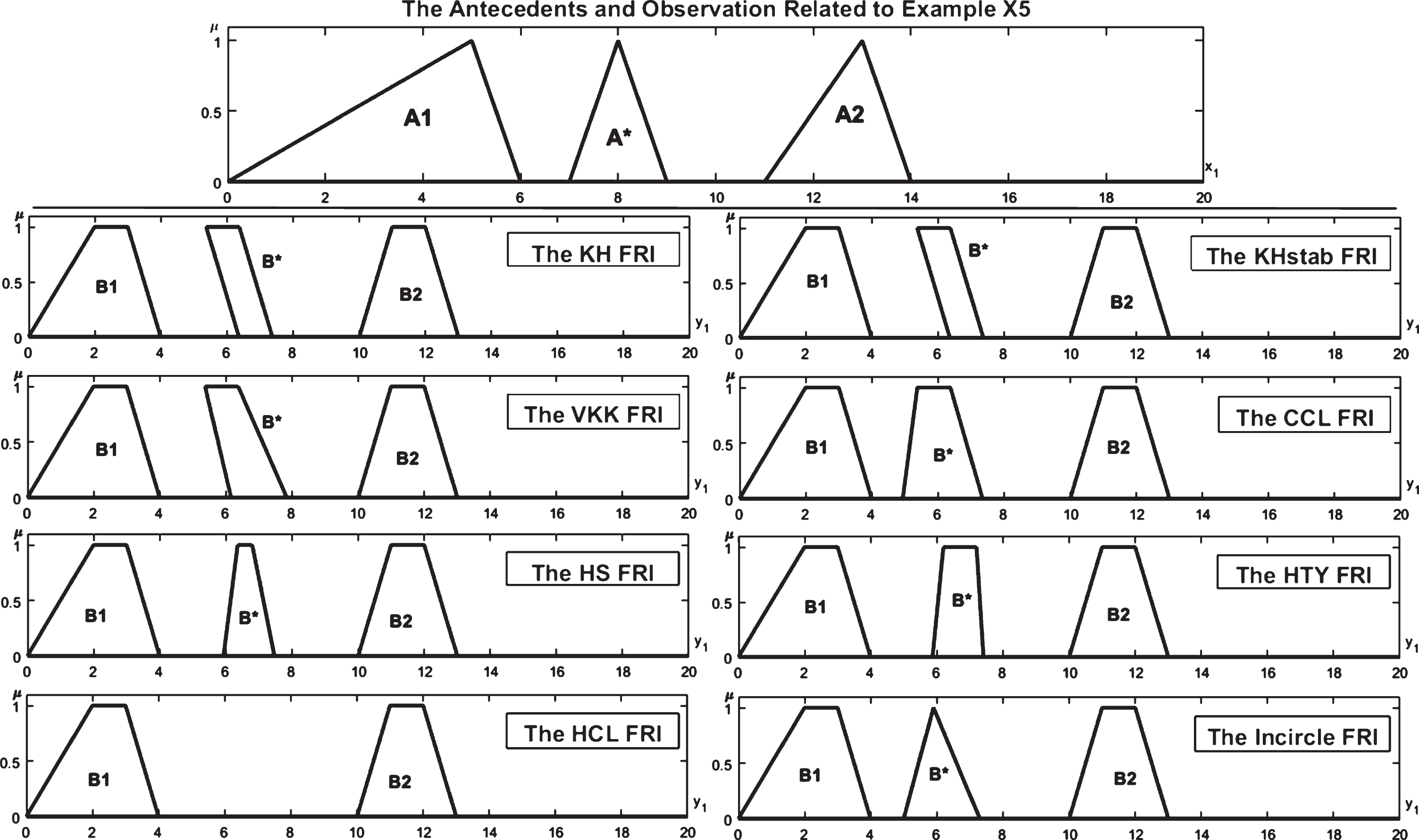
A comparison of FRI results of Example X5 for several methods.
Based on Equations (4), (5), (13), (14), (15), and (16) the conclusion of the Incircle FRI can be calculated by the fuzzy interpolation of the fuzzy sets A1, A2, B1, and B2. The center values GP x .B* L = 5.331, GP x .B* R = 6.435, and MP.B* = 5.9, the fuzziness values of the left triangular are TR L PS1 = 0.3233 and TR L PS3 = 0.0, the fuzziness values of the right triangular are TR R PS1 = 0.0 and TR R PS3 = 0.898. Therefore, the Incircle FRI produced a trapezoidal fuzzy conclusion B* = [5.0 5.9 5.9 7.3] that is calculated according to Equation (20). This case the HCL FRI is unable to generate any conclusion. The conclusion of the KH FRI [1–3], the KHstab FRI [5], and the VKK FRI [4] are not convex and normal.
The CCL FRI [14], the HS FRI [13], the HTY FRI [15], and the Incircle FRI generate CNF trapezoidal conclusion.
Based on by Equations (10) and (11) and Table 5, the ratios of fuzziness the two adjacent Rules (A1 ⇒ B1, A2 ⇒ B2), and the ratios of fuzziness of the observation and conclusion (A* ⇒ B*) of the FRI methods. The left ratio fuzziness of RF.PS 1 (A1, B1) = 0.4, RF.PS 1 (A2,B2) = 0.5, and the left ratio fuzziness RF.PS 1 (A*, B*) of the proposed Incircle FRI, the HS FRI, the CCL FRI and HTY FRI are 0.44, 0.43, 0.44, and 0.33, respectively, therefore, the proposed Incircle FRI, the HS FRI and the CCL FRI satisfy property 1, where MIN (RF.PS 1 (A1, B1), RF.PS 1 (A2,B2))≤RF.PS 1 (A*, B*)≤MAX (RF.PS 1 (A1, B1), RF.PS 1 (A2,B2)), which is equal 0.4≤(0.44, 0.44, 0.43)≤0.5. In the right ratio fuzziness, the ratio RF.PS 3 (A1, B1) = RF.PS 3 (A2, B2) = 1, and RF.PS 3 (A*, B*) of the proposed Incircle FRI, the HS FRI, the CCL FRI, HTY FRI, KHstab FRI, and KH FRI are 1, 0.67, 1, 0.21, 1, and 1. Therefore, the right ratio fuzziness RF.PS 3 (A*, B*) of the proposed Incircle FRI, CCL FRI, KHstab FRI, and KH FRI satisfy Property 2. Hence, the fuzzy interpolative reasoning results of the proposed method are logically consistent in terms of Property 1 and Property 2.
Fuzzy interpolative reasoning results of Example X6
Note: the sign (-) indicates no clear evidence for the method to handle the case in the example.
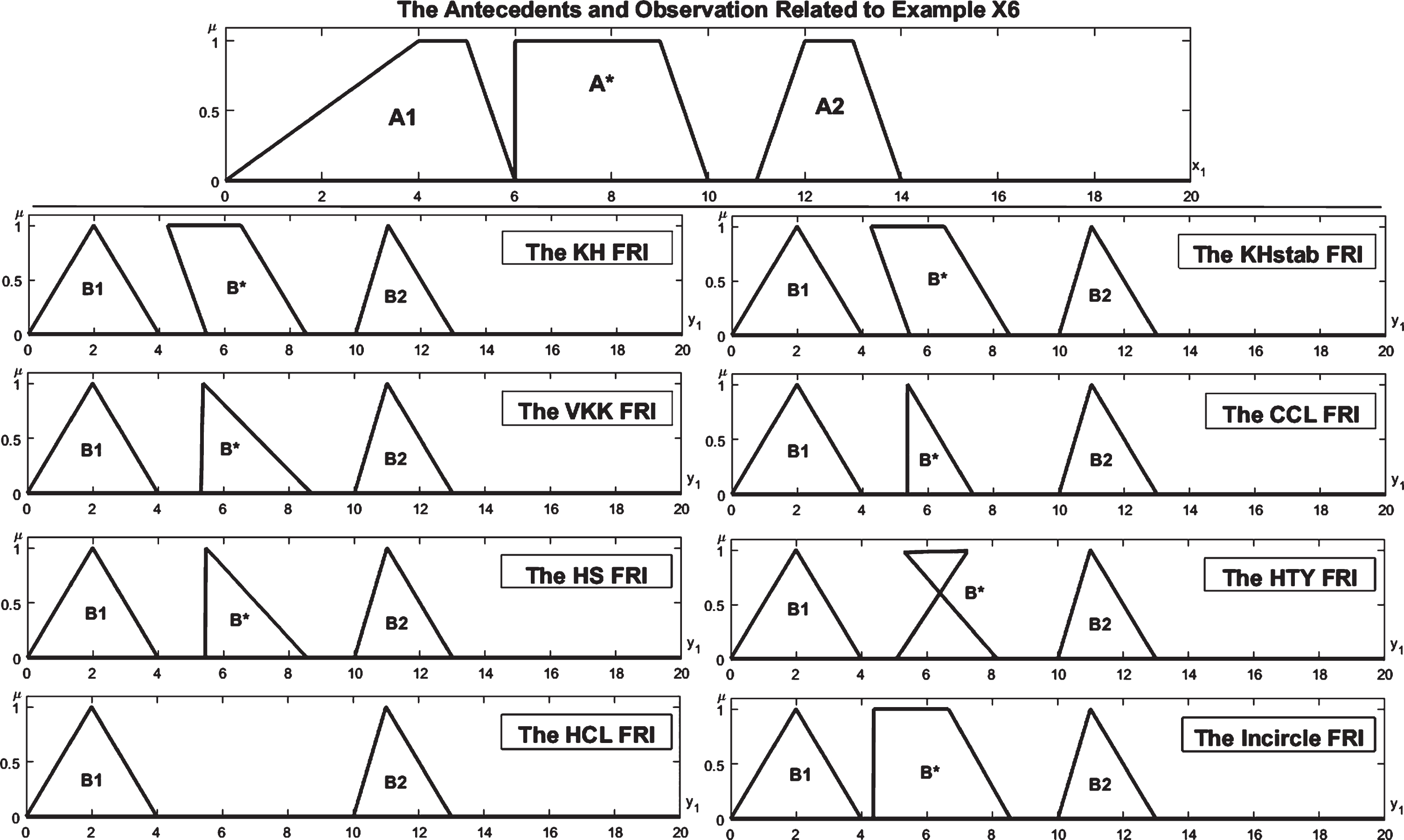
A comparison of FRI results of Example X6 for several methods.
Based on Equations (10) and (11) and Table 6, the left ratio fuzziness of the Rule1 (A1 ⇒ B1) RF.PS 1 (A1, B1) = 0.5 and the ratio of the Rule2 (A2 ⇒ B2) RF.PS 1 (A2, B2) = 1. Thus, the left ratio fuzziness RF.PS 1 (A*, B*) of the proposed Incircle FRI and CCL FRI are 0.64 and 0.69, therefore, the proposed Incircle FRI and CCL FRI satisfy property 1, where MIN (RF.PS 1 (A1, B1), RF.PS 1 (A2, B2)) = 0.5≤RF.PS 1 (A*, B*) [Incircle(0.64), CCL(0.69)]≤MAX (RF.PS 1 (A1, B1), RF.PS 1 (A2,B2)) = 1.
For the right ratio fuzziness, the ratio RF.PS3 (A1, B1) = RF.PS3 (A2, B2) = 2, and the right ratio fuzziness RF.PS3 (A*, B*) of the proposed Incircle FRI, CCL FRI, the HTY FRI, HS FRI, the VKK FRI, the KHstab FRI, and the KH FRI methods are 2, 2, 2.8, 3.1, 3.3, 2, and 2, respectively. Thus, the right ratio fuzziness RF.PS3 (A*, B*) of the proposed Incircle FRI, CCL FRI, the KHstab FRI, and the KH FRI satisfy Property 2, where RF.PS3 (A1, B1) = RF.PS3 (A2, B2) = RF.PS3 (A*, B*) = 2. Therefore, the fuzzy interpolative reasoning result of the proposed method is logically consistent in terms of Property 1 and Property 2.
Fuzzy interpolative reasoning results of Example X7
Note: the sign (-) indicates no clear evidence for the method to handle the case in the example.
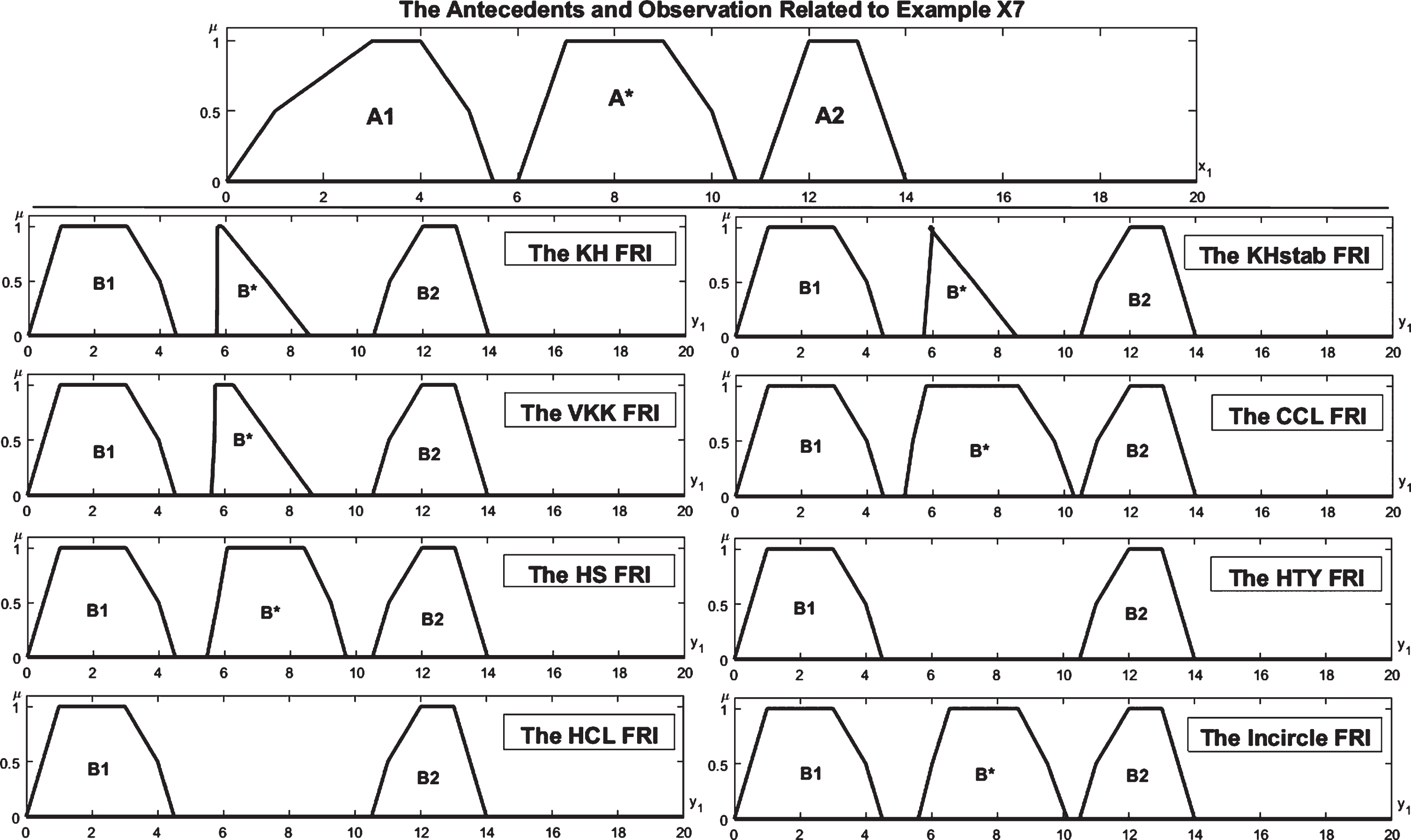
A comparison of FRI results of Example X7 for several methods.
Table 8 presents a summary of evaluation for the proposed Incircle FRI method compared with the current methods (i.e., KH FRI [1–3], KHstab FRI [5], VKK FRI [4], HCL FRI [12], HTY FRI [15], CCL FRI [14], and HS FRI [13]) according to the criteria (i.e., CNF property”, “different membership functions,” “different kinds membership functions of the antecedents and the consequents fuzzy rules, the similarity propagation of the fuzziness and core between the observation and conclusion, and “logically consistent with respect to the ratios of fuzziness (property 1 and property 2)”). From Table 8, we can see that the Incircle FRI methods satisfy with these five evaluation criteria, where the sign (√) indicates the technique is satisfied with all criteria for all selected examples, while a sign (-) shows the method has a problem in most examples, and the sign (x) indicates the technique does not satisfy with all examples.
Description of the evaluation criteria of the Incircle FRI with existing methods
In this paper, a new fuzzy interpolative reasoning method called “Incircle FRI”, is introduced, which is defined for triangular CNF fuzzy sets, for a single antecedent universe and two surrounding rules from the rule-base. The suggested “Incircle FRI” is based on the incircle of a triangular fuzzy number, the Gergonne Point (GP) as a reference point of the triangular fuzzy set, and the “fuzziness sides”, i.e. the distances of the endpoints of the support, and the core from the incircle InTouch points (noted by PS1, PS2 and PS3 in this paper). The proposed method calculates the conclusion by holding the same rate of distances among the observation and the two rule antecedents, and the conclusion and the two corresponding rule consequents with the Gergonne Points (for the reference point of the conclusion), and with the “fuzziness sides” (for the shape of the conclusion). The paper also extends the suggested “Incircle FRI” to trapezoidal, and hexagonal shaped fuzzy sets by decomposing their shapes to multiple triangulars. The generated conclusion is also a CNF fuzzy set. The performance of the suggested “Incircle FRI” is discussed based on numerical examples, and a comprehensive comparison to other FRI methods, namely with the KH method [1–3], the KHstab method [5], the VKK method [4], the HCL method [12], the HTY method [15], the CCL method [14], and the HS method [13]. From the experimental results and Table 8, we can see that the proposed method is considered one of the best current FRI methods. Consequently, the proposed method provides a useful method as a fuzzy interpolation in dispersed rules-based systems.
Footnotes
Acknowledgments
The described study was carried out as part of the EFOP-3.6.1-16-00011 Younger and Renewing University - Innovative Knowledge City - institutional development of the University of Miskolc aiming at intelligent specialization project implemented in the framework of the Szechenyi 2020 program. The realization of this project is supported by the European Union, cofinanced by the European Social Fund.