




Abstract
We use the notion of fuzzy chromatic number (FCN) of fuzzy graphs based on fuzzy independent vertex sets introduced in 2015. Let
Introduction
A graph was used to model many real problems where vertices represent objects and edges represent connection between two objects on a network ([1, 11]). In real world, connection between two objects is uncertain. For example, a conflict between two traffic movements in traffic networks is an indeterminate phenomenon. Also, signal interferences between two transmitters in telecommunication networks are imprecise phenomena. Therefore, we need another type of graph that can model these phenomena. This is one of the reasons why fuzzy graph is needed. The research on fuzzy graph has developed rapidly. Recently, Poulik and Ghorai [20] have proposed detour g-interior nodes and detour g-boundary nodes in bipolar fuzzy graph with applications. Further, they also have investigated certain indices of graphs in bipolar fuzzy environment [21]. In [22], Poulik and Ghorai have established an updated version of definition and theorem in bipolar fuzzy graphs and demonstrated some numerical examples. Furthermore, Sahoo et al. [24] provided certain types of edge irregular intuitionistic fuzzy graphs. Also, they discussed covering and paired domination in intuitionistic fuzzy graphs in [25].
Kaufmann initiated a fuzzy graph with fuzzy edge set in 1973 [26]. Whereas, Rosenfeld introduced a fuzzy graph where fuzziness appears in both vertex and edge sets [26]. After that, many concepts in fuzzy graphs were generalized, such as dominating set, clique, and independent vertex set. For more concepts in fuzzy graphs, readers may refer to [4, 16], and [17]. Further, the concept of coloring of fuzzy graph was introduced by several researchers ([3, 19]). However, some of the methods of fuzzy graph coloring still involved crisp chromatic number.
Papers related to generalization of chromatic number can be found in [3, 19], and [27]. Munoz et al. [19] provided fuzzy chromatic number (FCN) of fuzzy graphs based on α-cut graphs coloring. Meanwhile, Bershtein and Bozhenuk ([3, 4]) defined FCN by means of maximal independent vertex sets. Keshavarz [12] gave an FCN of fuzzy graphs through incompatibility degrees of adjacent vertices. In 2015, we established FCN of fuzzy graphs based on fuzzy independent vertex sets [27] which is different to the works in [3, 4 and 19]. We also initiated a concept of an uncertain chromatic number by means of uncertainty theory in [28]. Recently, we have constructed FCN of join and union of fuzzy graphs ([29, 30]). In 2019, we have constructed FCN of cartesian product of path and complete fuzzy graphs and designed an algorithm ([31, 32]).
Cartesian product of fuzzy graphs has been used to model real problems, such as in the product of DNA structure [18], in computer science, geometry, algebra, number theory [23], also in combinatorial bayesian optimization [8]. Therefore, we are interested in investigating some problems related to cartesian product of fuzzy graphs. The problem to find FCN of cartesian product of any two fuzzy graphs has not been solved until now. Also, properties of FCN of the cartesian product have not been verified. We are interested to investigate FCN of the cartesian product of fuzzy graphs because the FCN is more suitable to handle indeterminate phenomena in real problems. Furthermore, the result in [32] is a general algorithm to find FCN of cartesian product of any fuzzy graphs based on FCN algorithm in [30] and the cartesian product concept. In other words, an algorithm to find FCN of cartesian product of path and other fuzzy graphs which is constructed based on the properties of FCN has not been created. In order to complete the work in [31] and [32], the aims of this research are to construct FCN of cartesian product of path and other fuzzy graphs, to investigate properties of the FCN, to develop an algorithm based on the properties obtained, and to verify ranking between FCN of the cartesian product
This paper is organized as follows: Section 2 discusses basic theories needed to solve the problems. Construction of FCN of cartesian product of path and other fuzzy graphs is presented in Section 3. Moreover, an algorithm to determine FCN of the cartesian product is described in Section 3. Finally, conclusions are given in Section 4.
Theoretical background
In this section, we recall some basic concepts in fuzzy sets, fuzzy numbers, and fuzzy graphs which are needed to solve the problems.
Let X be a universal set (nonempty). A set
Given two discrete fuzzy numbers
Further, the set S (A) ⋀ S (B) = {z| min {min S (A) , min S (B)} ≤ z ≤ min {max S (A) , max S (B)}} . Given Q
α
= {z ∈ S (A)
For any discrete fuzzy numbers
Given fuzzy graph
Given fuzzy graphs
Cioban [9] proposed a method to color fuzzy graphs which is based on a value δ. Given δ ∈ [0, 1]. A fuzzy independent vertex set (FIVS)
In this section, we discuss properties and algorithm of FCN of cartesian product of path and other fuzzy graphs. The properties are shown on two theorems. First theorem depicts construction of FCN of the cartesian product. On the second theorem, we give ranking between FCN of the two fuzzy graphs and their cartesian product. Following Theorem 1, we establish an algorithm (Table 2) in determining FCN of the cartesian product.
Properties of FCN of cartesian product of path and other fuzzy graphs
For k = 1: let δ ∈ [0, 1]. Let μmax1 = max {μ (u
i
u
j
) |u
i
, u
j
∈ V1} and μmax2 = max {μ (v
i
v
j
) |v
i
, v
j
∈ V2}. It is obvious that Further, we assume that the theorem is fulfilled when k = r (1 < r < k′) with If It is clear that and the proof is complete. ■
The supports of
In one hand, we can check the inequality (3) by comparing the maximum of
Thus,
In addition, FCN of the cartesian product
Further, we compare
Hence,
Thus,
In other hand, we can prove the inequality (3) by comparing the minimum of
It is clear that
Thus,
We also have
Furhermore, a remark related to Theorem 1 and Theorem 2 is given as follows.
An illustration of Theorem 1 is given inExample 1.
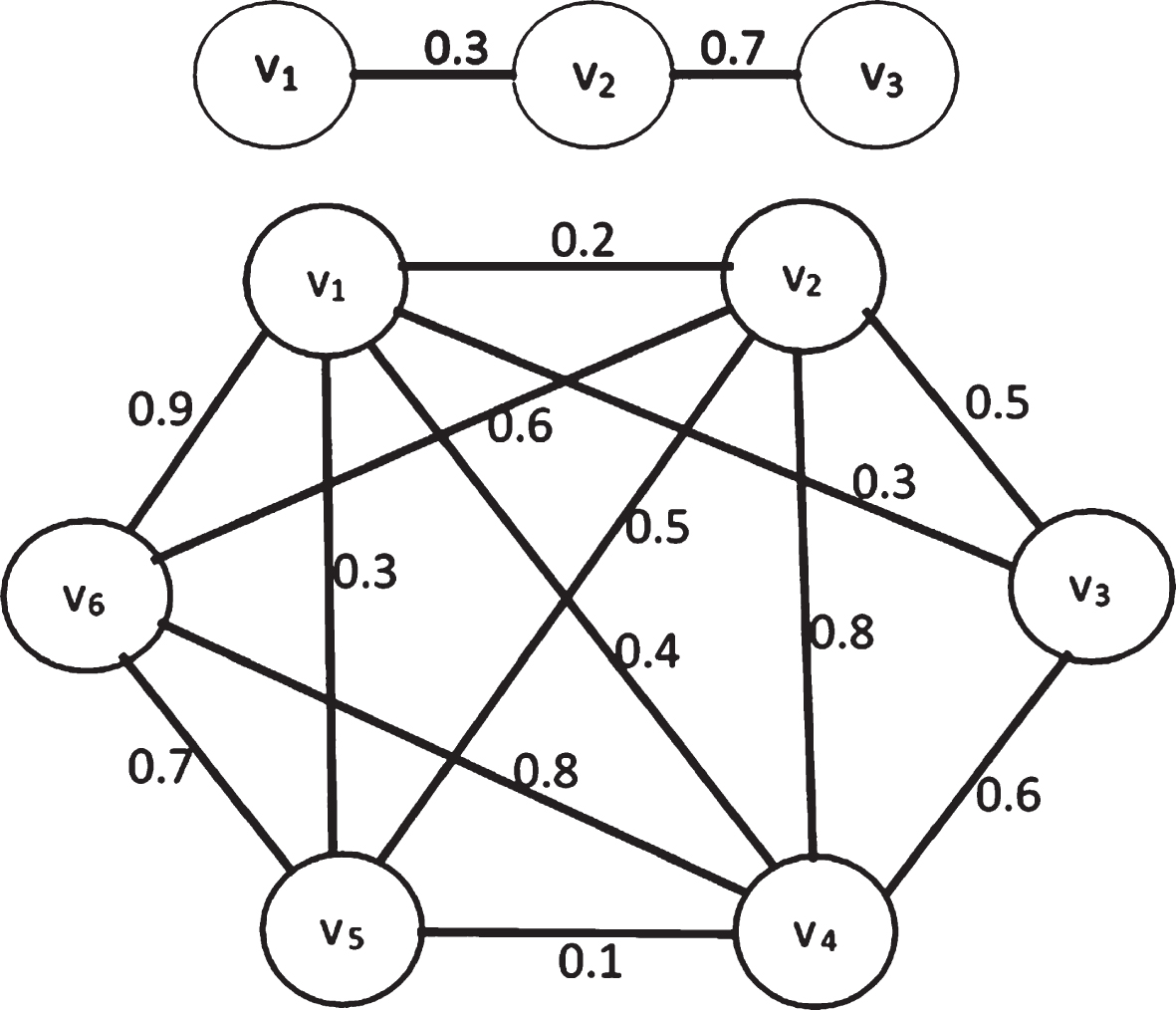
Path fuzzy graph

The cartesian product
FCN of fuzzy graphs
FCN of
Further, we compare FCN
Therefore,
Moreover, we compare
We get
We can also get FCN of the cartesian product
An algorithm to find FCN of cartesian product of path and other fuzzy graphs is designed as shown in Table 2. Step 1 until Step 6 (in Table 2) are inputing vertices and edges of fuzzy graphs
Algorithm to find FCN of cartesian product of path and other fuzzy graphs
Algorithm to find FCN of cartesian product of path and other fuzzy graphs
The algorithm has been evaluated on many cartesian product of path and other fuzzy graphs. In the next section, we present one of the experimental results related to the algorithm.
Let us consider path fuzzy graph
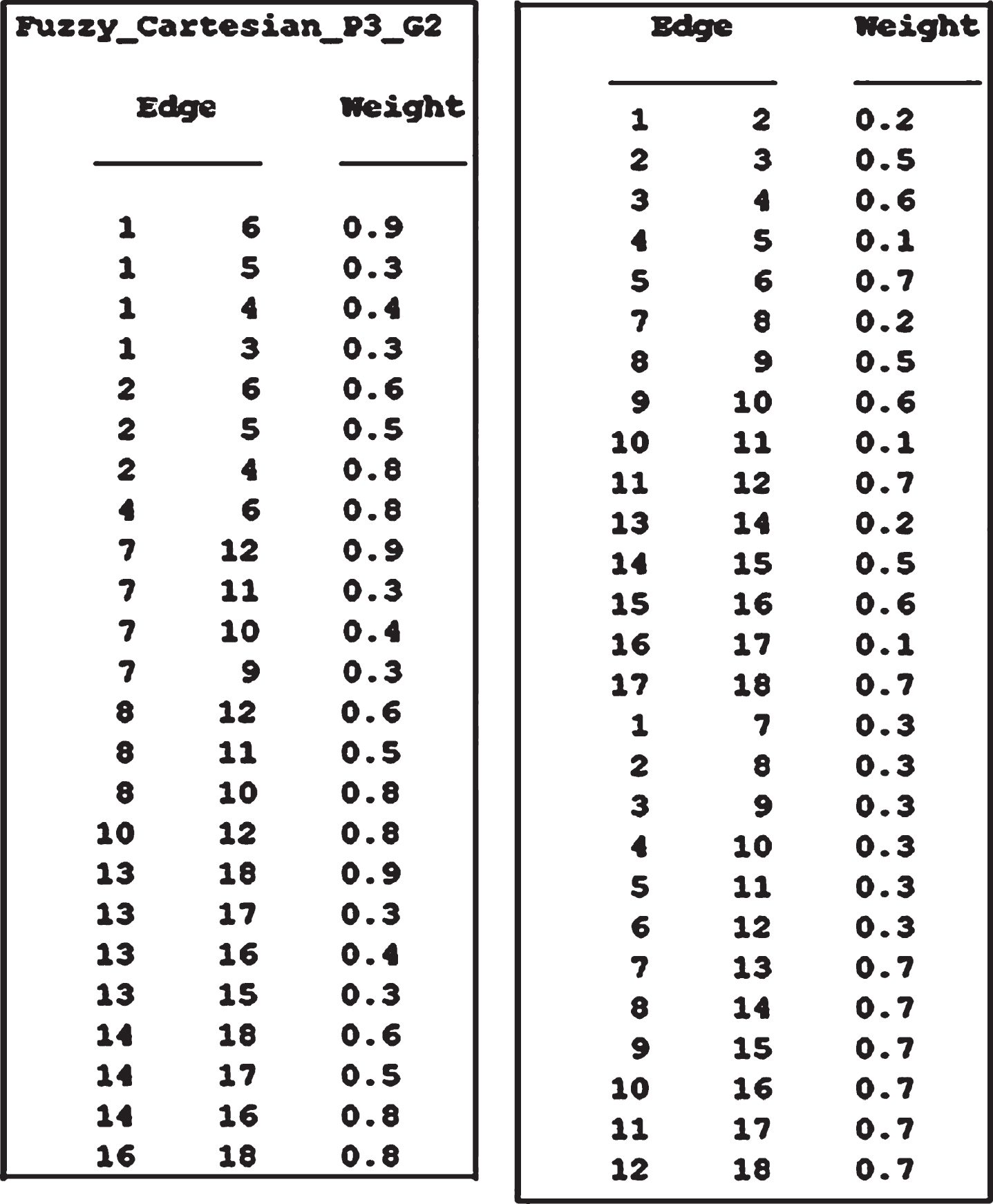
The cartesian product
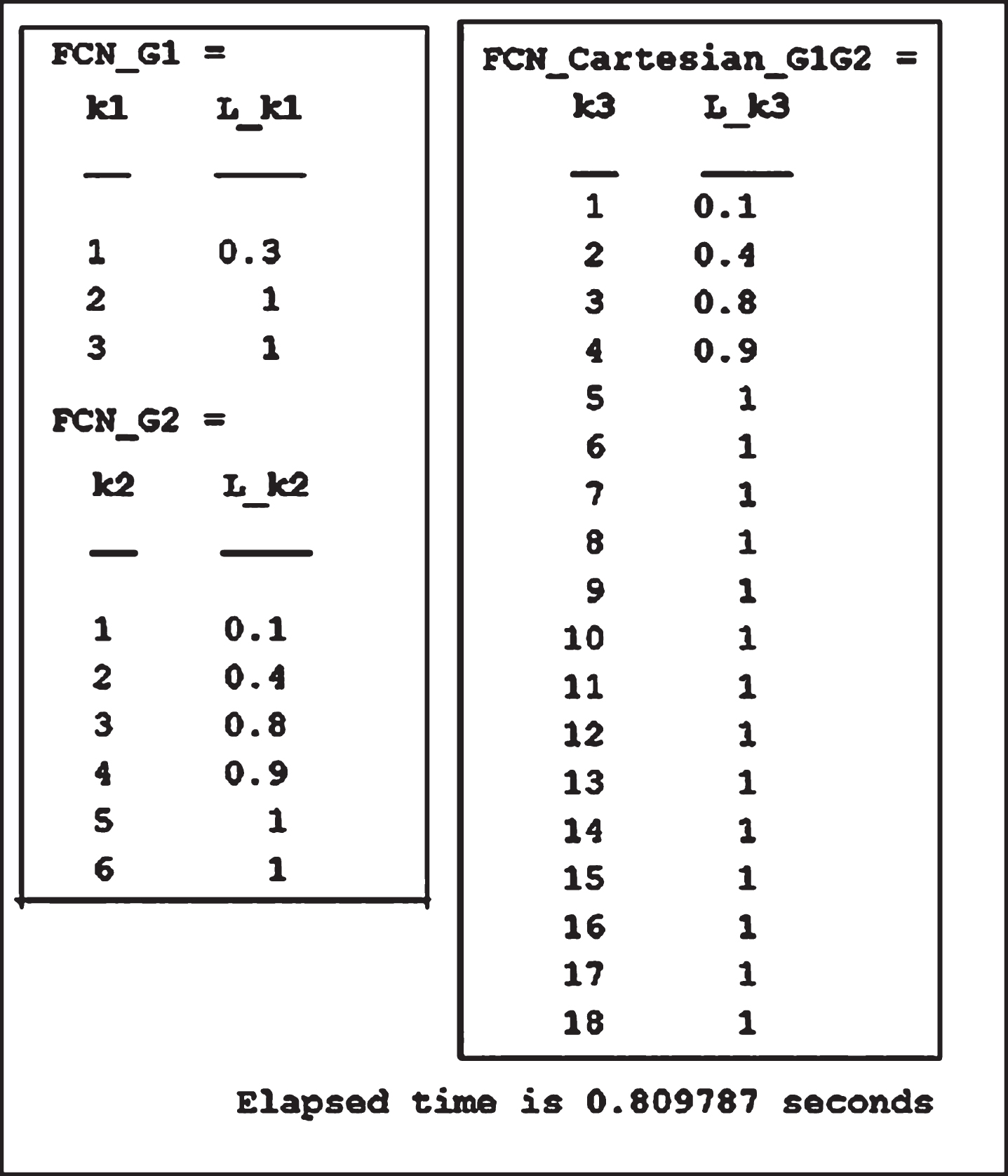
Output of finding FCN of the cartesian product in Fig. 2 by the proposed algorithm.

Output of finding FCN of the cartesian product in Fig. 2 by the general algorithm in [32].
Representation of FCN of
We have constructed fuzzy chromatic number (FCN) of cartesian product of path and other fuzzy graphs in a theorem. Also, we have compared FCN of both fuzzy graphs and their cartesian product through the maximum concept of discrete fuzzy numbers. We show lower bound of FCN of the cartesian product in a theorem. Further, we have given the algorithm of constructing FCN of the cartesian product and the evaluation of the algorithm is shown in the experimental results. In upcoming research, we will construct FCN of cartesian product of any two fuzzy graph, examine the properties on it, design an algorithm, and verify complexity of the algorithm. Also, we will investigate FCN of strong product of fuzzy graphs, verify properties of the FCN, create an algorithm to find it, and show itcomplexity.
Footnotes
Acknowledgments
Authors thanks for assistance or encouragement from Nurhaida (n.nurhaida@unipa.ac.id) who gave fuzzy chromatic function in Matlab R2016a. Also, authors thanks to reviewers for their valuable comments.