We generalized triangular fuzzy numbers from to . By defining parametric operations between two α-cuts, which are regions, we obtained parametric operations for two triangular fuzzy numbers defined on . We also generalized triangular fuzzy numbers from to . By defining parametric operations between two α-cuts, which are subsets of , we derived parametric operations for two triangular fuzzy numbers defined on . For the calculation of Zadeh’s principle operators, the definition of parametric operations between two α-cuts, which are subsets of , is critical.
Many results exist for Zadeh’s principle operator. The results for Zadeh’s principle operator or Zadeh’s max-min compositions have been utilized in principle operators for two fuzzy sets, fuzzy logics, and fuzzy engineering. We have previously proven the operators for various types of fuzzy sets (see [6, 11]). We generalized the results on 1-dimensional fuzzy set to 2-dimensional fuzzy set in [4, 10]. We also generalized triangular fuzzy numbers from to . By defining parametric operations between two region valued α-cuts, we obtained parametric operations for two triangular fuzzy numbers defined on in [2]. We also demonstrated that 2-dimensional Zadeh’s max-min operator constitutes the generalization of 1-dimensional Zadeh’s max-min operator in [5]. In this paper, we generalized triangular fuzzy numbers from to . By defining parametric operations between two α-cuts, which are subsets of , we determined parametric operations for two triangular fuzzy numbers defined on . For the calculation of Zadeh’s principle operators, the definition of parametric operations between two α-cuts, which are subsets of , is essential. This result can be utilized in the proof that the 3-dimensional case is the generalization of the 2-dimensional case.
Preliminaries
We define α-cut and α-set of the fuzzy set A on with the membership function μA (x).
Definition 2.1. An α-cut of the fuzzy number A is defined by if α ∈ (0, 1] and . For α ∈ (0, 1), the set Aα = {x ∈ X ∣ μA (x) = α} is said to be the α-set of the fuzzy set A, and A0 is the boundary of and A1 = A1.
Following Zadeh, Dubois, and Prade, the extension principle is defined as follows:
Definition 2.2. [13] The extended addition A (+) B, extended subtraction A (-) B, extended multiplication A (·) B, and extended division A (/) B are fuzzy sets with membership functions as follows. For all x ∈ A and y ∈ B,
We defined the parametric operations for two fuzzy numbers defined on , and showed that the results for parametric operations are the same as those for extended operations in [2]. For this, we proved that, for all fuzzy numbers A and all α ∈ [0, 1], there exists a piecewise continuous function fα (t) defined on [0, 1], such that Aα = {fα (t) |t ∈ [0, 1]}. If A is continuous, then the corresponding function fα (t) is also continuous. The corresponding function fα (t) is stated to be the parametric α-function of A. The parametric α-function of A is denoted by fα (t) or fA (t).
Definition 2.3. [2] Let A and B be two continuous fuzzy numbers defined on and fA (t) , fB (t) be the parametric α-functions of A and B, respectively. The parametric addition, parametric subtraction, parametric multiplication, and parametric division are fuzzy numbers that have their α-cuts as follows:
(1) parametric addition A (+) pB: (A (+) pB) α = {fA (t) + fB (t) | t ∈ [0, 1]}
(2) parametric subtraction A (-) pB: (A (-) pB) α = {fA (t) - fB (1 - t) | t ∈ [0, 1]}
(3) parametric multiplication A (·) pB: (A (·) pB) α = {fA (t) · fB (t) | t ∈ [0, 1]}
(4) parametric division A (/) pB: (A (/) pB) α = {fA (t)/fB (1 - t) | t ∈ [0, 1]}
Theorem 2.4.[2] Let A and B be two continuous fuzzy numbers defined on . Then, we have A (+) pB = A (+) B, A (-) pB = A (-) B, A (·) pB = A (·) B, and A (/) pB = A (/) B.
Remark 2.5. Zadeh defined max-min operators in different ways for positive and negative fuzzy numbers. When defined using parametric operators as above, it can be defined in one way without distinguishing between positive and negative cases, and the result is the same as that calculated by Zadeh’s positive case.
We defined the 2-dimensional triangular fuzzy numbers on as a generalization of triangular fuzzy numbers on . We then defined the parametric operations between two 2-dimensional triangular fuzzy numbers. For that, we have to calculate operations between α-cuts in . The α-cuts are intervals in , but in the α-cuts are regions, which makes the existing method of calculations between α-cuts unusable. We interpret the existing method from a different perspective, and apply the method to the region valued α-cuts on .
Definition 2.6. A fuzzy set A with a membership function
where a, b > 0 is called the 2-dimensional triangular fuzzy number and denoted by (a, x1, b, y1) 2.
Note that μA (x, y) is a cone. The intersections of μA (x, y) and the horizontal planes z = α (0 < α < 1) are ellipses. Moreover, the intersections of μA (x, y) and the vertical planes are symmetric triangular fuzzy numbers in those planes. If a = b, ellipses become circles. The α-cut Aα of a 2-dimensional triangular fuzzy number A = (a, x1, b, y1) 2 is an interior of ellipse in an xy-plane, including the boundary
Definition 2.7. A 2-dimensional fuzzy number A defined on is called a convex fuzzy number if, for all α ∈ (0, 1), the α-cuts
are convex subsets in .
Theorem 2.8.[2] Let A be a continuous convex fuzzy number defined on , and be the α-set of A. Then, for all α ∈ (0, 1), there exist continuous functions and defined on [0, 2π] such that
If A is a continuous convex fuzzy number defined on , then the α-set Aα is a closed circular convex subset in .
Definition 2.9. Let A and B be convex fuzzy numbers defined on , and
be the α-sets of A and B, respectively. For α ∈ (0, 1), we define that the parametric addition, parametric subtraction, parametric multiplication, and parametric division of two fuzzy numbers A and B are fuzzy numbers that have their α-sets as follows:
(1) parametric addition A (+) pB:
(2) parametric subtraction A (-) pB:
where
and
(3) parametric multiplication A (·) pB:
(4) parametric division A (/) pB:
where
and
For α = 0 and α = 1, and , where * = + , - , · , /.
Theorem 2.10.[2] Let A = (a1, x1, b1, y1) 2 and B = (a2, x2, b2, y2) 2 be two 2-dimensional triangular fuzzy numbers. We then have the following:
(3) (A (·) pB) α = {(xα (t) , yα (t)) | 0 ≤ t ≤ 2π} , where
and
(4) (A (/) pB) α = {(xα (t) , yα (t)) | 0 ≤ t ≤ 2π} , where
Therefore, A (+) pB and A (-) pB become 2-dimensional triangular fuzzy numbers, but A (·) pB and A (/) pB are not 2-dimensional triangular fuzzy numbers.
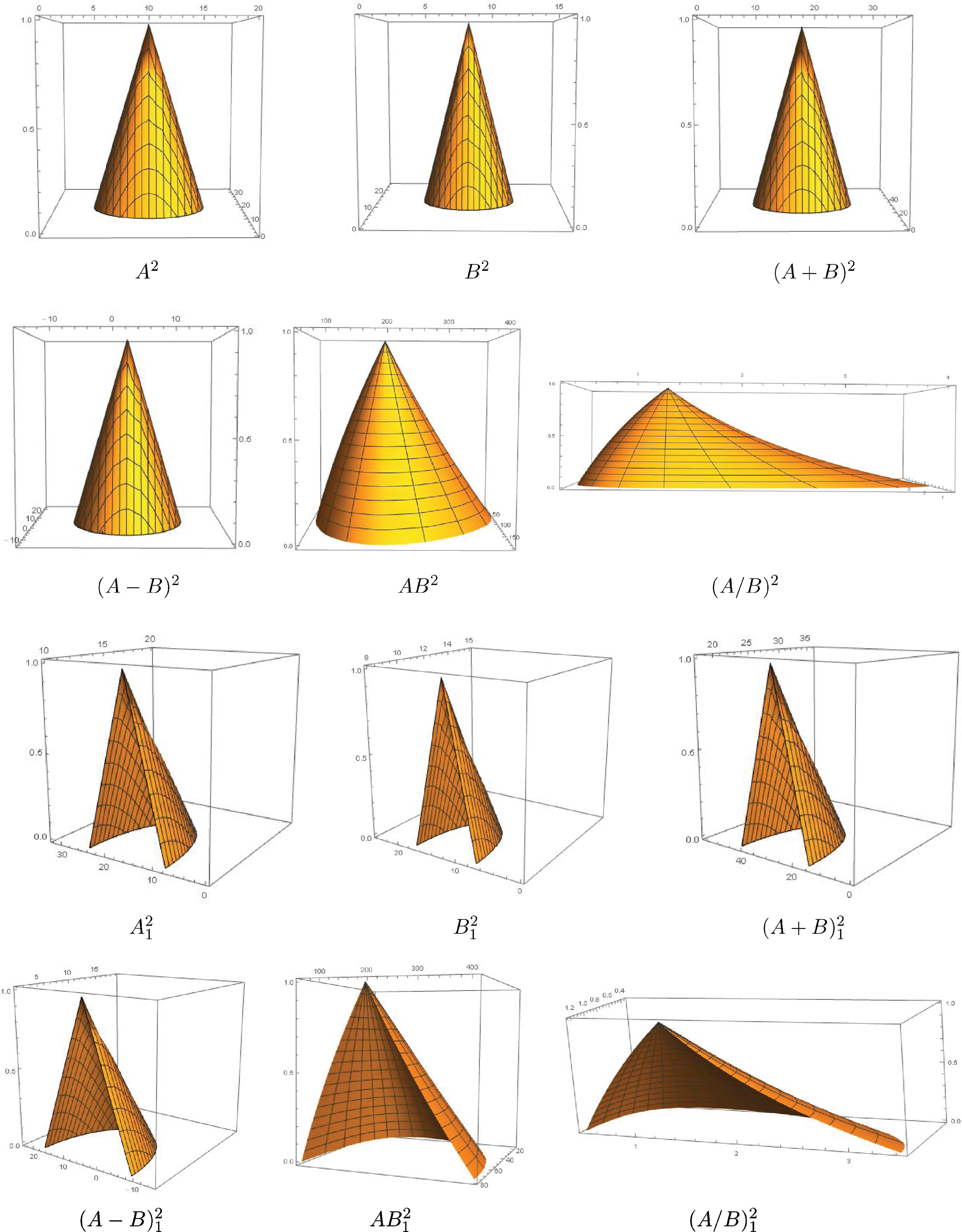
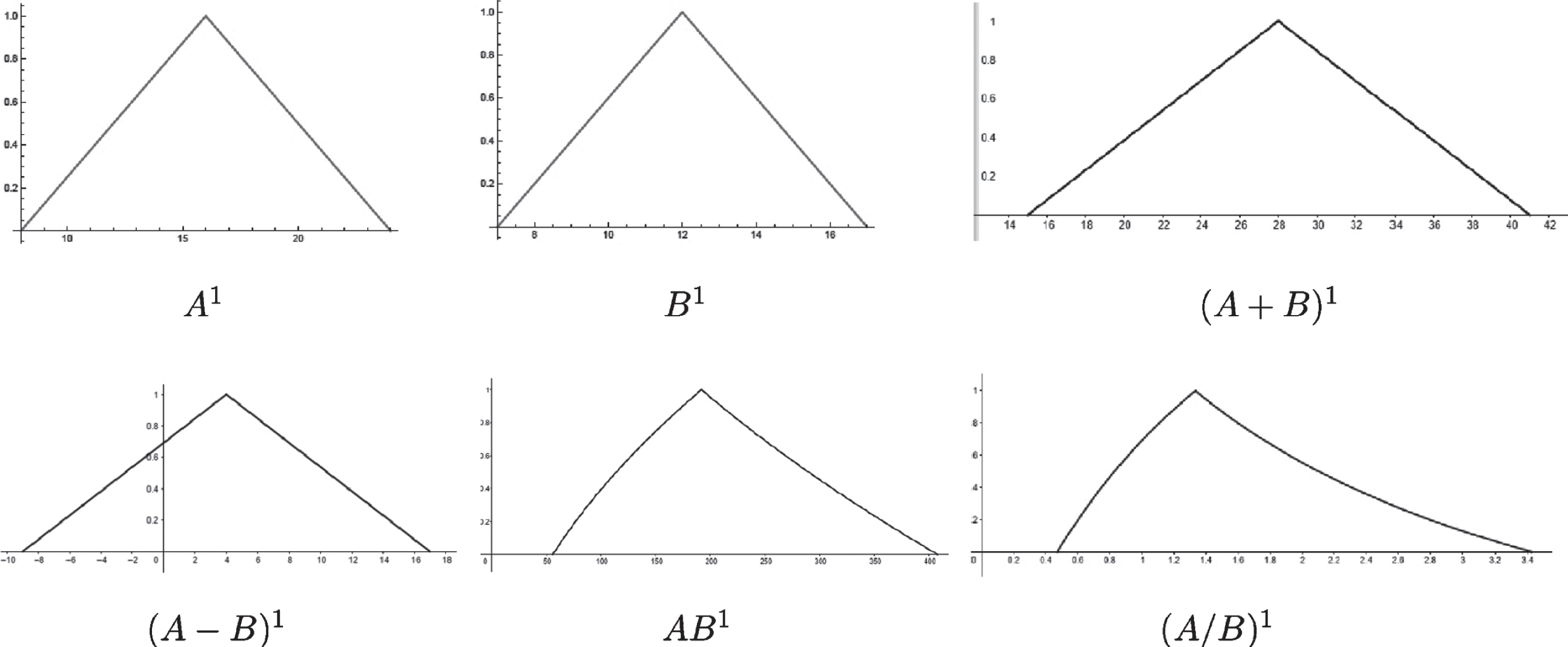
Remark 2.11. The 2-dimensional case is an extended concept of the 1-dimensional case. As in 1-dimension, fuzzy numbers in 2-dimension are defined in all xy-planes without distinguishing positive and negative regions. Cutting a 2-dimensional fuzzy number at its vertices into a plane parallel to the xz-plane or the yz-plane produces a 1-dimensional fuzzy number on the cut plane. As a consequence, if 2-dimensional results are cut into planes and reduced to one dimension, they are consistent with the 1-dimensional results. For the sake of understanding, cuts were made in a plane parallel to the xz-plane or yz-plane, but cutting at its vertex into any vertical plane is consistent with the 1-dimensional results. The above results are proven in [5], and a corresponding graph is presented below for clear illustration.
3-dimensional triangular fuzzy numbers
In this section, we define the 3-dimensional triangular fuzzy numbers on as a generalization of triangular fuzzy numbers on . We then want to define parametric operations between two 3-dimensional triangular fuzzy numbers. To achieve this, we have to calculate operations between α-cuts in . The α-cuts are regions in , but in the α-cuts are some subsets of , which makes the existing method of calculations between α-cuts inapplicable. We interpret the existing method from a different perspective, and apply the method to the subset valued α-cuts on .
Definition 3.1. A fuzzy set A with a membership function
where a, b, c > 0 is called the 3-dimensional triangular fuzzy number and denoted by (a, x1, b, y1, c, z1) 3.
Note that μA (x, y) is a cone in , but it is not possible to know the shape of μA (x, y, z) in . The α-cut Aα of a 3-dimensional triangular fuzzy number A = (a, x1, b, y1, c, z1) 3 is the following set
Definition 3.2. A 3-dimensional fuzzy number A defined on is called a convex fuzzy number if for all α ∈ (0, 1), the α-cuts
are convex subsets in .
Theorem 3.3.Let A be a continuous convex fuzzy number defined on and be the α-set of A. Then, for all α ∈ (0, 1), there exist continuous functions , and , such that
Proof. Let α ∈ (0, 1) be fixed. Since A is a convex fuzzy number defined on , the α-cut Aα is a convex subset in . Therefore, the set
is a subset in . Let , and are the boundaries of and Aα, respectively. The upper surface of Aα is the graph of a continuous concave function h1 (x, y), and the lower surface of Aα is also the graph of a continuous convex function h2 (x, y) defined on . Let
The upper boundary of is the graph of some continuous concave function g1 (x) defined on [l, m], and the lower boundary of is also the graph of some continuous convex function g2 (x) defined on [l, m] (see [2]). Define
Then, moves from m to l if 0 ≤ s ≤ π, and from l to m if π ≤ s ≤ 2π. Let
Define
Then, moves from P (s) to if , and moves from to if . We then have
If we define
we have
The proof is now complete.
Remark 3.4. We proved that Theorem 3.3 is satisfied in the case that A is a continuous convex fuzzy number. If A is a piecewise continuous convex fuzzy number, we can prove similarly (see [2]).
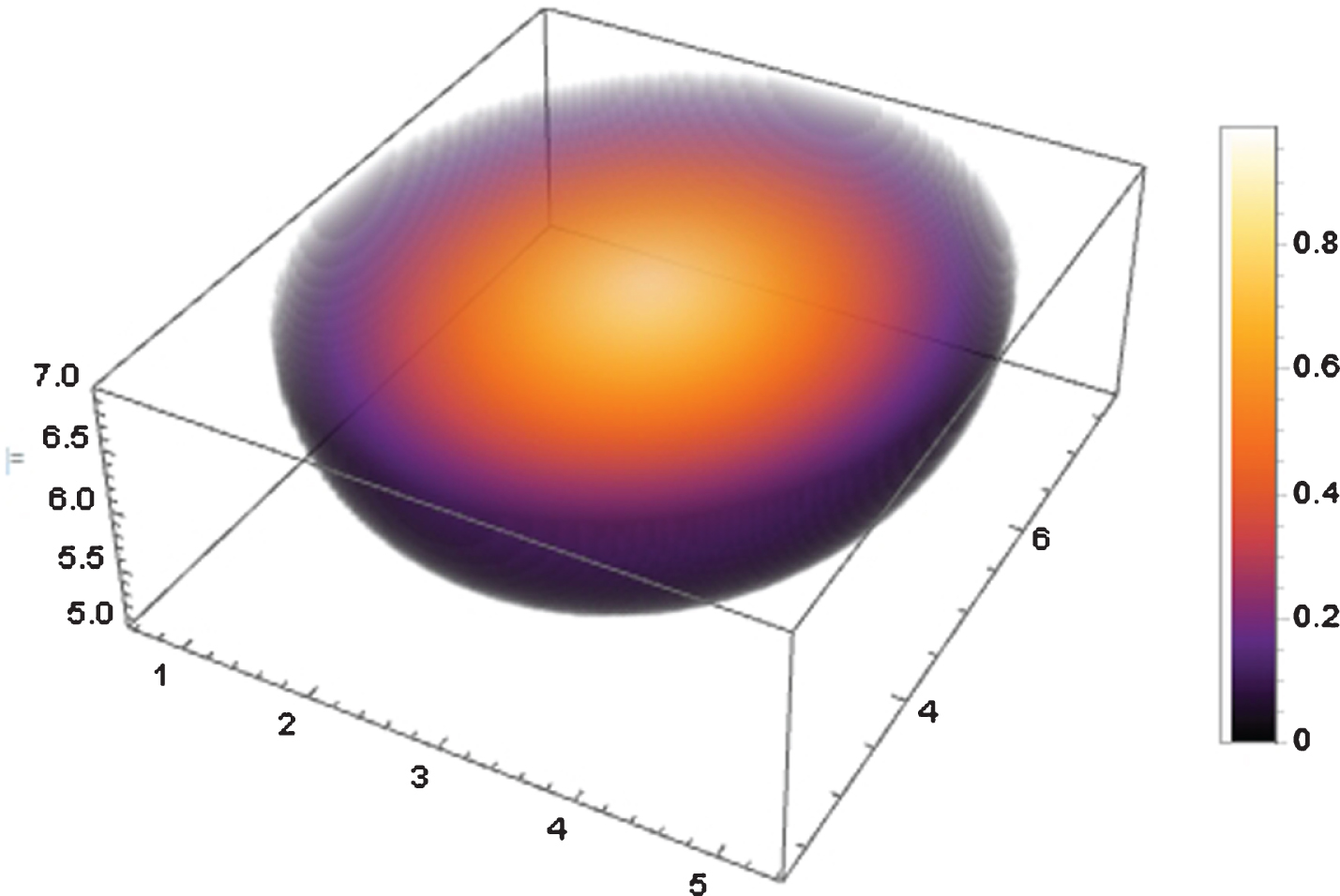
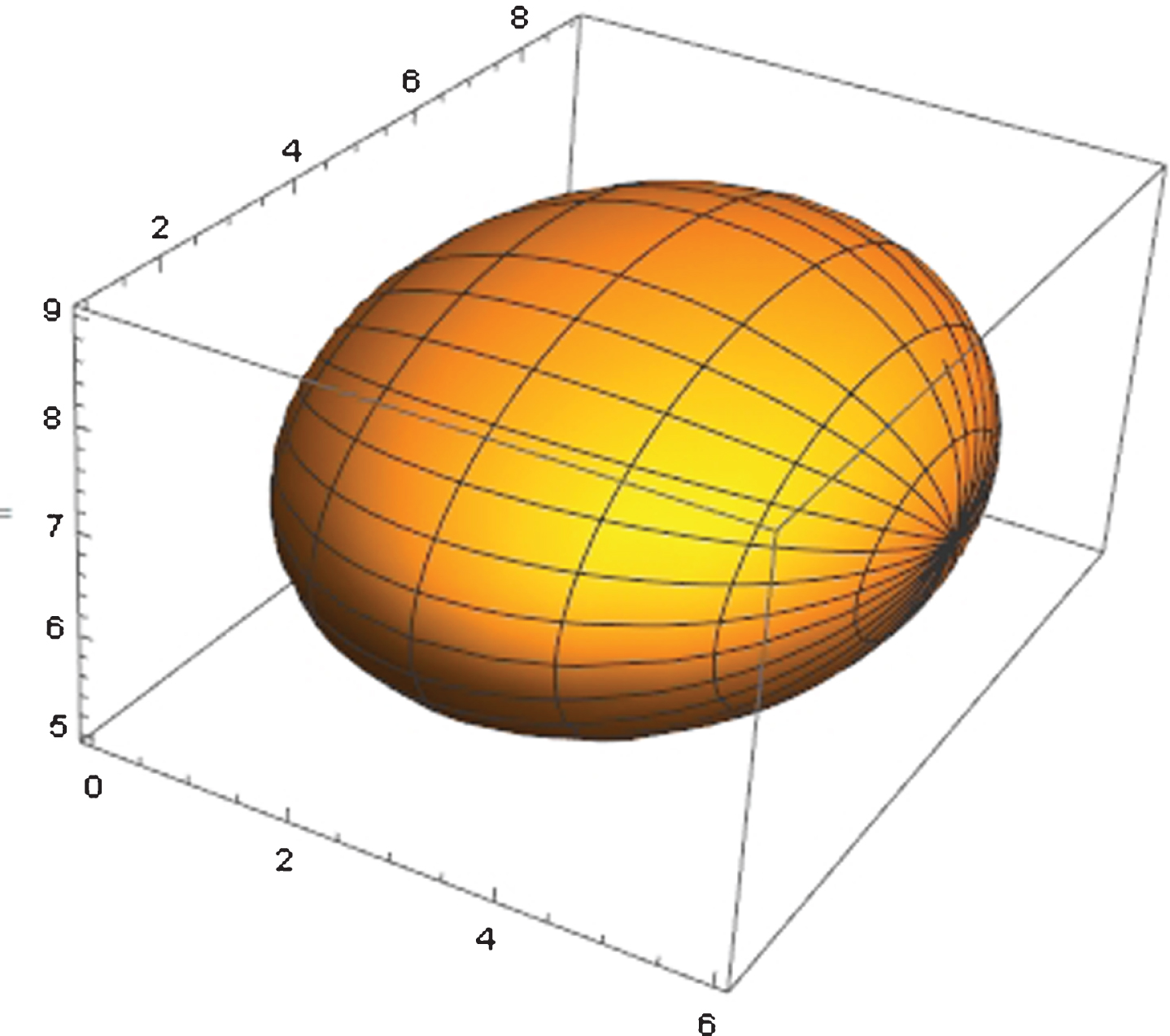
The membership function of the 3-dimensional triangular fuzzy number is a function defined on with values in [0, 1]. In case of , we represent the values of membership function with colors as shown in Figure 1. Cutting the graph of with plane z = 7, we get Figure 2. In Figure 3, we restrict the domain to the cutting plane, and then represent the membership function as the graph on . Then we know that the 3-dimensional triangular fuzzy number is an extension of the 2-dimensional triangular fuzzy number. In 3-dimensional triangular fuzzy number, the α-cut must be an ellipsoid including interior and the α-set must be an ellipsoidal surface. The -set for is given in Figure 4 for 0 ≤ s ≤ 2π and . In case of 0 ≤ s ≤ π and , the graphs are given in Figure 5 and Figure 6, respectively. Therefore, we can confirm that the range of s and t is 0 ≤ s ≤ 2π and , respectively.
Definition 3.5. Let A and B be two continuous convex fuzzy numbers defined on , and
be the α-sets of A and B, respectively. For α ∈ (0, 1), we define that the parametric addition, parametric subtraction, parametric multiplication, and parametric division of two fuzzy numbers A and B are fuzzy numbers that have their α-sets as follows:
(1) parametric addition A (+) pB:
(2) parametric subtraction A (-) pB:
(3) parametric multiplication A (·) pB:
(4) parametric division A (/) pB:
For α = 0 and α = 1, and , where * = + , - , · , /.
Theorem 3.6.Let A = (a1, x1, b1, y1, c1, z1) 3 and B = (a2, x2, b2, y2, c2, z2) 3 be two 3-dimensional triangular fuzzy numbers. Then, we have the following:
Therefore, A (+) pB and A (-) pB become 3-dimensional triangular fuzzy numbers, but A (·) pB and A (/) pB are not 3-dimensional triangular fuzzy numbers.
Proof. Since A and B are continuous convex fuzzy numbers defined on , by Theorem 3.3, there exists and , such that
and
Since A = (a1, x1, b1, y1, c1, z1) 3 and B = (a2, x2, b2, y2, c2, z2) 3, we have
and
(1) Since
and
we have
Thus
(2) If 0 ≤ s ≤ π,
and
In the case of π ≤ s ≤ 2π, we have
and
Thus
i.e.,
(3) Let . Then
and
(4) Let . Then
and
The proof is now complete.
Example 3.7. Let A = (6, 3, 8, 5, 4, 7) 3 and B = (4, 2, 5, 3, 6, 4) 3. Then, by Theorem 3.5, we have the following:
(1) A (+) pB = (10, 5, 13, 8, 10, 11) 3
(2) A (-) pB = (10, 1, 13, 2, 10, 3) 3
(3) where
and
(4) where
and
Therefore, A (+) pB and A (-) pB become 3-dimensional triangular fuzzy numbers, but A (·) pB and A (/) pB are not 3-dimensional triangular fuzzy numbers.
Conclusion
We generalize triangular fuzzy numbers from to . In addition, by defining parametric operations between two α-cuts, which are subsets of , we obtain parametric operations for two triangular fuzzy numbers defined on . It is meaningful to expand the dimension by unifying what Zadeh has defined as the max-min operation in two ways (see [12]). Moreover, since the calculations of the operations are the same, this will assist to expand the study of triangular fuzzy matrices in the future (see [1, 3]).
In [10], the results of 2-dimensional trapezoidal fuzzy sets have been illustrated. In the case of 3-dimension, we can not illustrate the results, but predict that A (+) B and A (-) B become 3-dimensional triangular fuzzy numbers. However, A (·) B and A (/) B do not. Since A (+) B and A (-) B are perfectly formed, they can be applied to many areas without any modification. On the other hand, if the forms of A (·) B and A (/) B are modified, they can be used in various applications. This result can be utilized in proving that the 3-dimensional case is the generalization of the 2-dimensional case. There have been several attempts to expand the dimension, but no studies have yet succeeded in expansion while maintaining Zadeh’s 1-dimensional results. In this sense, this paper will facilitate the development of applications of triangular fuzzy numbers to be an extension dimension of the application (see [7, 8]). Since there are few results for 3-dimensional case, this paper will be applied to 3-dimensional fuzzy operation. Research results have a possibility for real time application as well as a theoretical significance. This paper is expected to be applied to numerous fields from engineering such as robotics and software programming to public policy making and medicine.
Acknowledgments
The author would like to express sincere thanks to the anonymous referees for their carefully reading the paper and valuable comments and suggestions which have improved the original paper.
This research was supported by the 2020 scientific promotion program funded by Jeju National University, and the Basic Science Research Program through the National Research Foundation of Korea(NRF) funded by the Ministry of Education(NRF-2018R1D1A1B07040648).
References
1.
BhowmikM., PalM. and PalA., Circulant triangular fuzzy number matrices, Journal of Physical Sciences12 (2008), 141–154.
2.
ByunJ. and YunY.S., Parametric operations for two fuzzy numbers, Communications of Korean Mathematical Society28(3) (2013), 635–642.
3.
DasA., PalM. and BhowmikM., Permanent of interval-valued and triangular number fuzzy matrices, Annals of Fuzzy Mathematics and Informatics10(3) (2015), 381–395.
4.
KangC. and YunY.S., A Zadeh’s max-min composition operator for two 2-dimensional quadratic fuzzy numbers, Far East Journal of Mathematical Sciences101(10) (2017), 2185–2193.
5.
KangC. and YunY.S., An extension of Zadeh’s max-min composition operator, International Journal of Mathematical Analysis9(41) (2015), 2029–2035.
6.
LeeB.J. and YunY.S., The generalized trapezoidal fuzzy sets, Journal of the Chungcheong Mathematical Society24(2) (2011), 253–266.
7.
VoskoglouM.Gr., An application of triangular fuzzy numbers to learning assessment, Journal of Physical Sciences20 (2015), 63–79.
8.
VoskoglouM.Gr. and SubbotinI.Ya., Application of triangular fuzzy numbers for assessing the results of iterative learning, International Journal of Applications of Fuzzy Sets and Artificial Intelligence7 (2017), 59–72.
9.
YunY.S., An algebraic operations for two generalized 2-dimensional quadratic fuzzy sets, Journal of the Chungcheong Mathematical Society31(4) (2018), 379–386.
10.
YunY.S., Parametric operations for two 2-dimensional trapezoidal fuzzy sets, Journal of Algebra and Applied Mathematics18(1) (2020), 27–41.
11.
YunY.S. and ParkJ.W., The extended operations for generalized quadratic fuzzy sets, Journal of The Korean Institute of Intelligent Systems20(4) (2010), 592–595.
12.
ZadehL.A., The concept of a linguistic variable and its application to approximate reasoning – I, Information Sciences8 (1975), 199–249.
13.
ZimmermannH.J., Fuzzy Set Theory - and Its Applications, Kluwer-Nijhoff Publishing, Boston-Dordrecht-Lancaster, (1985).