



Abstract
In this article, we study some concepts related to q-rung orthopair fuzzy soft sets (q-ROFSSs) together with their algebraic structure. We present operations on q-ROFSSs and their specific properties and elaborate them with real-life examples and tabular representations to develop an influx of linguistic variables based on q-rung orthopair fuzzy soft (q-ROFS) information. We present an application of q-ROFSSs to multi-criteria group decision-making (MCGDM) process related to the university choice, accompanied by algorithm and flowchart. We develop q-ROFS TOPSIS method and q-ROFS VIKOR method as extensions of TOPSIS (a technique for ordering preference through the ideal solution) and VIKOR (Vlse Kriterijumska Optimizacija Kompromisno Resenje), respectively. Finally, we tackle a problem of construction utilizing q-ROFS TOPSIS and q-ROFS VIKOR methods.
Introduction
The fuzzy linguistic framework offers favorable outcomes in a number of areas, the description of which is relatively qualitative. The incentive to use phrases rather than just numbers seems to be that linguistic characterizations or categories are generally even less accurate than algebraic or arithmetic characterizations. Issues associated with unstable situations typically arise in decision-making and, furthermore, they are making demands on the complex problem of modeling and manipulation that appears as a side product in these uncertainties. Often we face problems in coping with daily life problems, which are usually complex in nature. The main factor behind these hindrances is that the methodologies commonly selected for use in conventional mathematics are not always of assistance due to the many types of uncertainties and vagueness present in these problems. To deal with uncertainties and vagueness Zadeh initiated fuzzy set (FS) theory [52], Atanassov [6] introduced intuitionistic fuzzy sets (IFSs), Molodtsov [25] introduced soft set theory, Zhang et al. [59–61] presented bipolar fuzzy sets. Yager [46, 47] and Yager and Abbasov [48] introduced the notion of Pythagorean fuzzy sets (PFSs) as an extension of IFSs.
Applications of fuzzy sets, rough sets, soft sets and their hybrid structures have been studied by many researchers; Ali et al. [1], Ali [2], Akram et al. [3–5], Chen et al. [7], Chi and Lui [8], Çağman et al. [9], Eraslan and Karaaslan [10], Feng et al. [11–14], Garg and Arora [15–17], Garg and Nancy [18], Jose and Kuriaskose [19], Kaur and Garg [20], Kumar and Garg [21], Karaaslan [22], Liu and Wang [23], Liu et al. [24], Naeem et al. [26–28], Peng et al. [29–32], Riaz and Hashmi [33, 34], Riaz et al. [35–37], Riaz and Tehrim [38–40], Shabir and Naz [41], Wang et al. [42], Xu [43], Xu and Cai [44], Xu [45], Ye [50, 51], Zhang and Xu [53], Zhan et al. [54, 55] and Zhang et al. [56–58].
Yager initiated the idea of q-rung orthopair fuzzy set (q-ROFS) as an extension of PFS [49], in which the sum of membership degree (MD)
The rest of this paper is organized as: Section 2 consists of the basic concepts of fuzzy sets and their extensions. Section 3 sets out the vital operations and fundamental characteristics of q-rung orthopair fuzzy soft sets (q-ROFSSs). Section 4 represents an excellent implementation of multi-criteria group decision-making (MCGDM) to q-ROF TOPSIS. In Section 5, we presented the VIKOR approach and implemented that to the same example in section four. Section 6 consists on MCGDM based on aggregation operators of q-ROFSSs. Lastly, Section 7 sums up the entire article.
Preliminaries
In this section, we present some basics of the fuzzy set, soft set, IFS and q-ROFS that would be helpful for better study of this paper.
For convenience, a basic element
Operational laws of q-ROFs
Let
A1 ⊆ A2 iff A1 = A2 iff A1 ⊆ A2 and A2 ⊆ A1.
Operational laws of q-ROFNs
Let
If S (★ 1) > S (★ 2), then ★1 ≻ ★ 2
If S (★ 1) = S (★ 2), and If R (★ 1) > R (★ 2) then ★1 ≻ ★ 2, If R (★ 1) = R (★ 2), then ★1 ∼ ★ 2.
q-Rung orthopair fuzzy soft sets
We propose, in this section, the idea of q-rung orthopair fuzzy soft set (q-ROFSS) along with some basic notions and basic characteristics.
If we write
and in matrix form as
The corresponding q-ROFS matrix is
H ⊆ K, and φ (e) is q-ROFS subset of ϱ (e) for all e ∈ H.
There is something worth noting that
(φ, e) = (φ1, e) \ (φ2, e); ∀ e ∈ E and is represented as
With the assistance of illustration below we explain some of these concepts.
(1) Their union is
(2) Their intersection is
(3) The complements of (φ1, H1) and (φ2, H2) are (φ1, H1) c = {(e1, {ζ1, 0.36, 0.71} , {ζ3, 0.96, 0.24} , {ζ6, 0.49, 0.34}) , (e3, {ζ2, 0.82, 0.61} , {ζ6, 0.41, 0.83})} and (φ2, H2) c = {(e2, {ζ3, 0.51, 0.46} , {ζ4, 0.49, 0.61} , {ζ5, 0.32, 0.94} , {ζ6, 0.45, 0.87}) , (e3, {ζ1, 0.66, 0.56} , {ζ6, 0.55, 0.71}) , (e4, {ζ2, 0.87, 0.36} , {ζ3, 0.39, 0.71} , {ζ6, 0.63, 0.46})} respectively.
(4) The difference of (φ1, H1) and (φ2, H2) is
Proof.
As we know, MD and NMD always lay in [0, 1], so As we know, MD and NMD always lay in [0, 1], so
Proof. The proof is obvious.□
Proof. We only prove (i) The (ii) proof can be accommodated along parallel track.
Since
(φ1, H1) = {(e1, {ζ1, 0.37, 0.91} , {ζ3, 0.93, 0.21} ,
{ζ6, 0.87, 0.41}) , (e3, {ζ2, 0.39, 0.85} , {ζ6, 0.6, 0}) }, and (φ2, H2) = {(e3, {ζ1, 0.73, 0.46} , {ζ6, 0.66, 0.76}) ,
(e5, {ζ2, 0.74, 0.53} , {ζ3, 0.76, 0.56} , {ζ6, 0.47, 0.23}) }
Then,
{ζ2, 0.39, 0.85} , {ζ6, 0.66, 0}) , (e5, {ζ2, 0.74, 0.53} , {ζ3, 0.76, 0.56} , {ζ6, 0.47, 0.23}) }
so that
{ζ2, 0.85, 0.39} , {ζ6, 0, 0.66}) , (e5, {ζ2, 0.53, 0.74} , {ζ3, 0.56, 0.76} , {ζ6, 0.23, 0.47}) }
Also,
(φ1, H1) c = {(e1, {ζ1, 0.91, 0.37} , {ζ3, 0.21, 0.93} ,
{ζ6, 0.41, 0.87}) , (e3, {ζ2, 0.85, 0.39} , {ζ6, 0, 0.6}) }, and (φ2, H2) c = {(e3, {ζ1, 0.46, 0.73} , {ζ6, 0.76, 0.66}) ,
(e5, {ζ2, 0.53, 0.74} , {ζ3, 0.56, 0.76} , {ζ6, 0.23, 0.47}) } so that
(φ, H) =
so that
(φ, H)
c
=
We observe that
 ) be a q-ROFSS over

Collection of all q-ROFSS cardinal sets over
and in matrix form as
This collection is called aggregate q-rung orthopair fuzzy set of q-ROFSS φ
H
. The membership function
and in matrix form as
MCDM using q-ROFSS TOPSIS methodology
TOPSIS is being utilized to choose on a supreme elective to compromise solutions. The solution closest to the ideal solution and the furthest from the negative ideal solution is recognized as a compromise solution. In this part, we’re studying how q-ROFSSs can be used in MCDM by making use of TOPSIS. Firstly, we will expand TOPSIS to the q-ROFSSs and afterwards study a problem related to construction company. Amid the gargantuan practices brought into being in the texts, TOPSIS is widely used approach in addressing such issues. Depending on the nature of the problem considered, each technique has its own advantages and disadvantages.
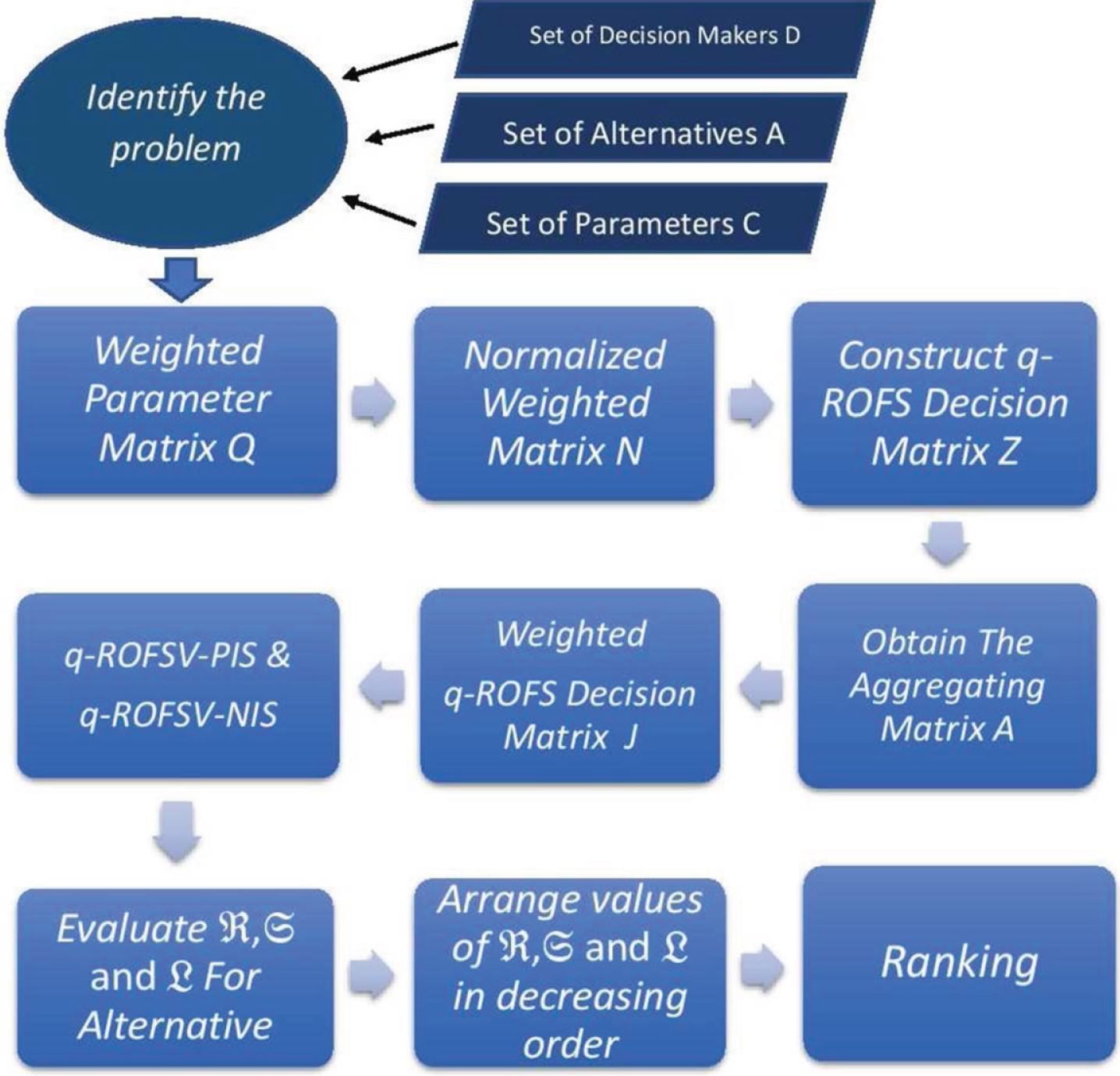
Step 1: Understand the problem: Let
Step 2: Using semantic terms from Table 1, constructing weighted parameter matrix
Linguistic terms for judging alternatives
Linguistic terms for judging alternatives
where y
ij
is the weight assigned by the expert
Step 3: Here, in this step we design a normalized weighted (NW) matrix
where
Step 4: Acquire q-ROFS decision matrix
where
Step 5: Acquire the weighted q-ROFS decision matrix
where
Step 6: Locate q-ROFS-valued positive ideal solution (q-ROFSV-PIS) and q-ROFS-valued negative ideal solution (q-ROFSV-NIS), employing in order
Step 7: Find q-ROFS Euclidean distances to every alternative from q-ROFSV-PIS and q-ROFSV-NIS, respectively,
Step 8: Evaluate the coefficient of relative nearness related to every choice under discussion to best plausible solution by using
Step 9: Evaluate the choices in decrease (or increase) arrangement to acquire the alternatives preferential array.
The process diagram is shown in the Fig. 1:

Procedural steps of Algorithm-1.
We apply this algorithm in the following example to demonstrate its effectiveness.
Step 1: Understand the problem: Let
Step 3: The NW matrix is
Step 4: Especially considering the previous record of respective companies, the q-ROFS decision matrix Z i of every specialist is given in which alternatives are shown row-wise whereas parameters are represented column-wise.
Step 5: The weighted q-ROFS decision matrix
where
Step 6: Now, we evaluate q-ROFS valued positive ideal solution (q-ROFSV-PIS) and q-ROFS-valued negative ideal solution (q-ROFSV-NIS) and are listed, respectively, as
Step 7, 8: The q-ROFS distances of every choice from q-ROFSV-PIS and q-ROFSV-NIS including the closeness coefficients can be seen in Table 2:
Distance measures & closeness coefficient of each alternative
Step 9: Therefore, the preference initial order of the alternatives is
VIKOR (Vlse Kriterijumska Optimizacija Kompromisno Resenje) is a Serbian term that refers to different parameters of optimization and compromise. It was initially conceived by Serafim Opricovic to solve decision-making problems with contrasting and non-commensurable (different units) requirements, presuming that compromise is appropriate for conflict resolution, the decision-maker seems to want a solution that is the nearest to the ideal, and the alternatives are analyzed according to all indicators. VIKOR ranks the alternatives and calculates the solution referred to as a compromise that is the closest to the ideal.
We shall begin by illustrating the suggested technique step by step:
Step 1: Analyzing the issue: Let
Step 2: Choosing the linguistic terms as well from the Table 1, acquiring weighted parameter matrix
Step 3: Acquired NW matrix
where
Step 4: Acquire q-ROFS decision matrix
where
Step 6: Mark q-ROFS-valued +ve ideal solution (q-ROFSV-PIS) and q-ROFS-valued -ve ideal solution (q-ROFSV-NIS), employing in order
(1) Feasible benefit:
If top most two alternatives in
(2) Acceptance stability:
The choice
If the requirement (1) and (2) are not met at the same time, then several compromise solutions exist:
(i) If only (1) is met then both alternatives
(ii) If (1) is not met then there will be a series of compromise solutions, which are
The process diagram is shown in the Fig. 2.
Procedural steps of Algorithm 2.
Step 6: We find q-ROFSV-PIS and q-ROFSV-NIS, listed as {q-ROFSV - PIS = {
Step7 : Let′schoose
Values of
Step 8: The choices are ranked as solution. Initially given below: By
Decision making is a part of our everyday lives. Decision-making is a process of choosing the best among the various alternatives. Every person in the world needs to make decisions. Whatever you are; whether you are a teacher, a management officer, a student or even a child; you are making decisions in your daily routine. Any policy or plan is established through decision making. No plan can fulfil its requirement without decision making. Therefore, decision making is very useful to achieve goals in planning. Decision making is also used to choose the best alternatives among all considered alternatives. So decision makers evaluate various advantages and disadvantages of every alternative and select the best alternative. Decision making is used in group behavior (sociology) and social psychology, utility and probability (economics/statistics), individual behavior (psychology), modeling and simulation (mathematics), environment (law anthropology political science) and values and ethics (philosophy).
We can make a MCGDM based on q-ROFSSs using the following algorithm:
Algorithm-3 (q-ROFSS aggregation operators)
Step 1: Consider input, ℋ = {
Step 2: Acquired q-ROFSS ¥ z : i = 1, 2, ..., t by each decision expert D = {Di: i = 1, 2, ..., t}over the universe ℋ.
Step 3: Find intersection of all ¥ z : i = 1, 2, ..., t for unanimous decision by team of decision experts and obtain q-ROFSS φ H over ℋ.
Step 4: Find the cardinalities and cardinal set c φ H of φ H .
Step 5: Find aggregate q-ROFSS
Step 6: Evaluate the score values corresponding to each member of ℋ.
Step 7: Select the best alternative by using max operation.
The process diagram is shown in the Fig. 3.
We apply Algorithm-1 in the following example of MCDM.

Procedural steps of Algorithm 3.
Step-1: Take input ℋ = {
Step-2: Acquired q-ROFSS ¥ z : i = 1, 2, ..., t by each decision expert.
¥1 =
{ (
and
¥3 =
{ (
(
Step-3: Compute intersection of all ¥ z and obtain q-ROFSS φ H over the universe ℋ as
φ H =
{ (
(
Step-4: The cardinal set of φ H is
c φ
H
= {
Step-5: By virtue of Theorem 3.18, the aggregate q-ROFSS
Step-6: The values of the score function S(
Score values for each member of ℋ
Step-7: We observe that max {S(
The proposed approaches of TOPSIS, VIKOR and aggregation operators are compared as presented in Table 5. It can be noted in the comparison Table 5, the selected alternative given by any one MCDM approach acknowledges the authenticity and effectiveness of the proposed algorithms.
Final classification review relative to current methods
Final classification review relative to current methods
We introduced the novel concept of q-rung orthopair fuzzy soft set (q-ROFSS). We established some fundamental properties of q-ROFSSs and explained them with the help of some examples. The proposed model of q-ROFSS is an important technique to deal with uncertainties by means of parametrization along with membership and non-membership in the larger space. We proposed three algorithms for MCDM under q-ROFSS environment. One of them is the use of the q-ROFS aggregation operator and the technique based on the function values. We presented ranking methodology by using q-ROFS aggregation operator for the university selection. Two other proposed algorithms are designed for MCDM named as q-ROFS TOPSIS and q-ROFS VIKOR, respectively. We tackled the problem of supplier selection for a construction company using these two techniques. The comparison analysis of TOPSIS, VIKOR and aggregation operators for q-rung orthopair fuzzy soft sets is presented with some existing MCDM methods to justify the selection of optimal alternative.
In the future, we will extend our work to solve other MCDM problems by using different approaches like AHP, COMET, ELECTRE family and PROMETHEE family based on different extensions of fuzzy sets like Pythagorean m-polar fuzzy sets, linear Diophantine fuzzy sets and cubic m-polar fuzzy sets.
Footnotes
Acknowledgment
The authors would like to thank the Editor-in-Chief and the referees for their valuable suggestions and recommendations for making our results more accurate.