



Abstract
We study, in this paper, some notions related to Pythagorean fuzzy soft sets (PFSSs) along with their algebraic structures. We present operations on PFSSs and their peculiar characteristics and elaborate them with real life examples and tabular representation to develop the affluence of linguistic variables based on Pythagorean fuzzy soft (PFS) information. We present an application of PFSSs to the multi-criteria group decision-making (
Introduction
The fuzzy linguistic approach provides favorable outputs in several areas, whose description is relatively qualitative. The encouragement for the utilization of sentences or words instead of numbers is that linguistic characterizations or classifications are usually less absolute than algebraic or arithmetical ones. Problems that are related to uncertain conditions usually exist in decision-making, but are demanding because of the challenging situation of modeling and handling that comes with such uncertainties. To tackle complex real world problems the techniques usually employed in classical mathematics are not always beneficial due to a number of types of uncertainties and vagueness present in these problems. There are numerous techniques, like theory of probability, the interval mathematics, fuzzy set theory, soft and rough set theories which we can be thought of as mathematical models for coping with uncertainties. Unluckily, all these models have their own drawbacks and difficulties. For example, in fuzzy set theory the word beautiful is vague. The criteria for beautiful varies from person to person. To overcome these kinds of deficiencies Zadeh [70] introduced the idea of fuzzy sets as an extension of the traditional crisp set. A fuzzy set is a significant mathematical model to characterize an assembling of objects whose boundary is obscure. Atanassov [8–10] proposed the idea of intuitionistic fuzzy sets as an extension of fuzzy set by introducing the concepts of membership (denoted by μ (x)) and non-membership grades (denoted by ν (x)) along with the restriction that sum of these two grades must not exceed unity. Atanassov [11] presented geometrical interpretation of the elements of the intuitionistic fuzzy objects. Molodtsov [33] originated the notion of a new kind of sets conventionally known as soft sets, as a mathematical model for sorting out uncertainties. Akram et al. [2–4] presented certain applications of Pythagorean fuzzy graphs and rough Pythagorean fuzzy bipolar soft information to the decision making problems (
Yager [66–68] introduced Pythagorean fuzzy set as an extension of Atanassov’s intuitionistic fuzzy set and presented Pythagorean membership grades with applications to the multi-criteria decision making (
Riaz and Naeem [40, 41] presented some essential ideas of soft sets together with soft sigma algebra. They additionally displayed a few utilizations of soft mappings to the decision making problems (
TOPSIS and VIKOR methods for decision making problems have been studied by many researchers: Adeel et al. [1], Akram and Arshad [5], Boran et al. [13], Eraslan and Karaaslan [24], Kumar and Garg [26], Li and Nan [27], Mohd and Abdullah [34], Peng and Dai [39], Selvachandran and Peng [55], Xu and Zhang [65] and Zhang and Xu [72]. Zhan et al. [73–75] established various properties of soft rough set, soft rough hemirings, Z-soft fuzzy rough set and their applications to the multi-criteria group decision making
Recently, Tang et al. [58] studied some MADM models employing interval-valued Pythagorean fuzzy Muirhead mean operators and presented their application to green suppliers selection. Wang et al. [30] presented novel concepts of Dice similarity measures along with its characteristics. They also proposed the generalized Dice similarity measures-based MAGDM models with Pythagorean fuzzy information. Lu et al. [29] proposed a bidirectional project method to handle the MADM problem under the dual hesitant Pythagorean fuzzy environment. They presented a fascinating application of proposed method in performance assessment of new rural construction. Wei [61] utilized Hamacher operations and power aggregation operators to develop some new Pythagorean fuzzy Hamacher power aggregation operators along with their prominent properties. Utilizing the proposed operators, he developed some approaches to solve the MADM problems with Pythagorean fuzzy numbers.
Wu et al. [62] studied attitudinal trust recommendation mechanism to balance consensus and harmony in group decision making. Wu et al. [63] presented attitudinal consensus degree to control feedback mechanism in group decision making with different adjustment cost. A harmony degree (HD) is defined to determine the extent of the difference between an original opinion and the corresponding revised opinion after adopting the recommended advices. Wu et al. [64] discussed the idea of trust propagation and collaborative filtering based method for incomplete information in social network group decision making with type-2 linguistic trust. Dong et al. [17] discussed hybrid group decision making framework for achieving agreed solutions based on stable opinions. Zhou et al. [79] studied evidential reasoning approach with multiple kinds of attributes and entropy-based weight assignment.
The goal of this paper is to introduce Pythagorean fuzzy soft sets (PFSSs) as a hybrid structure of soft set and Pythagorean fuzzy set. In order to solve the real world problems that intuitionistic fuzzy soft set (
The paper is organized as follows: Section 1 provides literature review of Pythagorean fuzzy sets and related fields to solve various real world problems by using different decision making methods. Section 2 introduces basic concepts of fuzzy sets, soft sets, intuitionistic fuzzy sets and Pythagorean fuzzy sets. Section 3 introduces essential operations and fundamental properties of Pythagorean fuzzy soft sets. Section 4 provides an interesting application of multi-criteria group decision making
Preliminaries
In this segment, we concisely review some rudiments of different kinds of sets which will be employed in the rest of the paper.
The aggregate of all fuzzy soft sets over X is designated as FS (X).
The set of all
The space for a
The degree of indeterminacy may be computed employing
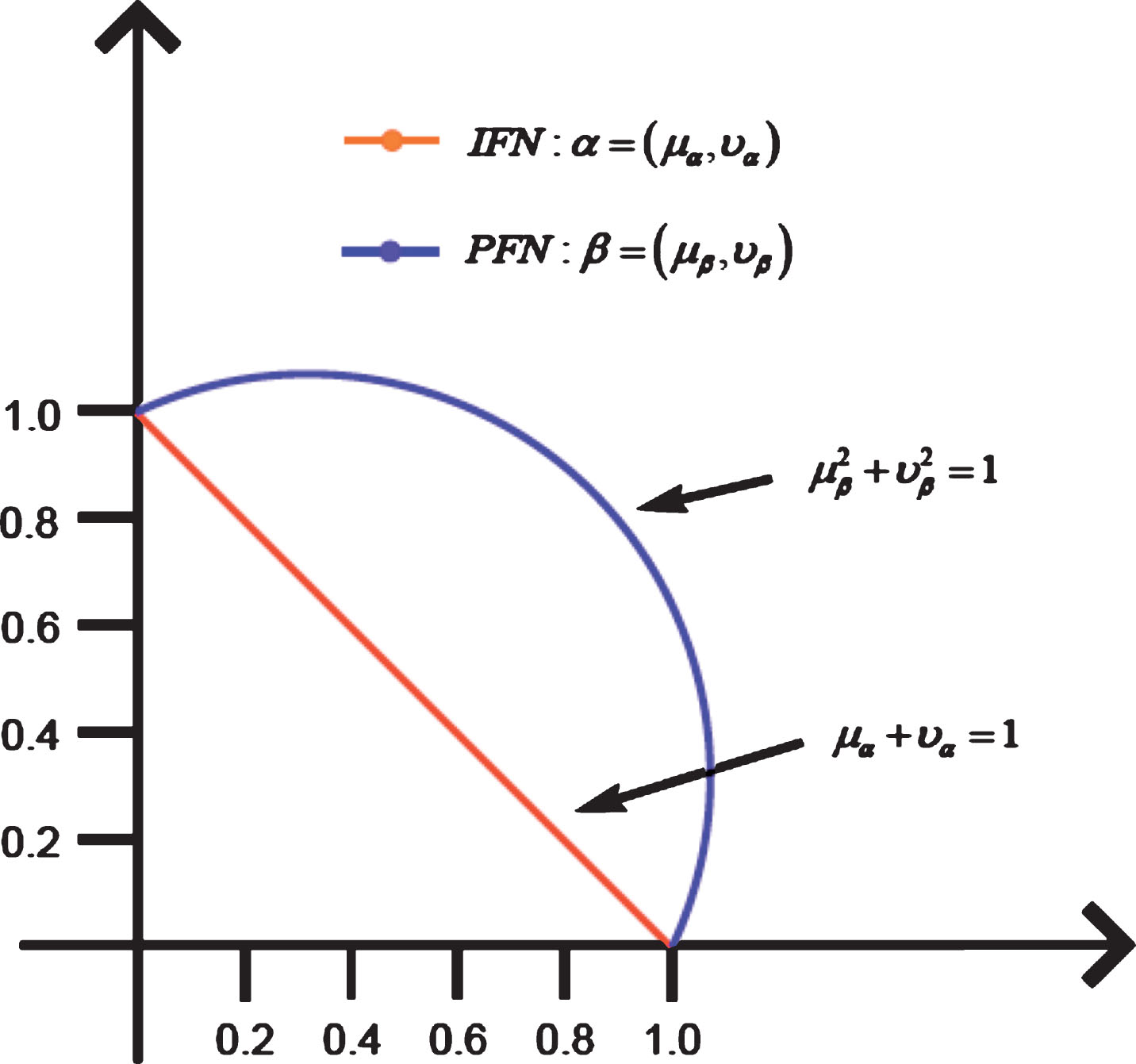
Spaces of
If s (p
i
) < s (p
j
) then p
i
precedes p
j
i.e. p
i
≺ p
j
, If s (p
i
) > s (p
j
) then p
i
succeeds p
j
i.e. p
i
≻ p
j
, If s (p
i
) = s (p
j
) then p
i
∼ p
j
.
s (p
i
) = s (p
j
) & a (p
i
) > a (p
j
) ⇒ p
i
≻ p
j
, s (p
i
) = s (p
j
) & a (p
i
) = a (p
j
) ⇒ p
i
∼ p
j
.
Recently, Peng et al. [38] proposed the idea of Pythagorean fuzzy soft set and rendered some of its applications. Guleria and Bajaj [25] introduced Pythagorean fuzzy soft matrices (PFS matrices), their operations and applications in decision making and medical diagnosis. In this section, we study some primary notions, fundamental properties and algebraic operations on PFS set with the help of examples.
For any attribute e, ψ (e) yields the value of multi-valued mapping at e which is always a Pythagorean fuzzy set. Hence, a PFS set (ψ, A) is described by the multi-valued mapping ψ : A → 2 X .
The set of all PFSSs over X and with set of parameters from E is called PFS class and is designated as PFS (X, E).
and in matrix form as
The corresponding PFS matrix is
A ⊆ B, and ψ (e) is PFS subset of G (e) for all e ∈ A.
It is worth mentioning that
We illustrate some of these concepts with the help of following example.
Their union is Their intersection is The complements of (ψ1, A1) and (ψ2, A2) are (ψ1, A1)
c
= {(e1, {ρ1, 0.5, 0.3} , {ρ3, 0.1, 0.7} , {ρ6, 0.2, 0.8}) , (e3, {ρ2, 0.3, 0.5} , {ρ6, 0, 0.3})} and (ψ2, A2)
c
= {(e2, {ρ3, 0.5, 0.4} , {ρ4, 0.1, 0.3} , {ρ5, 0.1, 0.4} , {ρ6, 0.2, 0.6}) , (e3, {ρ1, 0.4, 0.5} , {ρ6, 0.2, 0.6}) , (e4, {ρ2, 0.3, 0.7} , {ρ3, 0.2, 0.6} , {ρ6, 0.2, 0.4})} respectively. The difference of (ψ1, A1) and (ψ2, A2) is
We can easily comprehend these notions with the help of PFS matrices as given below:(ψ1, A1) =
By definition, degrees of membership and non-membership always fall in [0, 1], so 0 ≤ μ (ρ) and 1 ≥ ν (ρ) for all ρ ∈ X. Thus, it follows from definition of subset and ψ
ϕ
that By definition, degrees of membership and non-membership always lie in [0, 1], so μ (ρ) ≤1 and ν (ρ) ≥0 for all ρ ∈ X. Thus, it follows from definition of subset and
Since min {μ ψ A (ρ) , μ ψ B (ρ)} ≤ μ ψ A (ρ) ≤ max {μ ψ A (ρ) , μ ψ B (ρ)} and max {ν ψ A (ρ) , ν ψ B (ρ)} ≥ ν ψ A (ρ) ≥ min {ν ψ A (ρ) , ν ψ B (ρ)} for all ρ ∈ X. So (i) follows.□
Then,
Also, (ψ1, A1)
c
= {(e1, {ρ1, 0.9, 0.3} , {ρ3, 0.1, 0.3} , {ρ6, 0.2, 0.8}) , (e3, {ρ2, 0.3, 0.8} , {ρ6, 0, 0.3}) }, and (ψ2, A2)
c
= {(e3, {ρ1, 0.4, 0.7} , {ρ6, 0.6, 0.6}) , (e5, {ρ2, 0.3, 0.7} , {ρ3, 0.5, 0.6} , {ρ6, 0.2, 0.4}) } so that
Hence, we have the following theorem.
ψ (ϑ) ≠ ψ
ϕ
, and
and in matrix form as
and in matrix form as
Proposed method for MCGDM based on PFS sets
Decision making is a vital part of our daily life. An interviewer asked highly praised graphic designer James Victor what made him so competent? He simply replied: "I make decisions". We make millions of micro-choices daily - from what to focus our energies on, to how to talk to someone, to how to answer back an email, to what to eat which suits our health requirements. One could simply indicate that becoming a better and swifter decision-maker would be the shortest route to improving one’s daily productivity. Every person whether he is a layman or a statesman, whether he is an employee or an employer, whether he is a teacher or a student, whether he is a grown up man or an infant; everyone makes hundreds, if not millions, of decisions in his daily life. When an infant feels hungry, he can’t speak, so he decides to cry to seek attention of his attendant and shows by his body gestures that his stomach is empty.
Often we are played by our emotions to make important decisions in life and later we have to repent upon those decisions. Suppose we are making a hard choice, one that could impact our life significantly. Every time we think we have settled on something, the other option tugs us back to its side. We end up where we started: It’s a draw. Should we make ever-more-detailed lists of pros and cons and seek advice from even more trusted sources? Or should we go with our gut? Deciding how to decide is another core issue. Besides other enormous applications, Mathematics also helps us in making decisions on scientific grounds.
Besides other enormous applications, Mathematics also helps us in making decisions on scientific grounds. In this section, we give a decision making application of PFS sets. Suppose that we have an aggregate PFS set, now it is necessary to choose the best alternative form of this set. We can make a multi-criteria group decision making based on PFS sets by the following algorithm:
Construct PFS set ψ
A
over the universe X. Compute the cardinalities and find the cardinal set cψ
A
of ψ
A
. Find aggregate PFS set Compute the value of score function for each element of X utilizing
The flow chart of Algorithm 1 is given by Figure 2.
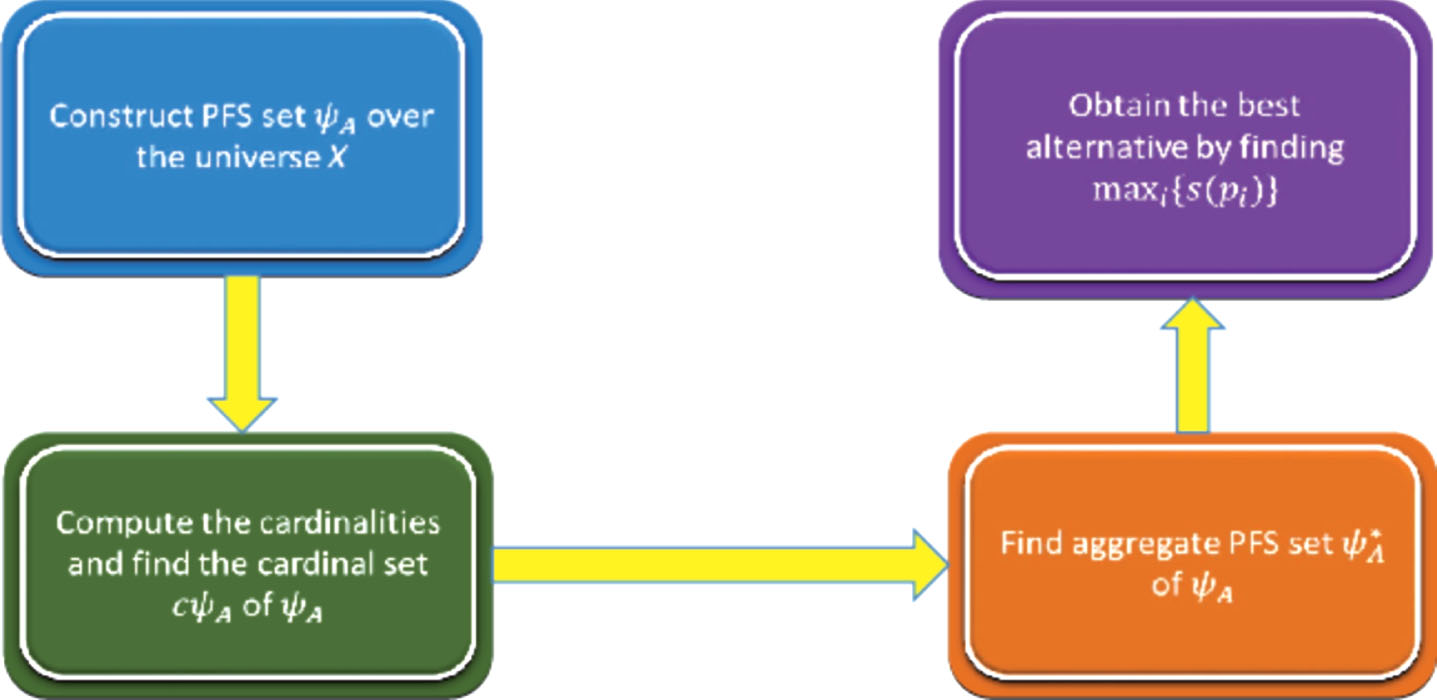
Flow chart representation of Algorithm 1.
In the forthcoming example, we first elaborate the idea to illustrate the
Hence,
The rankings are depicted with the aid of bar diagram in the Figure 3.

Bar chart showing values of score function for each p i .
Since max {s (p i )} =0.0025190 which corresponds to p1, so they must choose the site p1 for outing.
In this subsection, we represent two other existing algorithms based on Pythagorean fuzzy soft sets for comparison analysis first.
Construct the Pythagorean fuzzy soft matrix (PFS matrix) on the basis of the parameters. Case I (Equal weights): Compute the choice matrix for the membership and non-membership of PFS matrix. Case II (Unequal weights): Compute the weighted choice matrix for the membership and non-membership of PFS matrix. Choose alternative with highest membership value. Obtain the aggregated Pythagorean fuzzy weighted averaging ( Compute the score function of s (p
i
). Select the optimal alternative by
The proposed method is compared with two other methods, Guleria and Bajaj [25] and Peng et al. [38], as indicated in the Table 1 as given below listing the results of the comparison in the final ranking of top 5 alternatives. It can be observed in the comparison Table 1, the best selection made by the proposed method is comparable with the already established methods which is expressive in itself and approves the reliability and validity of the proposed method.
TOPSIS is employed to decide the superlative alternative from the notions of compromise solution. The solution which is closest to the ideal solution and farthest from negative ideal solution is acknowledged as compromise solution. In this section, we study how PFS-sets may be utilized in multiple criteria group decision making (MCGDM) using TOPSIS. First of all we shall extend TOPSIS to PFS-sets and then shall consider a problem of stock exchange investment. Amongst enormous techniques found in literature, TOPSIS holds a central position in tackling such problems. Depending upon the nature of the problem under consideration, every technique has its own pros and cons.
We make an inception by explaining the proposed technique step by step. The proposed PFS TOPSIS is generalization of fuzzy soft TOPSIS presented by Eraslan and Karaaslan [24].
where w
ij
is the weight assigned by the expert
Comparison analysis of final ranking with existing methods in given numerical example
Comparison analysis of final ranking with existing methods in given numerical example
where
where
where
The flow chart of these procedural steps is given in the Figure 4.
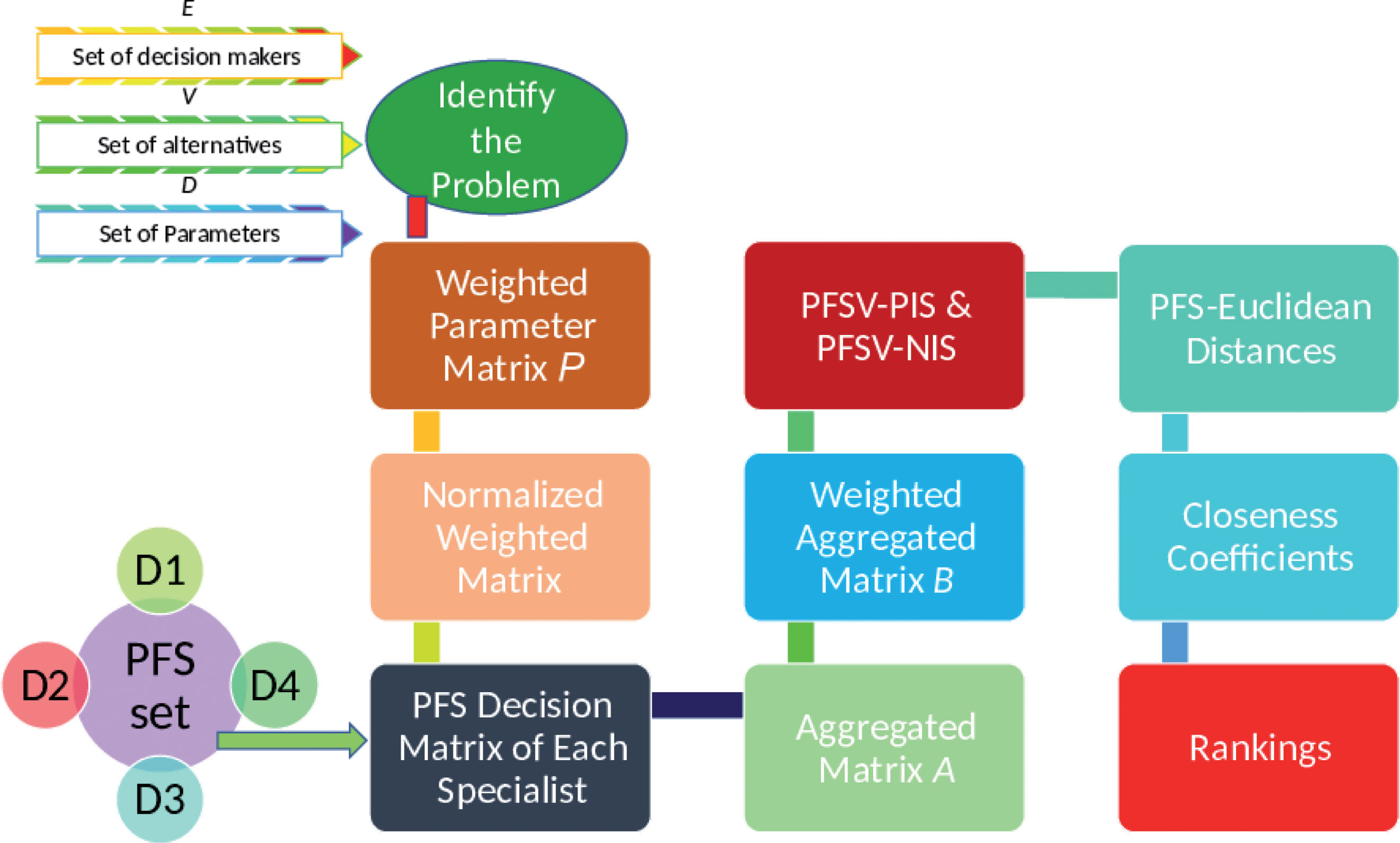
Flow chart of Algorithm 4.
Linguistic terms for judging alternatives

Line chart of rankings.
Keeping in view the above ranking, it may be concluded that the firm should invest 40% of the money on
VIKOR (Vlse Kriterijumska Optimizacija Kompromisno Resenje) is a Serbian word used to mean multiple criteria optimization/analysis and compromise solution. This method was initially established by Serafim Opricovic to tackle decision making problems with disagreeing and non-commensurable criteria, supposing that compromise is suitable for conflict determination, the decision maker looks for a solution that is closest to the ideal, and the alternatives are assessed according to all recognized principles. This method has emerged as a quite popular multi-criteria decision making technique due to its computational ease and solution exactitude. It emphases on deciding on and ranking from a collection of viable choices, and decides compromise solution for a problem with inconsistent standards to comfort the decision makers in reaching a final conclusion. It determines the compromise grading list established for the specific degree of closeness to the ideal solution.
We begin by explaining the proposed technique step by step as follows:
where w
ij
is the weight assigned by the expert
where
where
where
The flow chart of these procedural steps is given in the Figure 6.

Flow chart of Algorithm 5.
Distance measures & closeness coefficient of each alternative
Values of S i , R i and Q i for all alternatives
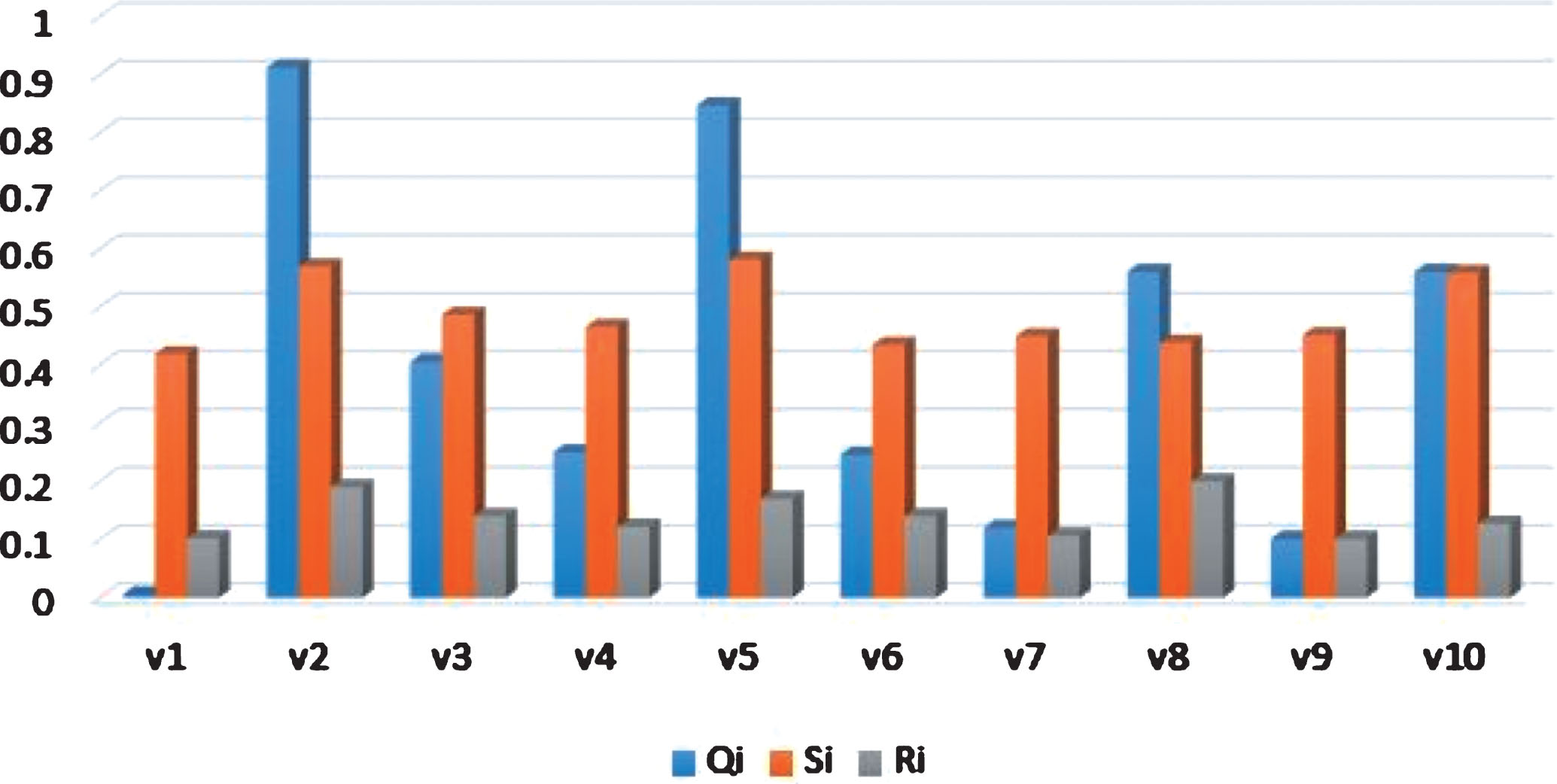
Bar chart of rankings.
Hence, the firm should invest 40% on
Both models assume a scale factor for each criterion. This scale have need of eliminating the different units of all criteria values. For ranking the values calculated by these methods are defined with the help of an aggregating function. The major difference between two methods appears in the aggregation approaches. The VIKOR method provides an aggregating function representing the distances from ideal solution. In addition to TOPSIS, VIKOR method provides a compromise solution with an advantage rate.
The normalization procedures are different in the two methods. VIKOR method uses linear normalization whereas in TOPSIS vector normalization is used. TOPSIS method introduces the ranking index including the distances from the ideal point and from the negative-ideal point. These distances in TOPSIS are simply summed without paying heed to their relative importance.
The TOPSIS method uses n-dimensional Euclidean distance that by itself could represent some balance between total and individual satisfaction, but uses it in a different way than VIKOR, where weight κ is introduced. Both methods provide a ranking list. The highest ranked alternative by VIKOR is closest to the ideal solution. However, the highest ranked alternative by TOPSIS is the best in terms of the ranking index, which does not mean that it is always closest to the ideal solution. In addition to ranking, the VIKOR method proposes a compromise solution with an advantage rate.
Both methods are mostly used MCDM methods in decision making projects. Ability to adapt methods to Geographical Information Systems increase the applicability in the field of environmental, business, stock exchange, trade, commerce, meteorological, medical diagnosis, armed forces decisions and engineering problems. Different solutions enhance the decision process and increase the preference of decision makers. Thus, right decision giving can be possible with two probabilities.
Conclusion
We studied various properties of Pythagorean fuzzy soft sets along with some of their particular characteristics, in this paper. We used tables and matrices to conceive the notions effectively. We also studied some set theoretic properties of these sets. We proposed three algorithms accompanied by flow charts in this paper, for MCGDM under PFS environment. The first one is by making use of PFS aggregation operator and score function values based technique. We applied this method on site selection problem. Two other proposed algorithms are based on PFS linguistic TOPSIS and PFS linguistic VIKOR approaches. We rendered an application of stock exchange investment problem by these two techniques. We made use of different sorts of statistical charts to visualize the rankings of different alternatives under consideration. We hope this study will open new doors of enquiry for the knowledge seekers and researchers in various fields including real world problems, artificial intelligence, pattern recognition, image processing and forecasting.