




Abstract
To consider the decision makers’ regret behavior and describe the hybrid evolution information in the risk decision-making problem, a new approach is proposed based on regret theory in this paper. Firstly, the probable value of different states are calculated by Pignistic probability transformation method. Secondly, the relative closeness formula of hybrid information are established and the utility values of alternatives are computed. Then, decision makers’ utility values are obtained according to the regret theory. Moreover, the overall perceived utility values of alternatives are obtained by weighted arithmetic mean and got the optimal one by the ranking order. Finally, an numerical example is illustrated the method and comparative analysis are offered between the proposed approach and other existed methods to show that is feasible and usable.
Introduction
As we all know, management is actually a decision-making, which includes the selection of plans, organization and implementation. The process of decision-making usually goes with risk, ambiguity, randomness, and etc. In recent years, multi-attribute risk decision-making has attracted more attention, which is used to analyze and describe those factors that affect realizable goals, and in which various natural states are consider [1, 2]. For example, because company failed to consider the environmental risk of future market, the profit of Hangzhou Bay Bridge project in China reduced 30% in 2018, which lead to enterprise’s regret and disinvestment. Therefore, it deserves to study the method for multiattribute risk decision-making of hybrid information with the social value and practical significance. Therefore, multi-attribute risk decision-making should fully consider decision-makers’ regret behavior.
Multi-attribute risk decision-making generally involve cost, competition, politics, economy, technology and other factors, in which the cost and technology may be quantitatively evaluated, while competition, politics, economy and other factors may be qualitatively evaluated, so quantitative evaluation and qualitative evaluation often coexist in real life. Zhang [3] proposed a method to select investigative project for venture capital enterprises with information of interval numbers and triangular fuzzy numbers. Liu [4] introduced probability multi-attribute risk decision making method to obtain the optimal alternative for new factory based on real numbers, interval numbers and linguistic numbers. Jiang [5] discussed a method to select the investigative project based on prospect theory with random variables of gray numbers and uncertain linguistic information. Tao et al. [6] solved the supplier selection problem in green supply chain by a decision method with hybrid Z information. Wen et al. [7] considered the trust degree of decision-makers and the combination information of real numbers and triangular fuzzy numbers in the process of risk decision-making. Based on above papers, more quantitative evaluation and qualitative evaluation information, such as Real numbers, Interval numbers, Triangular fuzzy numbers, Intuitionistic fuzzy numbers, Linguistic numbers, would be considered in the process of risk decision-making according to the real world.
In mostly literature, risk decision-making methods are based on the classical expected utility theory, such as the distance measurement methods of TOPSIS and VIKOR based on probability theory [8–12]. The regret theory describes the bounded rational of decision makers and reflects the additional pleasure by choosing one of the un-selected alternative instead of the selected alternative, which may be the best alternative [24, 25]. Bell and Loomes [14, 15] extended regret theory to decision-making method. After that, Zhang [16] applied VIKOR method to solve the risk decision making problem with triangular fuzzy numbers based on regret theory. Liu and Yu [17, 18] proposed a stochastic risk decision method on regret theory and group satisfaction degree with uncertain fuzzy values. Wang [19] considered the regretful behavior of decision maker and the hesitant fuzziness of evolution information in the coal mine accidents. Zhang [20] proposed a method based on regret theory and solve the risk problem with interval intuitionistic trapezoidal fuzzy numbers. As the type-2 fuzzy set is more flexible than the type-1, Wang et al. [21] put forward the multi-attribute decision making of regret theory on the basis of type-2 fuzzy set. Liu et al. [22] introduced the probabilistic hesitation multi-attribute risk investment decision making on the basis of regret theory. Yang et al. [23] considered the random multi-attribute decision making problems with probability and probability limit information based on the regret theory. However, decision makers are not completely rational, who may be affected by complex environment, and so they are not purely rational thoughts. In this paper, the regret well-being of decsion makers are researched in the process of risk decision-making.
In this paper, our motivation is that a novel method is proposed to solve the multi-attribute risk decision-making problems with the hybrid information, in which the decision makers’ regret behavior is considered in the different probabilistic states. The importance of the study is that we consdier the risk states, hybrid information and regret well-being in the process of decsion making. The paper can be listed as follows: Section 2 proposes the risky decision-making model of hybrid information based on regret theory and presents a general framework of method. In section 3, an illustrative example is demonstrated and a comparative analysis is conducted to verify its feasiblility and effectiveness. Finally, the paper is concluded in section 4.
Risky decision-making model of hybrid information based on regret theory
In this section, we apply the regret theory to compare own chosen alternative with other possible alternatives, and decision maker may regret if it is inferior to other alternatives and rejoice if it is superior [14, 26]. Let u (x) and u (y) respectively represent the utility obtained by decision makers’ from alternatives A and B, then the perceived utility of alternative A relative to alternative B is expressed as: u (x, y) = u (x) + R (u (x) - u (y)), and function R (•) is a monotonously increasing concave function. R (u (x) - u (y)) > 0 is rejoice value, R (u (x) - u (y)) < 0 is regret value. Other, in view of the complexity and uncertainty of the current market environment, due to the fuzziness and uncertainty in the decision information, real numbers, interval numbers and triangular fuzzy numbers are usually used for quantitative description, and linguistic numbers and intuitive fuzzy numbers are used for qualitative description. Therefore, the evaluation information is usually hybrid.
A multi-attribute risk decision-making problem has a set of alternatives
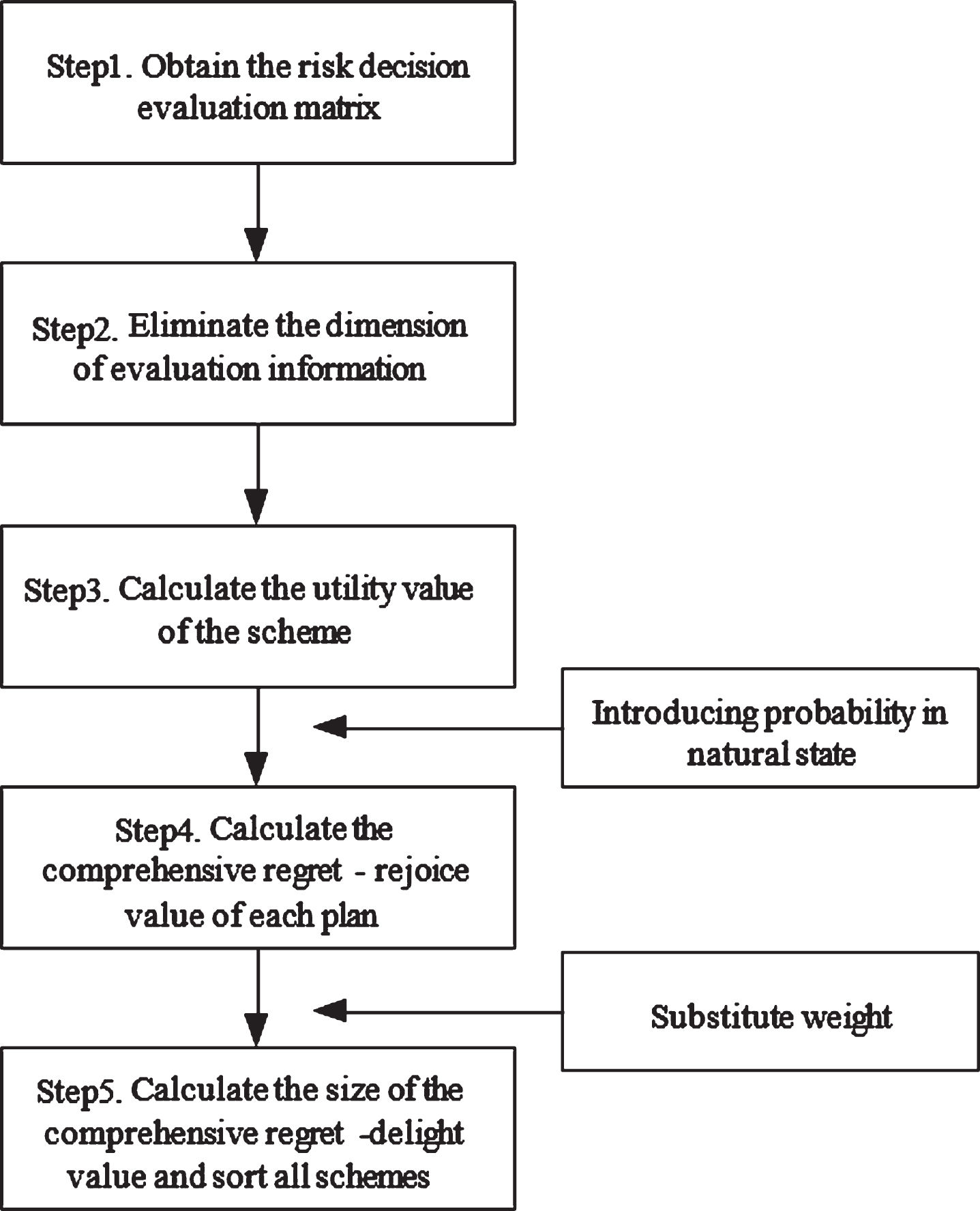
The process of multi-attribute risk decision-making on regret theory.
Normalize the hybrid information [27]
Positive and negative ideal points
The distance from the Positive and negative ideal
Where Pignistic probability transformation method is used to calculate the risk probability p
t
in a risk environment [13–16, 28]. Under the natural state p
t
and attribute c
j
, the regret value
The r (a i ) is the perception of decision makers that alternative a i is inferior to all other alternatives. If r (a i ) ⩽ 0, the higher the value r (a i ) is, the less inferior the alternative a i is to other alternatives. g (a i ) is the perception of decision makers that alternative a i is superior to all other alternatives. If g (a i ) ⩾ 0, the higher the value g (a i ) is, the greater the superiority of alternative a i is to other alternatives.
Where the larger the value Φ (a i ) is, the better the alternative a i is [2].
Based on the literature [29], a fresh e-commerce company wants to choose one of the four alternative cold chain logistics service providers (a1,a2,a3,a4) as its strategic partner that considers the five attributes of the degree of enterprise informatization c1, delivery punctuality rate c2, enterprise emergency response capability c3, enterprise cooperation capability c4 and logistics service quality c5. Through a large number of market research and expert consultation, the degree of enterprise informatization is scored by experts on the basis of a ten-point system based on real numbers. The on-time delivery rate often fluctuates within a certain range and is expressed by interval numbers. Due to the influence of external uncertain factors, the emergency response capability of enterprises shows certain volatility in different time periods, which are expressed by triangular fuzzy numbers. The cooperative ability of enterprises can be expressed by intuitionistic fuzzy numbers. Logistics service quality can be measured by linguistic numbers. Suppose that the market environment may have three states in the future: good θ1, medium θ2 and poor θ3, and the probability of occurrence is p1, p2, p3. The probability distribution under the three state sets Θ ={ θ1, θ2, θ3 } is obtained as f ({ θ1 }) = 0.3, f ({ θ1, θ2 }) = 0.4, f ({ θ2, θ3 }) = 0.15, f ({ θ1, θ2, θ3 }) = 0.15, and the other subset distribution of 2
Θ
are all 0. The attribute weight vector is
To solve this problem, the method is used to select the most suitable cold chain logistics service provider. The specific process is determined as:
Step 1: Establish the risk decision matrices, as shown in Table 4, Tables 5 and 6.
Subjective risk decision matrices D1 of good market
Subjective risk decision matrices D1 of good market
Subjective risk decision matrices D2 of medium market
Subjective risk decision matrices D3 of poor market
Step 2: Obtain normalized matrixs, as shown in Table 7, Tables 8 and 9. Based on Table 2, the positive and negative ideal points of hybrid information are obtained under different states, as show in the Table 10.
Normalized subjective risk decision matrices D1 in good market
Normalized subjective risk decision matrices D2 in medium market
Normalized subjective risk decision matrices D3 in poor market
The positive and negative ideal points in different states
Step 3: Calculate the perceived utility value of each logistics supplier attribute value under different natural states based on the positive and negative ideal points by Equation (1), as shown below.
Step 4: Establish regret matrices and rejoice matrices for comparisons of suppliers with each attribute by Equations (2) (3) (4) (5), as shown in Table 11, where γ = 0.3 and the probabilities of occurrence in three natural states are p1 = 0.55, p2 = 0.325 and p3 = 0.125 by the Pignistic probability transformation method.
Total regret/rejoicing matrices
Step 5: Determine the total regret value and the rejoice value of each alternative logistics service provider relative to other logistics service providers are calculated by Equations (6) and (7):
Step 6: Calculate the sorting values of each logistics service provider by Equation (8):
Therefore, the sorting result of logistics service providers is a1 > a4 > a3 > a2.
In order to analyze the influence of the regret avoidance coefficients γ on the decision analysis results, where γ = (0.1, 0.2, ⋯ , 1). As can be seen from Fig. 2, with the gradual increase of regret avoidance coefficients γ incresasing, the perception (optimal sorting value) of logistics service providers and decision makers becomes larger and larger, while the perception (optimal sorting value) of corresponding logistics service providers and decision makers becomes smaller and smaller. Therefore, the regret aversion of decision-maker would influence the decision behavior in some extent. As can be seen from Fig. 2, logistics service provider a1 is the best one from the beginning to end. Therefore, the fresh e-commerce company a1 should be chosen as long-term strategic partners.
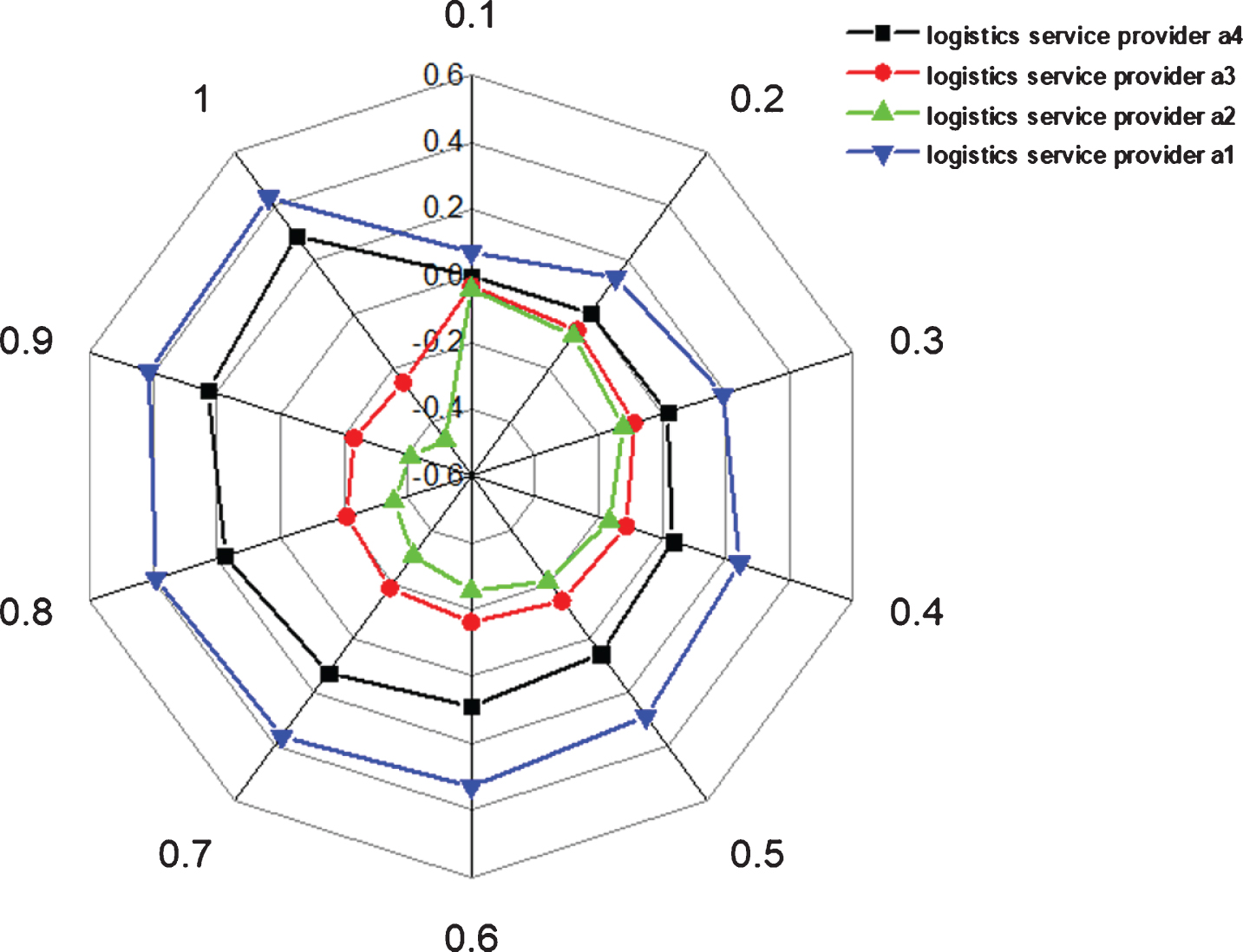
The ranking results of logistics service providers under different γ.
In view of the decision-making problems, this paper would use the decision-making model proposed in the literature [29] to solve the hybird data and simply analyze the feasibility of the method proposed in this paper.
According to the decision-making method proposed in the literature [29], firstly, the decision-making matrices under the three natural states in this paper is normalized by using the formulas (1), (4) and (5) in the literature [29]. Then, by combining the formulas (8) and (9) in the literature [29] with the measurement formulas of various types data in the literature [29], and carrying out normalization processing, the weight of each attribute in differernt states is finally obtained as:
By adopting the same case study of logistics service providers selection problem, a comparative analysis with VIKOR method is conducted to validate the feasibility and effectiveness of the proposed approach [16, 29]. The comparisons between the proposed methods with the existing methods are shown in Table 12. The best probability set p* = [0 . 3230, 0 . 3251, 0 . 3519] can be obtain by matlab according the lecture [29]. The final decision values of each alternative are Q1 = 0 . 2776, Q2 = 0 . 6750, Q3 = 0 . 3415, Q4 = 0 . 8416, and the ranking order is a1 > a3 > a2 > a4. Although the sorting results are slightly different with that in this paper, the optimal alternative is also a1. The difference is mainly reflected in the decision-makers’ regret action and a4 is facing more regret losses. Therefore, the final perceived utility value a4 is lower. Meanwhile, the optimal decision result in this paper would become more obvious with the change of regret avoidance coefficient, where the decision results are closer to the reality. If the two methods cause same probability and property weight in the market, there is no change on the result. This is because that it is the error of result caused by regret aversion coefficient, the regret and rejoice values are in the form of exponent, so that their changes would also present exponential change, which would have some influence on the final result. Since the proposed method highlights the indeterminacy, regret and uncertainty, it seems that it is better and more functional to solve risk decsion making problems.
The S, R, Q values of logistics service providers
In this paper, a novel approach is proposed based on regret theory, which were used to aggregate the evaluation information and obtain the collective values of the alternatives in this risk decsion making problem, and then regret theory is used in order to rank the alternatives. Lastly, an illustrative example of logistics service providers selection was provided and a comparative analysis was presented to verify the applicability and efficacy of the proposed approach. The advantage of the proposed approach lies on the consideration of hybrid evaluation information and the decision makers’ regret behavior. It is suitable and practical to solve risk decsion making problem since hybrid evolution information emphasized the truth, indeterminate and uncertainty. More multi-attribute risk decision-making methods under regret theory could be developed in the future and its diverse applications to solve real problems applications such as supplier selection, enterprise credit quality evaluation, novel product development risk prediction and supply chain management.
Footnotes
Acknowledgments
The authors would like to thank the anonymous reviewers and editors for their insightful and constructive comments on our paper. This work was supported in part by the Doctoral Project of Chongqing Federation of Social Science Circles under Grant 2018BS71 amd the Humanities, Social Sciences Research General Project of Chongqing Education Commission under Grant 18SKGH045, Research Center for Cyber Society Development Problems under Chongqing Municipal Key Research (No. 2018skjd06), National Social Science Fund of Chongqing University of Posts and Telecommunications (No. 2017KZD10).