



Abstract
Reliability analysis of complex systems subject to competing failure processes based on probability theory has received increasing attention. However, in many situations, the observed data is too limited to estimate the parameters and probability distributions of the system by statistic methods. To address this problem, an uncertain degradation models is proposed in this paper under the framework of uncertainty theory. Based on this model, a complex system which is subject to both continuous internal degradation and external shocks is introduced. The continuous internal degradation of the system is controlled by some uncertain factors, and the external shocks are deemed to an uncertain renewal reward process. Reliability for the complex systems is obtained by employing the uncertainty theory. Finally, a case study is presented to demonstrate the effectiveness of the results obtained in the paper.
Keywords
Introduction
The accurate evaluation of system reliability is of critical importance since failures will cause tremendous economic loss and significant damage. Ageing is the main cause of system failure and numerous models have been proposed to model system ageing. The virtual age method and shot noise method are firstly proposed to characterize the gradual system ageing process, e.g., [1, 2]. Nowadays, with the rapid development of sensor technology, degradation analysis based on probability theory is drawing increasing attention in the reliability field. Degradation models can be generally classified into stochastic models and path models [3]. Stochastic processes which have been widely used to model system degradation behaviors include Gaussian process, Gamma process, and Brownian motion process etc. [4]. Systems may fail due to the internal degradation or the external environmental conditions caused by shocks. The reliability evaluation for complex systems subject to independent competing failure processes have been a hot topic and studied in references [5–8] and others. Although independent competing failure processes provides convenience for reliability modelling, in engineering practice, systems may experience multiple dependent competing failure processes (MDCFP). Peng et al. [9] proposed reliability evaluation methods considering extreme and cumulative random shock models. Reliability models including four different random shock patterns were developed in [10] for systems subject to MDCFP with changing degradation rate. Gao et al. [11] considered systems operating in a random environment with multiple species of shocks. A new reliability analysis method for coherent systems experiencing internal degradation and external shocks was given in [12]. Raifiee et al. [13] investigated the optimal condition-based maintenance policy for systems based on a generalized mixed shock model. An optimal age-based group maintenance policy for multicomponent aging systems was presented in [14]. Qiu and Cui [15] generalized the existing MDCFP models by considering two-stage degradation process with competing failures. Other representative literature on MDCFP models can be found in [16–19].
The above mentioned degradation models are applicable in the case in which there are abundant failure data, because the obtained probability distribution function can approximate the long-run cumulative frequency based on the law of large numbers. Data in real engineering applications such as the range of a newly developed missile and the material strength, however, are difficult to obtain due to the technological or economical reasons. In such case, the law of large numbers is no longer valid since only few failure data are accessible and thus the probability theory based degradation models are not applicable. Hence, such systems are mainly affected by epistemic uncertainty. Then experts can be invited to provide empirical failure data. Obviously, it is not suitable to employ random variable to address these empirical data. Fuzzy theory was proposed by Zadeh [20] in 1965 to model systems with few failure data. However, there exists some paradox in the models established on fuzzy theory due to the lack of the law of excluded middle. More explanation about uncertainty theory and fuzzy theory was introduced in [21]. To quantify the epistemic uncertainty caused by few failure data, we have to invite domain experts to evaluate their belief degree. To deal with human uncertainty arising from the belief degree, an uncertainty theory was invented by Liu [22] in 2007 and then refined by Liu [23] in 2010. It has the mathematical properties of normality, duality, subadditivity and product axioms. Uncertain process theory was introduced by Liu [24] in 2008 to model the evolution of uncertain phenomena with time. Furthermore, Liu [25] proposed a Liu process which is an uncertain stationary independent increment process with normal distributed increments. Uncertain differential equations driven by the Liu process were studied by Yao and Chen [26], Yao [27]. Nowadays, the uncertainty theory is playing an increasingly important role in uncertain reliability analysis, uncertain risk analysis, uncertain statistics analysis, uncertain financial analysis and uncertain population model [28–32]. So far there have been much literature on uncertain reliability analysis, for example, see Gao et al. [33]. They investigated the reliability of uncertain weighted k-out-of-n systems by using Boolean uncertain variables. Zhang and Guo [34] discussed an uncertain block replacement policy with no replacement in failure. Ke and Yao [35] studied the block replacement policy in an uncertain environment, and the optimal scheduled replacement time under three different criterions was investigated utilizing uncertainty theory. An optimal maintenance model based on maximum entropy principle was introduced in [36] to estimate belief reliability distribution. Thus, uncertainty theory is an effective tool to evaluate system reliability when a few failure data or no failure data are available [37, 38].
In our daily life, some complex systems are often subject to internal degradation and external shocks. For example, the stent which is implanted in human body experiences cyclic stress and a variety of overloads. The cyclic stresses include contractions and dilations due to heartbeat, and the overloads are mainly caused by patient’s excessive activities. In this paper, the uncertainty theory is introduced to measure the reliability of some complex degradation systems with few failure data. Reliability models are developed in this paper for degrading systems experiencing independent uncertain continuous internal degradation and uncertain external shocks. Continuous internal degradation and external shocks are modelled by different uncertain processes. Soft failure occurs when continuous internal degradation is above a soft failure threshold level L, and hard failure occurs when the accumulated damage caused by uncertain external shocks exceeds a hard failure threshold D. Based on the reliability models, we present the corresponding calculation formulae for system reliability in an uncertain situation. To our best knowledge, this is the first report in the literature on such a degradation complex system under uncertain environment, which offers much scope for research on reliability for degradation models under uncertainty theory.
The rest of the paper is organized as follows. Section 2 gives some basic concepts and properties about uncertainty theory to be used in the paper. Section 3 develops the reliability models considering the two independent failure processes. In Section 4, the formulae of system reliability is given. A case study is presented in Section 5 to demonstrate the effectiveness of the results obtained in the paper. Finally, the conclusions are summarized in Section 6.
Preliminaries
In this section, some basic concepts and results in uncertainty theory will be introduced.
Axiom 1 (Normality Axiom): M {Γ} =1 for the universal set Γ.
Axiom 2 (Self-Duality Axiom): M {Λ} + M {Λ c } =1 for any event Λ.
Axiom 3 (Subadditivity Axiom): For every countable sequence of events Λ
i
s, we have
Axiom 4 (Product Axiom): Let (Γ
k
, L
k
, M
k
) s be a sequence of uncertainty spaces. For any sequence of events Λ
k
s chosen from L
k
s, the uncertain measure M satisfies
For any real number x.
Provided that at least one of the two integrals is finite.
for any Borel sets B1, B2, …, B n .
C0 = 0 and almost all sample paths are Lipschitz continuous; C
t
has stationary and independent increments; every increment Cs+t - C
s
is a normal uncertain variable with expected value 0 and variance t2, whose uncertainty distribution is
The canonical process as defined above is called Liu process now.
Details about uncertainty theory readers can refer to Liu [20, 21].
Continuous uncertain internal degradation
In the traditional reliability analysis of complex systems, the continuous failure processes are usually described by stochastic differential equations e.g., [1], one of such equations is
Equation (6) is equivalent to the following equation
The left hand part of Equation (7) is actually the rate of the degradation,
The continuous uncertain degradation X (t) for the system follows a given uncertain process
Equation (8) is equivalent to the following equation
where Φ-1 (α) is the inverse standard normal uncertain distribution, i.e.,
and 0 < α < 1.
It follows from Yao-Chen formula [26] that we know the uncertain degradation process X (t) has an inverse uncertain distribution, which is
The studied system experiences two independent competing failure modes: soft failure due to continuous uncertain internal degradation and hard failure due to uncertain external shocks. Soft failure occurs when the continuous uncertain degradation process is larger than the soft failure threshold level L.
Uncertain external shocks arrive according to an uncertain renewal process. Let N (t) be the number of uncertain shocks that have arrived by time t, X
k
be the interval time of the k - 1th and the kth shocks, and Y
k
be the magnitude of the kth shock load, then
The system fails when the continuous uncertain internal degradation process is larger than the soft failure threshold level L or when the cumulative damage size of the uncertain external shocks is exceeds the hard failure threshold D, whichever happens first.
Reliability analysis of uncertain degradation systems
In order to obtain the reliability of the uncertain system, we need to calculate the reliability of the continuous uncertain internal degradation and uncertain external shocks. Denote by
Reliability formulae for systems subject to the continuous uncertain internal degradation
In this situation, we assume that the uncertain degradation system introduced in Section 3 has no external shocks. Therefore, the reliability for the continuous uncertain internal degradation,
Let
where Ψ t (x) is the uncertain distribution of X (t).
By using the duality axiom, we obtain
The proof is completed.
In this situation, we assume that the uncertain degradation system introduced in Section 3 has no continuous internal degradation. Thus, the uncertain system survives in the given time interval [0, t] when the cumulative damage size of the uncertain external shocks by time t is less than or equal to D. Then the reliability for the system only subject to uncertain external shocks, denoted by γ
t
(D), can be expressed as follows
Then follows from Lemma 2, Equation (16) holds.
By Theorem 2, the reliability for the uncertain external shocks, γ t (D), can be obtained easily.
In the following, we discuss the reliability of uncertain degradation system that is subject to both continuous uncertain internal degradation and uncertain external shocks, and the two processes are independent.
Proof: The system reliability at instant time t is defined as the uncertain measure that the lifetime of the system is larger than t, i.e.,
The proof is completed.
For results presented above, our model can be extended. Assume that the continuous uncertain degradation of the system follows J (X (t)), where J (x) is a monotonic function and X (t) satisfies the uncertain differential equation
As shown in Fig. 1, a micro-engine consists of several orthogonal linear comb drive actuators which are mechanically joined to a rotating gear. The wear on the rubbing surface between the gear and the pin joint usually causes a broken pin, which is the dominant reason for micro-engines failure. Additionally, in shock tests on micro-engines, the springs fracture is observed when the cumulative magnitude of shocks are larger than a certain threshold. Therefore, the micro-engine is subject to two competing failure processes: soft failure due to wear degradation and hard failure due to springs fracture caused by external shocks. Failure time data is few when the micro-engine is an innovative product, so the failure time distributions of the micro-engine can be obtained through expert’s empirical data. The failure mode of the micro-engine is modeled by employing uncertainty theory in this paper.

Scanning electron microscopy image of the micro-engine. The shuttle and comb fingers are shown in the upper inset. The lower inset shows an enlarged view of the output gear (diameter of 80μm) and the location of the pin joint [40].
The wear degradation of the micro-engine follows a continuous uncertain degradation process X (t) = μ (t) + σC (t), with the initial degradation value X (0) =0.5 Gpa. For simplification, we suppose that μ (t) =3t + 1, σ = 1μm3, and the soft failure threshold level L = 20 Gpa. The uncertain external cumulative shocks process is
In this case, the continuous uncertain internal degradation process X (t) has an inverse uncertain distribution
Therefore, the uncertain distribution of the continuous uncertain internal degradation process X (t) is
Also, the continuous uncertain internal degradation process X (t) has a survival function
Then the system reliability is
where
Setting t = 10 and t = 30, when x varies from 0 to 140 gradually, we get the uncertain distribution M {X (t) ≤ x} as shown in Fig. 2.

The uncertain distribution of X (t) when t = 10μm3 and t = 30μm3.
Setting L = 20 Gpa, L = 25 Gpa and L = 30 Gpa, when x varies from 0 to 15 gradually, we get the uncertain survival function,
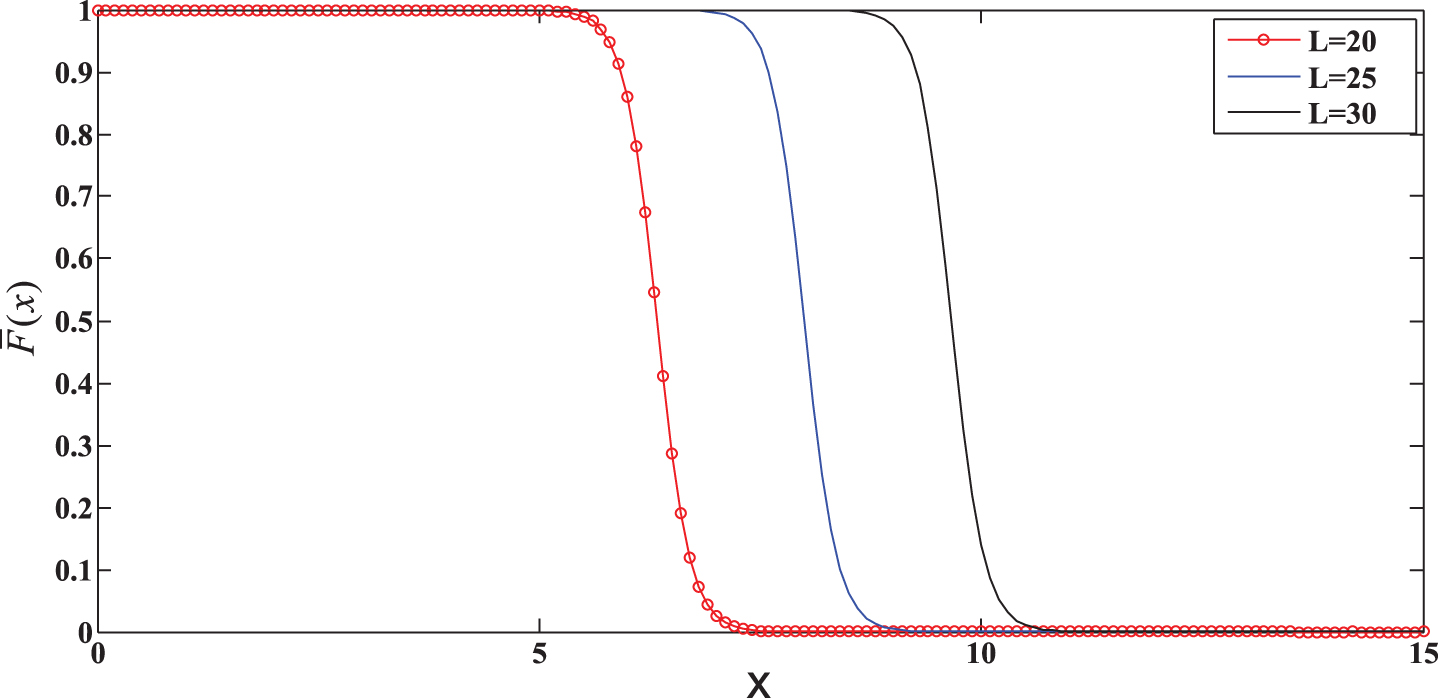
The survival distribution of X (t) when L = 20 Gpa, L = 25 Gpa, and L = 30 Gpa, respectively.
Setting L = 20 Gpa, D = 5 Gpa, D = 10 Gpa, and D = 20 Gpa, when t varies from 0 to 12 gradually, we get the reliability function, R (t), as shown in Fig. 4. As can be observed in Fig. 4, the hard failure threshold, D, affects the system reliability. When D increases from 5 to 20, R (t) is not sensitive to D before t reaches 3 approximately. For the region of t larger than 3 and smaller than 6, R (t) shifts to the right when D increases, which implies that systems with a larger D have a better reliability. For the region of t larger than 6, R (t) is not sensitive to D. It can be observed that when t approaches 15, the three curves converge to the same value, this phenomenon is duo to the fact that the system fails with almost the same probability when t is large enough.
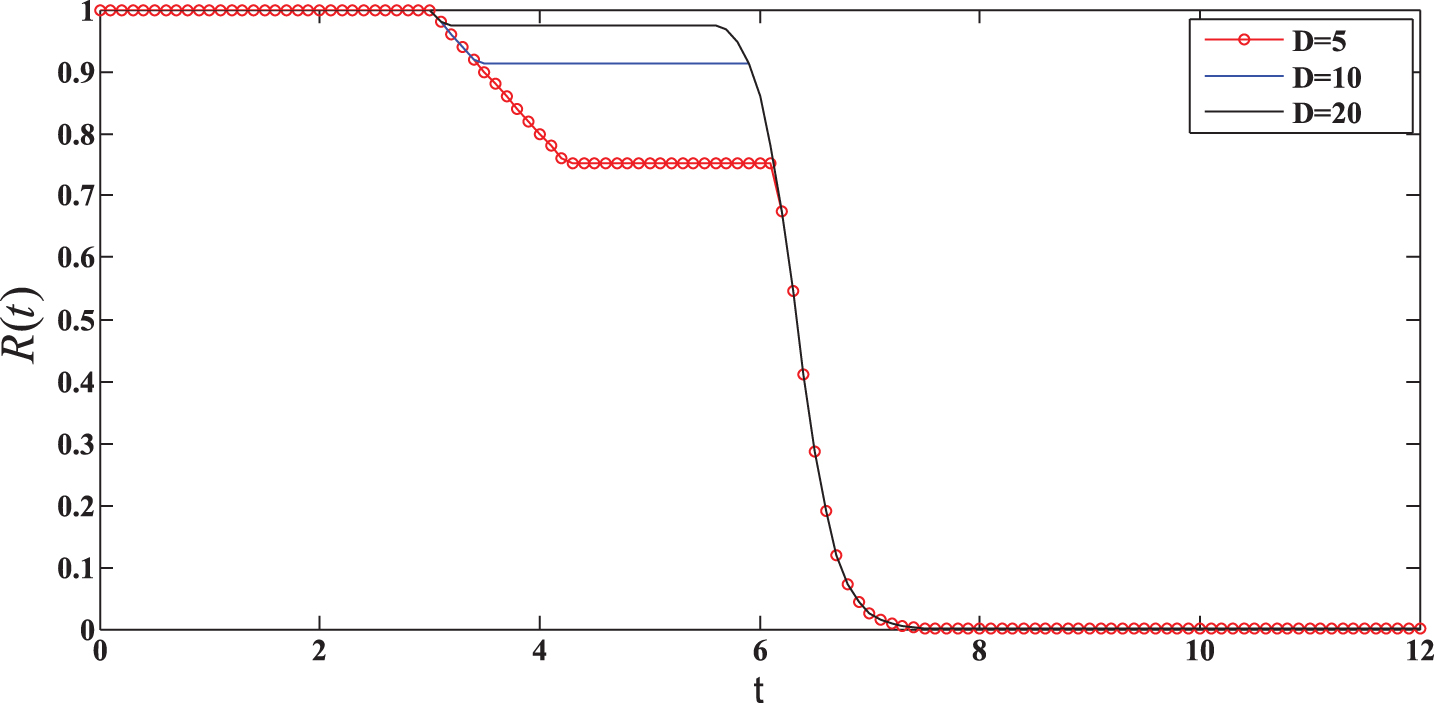
The reliability of X (t) when D = 5 Gpa, D = 10 Gpa, and D = 20 Gpa, respectively.
Setting D = 20 Gpa, L = 5 Gpa, L = 10 Gpa, and L = 20 Gpa, when t varies from 0 to 12 gradually, we get the reliability function, R (t), as shown in Fig. 5. Fig. 5 indicates that the soft failure threshold value L has a significant effect on the reliability function and systems designed with higher failure threshold is more reliable. For a larger value of L, the system has higher resistance to both internal degradation and shock damage. Thus, given a fixed time point t, the uncertain measure that the degradation level is below the failure threshold is also larger. As can be observed from Fig. 5, when L increases from 5 to 20, R (t) shifts to the right, which implies a better reliability performance for a larger value of L.
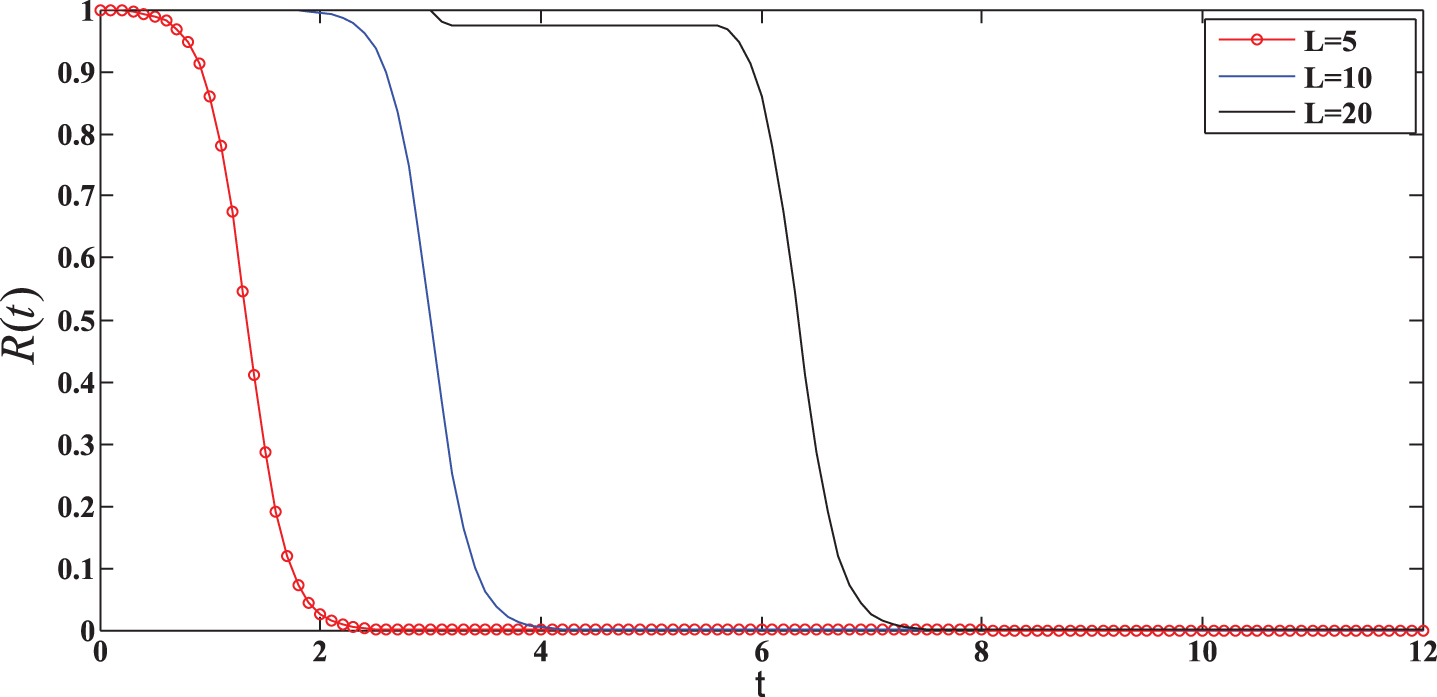
The reliability of X (t) when L = 5Gpa, L = 10 Gpa, and L = 20 Gpa, respectively.
In this paper, we have proposed reliability models for complex systems that experience multiple independent competing failure processes in an uncertain environment. The continuous internal degradation satisfies an uncertain differential equation, and the external shock model is described by an uncertain renewal reward process. We obtain a formulae to calculate the system reliability by employing uncertainty theory.
The contributions of this paper are as follows:
(1) the uncertain degradation system model is developed for the first time, (2) the reliability formulae of the multiple independent competing failure processes is derived based on uncertain theory, (3) the reliability formulae of compound uncertain degradation systems is derived, (4) an example of micro-electro mechanical systems (MEMS) is presented to validate the application of the uncertain degradation model.
Unknown parameter estimation based on the least square principle and linear interpolation method in [23] is one of the future research directions. It is also worthwhile to study the reliability of complex systems that experience multiple dependent competitive failure processes in uncertain or uncertain random environments [41]. Other shock modes can also be considered under the framework of uncertainty theory.
Footnotes
Acknowledgments
This research is supported by the National Natural Science of China under Grants No. 71601101 and 71631001, Scientific and Technological Innovation Programs of Higher Education Institutions in Shanxi (No. 2019L0738, 2020L0463), the Research Project of Shanxi Datong University No. 2019CXK1. The authors are very grateful to comments and suggestions of the editors and three anonymous referees that improved the previous version of the paper.