



Abstract
Unlike other linguistic modellings, probabilistic linguistic term sets can express clearly the importance of different linguistic variables. The notion of Probabilistic Linguistic Preference Relations (PLPRs) constitutes an extension of linguistic preference relations, and as such has received increasing attention in recent years. In group decision-making (GDM) problems with PLPRs, the processes of consistency adjustment, consensus-achieving and desirable alternative selection play a key role in deriving the reliable GDM results. Therefore, this paper focuses on the construction of a GDM method for PLPRs with local adjustment strategy. First, we redefine the concepts of multiplicative consistency and consistency index for PLPRs, and some properties for multiplicative consistent PLPRs are studied. Then, in order to obtain the acceptable multiplicative consistent PLPRs, we propose a convergent consistency adjustment algorithm. Subsequently, a consensus-achieving method with PLPRs is constructed for reaching the consensus goal of experts. In both consistency adjustment process and consensus-achieving method, the local adjustment strategy is utilized to retain the original evaluation information of experts as much as possible. Finally, a GDM method with PLPRs is investigated to determine the reliable ranking order of alternatives. In order to show the advantages of the developed GDM method with PLPRs, an illustration for determining the ranking of fog-haze influence factors is given, which is followed by the comparative analysis to clarify its validity and merits.
Keywords
Introduction
As a pivotal part of administration activities, group decision making (GDM) is a process in which decision makers (DMs) participate in decision-making analysis and has an extensive application in diverse fields [1–4]. In many practice GDM situations, DMs provide the evaluation information for a set of alternatives via a pairwise comparison method, subsequent to which a preference relation can be developed for the evaluated alternatives [5, 6]. To this end, preference relations have been employed to express DMs’ evaluation information. In particular, fuzzy preference relations (FPRs) and multiplicative preference relations (MPRs) [7–9] are two useful preference relations. Since then, a great deal of research proposed various expanded forms of FPRs and MPRs [10–19], and these preference relations express assessments in the evaluation process by means of crisp values. However, DMs are more comfortable to describe the evaluation information with linguistic variables, hence linguistic preference relations (LPRs), alternatively FPRs, as noted by several authors [20–22].
Consistency improvement and consensus achievement processes are important and necessary stages in multi-attribute GDM problems [23–26]. With interesting consistency properties, Herrera-Viedma et al. [27] proposed an approach to construct the consistent FPRs. Wu and Xu [28] investigated a GDM model with MPRs to derive reliable results that includes an individual consistency adjustment process and a group consensus achieving method. For GDM problems with interval-valued information, Zhang [29] designed a GDM approach by utilizing several mathematical programming algorithms, and the sorting results of alternatives were determined. For emergency management evaluation problems, Jin et al. [30] developed a GDM method with intuitionistic fuzzy preference relations (IFPRs) to assess the emergency operating centers. Xu and Liao [31] summarized and analyzed the state of the art of the consistency for IFPRs, and studied the characteristics among different methods that derive the weights of alternatives. Based on the optimization-based model, Dong et al. [32] developed a new algorithm for generating the acceptable consistency unbalanced LPRs, wherein the evaluation data provided by DMs can be retained as much as possible. For GDM problems with LPRs, Jin et al. [33] presented two novel GDM methods, automatic iteration algorithm and mathematical programming model, for determining the priority weights of alternatives. Zhu et al. [34] designed a novel optimization model and a consistency-improving algorithm for obtaining a priority weight vector. For GDM problems with Distribution Linguistic Preference Relations (DLPRs), Zhang et al. [35] proposed two individual and group consensus indices and constructed a consensus-achieving method to reach the consensus threshold. However, in some situations, DMs cannot describe the original GDM information sufficiently with HFPRs in GDM problems. Therefore, Zhang et al. [36] presented a notion of probabilistic linguistic preference relations (PLPRs) to describe the original GDM information, and as such has received increasing attention in recent years [37–39]. Zhang et al. [36] investigated an automatic optimization algorithm for PLPRs to adjust the additive consistency, and then they developed a probabilistic linguistic decision-making method to evaluate the country’s investment risk. Based on the expected consistency, Gao et al. [40] presented a complete algorithm to translate the incomplete PLPRs into complete PLPRs, and an emergency decision-making method was constructed. For the unacceptable consistent PLPRs, Gao et al. [41] designed an emergency decision support method to derive the reliable ranking order for emergency alternatives with probabilistic linguistic multi-objective programming models.
From the above analysis, although existing GDM methods and theories have achieved fruitful results, there are some challenges in getting the reliable GDM results [42]. To this end, Dong et al. [43] constructed a consistency adjustment approach to increase the consistency level of LPRs provided by experts and to obtain acceptable LPRs. However, with this approach, we need to transform LPRs into a set of consistent interval-valued LPRs, which makes decision-making process less than transparent. In addition, a certain amount of randomness is inevitably introduced with this method, which may not be acceptable. Joshi et al. [44] introduced an occurrence probability into HFLEs, and used a hesitant probabilistic linguistic information aggregation algorithm to integrate a collection of evaluation information into an overall value. However, the utilized HFLPRs in Joshi et al. [44] do not satisfies the acceptable consistency condition, which means that the GDM results generated by this approach may be unreasonable. Zhang [45] proposed a decision-making method to check the expected consistency for PLPRs and derive the priority weight vector for alternatives. However, the calculation process with the optimization model in Zhang [45] is relatively complex, and the effective optimal solution cannot be obtained in some cases. Based on the consistency improving algorithm [36] and consensus reaching approach, Zhang et al. [46] presented a new GDM method to determine the ranking among alternatives. However, the Algorithm 2 in Zhang et al. [46] needs to adjust more original judgments, which means that most of original evaluation information may be lost and the final decision results may not meet the originally intended objective (see details given in Section 6).
Therefore, in order to cope with the above shortcomings, this paper mainly focuses on the following issues: A consistency adjustment algorithm is developed for generating acceptable multiplicative consistent PLPRs. In order to reach the consensus goal, a consensus-achieving method with PLPRs is constructed. A GDM method with PLPRs is investigated to obtain the sorting of alternatives. An illustration for determining the ranking of fog-haze influence factors is given to show the applicability and advantages of the developed GDM method.
The rest of the paper is set out according to the following scheme. Section 2 offers some basic knowledge about LTSs and PLPRs. In Section 3, some concepts of PLPRs are presented, and we also propose an algorithm based on local adjustment strategy (LAS) to improve the consistency of PLPRs. Section 4 constructs a consensus-reaching model for PLPRs based on LAS to reach the consensus goal. Section 5 designs a GDM method for PLPRs. An illustration of the proposed method in selecting the most important fog-haze influence factor and a comparative analysis are provided in Section 6. In Section 7, we point out the conclusions of this paper.
Preliminaries
In what follows, we offer several main concepts about LTSs, and then some concepts related to PLPRs are presented.
LTSs
Suppose that S = {s0, s1, ⋯ , s2τ} is a discrete linguistic term set (LTS), where s i indicates a linguistic term. Zadeh [47] presented two characteristics of LTS S as follows: (a) If α ⩾ β, then s α ⩾ s β ; (b) neg (s α ) = s2τ-α, especially neg (s τ ) = s τ .
To avoid the information loss problem, Xu [14] expanded the discrete LTS into a continuous one
PLPRs
In what follows, inspired by the probabilistic linguistic term sets [48], Zhang et al. [36] introduced PLPRs to sufficiently describe the original GDM information.
To compare the different PLEs, we present the concepts of expected value and variance value for PLEs.
if E (h1) > E (h2), then h1 > h2; if E (h1) = E (h2), then if V (h1) = V (h2), then h1 = h2; if V (h1) > V (h2), then h1 < h2.
In this section, we first present the multiplicative consistency for PLPRs, and some properties for multiplicative consistent PLPRs are studied. Then, a consistency adjustment algorithm for PLPRs is constructed, in which the LAS is utilized to retain the preference evaluation of DMs as much as possible.
Construction method of complete consistent PLPRs
Motivated by Xu [14, 49], we introduce a notion of multiplicative consistency for PLPRs.
Next, a novel construction approach of multiplicative consistent PLPRs is provided by using the original PLPRs.
H
is a PLPR with complete multiplicative consistency.
Therefore, we only need to prove that if H is complete multiplicative consistent, then Equation (5) holds.
Since i < j, we denote k = j - i. Then, according to Equation (5), we have
Now, we prove Equation (6) holds with respect to all positive integer k.
When k = 1, it is obvious that
Let Equation (6) holds when k = l, i.e.,
Assume that k = l + 1. Owing to H is a multiplicative consistent PLPR, then
As i < i + l < i + l + 1, according to Definition 4, we have
Therefore, Equation (6) holds for k = l + 1.
(b) ⇒(a) On the converse, Proposition (b) can be written as Equation (5). Let i < k < j
Suppose that
Therefore,
Utilizing Theorem 2, one can obtain the multiplicative consistent PLPR
According to Theorem 2, the following result is given.
For GDM problems, the obtained decision-making results should not be self-contradictory, therefore, multiplicative consistent PLPRs should be derived. However, owing to the rapid development of social economy and technology, the GDM environment becomes increasingly complex, DMs can hardly give a completely consistent PLPR. Therefore, Corollary 1 may not hold, i.e.,
According to Equation (15), we have CI (H) ∈ [0, 1]. The smaller of CI (H) is, the higher of the consistency level of H is. CI (H) =0 indicates that H is completely multiplicative consistent.
For an unacceptable PLPR H = (h ij ) n×n, we investigate a consistency adjustment algorithm for increasing the consistency level of the given PLPR.
It is obvious that one of the most important goals of consistency-adjustment algorithm is to retain as much of the evaluation data as possible in the modified PLPRs. Therefore, the LAS is utilized to increase the consistency level of PLPRs, i.e., we can revise the most inconsistent element
Let t = t + 1, and return to Step 2.
Next, we discuss the convergence of Algorithm I.
According to Theorem 2, we have
From Algorithm I, we have
(2) Because
From Equation (17), for each t, we have
For GDM problems, consensus achievement is an important stage to derive reliable decision results. There are some models that can reach the consensus goal. However, the original GDM information provided by DMs cannot be retained by using existing consensus reaching models. Therefore, we present the notions of individual and group consensus indices for detecting the consensus levels among PLPRs provided by DMs. Subsequently, with LAS, a consensus-reaching model for PLPRs is investigated to reach the consensus goal and to retain the preference evaluation of DMs as much as possible.
Let X = {x1, x2, ⋯ , x
n
} be a collection of alternatives, E = {e1, e2, ⋯ , e
m
} be a group of DMs, its weight vector is
Consensus measures for PLPRs
Assume that H
k
= (hij,k) n×n (k ∈ M) are m PLPRs, their normalized PLPRs are
From Equation (21), for ∀i < j, we have
then ICI (H k ) is called the individual consensus index of PLPR H k , GCI is called the group consensus index.
As
It is obvious that the smaller of GCI is, the closer of the group PLPRs H
k
= (hij,k) n×n (k ∈ M), and the greater the global consensus level for DMs. If GCI = 0, then this group PLPRs reaches complete consensus. However, with GDM problems becoming increasingly complex, DMs can hardly reach a completely consensus. Thus, the value of GCI usually cannot reach the consensus threshold
Let t = t + 1, and go to Step 2.
In what follows, we discuss the convergence of Algorithm II.
This completes the proof of Theorem 5.■
In this section, combining the consistency-improving algorithm (Algorithm I) and consensus- reaching algorithm (Algorithm II), a GDM method with PLPRs H k = (hij,k) n×n (k ∈ M) is constructed to get the reliable decision-making results.
Generating the acceptable multiplicative consistent PLPRs
Deriving the adjusted PLPRs
Obtaining a comprehensive PLPR
The flow chart of the GDM method with PLPRs can be shown in Fig. 1.
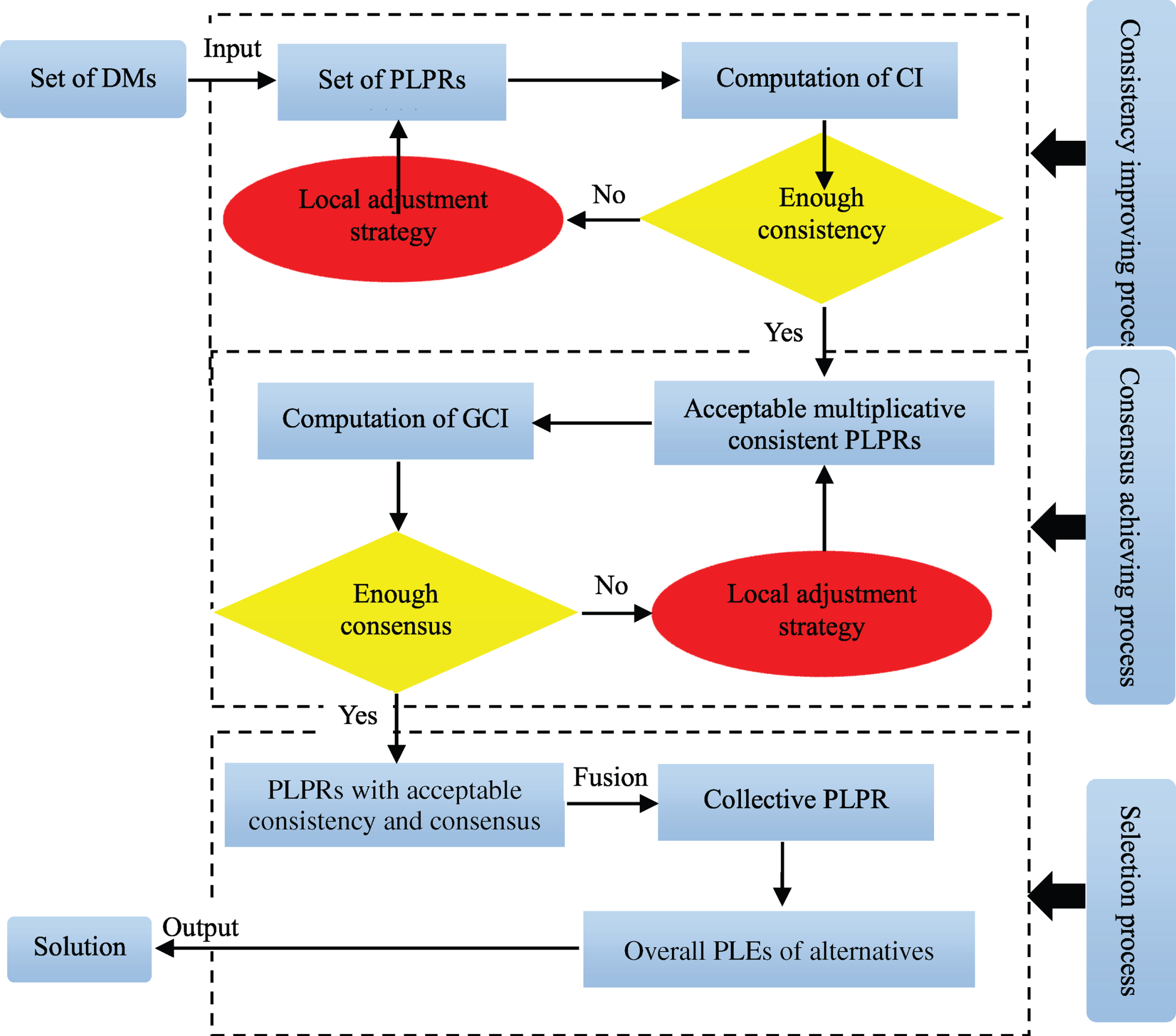
GDM method with PLPRs.
This section provides an example about fog-haze influence factor selection problem to perform how to utilize the developed GDM method with PLPRs and highlight its validity and merits.
Case description and solution by GDM method with PLPRs
In recent years, although China’s economy has developed rapidly, many areas are suffering from environmental pollution. Fog-haze pollution is becoming increasingly serious, which also hinders economic development. Hefei, the capital of Anhui Province, is no exception. In summary, the factors causing fog-haze weather come from many sources, and the main factors are as follows: PM10 concentration x1, PM2.5 concentration x2, geographical conditions x3, and meteorological conditions x4. To evaluate the pivotal impact of these factors on fog-haze weather, the city’s environmental protection department invites three fog-haze experts E = {e1, e2, e3} to perform the evaluation for the above four factors, and their weight vector is λ = (0.3, 0.4, 0.3) T. The evaluation data provided by experts is described with the following three PLPRs H
k
= (hij,k) 4×4 (k = 1, 2, 3), where PLE
In the following, we employ the proposed Algorithm III to get the ranking of four fog-haze influence factors. Let
Then, by Algorithm I, we generate the acceptable multiplicative consistent PLPR
Then, we generate the overall probabilistic hesitant fuzzy linguistic preference degree
Thus,
Comparison with other approaches
Based on the HPFLWA operator, Joshi et al. [44] developed a GDM approach to handle the probabilistic hesitant fuzzy linguistic GDM problems. Now, we utilize the method in Joshi et al. [44] to handle the aforementioned problem.
With respect to the GDM problem with PLPRs, Zhang [45] investigated a model to check PLPRs’ expected consistency level and derive the priority weight vector of alternatives. Now, we use Zhang [45]’s method to select the most important influence factor:
By computing the above optimization model, we obtain the positive deviations of H1 as follows:
Appling Lingo to solve the above optimization model, we get the priority weights of
Zhang et al. [46] proposed a new GDM method to get the best alternative, which includes consistency improving mechanism and consensus reaching process. Utilizing Algorithm 2 in Zhang et al. [46] to address the above problem, the main steps are listed as follows:
Because
The ranking results and the most important influence factor are listed in Table 1.
The decision-making results by different methods
The decision-making results by different methods
From the above comparison, the GDM method with PLPRs has some advantages: Since PLE introduces probability into HFLE, then PLE is a valuable technology to describe the qualitative evaluation information provided by DMs. Therefore, the PLPRs are more reasonable and convenient for handling higher uncertainty, and the proposed GDM method can address the complex GDM problems with PLPRs. Consistency adjustment process and consensus-reaching process are important to avoid obtaining the inconsistent and unreliable results. Therefore, it is necessary to manage the consistency and consensus before fusing probabilistic hesitant fuzzy linguistic information. However, the algorithm in Joshi et al. [44] neglects the process of checking consistency and consensus for PLPRs, and directly applies the HPFLWA algorithm to fuse individual evaluation data into the collective probabilistic hesitant fuzzy linguistic values. In our proposed GDM method, the acceptable consistency and consensus for the given PLPRs are detected, and then the consistency level and consensus degree of the PLPRs are improved. In the end, the integration of information and selection of the most desirable alternative are achieved. Consequently, the developed GDM method is more reasonable and systematic than Joshi et al. [44]’s algorithm. Compared with method in Zhang [45], the proposed GDM method and Zhang [45]’s method generate the different ranking results. On the one hand, in the process of checking and improving the expected consistency level, Zhang [45]’s method needs to construct the corresponding optimization model. However, the calculation process of the optimization model is relatively complex, and the effective optimal solution cannot be obtained in some cases. On the other hand, from the obtained collective PLPR Although the most important influence factor is x3 by using our GDM method and Algorithm 2 in Zhang et al. [46], the outcomes for four influence factors are different. With the help of LAS in our GDM method, only two pairs of judgements in PLPRs are modified to generate acceptable multiplicative consistent PLPRs. The original evaluation information of the DMs can be retained to the maximum extent and fully utilized. However, Algorithm 2 in Zhang et al. [46] needs to adjust more original judgments, which means that most of original evaluation information may be lost. Therefore, our GDM method is much more efficient than Algorithm 2 in Zhang et al. [46].
Conclusions
With respect to the GDM problems with PLPRs, this paper first presents several new notions, such as multiplicative consistent PLPRs, consistency index, ICI and GCI. Then, we propose a consistency adjustment algorithm to determine the acceptable multiplicative consistent PLPRs. Based on LAS, a consensus-reaching algorithm is constructed to achieve the consensus goal of group PLPRs, which is followed by the construction of a GDM method with PLPRs. The proposed GDM method can retain the preference evaluation of DMs as much as possible. Finally, we gave a case study on the proposed GDM method in selecting the most important fog-haze influence factor.
However, the proposed GDM method with PLPRs neglects the situation in which the DMs do not make their decisions. In other words, there is no discussion on formulating an approach for incomplete PLPRs in GDM problems. Besides, the proposed GDM method does not consider the cooperation consensus among DMs. Therefore, in the future, it is necessary to extend the GDM method to investigate the consistency improvement algorithm with incomplete PLPRs and investigating the collaborative GDM models for PLPRs by considering the trust relationship among DMs. Some potential applications also be considered, such as personnel selection and cooperative decisions.
Conflicts of interest
Declarations of interest: none.
Footnotes
Acknowledgments
The authors are thankful to the editors and the anonymous reviewers for their valuable comments and suggestions that significantly improve the quality and presentation of this paper. This study was supported by National Natural Science Foundation of China (Nos. 71901001, 11901150, 72071001, 71871001), the Humanities and Social Sciences Planning Project of the Ministry of Education (No. 20YJAZH066), Natural Science Foundation of Anhui Province (Nos. 2008085MG226, 2008085QG333), the Construction Fund for Scientific Research Conditions of Introducing Talents in Anhui University (No. S020118002/085), the Project of Anhui Ecological and Economic Development Research Center (No. AHST2019009), the Scientific Research Foundation for High-level Talents of Hefei Normal University in 2020 (No. 2020rcjj02), Key Research Project of Humanities and Social Sciences in Colleges and Universities of Anhui Province (No. SK2020A0038).