



Abstract
The day-to-day progress in communication plays a vital role in transmitting millions and trillions of data through the unsecured network channels. It creates a way where the user’s data becomes the victim of various security threats. Among those users’ data, images act as primary data, and its encryption security methodologies are fascinating. The conventional encryption techniques don’t work well against the various other hidden security threats but require substantial computational time and cost with poor permutation performance. Hence to deal with this, an auto-encoder induced DNA (Deoxyribonucleic acid) sequence via chaotic image encryption framework is designed in our proposed work. It integrates the properties of DNA encoding and the chaotic maps to handle the data losses effectively and resist several attacks such as statistical attacks, chosen-plaintext attacks, etc. Moreover, an auto-encoder is used to control the data noises, thereby ensuring a better encryption performance. Here, the auto-encoder is activated to generate a permuted image with less time complexity and noise. A secret key is then initialized with the aid of SHA-256. Finally, image encryption and decryption are achieved, followed by the successful transmission of data over a digital network. The performance of the proposed work is analyzed with varied metrics to strengthen its efficiency over the prior techniques.
Introduction
Due to the varied advancements in the network and digital communication technologies, digital images and video-based digital images have become the primary source of information storage and transmission. The security threats in those network communications made the technologies frail and highly restricted to perform massive information transmission in specific fields such as civil, military, medical fields, etc. Here, the security threats include data theft, deletion, tampering, and attacks, affecting the data owners and the publishers and creating a significant loss to them while transmitting the digital images [1]. Thus, when dealing with the information resources of the public and the government sectors, it becomes essential to look upon the data security/protection methodologies, which becomes a hot topic in research in information security. Henceforth, the secured digital image transmission becomes the attraction from all parties supposed to perform digital network communication.
Moreover, most researchers pay their attention to ensure secure data transmission and have initiated an encryption-based technology. At the same time, image-based encryption has converted the plain image into a cipher image to prevent unauthorized access. It provides a highly secured and reliable data transmission based on text encryption. However, the prior encryption methodologies such as DES, RSA, etc., fail to satisfy the user’s requirements due to its substantial information limits and strong connections among adjoining pixels [2]. Moreover, the existing methods don’t achieve better results in terms of compatibility and encryption quality of the digital images. In addition to that, the text encryption techniques are often suffered from issues such as inefficiency, low practicability, and inadequate security performance.
In later days, when there is a rise in the demand for image encryption reaching the peak, most research scholars have explored this area. They have proposed various new image encryption methodologies with improved data security features. Some of them are based on pixel transformation, random sequence, image compression coding, image key-based encryption, etc. [3] deployed an image encryption algorithm with the aid of bit plane of the source image as a secured key to obtain the encrypted image. Moreover, to change the bit position, this work had developed a bit-level scrambling algorithm. [4] works with the principle of selecting a specific area of the image holding maximum information with the aid of encryption based on the percentage of coefficients.
Furthermore, DNA calculations create a new era of image-based encryption. It makes use of DNA as a carrier and modern biology techniques for encryption [5]. However, it fails to deal with brute-force attacks. It is then followed up with a modern technology called image encryption based on chaotic maps. It enables high security to the data, which is being encrypted and transferred owing to its random behaviour and sensitivity to a preliminary set of rules [6]. Also, it is difficult to crack, and the precision is more accurate, which makes the technology a highly reliable one [7, 8].
Moreover, the technique is easy to execute and is immune to attacks/assaults. Hence, they are now widely applied in research, health care monitoring, military, civil services, etc. Due to overcome the cons of DNA encoding schemes, related to their poor confidentiality, the method is used along with chaotic maps to enhance security and privacy [9].
Image encryption algorithms are broadly classified into two stages to enhance security measures: Diffusion and permutation. Some examples of conventional permutation algorithms are the sort-based permutation algorithm, the Arnold-based permutation algorithm, the Baker-based permutation algorithm, and the cyclic shift permutation algorithm [10–14]. [15] initiated a digital image encryption scheme with the aid of the Monte Carlo method to conjure up the Brownian motion and perform image diffusion. A PWLCM chaotic system has been utilized, which has enhanced the sensitivity of the key and the plain text.
In most of these algorithms, the SHA-256 hash value of the image is used as the external key of the encryption system so that the encryption keys of different images are different to achieve the effect of a “one-time pad.” Taking the scheme in [28] as an example, firstly, the initial values and parameters of the two-dimensional Logistic chaotic map are calculated from the SHA 256 hash of the original image and given values. Secondly, the chaotic system’s initial values and system parameters are updated using the Hamming distance of the original image. So the generated random sequence is related to the plaintext image. This encryption method has the advantages of high sensitivity to plaintext and strong attack against plaintext. However, the decryption end needs the initial key not related to the plaintext and the key related to the plaintext. Therefore, decrypting different ciphertext requires different plaintext-related keys, making the system work in an OTP fashion and dramatically increasing the complexity for applications.
Concerned about the above issue, we propose to encrypt images based on permutation–diffusion framework using secure hash algorithm SHA-256. Two innovations are the main contributes to this work. Firstly, the hash value of the plaintext image is converted into the number in the range of [0, 255], Which is added as the random number around the plaintext image, rather than as the external key of the encryption system. This can resist chosen plaintext attacks and does not need the hash value of the plaintext image in the decryption phase. Secondly, in the permutation and diffusion processes, random sequences are related to intermediate cyphertext. In this way, the key used to encrypt different images is the initial value of the chaotic system, but the generated key stream is different.
A block-based image encryption algorithm. It has used a wave function and a chaotic system to determine the source point in the wave and created a diffusion matrix for modular operation. Anyhow, the algorithm fails to deal with the time overhead issues along with deprived permutation performance. Moreover, the linear image encryption techniques highly struggle with the chosen plaintext attack. Hence, an innovative chaos-based image encryption framework aiding DNA computing sequence is proposed in this work to deal with this.
The remnant of the paper is structured as follows: reviews about various prior methodologies are briefly discussed in section 2, which is then followed by a detailed description of the proposed method in section 3. Section 4 analyses the proposed methodology’s performance and compared the prior techniques to prove the strength of the proposed work; finally, section 5 wrap up the proposed work.
Literature survey
This section describes a detailed review of various prior methodologies that existed in the field of data security using image encryption.
Khan et al. [17] initiated a secure and lightweight encryption scheme to deal with digital images. Here, the plain text has been partitioned into several numbers of blocks, and then it is followed by the determination of every single block correlation coefficient. With the aid of the skew tent map, which works based on the predefined threshold value, the blocks with high correlation are XOR-ed with the random numbers generated by them. Finally, TD-ERC chaotic map had been used to construct a permuted image. However, the system fails to tackle the time complexity.
Ge et al. [18] had deployed an approach that had used a bit-pair level XOR to enhance the diffusion property, which in turn resulted in high encryption speed with secure image transmission. Here, the encryption is performed with chaotic series acquired from the modified pulse-coupled spiking neurons circuit map. The methodology works well with high performance in terms of sensitivity, complexity, etc., though in some scenarios, the method exhibits poor permutation performance.
Wang et al. [19] used a chaotic colour image encryption algorithm. In this method, initial key processing is made to integrate a chaotic map with the staged Logistic map and Tent map. Moreover, a Hop-field chaotic neural network is utilized here to produce the self-diffusion chaotic matrix. At last, the cipher image is retrieved by XOR-ed the scrambled images with the key produced by the transformation function. However, it fails to handle data losses, which causes the decryption process to an invalid one.
Wang et al. [20] had utilized a permutation algorithm in a parallel diffusion method to achieve image encryption with low time and space complexity. It had achieved great efficiency compared with other traditional streaming diffusion methods but ended up with a high computational cost.
Zarebnia et al. [21] deployed fast and efficient multiple-image encryption based on a chaotic system. This integration is supposed to generate pseudo-random chaos sequences, which had replaced the sub-blocks of the plain images. In addition to that, Arnold cat map and some operations, including XOR and cyclic shift, are deployed to acquire the encrypted image. Yet, the system was unaware of the attackers, who crack the encrypted image using the pixel comparison method.
Gong et al. [22] reduces the correlation between the pixels of the image with effective image compression and the encryption algorithm depending on chaotic compressive sensing. Initially, Arnold transforms permute the input image, which is then compressed and re-encrypted.
Wen et al. [23] initiated an image encryption algorithm depending on DNA encoding and Spatio-temporal chaos. It is an integration of rigid DNA-based pose permutation and a bitwise complement. It guarantees the effective recovery of secret keys, even if it is supposed to be under any attack. Anyhow, these methods are not alone considered as a secure medium to perform network communication.
Liu et al. [24] initiated an RGB image encryption algorithm that integrates both the properties of DNA encoding and chaotic maps. The encrypted image is obtained by the reconstruction of R, G, B components with a Logistic chaotic sequence. The algorithm worked effectively by offering resistance against several attacks but with high computational time and cost.
Wang et al. [25] introduced an image encryption scheme comprising DNA and chaotic sequences. Initially, pseudo-random chaos sequences are generated with the aid of a spatiotemporal chaos system. It was then followed up with the retrieval of the DNA matrix, and a permuted DNA matrix results with the DNA decoding to acquire the ciphered image. However, at last, the scheme achieves less reliability due to the presence of noise.
Thus from the above discussion, it is clear that the prior methodologies, such as the algorithm in [17], fail to tackle the time complexity. The algorithm in [18] exhibits poor permutation performance, the algorithm in [19] fails to handle data losses, [20, 24] suffers from high computational time. Cost and the algorithms in [21–23] were unreliable due to the intrusion of attackers and are supposed to be affected by huge noise [25]. Henceforth it is mandatory to deal with all those issues; there arises a need for novelty in network communication.
Proposed methodology
With the recent advancements in multimedia, many images hold lots and lots of data transferred over the network. Consequently, it is essential to ensure security to those images that carry the data. Henceforth to guarantee secured digital image transmission, the prior methodologies had initiated various techniques to prevent the security threats caused by the attackers. As a result, more image encryption techniques had grown up and captured the attention of researchers. In the real-world application of image encryption techniques, the encrypted images transmitted across the communication channel are typically subjected to channel noise, which initiates an invalid decryption process with substantial data losses. Moreover, linear image encryption systems are susceptible to the chosen plaintext attack. Permutation and diffusion processes are deployed in the image encryption algorithms to handle such types of attacks with utmost security. Yet, prior methodologies are getting troubled due to poor permutation performance and huge time overhead.
Though DNA encoding possesses inimitable recompenses rather than the conventional cryptographic techniques, it alone doesn’t guarantee data security. During this scenario, Chaos-based image encryption effectively handles the security issues caused during image encryption. Though chaotic encryption techniques own many pros, it is easy for the attackers to crack an encrypted image with the pixel comparison method. Hence, to tackle all those hidden insecurity issues, a novel framework is designed by integrating DNA encoding with the chaotic sequence inbuilt auto-encoder in the field of network communication to perform image encryption.
In the non-auto-encoder setting, the lack of differentiability of the permutation is not a problem due to the pathwise differentiability. However, in the auto-encoder environment, we make use of the permutation in the decoder. While gradients can still be propagated through it, it introduces discontinuities whenever the sorting order in the encoder for a set changes, which we empirically observed to be a problem. The PCA, and traditional AE, ignore the spatial structure and location of pixels in the image; this is also termed as being permutation invariant. It is important to note the permutation invariance when working with image frames of few 100×100 pixels. These methods introduce significant redundancy in network parameters and span the entire visual receptive field. To avoid this issue, we need the sort’s permutation to be differentiable with reduced noise.
Auto-encoder reduces data dimensions by learning and how to ignore the noise in the data. A critical insight for auto-encoding is that we can store the permutation that the sorting applies in the encoder and use the inverse of that permutation in the decoder. This allows the model to restore the arbitrary order of the set element so that it no longer needs an assignment-based loss for training. This avoids the rotating problem and permutes the outputs of the network accordingly. Thus, there is no longer a discontinuity in the outcomes during the rotation. In other words, we make the auto-encoder permutation equivariant: permuting the input set also permutes the output in the same way.
Figure 1 shows the architecture of Auto encoder-induced chaos-based image encryption framework aiding DNA sequence. In our cryptosystem, we use the hash value of the plain image to generate the initial values of the system. Thus, the secret keys are strongly related to the plain image. Our proposed scheme can effectively resist both chosen-plaintext attack and chosen-cipher text attack. The SHA-256 is employed to generate the one-time keys from the plain image and the secret hash keys. This hash value is the encryption key. A tiny change in any plain-image pixels or the hash keys leads to a different encryption key. The 256-bit hash value is served as the one-time keys and applied to produce the initial values of the system. The diffusion process is based on shuffling pixels by using chaotic sequences. The system is employed to generate three sequences. These sequences are used to shuffle the red, green, and blue components of the image. The confusion process is based on DNA XOR to scramble the pixel values of image R, G, and B components and then encrypt the scrambled images. Experimental results indicate that the encryption key cannot be recovered if the cryptanalyst only possesses some portion of the plaintext but not the secret hash keys. Therefore, the proposed algorithm is secure and efficient.

Autoencoder induced chaos-based image encryption framework aiding DNA sequence.
A Stacked Auto-encoder (SAE) is designed and represented in Fig. 2. In contrast, a backpropagation algorithm is used in the fine-tuning process, which is used to set the optimum values of the weights. Once the network has been trained, the weights are determined and are fed into two generators to obtain the shuffling matrix. Here, the stacked auto-encoder is designed to reduce the run-time complexity and reduce the noise rate, thereby enhancing the encryption effects. The shuffling matrix gets shuffled with the plain image to obtain the permuted image, in which the permutation performance is considerably high. Though the prior DNA encoding and chaos-based encryption methodologies are well performed in image encryption, they alone failed to provide security.
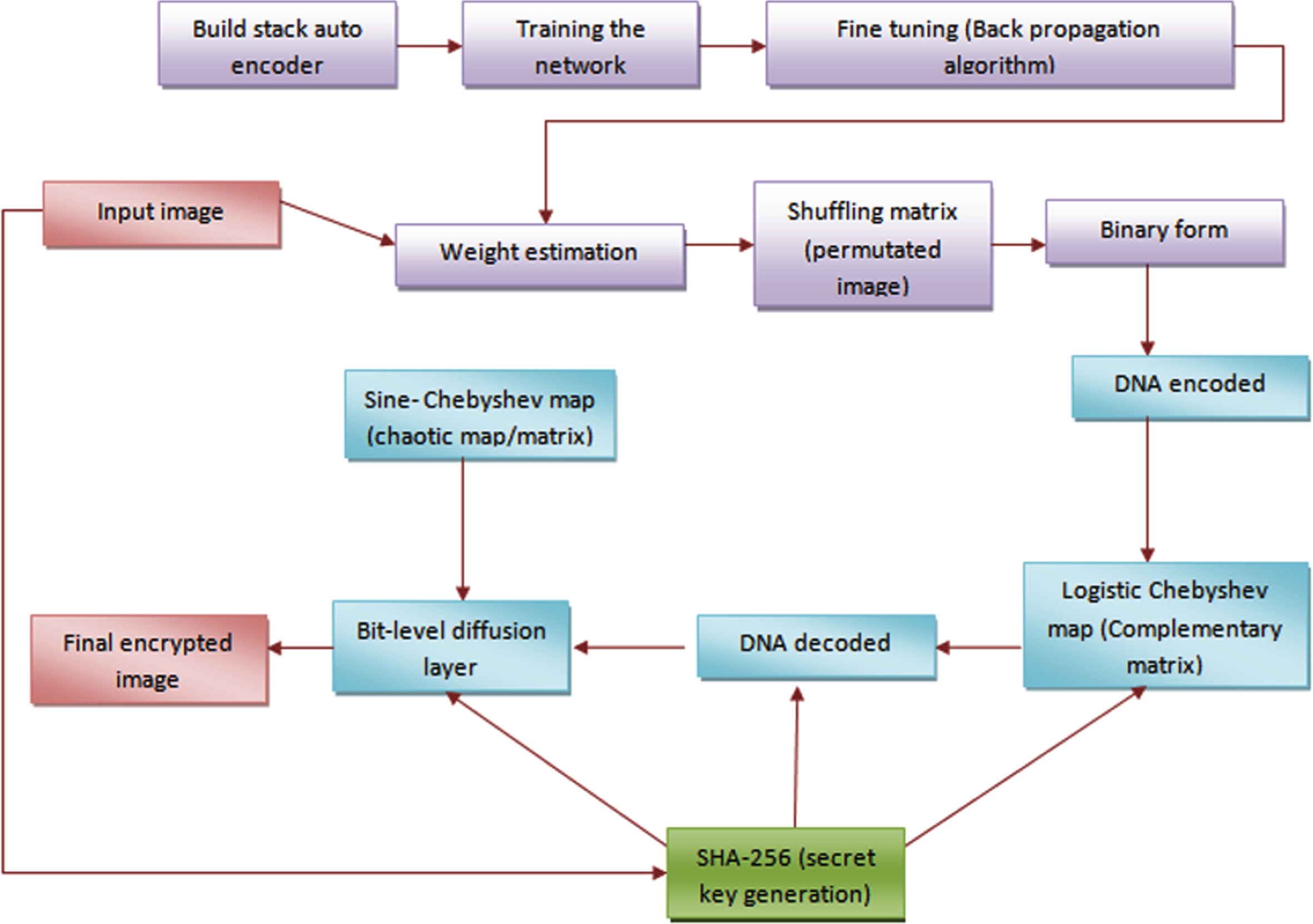
Proposed workflow.
Hence, a hybrid entangled chaotic DNA amalgam is designed to enhance security during image encryption during network communication. Moreover, the data loss, which makes the existing cryptographic techniques invalid, got barred with this proposed work.
Initially, to initiate the image encryption process, an SAE is used in our proposed work. It uses a back-propagation algorithm, which produces the target output, which is similar to that of the input. Moreover, to optimize the parameters of both the encoding and decoding functions, the Stochastic Gradient Descent (SGD) is utilized here.
Training SAE
At the outset, the SAE is an edifice with input and an output layer and three numbers of hidden layers. The size of the input layer is represented as ‘Is’ indicates the total number of pixels in a grayscale image. In contrast, the second and fourth layers’ size is equivalent to the total number of images, which are encrypted and denoted by ‘Es.’ Consequently, the size of the middle layer is said to be (Es-1).
While training the network, the input data (IN) is encoded to generate the values of the first hidden layer, say L1 is then followed with the decoding of L1 to generate the output (IN’) with an error E, where E =(IN’- IN). Again, the network encodes L1 to generate output L2, whereas the error E here is (L1’- L1); during this process, the weights between L1 and L2 are well-tuned. The process continues until the output layer is reached, which is the same as that of the input layer.
During the fine-tuning process, a backpropagation algorithm is utilized for training the weights to achieve the optimum results. The initial values of the weights must be both unequal and small. Equality of the initial weights prevents the network from learning when the problem requires that the network learns by unequal weights. This is due to the proportionality between the backpropagated error through the network and the value of the weights. For instance, if all the weights are equal, the backpropagated errors will be similar, and consequently, all of the weights will be updated equally. Thus, to avoid this equilibrium problem, the initial weights of the network should be unequal. Moreover, the initial weights should be small. This is because the weights in the BP algorithm are updated proportionally to the derivative of the activation function. Reaching the output layer will tend to estimate the grade error using Equation (1):
Furthermore, the grade for each hidden layers are calculated with the aid of Equation (2):
Whereas the partial derivatives are as follows:
Where, d = ws * x + b; w represents the weights, x and b be the input and offset values, respectively. y is denoted as the expected output and describes the sigmoid function. Once after completing network training, the weights are calculated, say (W1 and W2 respectively), and fed to the generator to obtain the shuffling matrix.
The input images are said to have an ‘n’ number of pixel components of similar dimensions. Here, the obtained weights are converted into a single-dimensional array (S
a
), whereas the array values range between 0 and 1. While carrying out this process, the weights of the prior epochs are added with the S
a
if Sa’s size is smaller than n. The shuffling matrix is represented by Equation (4).
After establishing the shuffling matrix, the plain images are allowed to shuffle. The pixel values of the plain image are replaced with the corresponding shuffling matrix value with the position the same as the pixel value of the picture. Thus the sum of the shuffling matrixes is finally determined to obtain the permuted image (Q1).
It then succeeds in confusing the permuted image by the chaotic matrix to produce an encrypted image. Thus with this whole process, a better permutation is achieved with less time complexity and is followed by generating the chaotic matrix aiding DNA encoding and decoding.
After obtaining the permuted image, a hybrid entangled chaotic DNA amalgam is designed in our proposed framework. It integrates both the chaotic maps and DNA encoding decoding, ensuring a highly secured network communication via image encryption. This method prevents the intruders or attackers who induce data losses and causes various types of statistical attacks: brute force attack, chosen-plaintext attack, correlation-based attacks, etc. The process of how the proposed framework effectively tackles security issues is briefly discussed below as follows:
Establishing chaotic maps
A cryptographic hash function SHA-256 is deployed to establish the chaotic maps and prevent intrusions and attacks, which generates the secured secret keys for the chaotic system. For that, initially, SHA-256 hash value H1 has to be calculated. H1 is nothing but the hash value of the original image (IN).
The secret keys that are generated initially are one-dimensional chaotic systems comprising of certain Equations (6 and 7):
Where, P
n
be the initial value, γ be the control parameter, and x ε N is the degree of Chebyshev map. Here, Equations (6) and (7) represent the Logistic Chebyshev map and Sine Chebyshev map. With this proposed work, the initial conditions and the control parameters of the generated secret keys are updated with the aid of the SHA-256 hash function and are given by:
A function, which renovates the binary string into a decimal number and ⨀ is the symbol, denotes the bit-XOR operation. Thus the secret keys are updated with the aid of Equations (8–11) and are used in our proposed work to perform image encryption.
The permuted image (Q1) obtained using the shuffling matrix is now divided into four blocks, say (C i ) where i = 1, 2, 3, and 4. Moreover, Q j , (j = 1, 2, . . k). It is denoted as the jth pixel in the block C i , whereas k is assumed as the total number of pixels found at each block. Now, the blocks are transformed using the concept of S-box (S Ci ), where i ranges between (1, 2, 3, and 4) as discussed in [26].
Consider, S j = S Ci (Q j + 1), where S j is said to be the new pixels and S Ci has replaced the Q j to develop a new matrix say Q2. The matrix Q2 is then transformed into its binary form Q b of dimension MX8N and is supposed to undergo DNA encoding, resulting in creating a MX4N DNA matrix say (Q3).
After accomplishing DNA encoding, a complementary matrix has to be generated. A chaotic matrix Y
MX4N has to be obtained by iterating the Equation (6) to hide the transient effects using the updated parameters and conditions established in Equations (8–12). This would result in the formation of a chaotic map Y given by Equation (12).
Now to calculate the complementary matrix of Q3,
Finally, at the encryption side, Q4 DNA decoded to obtain MX8N matrix say, (Q de ). Iterate Equation (7) for (l≥500) times to avoid the transient effects with Equations (7). Here, Q de is decimal converted to obtain a matrix Q5 with MXN dimension.
Generate a chaotic matrix U with the continuous iteration of Equation (7) for MXN times as per the Equation (14):
In addition, a scrambled matrix Q6 is to be generated in the bit-level diffusion layer to obtain the encrypted image (Z) by Equation (15).
Repeat the process using initial conditions and parameters in Equations (8–11) as secret keys to obtain the encrypted image Z. A flowchart representing the overall encryption process is as follows:
Image decryption is the process in which the encrypted image is decrypted to retrieve the original image by a similar procedure carried out during encryption but in reverse order. Here the process begins with the bitwise-OR operation for the between the encrypted image and the matrix obtained by Equation (15).
Convert Z to its binary form Z
b
, (MX8N), followed by the RNA encode to obtain the chaotic matrix Z2, (MX4N). Consequently, the complementary matrix for Z2 is derived with the aid of Equation (16):
A is the chaotic matrix generated in the encryption process with the aid of secret keys stated in Equation (8–11). Generate a decoded matrix Z4, (MX8N), and convert it to its decimal form, say,
Thus with the initial encryption process, the final decrypted image S has been obtained securely. Thereby, the proposed methodology ensures a secured network communication with less time complexity and better permutation performance.
In below encryption process flow is explained in step by step manner as follows: Input the plain image IN, where N be the dimension of the image matrix. Train the Stacked Auto Encoder (SAE) according to subsection 3.1.1. Shuffling matrix is established by the ‘n’ number of pixel elements and weight epochs to obtain the permuted image (Q1). Generate secret keys with SHA-256, and the hash values of the original image (IN) are H1 = H1 (1) , H1 (2) , . . . , H1 (32). Secret keys of the one dimensional chaotic systems comprise the Logistic Chebyshev map, Generate a chaotic matrix U with the continuous iteration of Equation (7) for M × N times as per the equation V = (U × 1015) mod 256 Also, a scrambled matrix Q6 is to be generated in the bit-level diffusion layer to obtain the encrypted image (Z) by Q6 = Q5 ⊕ V
Repeat the process using initial conditions and parameters in Equations (8–11) as secret keys to obtain the encrypted image. Finally, recover the RGB image, and that is the encrypted colour image. Because of the symmetric structure, the decryption steps for our encryption algorithm are the same but in inverse order.
In this section, the security and performance of the proposed methodology have been analyzed and are evaluated against various prior techniques to prove the effectiveness of the proposed method.
System configuration
We have analyzed the speed of the proposed image encryption technique in Matlab2019b in a computer with an Intel Corei7 2.8 GHz and 8GB RAM running the Windows 7 operating system. For accuracy, each set of the timing tests was executed several times for the considerable number of images, and then the average obtained was reported.
Simulation result
Here for analyzing the performance of the proposed work, the images such as Lena, baboon, city, and brone are taken from the image dataset in [27]. The images taken as input for our proposed work are shown in Fig. 4.
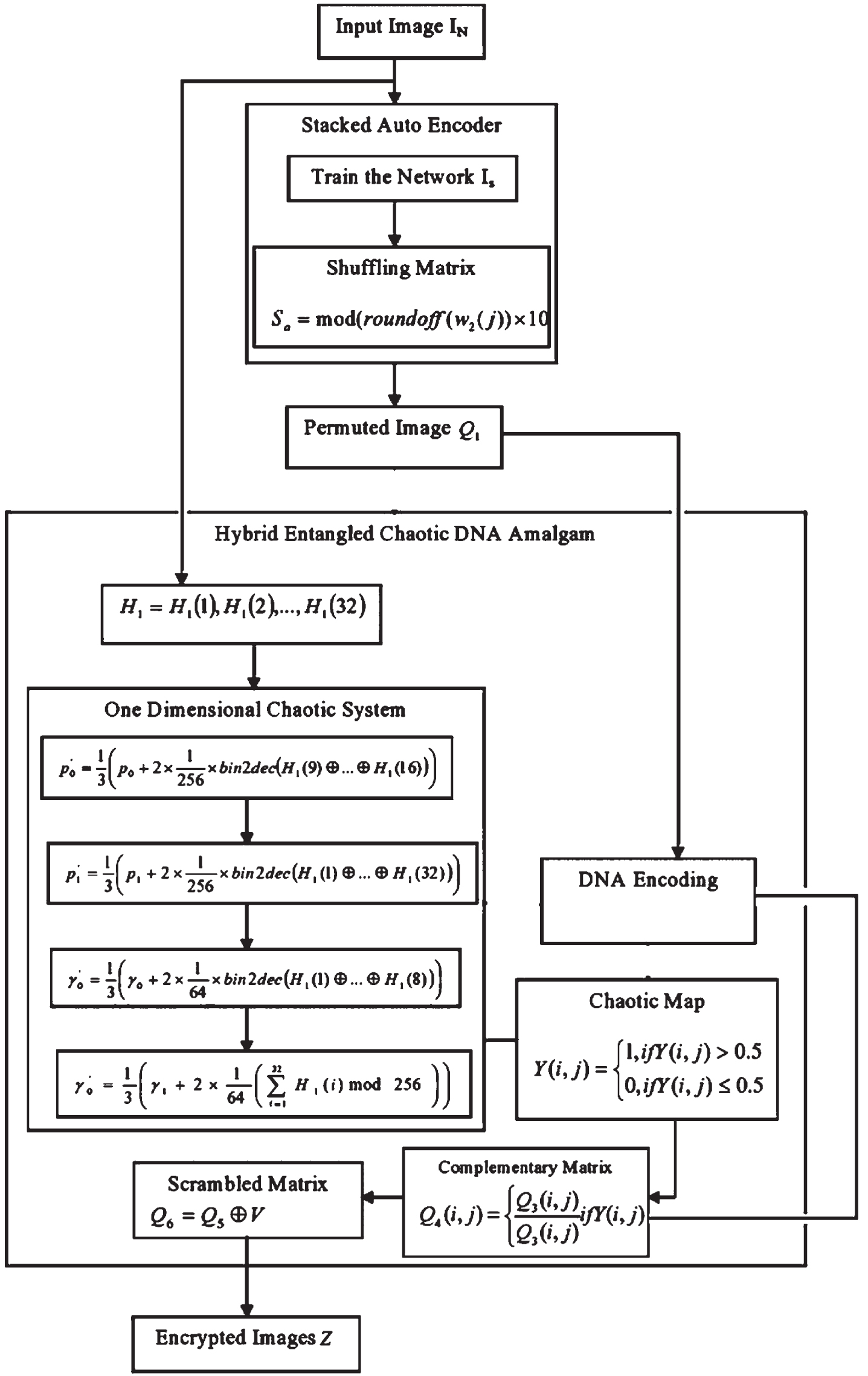
Image Encryption based on the hybrid approach.

Input Images.
Once the images are gathered from the image dataset, the auto-encoder trains the network and processes the images, whereas the shuffling matrix is obtained to generate the permuted images.
Initially, consider the image in Fig. 5; the colour image is converted into a grayscale image, which is then transformed into a permuted image with the aid of the shuffling matrix.

Permuted image, chaotic matrix, and its encrypted image.
After obtaining the permuted images, they are divided into several blocks. It is then undergoing the DNA encoding and decoding procedures, thereby getting a chaotic matrix with a logistic sine-Chebyshev map and image encryption. Figure 5 shows the chaotic matrix obtained during the image encryption process.
Figure 6 shows the resultant encrypted image for an input image along with its decrypted image.
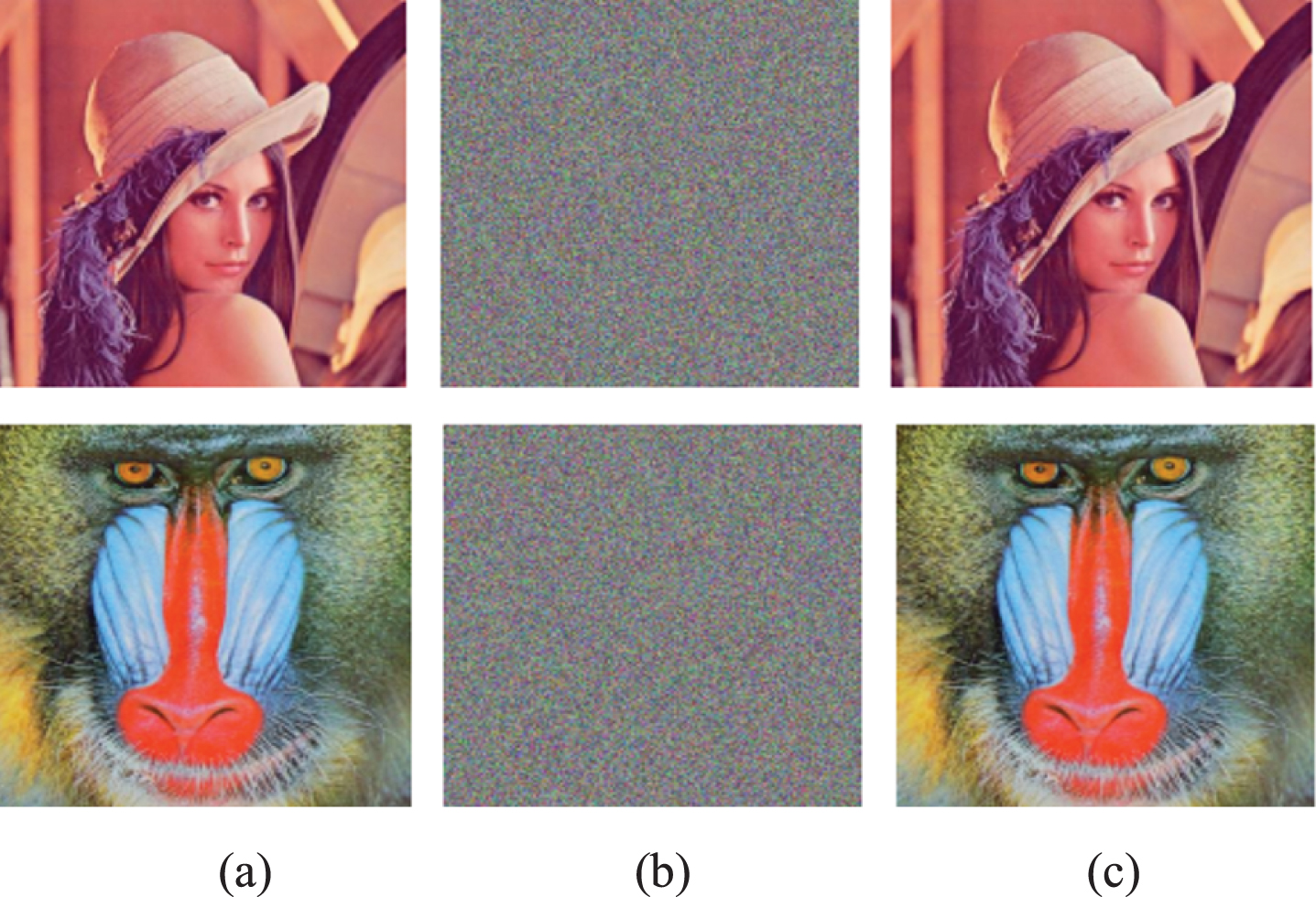
a) input image, b) encrypted image, and c) decrypted image.
The total number of keys that can be used in the process of encryption and decryption is called the keyspace of the algorithm [30]. The keyspace is calculated using how many keys are used in permutation and diffusion processes. The keyspace of an algorithm should be more significant than 2128 to resist brute-force attack efficiently. Keys used in this algorithm are,
Table 1 presents the total keyspace of the proposed algorithm. In this cryptosystem, a keyspace of 1015 is used for each of the individual keys. This is because the algorithm uses a 64-bit floating-point standard, and the IEEE suggested a keyspace of 1015 for the 64-bit floating-point standard [30]. Also, the proposed algorithm uses a keyspace of 2128 for the “Secure Hash Algorithm SHA-256” for resisting the best attack in that algorithm. Therefore, the total keyspace is 10128, which is more significant than 2128 to resist the brute-force attack strongly.
Total keyspace of the proposed algorithm
Total keyspace of the proposed algorithm
Information entropy
It has been determined by using the following Equation (17):
Where q(li) be the probability of li, the entropy of a random image having 256 gray levels must be eight unless there arises a chance of predictability if the cipher image entropy is less than 8.
Evaluating the plain well’s local randomness as the cipher image Equation (18) has been used.
It analyses the plain and the cipher images horizontally, vertically, and diagonally with the aid of the following Equations (19–21):
N is the sum of pixels selected from image a, and b denotes the two adjacent pixels’ grey level values. Are the expectation and variance of variable a, correspondingly.
Unified average changing intensity (UACI) and Number of pixel change rate (NPCR) metrics are used to analyze the resisting performance and are calculated using Equations (22, 23).
Where X and I represents the width and height of the image correspondingly and D2 represents the cipher images, the original image is amended after and before one pixel.
It is analyzed to examine the pixel distribution of the image; whereas, if the probability acquired for each gray level of a cipher image are equal, then the encryption technique is said to be highly resistant to various statistical attacks. To carry out this, Y
2 test and variances are evaluated using Equations (24 and 25):
Where a i is the incidence frequency of gray level i and a/256 be the expected incidence frequency of each gray level. Here, Equation (25) G = (g1, g2, … . . , g256) denotes the histogram vector values; g i and g j represents the numbers of pixels; whereas, the gray values are equivalent to i and j, correspondingly.
It is carried out with the aid of the performance metrics such as Uniform Histogram Deviation (UHD) and Irregular Deviation (ID) using Equations (26 and 27).
It calculates the histogram of total discrepancy amid plaintext image P and ciphertext image C. Where H c is the histogram of the ciphertext image, and H cs is the frequency of incidence at index l.
Moreover, the contrast of the image is calculated using the Equation (28):
Where Z (i, j) determines the number of gray-level co-incidence matrices.
Thus to analyze the performance of the proposed work, all the above metrics are to be calculated for this work as follows:
At first, the information entropy test for the four different images is carried out, and the outcomes are scheduled in Table 2.
Information entropy
Let us consider Table 2 having a theoretical value close to 8; this, in turn, indicates that the proposed work has effectively prevented the information leakage and data loss in a wide range. Thus it concludes that this work has exhibits improved performance.
Here in our proposed framework, let us consider the number of test images L as 256, where k is 32 and TB is 1938. The results obtained in Table 3 shows that generated cipher images exhibit greater values, say, 7.90, which represents better local randomness.
Local Shannon entropy
Table 4 shows the resultant values of the correlation coefficient obtained for the retrieved cipher images analyzed vertically, horizontally, and diagonally. Here the correlation coefficients obtained are below 0.03, which is significantly less when compared with the original images. Thus the table ensures that our proposed work has achieved better performance in terms of its efficiency in withstanding against various statistical attacks.
Correlation analysis
For the plain input images of size (512×512), a distribution diagram has been drawn for both the plain and the cipher images horizontally, vertically, and diagonally, which is shown in Fig. 7. The figure shows a strong correlation in the plain image amid adjacent pixels; the correlation coefficients are close to 1, while the pixels of the cipher image are strewn around the entire plane, and the strong correlations of adjacent pixels in the original image are highly lessened through the proposed encryption methodology.
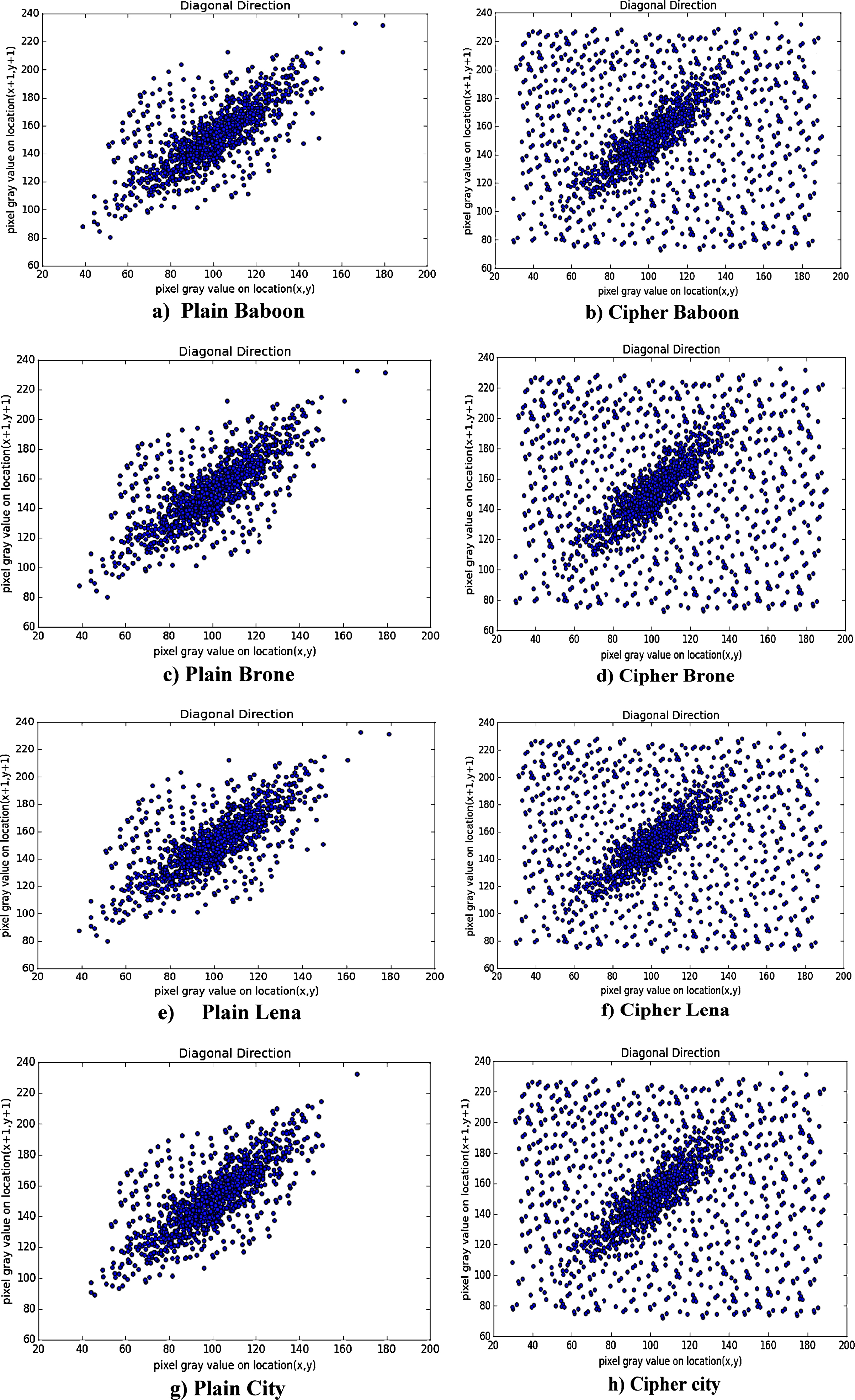
Correlation coefficients of the input image.
Here, for the four different test images, NPCR and UACI are calculated and are shown in Table 5,
Differential attack analysis
The obtained values for a 256-Gy scale image are 99.72% and 33.41% correspondingly, with highly closed results and robust against differential attack.
The histogram analysis of our proposed framework is illustrated in Fig. 8. When the considerable level is 0.05, the subsequent Y2 (0.045, 255) is 292.55. If the variance is lower, then the image uniformity will be higher. Initially, Y2 is executed, and the outcome is less than 292.55, which indicates that the proposed work ensures high security. The formulation of variance follows it. In contrast, the variance of the plain image is more significant than the cipher images, which specifies that the cipher images are uniformly distributed. It reveals the efficacy of the proposed work against the security threads.
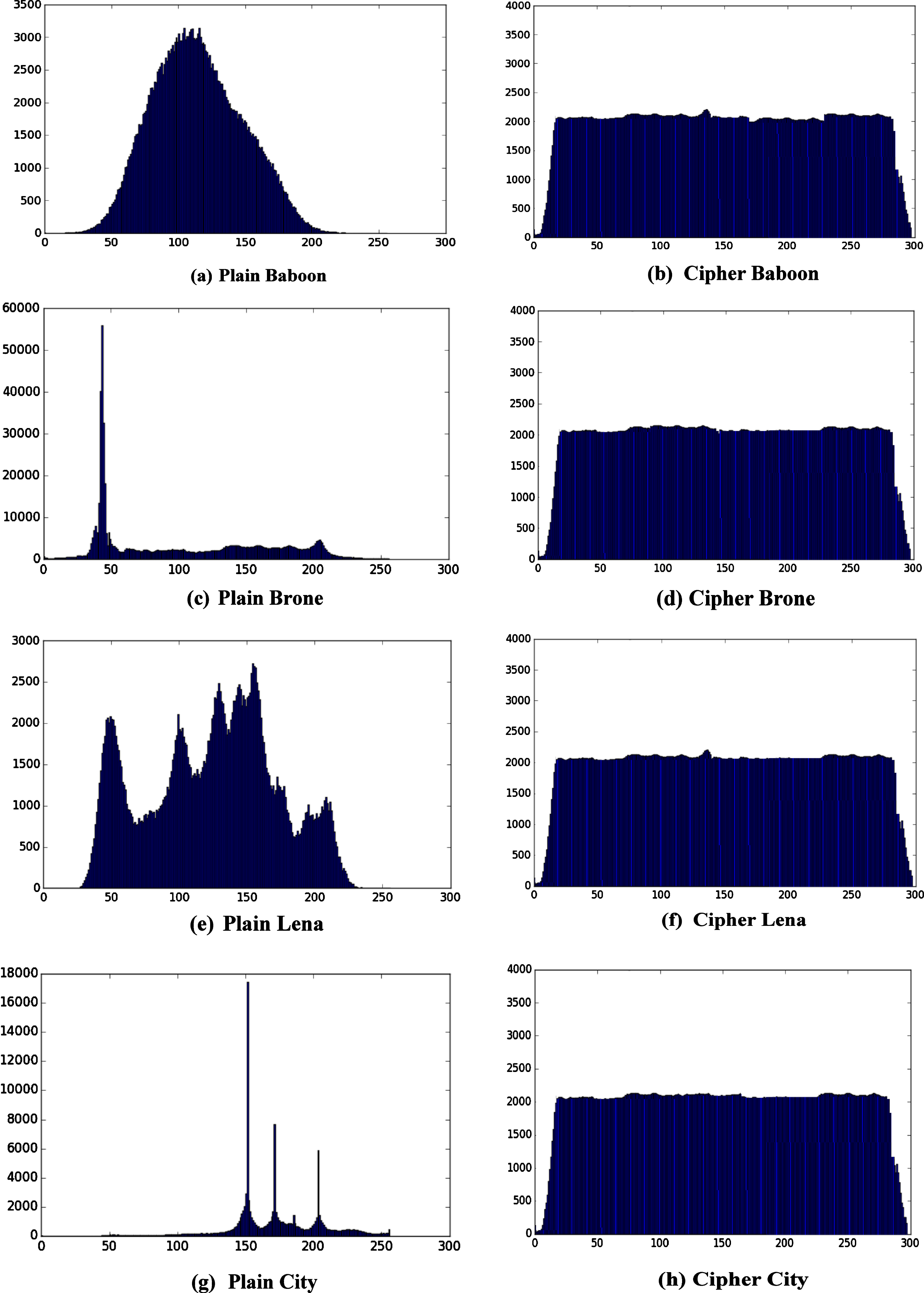
Histogram analysis of various input images.
In terms of computational complexity, the proposed encryption scheme was calculated to require O(MNlog(MN)) iterations to encrypt an image with a width of 516 and a height of M and N, respectively. Table 6 compares the performance data of the proposed algorithm with other encryption schemes.
Encryption speed for an image size of 256×256 pixels and computational complexity
Encryption speed for an image size of 256×256 pixels and computational complexity
Occlusion attack analysis
During transmission of data from sender to receiver, there is a possibility that the encrypted data may get distorted due to an insecure channel. This distorted data is referred to as occluded data. For occlusion analysis, we have taken occluded parts of the image, and the results in Fig. 7 show that the decrypted concatenated images contain distortion. However, still, the images are detectable by appearance. Hence, it is inferred that our Hybrid Entangled Chaotic DNA Amalgam cryptosystem can survive up to 78% of occlusion attack.
Known-plaintext and chosen-plaintext attack analysis
Most of the image encryption algorithms have been broken by the known-plaintext attack and chosen plaintext attack. In this proposed cryptosystem, the keys (initial values and systems parameters) are generated from the given initial values and system parameters of PWLCM systems and the 256-bit hash value.0 of plain image. When any one of the plain images changes, the key values change, different chaotic sequences are produced, and different cipher images are obtained. So attackers cannot obtain cipher images by selecting some known plain images. This concludes that the proposed algorithm strongly resists known-plaintext attack and chosen-plaintext attack.
Noise attack analysis
To verify the robustness of the proposed image encryption algorithm against noise attacks, the plain image of ‘City’ is encrypted using the proposed image encryption algorithm. Then, salt and pepper noise with different intensities (0.01, 0.05, and 0.1) are added to the plain image. Finally, the noisy cipher images are decrypted to obtain the original plain image. The experiment is repeated using two perceptual hash algorithms: the average hash and the SHA-256, with hamming-distance threshold = 20. Figure 9 shows the cipher images of plain ‘City’ images for each intensity and the corresponding decrypted images. The similarity between the plain-image and decrypted images can be easily observed. This similarity can be verified with the high value of PSNR values shown in Table 7, which demonstrates the resistance of the proposed image encryption algorithm against noise attacks.
Noise attack resistance evaluation
Noise attack resistance evaluation
Table 8 proves the efficiency of the proposed work in terms of secured data transmission with encryption quality assessment. Here, the divergence is less, and the contrast values range between 10.534, 10.532, and 10.132 for colour, gray and binary images, respectively.
Encryption quality interpretation
Hence the percentage difference of the two ciphertexts shown in Table 9 is calculated. It can be seen from Table 9 that the percentage differences for binary images are greater than 98% and for colour and gray images are even more significant than 99%. Thus key sensitivity test confirms that the proposed image encryption scheme is very sensitive to smaller changes in key.
Key sensitivity test
Table 10 presents the keyspace comparison results between the proposed scheme and the existing algorithm. Using the proposed scheme, it shows the high resistivity of brute-force attack.
Comparison of existing and proposed Total Keyspace value
This section shows the efficiency of the proposed work by comparing our proposed work against various other prior methodologies. Initially, Table 11 describes the time analysis between the proposed framework and the previous methods discussed in [25, and 4]. While on the comparison, the table shows that the proposed work exhibits less encryption time rather than the two prior conventional methodologies. Though traditional methods work well for transmitting digital images, they require more time, say (0.65, 0.55 and 0.56; 8.22, 7.21, and 7.01 sec; 4.57, 3.12 and 3.30), whereas the proposed requires 0.61, 0.49, and 0.54 seconds for colour, gray and binary images respectively.
The information in Table 12 strengthens the proposed work by comparing it with the prior methodologies discussed in [3, and 25]. Comparing the proposed work with the previous methods exhibits better results for the four input images having entropies as 7.9994%, respectively. At the same time, the existing methodologies achieve 7.9993, 7.99984%, etc. Thus the table reveals that the proposed work is highly secured and is resistant against several statistical attacks.
Time analysis comparison table
Time analysis comparison table
Information entropy comparison table
Table 13 comprises various performance metrics such as secret key sensitivity, plain image sensitivity, uniform histogram distribution, correlation coefficient, image information entropy, etc., which determine whether the image encryption techniques are highly secured by performing image encryption during digital image transmission. From the table, it is clear that the proposed framework is susceptible to the secret key and the plain image, non-zero correlation, uniform histogram, the information entropy is nearly close to 8, etc. Thus, from Table 13, the proposed work plays well against several attacks and the data losses caused by the intruders. Moreover, with the aid of an autoencoder, it is highly resistant against noise, too, also with reduced computational time and cost.
Comparison table
Thus, from the overall analyses and their discussions, it is clear that the proposed framework achieves better performance than the other prior and traditional methodologies in case of tackling several attacks such as Bruteforce attacks, eavesdroppers, plain chosen text attacks, etc. Moreover, it exhibits secured image encryption during the digital image transmission through the network with less computational time and cost. Thus, the permutation performance is improvised with less running /encryption time, though the data size is tremendous.
The proposed framework deals with image encryption, mainly focused on providing security to the vast digital data transmitted through the network channels. To tackle the security threats, data losses, etc., caused by the attackers and noise, the proposed framework integrates DNA encoding with chaotic sequences by a novel hybrid amalgam. Thus with the aid of auto-encoder-induced amalgam, the issues are successfully handled and are tested against various prior/conventional methodologies. Moreover, the proposed framework achieves better performance in multiple metrics executed at less running time and enhanced encryption performance.