



Abstract
With the rapid increase of COVID-19, mostly people are facing antivirus mask shortages. It is necessary to select a good antivirus mask and make it useful for everyone. For maximize the efficacy of the antivirus masks, we propose a decision support algorithm based on the concept of Fermatean fuzzy soft set (FFS f S). The basic purpose of this article is to introduce the notion of FFS f S to deal with problems involving uncertainty and complexity corresponding to various parameters. Here, the valuable properties of FFS f S are merged with the Yager operator to propose four new operators, namely, Fermatean fuzzy soft Yager weighted average (FFS f YWA), Fermatean fuzzy soft Yager ordered weighted average (FFS f YOWA), Fermatean fuzzy soft Yager weighted geometric (FFS f YWG) and Fermatean fuzzy soft Yager ordered weighted geometric (FFS f YOWG) operators. The fundamental properties of proposed operators are discussed. For the importance of proposed operators, a multi-attribute group decision-making (MAGDM) strategy is presented along with an application for the selection of an antivirus mask over the COVID-19 pandemic. The comparison with existing operators shows that existing operators cannot deal with data involving parametric study but developed operators have the ability to deal decision-making problems using parameterized information.
Keywords
Introduction
COVID-19 is a pandemic disease. Most of the infected people with the COVID-19 virus suffer respiratory illness and some recover without requiring special treatment. Older people and people having diseases like cardiovascular disease, diabetes, chronic respiratory disease and cancer are more likely to develop serious illness. Mostly COVID-19 spreads through the sneezing or coughing of an infected person. So, it is necessary to follow respiratory etiquette, for example, by coughing into a flexed elbow. This pandemic is moving like a waveone that infected rapidly many people in a few months. COVID-19 is affecting adversely the economic, social and politically condition of every country all over the world. Under the COVID-19 pandemic, masks have become essential items. Hence, optimizing the use of antivirus masks according to disparate people is the efficacious basic measure to deal with the mask shortage and COVID-19 diffusion.
Decision-making (DM) is a system of nominating the best option among various objects. That’s why DM performs an important role in the human life problems. A decision maker firstly tries to know about the restrictions, advantages and qualities of each alternative and then he finds out the final decision. To handle with such situations, Zadeh [44] proposed the prominent model of fuzzy set (FS). In this theory, each object is assigned by a membership degree (MD) belongs to [0, 1]. As an extension of FS, Atanassov [8] proposed the intuitionistic fuzzy set (IFS) which has both the MD μ and the nonmembership degree (NMD) ν in [0, 1], respectively such that μ + ν ≤ 1. From last few years, different researchers proposed various operators on the existing ideas in which the best one idea is the aggregation operators (AOs). The applications of novel geometric AOs for IFS in multi-attribute decision-making (MADM) were presented by Xu and Yager [39]. Xu [37] studied the intuitionistic fuzzy (IF) AOs. Wang and Liu [33] discussed the IF Einstein weighted geometric (IFEWG) operators. The notion of complex IF AOs with application in MADM was initiated by Garg and Rani [13]. IFS is a robust concept and many researchers have done work on it. However, there are some difficulties in the model of IFS, due to which this theory fails to handle the problems. Yager [40] proposed the theory of Pythagorean fuzzy set (PFS) to reduce the limitations of IFS. PFS replaces the constraint of IFS with the condition μ2 + ν2 ≤ 1. Akram et al. [1] worked for the development of Pythagorean Dombi fuzzy AOs. Shahzadi et al. [31] proposed the model of Yager AOs under Pythagorean fuzzy (PF) data. Liang et al. [20] introduced the idea of linear assignment method for MAGDM based on interval-valued PF Bonferroni mean operators. Wei and Lu [34] proposed PF Maclaurin symmetric mean operators. The idea of PF power AOs was initiated by Wei and Lu [35]. Wang and Li [32] used the idea of PF interaction power Bonferroni mean AOs in MADM. However, PFS has also some limitations.
Yager [41] defined q-rung orthopair fuzzy set (q-ROFS) in which μ q + ν q ≤ 1. Jana et al. [16] discussed the q-rung orthopair fuzzy (q-ROF) Dombi AOs. Joshi and Gegov [19] developed the confidence levels q-ROF AOs. The idea of Yager AOs for q-ROFS was introduced by Akram and Shahzadi [4]. The trigonometric operations laws for q-ROFS were studied by Garg [9]. Garg and Chen [11] examined the concept of neutrality AOs for q-ROFS. Recently, Senapati and Yager [30] gave the concept of Fermatean fuzzy set (FFS) as a generalization of IFS and PFS. The theory of Fermatean fuzzy (FF) weighted averaging/geometric operators was also given by Senapati and Yager [28]. As FS, IFS, PFS, FFS and so forth are generally applied by researchers to deal with vagueness and uncertainty during analysis but all these concepts have no information about parameterized study.
Molodstov [36] developed the model of S f S for parametrization tool to handle with vague data. Maji [24, 25] introduced the theories of fuzzy S f S (FS f S) and intuitionistic fuzzy S f S (IFS f S). Arora and Garg [7] studied the IFS f aggregation operators. Garg and Arora [10] discussed the generalized IFS f power AOs and their application in MADM. q-rung orthopair fuzzy soft (q - ROFS f ) AOs were initiated by Hussain et al. [15]. For other terminologies not discussed in the paper, the readers are suggested to [2, 46].
The motivations of this article are described as:
What are the advantages and restrictions of FFS
f
S? FFS
f
S is a peculiar extension of IFS
f
S and PFS
f
S which works with more generality than IFS
f
S and PFS
f
S. It allows the sum of the MD and NMD to be larger than one and the square sum of the MD and NMD to be larger than but restricts that their cubic sum is bounded by one corresponding to different parameters. However, this model fails when cubic sum of MD and NMD is not bounded by one. Why we need S
f
S? S
f
S theory handles the uncertainty problems with parameterized information. What are the logics behind the use of Yager AOs? Yager AOs are the simplest and quite creative approach for dealing with DM affairs. Basically this article directs Yager AOs in FFS
f
surroundings to face complex issues corresponding to different parameters. The outcomes based on conclusion are quite accurate under Yager AOs when it is put on to the reality based MAGDM problems in FFS
f
data. The limitations of previously existing operators can be overcome by proposed operators as these operators are more general that work excellently not only for FFS
f
information but also for IFS
f
and PFS
f
data.
The contributions of this article are described as: The concept of Yager AOs is extended to FFS
f
numbers (FFS
f
Ns) and fundamental properties including idempotency, boundedness, monotonicity, shift invariance and homogeneity are discussed. An algorithm is developed to handle complex realistic problems with FFS
f
data. The proposed algorithm is supported by an illustrative example for the selection of an antivirus mask over the COVID-19 pandemic. The superiority and importance of proposed model is shown through comparison analysis.
The rest of this article is composed as follows: In Section 2, we recall some basic definitions. In Section 3, we introduce the concept of FFS f S, Yager operations for FFS f Ns and related score functions. Section 6 defines FFS f YWA operator, FFS f YOWA operator and some properties related to them. In Section 5, we analyze FFS f YWG and FFS f YOWG operators to aggregate the FFS f Ns. In Section 6, we propose an algorithm for MAGDM along with a numerical example in the field of an antivirus mask selection based on FFS f Ns and discuss the comparison analysis with existing operators to show the superiority and validity of proposed theory. In Section 7, results are concluded about proposed theory.
Preliminaries
Fermatean fuzzy soft set
On the basis of above criteria a decision maker evaluates the alternatives with rating values and described the results in the form of FFS f Ns as given in Table 1.
Tabular representation (TR) of FFS
f
S
Tabular representation (TR) of FFS f S
Why the name “Yager operations”? These operations are derived using the theoretical foundations of Yager t-norm and Yager t-conorm for the FFS f environment. These operations carry the accuracy feature and aggregation skills of the Yager norm for the flexible model of FFS f S. Therefore, these operations are named as “Yager operations”.
if if if if if if
Fermatean fuzzy soft Yager weighted average operators
In this section, we develop Yager weighted average operators for FFS f Ns.
(i) When
Now for
By applying Equation 1,
Therefore, I ≤ I′. Similarly we can show that J ≥ J′. Hence,
From Equations 2 and 3,
Why we need FFS f YOWA operator? FFS f YWA operator only weighted the FFS f N′s values but FFS f YOWA operator weights the ordered positions via scoring the FFS f values rather than weighting the FFS f values themselves. In this section, we develop FFS f YOWA operator and related properties.
TR of FFS f Ns
TR of FFS
f
Ns
By using Equation 6,
We give some properties without their proofs.
Fermatean fuzzy soft Yager weighted geometric operators
In this section, we develop Yager weighted geometric operators for FFS f Ns.
Why we need FFS f YOWG operator? FFS f YWG operator only weighted the FFS f N′s values but FFS f YOWG operator weights the ordered positions via scoring the FFS f values rather than weighting the FFS f values themselves. Here, we will develop FFS f YOWG operator and related properties.
We give some properties without their proofs.
This section discusses a mathematical description of proposed approach for MAGDM under FFS f information. The basic idea and steps of an algorithm for given approach are described as:
Let
For solving a MAGDM problem, the steps of Algorithm 1 are given as:
Algorithm 1: Steps to deal MAGDM problem by proposed operator
In the first step, collect the assessment information of expert’s corresponding to their parameters for each alternative and compose a DMx Find the normalize DMx by interchanging the assessment value of cost parameter (CP) into benefit parameter (BP) by using the expression taken from [38], i.e., For each alternative x
s
(s = 1, 2, ⋯ , l), aggregate the FFS
f
Ns by using proposed operators in the collective DMx Ω
s
. By utilizing the score function, find the score values for Ω
s
of all alternatives. Arrange the alternatives in the decreasing order of score values and choose the best alternative.
Selection of an effective antivirus mask
For the importance and validity of proposed model under FFS f data, we discuss a numerical example for the selection of an antivirus mask in the critical situation of COVID-19 pandemic. Everyone in the society is facing many difficulties in getting a good and effective antivirus mask to prevent himself/herself from COVID-19. Demand of an antivirus mask is increased in such critical situation of COVID-19. Due to increasing demand, it is difficult to get good and effective antivirus masks in local markets. Increasing demand has also led to low quality antivirus masks entering the market. Yang et al. [43] found out the effective antivirus mask over COVID-19 pandemic based on spherical normal fuzzy set and the main motive of this application is to select an effective antivirus mask to mitigate transmission of coronavirus by applying FFS f YWA (or FFS f YWG) operator based on FFS f S.
The team of experts involve four members in a group The evaluation of experts for the evaluation of antivirus masks in terms of FFS
f
Ns is given in Tables 4–7, respectively. The evaluation of antivirus masks is being evaluated by four experts to give their grades in terms of FFS
f
Ns, given in Tables 4–7, respectively. The normalize DMx is not required because all parameters are of same type. The evaluation of group members for each mask is aggregated by using Equation 1, given by
The score values of aggregated value Ω
s
are
Rank the masks in the decreasing order of score values. The ranking order (RO) is
Same as above. Same as above. The evaluation of group members for each mask is aggregated by using Equation 7, given by
The score values of aggregated value Ω
s
are
Rank the masks in the decreasing order of score values. The RO is
The RO of masks from both methods is shown in the Fig. 1.
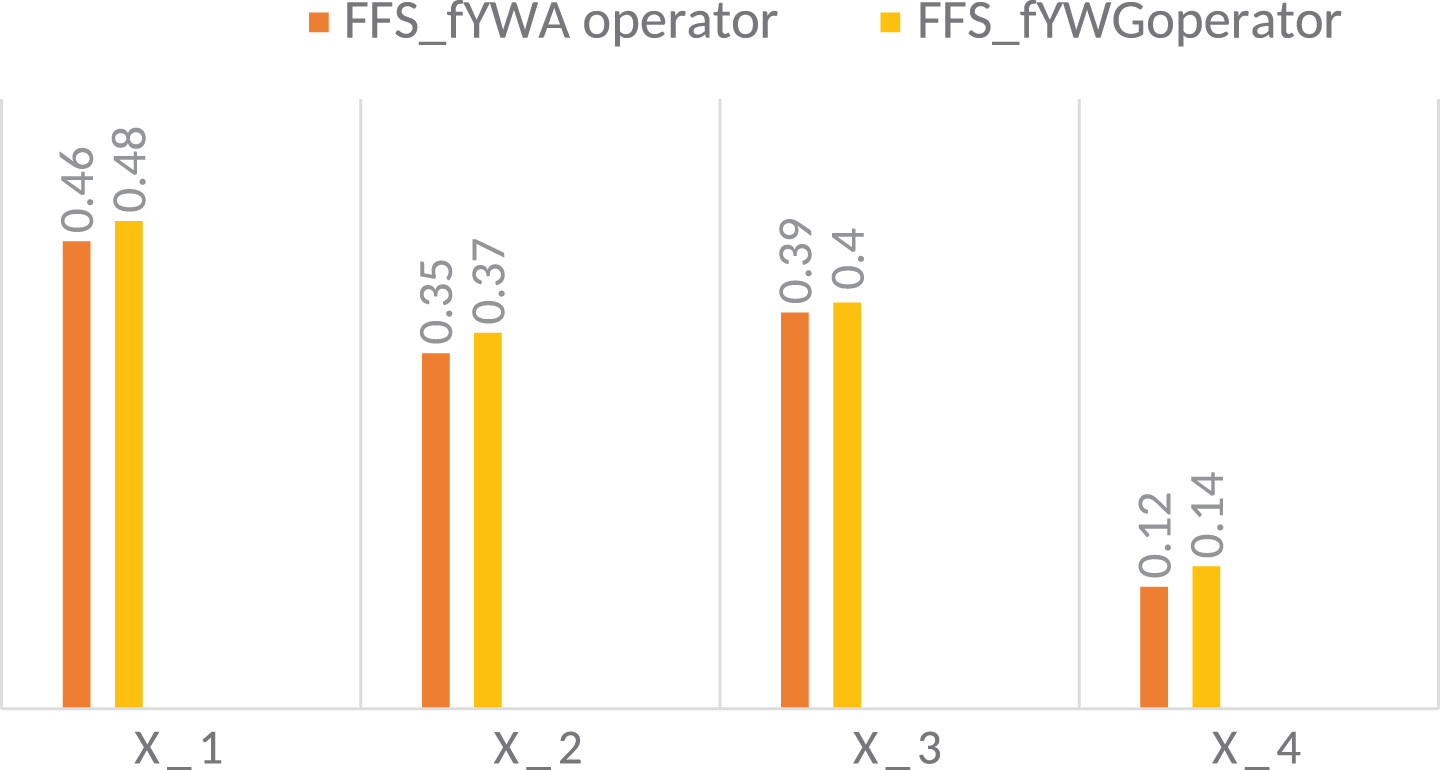
RO of alternatives.
The framework for the selection of most effective antivirus mask is shown in Fig. 2.
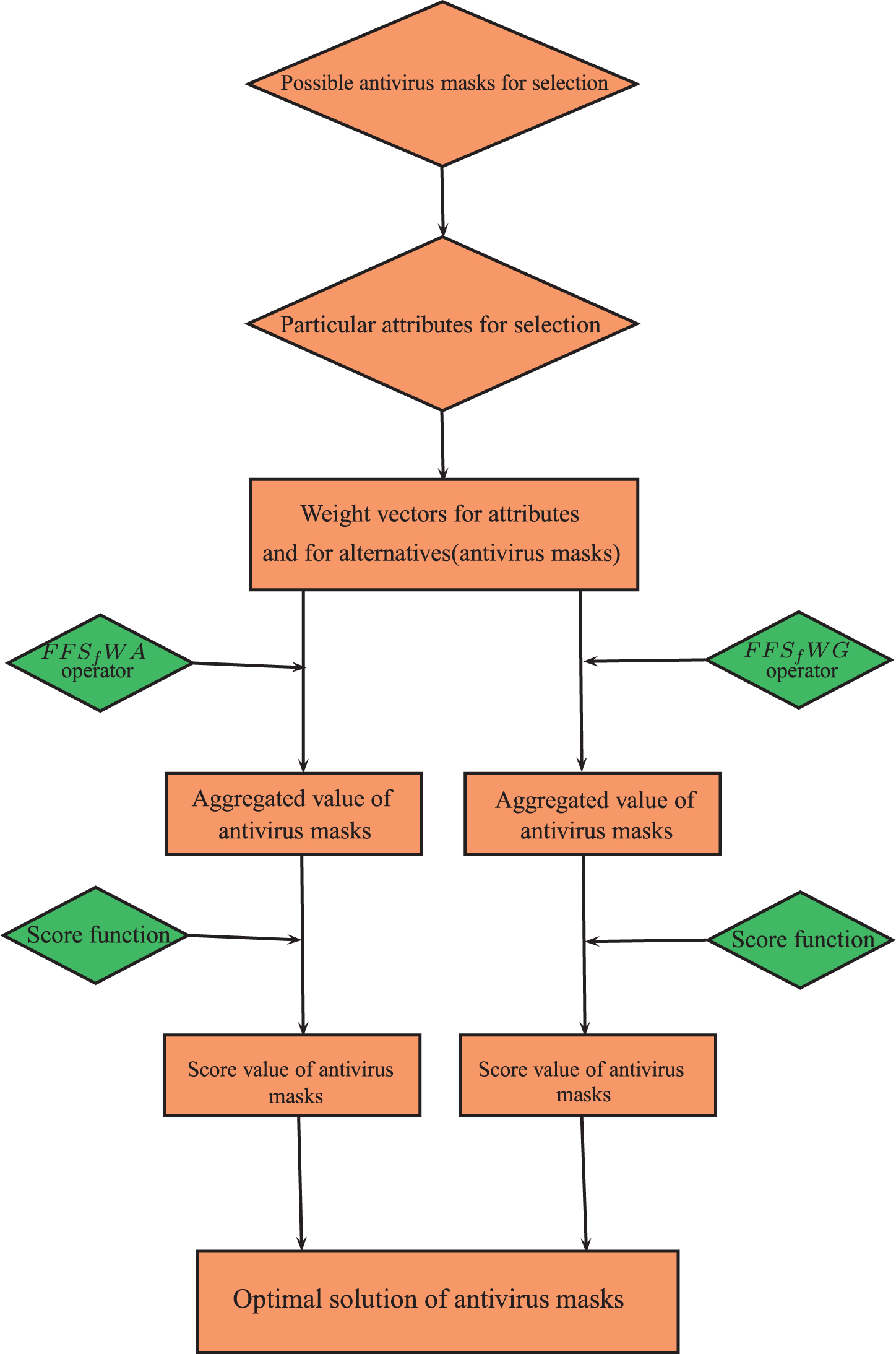
Framework for the selection of an effective antivirus mask.
Here, we discuss the comparison analysis of proposed operators with existing operators to elaborate the importance of proposed model. We can see that from Tables 4-7, there are some values for which sum of MD and NMD is greater than 1 and square sum of MD and NMD is also greater than 1. Therefore, methods given in [7, 10] are fail to handle the situations.
FFS
f
matrix for x1
FFS f matrix for x1
FFS f matrix for x2
FFS f matrix for x3
FFS f matrix for x4
This subsection discusses the comparison with FF Yager weighted average (FFYWA) [12] and FF Yager weighted geometric [12] operators. If we take the data given in Tables 4-7, then the existing model presented in [12] is fail to handle the problems but proposed theory cover all such situations. For that reason distinct parameters of FFS f Ns are aggregated by utilizing Fermatean weighted averaging operator with WV w = (0.28, 0.22, 0.25, 0.25) T and aggregated FFS f matrix for different masks is given in Table 8. Using this evaluated matrix, comparison with FFYWA and FFYWG operators is given in Table 9.
Aggregated FFS
f
matrix
Aggregated FFS f matrix
Comparison with FFYWA and FFYWG operators
From above table, it is clear that x1 is more effective antivirus mask as compared to others.
Here, we discuss the comparison with FF TOPSIS [30] method. The steps to find out the best alternative by FF TOPSIS method are: Table 8 represents the FF decision matrix in which each entry corresponds to a FFN. The FF positive ideal solution (FFPIS) The Euclidean distance between the alternative The revised closeness degree of each alternative is given as
We get the following ranking list by arranging the alternatives in decreasing order with respect to x1 is the best alternative.
The results obtained from proposed operators and existing methods are shown in Fig. 3.
Euclidean distance of alternatives from FFPIS and FFNIS
Euclidean distance of alternatives from FFPIS and FFNIS

Comparison with existing methods.
It is clear from Fig. 3 that the results obtained from proposed operators, FFYWA operator, FFYWG operator and FF TOPSIS method are same but FF TOPSIS method, FFYWA and FFYWG operators has no knowledge about parameterized study. The superiority of proposed theory is that it has the ability to solve real life problems by utilizing parameterized information. Therefore, developed approach can be applied for handling DM problems involving parameters.
As an extension of IFS f S and PFS f S, FFS f S are more flexible to solve DM problems involving vagueness and complexity corresponding to different parameters. To solve MAGDM problems, we have combined Yager norm operators with FFS f S. By combining these two structures, we have developed a new hybrid model to solve MAGDM problems. We have proposed four families of AOs, namely, FFS f YWA, FFS f YOWA, FFS f YWG and FFS f YOWG operators. Some basic properties of proposed operators including idempotency, boundedness, monotonicity, shift invariance and homogeneity have been elaborated. This article develops a method based on the proposed operators to handle MAGDM problem under FFS f data. The proposed approach helps in the the selection of an effective antivirus mask in the critical situations of COVID-19. The comparison analysis with FF TOPSIS method and other operators show that the developed approach has the ability to deal with DM problems involving parameterized study which shows the superiority of proposed approach over existing study. In short, this article builds up a tool that has the rich properties of Yager AOs and flexibility of FFS f model. However, there are some restrictions of proposed theory, it cannot applied on those DM problems where (i) cubic sum of MD and NMD is greater than 1, (ii) multi-polarity of an alternative cannot discussed in this model. Therefore, in future, we will extend our models to q-rung orthopair fuzzy set, m-polar fuzzy soft set, bipolar fuzzy soft set and neutrosophic set.
Conflict of interest
The authors declare no conflict of interest.