



Abstract
Root cause diagnosis is of great significance to make efficient decisions in industrial production processes. It is a procedure of fusing knowledge, such as empirical knowledge, process knowledge, and mechanism knowledge. However, it is insufficient and low reliability of cause analysis methods by using crisp values or fuzzy numbers to represent uncertain knowledge. Therefore, a dynamic uncertain causality graph model (DUCG) based on picture fuzzy set (PFS) is proposed to address the problem of uncertain knowledge representation and reasoning. It combines the PFS with DUCG model to express expert doubtful ideas in a complex system. Then, a new PFS operator is introduced to characterize the importance of factors and connections among various information. Moreover, an enhanced knowledge reasoning algorithm is developed based on the PFS operators to resolve causal inference problems. Finally, a numerical example illustrates the effectiveness of the method, and the results show that the proposed model is more reliable and flexible than the existing models.
Introduction
In industrial processes, identifying the root cause of abnormal events has become significant research as it can provide guidance for experts to make decisions and ensure that industrial production works efficiently and stably. Recently, root cause diagnosis of abnormal working conditions is usually modeled by the knowledge acquired from industrial data, empirical knowledge and process knowledge [1, 2]. And probability graph models have been extensively applied for knowledge representation and inference [3–5], which mainly include Bayesian network, Petri net, and dynamic uncertain causality graph. They can graphically map the causal relationships between variables to represent information explicitly and perform uncertain knowledge reasoning efficiently. Wee et al. [6, 7] propose a Bayesian network based on the causal relationship between variables. It provides an available and practical reasoning method for root cause diagnosis. In [8], a method is proposed to construct a multi-source knowledge solidification reasoning model on the basis of a fuzzy Bayesian network (FBN). This method can not only effectively solidify the information of mechanism knowledge, expert knowledge and industrial data, but also provides an effective analysis for abnormal states of the aluminum electrolytic cell. In [9] and [10], improved fuzzy Petri nets are proposed to acquire the feature of fuzzy knowledge, and diagnose the system fault by parallelizing the knowledge reasoning process, in which fuzzy sets are adopted to represent the uncertain and ambiguous information. In [11–13], reversed fuzzy Petri net method is proposed for fault diagnosis, which makes the knowledge representation and reversed reasoning process more intuitive and well formalized. However, it involves complex inference rules in large scale systems. In [14–16], a dynamic uncertain causality graph (DUCG) model is proposed for the intelligent fault diagnosis of complex systems. This model judges the root cause by comparing the probability of events and presents the fault process. In [14], DUCG is proposed for clinical diagnosis, which can reason in the case of insufficient information. Zhou [15] develops a DUCG model for the probabilistic safety assessment to address the issues of dependency and circulation. Zhang [16] extends the individual event descriptions of DUCG to the event matrix expressions, which can construct and keep a large scale of knowledge base to consider complex situations.
As a widespread method of expert system, DUCG is a crucial tool for establishing a knowledge model that integrates qualitative concepts and quantitative knowledge effectively. It provides effective graphical support for knowledge representation and inference by constructing the causal relationships between the interconnected events, and permits incomplete expression of knowledge to reduce the difficulty of building knowledge bases. Additionally, Bayesian networks (BN) require a large number of statistical data to construct a conditional probability table (CPT), and Petri net (PN) has a state-space combination explosion when there are too many nodes of systems. However, DUCG overcomes the shortcomings of BN and PN. Currently, DUCG is mainly focused on studying different types of events, for example, in [17], DUCG deals with discrete events, which provides compact causal relationship descriptions for both single-valued and multi-valued cases. In [18], it considers the continuous variables to address the limitations of discrete events. In [19], it considers the causal cycle problem of events, which not only improves the performance of DUCG but also can be used to simplify a huge and complicated DUCG model.
Although the existing DUCG models solve various types of problems, there are some shortcomings of limitations in describing fuzzy events by precise values. In actual situations, researchers are required to express ideas by developing restricted information, while it is unreliable to deal with incomplete and uncertain knowledge by accurate methods. Thus, different theories have been reported for uncertain information representation, such as fuzzy set (FS) [20, 21], intuitionistic fuzzy sets (IFS) [22–24], picture fuzzy sets [25–28], T-spherical fuzzy set (T-SFS) [29, 30], type-II fuzzy set [31, 32] and so on. The type-I and type-II fuzzy sets are common and effective ways to deal with uncertainty. However, they are difficult to describe a situation when there exists a neural or a refusal opinion. In fact, humans deal with high levels of imprecise, vague, and uncertain information, and the viewpoint of experts usually involves four different options, namely, yes, abstain, no and refusal. Correspondingly, failure symptoms may have positive, neutral, or negative influence on the causes in a diagnosis system. For example, in a medical diagnosis system, the symptoms headache and temperature have neutral influence on a patient suffering from chest and stomach disease [33, 34]. As a result, type-I and type-II fuzzy sets may lead to loss of information and distort original evaluation information under this uncertain environment. In contrast, PFS and T-SFS can present diverse opinions by considering membership functions of positive, neutral and negative, which can reduce the information loss, and is more favourable to human nature than the fuzzy type-I and type-II sets.
Motivated by the work mentioned above, a novel dynamic uncertain causality graph based on picture fuzzy set is proposed for casual inference. The symptom values of faults are assigned by PFS in the novel DUCG model, thus allowing expert to express their different opinions on failure symptoms. In addition, as the extant picture fuzzy operators pay little attention to the relevance of attribute, a new PFS division operator is introduced. It can characterize the importance of variables and connections between various information. Furthermore, an enhanced knowledge reasoning algorithm is developed based on the PFS operators for cause analysis. As a result, the model can address the vulnerability of uncertain problems to some degrees and be more powerful for causal inference. Especially, the proposed model is demonstrated by an industrial fault diagnosis system. The comparison results of different methods validate that the novel DUCG model provides a more feasible way for fuzzy knowledge representation and reasoning, and has a promising purpose for actual applications.
The following part of the paper is organized as follows. In Section 2, some basic definitions of PFS are briefly reviewed, and a division PFS operator and concepts of the novel DUCG model are presented. In Section 3, the root cause diagnosis method based on the novel DUCG is introduced. A numerical example in Section 4 illustrates the root cause reasoning algorithm and the validity of the novel DUCG model. Finally, a conclusion is made in Section 5.
The novel DUCG model
As the traditional DUCG models have low reliability and flexibility in describing fuzzy events, the novel DUCG is proposed to model the uncertain and fuzzy information by three characters of positive membership, neutral membership and negative membership. What’s more, a new operator of PFS is proposed to present the importance of variables and connections between them. Thus, the proposed model can effectively depict the vague and fuzzy evaluations of decision makers towards diverse selections.
Basic definitions of PFS
In this section, some basic operators of PFS are reviewed. Additionally, a division operator is proposed based on the multiplication operator to feature the importance of variables and deal with the vulnerability of fuzzy information.
a1 ⊕ a2 = (1 - (1 - μ1) (1 - μ2) , η1η2, (ν1 + η1) (ν2 + η2) - η1η2) a1 . a2 = (μ1μ2, 1 - (1 - η1) (1 - η2) , 1 - (1 - ν1) (1 - ν2))
neg (a1) = (ν1, η1, μ1)
If S (a1) > S (a2), then a1 > a2, If S (a1) = S (a2), then If H (a1) = H (a2), then a1 = a2, If H (a1) > H (a2), then a1 > a2.
An equation is considered as
Based on the multiplication operator in Definition 2, it can be acquired that
① μ C · μ B = μ A , ②1 - (1 - η C ) (1 - η B ) = η A ,
③1 - (1 - ν C ) (1 - ν B ) = ν A ,
then
④μ C = μ A /μ B , ⑤η C = (η A - η B )/(1 - η B ),
⑥ν C = (ν A - ν B )/(1 - ν B ).
Thus, a division operator between picture fuzzy number a1 = (μ1, η1, ν1) and a2 = (μ2, η2, ν2) is defined as
The novel DUCG model connects various events through graphic symbols. Moreover, it describes the variables in the form of picture fuzzy sets by three characters involving the degrees of membership, neutral membership, and non-membership. It is more conducive to the expressions of uncertain information than FS and IFS. The basic model of the novel DUCG is shown in Fig. 1.

The basic model of the novel DUCG.
The explanation of symbols in Fig. 1 is shown in Table 1. For example, in Fig. 1, a one-way arrow from variable B1 to variable X2 means that B1 is the cause of X2. Two-way arrows between variables X2 and X3 mean mutual relationships of them. F2 ;1 indicates the possibility of variable B1 causing variable X2. Suppose that V variable can be either X variable or B variable, and it is represented by a picture fuzzy number, then the basic expression of the novel DUCG is
The explanations of symbols
When there are multiple states for each variable, the expression of the novel DUCG is
To perform uncertainty knowledge inference based on the proposed model, some rules are presented, which are consistent with the basic rules of traditional DUCG.
It is helpful for Rule 1 to handle with the directed circulation problem of the novel DUCG in the process of knowledge reasoning.
These rules are commonly used to simplify the variable expressions of the novel DUCG model.
Root cause diagnosis can identify the cause and effect of events, and locate the possible cause to provide experts with decision-making guidance. The cause analysis based on the graph model consists of nodes and arcs. Nodes indicate events, and arcs denote causal links between events. In an actual system, information is usually derived from insufficient data or biased expert knowledge, which is full of uncertainty and cannot be described precisely. Therefore, the root cause diagnosis method based on the novel DUCG is proposed to represent vague and ambiguous concepts. The proposed model describes uncertain events by PFS, which canenhance the capability and reliability of fuzzy knowledge in a complex system. The novel DUCG-based root cause diagnosis method can be described by the processes of knowledge representation and reasoning. Generally, the novel DUCG model is firstly established according to the acquired knowledge including crucial variables information and inference rules, and variables are described by picture fuzzy sets. Then an inference of the novel DUCG model is executed based on the process of cut-set solutions, where a PFS division operator is developed to characterize the importance of variables and connections between various information. Subsequently, the probabilities of the target events are calculated according to picture fuzzy theory. Finally, the root cause is reasoned by ranking the score functions. The framework of the method is shown in Fig. 2.
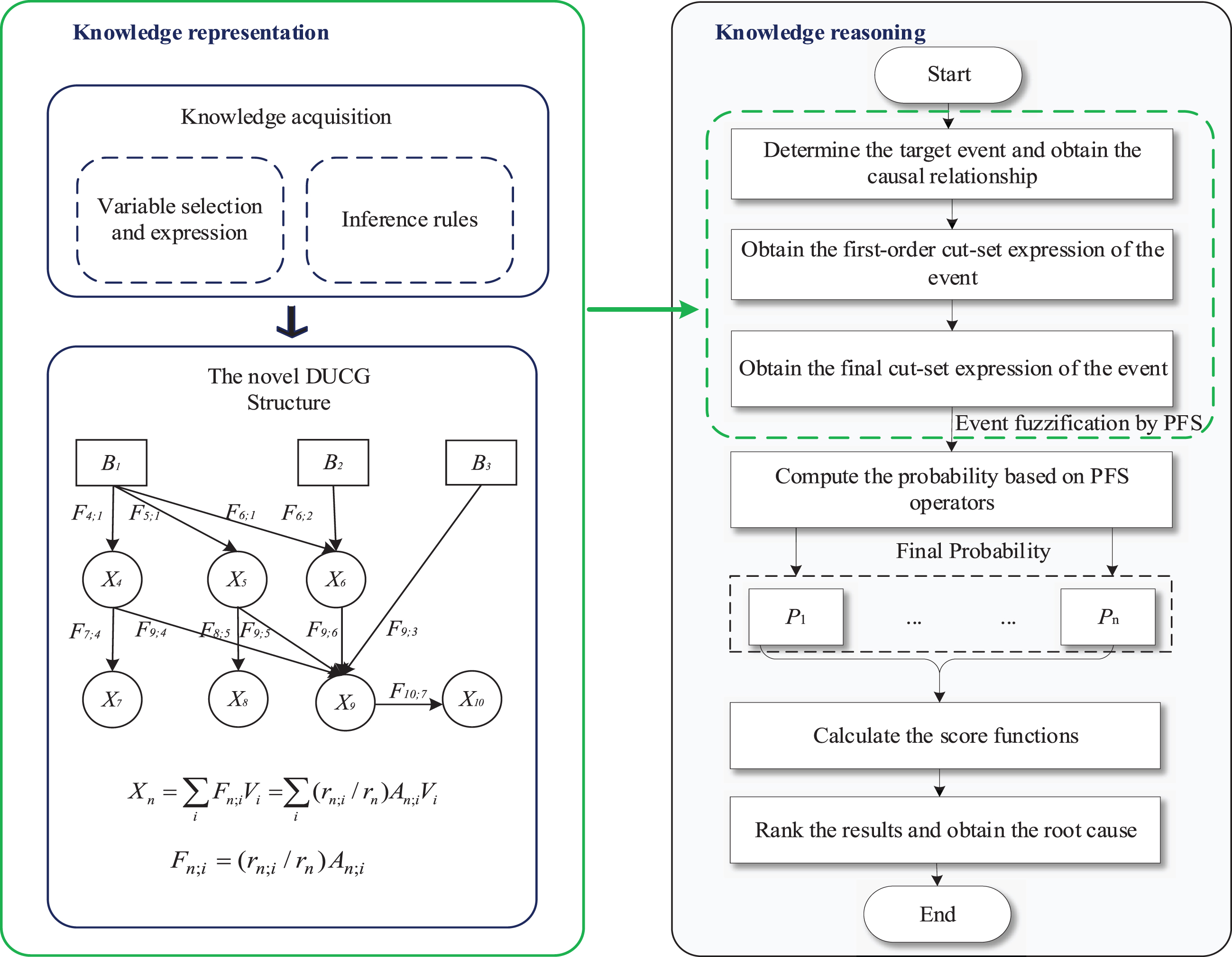
The framework of the novel DUCG method.
In the knowledge representation of the novel DUCG model, causes are defined as root variables, and failure phenomena are intermediate variables. Then causal relationships among events and inference rules are established based on industrial processes. The process of knowledge representation mainly includes the following three aspects.
(1) The expression of variables.
The key variables and causal relationships between events are firstly obtained from mechanism information and expert knowledge. Then the variables of the novel DUCG model can be expressed as
When there are multiple states for each variable, the model can be expressed as
(2) The generation of inference rules.
The inference rules are determined based on theoretical knowledge and expert knowledge. Generally, the generation of inference rules meets the conditions as follows:
① Root events triggering intermediate events can form inference rules;
② Intermediate events triggering intermediate events can form inference rules;
③ Repeat the above process ① and ② until the rules cover the relevant information of all events.
(3) The quantitation of fuzzy events.
It is crucial to quantitatively express fuzzy events for a complex system. FS and IFS can be applied for describing uncertainty, however, they have limitations in some situations. For example, an engineer may have a judgement about something that 0.3 is the possibility of occurrence, 0.4 is non-occurrence and 0.2 for not sure. This issue cannot be handled by FS or IFS, but can be processed by PFS effectively based on three characters of positive membership, negative membership, and neutral membership. Thus, PFS is used to express an uncertain event in the proposed model. The intermediate events are described as X n = (μ n , η n , ν n ) and the root events are presented as B i = (μ i , η i , ν i ).
The flowchart of knowledge reasoning based on the novel DUCG is shown in Fig. 3 and the detailed steps are as follows.
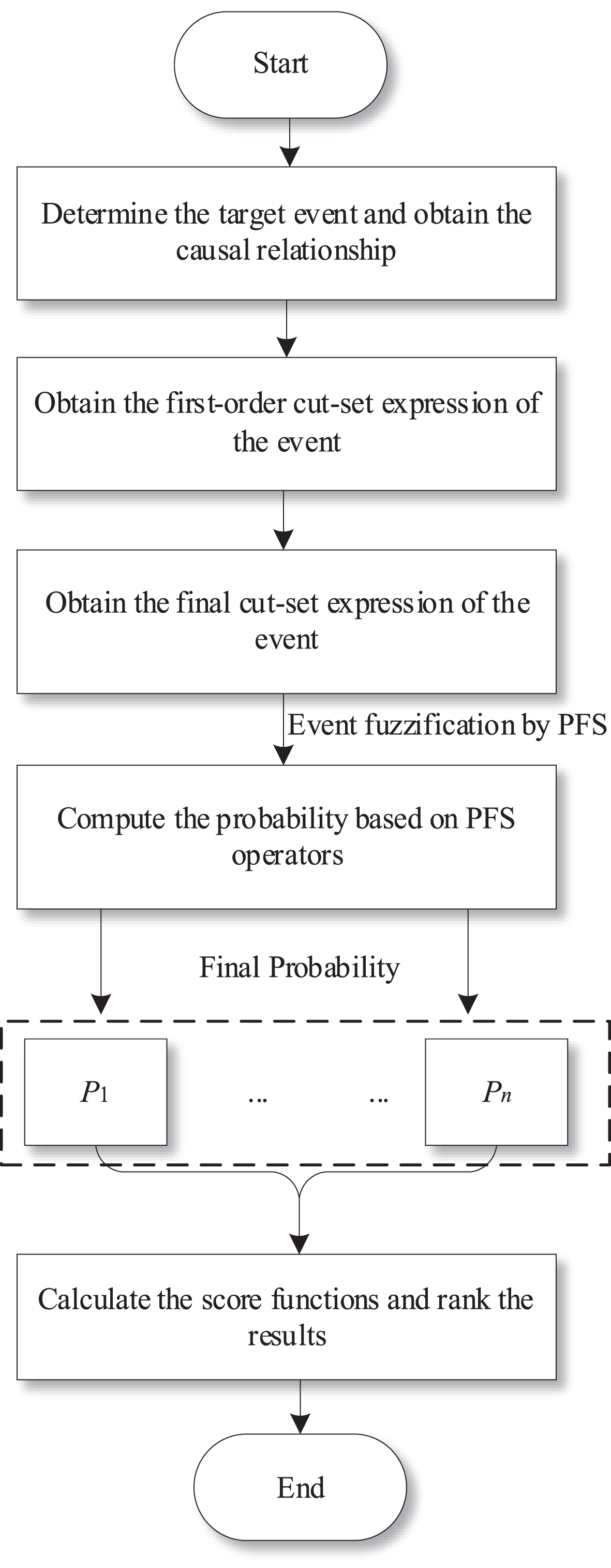
The flowchart of knowledge reasoning based on the novel DUCG.
(1) Determine the target event and obtain the causal relationships between events according to expert knowledge and theoretical knowledge of the industrial process, then the novel DUCG model can be established based on the theory in Section 3.1.
(2) Obtain the first-order cut-set expression of the event by Equation (8) or Equation (9) in Section 3.1, then the event is described by the combination of root variables, intermediate variables, and connection variables. For example, events X2, X3 can be expressed as X2 = F2;1B1 + F2;3X3 and X3 = F3;4B4 in Fig. 2.
(3) Obtain the final cut-set expression of the event, namely, intermediate variables are expanded to root variable by the cause-effect relationships according to Equation (8) or Equation (9), and the variables are then fuzzified by PFS. As shown in Fig. 2, it can be obtained that
(4) Compute the probability of the event. The probability is calculated based on the Bayesian theorem and PFS operators. For example,
(5) Calculate the score functions S of events.
(6) Sort the score functions. The larger the value of S, the more likely the root cause.
In this section, an example is provided to illustrate the root cause diagnosis method of the novel DUCG. The example is taken from an industrial fault diagnosis system. Due to the uncertainty of information in the system, root cause diagnosis may be disturbed when knowledge is represented by a crisp number of Petri net. Therefore, the novel DUCG model is proposed for the root cause analysis.
Implementation
Based on the system provided in [11], the casual relationships and inference rules of the novel DUCG model can be described as: The failure of hardware (B1) can cause a reduction of measuring resolution (X4). The failure of hardware (B1) can cause the failure of control unit (X5). The failure of hardware (B1) and software (B2) can cause the failure of servo system (X6). The reduction of measuring resolution (X4) can cause the reduction of machining resolution (X7) and the open-loop control of the system (X9). The failure of control unit (X5) can cause the failure of tools (X8). The failure of control unit (X5) can cause the open-loop control of the system (X9). The failure of servo system(X6) and sensors(B3) can cause the open-loop control of the system (X9). The open-loop control of the system (X9) can cause the failure of machining (X10).
In the proposed model, B and X type variables are represented by PFS, and F type variable is defined based on the information in [11]. Given that B1=(0.70,0.10,0.10), B2=(0.70,0.10,0.20), B3=(0.70,0.10,0.20). Take B2=(0.70,0.10,0.20) for example, 0.70 is the probability of occurrence, 0.20 is the probability of non-occurrence and 0.10 is the possibility for not sure of occurrence or non-occurrence. Then the steps of the reasoning algorithm based on the novel DUCG are as follows:
(1) Obtain the novel DUCG-based fault diagnosis model.
By obtaining causal relationships between events based on the above information, the novel DUCG-based fault diagnosis model can then be obtained as shown in Fig. 4. The meanings of the variables are shown in Table 2. Moreover, the root events and intermediate events are both described by picture fuzzy numbers.

The novel DUCG-based fault diagnosis model.
The meanings of variables
(2) Obtain the first-order cut-set expression of the event.
In line with the basic definition of the novel DUCG model, an event can be described by the combination of different types of variables. Thus, events X7, X8 and X10 in Fig. 4 can be expressed as X7 = F7;4X4, X8 = F8;5X5 and X10 = F10;9X9.
(3) Obtain the final cut-set expression of the event.
As shown in Fig. 4, the intermediate events X7, X8 and X10 can be expanded to the combination of root events as
The events X7, X8 and X10 are expressed in the form of PFS.
(4) Compute the probability of the target event.
Based on the rules mentioned in Section 2.2, the events B1|X7X8X10, B2|X7X8X10 and B3|X7X8X10 are expanded and simplified. Then the probabilities of the events are calculated to obtain the root cause of the system. From step (3), it can be obtained that
F variables can be computed by Fn;i = (rn;i/r
n
) An;i, while r and A variables are given based on the information in [11]. Suppose a4 ;1 = 0.8; a5 ;1 = 0.7; a6 ;1 = 0.8; a6 ;2 = 0.8; a7 ;4 = 0.6; a9 ;4 = 0.6; a8 ;5 = 0.8; a9 ;5 = 0.9; a9 ;6 = 0.5; a9 ;3 = 0.8; a10 ;9 = 0.9; r4 ;1 = 0.8; r5 ;1 = 0.7; r6 ;1 = 0.8; r6 ;2 = 0.8; r7 ;4 = 0.6; r9 ;4 = 0.6; r8 ;5 = 0.8; r9 ;5 = 0.9; r9 ;6 = 0.5; r9 ;3 = 0.8; r10 ;9 = 0.9, then the posterior probability is computed based on the Bayesian theory and the PFS division operator as shown in Definition 6.
The results are shown in Table 3. For example, the picture fuzzy probability of event B2|X7X8X10 is (0.61,0.21,0.03), which means that the event B2 has a positive effect on X7X8X10 at the degree of 0.61, a negative effect at the degree of 0.03, and a neutral effect at the degree of 0.21.
The results of different methods
(5) Calculate the score functions S.
In terms of the target events B1|X7X8X10, B2|X7X8X10 and B3|X7X8X10, it can be obtained that S1 = 1.00, S2 = 0.58, S3 = 0.66 based on the equation S (a) = μ - ν
(6) Sort the score functions S and obtain the root cause.
As S1 > S3 > S2, it can be concluded that the event B1 is the root cause of the fault system, namely, the event B1 is more likely to cause the event X7X8X10 than B2 and B3 . It conforms to the reasoning result of RFPN model in [11]. The results of different methods are shown in Table 3. It is obvious that the result of picture fuzzy based DUCG method is characterized by three different degrees of positive, neutral and negative membership. Especially, the neutral information forms an integral and important part of fault analysis that is absent in other fuzzy theories dealing with uncertainty. As a result, the novel DUCG model permits the experts to more naturally express their diverse ideas on failure symptoms. Moreover, it can reduce the information loss in the process of cause analysis. Therefore, the novel DUCG is more beneficial for fuzzy knowledge representation and inference than the existing models.
To prove the effectiveness of the proposed model, comparisons are made with the well-known cause analysis methods including reversed fuzzy Petri nets (RFPN) [12, 13], dynamic uncertain causality graph (DUCG) [40, 41] and intuitionistic fuzzy sets based DUCG (IFDUCG) [42]. The parameters are initially set according to the system in Section 4.1. Based on DUCG and IFDUCG model mentioned in the related literature, the root cause can be diagnosed as the event B1. The results of different methods are shown in Table 3, and it can be seen that the novel DUCG has the same reasoning results as other models. Hence, it proves that the proposed model is effective in the root cause analysis. Moreover, the proposed method has advantages over others. As DUCG model ignores uncertain information, it is likely to attain inaccurate results in a complicated situation. Additionally, RFPN and IFDUCG describe knowledge by using fuzzy sets and intuitionistic fuzzy sets respectively, which may lose valuable information to some degree. However, the novel DUCG takes advantage of the picture fuzzy set to deal with ambiguities and uncertainties by introducing the characters of positive membership, neutral membership and negative membership. Therefore, the novel DUCG is more reliable and suitable for expressing human ideas than other methods. What’s more, a division operator of PFS introduced in the paper can feature the importance of factor as well as reflect the interrelationships between various variables, which is preferable for handling the vulnerability of systems. In terms of adaptability, RFPN is restricted to some specific rules and requires remodeling if the configuration varies, while DUCG and the improved DUCG can be updated dynamically due to the flexible graphic structures and rules. Table 4 shows the performance of different methods, and it can be concluded that the novel DUCG is more available and practical in uncertain applications.
The performance of different methods
The performance of different methods
In summary, the advantages of the model in this paper mainly include:
(1) The novel DUCG method takes advantage of picture fuzzy set to deal with ambiguities and uncertainties in the cause analysis problem, which results in a higher flexibility by degrees of positive, neutral, and negative membership. Therefore, the novel DUCG is more reliable and suitable for expressing human diverse opinions than the conventional fuzzy methods.
(2) A new PFS division operator is introduced in the paper to fuse picture fuzzy assessment data and study several remarkable properties. Thus, it can characterize the importance of variables and connections between various information. In addition, a new inference algorithm is developed based on the integration of DUCG and PFS operators. Moreover, it is employed to deal with the causal inference problems in an industrial case. Hence, it can address the vulnerability of uncertain problems to some degrees and be more powerful for causal inference.
(3) The novel model contains more information and mitigates information loss by combining PFS and DUCG. As a result, the proposed picture fuzzy DUCG method can be beneficial to uncertain knowledge representation and inference. Additionally, it is not limited to specific inference rules and is flexible in the topology structure. Thus, the proposed model is superior to other methods under the qualitative evaluation criteria.
In conclusion, the proposed model contains more information and improves the reliability of knowledge representation and inference.
In this paper, a picture fuzzy based DUCG model was proposed for root cause analysis. It dealt with the uncertain information based on the concept of positive, neutral and negative membership degree, which was more favourable and reliable to express the expert skeptical opinion by combining PFS with DUCG. In addition, with the introduction of PFS division operator, the novel DUCG model characterized the significance of factors and connections between variables, so that it could address the vulnerability of fuzzy knowledge to a certain degree. Moreover, an improved knowledge reasoning algorithm was developed based on the PFS operators for cause analysis. Hence, the novel DUCG considered more information and was practical in describing fuzziness of knowledge. The example of root cause diagnosis proved that the method had a better performance from a comprehensive viewpoint and could have wider application in real industrial processes. Further research will consider time factor of the novel DUCG model for online analysis in a failure system. Additionally, due to the complexity of uncertain environments and expert cognition, the model can be strengthened to TSFS-based DUCG which addresses constraints of the novel DUCG in space domain.
Footnotes
Acknowledgments
This project is partly supported by the National Natural Science Foundation of China (Grant Nos. 61725306, 61751312, 61773405 and 61533020) and the Fundamental Research Funds for the Central Universities of Central South University (2019zzts063).