In the present work, the adjacency matrix, the energy and the Laplacian energy for a picture fuzzy graph/directed graph have been introduced along with their lower and the upper bounds. Further, in the selection problem of decision making, a methodology for the ranking of the available alternatives has been presented by utilizing the picture fuzzy graph and its energy/Laplacian energy. For the shake of demonstrating the implementation of the introduced methodology, the task of site selection for the hydropower plant has been carried out as an application. The originality of the introduced approach, comparative remarks, advantageous features and limitations have also been studied in contrast with intuitionistic fuzzy and Pythagorean fuzzy information.
Various generalizations for the fuzzy sets (FSs) [1] and the intuitionistic fuzzy sets (IFSs) [8] have been provided by the researchers in the literature to model the uncertainties & the hesitancy inherent in many practical circumstances for having a better applicability and flexibility. Yager [22] stated that fuzzy set and IFS are not sufficient to address the manual perception in a practical sense and defined Pythagorean fuzzy set (PyFS) which has certainly expanded the coverage of information by modifying the existing constraint. Actually, the concept of belongingness (yes), non-belongingness (no) and indeterminacy (abstain) have been considered differently in the definitions of IFS and PyFS. “Smarandache [10] defined the neutrosophic set by introducing the degree of indeterminacy as an independent component. Some other generalizations may also be easily found in the literature.”
Further, Cuong [21] defined the concept of picture fuzzy set (PFS) in which all the four parameters, i.e., “degree of membership, degree of indeterminacy (neutral), degree of nonmembership and the degree of refusal have been taken into account”. In order to understand the importance of picture fuzzy information, we consider an example of a voting system - “Suppose the voters have been categorized into four different classes: one who votes for (yes), one who votes against (no), one who neither vote for nor against (abstain) and one who refused for voting (refusal). It may be noted that the concept of ‘refusal’ is found to be an additional component which was not being taken into account by any of the sets or by their generalizations (fuzzy set, intuitionistic fuzzy set, Pythagorean fuzzy set, neutrosophic set) stated above”. This introduced setup has the capability to handle the human’s imprecise perception in a more flexible fashion.
Kifayat et al. [38] studied the geometrical aspects and features of these generalizations - “fuzzy sets, intuitionistic fuzzy sets, Pythagorean fuzzy sets and picture fuzzy sets”. It may be noted that the phenomenon of the voting system stated above can not be represented closely and sufficiently by utilizing the Pythagorean fuzzy graphs/sets. For capturing the information content and utilizing the flexibility in a more broader sense, we extend the graph-theoretic literature of picture fuzzy set, picture fuzzy graph and its applications. Figure 1 clearly illustrates the wider scope of different extensions of fuzzy sets:
Geometrical Representations of Generalizations of Fuzzy Set.
In many practical situations containing structural information viz. operation management, networking, systems analysis, economical interpretation, decision support system, the graph representation of the information has been found to be more effective and convenient for dealing with the information embedded among different objetcs/attributes/alternatives.
A brief literature survey on the Pythagorean fuzzy graph, picture fuzzy graph, other graph theoretic operations and applications has been given below:
“Based on the fuzzy relation [2], Kaufmann [3] proposed the concept of fuzzy graphs and Rosenfeld [4] subsequently developed the concept of fuzzy vertex and fuzzy edge. Some standard operations on the fuzzy graphs were studied by the Mordeson and Peng [9] along with their properties. Further, Parvathi et al. [11, 16] extended the notion of a fuzzy graph to intuitionistic fuzzy graph and analyzed various properties related to minmax intuitionistic fuzzy graph. Karunambigai et al. [17] proposed a category of constant and totally constant intuitionistic fuzzy graphs and subsequently Akram et al. [18] presented the concept of strong intuitionistic fuzzy graphs along with their properties. Also, Akram et al. [20] presented intuitionistic fuzzy hypergraphs with their applications and Alshehri et al. [24] defined the planarity, duality and multigraphs in context with intuitionistic fuzzy graphs. Sahoo and Pal [28] [33] proposed various types of product operations for intuitionistic fuzzy graphs, intuitionistic fuzzy tolerance graph with their applications.”
“Various researchers utilized the flexibility and its applicability to set forward some new ideas concerning the extended structures of intuitionistic fuzzy graphs and provided many interesting applications in clustering and decision-making problems and support systems [23, 35]. Naz et al. [39] proposed a generalization of the intuitionistic fuzzy graph, termed as the Pythagorean fuzzy graphs, and studied their applications in various decision making problems. Some graph-theoretic operations related with Pythagorean fuzzy graphs have been well studied by Verma et al. [36].”
Zuo et al. [40] introduced the new concept of picture fuzzy graph and its various types with different properties. Some important operations such as Cartesian product, composition, join, direct product, lexicographic and strong product on picture fuzzy graph have also been defined along with its utility and social networking application. Additionally, the significance of picture fuzzy graph has been explained with the help of social networking problem where the cluster of nodes and links forms a network which represents the agency/people/state and connection between the nodes respectively. The variation/vagueness in the relationship in the links can not be studied by the classical graphs and hence Samanta and Pal [27] utilized type 1 fuzzy graph in place of classical fuzzy graph.
Further, Das et al. [41, 43] comprehensively proposed a lot of research in the field of picture fuzzy graph, planar graphs with its applications using the introduced novel notions of m-step picture fuzzy competition graphs, picture fuzzy economic competition graphs and picture fuzzy competition hypergraphs [42]. The applications have been dealt in the field of academics, environment and companies etc. Pal et al. [44] explained the modern trends in study of fuzzy theory in the field of medicine. Some useful applications in various fields, e.g., decision making, medical diagnosis, pattern recognition, service quality analysis etc are available in literature.
In a different context, it may be noted that Meenakshi et al. [26] explained the energy of graph connecting the graph more closely to the chemical quantity known as π- electron energy of conjugated hydro carbon molecule. Nowadays, the analogous energies are being calculated using the eigenvalues of the graph matrices which technically makes the study more powerful in both the cases of chemistry as well as mathematics. This proves the importance of calculation of energy of a graph. The concept of energy of a graph [6, 13] has been utilized in chemical engineering applications-the molecular orbital theory of conjugated molecules [5, 15]. The concept of energy to fuzzy graphs has been extended by Narayanan and Mathew [19] with some bounds on the energy of fuzzy graphs. Further, Praba et al. [25] extended the energy concept for intuitionistic fuzzy graph with important results. Sridhara and Kanna [31] studied the bounds on the energy and Laplacian energy of graphs with various important observations and results. Recently, the application of energy of Pythagorean fuzzy graphs has been studied in the decision making example of a satellite communication system and in the evaluation of the schemes of reservoir operation [37].
In the present communication, we introduce the novel concept of adjacency matrix, energy and Laplacian energy for picture fuzzy graphs with applications. A new methodology for solving a selection problem based on the proposed notions of picture fuzzy graph has also been provided with an example. In whole, the purpose of the proposed work is to further expand the fuzzy graph related concepts under picture fuzzy environment. Such extensions and enrichment will certainly help in widening the span and coverage of the information significantly.
The rest of the manuscript has been presented as follows. In Section 1, some basic definitions and fundamental notions in connection with the picture fuzzy set, Pythagorean fuzzy graph, picture fuzzy graph, energy etc. Considering the fact that picture fuzzy graph has the sufficient strength to formulate the impreciseness, vagueness and incompleteness embedded in the information of an application, we have proposed the definition of adjacency matrix of such graph, its spectrum and energy/Laplacian energy with upper/lower bounds in Section 2. In reference with picture fuzzy directed graph, similar studies and results have been presented in Section 3. Further, we present a new algorithm to solve hydropower plant site selection problem by utilizing the notion of energy/Laplacian energy of picture fuzzy graph in Section 4. In Section 5, some comparative findings and advantages of the proposed approach have been provided. The paper has been finally concluded in Section 6.
Preliminaries
Here, we present some fundamental and basic definitions in relation with the Pythagorean fuzzy graph, picture fuzzy graph and energy etc. The generalization process from intuitionistic fuzzy sets to picture fuzzy sets may be well understood through the following definitions:
Let U be the universe of discourse with μM : U → [0, 1] and νM : U → [0, 1] being membership and non-membership grade respectively.
The set M ={ < α, μM (α) , νM (α) > ∣ α ∈ U } is called
Intuitionistic fuzzy set [8] in U if it satisfies the condition 0 ≤ μM (α) + νM (α) ≤1 with the degree of indeterminacy given by
Pythagorean fuzzy set [22] or Intuitionistic fuzzy set of second type [29] in U if it satisfies the condition with the degree of indeterminacy given by
Definition 1. [21] “A picture fuzzy set A in U (universe of discourse) is given by
where μA : U → [0, 1], ηA : U → [0, 1] and νA : U → [0, 1] denote the degree of membership, degree of neutral membership (abstain) and degree of non-membership respectively and for every α ∈ U satisfy the condition
The degree of refusal for any picture fuzzy set A and α ∈ U is given by
In this paper, throughout PFS (U) denotes the set of all picture fuzzy sets.”
Definition 2. [21] “An intuitionistic fuzzy graph on U, denoted by , where P is an intuitionistic fuzzy set on U and Q is an intuitionistic fuzzy relation in U × U such that
satisfying the constraint condition
The set P is called the intuitionistic fuzzy vertex set of the graph and Q is called the intuitionistic fuzzy edge set of the graph .”
Definition 3. [39] “A Pythagorean fuzzy graph on U, denoted by , where M is a Pythagorean fuzzy set on U and N is a Pythagorean fuzzy relation in U × U such that
satisfying the constraint condition . The set M is called the Pythagorean fuzzy vertex set of the graph and N is called the Pythagorean fuzzy edge set of the graph .”
Definition 4. [40] “A picture fuzzy graph on (S, R), denoted by G = (M, N), where M is a picture fuzzy set on S and N is a picture fuzzy relation in R = S × S such that
satisfying the constraint condition 0 ≤ μN (α, β) + ηN (α, β) + νN (α, β) ≤1, ∀ α, β ∈ S. The set M is called the picture fuzzy vertex set of the graph G and N is called the picture fuzzy edge set of the graph G.”
Definition 5. A picture fuzzy graph G = (M, N) is called a
Regular picture fuzzy graph [40] if it satisfies the condition
Strong picture fuzzy graph [40] if it satisfies the condition
Definition 6. [12] Let G′ = (V, E) be a graph and A (G′) be its adjacency matrix with eigenvalues λi. Then the energy of the graph is sum of absolute eigenvalues of A (G′), i.e., E (G) = ∑i|λi|.
Definition 7.[25] Let be a intuitionistic fuzzy graph and be its adjacency matrix. Consider λi be the eigenvalues of and γi be the eigenvalues of . Then the energy of the intuitionistic fuzzy graph is given by
Notion of energy of picture fuzzy graph
In this section, we propose some novel concepts of adjacency matrix, spectrum, energy and Laplacian energy of picture fuzzy graph as follows:
Let G = (S, R) be a picture fuzzy graph, where S is the picture fuzzy vertex set and R is the picture fuzzy edge set.
Definition 8. The adjacency matrixA (G) of the graph G is a square matrix defined as
Here, μR (αi, αj) , ηR (αi, αj) & νR (αi, αj) are the degree of membership, degree of neutral membership (abstain) and degree non-membership respectively.
Definition 9. The spectrum of the adjacency matrix A (G) of the picture fuzzy graph G = (S, R) is given by (Θ, Φ, Ψ), where Θ, Φ and Ψ are the set of the eigenvalues of matrices
and
respectively.
Definition 10. The energyE (G) of the picture fuzzy graph G is defined as
For illustrating the proposed definitions, we consider the following example of a picture fuzzy graph:
Example 1. Suppose G = (S, R) be a picture fuzzy graph given in Figure 2.
Graph G = (S, R).
In view of the definitions proposed above, the adjacency matrix A (G) is given by
Using the adjacency matrix A (G), the spectrum of the picture fuzzy graph G can be evaluated as
Hence, the spectrum of G may be presented as
Now, the calculation of energy of the picture fuzzy graph can be done as
Hence, the energy of G is
Next, we present the studies and various important results related to eigenvalues of adjacency matrix, upper bound and lower bound of energy of picture fuzzy graph.
Theorem 1. Let G = (S, R) be a picture fuzzy graph and A (G) be its adjacency matrix. If θ1≥ θ2 ≥ … ≥ θm, φ1 ≥ φ2 ≥ … ≥ φm and ψ1 ≥ ψ2 ≥ … ≥ ψm are the absolute eigenvalues of A (μR (αi, αj)), A (ηR (αi, αj)) and A (νR (αi, αj)), respectively, then:
, and ;
; ; and .
Proof:
Since the diagonal entries of adjacency matrix A (G) are zero, therefore the trace of the matrix is zero. As the trace of a matrix is equal to sum of its eigenvalues, the proof is obvious.
By the trace property of a matrix, we have
where
Hence,
Similarly, we can show that
Hence, the results of the theorem are proved.
Further, throughout the manuscript we denote
Also, we denote
Theorem 2. Let G = (S, R) be the picture fuzzy graph with m vertices and A (G) be its adjacency matrix. Then
;
;
.
Proof: Using Cauchy-Schwarz inequality for the vectors (1, 1, …, 1) and (|θ1|, |θ2|, …, |θm|) with m entries, we get
Also,
The characteristic polynomial of A (G) is given by
Now, comparing the coefficients of λn-2 in above polynomial, we get
Using equation (3.3) in equation (3.2), we have
Substituting equation (3.4) in equation (3.1), we have
Therefore,
Next,
Since the arithmetic mean is greater than or equal to the geometric mean, i.e., AM {|θiθj|} ≥ GM {|θiθj|}, therefore,
Also,
Substituting equation (3.7) in equation (3.6), we get
Thus, from equations (3.5) and (3.8), we have
On similar lines, we can show that
and
Theorem 3. Let G = (S, R) be a picture fuzzy graph on m vertices and A (G) be its adjacency matrix. If m ≤ 2Mμ, m ≤ 2Mη and m ≤ 2Mν, then:
;
;
.
Proof: Since A (G) of the picture fuzzy graph G is symmetric with trace zero, therefore,
where θ1, θ2, …, θm are the eigenvalues of A (G). In view of the results obtained in Theorem 1, we write
Using Cauchy- Schwarz inequality for the vectors (1, 1, …, 1) & (|θ1|, |θ2|, …, |θm|) with (m - 1) entries, we get
Substituting equation (3.9) in equation (3.10) and after rearranging, we have
Since the function decreases on the interval , as , therefore,
Thus the equation (3.11) implies
On similar lines, we can also show that
and
It may be noted that the results obtained in the above theorem provide the upper bound for the energy of the picture fuzzy graph, with the conditions m ≤ 2Mμ, m ≤ 2Mη and m ≤ 2Mν.
Theorem 4. Let G = (S, R) be a picture fuzzy graph on m vertices. Then .
Proof: If n ≤ 2Mμ, then by calculus it is easy to show that
obtains a maximum value when . Substituting this value of Mμ in the above Theorem 3, we get . Similarly, the results for other energy components can be obtained. Hence, the theorem is proved.
Next, we study another important notion of energy of graph, known as Laplacian Energy of Picture Fuzzy Graph and discuss its various graph-theoretic aspects.
Definition 11. Let G = (S, R) be a picture fuzzy graph on m vertices. The degree matrixD (G) = [dij], of G is a m × m diagonal matrix defined as:
Example: We consider an example of picture fuzzy graph on 4 vertices. The degree matrix D (G) would be a 4 × 4 diagonal matrix presented by
Definition 12. Let G = (S, R) be a picture fuzzy graph on m vertices. The Laplacian matrix of a picture fuzzy graph G is defined as L (G) = D (G) - A (G) ; where D (G) & A (G) are degree and adjacency matrix of the picture fuzzy graph G, respectively.
Example: We consider the picture fuzzy graph on 4 vertices whose Laplacian matrix may be represented by
Definition 13. The spectrum of the Laplacian matrix L (G) of the picture fuzzy graph G = (S, R) is given by {(Δ, ϒ, Ω)}, where Δ, ϒ and Ω are the set of the eigenvalues of L (μR (αi, αj)), L (ηR (αi, αj)) and L (νR (αi, αj))), respectively.
Example: Using the example given in the definition of the Laplacian matrix (Definition 1), we calculate the spectrum ofL (G) as given below:
Theorem 5. Let G = (S, R) be a picture fuzzy graph on m vertices and L (G) be its Laplacian matrix. If δ1 ≥ δ2 ≥ … ≥ δm, υ1 ≥ υ2 ≥ … ≥ υm and ω1 ≥ ω2 ≥ … ≥ ωm are the absolute eigenvalues of L (μR (αi, αj)), L (ηR (αi, αj)) and L (νR (αi, αj))) respectively, then
; ; and .
; ; and
Proof: The theorem can be proved on the similar lines as the proof of Theorem 1.
Definition 14. The Laplacian energy of the picture fuzzy graph G = (S, R), denoted by LE (G), is defined as
where
Example: Here, we use the example used in the definition of Laplacian matrix (Definition 1) to present the evaluated Laplacian energy of the picture fuzzy graph as:
Theorem 6. Let G = (S, R) be a picture fuzzy graph on m vertices and L (G) be its Laplacian matrix. If δ1 ≥ δ2 ≥ … ≥ δm, υ1 ≥ υ2 ≥ … ≥ υm and ω1 ≥ ω2 ≥ … ≥ ωm are the absolute eigenvalues of L (μR (αi, αj)), L (ηR (αi, αj)) and L (νR (αi, αj))), respectively, then
and ;
; where ; and .
Proof: The proof of the theorem is obvious.
Theorem 7. Let G = (S, R) be a picture fuzzy graph on m vertices and L (G) be its Laplacian matrix. Then
Proof: The proof can be given on the similar lines as the proof of the Theorem 2.
Theorem 8. Let G = (S, R) be a picture fuzzy graph on m vertices and L (G) be its Laplacian matrix. Then
Proof: The proof can be given on the similar lines as the proof of the Theorem 2.
The results obtained in the above theorems provide us the upper bound and lower bound of the Laplacian energy of the picture fuzzy graph G.
Theorem 9. Let G = (S, R) be a picture fuzzy graph on m vertices and L (G) be its Laplacian matrix. Then
;
;
.
Proof: The proof can be given on the similar lines as the proof of the Theorem 3.
Energy and Laplacian energy of picture fuzzy directed graph
In case of the directed graph, the adjacency matrix A (G) of a picture fuzzy directed graph is not necessarily symmetric. Therefore, the eigenvalues of the adjacency matrix may be complex numbers. This section generalizes the concept of energy and Laplacian energy for picture fuzzy directed graphs.
Definition 15. The spectrum of the adjacency matrix A (G) of the picture fuzzy directed graph is given by {(Θ, Φ, Ψ)}, where Θ, Φ and Ψ are the set of the eigenvalues of , and , respectively.
Definition 16. The energy of the picture fuzzy directed graph G is given as:
where Re (θi), Re (φi) and Re (ψi) represents the real part of the eigenvalues θi, φi and ψi, respectively.
Theorem 10. Let be a picture fuzzy directed graph and A (G) be its adjacency matrix. If θ1 ≥ θ2 ≥ … ≥ θm, φ1 ≥ φ2 ≥ … ≥ φm and ψ1 ≥ ψ2 ≥ … ≥ ψm are the absolute eigenvalues of A (μR (αi, αj), A (ηR (αi, αj) and A (νR (αi, αj), respectively, then , and .
Definition 17. Let be a picture fuzzy graph on m vertices. The out-degree matrix Dout (G) = [dij], of G is a m × m diagonal matrix defined as:
Definition 18. Let be a picture fuzzy directed graph on m vertices. The Laplacian matrix of a picture fuzzy directed G, denoted by L (G) is defined as
where Dout (G) & A (G) are the out degree matrix and adjacency matrix of the picture fuzzy directed graph G, respectively.
Definition 19. The spectrum of the Laplacian matrix L (G) of the picture fuzzy directed graph is given by {(Δ, ϒ, Ω)}, where Δ, ϒ and Ω are the set of the eigenvalues of , and , respectively.
Theorem 11. Let be a picture fuzzy graph on m vertices and L (G) be its Laplacian matrix. If δ1 ≥ δ2 ≥ … ≥ δm, υ1 ≥ υ2 ≥ … ≥ υm and ω1 ≥ ω2 ≥ … ≥ ωm are the absolute eigenvalues of , and respectively, then
and
Proof: The proof can be given on the similar lines as the proof of the Theorem 1.
Definition 20. The Laplacian energy of the picture fuzzy directed graph denoted by LE (G) is defined as
where
Theorem 12. Let be a picture fuzzy directed graph on m vertices and L (G) be its Laplacian matrix. If δ1 ≥ δ2 ≥ … ≥ δm, υ1 ≥ υ2 ≥ … ≥ υm and ω1 ≥ ω2 ≥ … ≥ ωm are the absolute eigenvalues of , and , respectively, then and .
Proof: The proof of the theorem is obvious.
For illustrating the proposed definitions, we consider the following example of a picture directed fuzzy graph:
Example 2. Suppose G = (S, R) be a picture fuzzy graph as given in Figure 3.
Graph G = (S, R).
In view of the above definitions and Figure 3, the adjacency matrix of picture fuzzy directed graph can be given by
The spectrum of the picture fuzzy directed graph G can be computed as
Hence, the spectrum of picture fuzzy directed graph G may be presented as
The calculation of the components for energy of picture fuzzy directed graph G has been listed below:
Hence, the energy of picture fuzzy directed graph G is
Next, the out-degree matrix D (G) and the Laplacian matrix L (G) of the picture fuzzy directed graph G are given by
and
respectively. The Laplacian spectrum of the picture fuzzy directed graph G can be computed as
Hence, the Laplacian spectrum of picture fuzzy directed graph G may be written as
The calculation of the components for Laplacian energy of picture fuzzy directed graph G has been listed below:
Hence, the Laplacian energy of picture fuzzy directed graph G is
Algorithm for selection process using picture fuzzy graph energy
In this section, we focus on the application of the proposed energy/Laplacian energy of picture fuzzy directed graph in a real world problem related to the site selection process. For ensuring the sustainable development, the use of natural resources in an environmental consciousness framework has got a remarkable popularity in recent decades. Establishment of hydropower plants certainly provides high usability, better reliability and clean source of energy. The problem of site selection for the hydropower plants also comprise of political, social, environmental and cultural aspects in addition to the technical requirements.
Decision making methods are often used in various selection processes where the final task is to select the best one out of the given set of alternatives. While drawing some concluding remarks in applicable fields, the experts mainly focus on different correlated factors with their prior perception and expertise. The preference relation is supposed to be the best and fruitful tool to achieve the actual sorting of the given set of alternatives among which the experts put forward their preference over other alternatives. In order to implement the preference relation concept, we would consider the information in the shape of picture fuzzy numbers as follows:
Definition 21. A picture fuzzy preference relation (PFPR) on the universe of discourse U = {α1, α2, α3, …, αm} is represented by a matrix , where ∀ i, j = 1, 2, …, m.
For the sake of simplicity, suppose , where μij is the degree to which the object αi has been preferred over the object αj, ηij is the degree to which the expert is in dilemma whether to prefer the object αi or αj. In addition to this, νij gives the degree to which αi is not preferred to αj and
gives the amount of refusal with the following constraint:
∀ i, j = 1, 2, …, m.
Suppose that the issue of site selection for the establishment of hydropower plant is formulated as:
Based on the comprehensive survey conducted by the government agencies, let there are four possible locations/sites (α1, α2, α3, α4) for the hydropower plant to be established.
The survey has a detailed database and reports for all the four possible sites in context with the various deterministic features such as ecological safety, plant safety, social factor, economical factors, maximum efficiency, hydrological factors, environmental factor etc.
For conducting the evaluation process based on the survey database report, suppose there are three experts (ek ; k = 1, 2, 3) who have been independently deputed. Based on the their experience, the expert’s comparative opinions have been marked in the form picture fuzzy numbers.
Further, picture fuzzy preference relations in the form of matrices have been constructed as the initial step for the site selection process.
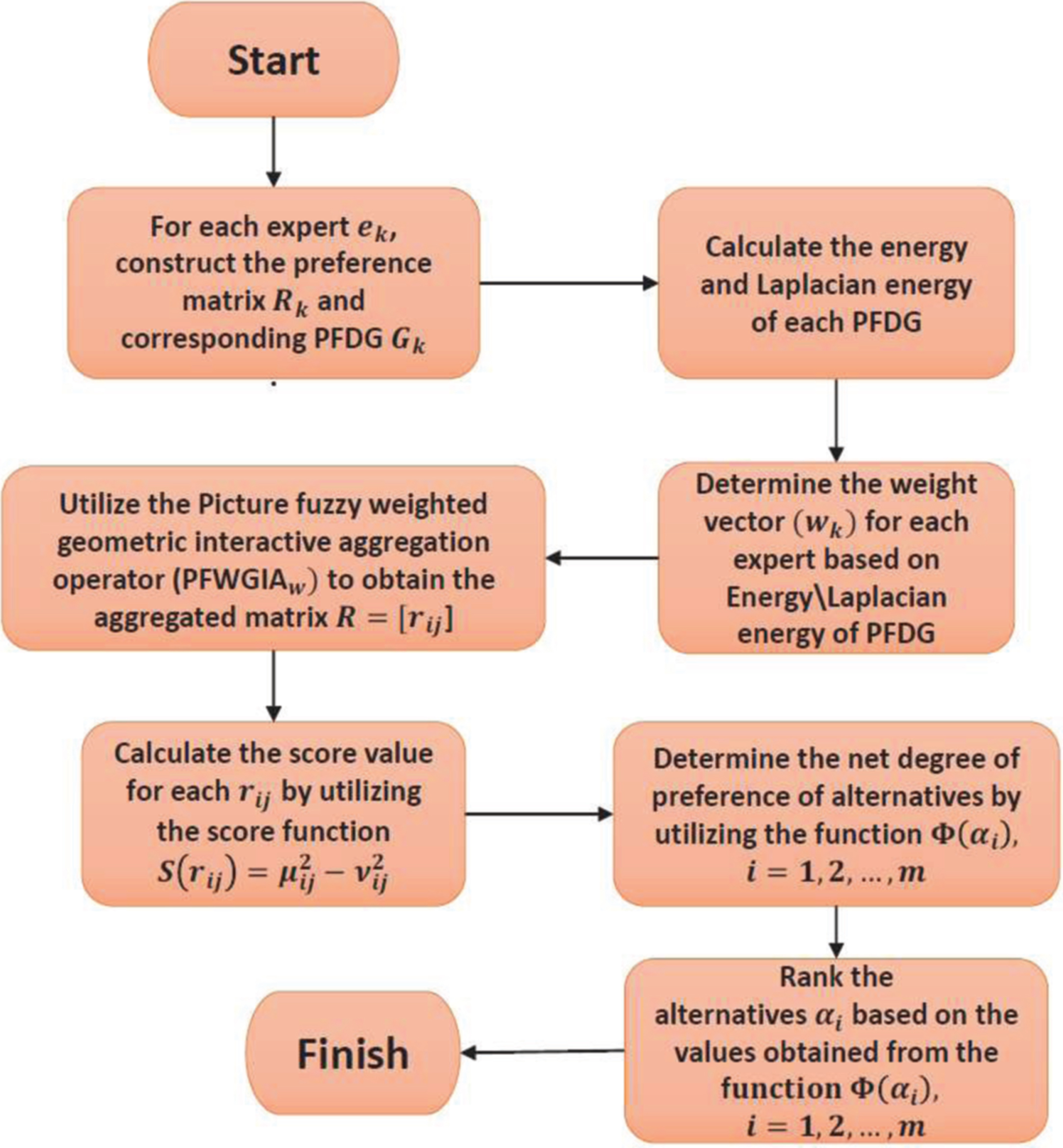
In view of the proposed energy/Laplacian energy of picture fuzzy directed graphs with preference relations, an algorithm for accomplishing the computing task of site selection along with a flow chart is being presented in Figure 4.
Flow chart of algorithm for alternatives selection process.
Working Methodology of Proposed Algorithm
Step 1: The experts compare the involved factors and present some initial inputs for the computing process in the shape of picture fuzzy preference relations, represented in the form of matrices .
Step 2: Consider a suitable picture fuzzy directed graph Gk corresponding to the PFPRs given by Rk (k = 1, 2, 3).
Step 3: Compute the energy of each picture fuzzy directed graph as per the definition of the energy of PFDG.
Step 4: The weight vector for each expert can be calculated by using
Step 5: In this step, we use picture fuzzy weighted average or picture fuzzy ordered weighted average or picture fuzzy hybrid average aggregation operator recently given by Garg [30]. In this way, we aggregate the three picture fuzzy preference relations R1, R2 and R3 given in step 1 into a single preference relation R.
Step 6: We compute the score values by utilizing the score function
and tabulate them in the form of a matrix S (R) = [rij].
Step 7: Next, we determine the net degree of preference of alternatives by utilizing the function φ (αi) given by Wang and Fan [14] as follows:
Step 8: On the basis of the highest value of the net degree, finally we choose the optimal alternative by ranking all the , i.e,
Hence, we conclude that the site α1 is the best site for the establishment of hydropower plant based on our proposed methodology and algorithm.
Important Comparative Remarks: For the sake of justification in connection with the proposed technique, we consider two examples of problems of site selection which have been solved recently by different researchers. Gundogdu et al. [46] proposed Picture Fuzzy Linear Assignment Method and Jovicic et al. [45] proposed Picture Fuzzy ARAS Method to solve the site selection problems.
In both the approaches, the decision matrix has been constructed by considering the available alternatives and the laid down criteria according to the respective needs.
In step 4, we can replace the concept of energy by the concept of Laplacian energy for the evaluation of weights. In this case, we will be using the following formula for the calculation of weights:
All the computations can similarly by performed for the evaluation process.
The difference is in the process of considering the vertices and edges where the vertices of the particular individuals and connecting edges would represent the mutual relationships and makes the situation easier to understand and interpret. The data of the problem under consideration fits for the picture fuzzy graph-theoretic approach.
The next advantage of our method over others are explained by following table:
The above table proved that our method is having few advantages over the research related to the site selection problem in literature.
Initially the alternatives and the criteria-based table have been designed with the help of experts. Utilizing Picture Fuzzy Weighted Averaging operator (PFWA), the individual decision matrix has been accumulated and the elements have been computed with the picture fuzzy score function. Further, the rank frequency of the positive valued matrix/weighted matrix π is calculated. After solving these two matrices the solutions are obtained. The weight vector is dependent on the expert view.
The linguistic criteria weight matrices are considered with the help of decision makers. The picture fuzzy evaluation matrices have been evaluated and normalized to determine the picture fuzzy decision matrix. Further, in this process the picture fuzzy weighted decision matrix is calculated. In the end, the author calculated the picture fuzzy optimality function which leads to the defuzzified value of the optimality function and ultimately the utility degree of each alternative is obtained (for ranking).
Laplacian Energy of Picture Fuzzy Graph
But in our case the data is collected only for the graph after the graph is made according to the various criteria. We calculated the weight vector of the graph which makes it more reliable. The mutual relationships among the criteria and alternatives have been translated with the concept of Laplacian energy for the evaluation of the necessary weights.
Comparative remarks, advantages and limitations of the proposed methodology
On the basis of the work proposed in the manuscript, we present some important comparative remarks & advantageous features behind the implementation of picture fuzzy graphs and their operations:
As mentioned earlier in the introduction, the incorporation of intuitionistic fuzzy sets and Pythagorean fuzzy sets has some limitations and not able to capture the full information specification of the situation. Therefore, the additional components of the degrees of membership, neutral membership, non-membership and degree of refusal in case of the picture fuzzy sets certainly provide a wider coverage and wider geometrical span.
In this way, we find that the proposed graphs & operations are sufficiently capable to address the connected dependance due to the incompleteness of the information having the refusal factor in a more reliable way.
The drawback in the existing literature of the intuitionistic fuzzy graphs and Pythagorean fuzzy graphs is that the condition does not allow the experts/decision makers to allocate the membership values of their own choice (Refer Table 1). Somehow, this makes the experts bounded for giving their input in a particular defined domain. However, the proposed picture fuzzy graphs provide a generalization feature which make a strong impact.
The weights are being evaluated using the energy and the Laplacian energy. This computation significantly plays a key role in the evaluation process. This is because the utility factors of the available alternatives are directly translated into the weights with the help of the energy.
Concerns Raised in IFSs and PyFSs
R
C1
C2
C3
C4
C1
(1.0 + 0.0 + 0.0 = 1)
(0.40 + 0.20 + 0.69 > 1)
(0.36 + 0.19 + 0.79 > 1)
(0.56 + 0.17 + 0.62 > 1)
C2
(0.68 + 0.20 + 0.44 > 1)
(1.0 + 0.0 + 0.0 > 1)
(0.40 + 0.24 + 0.56 > 1)
(0.51 + 0.29 + 0.61 > 1)
C3
(0.76 + 0.20 + 0.42 > 1)
(0.54 + 0.24 + 0.42 > 1)
(1.0 + 0.0 + 0.0 > 1)
(0.48 + 0.14 + 0.77 > 1)
C2
(0.49 + 0.17 + 0.68 > 1)
(0.59 + 0.29 + 0.53 > 1)
(0.77 + 0.17 + 0.38 > 1)
(1.0 + 0.0 + 0.0 > 1)
Conclusions & scope for future work
The Pythagorean fuzzy graph-theoretic model and concepts are however sufficient to discuss the issues related with uncertainty, impreciseness & inconsistency of the information, but the containment of the refusal degree can not be given due consideration without picture fuzzy graphs. We have successfully put forward the novel notion of energy and Laplacian energy for the picture fuzzy graph along with the necessary bounds on them. Through the proposed approach, we are certainly able to model accordingly and deal with the refusal component for providing a better geometrical span. The proposed concepts are well composed and clearly discussed with illustrative picture fuzzy graph examples. The implementation of the proposed algorithm has been presented by taking a hydropower plant site selection problem into account.
In future, the proposed deliberations can further be extended to obtain the Laplacian energy for spherical fuzzy graphs, interval-valued spherical fuzzy graphs, hesitant spherical fuzzy hyper graphs etc. with suitable comparative remarks. The concept of isomorphic graphs, planar graphs, dual graphs, regular graphs, etc., may also analogously defined and applied in various application fields of engineering design, system science, networking etc. Also, these definitions may be applicably enhanced to “hesitant picture fuzzy graph” and “picture fuzzy soft graph” for solving the problems related to the site selection and decision making processes.
Compliance with ethical standards
Conflict of interest: Authors declare that they have no conflict of interest.
Ethical approval: This article does not contain any studies with human participants or animals performed by any of the authors.
References
1.
ZadehL.A., Fuzzy sets, Information and Control8 (1965), 338–353.
2.
ZadehL.A., Similarity relations and fuzzy orderings, Information Science3 (1971), 177–200.
3.
KaufmannA., Introduction a la Theorie des Sour-Ensembles Flous, Masson et Cie, Paris, France, (1973).
4.
RosenfeldA., Fuzzy graphs, Fuzzy Sets and their Applications,
ZadehL.A.,
FuK.S.,
ShimuraM., Eds., Academic Press: New York, NY, USA, (1975), 77–95.
5.
GraovacA., GutmanI., TrinajsticN., Topological Aproach to the Chemistry of Conjugated Molecules, Springer, Berlin, (1977).
6.
GutmanI., The energy of a graph, Ber Math Statist Sekt Forschungsz Graz103 (1978), 1–22.
7.
GutmanI., PolanskyO.E., Mathematical Concepts in Organic Chemsitry, Springer, Berlin, (1986).
MordesonJ.N., PengC.H., Operations on fuzzy graphs, Information Sciences79 (1994), 159–170.
10.
SmarandacheF., A unifying field in logics, neutrosophy: neutrosophic probability, set and logics, American Research Press, Rehoboth, (1998).
11.
ParvathiR., KarunambigaiM.G., Intuitionistic fuzzy graphs, Computational Intelligence, Theory and Applications; Springer: Berlin, Germany, (2006), 139–150.
12.
BrualdiR.A., Energy of a graph, Notes to AIM Workshop on spectra of families of Matrices described by graphs, digraphs and sign patterns, (2006).
13.
GutmanI., The energy of a graph: Old and New Results, ed. by
BettenA.,
KohnertA.,
LaueR.,
WassermannA., Algebraic Combinatorics and Applications, Springer, Berlin, (2007), 196–211.
14.
WangY.M., FanZ.P., Fuzzy preference relations: Aggregation and weight determination, Computer and Industrial Engineering53(1) (2007), 163–172.
15.
LiuH., LuM., TianF., Some upper bounds for the energy of graphs, Journal of Mathematical Chemistry41(1) (2007).
16.
ParvathiR., KarunambigaiM.G., AtanassovK.T., Operations on intuitionistic fuzzy graphs, In: Proceedings of the IEEE International Conference on Fuzzy Systems, South Korea, (2009), 1396–1401.
NarayananA., MathewS., Energy of a fuzzy graph, Annals of Fuzzy Mathematics and informatics6(3) (2013), 455–465.
20.
AkramM., DudekW.A., Intuitionistic fuzzy hypergraphs with applications, Information Science218 (2013), 182–193.
21.
CuongB.C., Picture fuzzy sets first results. Part 1, in preprint of seminar on neuro-fuzzy systems with applications, Institute of Mathematics, Hanoi, May, (2013).
22.
YagerR.R., Pythagorean fuzzy subsets, In: Proceedings of Joint IFSA World Congress and NAFIPS Annual Meeting, Edmonton, Canada, (2013), 57–61.
23.
AkramM., AshrafA., SarwarM., Novel applications of intuitionistic fuzzy digraphs in decision support systems, The Scientific World Journal(2014) (2014), Article ID 904606.
24.
AlshehriN., AkramM., Intuitionistic fuzzy planar graphs, Discrete Dynamics in Nature and Society(2014), Article ID 397823.
25.
PrabaB., ChandrasekaranV.M., DeepaG., Energy of an intuitionistic fuzzy graph, Italian Journal of Pure and Applied Mathematics32 (2014), 431–444.
26.
MeenakshiS., LavanyaS., A survey on energy of graphs, Annals of Pure and Applied Mathematics8(2) (2014), 183–191.
27.
SamantaS., PalM., A new approach to social networks based on fuzzy graphs, Journal of Mass Communication and Journalism5 (2014), 078–099.
28.
SahooS., PalM., Different types of products on intuitionistic fuzzy graphs and degree, Pacific Science Review A: Natural Science and Engineering17(3) (2015), 87–96.
29.
AtanassovK.T., Geometrical interpretation of the elements of the intuitionistic fuzzy objects, Preprint IMMFAIS1–89, Sofia, 1989. Reprinted:Int J Bioautomation20(1) (2016), S27–S42.
30.
GargH., Some Picture Fuzzy Aggregation Operators and Their Applications to Multicriteria Decision-Making, Arabian Journal of Science and Engg42 (2017), 5275–5290.
31.
SridharaG., KannaR., Bounds On Energy And Laplacian Energy of Graphs, Journal of the Indonesian Mathematical Society23(2) (2017), 21–31.
32.
KarunambigaiM.G., AkramM., SivasankarS., PalanivelK., Clustering Algorithm for Intuitionistic fuzzy graphs, International Journal of Uncertainty, Fuzziness Knowledge-based Systems25(3) (2017), 367–383.
33.
SahooS., PalM., Intuitionistic fuzzy tolerance graphs with application, Jornal of Applied Mathematics and Computing55(1-2) (2017), 495–511.
34.
SarwarM., AkramM., Representation of graphs using m-polar fuzzy environment, Italian Journal of Pure and Applied Mathematics38 (2017), 291–312.
35.
ShahzadiS., AkramM., Graphs in an intuitionistic fuzzy soft environment, Axioms7(20) (2018), 1–16.
AkramM., NazS., Energy of Pythagorean fuzzy graphs with applications, Mathematics6 (2018), 136.
38.
KifayatU., KhanQ., JanN., Similarity Measures for T-Spherical Fuzzy Sets with Applications in Pattern Recognition, Symmetry10 (2018), 193.
39.
NazS., AshrafS., AkramM., A novel approach to decision-making with Pythagorean fuzzy information, Mathematics6 (2018), 1–28.
40.
ZuoC., PalA., DeyA., New Concepts of Picture Fuzzy Graphs with Application, Mathematics7(5) (2019), 470.
41.
DasS., GhoraiG., PalM., Certain competition graphs based on picture fuzzy environment with applications, Artificial Intelligence Review (2020), 1–31.
42.
DasS., GhoraiG., Analysis of the effect of medicines over bacteria based on competition graphs with picture fuzzy environment, Computational and Applied Mathematics39(3) (2020), 1–21.
43.
DasS., GhoraiG., Analysis of Road Map Design Based on Multigraph with Picture Fuzzy Information, International Journal of Applied and Computational Math.6 (2020), 57.
44.
PalM., SamantaS., GhoraiG., Modern Trends in Fuzzy Graph Theory, Springer, Singapore, 2020. doi: 10.1007/978-981-15-8803-7.
45.
AkramM., IlyasF., BorumandA., Saeid, Certain notions of Pythagorean fuzzy graphs, Journal of Intelligent & Fuzzy Systems36(6) (2019), 5857–5874.
46.
GanieA.H., SinghS., BhatiaP.K., Some new correlation coefficients of picture fuzzy sets with applications, Neural Computing and Applications (2020), 1–17.
47.
JovicicS., SimicV., PrusaP., DobrodolacM., Picture Fuzzy ARAS Method for Freight Distribution Concept Selection, Symmetry12(7) (2020), 1062.
48.
GundogduF.K., Picture Fuzzy Linear Assignment Method and Its Application to Selection of Pest House Location, In International Conference on Intelligent and Fuzzy Systems, Springer, Cham, 1197 (2020), 101–109.