



Abstract
With the aggravation of market competition, strategic supplier is becoming more and more critical for the success of manufacturing enterprises. Suppler selection, being the critical and foremost activity must ensure that selected suppliers are capable of supporting the long-term development of organizations. Hence, strategic supplier selection must be restructures considering the long-term relationships and prospects for sustainable cooperation. This paper proposes a novel multi-stage multi-attribute group decision making method under an interval-valued q-rung orthopair fuzzy linguistic set (IVq-ROFLS) environment considering the decision makers’ (DMs) psychological state in the group decision-making process. First, the initial comprehensive fuzzy evaluations of DMs are represented as IVq-ROFLS. Subsequently, two new operators are proposed for aggregating different stages and DMs’ preferences respectively by extending generalized weighted averaging (GWA) to IVq-ROFLS context. Later, a new hamming distance based linear programming method based on entropy measure and score function is introduced to evaluate the unknown criteria weights. Additionally, the Euclidean distance is employed to compute the gain and loss matrix, and objects are prioritized by extending the popular Prospect theory (PT) method to the IVq-ROFLS context. Finally, the practical use of the proposed decision framework is validated by using a strategic supplier selection problem, as well as the effectiveness and applicability of the framework are discussed by using comparative analysis with other methods.
Keywords
Introduction
With the rapid development of Industry 4.0, the manufacturing industry is undergoing a breakthrough transformation [1]. Manufacturing enterprises are faced with urgently needed to be addressed problems which are embodied in huge inventory pressure, non-sharing of information with suppliers and low production profits. More and more enterprises seek long-term cooperation in supplier networks to form a stable manufacturing industry alliance, which can reduce cost through scale effect, reduce inventory pressure and realize information exchange. Thus, strategic supplier selection is becoming a critical aspect of enterprises’ competitiveness [2]. Considering the requirement of long-term sustainable development between strategic suppliers and enterprises, the process of strategic supplier selection often goes through the comprehensive consideration of the sales, technical, financial, purchasing and other relevant departments. It can be considered as a process of generating deterministic group preference by utilizing different preferences for a set of attributes and DMs [3]. Hence, strategic supplier selection can be also regarded as an extension of the multi-attribute group decision making (MAGDM) problem.
In recent years, many scholars have done a lot of research on the MAGDM problem for supplier selection [4–8]. However, from the perspective of long-term cooperation of strategic suppliers, the comprehensive performances of suppliers in a multi-stage dimension are vital but rarely mentioned. Olanrewaju, Dong and Hu [9] studied a multi-stage stochastic programming model for supplier selection in disaster response. Xue, Fu, Feng, Lu, Chang and Yang [10] considered an evidential reasoning based multi-stage approach for evaluation of high-speed train supplier. Kaur and Prakash Singh [11] proposed a multi-stage hybrid model for supplier selection and order allocation problem. The above literature mainly considered the supplier selection problem with multi-stage single decision maker participation. Therefore, a novel multi-stage MAGDM structure for multi-stage evaluations and group decision making process respectively aggregated to select strategic supplier is proposed.
Since the judgments evaluated by DMs are subjective, vague and imprecise, uncertainty is an important challenging problem in strategic supplier selection problem [12]. To handle this concern, Zadeh [13] established the traditional fuzzy set (TFS) theory. Subsequently, various scholars extended the TFS into intuitionistic fuzzy set (IFS) [14], interval-valued intuitionistic fuzzy set (IVIFS) [15], Pythagorean fuzzy set (PFS) [16], interval-valued Pythagorean fuzzy set (IVPFS) [17] to describe the uncertain information in MAGDM problems. Recently, a novel fuzzy set called q-rung orthopair fuzzy set (q-ROFS) [18] was proposed which can provide a wider and more flexible space for preference elicitation than the above fuzzy sets [19]. The q-ROFS is redefined by Yager [18] by enlarging the scope which can be used to maximize the accuracy and integrity of fuzzy information, where the q ⩾ 1 in which qth power sum of membership degree (MD) and non-membership degree (NMD) is not bigger than one. Besides, IFS and PFS are the special cases of q-ROFS by setting q = 1 and q = 2 respectively. The difference of them can be seen in Fig. 1. Although q-ROFS is an effective tool for describing fuzzy and uncertain information, it cannot express evaluations qualitatively in strategic supplier selection. Considering this, linguistic term set (LTS) [20] can solve the problem of qualitative evaluations and it is regarded as one another effective way to express the ambiguity of DMs’ opinions. Hence, to better deal with qualitative evaluations and uncertainty, we combine LTS [21] and interval-valued q-rung orthopair fuzzy set (IVq-ROFS) [22] to a new fuzzy set called IVq-ROFLS. Based on IVq-ROFLS, the uncertainty of the preference information from DMs in strategic supplier selection process will be evaluated qualitatively well.
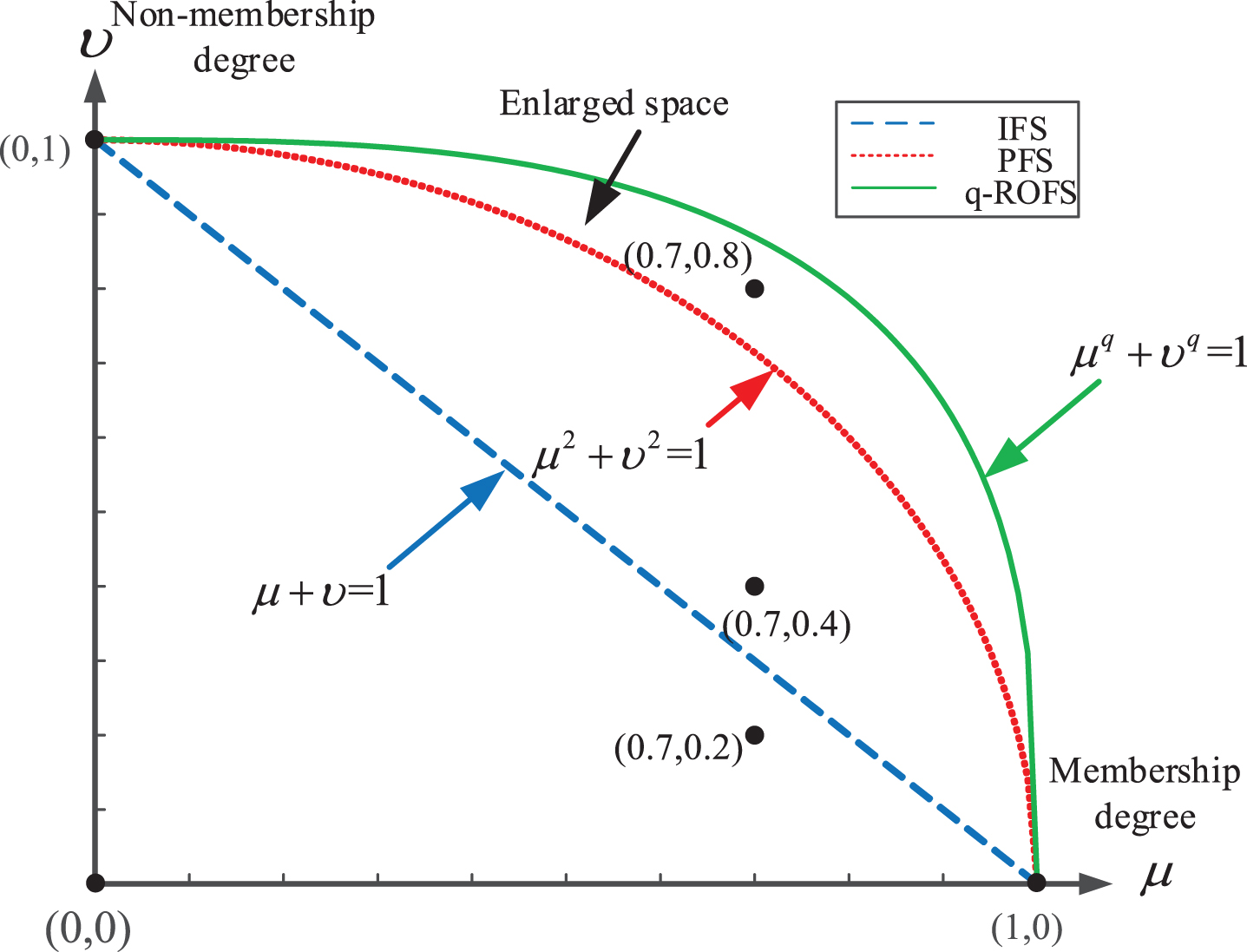
Space range of IFS, PFS and q-ROFS.
In MAGDM, the determination of the optimal attribute weights is the crucial part of the rank of alternatives. In the existing approaches, the acquisition methods of attribute weights are mainly carried out in the following two ways: one is the objective weights using objective decision information [23–25]; the other is the subjective weights considering the subjective preferences of DMs [26–28]. But only considering the objective or subjective weights may ignore the effect of the other one. Given this situation, the method of obtaining attribute weights considering both objective information and subjective preferences is being studied. Liang, Goh and Wang [29] proposed a minimum relative entropy based method to determine the attribute weights considering both objective information and subjective preferences. Ding, Liu and Shi [30] employed a parameter to combine subjective and objective weights. However, they were somewhat arbitrary in their determination of final weights. Here, we apply the hamming distance based linear programming method to propose a novel method to determine the optimal attribute weights considering both subjective preferences and objective information on score function and entropy method.
Most of the existing MAGDM methods assume that DMs are totally rational [30], but in realistic decision making process, DMs exercise limited rationality under the risk which comes from the interaction of one person with others and is hard to avoid [31]. In consideration of this situation, the prospect theory (PT), proposed by Kahneman and Tversky [32] and developed by Tversky and Kahneman [33], is a decision theory that can accurately capture the risk characteristics, psychological behaviors and reference dependence of DMs. It is stated in PT that DMs select the alternatives with the highest prospect value under an assumed risky condition. The gain or loss of each prospect value is an outcome compared with a reference point. The DMs are risk aversion towards gains and risk seeking towards losses [34]. In addition, PT employs a value function and a probability weighting function to convert objective values to subjective ones and probabilities to decision weights respectively [35]. Xu, Huang and Li [36] proposed a PT based direct consensus framework to solve heterogeneous group decision making problem. Wu, Li and Dong [37] studied a PT based method for matching the technology suppliers and demanders. Cheng, Long and Chen [38] employed PT in the research of government policy making. Ding, Liu and Shi [30] applied PT to handle emergency decision making problem. Herrmann, Jong-A-Pin and Schoonbeek [39] incorporated PT in a game-theoretic model to predict voter turnout. Wan, Zou and Dong [40] conducted a research on hybrid fuzzy truth degrees of comparisons by PT. Surti, Celani and Gajpal [41] used PT to carry on newsvendor ordering behavior research. In general, strategic supplier selection entails risk, faced with risk the behavior of DMs conforms to prospect theory: the preferences rely on reference information and exhibit loss aversion, and probabilities are subjectively weighted. Thus, the ranking results can be more reasonable after applying the prospect theory to strategic supplier selection problem.
Therefore, this paper proposes a novel multi-stage multi-attribute group decision making method to select the strategic supplier with a long-term relationship. First, the IVq-ROFLS is used by DMs to qualitatively express the evaluation information of various attributes of potential strategic suppliers. Second, two aggregation operators called GIVq-ROFLWA and IVq-ROFLWA are used to aggregate the IVq-ROFLS evaluations of different periods and DMs respectively. Third, the optimal weights of attributes are calculated by a hamming distance based linear programming method incorporating objective information and subjective preferences of DMs on score function and entropy method. Finally, the Euclidean distance is employed to compute the gain and loss matrix and the prospect theory is used to find out the strategic supplier. Additionally, the case of an enterprise operating in machinery industry is adopted to verify the effectiveness and applicability of the proposed method.
The rest of this paper is structured as follows: In Section 2, the concepts of IVq-ROFLS, hamming distance based linear programming method (HDLP) and Prospect theory are reviewed briefly. In Section 3, the IVq-ROFLS-HDLP-PT approach is presented to solving strategic supplier selection problem. An illustrative case analysis and a comparison analysis are presented in Section 4. Finally, conclusions and future work are drawn in Section 5.
This section presents some basic notions associated with q-ROFS, linear programming method and Prospect Theory.
IFS, PFS and q-ROFS
Her μ I (x) ∈ [01] and υ I (x) ∈ [01] denote a membership degree and a non-membership degree of x ∈ X to the set I, respectively, satisfying the condition 0 ⩽ μ I (x) + υ I (x) ⩽1 for all x ∈ X.
Her μ
P
(x) ∈ [01] and υ
P
(x) ∈ [01] denote a membership degree and a non-membership degree of x ∈ X to the set P, respectively, satisfying the condition
But in some real-world decision-making process, the sum or the square sum of membership degree and non-membership degree may be bigger than 1. Based on this situation, the q-ROFS [18] is proposed to solve this problem.
Here μ
Q
(x) ∈ [01] and υ
Q
(x) ∈ [01] indicate the membership degree and the non-membership degree of x ∈ X to the set Q, respectively, for all x ∈ X, it satisfies the condition
The set is ordered, if i > j, then s
i
> s
j
. neg (s
i
) = s
j
, where i + j = t + 1.
Besides, a continuous linguistic term set
Where
In addition, the indeterminacy degree of the element x ∈ X to
Let
Then, an interval-valued q-rung orthopair fuzzy linguistic weighted averaging (IVq-ROFLWA) operator [46] and a generalized interval-valued q-rung orthopair fuzzy linguistic weighted averaging (GIVq-ROFLWA) operator [46] are used to aggregate the linguistic evaluations expressed by IVq-ROLFS.
Where w = (w1, w2, . . . , w
n
)
T
is the weight vector of
Where n represents the number of decision variables and m represents the number of constraints. The linear programming technology aims at getting the optimal solution for the goal function ϖ.
Prospect theory [32] is often used to reflect decision-makers’ subjective risk preference on the basis of limited rationality. Based on PT, a decision-making process is divided into two stages: the editing stage and the evaluation stage. In the editing stage, decision maker sets a reference point and then the outcomes of alternatives are coded as gains and losses relative to the reference point. In the evaluation stage, the edited prospects are evaluated by a value function and a weighting function, then the prospect of highest value is selected.
Suppose x0 is the reference point and x
j
is the existing prospect value, and then Δx
j
= x
j
- x0 is the deviation degree between x0 and x
j
, Δx
j
> 0 means existing prospect value can get gains, otherwise it means losses. Then the value function V (Δx
j
) is computed as follows [33]:
Where α and β reflect the concave-convex degree parameter related to the gains and losses. 0 ⩽ α, β ⩽ 1, the greater the value α and β are, the more tendentious the decision maker is to the risk. η is loss-aware parameter, η > 1 means that decision maker is more sensitive to the losses than to the absolutely commensurate gains. Based on the previous experiments, the recommended values for α, β and η are 0.88, 0.88 and 2.25 [33].
The probability weighting function π (w
j
) is expressed as follows:
Where ɛ and δ reflects the different attitude of DMs towards the risk of gains and losses. The values of ɛ and δ were 0.61 and 0.72 [32].
Through the value function V (Δx
j
) and the probability weighting function π (w
j
), we can calculate the prospect value by the following formula:
In this section, a novel multi-stage multi-attribute group decision making approach is developed for selecting strategic supplier. Let K ={ k1, k2, . . . , k
m
} be a set of alternative strategic suppliers, C ={ c1, c2, . . . , c
n
} be a predefined set of attributes. T ={ t1, t2, . . . , t
l
} is a set of periods and the weight vector of these periods is denoted as w
T
= (w
t
1
, w
t
2
, . . . , w
t
l
)
T
, where

Flowchart of the proposed approach for strategic supplier selection problem.
Where, if this criterion is a benefit criterion (such as profit, quality.etc.), we take the upper standardized formula; if this criterion is a cost criterion (such as delivery time.etc.), we take the below standardized formula.
Where
The entropy method [49] calculates weights based on the information of each attribute. Based on the Chen [50], the steps of entropy method are as follows:
Where
Where w S j is the objective weight of the jth attribute based on the score matrix.
Suppose
Where,
Where
Where V+ (x ij ) and V- (x ij ) are positive and negative prospect value matrices, respectively.
Where, w j is the weight of the jth attribute obtained by linear programming method.
In this section, an example of strategic supplier selection for a mechanical enterprise is used to analyze the efficiency and applicability of the proposed method by comparing with other existing methods.
The preparation process
This section shows the application of the proposed framework on the strategic supplier selection of a machinery manufacturing enterprise in China. Due to the various accessories of the production of bucket elevator and the rising cost of labor and land, the enterprise is facing huge inventory and economic pressure. Therefore, the enterprise urgently needs a long-term strategic supplier to construct manufacturing strategic alliance to relieve inventory pressure and improve profits. Through the selection of the cooperated enterprises, there are four enterprises that have the potential to become the strategic supplier and the proposed method is employed to select the best one as a strategic supplier. In order to protect the confidential information of the enterprise and its potential strategic suppliers, some irrelevant information is not be presented. A set K ={ k1, k2, k3, k4 } is used to refer the four potential strategic suppliers. In addition, a decision committee consisting of five DMs from the enterprise and represented by a set D ={ d1, d2, d3, d4, d5 }, they are a mechanical engineer, a sales manager, a financial executive, a human resources supervisor and an experienced front-line employee, respectively. Meanwhile, the weights of the DMs are shown below: w d s ={ 0.25, 0.15, 0.20, 0.30, 0.10 }. Let T ={ t1, t2, t3 } is set of periods, t1 represents the last one year, t2 represents the current year and t3 represents the coming year. Meanwhile, the weights of the periods are shown below: w t k ={ 0.30, 0.45, 0.25 }. According to the previous researches [53, 54] and the actual needs of the enterprise itself, six main attributes are listed in the Fig. 3 The integrated prospect values of different periods.
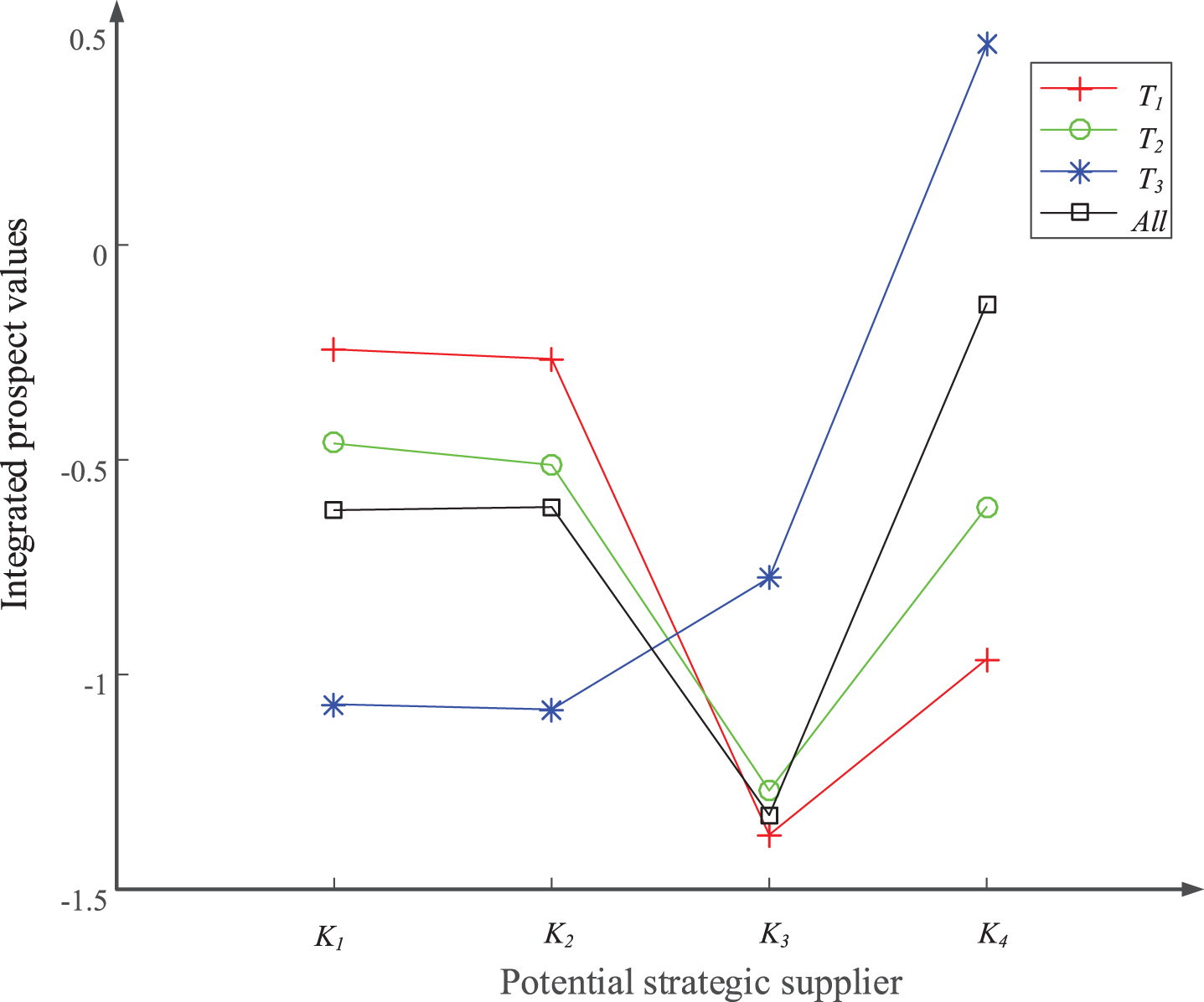
The integrated prospect values of different periods.
Table 1. As the need of the enterprise is to select a long-time strategic supplier, the stability of the supplier C4 is an absolutely necessary attribute. C 2 is a qualitative attribute and depends on the supplier’s stability and continuity. Based on the Planning, the enterprise is inclined to select the more deeply cooperative suppliers. Hence, the degree of cooperation C5 is an indispensable attribute.
The attributes and definitions for strategic supplier selection
Where C1 and C3 are cost attributes, the others are benefit attributes.
The linguistic term set is given as S={s_1=extremely poor, s_2=very poor, s_3=poor, s_4=medium, s_5=good, s_6=very good, s_7=extremely good.}
By employing Equation (16), the standardized IVq-ROFLS evaluations of three periods are aggregated into a new decision matrix
The interval-valued numbers decision matrix
The interval-valued numbers decision matrix
The PIS and NIS of each attribute
All the DMs give their evaluations about the importance of attributes by the form
Through employing Equations (20)–(23), the object weights w S are determined, where w S = (0.05, 0.35, 0.02, 0.13, 0.25, 0.21). By employing Equations (24)–(26), the subjective weights w H are determined, where w H = (0.16, 0.14, 0.09, 0.27, 0.18, 0.16) Then by Equation (27), we can get the range of the weight of each attribute that 0.05 ⩽ w1 ⩽ 0.35, 0.14 ⩽ w2 ⩽ 0.35, 0.14 ⩽ w3 ⩽ 0.35, 0.13 ⩽ w4 ⩽ 0.27, 0.18 ⩽ w5 ⩽ 0.25 and 0.16 ⩽ w6 ⩽ 0.21.
Then the linear programming model is built through Equation (28) and shown as follows:
After solving this linear programming model, the final attribute weights are w = (0.05, 0.35, 0.02, 0.17, 0.25, 0.16).
Firstly, gain matrix G = [g ij ] 4 ×6 and loss matrix L = [l ij ] 4 ×6 are calculated by Equation (29) and shown in Table 4, respectively. Then, compute positive and negative prospect value matrix by Equation (30), and the results are shown in Table 5. The values of probability weighting function for gains and losses are calculated by Equation (31) as π+ (w) =(0.132, 0.345, 0.081, 0.241, 0.291, 0.234) and π- (w) = (0.104, 0.363, 0.056, 0.229, 0.292, 0.220). Then, through Equation (32), the integrated prospect values of the four strategic suppliers are calculated as: V K 1 = -0.617, V K 2 = -0.610, V K 3 = -1.327 and V K 4 = - 0 . 136. Therefore, the ranking of the potential strategic suppliers is K4 ≻ K2 ≻ K1 ≻ K3. The K1 is the most appropriate strategic supplier.
The gain and loss matrix
The positive and negative prospect value matrix
Comparison of periods
A comparative analysis is conducted to investigate the necessity of considering the comprehensive information of all periods in the selection of strategic supplier. The integrated prospect values of T1, T2, T3 and all of them are shown in Fig. 3.
It can be seen from Fig. 3 that the rank of suppliers is completely different. If we only take consider of T1, the supplier K1 is the best solution. If we only obtain the information of T2, the supplier K1 becomes the strategic supplier. If we only obtain the information of T3, the supplier K4 becomes the best supplier. However, if we take all periods into consideration, the supplier K4 turns out to be the optimal solution. And the final result is also corresponding to the situation of each supplier. K1 is one of the earliest suppliers to cooperate with the enterprise. But the enterprise comes to a standstill this year due to financial problems, and its integrated prospect value decline over time. Therefore, it would be a bad decision to choose K1. K4 is a new coadjutant supplier, but it has recently made a breakthrough in technology and its quoted price is quite attractive. Therefore, based on the joint analysis of all periods, K4 is selected as the strategic supplier. In addition, when each period is considered separately, the integrated prospect value curve fluctuates greatly. On the contrary, the integrated prospect value becomes stable after the aggregation of each period. Therefore, aggregating all periods avoids the extreme option.
Based on the comparison of periods, the necessity of aggregating all periods is proved and the applicability and effectiveness of the proposed method are also verified at the same time.
Compare with other methods
In order to further verify the applicability and effectiveness of the proposed method, three comparison methods are implemented to handle the decision making problem, i.e., TOPSIS, the VIKOR and TODIM [55]. In addition, to measure the differences between the proposed method and the above three methods, Spearman’s rank-correlation test [56] is employed to ascertain whether there is significant rank-correlation between two sets of values. The comparative results and the Spearman’s rank-correlation tests are shown in Table 6. Then, the distinct ranking results are displayed in Fig. 4.
Ranking results and differences of the four methods
Ranking results and differences of the four methods
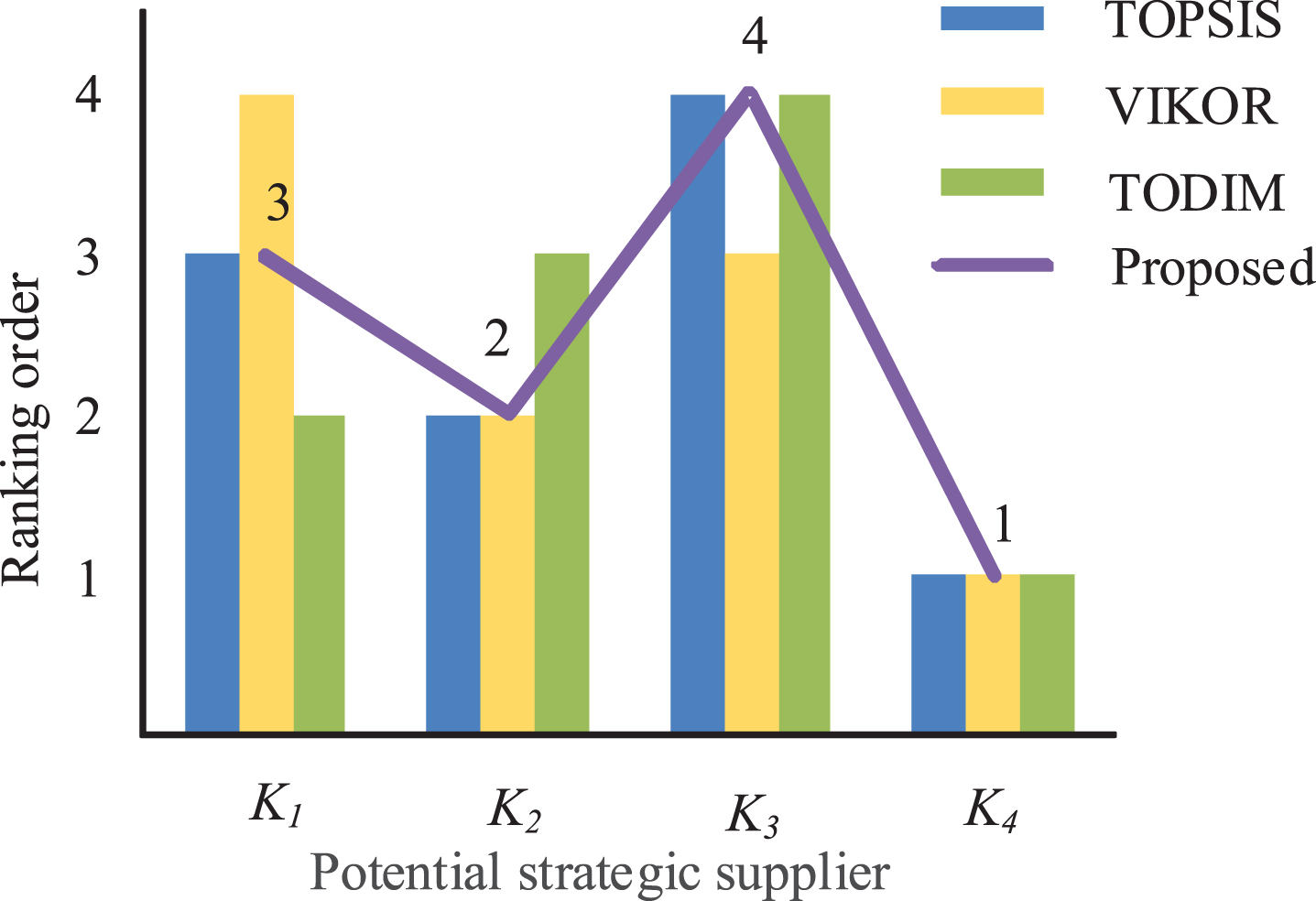
Ranking results with different methods.
With reference to the research conducted by Parkan and Wu [56], the range of r s is –1 to 1. The closer the value of r s is to the boundary of the range, the stronger the correlation between two ranking orders. If the test value Z ⩾ 1.625, it means that there is evidence of a positive relation between two ranking orders. Otherwise, it is considered that the two ranking orders are dissimilar. The Spearman’s rank-correlation coefficient of the method I and the method II is the upper boundary of 1, and the test value is 1.73≥1.625. Therefore, there is a significant positive relation between two ranking orders. However, the test values of the method III and the method IV by the method are lower than 1.625. Therefore, these two ranking orders are considered to be dissimilar, respectively. It can be seen from Table 6 that the best solution determined by the four methods are the same, which is K4. The results make a difference in the rest options. People do not like to take risks when it comes to profits, so K3 is the worst option for risk aversion. K2 is ought to be better than K1, because people tend to get a steady rather than a risky profit. Therefore, the proposed method is more practical.
By comparing with other methods, the advantages of the IVq-ROFLS-HDLP-PT approach can be summarized as follows: (1) By IVq-ROFLS, the proposed approach can better represent the fuzziness and uncertainty of evaluation information given by DMs. This is particularly useful for the strategic supplier selection problems characterized by multi-stage, comprehensive information and limited expertise. (2) Based on HDLP method, the optimal criteria weights can be obtained by considering both subjective and objective weights of evaluation criteria, which makes the proposed method more practical. (3) By applying the Euclidean distance to the prospect theory, the process of select the strategic supplier is simplified. Besides, the proposed method considers the psychological behaviors of DMs. Hence, the proposed method can get a more accurate ranking in the strategic supplier selection.
Considering the current actual situation and previous research, a new supplier selection method for selecting strategic supplier has been developed in this paper. The proposed method makes the following contributions to strategic supplier selection problem:
We take the strategic supplier selection problem as a special multi-stage multi-attribute group decision making problem and express all the evaluation information in the form of IVq-ROFLS in order to adopt a flexible, generalized preference style to minimize subjective randomness and describe the uncertainty.
The GIVq-ROFLWA operator and the IVq-ROFLWA operator are used to aggregate the evaluation information of different periods and DMs separately.
To comprehensively and optimally consider the weights of attributes, the Hamming distance based linear programming method is employed to get the optimal weights under the range of the subjective and objective weights of attributes based on score function and entropy method.
The proposed method based on prospect theory can reflect risk attitude with consideration of the bounded rationality of DMs, because it combines different attitudes toward gain and loss. This makes the ranking order more persuasive than some other methods.
The multi-stage evaluations are given independently in this paper. Nevertheless, in the realistic situation, there is a certain degree of coupling between multi-stage evaluations. Accordingly, the one main future research direction is to further enhance the coupling between multi-stage evaluations.
Footnotes
Acknowledgments
This research was supported by the National Natural Science Foundation of China under Project (No. 51705386); China Scholarship Council (No. 201606955091); Fundamental Research Funds for the Central Universities, China (No. 2018-IVB-010).