Yager introduced the Pythagorean Fuzzy Set (PFS) to deal with uncertainty in real-world decision-making problems. Binary relations play an important role in mathematics as well as in information sciences. Soft binary relations give us a parameterized collection of binary relations. In this paper, lower and upper approximations of PFSs based on Soft binary relations are given with respect to the aftersets and with respect to the foresets. Further, two kinds of Pythagorean Fuzzy Topologies induced by Soft reflexive relations are investigated and an accuracy measure of a PFS is provided. Besides, based on the score function and these approximations of PFSs, an algorithm is constructed for ranking and selection of the decision-making alternatives. Although many MCDM (multiple criteria decision making) methods for PFSs have been proposed in previous studies, some of those cannot solve when a person is encountered with a two-sided matching MCDM problem. The proposed method is new in the literature. This newly proposed model solved the problem more accurately. The proposed method focuses on selecting and ranking from a set of feasible alternatives depending on the two-sided matching of attributes and determines a ranking based solution for a problem with conflicting criteria to help the decision-maker in reaching a final course of action.
Soft set (SS), Fuzzy set (FS), and Rough set (RS) are significant methods to study the incompleteness and uncertainty in the information system. They have their own properties and superiorities, and they do have applications in artificial intelligence, real-life problems, and computer science.
In the natural sciences, and social sciences, there exist numerous fuzzy concepts. Zadeh [28] initiated the idea of a Fuzzy set (FS) in 1965, in which he portrayed fuzziness with proper mathematical language. FS provides an amazing technique to process fuzzy and uncertain information since it can explain the same indefinite but inaccurate meaning. Moreover, due to its structured and formulated mathematical methods, it empowered humanity to handle the data and information with uncertain borders. This theory rightly conforms to the way of humanity’s cognition. In [30], Zhang et al. proposed an approach to two-sided matching decision making with Fuzzy preference relation based on the logarithmic least squares method and devised two algorithms. In [31, 32], Zhang et al. proposed approaches to deal with two-sided matching with multi-granular hesitant fuzzy linguistic term sets and consensus reaching for social network group decision-making.
The idea of a Soft set (SS) was given by Molodstove [18] which was different from other concepts due to the parameterization technique. SS can easily handle vague and uncertain concepts. It has a wide range of applications such as Riemann Integration, operational research, game theory, probability theory, and measure theory. Maji et al. [17] gave various operations of SS, which improved the theoretical study of SS. Ali et al. [2] improved the operations of SS defined in [17] and proved De-Morgan’s laws in SS. Maji et al. [15] combined the structure of SS and FS and presented the concept of a Fuzzy Soft set (FSS). Feng et al. [10] presented an approach to deal with a decision-making problem based on FSS. Feng et al. [11] combined SS with FS and RS and defined soft approximation space. Feng et al. [8] applied Soft relations to semigroups. Ali and Shabir [4] defined logic connectives for SSs and FSSs. In another manuscript, Ali and Shabir [3] presented an improvement of some operations of FSS defined in [15].
Pawlak [22] proposed the idea of a Rough set (RS), which can be viewed as another mathematical approach to deal with vagueness and uncertainty. The basic assumption made in RS is that each object of the universe of discourse has some information, data, and knowledge associated with it. For instance, if objects are citizens of Pakistan, then National Identity Cards structure an information system about citizens. According to the available information, objects are classified as indiscernible based on the similarity between them. The indiscernibility relation is the mathematical foundation of the Rough set theory. Similarity relation constitutes the equivalence classes. Each class is referred to as a concept in the knowledge base. Each concept is presented by a pair of concepts called upper and lower approximations. It has engaged many researchers of different aspects including artificial intelligence, and cognitive sciences, specifically research areas, for instance, intelligent systems, machine learning, pattern recognition, inductive reasoning, mereology, expert systems, decision analysis, and knowledge discovery. RS has leverage that it does not require any additional information about data during data analysis like those of Probability in Statistics, membership degree in FS. The combination of RSs and FSs have made it easy to describe attribute set with RS. Dubois and Prade [7] combined the concepts of RSs and FSs based on Pawlak approximation space. Ali [1] defined approximation space associated with SS. Kanwal and Shabir [13] provided the approximations of a FS in semigroups based on Soft relations.
In decision-making problems, different experts produce different evaluation results. Besides the membership degree in FS, the non-membership degree is also needed in many real-life situations. To this end, Atanassov [5] set forward the idea of an Intuitionistic Fuzzy set (IFS). In an IFS, the relationship between AY (u) (membership degree) and AN (u) (non-membership degree) of an element u in universal set U is AY (u) + AN (u) ≤1. Due to its novelty, numerous researchers have worked on IFS Theory. Feng et al. [9] introduced the Intuitionistic Fuzzy Soft set (IFSS) and considered many operations on it. Khatibi and Montazer [14] gave an application of an IFS in pattern recognition.
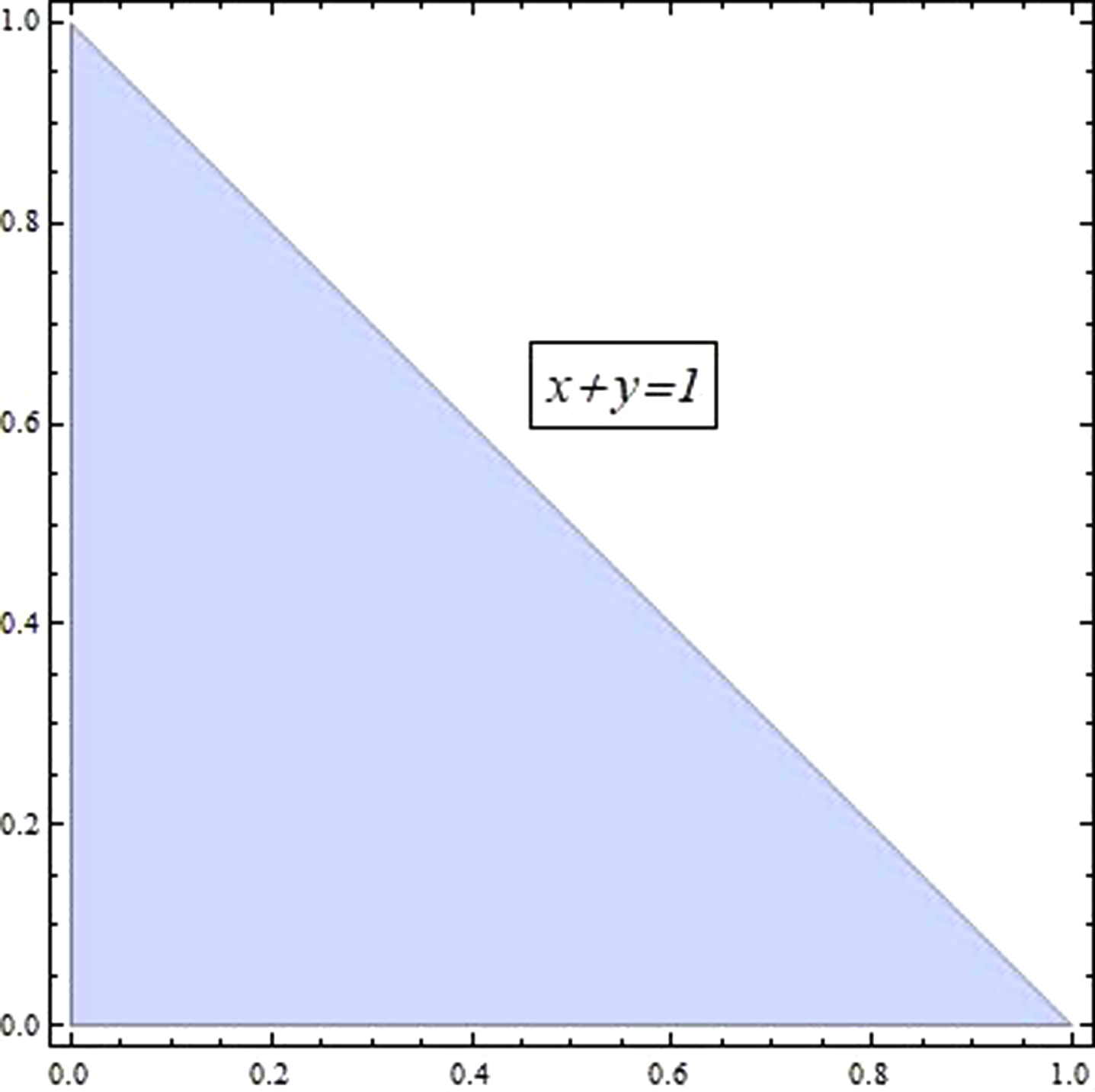
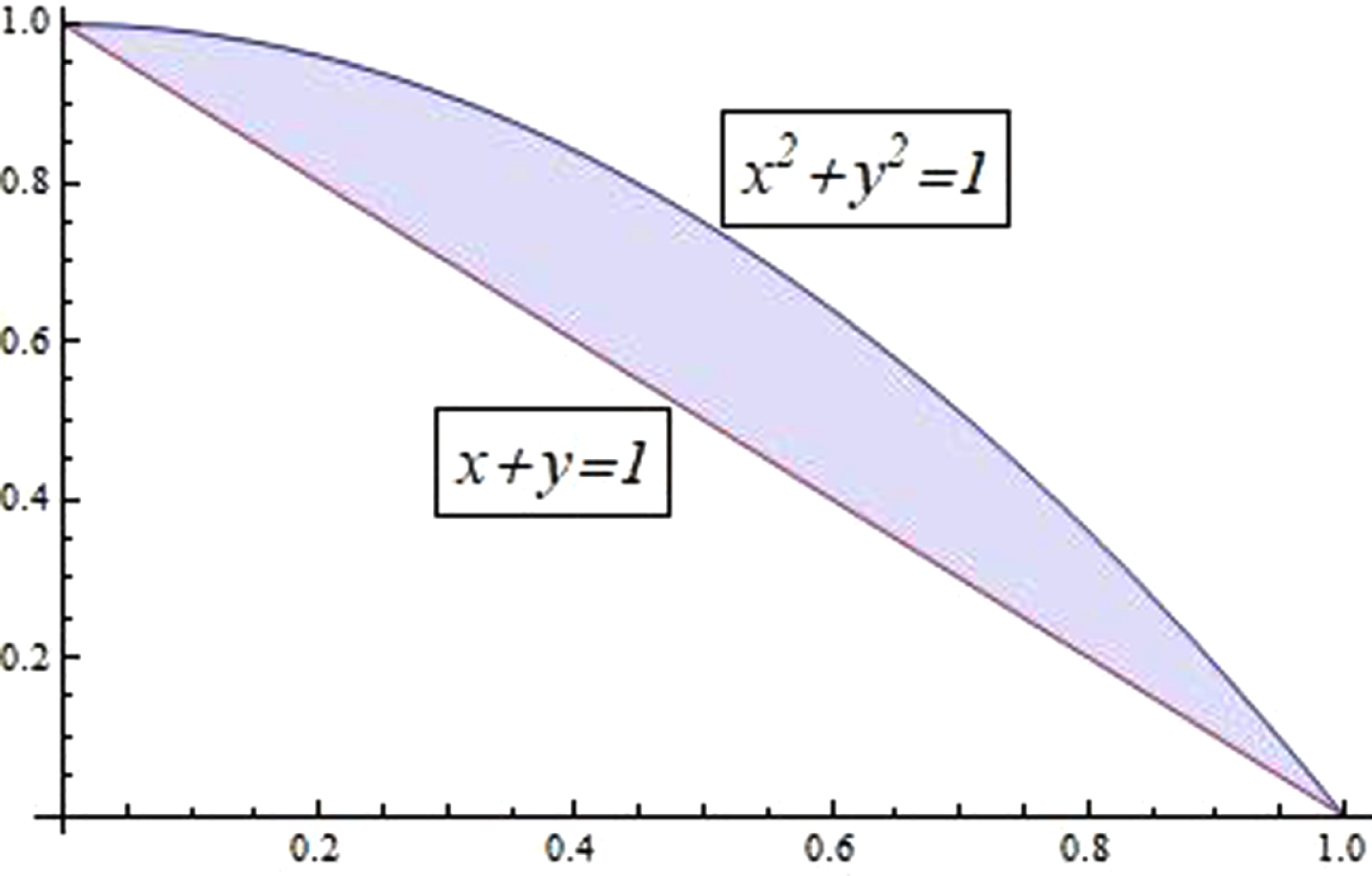
However, since the relation AY (u) + AN (u) ≤1 is satisfied by all the points below or on the line x + y = 1 in the first quadrant so, IFS cannot handle the situation when AY (u) + AN (u) >1, provided AY (u) , AN (u) ∈ [0, 1]. This restriction confines the selection of AY (u) and AN (u) to form a triangular region as shown in Figure 1. To tackle this, Yager [27] initiated the idea of the Pythagorean Fuzzy set in which AY (u) (membership degree) and AN (u) (non-membership degree) satisfy the relation . Clearly, this relation describes the unit quarter circle in the first quadrant as shown in Figure 2. Thus, we have got a wide range of membership and non-membership degrees. So, one can describe the uncertainty associated with membership and non-membership degrees in a better way than in the case of IFS, as PFS covers more points that were not covered by IFS as shown in Figure 3.
So far, many researchers have accomplished numerous work in PFS Theory and many applications showed up in different fields. Peng et al. [23] presented the idea of a Pythagorean Fuzzy Soft set (PFSS), basic operations, and provided its application in decision-making. Zhang and Xu [29] presented an extension of TOPSIS to multiple criteria decision-making using a PFS. Hussain et al. [12] gave the idea of Pythagorean Fuzzy Soft Rough sets and talked about their applications in decision-making. Olgun et al. [21] presented the idea of Pythagorean Fuzzy Topological Spaces (PFTS). They defined Pythagorean Fuzzy Continuity between two PFTSs. Wang and Li [26] proposed Pythagorean Fuzzy interaction power Bonferroni mean operator, weighted Pythagorean fuzzy interaction PBM operator, analyzed their properties and special cases of these operators. In another manuscript [25], Wang et al. proposed various interactive Hamacher power aggregation operators for Pythagorean Fuzzy Numbers (PFNs).
Following the pioneering idea of Yager [27], in this paper we extend the idea presented by Kanwal and Shabir [13] and Hussain et al. [12] to the setting of PFS, using soft binary relations on dual universes. A Soft binary relation is a parameterized family of binary relations on a universe. It is a generalization of ordinary binary relations on a set. In RS theory, rough approximations just address single binary relations. In any case, rough approximations in the sense of soft binary relations can deal with different binary relations. Pawlak’s rough set theory can be seen as an uncommon instance of Soft Rough sets with respect to soft binary relations. Paper is organized as:
In Section 2, we discuss some fundamental concepts of RSs, PFSs, and PFSSs. In Section 3, we present lower and upper approximations of PFSs using soft binary relations with respect to foresets and aftersets and prove their properties. In Section 4, we introduce two kinds of Pythagorean Fuzzy Topological Spaces induced by soft binary relations. In Section 5, we introduce similarity relations between PFSs based on soft binary relations. In Section 6, we introduce the degree of roughness and the degree of accuracy for Pythagorean membership degrees with respect to foresets and aftersets. In Section 7, we present an algorithm to solve the decision-making problem using PFSs. Further, we give an illustrative example of the proposed method and show how the proposed approach works in a decision-making problem. In Section 8, we summarize the resulted outcomes of the paper with the future direction of research.
Preliminaries
In this section, basic notions of Binary relations, Rough set, Fuzzy Soft set, Pythagorean Fuzzy set, and Pythagorean Fuzzy Soft set are given.
U and W are two non-empty finite sets throughout the discussion unless otherwise stated.
Definition 2.1. A binary relation R from U to W is a subset of U × W and a subset of U × U is called a binary relation on U.
If R is a binary relation on U then,
1)R is reflexive if (x, x) ∈ R; for all x ∈ U
2)R is symmetric if (x, y) ∈ R implies (y, x) ∈ R; for all x, y ∈ U
3)R is transitive if (x, y) , (y, z) ∈ R implies (x, z) ∈ R; for all x, y, z ∈ U.
If R satisfies the above three conditions, then it is called an equivalence relation.
If U is a non-empty finite universe and R is an equivalence relation on U, then (U, R) is said to be an approximation space. If V ⊆ U consists of the union of some of the equivalence classes of U, then V is definable, [22]. If V is not definable, then we can approximate it by two definable subsets called upper approximation and lower approximation of V as; and . A Rough set (RS) is a pair . Boundary region is represented by the set . Clearly, if , then V is definable and .
Yager [27] proposed the concept of the Pythagorean Fuzzy set which enlarges the range of membership functions due to its condition of the sum of the square of membership and non-membership degrees less than or equal to 1.
Definition 2.2. [27] Let U be a non-empty universe. A Pythagorean Fuzzy set (PFS) A in the universe U is a set having the form
where AY : U → [0, 1], AN : U → [0, 1] and , for all u ∈ U, where r : U → [0, 1]. The value AY (u) is called the degree of membership of u, the value AN (u) is called the degree of non-membership of u, and the value r (u) is called the strength of commitment at point u ∈ U. The pair (AY (u) , AN (u)), for any u ∈ U, is called a Pythagorean Fuzzy Number (PFN).
Definition 2.3. [27] Let (r (u) , θ (u)) be the polar coordinates of Pythagorean Fuzzy Number (AY (u) , AN (u)) such that
for u ∈ U. Then the function d : U → [0, 1] defined by is the direction of commitment at u.
If , then AY (u) =0, AN (u) = r (u) which means d (u) =0 and if θ (u) =0, then AY (u) = r (u), AN (u) =0 and the direction d (u) =1.
It is easy to check that PFS generalizes both IFS and FS. In decision-making problems, the PFS gives a large membership space than the IFS. Thus, a PFS has a higher capability than an IFS to model vagueness in real-life decision-making problems.
Here, is called indeterminacy of an object u ∈ U.
The collection of all Pythagorean Fuzzy subsets in U is represented by PFS(U).
Consider A = {(u, AY (u) , AN (u)) : u ∈ U} and B = {(u, BY (u) , BN (u)) : u ∈ U} be two PFSs in U, then the basic operations on PFS(U) defined by Yager [27] are as follows:
i)A ∪ B = {(u, AY (u) ∨ BY (u) , AN (u) ∧ BN (u)) : u ∈ U}
ii)A ∩ B = {(u, AY (u) ∧ BY (u) , AY (u) ∨ BN (u)) : u ∈ U}
iii)A ⊆ B if and only if AY (u) ≤ BY (u) and AN (u) ≥ BN (u), for all u ∈ U
iv)A = B if and only if AY (u) = BY (u) and AN (u) = BN (u), for all u ∈ U
v)Ac = {(u, AN (u) , AY (u)) : u ∈ U}.
The PFS 1U = (1, 0) and PFS 0U = (0, 1), where 1 (u) =1 and 0 (u) =0, for all u ∈ U.
In [27], Yager defined a score function to compare two PFNs and rank them according to score of the PFNs.
Definition 2.4. Let (AY (u) , AN (u)) be a PFN, for u ∈ U. Yager [27] defined the score function f of a PFN as follows:
where and .
Definition 2.5. [27] Let A (u) , B (u) for u ∈ U be two Pythagorean Fuzzy Numbers, f (rA (u) , θA (u)) and f (rB (u) , θB (u)) be the scores of A (u) and B (u) respectively. Then
i)A < B if f (rA (u) , θA (u)) < f (rB (u) , θB (u))
ii)A > B if f (rA (u) , θA (u)) > f (rB (u) , θB (u))
iii)A = B if f (rA (u) , θA (u)) = f (rB (u) , θB (u)) .
Maji et al. [15] combined the structure of SS and FS and presented the new concept of Fuzzy Soft set (FSS) which gives us a parameterized collection of Fuzzy sets on U. Peng et al. [23] proposed the idea of Pythagorean Fuzzy Soft set and discussed some operations on it.
Definition 2.6. [23] A pair (F, D) is called a Pythagorean Fuzzy Soft set (PFSS) over U if F : D → PFS (U) such that F (e) is a PFS in U, for each e ∈ D, where D is a subset of the set of parameters E. Hence, a Pythagorean Soft set over U is a parameterized collection of PFSs in U.
Definition 2.7. [23] For two PFSSs (F1, D1), (F2, D2) over a common universe U, we say that (F1, D1) is a Pythagorean Fuzzy Soft subset of (F2, D2) if D1 ⊆ D2 and F1 (e) ⊆ F2 (e), for all e ∈ D1.
Two PFSSs (F1, D1), (F2, D2) are said to be PFSS equal if (F1, D1) ⊆ (F2, D2) and (F2, D2) ⊆ (F1, D1).
Definition 2.8. [23] The union and intersection of PFSSs (F1, D), (F2, D) over the common universe U are the PFSSs (H, D) and (G, D), respectively, where H (e) = F1 (e) ∪ F2 (e) and G (e) = F1 (e) ∩ F2 (e), for all e ∈ D.
Approximations of pythagorean fuzzy sets by soft binary relations
In this section, we consider a soft binary relation from U to W and approximate a PFS over U by using foresets and get two Pythagorean Fuzzy Soft Sets over W.
Likewise, we approximate a PFS of W by using aftersets and get two Pythagorean Fuzzy Soft Sets over U. We additionally talk about some of their properties.
Definition 3.1. [8] A soft binary relation (F, D) from U to W is a soft set over U × W, that is,
where D is a subset of the set of parameters E.
Obviously, (F, D) is a parameterized collection of binary relations from U to W. Now we define the approximations of a PFS.
Definition 3.2. Let (F, D) be a soft binary relation from U to W and A = (AY, AN) be a PFS in W. Then we define lower approximation and upper approximation of A = (AY, AN) with respect to aftersets as follows:
and
where uF (e) = {w ∈ W : (u, w) ∈ F (e)}, and is called the afterset of u for all u ∈ U and e ∈ D.
1) represents the degree to which u definitely has the property e.
2) represents the degree to which u probably does not have the property e.
3) represents the degree to which u probably has the property e.
4) represents the degree to which u definitely does not have the property e.
Definition 3.3. Let (F, D) be a soft binary relation from U to W and A = (AY, AN) be a PFS in U. Then we define lower approximation and upper approximation of A = (AY, AN) with respect to foresets as follows:
and
where F (e) w = {u ∈ U : (u, w) ∈ F (e)}, and is called the foreset of w for all w ∈ W and e ∈ D.
1) represents the degree to which w definitely has the property e.
2) represents the degree to which w probably does not have the property e.
3) represents the degree to which w probably has the property e.
4) represents the degree to which w definitely does not have the property e.
Here, we have , , and .
The following example illustrates the concepts.
Example 3.1. Suppose a student wants to buy new shoes for his interview.
Let U = {the set of available shoe designs} = {d1, d2, d3, d4}, W = {the colors of all designs} = {c1, c2, c3, c4}, and the set of attributes D = {the set of stores near his house} = {e1, e2}. Define F : D → P (U × W) by
F (e2) = {(d1, c3) , (d1, c4) , (d2, c1) , (d2, c2) , (d2, c3) , (d2, c4) , (d3, c3)} represent the relation between designs and colors available at stores e1, e2, respectively. Now let two PFSs A and B on W and U, respectively, where A represents the preference of the colors and B represents the preference of the designs given by the student and defined by: , . Table 1 shows that lower and upper approximations , of PFS A with respect to aftersets diF (ej) are two PFSs on U. Similarly Table 2 shows that lower and upper approximations of PFS B with respect to foresets ciF (ej) are two PFSs on W, where 1 ≤ i ≤ 4 and 1 ≤ j ≤ 2.
Approximations of PFS with respect to aftersets
d1
d2
d3
d4
(0.9, 0)
(0.4, 0.7)
(0.9, 0)
(0.4, 0.7)
(0.8, 0.3)
(0.4, 0.7)
(0, 1)
(0, 1)
(0.4, 0.7)
(0.9, 0)
(0.4, 0.7)
(0, 1)
(0, 1)
(0, 1)
(0.4, 0.7)
(1, 0)
Approximations of PFS with respect to foresets
c1
c2
c3
c4
(1, 0)
(1, 0)
(0.7, 0.2)
(0.5, 0.6)
(0.5, 0.6)
(0.5, 0.6)
(0.1, 0.8)
(0.1, 0.8)
(0.7, 0.2)
(0.7, 0.2)
(1, 0)
(1, 0)
(0.7, 0.2)
(0.7, 0.2)
(0.5, 0.6)
(0.7, 0.2)
Theorem 3.1. Let (F, D) be a soft binary relation from U to W, that is, F : D → P (U × W). For any three PFSs A = (AY, AN), A1 = (A1Y, A1N), and A2 = (A2Y, A2N) of W, we have the following:
i) If A1 ⊆ A2, then
ii) If A1 ⊆ A2, then
iii)
iv)
v)
vi)
vii), if uF (e)≠ ∅
viii) and , if uF (e)≠ ∅
ix)
Proof. i) Let A1 ⊆ A2, that is, for all w ∈ W, A1Y (w) ≤ A2Y (w), and A1N (w) ≥ A2N (w).
If uF (e) =∅, then .
If uF (e)≠ ∅, then and
Thus, and Hence,
ii) Let A1 ⊆ A2, that is, for all w ∈ W, A1Y (w) ≤ A2Y (w), and A1N (w) ≥ A2N (w).
If uF (e) =∅, then
If uF (e)≠ ∅, then and
Thus, and Hence,
iii) Consider , and Thus,
iv) Since A1 ∩ A2 ⊆ A1 and A1 ∩ A2 ⊆ A2, we have and by part (i).
Which gives that
v) Since A1 ⊆ A1 ∪ A2 and A2 ⊆ A1 ∪ A2, we have and , by part (i).
viii) Consider = ⋁ w∈uF(e)AN (w) and Thus, , . Which gives that Similarly,
ix) Straightforward.□
Theorem 3.2. Let (F, D) be a soft binary relation from U to W, that is, F : D → P (U × W). For any three PFSs A = (AY, AN), A1 = (A1Y, A1N), and A2 = (A2Y, A2N) of U, we have the following:
i) If A1 ⊆ A2, then
ii) If A1 ⊆ A2, then
iii)
iv)
v)
vi)
vii), if F (e) w≠ ∅
viii), and if F (e) w≠ ∅
ix)
Proof. The proof is similar to the proof of Theorem 3.1.□
The following example shows that equality does not hold in parts (iv) and (v) of Theorem 3.1.
Example 3.2. Utilizing the information given in Example 3.1, define two PFSs A1, A2 on W by: , Then, , and
Now observing Table 3, we can easily see that and . Thus, union of lower approximations of two PFSs is not equal to the lower approximation of the union of two PFSs, that is, Similarly from Table 4, we see that intersection of upper approximations of two PFSs is not equal to the upper approximation of the intersection of two PFSs, that is,
Union of lower approximations and lower approximations of union of two PFSs
d1
d2
d3
d4
(0.4, 0.6)
(0.9, 0.4)
(0.2, 0.9)
(0.6, 0.5)
(0.6, 0.5)
(0.2, 0.9)
(0.9, 0.4)
(1, 0)
(0.4, 0.6)
(0.9, 0.4)
(0.4, 0.6)
(0.6, 0.5)
(0.6, 0.5)
(0.4, 0.6)
(0.9, 0.4)
(1, 0)
Intersection of upper approximations and upper approximations of intersection of two PFSs
d1
d2
d3
d4
(0.3, 0.7)
(0.3, 0.8)
(0.4, 0.5)
(0.3, 0.8)
(0.3, 0.8)
(0.4, 0.5)
(0.3, 0.8)
(0, 1)
(0.3, 0.7)
(0.3, 0.8)
(0.3, 0.7)
(0.3, 0.8)
(0.3, 0.8)
(0.3, 0.7)
(0.3, 0.8)
(0, 1)
Hence, equality does not hold in part (iv) and (v) the Theorem 3.1.
Theorem 3.3 Let (F1, D) and (F2, D) be two soft binary relations from U to W such that (F1, D) ⊆ (F2, D), that is, F1 (e) ⊆ F2 (e), for all e ∈ D. Then, for any A ∈ PFS (W), and .□
Proof. If uF1 (e) =∅, then , and This implies that
If uF1 (e)≠ ∅, then , and . Thus, Similarly, .□
Theorem 3.4. Let (F1, D) and (F2, D) be two soft binary relations from U to W such that (F1, D) ⊆ (F2, D), that is, F1 (e) ⊆ F2 (e), for all e ∈ D. Then, for any A ∈ PFS (U), and .
Proof. The proof is similar to the proof of Theorem 3.3.□
Theorem 3.5 Let (F1, D) and (F2, D) be two soft binary relations from U to W. Then, for any A ∈ PFS (W), the following are true:
1) and .
2) and .
Proof. The proof is a direct consequence of Theorem 3.3.
Similarly, we have the following
Theorem 3.6 Let (F1, D) and (F2, D) be two soft binary relations from U to W. Then, for any A ∈ PFS (U), the following are true:
1), and .
2) and .
Theorem 3.7 Let (F, D) be a soft binary relation from U to W and {Ai : i ∈ I} be a collection of Pythagorean Fuzzy Sets defined on W. Then the following hold:
1)
2)
3)
4).
Proof. 1) Let Ai ∈ PFS (W), for i ∈ I. Then = ⋀ i∈I (∧ w∈uF(e)AiY (w)) and = ⋁ i∈I (∨ w∈uF(e)AiN (w))
Thus,
2) Since Ai ⊆ ⋃ i∈IAi for each i ∈ I. Then This implies that
3) The proof is similar to the proof of part (1).
4) The proof is similar to the proof of part (2).□
Theorem 3.8. Let (F, D) be a soft binary relation from U to W and {Ai : i ∈ I} be a collection of Pythagorean Fuzzy Sets defined on U. Then the following hold:
1)
2)
3)
4).
Proof. The proof is similar to the proof of Theorem 3.7.□
Definition 3.4. If (F, D) is a soft set over U × U then (F, D) is called a soft binary relation on U. Actually, the set G = {F (e) : e ∈ D} is a parameterized collection of binary relations on U.
Definition 3.5. [8] A soft binary relation (F, D) on U is,
1) a soft reflexive relation if F (e) is a reflexive relation on U, for all e ∈ D
2) a soft symmetric if F (e) is a symmetric relation on U, for all e ∈ D
3) a soft transitive if F (e) is a transitive relation on U, for all e ∈ D.
Definition 3.6. [8] A soft binary relation (F, D) over U is a soft equivalence relation over U if F (e) is an equivalence relation over U, for all e ∈ D.
In this case, uF (e) = F (e) u and {uF (e) : u ∈ U} defines a partition in U. Also, and , for all A ∈ PFS (U).
Theorem 3.9. Let (F, D) be a soft reflexive relation over U. For any A ∈ PFS (U), the following properties for lower and upper approximations with respect to aftersets hold:
1) and , for all e ∈ D.
2), for all e ∈ D.
Proof. For u ∈ U,
1) Consider , since u ∈ uF (e), and since u ∈ uF (e) . Thus,
Also, , since u ∈ uF (e), and since u ∈ uF (e) . Thus,
2) From part (1) we get that which implies that .□
Theorem 3.10. Let (F, D) be a soft reflexive relation over U. For any A ∈ PFS (U), the following properties for lower and upper approximations with respect to foresets hold:
1) and , for all e ∈ D.
2), for all e ∈ D.
Proof. The proof is similar to the proof of Theorem 3.9.□
Pythagorean fuzzy topologies induced by soft binary reflexive relations
Cheng [6] defined the concept of Fuzzy Topological space and generalized some basic notions of Topology. Olgun [21] presented the idea of Pythagorean Fuzzy Topological Spaces and discussed continuity between two Pythagorean Fuzzy Topological Spaces.
Here, we introduce two kinds of Pythagorean Fuzzy Topologies induced by a soft reflexive relation.
Definition 4.1. [21] A family of PFSs on U is called a Pythagorean Fuzzy Topology on U if it satisfies:
1)
2), for all
3), for all , i ∈ I.
If is a Pythagorean Fuzzy Topology on U, then the pair is called a Pythagorean Fuzzy Topological Space. The elements of are called Pythagorean Fuzzy Open Sets.
Theorem 4.1. If (F, D) is a soft reflexive relation on U, then
is a Pythagorean Fuzzy Topology on U for each e ∈ D. Proof. 1) From Theorem 3.1, for each e ∈ D, we have and , which gives that .
2) If , then and From Theorem 3.1 . This implies that
(3) If , then for each i ∈ I. Since the relation is soft reflexive, so by Theorem 3.9, we have
Also, since Ai ≤ ⋃ i∈IAi, so This implies that Thus,
From Equations (??) and (??), we have
Hence, is a Pythagorean Fuzzy Topology on U.□
Theorem 4.2. If (F, D) is a soft reflexive relation on U, then
is a Pythagorean Fuzzy Topology on U for each e ∈ D.
Proof. The proof is similar to the proof of Theorem 4.1.□
Similarity relations associated with soft binary relations
Here, we talk about some binary relations between Pythagorean Fuzzy Sets based on their rough approximations and their properties.
Definition 5.1. Let (F, D) be a soft reflexive relation over U. For A1, A2 ∈ PFS (U), we define
if and only if
if and only if
A1RA2 if and only if and
Definition 5.2. Let (F, D) be a soft reflexive relation over U. For A1, A2 ∈ PFS (U), we define
if and only if
if and only if
A1rA2 if and only if and
The above binary relations may be called the lower Pythagorean Fuzzy Similarity relation, upper Pythagorean Fuzzy Similarity relation, and Pythagorean Fuzzy Similarity relation, respectively.
Proposition 5.1. The relations , , R are equivalence relations on PFS (U).
Proof. Straightforward. □
Proposition 5.2. The relations , , r are equivalence relations on PFS (U).
Proof. Straightforward. □
Theorem 5.1. Let (F, D) be a soft reflexive binary relation on U and A1, A2, A3, A4 ∈ PFS (U). Then the following hold:
1) if and only if
2) If and , then
3) If A1 ≤ A2 and , then
4) if and only if and
5) If A1 ≤ A2 and , then
6) If , then and .
Proof. 1) If , then . By Theorem 3.1, so we have, .
Conversely, if , then and This implies that and Thus, Hence,
2) If and , which implies that and By Theorem 3.1, . Thus,
3) Let A1 ≤ A2 and . Then . Also, since A1 ≤ A2, so we have . But , so . Hence, .
4) If , then . Since , so we have . Similarly, . Hence, and .
Conversely, if and , then and . By Theorem 3.1, Hence, .
5) If , then Since A1 ≤ A2, so But so, . Hence, .
6) If , then . By Theorem 3.1, we have . Thus, and .
Hence, and .□
Theorem 5.2. Let (F, D) be a soft reflexive binary relation on U and A1, A2, A3, A4 ∈ PFS (U). Then the following hold:
1) if and only if
2) If and , then
3) If A1 ≤ A2 and , then
4) if and only if and
5) If A1 ≤ A2 and , then
6) If , then and .
Proof. The proof is similar to the proof of Theorem 5.1□
Theorem 5.3. Let (F, D) be a soft reflexive binary relation on U and A1, A2, A3, A4 ∈ PFS (U). Then the following hold:
1) if and only if
2) If and , then
3) If A1 ≤ A2 and , then
4) if and only if and
5) If A1 ≤ A2 and , then
6) If , then and .
Proof. Straightforward.□
Theorem 5.4. Let (F, D) be a soft reflexive binary relation on U and A1, A2, A3, A4 ∈ PFS (U). Then the following hold:
1) if and only if
2) If and , then
3) If A1 ≤ A2 and , then
4) if and only if and
5) If A1 ≤ A2 and , then
6) If , then and .
Proof. Straightforward.□
Theorem 5.5. Let (F, D) be a soft reflexive binary relation on U and A1, A2 ∈ PFS (U). Then the following hold:
1)A1RA2 if and only if and
2) If A1 ≤ A2 and A2R0, then A1R0
3) (A1 ∪ A2) R0 if and only if A1R0 and A2R0
4) If (A1 ∩ A2) R1, then A1R1 and A2R1.
5) If A1 ≤ A2 and A1R1, then A2R1
Proof. It is a direct consequence of Theorems 5.1 and 5.3□
Theorem 5.6. Let (F, D) be a soft reflexive binary relation on U and A1, A2 ∈ PFS (U). Then the following hold:
1)A1rA2 if and only if and
2) If A1 ≤ A2 and A2r0, then A1r0
3) (A1 ∪ A2) r0 if and only if A1r0 and A2r0
4) If (A1 ∩ A2) r1, then A1r1 and A2r1.
5) If A1 ≤ A2 and A1r1, then A2r1
Proof. It is a direct consequence of Theorems 5.2 and 5.4□
Accuracy measure
The approximation of Pythagorean Fuzzy Sets gives a new method to check the accuracy of membership degrees of PFSs which describe the objects. Hussain et al. [12] defined the (α, β)-level cut set of a PFS and discussed some of its properties.
For membership degrees of PFS, in this section, we introduce the degree of roughness and the degree of accuracy, with respect to aftersets and foresets.
Definition 6.1. [12] Let A ∈ PFS (U) and α, β ∈ [0, 1] be such that α2 + β2 ≤ 1. Then (α, β)-level cut set of A is defined by
Hussain et al. [12] discussed some important properties of (α, β)-level cut of A ∈ PFS (U).
Lemma 6.1. [12] Let U be a non-empty set and A, B ∈ PFS (U). Let α1, α2, β1, β2 ∈ [0, 1] be such that and . Then the following hold:
1)A ⊆ B implies
2) If α1 ≥ α2 and β1 ≤ β2, then
Note that if (F, D) is a soft relation over U, then is the lower approximation of the crisp set and is the (α, β)-level cut of with respect to the aftersets. Therefore, for all e ∈ D,
and
Similarly, for all e ∈ D,
and
with respect to foresets.
Lemma 6.2. Let (F, D) be a soft reflexive relation on a non-empty set U and A ∈ PFS (U). Let α, β ∈ [0, 1] be such that α2 + β2 ≤ 1. Then,
for all e ∈ D.
Proof. Let α, β ∈ [0, 1] be such that α2 + β2 ≤ 1. Then
Similarly, we can show that .□
Lemma 6.3. Let (F, D) be a soft reflexive relation on a non-empty set U and A ∈ PFS (U). Let α, β ∈ [0, 1] be such that α2 + β2 ≤ 1. Then,
for all e ∈ D.
Proof. The proof is similar to the proof of Lemma 6.2.□
The degree of accuracy and degree of roughness of a PFS is defined below.
Definition 6.2. Let (F, D) be a soft reflexive relation on a non-empty set U. The degree of accuracy for the membership of A ∈ PFS (U), with respect to the parameters α, β, γ, θ ∈ [0, 1], such that α ≤ γ, β ≥ θ, and α2 + β2 ≤ 1, γ2 + θ2 ≤ 1 and with respect to aftersets, is defined as:
for all e ∈ D.
The degree of roughness for the membership of A ∈ PFS (U) is defined as:
for all e ∈ D.
Similarly, the degree of accuracy for the membership of A ∈ PFS (U) with respect to foresets can be defined as:
for all e ∈ D.
The degree of roughness for the membership of A ∈ PFS (U) with respect to foresets is defined as:
for all e ∈ D.
Note that the concept of foresets and aftersets coincide in the case of a soft equivalence relation. Further, contains the elements of U having γ as the least degree of definite membership and θ as the maximum degree of definite non-membership in A, while contains the elements of U having α as the least degree of possible membership and β as the maximum degree of possible non-membership in A, for all e ∈ D.
In other words, is the union of soft equivalence classes of U having γ as the least degree of definite membership and θ as the maximum degree of definite non-membership in the lower approximation of A, while is the union of soft equivalence classes of U having α as the least degree of possible membership and β as the maximum degree of possible non-membership in the upper approximation of A. Thus, (γ, θ), (α, β) serve as thresholds of definite and possible fulfillment of the object of u in A.
Hence, may be interpreted as the degree to which the membership of A is accurate, subject to the threshold parameters (γ, θ) and (α, β).
These degrees are illustrated in the following example.
Example 6.1. Let U = {h1, h2, h3, h4, h5, h6, h7, h8, h9, h10, h11} be a collection of houses and D = {GreenSurroundings, WoodenHouse, Cheap, costly} = {e1, e2, e3, e4} be a subset of set of parameters E.
Define a soft equivalence relation F : D → PFS (U × U) by the following soft equivalence classes:
For F (e1), the soft equivalence classes hiF (e1) are {h1, h9} , {h2, h4, h6, h7} , {h3, h5, h8, h10} , {h11}.
For F (e2), the soft equivalence classes hiF (e2) are {h1} , {h2, h3, h5, h9} , {h4, h7} , {h8, h11} , {h6, h10}.
For F (e3), the soft equivalence classes hiF (e3) are {h1} , {h2} , {h3, h4, h5, h6, h7, h8, h9, h10} , {h6} , {h11}.
For F (e4), the soft equivalence classes hiF (e4) are {h1, h2, h3, h4, h5, h6, h8, h11} , {h9} , {h7} {h10}.
Define a PFS A : U → [0, 1] by .
Take (γ, θ) = (0.7, 0.4) and (α, β) = (0.5, 0.6) then (γ, θ)-level and (α, β)-level cuts and are, , Then , , , , and , = {h1, h2, h3, h4, h5, h6, h7, h8, h9, h10, h11} , ,
Then , , ,
Theorem 6.1. Let (F, D) be a soft reflexive relation on a non-empty set U, A ∈ PFS (U), and α, β, γ, θ ∈ [0, 1] be such that α ≤ γ, β ≥ θ, and α2 + β2 ≤ 1, γ2 + θ2 ≤ 1. Then
for e ∈ D with respect to the aftersets.
Proof. Let A ∈ PFS (U) and α, β, γ, θ ∈ [0, 1] be such that α ≤ γ, β ≥ θ and α2 + β2 ≤ 1, γ2 + θ2 ≤ 1. Then by Lemma 6.1. Now by Theorem 3.1, , so we have . Thus, Hence, , for e ∈ D.□
Corollary 6.1. Let (F, D) be a soft reflexive relation on a non-empty set U, A ∈ PFS (U), and α, β, γ, θ ∈ [0, 1] be such that α ≤ γ, β ≥ θ, and α2 + β2 ≤ 1, γ2 + θ2 ≤ 1. Then
for e ∈ D with respect to the aftersets.
Proof. The proof directly follows from Definition 6.2 and Theorem 6.1.□
Theorem 6.2. Let (F, D) be a soft reflexive relation on a non-empty set U, A, B ∈ PFS (U), and α, β, γ, θ ∈ [0, 1] be such that α ≤ γ, β ≥ θ, and α2 + β2 ≤ 1, γ2 + θ2 ≤ 1. Then A ≤ B implies the following assertions, with respect to the aftersets, for all e ∈ D:
1), whenever
2) whenever .
Proof. 1) Let α, β, γ, θ ∈ [0, 1] be such that α ≤ γ, β ≥ θ, and α2 + β2 ≤ 1, γ2 + θ2 ≤ 1. Let A, B ∈ PFS (U) be such that A ≤ B which implies . Then by Theorem 3.1, , this implies that , whenever Thus, .
2) The proof is similar to the proof of part (1) .□
Corollary 6.2. Let (F, D) be a soft reflexive relation on a non-empty set U, A, B ∈ PFS (U), and α, β, γ, θ ∈ [0, 1] be such that α ≤ γ, β ≥ θ, and α2 + β2 ≤ 1, γ2 + θ2 ≤ 1. Then A ≤ B implies the following assertions, with respect to the aftersets, for all e ∈ D:
1), whenever
2), whenever .
Proof. The proof directly follows from Theorem 6.2.
□
Theorem 6.3. Let (F, D) be a soft reflexive relation on a non-empty set U, A ∈ PFS (U), and α, β, γ, θ ∈ [0, 1] be such that α ≤ γ, β ≥ θ, and α2 + β2 ≤ 1, γ2 + θ2 ≤ 1. If (G, D) is a soft equivalence relation on U such that F (e) ⊆ G (e), for all e ∈ D. Then with respect to the aftersets.
Proof. Let A ∈ PFS (U) and (F, D), (G, D) be two soft equivalence relations on U such that F (e) ⊆ G (e). By Theorem 3.1, and . Using Lemma 6.1, we have and so that and . Rearranging and dividing the two inequalities, we have . Hence, , for all e ∈ D.□
Corollary 6.3. Let (F, D) be a soft reflexive relation on a non-empty set U, A ∈ PFS (U), and α, β, γ, θ ∈ [0, 1] be such that α ≤ γ, β ≥ θ, and α2 + β2 ≤ 1, γ2 + θ2 ≤ 1. If (G, D) is a soft equivalence relation on U such that F (e) ⊆ G (e), for all e ∈ D. Then with respect to the aftersets.
Proof. The proof directly follows from the proof of Theorem 6.3.□
Application of proposed approach in decision-making
In decision-making problems, different experts have produced different evaluation results. Yager [27] introduced the Pythagorean Fuzzy Set and described some of its operations. So far, many researchers have accomplished numerous works in PFS Theory and many applications have appeared in different aspects. Peng et al. [23] presented the idea of a Pythagorean Fuzzy Soft Set (PFSS), basic operations, and provided its application in decision-making. Kanwal and Shabir [13] defined lower and upper approximations of a Fuzzy set in semigroup using soft binary relation with an application to a real-life problem. Hussain et al. [12] introduced Pythagorean Fuzzy Soft Rough Set and Soft Rough Pythagorean Fuzzy Set and gave a method for decision-making based on soft relation.
A Soft binary relation is a parameterized family of binary relations on a universe so that parameterized family of binary relations are really helpful in decision making approaches. It is a generalization of ordinary binary relations on a set. In RS theory, rough approximations just address single binary relations. In any case, rough approximations in the sense of soft binary relations can deal with different binary relations. Pawlak’s rough set theory can be seen as an uncommon instance of Soft Rough sets because of soft binary relations.
In this paper, we propose another way to deal with decision-making problems based on Pythagorean Fuzzy Soft Rough Set Theory by soft binary relations and extend the existing approach presented by Kanwal and Shabir [13] and Hussain et al. [12]. This approach will use the data information provided by the decision-making problem only and will not require any extra information by decision-makers or other ways. So, it can avoid the effect of subjective information on the decision results. Therefore, the outcomes could be more objective and could avoid the paradox results for the same decision problem since the effect of the subjective factors by the different experts.
As the rough lower approximation and upper approximation are the two most close to the approximated set of the universe. Therefore, we obtain the two most close values and with respect to the aftersets to the decision alternative ui ∈ U of the universe U by the Pythagorean Fuzzy Soft lower and upper approximations of the Pythagorean Fuzzy Set A. So, we define the choice-value δi for the decision alternative ui on the universe U with respect to the aftersets as follows:
where , , and , , .
So, the object ui ∈ U having maximum choice-value δi is taken as the optimum decision for the given decision-making problem, and the object ui ∈ U with the minimum choice-value δi as the worst decision for the given decision-making problem. If there exist two or more objects ui ∈ U with the same maximum (minimum) choice-value δi, then take one of them randomly as the optimum decision for the given decision-making problem.
Here, we present two algorithms for the proposed model which consist of the following steps:
Algorithm 1
Stepi Compute the lower Pythagorean Fuzzy Soft set approximation and upper Pythagorean Fuzzy Soft set approximation of a Pythagorean Fuzzy set A with respect to the aftersets.
Stepii Compute lower score function and upper score function .
Stepiii Compute the choice value
Stepiv The best decision is um ∈ U if , i = 1, 2, 3, . . .∣ U ∣.
Stepv The worst decision is um ∈ U if , i = 1, 2, 3, . . .∣ U ∣.
Stepvi If m has more than one value, then take anyone um as the best/worst alternative.
Algorithm 2
Stepi Compute the lower Pythagorean Fuzzy Soft set approximation and upper Pythagorean Fuzzy Soft set approximation of a Pythagorean Fuzzy set A with respect to the foresets.
Stepii Compute lower score function and upper score function .
Stepiii Compute the choice value
Stepiv The best decision is um ∈ U if , i = 1, 2, 3, . . .∣ U ∣.
Stepv The worst decision is um ∈ U if , i = 1, 2, 3, . . .∣ U ∣.
Stepvi If m has more than one value, then take anyone um as the best/worst alternative.
An application of the decision-making approach:
Here, we show the steps of the decision-making method proposed in this paper by using an example for the selection of a car.
Example 7.1. Ministry of Foreign Affairs, Pakistan needs to purchase a car for the reception of international guests. Foreign Minister is being provided with the following list of models and colors of cars available in three different showrooms in Islamabad, Pakistan. Let U = {the set of available car models} = {m1, m2, d3, m4, m5, m6}, W = {the set of available colors of car} = {c1, c2, c3, c4}, and the set of parameters D = {the set of car showrooms} = {e1, e2, e3}.
Define F : D → P (U × W) by F (e1) = {(m1, c1) , (m1, c2) , (m1, c3) , (m2, c2) , (m2, c4) , (m3, c1) , (m4, c2) , (m4, c3) , (m4, c4) , (m5, c3) , (m5, c4) , (m6, c2)},
F (e3) = {(m1, c2) , (m2, c4) , (m3, c1) , (m3, c3) , (m4, c2) , (m5, c3) , (m5, c4) , (m6, c2)} represent the relation between models and colors available at showrooms e1, e2, e3, respectively.
Minister gives preference for the models and colours in the form of two PFSs. Let A and B be two PFSs in W and U, respectively, where A represents the preference of colors and B represents the preference of models by the respected Minister, such that,
Table 5 and Table 6 represent the approximations of PFSs A, B with respect to aftersets and foresets, respectively. Moving on to step (iii) of the Algorithms 1 and 2, we calculate choice-values δ and δ′ in Table 7 and Table 8.
Approximations of PFS A with respect to aftersets
m1
m2
m3
m4
m5
m6
(0.9, 0.2)
(0.8, 0.65)
(0.9, 0.2)
(0.8, 0.65)
(0.42, 0.7)
(0.8, 0.65)
(0.4, 0.7)
(0.42, 0.78)
(0.9, 0.2)
(0.4, 0.78)
(0.4, 0.78)
(0.8, 0.65)
(0.4, 0.7)
(0.4, 0.7)
(0.42, 0.78)
(0.9, 0.2)
(0.9, 0.2)
(0.8, 0.65)
(0.4, 0.7)
(0.4, 0.7)
(0.42, 0.78)
(0.9, 0.2)
(0.9, 0.2)
(0.4, 0.7)
(0.8, 0.65)
(0.42, 0.78)
(0.9, 0.2)
(0.8, 0.65)
(0.42, 0.7)
(0.8, 0.65)
(0.8, 0.65)
(0.42, 0.78)
(0.4, 0.7)
(0.8, 0.65)
(0.4, 0.78)
(0.8, 0.65)
Approximations of PFS B with respect to foresets
c1
c2
c3
c4
(0.74, 0.32)
(0.74, 0.3)
(0.74, 0.32)
(0.7, 0.4)
(0.5, 0.6)
(0.2, 0.7)
(0.2, 0.7)
(0.2, 0.7)
(0.31, 0.45)
(0.4, 0.3)
(0.74, 0.3)
(0.5, 0.6)
(0.2, 0.7)
(0.4, 0.3)
(0.4, 0.4)
(0.5, 0.6)
(0.5, 0.6)
(0.74, 0.3)
(0.5, 0.45)
(0.7, 0.4)
(0.5, 0.6)
(0.2, 0.7)
(0.31, 0.6)
(0.31, 0.45)
Choice-values with respect to aftersets
m1
m2
m3
m4
m5
m6
0.83
0.57
0.83
0.57
0.37
0.57
0.36
0.34
0.83
0.33
0.33
0.57
0.36
0.36
0.34
0.83
0.83
0.57
0.36
0.36
0.34
0.83
0.83
0.36
0.57
0.34
0.83
0.57
0.37
0.57
0.57
0.34
0.36
0.57
0.33
0.57
δi
3.05
2.31
3.53
3.7
3.06
3.21
Choice-values with respect to foresets
c1
c2
c3
c4
0.69
0.7
0.69
0.64
0.46
0.27
0.27
0.27
0.43
0.55
0.7
0.46
0.27
0.55
0.5
0.46
0.46
0.7
0.52
0.64
0.46
0.26
0.38
0.44
2.77
3.03
3.06
2.91
It is clear from Table 7 that the maximum choice-value is δ4 = 3.7 scored by model m4, thus the decision goes in the favor of model m4.
Likewise, from the Table 8, the maximum choice-value is , scored by the color c3, so the decision is in the favor of color c3.
Thus, the most ideal choices are model m4 and c3, and Foreign Minister will select it. Hence, the best showroom is e1.
Conclusion
Rough set, Soft set, Intuitionistic Fuzzy set, and Pythagorean Fuzzy set theories are all exceptionally significant mathematical tools for managing uncertain circumstances. Pythagorean Fuzzy set generalizes the Intuitionistic Fuzzy set. In this manuscript, the notion of lower and upper approximations of the Pythagorean Fuzzy sets is presented using soft binary relations. We presented some basic ideas, properties, and related examples. Likewise, we defined two kinds of Pythagorean Fuzzy Topologies induced by soft reflexive relations. Further, we have proposed a new way approach to the accuracy measure of a Pythagorean Fuzzy set using soft reflexive relations. Nonetheless, further work should be done to explore the theoretical features as well as practical implications of the introduced measures. Moving on to the application perspective, the legitimacy and effectiveness of the proposed approach are checked by applying it to a real-life problem based on the Pythagorean Fuzzy set by analyzing the advantages and disadvantages of the existing literature. The decision steps and the algorithm of the decision method were also given. This method can give an object decision result with the data information owned by the decision problem only. Operators defined by Wang et al. [25, 26] can be used for ranking the Pythagorean Fuzzy sets based on soft binary relations. Further, using the ideas presented by Zhang [30, 31], an approach can be established for two-sided matching decision-making with multigranular Pythagorean Fuzzy linguistic term sets.
With the motivation of concrete ideas presented in this paper, an investigation of the theoretical parts of these generalized ideas is more important and needs more consideration. Besides, the axiomatization of the approximation operators is an interesting issue to be investigated.
References
1.
AliM.I., A note on soft sets, rough soft sets, and fuzzy soft sets, Applied Soft Computing11(4) (2011), 3329–3332.
2.
AliM.I., FengF., LiuX., MinW.K. and ShabirM., On some new operations in soft set theory, Computers and Mathematics with Applications57(9) (2009), 1547–1553.
3.
AliM.I. and ShabirM., Comments on De Morgan’s law in fuzzy soft sets, Journal of Fuzzy Mathematics18(3) (2010), 679–686.
4.
AliM.I. and ShabirM., Logic connectives for soft sets and fuzzy soft sets, IEEE Transactions on Fuzzy Systems22(6) (2013), 1431–1442.
5.
AtanassovK.T., Intuitionistic fuzzy sets, Fuzzy Sets and Systems20 (1986), 87–96.
6.
ChangC.L., Fuzzy topological spaces, Journal of Mathematical Analysis and Applications24(1) (1968), 182–190.
7.
DuboisD. and PradeH., Rough fuzzy sets and fuzzy rough sets, International Journal of General Systems17(2-3) (1990), 191–209.
8.
FengF., AliM.I. and ShabirM., Soft relations applied to semigroups, Filomat27(7) (2013), 1183–1196.
9.
FengF., FujitaH., AliM.I., YagerR.R. and LiuX., Another view on generalized intuitionistic fuzzy soft sets and related multiattribute decision-making methods, IEEE Transactions on Fuzzy Systems27(3) (2018), 474–488.
10.
FengF., JunY.B., LiuX. and LiL., An adjustable approach to fuzzy soft set based decision-making, Journal of Computational and Applied Mathematics234(1) (2010), 10–20.
11.
FengF., LiC., DavvazB. and AliM.I., Soft sets combined with fuzzy sets and rough sets: a tentative approach, Soft Computing14(9) (2010), 899–911.
12.
HussainA., AliM.I. and MahmoodT., Pythagorean fuzzy soft rough sets and their applications in decision-making, Journal of Taibah University for Science14(1) (2020), 101–113.
13.
KanwalR.S. and ShabirM., Rough approximation of a fuzzy set in semigroups based on soft relations, Computational and Applied Mathematics38(2) (2019), 89.
14.
KhatibiV. and MontazerG.A., Intuitionistic fuzzy set vs. fuzzy set application in medical pattern recognition, Artificial Intelligence in Medicine47(1) (2009), 43–52.
15.
MajiP.K., BiswasR. and RoyA., Fuzzy soft sets, Journal of Fuzzy Mathematics9 (2001), 589–602.
16.
MajiP.K., RoyA.R. and BiswasR., An application of soft sets in a decision making problem, Computers and Mathematics with Applications44(8-9) (2002), 1077–1083.
17.
MajiP.K., BiswasR. and RoyA., Soft set theory, Computers and Mathematics with Applications45(4-5) (2003), 555–562.
18.
MolodtsovD., Soft set theory—first results, Computers Mathematics with Applications37(4-5) (1999), 19–31.
19.
MolodstoveD., The theory of soft sets, Moscow: URSS; (2004), (Russia).
20.
MukherjeeA. and DebnathS., Intuitionistic fuzzy soft game theory, Songklanakarin Journal of Science and Technology40(2) (2018).
21.
OlgunM., ÜnverM. and YardimciŞ., Pythagorean fuzzy topological spaces, Complex and Intelligent Systems5(2) (2019), 177–183.
22.
PawlakZ., Rough sets, International Journal of Computer Information Sciences11(5) (1982), 341–356.
23.
PengX.D., YangY., SongJ.P. and JiangY., Pythagorean fuzzy soft set and its application, Computer Engineering41(7) (2015), 224–229.
24.
RoyA.R. and MajiP.K., A fuzzy soft set-theoretic approach to decision-making problems, Journal of Computational and Applied Mathematics203(2) (2007), 412–418.
25.
WangL., GargH. and LiN., Pythagorean fuzzy interactive Hamacher power aggregation operators for assessment of express service quality with entropy weight, Soft Computing (2020), 1–21.
26.
WangL. and LiN., Pythagorean fuzzy interaction power Bonferroni mean aggregation operators in multiple attribute decision-making, International Journal of Intelligent Systems35(1) (2020), 150–183.
27.
YagerR.R., Pythagorean membership grades in multicriteria decision-making, IEEE Transactions on Fuzzy Systems22(4) (2013), 958–965.
28.
ZadehL.A., Fuzzy sets, Information and Control8(3) (1965), 338–353.
29.
ZhangX. and XuZ., Extension of TOPSIS to multiple criteria decision-making with Pythagorean fuzzy sets, International Journal of Intelligent Systems29(12) (2014), 1061–1078.
30.
ZhangZ., KouX., YuW. and GaoY., Consistency improvement for fuzzy preference relations with self-confidence: An application in two-sided matching decision-making, Journal of the Operational Research Society (2020), 1–14.
31.
ZhangZ., GaoJ., GaoY. and YuW., Two-sided matching decision-making with multi-granular hesitant fuzzy linguistic term sets and incomplete criteria weight information, Expert Systems with Applications (2020), 114311.
32.
ZhangZ., GaoY. and LiZ., Consensus reaching for social network group decision-making by considering leadership and bounded confidence, Knowledge-Based Systems204 (2020), 106240.