



Abstract
Multi criteria decision-making problems are usually encounter implicit, vague and uncertain data. Interval type-2 fuzzy sets (IT2FS) are widely used to develop various MCDM techniques especially for cases with uncertain linguistic approximation. However, there are few researches that extend IT2FS-based MCDM techniques into qualitative and group decision-making environment. The present study aims to adopt a combination of hesitant and interval type-2 fuzzy sets to develop an extension of Best-Worst method (BWM). The proposed approach provides a flexible and convenient way to depict the experts’ hesitant opinions especially in group decision-making context through a straightforward procedure. The proposed approach is called IT2HF-BWM. Some numerical case studies from literature have been used to provide illustrations about the feasibility and effectiveness of our proposed approach. Besides, a comparative analysis with an interval type-2 fuzzy AHP is carried out to evaluate the results of our proposed approach. In each case, the consistency ratio was calculated to determine the reliability of results. The findings imply that the proposed approach not only provides acceptable results but also outperforms the traditional BWM and its type-1 fuzzy extension.
Keywords
Introduction
Multi-criteria decision-making (MCDM) is an important branch of decision science. According to their solution space, MCDM methods are divided into two categories: multi-objective decision-making (MODM) methods that deal with continuous problems and multi-attribute decision making (MADM) methods that solve discrete problems. The latter are also the subject of this paper. In literature, it is common to use the term MCDM to refer to MADM problems. Therefore hereafter we use MCDM to point out to discrete MCDM. There are various MCDM techniques. The most widely used technique is AHP (Analytic Hierarchy Process) [1]. Other well-known techniques include ANP (Analytic Network Process) [2], TOPSIS (Technique for Order of Preference by Similarity to Ideal Solution) [3], ELECTRE (Elimination Et Choix Traduisantla REalité) [4], VIKOR (VlseKriterijumska Optimizacija I Kompromisno Resenje) [5], SWARA step-wise weight assessment ratio analysis (SWARA) [6], Additive Ratio Assessment (ARAS) [7], Preference selection index (PSI) [8], Multi Attributive Ideal-Real Comparative Analysis (MAIRCA) [9], WASPAS [10], graph theory and matrix representation approach (GTMA) [11], grey relation analysis (GRA) [12, 13], Proximity Indexed Value (PIV) [14], and BWM (Best Worst Method) [15, 16].
In General, the problems that MCDM techniques deal with are usually associated with uncertainty and ambiguity of data. So the criteria weights and the alternative values may be inaccurate and incomplete. Various methods are employed to deal with this issue. Among them, the fuzzy set theory is the most common approach [17–22]. Researchers have developed various forms of fuzzy sets, including interval-valued fuzzy sets (IVFSs) [23], type-2 fuzzy sets (T2FSs) [24], and intuitionistic fuzzy sets (IFSs) [25]. In many practical cases, type-1 fuzzy sets are not sufficient to reflect the ambiguity embedded in data. To address this problem, Zadeh (1975) introduced the concept of Type-2 fuzzy sets (T2FSs) [24]. Type-2 fuzzy sets are an extension of ordinary fuzzy sets where their membership values are also fuzzy sets. Compared to type-1 fuzzy sets, T2FSs provide a more flexible and efficient way to express the vagueness and uncertainty of the real world. Due to the computational complexity of general T2FSs, it is very common to use Interval type-2 fuzzy sets (IT2FSs) in practical applications. IT2FSs are a specific case of T2FSs where their secondary membership function is equal to one. Although IT2FSs provide a better representation of uncertainty than T1FSs, they are computationally much simpler than T2FSs in general.
Despite these advantages, the application of IT2FSs has limitations in some cases. In many cases, there are difficulties in considering the membership of an element to a given set. For example, in a qualitative setting, it is quite common that a group of experts have various opinions about membership values of an element into a fixed set. Also, there are some cases where an expert cannot provide a single term to express his/her opinion or looks for a more complicated term, which is not provided in the linguistic term set. The traditional approach to cope with such cases is using an aggregator operator to obtain a single membership value. To handle such cases, Torra (2010) developed a concept which is called hesitant fuzzy set (HFS) [23]. HFSs are a generalized form of fuzzy sets where it is possible to consider several membership values of an element to a given set. There are several studies that extend various MCDM techniques using type-2 fuzzy sets [26–33] or hesitant fuzzy sets [34–37]. But incorporating a combination of both T2FSs and HFSs in the development of an MCDM technique is rarely done in the literature. Hu, et al. (2015) is the first study that introduced a novel approach based on HFSs and IT2FSs to solve MCDM problems and called it interval type-2 hesitant fuzzy sets (IT2HFSs) [38]. They demonstrated the applicability and efficiency of their proposed approach via an illustrative example. Later Deveci, (2018) used this approach in a practical case successfully [39]. In light of this idea, this paper develops an interval type-2 hesitant fuzzy version of BWM. Best-worst method is one of the latest MCDM techniques, which provides several advantages over previous MCDM techniques [16]. Traditional MCDM techniques such as AHP, ANP, and TOPSIS need a large number of pairwise comparisons, which can cause inconsistent results or rank reversal problems. In more recent MCDM techniques such as BWM and PIV, such issues have been reduced through fewer required comparisons [14–16]. BWM uses a different comparison method called reference comparison. In this approach, the best and the worst criteria are specified. Then instead of pairwise comparisons between all elements, only the preference of the best criterion over all other criteria and all criteria over the worst one are identified. Compared to pairwise comparison-based methods, BWM provides obvious advantages in terms of simpler and more precise implementation, fewer pairwise comparisons, and higher consistency [15]. This method has been successfully used in literature in various applications and contexts [40–44].
Our proposed approach provides more accuracy and efficiency to demonstrate the real-world information. It extends the application of the BWM in practical applications, especially to model the hesitancy and in the group decision-making context. Besides, we adopted the Hesitant Fuzzy Linguistic Term Sets (HFLTS) approach developed by Rodriguez, et al. (2013) to reflect the decision-maker’s preferences under a hesitant fuzzy environment [45]. This approach uses context-free grammar to extract the decision-maker’s linguistic preferences based on HFLTSs. Previously Guo and Zhao [25] developed a fuzzy extension of BWM where type-1 fuzzy sets are used to express the comparison judgments [18]. We present the applicability of our proposed approach through an illustrative example from literature. We compare the results in both optimistic and pessimistic points of view with the ones obtained from traditional BWM and its type-1 fuzzy extension [15, 18].
Compared to type-1 hesitant fuzzy sets, the application of IT2HFSs has various advantages. IT2HFSs have more flexibility to represent the vagueness and uncertainty embedded in data. Besides, HFLTSs cannot be handled in most of MCDM techniques directly. But converting it to IT2HFSs provides an opportunity to deal with these sets in an indirect way. Also, IT2HFSs can simplify the heavy computational process of HFLTSs. In fact, the use of IT2HFSs can enrich the theory of HFSs and overcome many limitations in the application of these sets [38]. The proposed method translates the decision-maker’s linguistic preferences into IT2HFSs, which models the uncertainty more accurately and efficiently than BWM and its type-1 fuzzy extension. Also, compared to IT2FS-based methods, the IT2HFS BWM provides an opportunity to consider a set of opinions in a group decision-making context without any information loss. Actually, the application of T2FS-based approaches in the context of group decision-making leads to the IT2HFSs concept. The same holds true for the hesitant decision-making environment.
This paper is structured as follows: section 2 reviews basic concepts and properties regarding type-2 fuzzy sets, hesitant fuzzy sets and also introduces the proposed IT2HFS-based BWM. Section 3 is devoted to the application of the proposed approach via some illustrative examples. Finally, section 4 provides the conclusion.
Material and methods
This section provides some definitions of T2FSs, IT2FSs, and their basic arithmetic operations.
The basic concepts
Type-2 fuzzy sets were introduced by Zadeh (1975) [24]. Since then, this concept was mainly developed by Mendel (2006)46. A type-2 fuzzy set has grades of membership which are themselves fuzzy. These grades are expressed by the primary membership function (PMF). The uncertainty associated with each primary membership grade is expressed by the secondary membership function (SMF). Therefore a Type-2 fuzzy set is characterized by these two membership functions. Indeed, T2FSs can be considered as an extension of T1FSs which are characterized by only PMF. So Type-2 fuzzy sets can provide more degree of freedom to express the fuzziness of data.
Where X is the domain of
The upper membership function (UMF) and lower membership function (LMF), which are both type-1 fuzzy sets, are used to describe FOU [46]. UMF and LMF define the upper and lower bounds of FOU, respectively.
For an IT2FS
So, the FOU of
Where
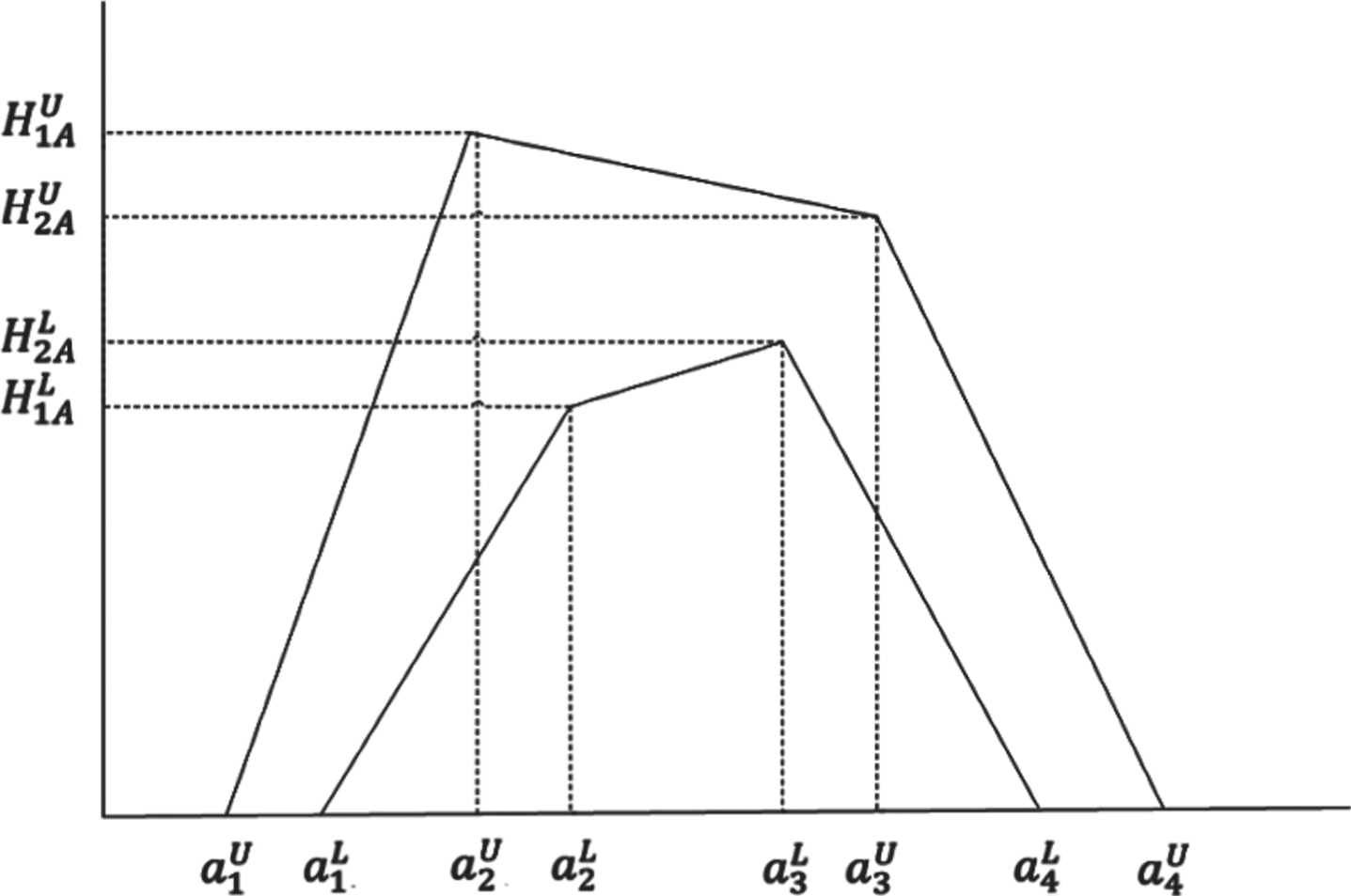
Sketch of a trapezoidal interval type-2 fuzzy number.

The procedure of the proposed approach.
Let
1. The addition operation
2. The subtractions operation
3. The multiplication operation
4. The division operation
5. The multiplication by real number operation
There are various defuzzification methods for type-2 fuzzy sets such as type reduction, type reduction indices, and likelihood-based approach. Type reduction is a straightforward approach where a type-2 fuzzy set is converted into a type-1 fuzzy set. The obtained type-1 fuzzy set is converted into a crisp value using one of the traditional defuzzification methods for type-1 fuzzy sets [46]. Type reduction indices method employs optimistic, pessimistic, and realistic points of view for the type reduction of intended interval type-2 fuzzy set and then calculates its weighted average type reduction value [47]. In likelihood-based approaches, the likelihood of
In this study we use a score function as a corresponding crisp value of an IT2FS.
Consider
Some basic definitions and operations on HFSs are expressed as follows [23]:
Where H E denotes to different possible membership values of the element x to the set E. Xia and Xu (2011) called H E as Hesitant fuzzy element (HFE) [48].
Where γ denotes to each member of h.
Based on HFSs concept, Rodriguez, et al. (2013) developed hesitant fuzzy linguistic term set (HFLTS) as an update on traditional linguistic computational methodologies to model the cognitive process of experts with hesitant opinions [45]. This tool uses context-free grammar to provide flexible and rich linguistic expressions for linguistic computational models.
To make this model more similar to the human cognitive process, a context-free grammar is proposed as described in definition 6 [45].
The grammar G
H
is a 4-tuple (V
N
, V
T
, I, P) composed from the following elements:
Where 〈〉 contains optional elements and | represents alternative elements. The expression ll ∈ S
ll
generated by G
H
could be either a single term s
t
∈ S or a linguistic expression. The transformation function E
G
H
transforms the linguistic expression generated by G
H
into HFLTS.
This could be done by means of the following rules. E
G
H
(s
t
) ={ s
t
|s
t
∈ S }; E
G
H
(at most s
m
) ={ s
t
|s
t
∈ S and s
t
⩽ s
m
}; E
G
H
(lower than s
m
) = {s
t
|s
t
∈ S ands
t
< s
m
}; E
G
H
(at least s
m
) ={ s
t
|s
t
∈ S and s
t
⩾ s
m
}; E
G
H
(greater than s
m
) = {s
t
|s
t
∈ S and s
t
> s
m
}; E
G
H
(between s
m
and s
n
) = {s
t
|s
t
∈ S and s
m
⩽ s
t
⩽ s
n
}.
So it is possible that different HFLTSs have different number of members. For further explanations, please see the Rodriguez, et al. [45].
The proposed method
In this section, we introduce the IT2HF BWM in order to determine the solution of an MCDM problem with n criteria and m feasible alternatives.
The procedure of our proposed approach is illustrated as follows:
Consider a decision-making problem consist of criteria set as C = (C1, …, C n ) and alternative set as A = (a1, …, a m ).
Let S be the linguistic term set and G H a context-free grammar of S as described in Definition 10.
Here we define the linguistic term set as S = {s0 = Equally important, s1 = Weakly important, s2 = Fairly important, s3 = Very important, s4 = Absolutely important}. The linguistic term set and the corresponding IT2FSs are expressed in Table 1.
Interval type-2 fuzzy scales of linguistic variables
Interval type-2 fuzzy scales of linguistic variables
Suppose a decision-maker is asked to determine the best and the worst criteria. The best is the most important criterion, and the worst is the least important criterion according to decision-maker. Subsequently, the decision-maker provides his/her preferences on n criteria (C1, C2, …, C
n
) as best-to-other and other-to-worst vectors.
Where ll Bj and ll jW are the linguistic expressions generated by G H to describe the decision-maker preferences about the best over the jth criterion and the jth criterion over the worst one, respectively.
LB-O and LO-W should be transformed into the HFLTS vectors. As described in Definition 10, the transformation function E
G
H
is used to transform these expressions into the HFLTSs.
Where H Bj ={ s t |s t ∈ S ; j = 1, …, n } and H jW ={ s t |s t ∈ S ; j = 1, …, n } denote to the corresponding HFE of the best over the jth criterion and the jth criterion to the worst one, respectively.
For each HFE obtained in the previous step, specify the lower and upper linguistic bounds. Let
Using Table 1, determine the corresponding IT2FSs with HB-O and HO-W. Let hB-O and hO-W be the IT2HF representation of HB-O and HO-W.
Let
Formulate the IT2- fuzzy BWM corresponding to optimistic and pessimistic points of view separately. Here we describe our proposed approach to solve the problem in general. This approach could be applied to both pessimistic and optimistic versions of the problem.
Consider the optimistic view of the decision problem which is described by
In traditional BWM to determine the optimal weights, the maximum absolute differences
We extended a IT2F version of basic BWM where,
Therefore the optimal fuzzy weights
Where
Where
We suppose
min k
s.t.:
By solving the above problem, the optimal fuzzy weights
The interval type-2 hesitant fuzzy weighted average (IT2HFWA) is employed to aggregate the criteria optimal fuzzy weights. The aggregator operator could be defined as follows:
Determine the scores
Let
Where # is the number of elements of IT2HFE that
Consistency ratio (CR) is an indicator to measure the degree of consistency of pairwise comparisons. In the BWM technique, a pairwise comparison is perfectly consistent when a
Bj
× a
jW
= a
BW
. The same holds for the development of this method with IT2FSs. If
To measure the degree of inconsistency of these fuzzy type-2 comparisons, the CR could be employed. We know that an inconsistency occurs whenever
This equation could also be represented as follows:
By solving Equation 29 for different values of
Now the equation 29 can be converted as follows:
For example, assume
Consistency index (CI) for IT2FS BWM
In this section, we use some numerical examples to demonstrate the application and verification of our proposed approach.
Case study 1
A company wants to select the optimal transportation mode in order to deliver its products to the market. Previously Rezaei employed the BWM to deal with this problem [16]. Also, Guo and Zhao extended type-1 fuzzy BWM to tackle this problem [18]. Here we use a modified version of this problem and employ our IT2HF-BWM to solve it. In the modified version of this example, the decision-maker has the opportunity to make his/her preferences using linguistic term sets together with context-free grammar. We used our approach to consider the uncertainty associated with decision-maker preferences. This approach could be employed in weighting the criteria and also in the evaluation of alternatives. Here we used this technique to determine the weights of criteria. The alternative evaluation could be done in a similar manner.
In this case study, there are three criteria to select the optimal transportation mode: ‘load flexibility’ (C1), ‘accessibility’ (C2) and ‘cost’ (C3), C = (C1, C2, C3).
Interval type-2 fuzzy scale described in Table 1 and context-free grammar described in Definition 10 are used to describe decision-maker’s preferences.
According to decision-maker judgment, the ‘cost’ (C3) and the ‘load flexibility’ (C1) are the best and the worst criteria, respectively. Using the grammar G H and linguistic term set expressed in Table 1, the decision-maker provides best-to-other and other-to-worst comparisons. Let Tables 3 and 4 represent these comparisons.
The comparison of the best criterion over all other criteria for case study 1
The comparison of the best criterion over all other criteria for case study 1
The comparison of all other criteria over the worst criterion for case study 1
So the linguistic hesitant best-to-other and other-to-worst vectors are obtained as follows:
The linguistic expressions stated in Tables 3 and 4 should be transformed into HFLTSs. Using the function E
G
H
given in Definition 6, the following HFLTS vectors are obtained:
According to Table 1, the IT2HF B-O and O-W vectors are obtained as follows.
The upper and lower bounds of these comparisons are determined as optimistic and pessimistic points of view, respectively. For example
The IT2F best-to-other and other-to-worst vectors for optimistic point of view are as follows:
Then, based on Equation 25, the following nonlinear optimization problem is formed:
min k
s.t.:
Which is equivalent to the following optimization problem:
min k
s.t.:
By solving the above optimization problem, the optimal fuzzy weights of criteria are derived as follows:
In the optimistic case, a
BW
= a31 = (2.5, 3, 3.5, 4 ; 1, 1) (2.75, 3.25, 3.25, 3.75 ; 0.8, 0.8). So the consistency index is 7.3723. Therefore the consistency ratio (CR) could be obtained as
Solving the same problem by Guo and Zhao approach provides the fuzzy optimal weights as follows:
So the consistency ratio (CR) is obtained as 0.354/8.04 = 0.044
Also, solving this problem by Rezaei (2016) approach provides the following weights:
W1 = 0.067
W2 = 0.169
W3 = 0.765
k = 2.469
Which leads to CR=2.469/5.23 = 0.472
The problem in pessimistic point of view is solved in a similar manner. The pessimistic IT2F B-O and O-W vectors are as follows:
So the problem is formulated as follows: min k
Which is equivalent to the following optimization problem: min k
s.t.:
Solving the above problem, provides the following optimal fuzzy weights.
In the pessimistic case, a
BW
= a31 = (2, 2.5, 3, 3.5 ; 1, 1) (2.25, 2.75, 2.75, 3.25 ; 0.8, 0.8) and the consistency index is 6.6926. Therefore the consistency ratio (CR) is
Adoption of type-1 fuzzy BWM developed by Guo and Zhao to solve this problem provides the fuzzy optimal weights as follows:
And the corresponding consistency ratio (CR) is 0.562/6.69 = 0.084
Also, solving this problem using Rezaei approach results in the following weights:
Which leads to CR = 0.298/3.73 = 0.080
Our CR is very close to zero and indicates the high comparison consistency. This CR value is considerably lower than the one obtained by employing BWM and its type-1 fuzzy extension
In order to aggregate the pessimistic and optimistic points of view for criteria weights, we use the IT2HFWA operator as follows:
The corresponding score values of the criteria weights are considered as their crisp scores as follows.
According to the results, the preference order of three criteria is cost ≻ accessibility ≻ loadflexibility which is the same order obtained from Rezaei (2016) and Guo and Zhao (2017) [16, 18]. This is due to the tiny changes in the problem structure where the preference of C31 = AI is replaced by “at least VI” and the preference of C21 = FI is replaced by “between WI and FI.”
This case study is a modification of the car selection decision problem in Rezaei, et al. (2016), where some criteria preferences are expressed hesitantly.
In this case, the buyer has 5 criteria to select the most desirable car, including ‘quality’ (C1), ‘price’ (C2), ‘comfort’ (C3), ‘safety’ (C4), and ‘style’ (C5).
According to decision-maker C2 and C5 are selected as the best and the worst criteria, respectively. The hesitant B-O and O-W preferences are presented in Tables 5 and 6.
The comparison of the best criterion over all the other criteria for case study2
The comparison of the best criterion over all the other criteria for case study2
The comparison of all the other criteria over the worst criterion for case study2
So the linguistic hesitant B-O and O-W vectors could be obtained as follows:
Using the transformation function given in Definition 6, the above linguistic expressions are transformed into HFLTS:
The process of obtaining the two optimistic and pessimistic versions of the problem (step 5) is quite similar to those of case1. To be concise in the following cases, we don’t mention this step again.
According to equation 3, the following optimization problem is obtained: min k
s.t.:
Solving the above optimization problem, provides the following optimal fuzzy weights:
In this case, a
BW
= a25 = (2.5, 3, 3.5, 4 ; 1, 1) , (2.75, 3.25, 3.25, 3.75 ; 0.8, 0.8). So the consistency ratio (CR) could be obtained as
The pessimistic version of case 2 is as follows: min k
s.t.:
The result of solving the above problem is as follows:
According to the results, the preference order of criteria is C2 > C1 > C4 > C3 > C5 which is slightly different from the order obtained by fuzzy type-1 BWM and BWM. The only difference between these two rankings is the replacement of the third and fourth criteria.
In this case, a
BW
= a2,5 = AI, which leads to consistency index = 7.0339. Therefore, the consistency ratio is obtained as
In this case study, a buying company uses four criteria to evaluate the supplier performance containing ‘willingness to improve performance’ (C1), ‘willingness to share information’ (C2), ‘willingness to rely on each other’ (C3), and ‘willingness to become involved in a long-term relationship’ (C4). Rezaei, et al. (2016) and Guo and Zhao adopted this case study to apply their approaches to solve it. Here we use a modified version of this problem where the decision-maker has hesitant opinions to compare criteria.
According to decision-maker opinion, ‘willingness to improve performance’ (C1) and ‘willingness to share information’ (C2) are assumed to be the best and the worst criteria, respectively. The comparisons of the best criteria over all the criteria and all the criteria over the worst criteria, which are stated as linguistic terms are presented in Tables 7 and 8.
The comparison of the best criterion over all the other criteria for case study 3
The comparison of the best criterion over all the other criteria for case study 3
The comparison of all the other criteria over the worst criterion for case study 3
The linguistic hesitant B-O and O-W vectors are as follows:
Using Definition 6, these linguistic expressions are transformed into HFLTS as follows:
Now, the optimistic and pessimistic versions of the problem could be derived as follows:
According to equation 3, the following optimization problem is formulated: min k
s.t.:
Solving the above problem provides the following results:
Here, a
BW
= a1,2 = AI. So, consistency index = 7.0339 and the consistency ratio is
Comparing this value to CR value obtained from BWM (i.e., 0.329) and type-1 fuzzy BWM (i.e., 0.03) indicates the good performance of the proposed method.
The pessimistic version of case study 3 is as follows: min k
s.t.:
By solving the above optimization problem, the optimal fuzzy weights are obtained as follows:
In this case a
BW
= a1,2 = VI = (2, 2.5, 3, 3.5 ; 1, 1) (2.25, 2.75, 2.75, 3.25 ; 0.8, 0.8). So, according to Table 2, the consistency index is 6.3481. Therefore the consistency ratio is derived as
Now, according to equation 26, the final weights of criteria is obtained as follows.
Based on equation 27, the crisp value corresponding to above weights could be obtained as follows:
The final preference order of criteria of this case, is C1 ≻ C3 ≻ C4 ≻ C2. This order is the same as the one obtained from Rezaei et al. (2016) and Guo and Zhao approach (2017).
We take the previous three cases from the literature to express the effectiveness and applicability of our proposed method. These three case studies have also been used by Rezaei et al. (2016) and Gu and Zhao (2017), where the results of their application were compared with our approach.
In this section, we provided a comparative analysis of our approach with an interval type-2 fuzzy AHP method developed by Ayodele, et al. (2018) [50]. Three previous case studies provide numerical examples for modeling the hesitancy of an expert in the decision-making process. In contrast, case study 4 is a real case study of group decision-making context. This case study aims to select the most appropriate location to set up a wind farm in Nigeria. According to this study, five criteria are determined to evaluate the suitability of a location to set up a wind farm: Wind speed (C1), Proximity to gridlines (C2), Slope (C3), Proximity to towns (C4), and Proximity to roads (C5).
Table 9 represents the criteria pairwise comparisons according to experts.
The criteria pairwise comparisons for case study 4
The criteria pairwise comparisons for case study 4
*EE=Exactly equal, SS = Slightly strong, FS = Fairly strong, VS = Very strong, AS = Absolutely strong, 1/SS = Reciprocal of Slightly strong, 1/FS = Reciprocal of Fairly strong, 1/VS = Reciprocal of Very strong and 1/AS = Reciprocal of Absolutely strong.
We use some of these preferences in our analysis. According to experts, C1 and C5 are considered as the best and worst criteria, respectively. By aggregating the opinions of experts in the form of hesitant fuzzy sets, the following linguistic hesitant B-O and O-W vectors are obtained as follows:
Based on these vectors, the following optimistic and pessimistic problems are formed.
Solving the above nonlinear optimization problem leads to the following result.
Based on the results obtained above, the consistency ratio is calculated equal to 0.06, which is within the acceptable range.
Using Equation (13), the corresponding crisp value of the criteria weights are obtained as follows:
W1opt = 0.412525
W2opt = 0.210664
W3opt = 0.158696
W4opt = 0.129588
W5opt = 0.088268
s.t.:
Solving this problem provides the following answer:
In this case aBW = AS, which leads to the consistency ratio equal to 0.03.
As can be seen, the IT2HF BWM, despite using a much smaller number of pairwise comparisons, produced reasonable results in both pessimistic and optimistic cases.
According to equation (13), the defuzzified value of the criteria weights are as follow:
W1pes = 0.3871
W2pes = 0.2227
W3pes = 0.1922
W4pes = 0.0916
W5pes = 0.1064
Now the aggregated value of criteria fuzzy weights can be obtained from equation (26).
based on Equation (13), the final crisp value of criteria weights are calculated as follows:
W1 = 0.401
W2 = 0.216
W3 = 0.174
W4 = 0.110
W5 = 0.099
Using the IT2F-AHP method from Ayodele et al. (2018) the following criteria weights are obtained.
W1 = 0.4974
W2 = 0.2449
W3 = 0.1681
W4 = 0.0519
W5 = 0.0378
Comparing the results reveals that the criteria’ preference order in both methods is the same (C1 ≻ C2 ≻ C3 ≻ C4 ≻ C5). However, the criteria weights are slightly different, so that in the application of HIT2F-BWM, the difference between the criteria weights is slightly reduced. Nevertheless, despite using a much smaller number of pairwise comparisons, the IT2HFS-BWM still provides reliable results.
It is noteworthy that this case study is not designed to be used by the BWM. In other words, experts were not requested to provide comparisons in a way that be used in BWM. However, here we used only some of these preferences to provide a comparative analysis. The results indicate the efficiency of our proposed method in producing reliable results with fewer pairwise comparisons.
There are also various other hesitant Fuzzy based MCDM techniques that used hesitant fuzzy sets to express and aggregate the decision makers’ preferences. For example, Devici (2018) used a hesitant type-2 fuzzy based MCDM approach to select hydrogen underground storage in Turkey [39]. Also, Wei and Zhang (2014) developed a fuzzy extension of VIKOR in the hesitant fuzzy environment where the interaction and correlation between different criteria are expressed by choquet integral [51]. There are other cases, such as Zeng and Xiao (2018) and Onar, et al. (2014) that developed TOPSIS and Mahmoodi, et al. (2016), who developed PROMETHEE under the hesitant fuzzy environment in the group decision-making context [52–54]. Also, Liao et al. (2019) is another example that used hesitant fuzzy based approach for early lung cancer screening [55].
Compared to existing literature, the most important advantages of the proposed approach are as follows: The proposed method requires fewer pairwise comparisons and makes it easier and more convenient for experts to participate in the decision-making process. The proposed method does not require complicated calculations and provides results through several simple and straightforward steps. Many different hesitant-based MCDM techniques, apply various distance functions which propose different ordering results. Our proposed approach is independent of distance operators and therefore provides more realistic results without any information loss. As can be seen from the literature, there are various studies used IT2FSs or HFSs to develop different MCDM techniques into the fuzzy environment. But the combination of these two approaches is rare in MCDM analysis. This study combines these two approaches to use the advantages of both in developing the fuzzy version of BWM. The proposed approach, can be used to represent the hesitancy of the decision-maker in expressing linguistic terms as well as group decision-making context. In addition, due to the use of IT2FSs, our approach has very simple and straightforward calculations.
This study uses the Rodriquez et al. (2013) approach to express the hesitancy of linguistic expressions as hesitant fuzzy sets [45]. Consequently, in light of Hu, et al, (2015) approach, we adopted a combination of hesitant fuzzy sets with IT2FSs to model the problem [38]. The authors used the proposed hybrid method to develop an IT2HF version of BWM and demonstrate its effectiveness and applicability through an illustrative example. The proposed approach could be used effectively to model BWM in a hesitant fuzzy environment. In addition, compared to traditional BWM and its type-1 fuzzy extension, the results indicate the more consistency of the proposed approach in both optimistic and pessimistic versions of the problem.
BWM is widely used in various researches and contexts [40–44]. This technique reduces inconsistency. It also reduces the number of required pairwise comparisons and therefore increases the participation of decision-makers. Compared to other traditional MCDM techniques, this technique not only needs fewer data requirements but also provides more reliable results [16]. However, this method has its own limitations in considering uncertainty, inaccuracy, and vagueness, which are inherent in real-world data. A very common instance of such cases is when the decision-maker is hesitant to select a specific item from a linguistic term set and prefers to express his/her opinion through a set of terms. A similar case can be found in the group decision-making practices. Hesitant fuzzy sets, which are a generalized form of fuzzy sets, enable us to represent such situations efficiently. Compared to type-1 fuzzy sets, HFSs can better represent vague, uncertain, and inaccurate information such as hesitant linguistic preferences. In this study, we use the context-free grammar developed by Rodriguez, et al. (2013) to grasp the decision-maker opinions by means of hesitant fuzzy linguistic term set. These sets are able to express the hesitancy of the decision-maker in pairwise comparisons as well as a group of opinions in the form of HFSs.
Many previous studies have used IT2FSs [26–33] or HFSs [34–37] to represent the fuzziness of data in MCDM analysis. But the combination of these two approaches has rarely been used in the literature. Hu et al. (2015) was the first study that proposed such a combination [38]. In light of this idea, the present study employs IT2FSs along with HFSs in developing the fuzzy version of BWM. The proposed approach is called IT2HFS-BWM. Developing an IT2HFS version of BWM is novel to MCDM problem solving and is first introduced in this paper. The proposed approach extends the application of the BWM method into vague, inaccurate and subjective information, especially in group and hesitant environment. On the other hand, this approach allows decision-makers to express their preferences in a more flexible and convenient way by means of wider and more complicated linguistic expressions. So one of the most important advantages of this approach is to provide a convenient way to depict experts’ opinions. Another important advantage of our method is the need for fewer pairwise comparisons that encourages the participation of experts in the decision-making process. This is especially the case with problems containing a large number of pairwise comparisons. Such problems are associated with many difficulties and confusions that may reduce the participation of experts. In addition, unlike many hesitant-based MCDM techniques, here the decision-maker does not need to specify any distance function or use dummy variables to extend the hesitant fuzzy elements. So this method does not lead to any data loss. The application of the proposed approach to different case studies implies the reliability of results.
Our proposed approach translates the hesitant linguistic expressions to IT2HFSs. These sets, due to the use of primary and secondary membership functions, can model the problem in a more flexible and efficient manner. Besides, due to simultaneously considering a wide range of decision-makers’ opinions without any information loss, the method is particularly suitable in the group decision-making context. In this paper, the hesitancy embedded in decision-maker preferences is seized using context-free grammar and is transformed into HFSs as described in section 2.5. According to the corresponding IT2HFSs representation of the problem, it is converted to two optimistic and pessimistic versions. We developed a simple algorithmic procedure in four steps to solve both versions of the problem. This procedure builds a non-linear constrained optimization problem that determines the type-2 fuzzy optimal weights of the problem.
The applicability and effectiveness of our proposed approach is demonstrated through some illustrative numerical examples and a comparative analysis. The results indicate that in both optimistic and pessimistic views of the problem, the IT2HFS-based BWM outperforms the original BWM method, as well as its type-1 fuzzy extension. Comparison of the results with the ones of above-mentioned methods, revealed that our proposed approach improves the consistency ratio significantly and provides more consistent and realistic results. The proposed technique does not require complicated computations. So this approach can be easily applied to various multi-attribute decision problems. Although the proposed approach is developed using trapezoidal interval type-2 fuzzy numbers, it could be easily expressed using triangular IT2FNs.
The main limitation of the application of our proposed method is related to the aggregation of expert opinions in the form of a hesitant set and the implementation of the BWM to solve it. The best conditions to apply the proposed approach is when experts have a consensus on choosing the best and the worst criteria. For example, in case 4, five experts had the same opinion about choosing the best criterion, and four experts had the same opinion about the worst one. Therefore, the proposed method was used effectively. However, if there is much diversity in the experts’ opinions about selecting the best and worst criteria, the efficiency of the method will be greatly reduced. It should be noted that this restriction is not the case in expressing the ambiguous opinions provided by one decision-maker.
In our future work, we will employ the proposed approach in various real-world cases, including green supplier selection and IT outsourcing decisions in the banking industry. Besides, further research on validation approach such as sensitivity analysis should be performed to represent the stability of weighting and ranking.
In addition, in our future work, we aim to compare the results obtained from the application of our proposed approach with the existing literature. The comparison could be done in terms of reliability, computational work and accuracy, sensitivity analysis and robustness of method.
Also Future studies should be done about using interval-valued fuzzy rough set based methods and compare their results with interval type-2 fuzzy set based method.