



Abstract
In today’s economy, information technology (IT) is vitally important, and the increasing use of the Internet, telecommunications services, and internal IT networks in organizations have led to rapid growth in the demands on big data processing. In general, site selection is a fundamental part of the design of a big data center (BDC), and a poor site decision can affect the sustainability of the facility. To construct a comprehensive assessment framework for a BDC, the following three categories of indicators are determined based on the “Specification for Design of Data Center” in GB50174-2017 of China: economic factors, natural climate environment factors, and energy resources factors. After explaining the rationality of choosing these indicators in detail, an integrated method that combines the multi-criteria decision-making (MCDM) method and the multi-choice goal programming (MCGP) model is proposed. The proposed approach uses two phases to conduct the decision procedure. First, the preference ranking organization method for enrichment evaluation (PROMETHEE) method is applied to evaluate the economic factors. Then, the evaluation results are added to the MCGP model as one of the goals of multi-objective programming. Second, the remaining five sub-indicators and the evaluation results generated from the first phase are formulated as a complete MCGP model. Finally, an empirical study on the site selection for the BDC is implemented based on the proposed method. The result shows that Guiyang is the most suitable place for locating a BDC in China.
Introduction
With the explosive growth of information technology (IT), the increasing need for fast and efficient data processing and storage services has promoted the rapid growth of big data centers (BDCs) [1, 2]. In general, the BDC’s span is a hundred to thousand square meters of area with high energy-intensive facilities due to the demands of having enormous power consumption, for running server farms and feeding them with energy processors, monitors, network equipment, lighting, air distribution fans, and cooling systems. Thus, building a cost-efficient BDC is of great significance [3]. Among the factors that affect the construction of BDCs, site selection is a fundamental part of the design of the BDCs. A poor site choice will affect the sustainability of the facility since there is no flexibility for changing or modifying the location once it is determined.
A BDC should be located in a region that is not prone to natural disasters or terrorism. At the same time, they need a robust facility that can operate every day without disruptions. When a country decides to build a new BDC, the energy cost is one of the main variables in the decision-making process. The energy cost accounts for a large proportion of the BDC’s operational cost. The concept of power usage effectiveness (PUE) is introduced to measure the energy efficiency, where PUE is defined as the total data center energy use divided by the IT energy use [4], and China strictly requires the value of PUE to be below 1.5. In addition, the environmental security, the probability of occurrence of natural disasters, the availability of electrical power, the reliability of the telecommunications network, the labor cost, and availability, and transportation accessibilities are also important. The “Specification for Design of Data Center” in GB50174-2017 of China [5], hereinafter referred to as the “Specification”, has stipulated several aspects that must be considered. Including the development of the economy in the candidate regions, natural climate conditions of the candidate regions, and energy resources of the candidate regions.
The main parts of the energy usage in a BDC are the cooling system and the hardware equipment (servers, routers, switches, and frames) [6]. Over the past decade, the energy consumed by BDCs has doubled every four years, the issue of saving energy and improving the use efficiency has always been a hot topic [7–10]. The expense of the cooling system is the highest operating cost in the BDCs, which makes many companies responsive to choosing places with cold weather, such as Finland and Siberia. Apart from the natural conditions, it is also essential to improve the cooling efficiency of the whole system. Intelligent placement algorithm [11], energy efficiency optimization strategy [12] and computer room model [13] has been proposed to minimize the power consumption of the data center cooling system, respectively. Although research on cooling efficiency improvement is necessary, choosing a location that has a low temperature can save energy. Considering that BDCs are becoming more and more critical for each country’s IT development, selecting a suitable location is of great significant. Thus, the factors that must be considered not only include the energy cost, but also include the economic development of candidate regions and the natural climate environment. To construct a comprehensive assessment framework, three categories of indicators can be determined based on the “Specification” [5]: economic factors, natural climate environment factors, and energy resources factors. Each category contains several sub-indicators. In other words, the site selection of a BDC should consider many complex factors, which follow the standard of the multi-criteria decision-making (MCDM) approach.
In the previous research on the site selection of critical infrastructures, optimization models are the most commonly used methods, which use Euclidean distances or other models of distances over a network, and the suppliers of the facility are the most critical aspects of the problem [14]. As a complex decision-making tool that involves quantitative and qualitative factors, MCDM tools have been suggested to choose good options in recent years [15]. Several techniques have been proposed to solve MCDM problems, including Analytic Hierarchy Process (AHP), Analytic Network Process (ANP), Technique for Order Preference by Similarity to Ideal Solution (TOPSIS), Weighted Product Model (WPM), Weighted Sum Model (WSM), Preference Ranking Organization Method for Enrichment Evaluation (PROMETHEE) and Multi-Attribute Utility Analysis (MAUA). The MCDM model is suitable for addressing location selection problems for BDCs due to the limitation of human expertise.
There are many applications for using MCDM tools to evaluate potential locations, for example, car-sharing station [16], aquaculture site selection [17], the renewable energy field [18], site selection of Mineral plant [19], and so on [20–22]. However, few studies have addressed having a comprehensive framework that simultaneously considers various criteria. Daim et al. created a hierarchical model to investigate factors for locating data centers from the perspective of challenges and issues faced by DMs [23]. Covas et al. formulated an outranking Elimination Et Choice Translating Reality Tree (ELECTRE TRI) model by considering social, technical, economic, and environmental dimensions. The results are depicted in a graphical form [24]. However, this literature uses the hierarchical structure. The scores of different criteria were assigned by DMs only, which could affect the validity of the results due to the bias of the DM’s subjective perception [25]. For complex problems, such as for site selection of BDCs, multi-objective goal programming (MOGP) is commonly used to determine answers to these complex problems.
The MCGP model, developed from MOGP, has never been used before in this field. The MCGP model was first proposed by Chang [26] to address the imprecise goals in the field of goal programming (GP). Afterward, the rapid development of MCGP produced many extensions in both modeling and formulation methods. In 2008, the revised MCGP was proposed to improve the method’s efficiency, which canceled the multiplicative terms of binary variables [27]. Another improved model was proposed in 2011 by using the capabilities of utility functions, which can improve the practical utility of MCGP in solving more real-world decision problems [28]. Later, modeling studies extended the concept of aspiration levels in MCGP to solve or formulate other types of issues, such as multi-segment GP (MSGP), multi-coefficient GP, and percentage GP [29–32]. MCGP can be applied in the site selection of renewable energy facilities [33, 34]. Moreover, the MCDM method integrated with the MCGP method has also been used in many real-life problems recently, such as catering supplier selection [35], supplier selection [36, 37], and portfolio selection [38].
Using the MCDM method will complicate the decision-making process because site selection for BDCs involves different aspects of factors. To establish a BDC site selection problem model, the PROMETHEE method [39], which arose from the MCDM framework, is integrated with the MCGP model. The resulting method is proposed in this paper. The PROMETHEE method has several optional preference functions that can be adapted flexibility to the different membership relations. Its algorithm is robust and has been verified in many fields [40]. The motivation for choosing MCGP to solve this problem is that a conservative decision-making process can lead to underestimation. The result cannot achieve the optimal solution [27]. For example, in the decision-making process for BDC site selection, to address the utilization rate of all types of energy and land utilization, resources should be fully used to achieve the most relevant results. The MCGP model can flexibly change the aspiration level, and there is no need to fix the individual expectation values, making the model more convenient in solving practical problems [34, 41]. To make the decision-making process more organized, the proposed approach uses two phases to construct an integrated method containing PROMETHEE and MCGP. First, the PROMETHEE method is applied to evaluate the economic factors. Then, the evaluation results are added as one of the goals of the multi-objective programming using the MCGP model. Second, the remaining two categories, natural climate environment factors and energy resources factors, which involve five sub-indicators, together with the evaluation results generated from the first phase, are formulated as a complete MCGP model. To the best of the author’s knowledge, this is the first paper that has adopted the PROMETHEE-MCGP method to select the suitable location for BDCs. This paper makes full use of MCDM method and MCGP model to avoid defects in decision making process. The PROMETHEE method integrated with the MCGP model proposed here is helpful for site selection decision making.
Based on the analysis above, the contributions of this paper are summarized as follows: Modeling the site selection of the BDC problem according to real-life conditions and proposing an integrated method based on the PROMETHEE method and the MCGP model to evaluate the candidate regions comprehensively. Adopting the revised MCGP model and solving the problems of “the more (higher), the better” and “the less (lower), the better” in one model at the same time without the normalization of distinct dimensions, which renders it also easy to operate. Proposing a systematic and hierarchical method for evaluating the location of a BDC, elaborating the selection of indicators in detail.
The rest of this paper is organized as follows. Section 2 describes a detailed criteria characterization. Section 3 introduces the proposed method of PROMETHEE integrated with the MCGP model. Section 4 carries out empirical research about BDC site selection in China. Section 5 discusses the model results, and possible further research is illustrated.
Indicator description
This research identifies the most suitable facility locations for a BDC under an integrated decision support methodology. Three dimensions of indicators are considered: economic factors, natural climate environment factors, and energy resources factors. The framework of the indicators is shown in Fig. 1.
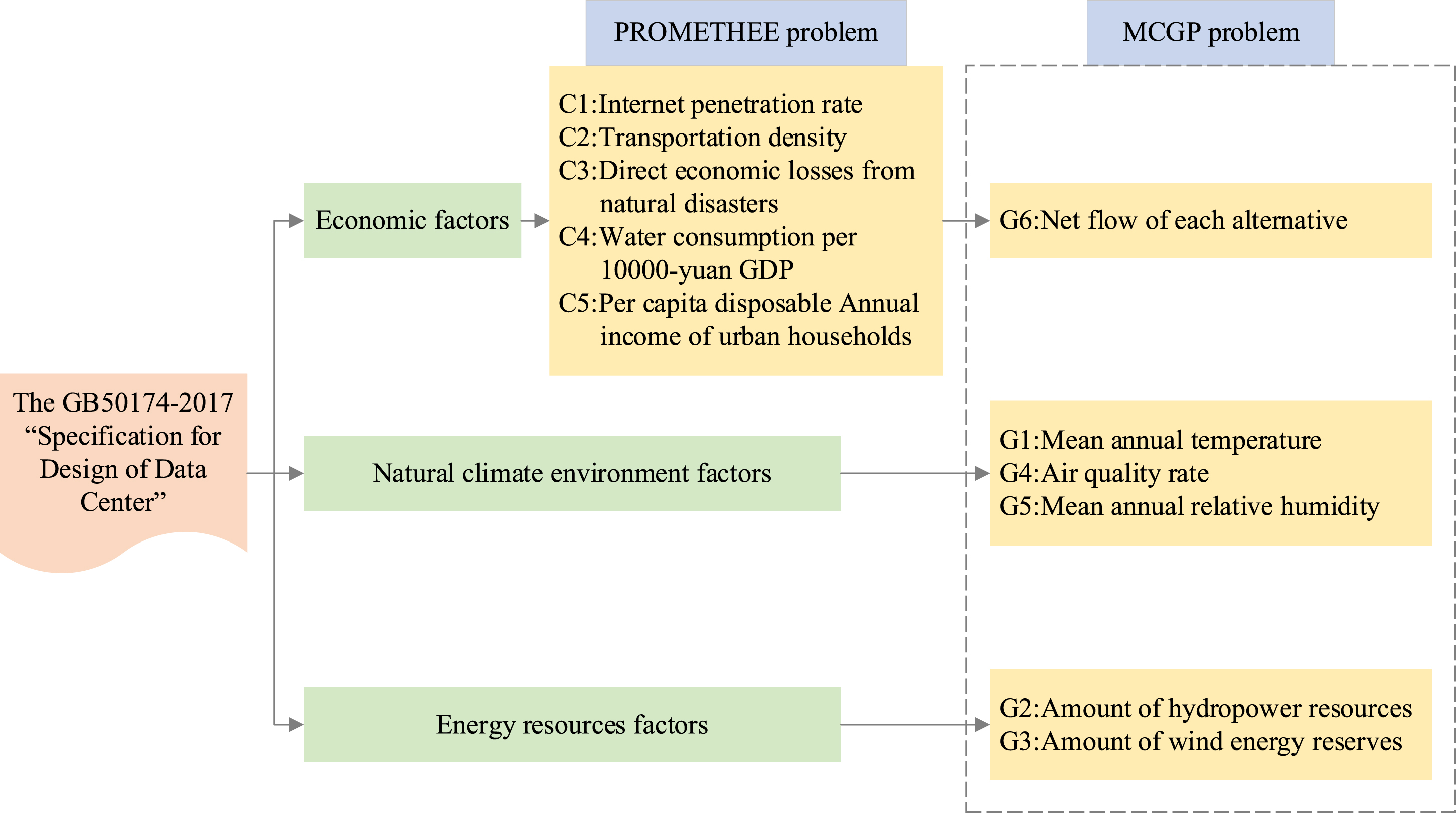
The framework of indicators.
The purpose of constructing a data center is to solve the information-sharing problem between government departments and to realize the data exchange among the business departments. Because the given problem must be studied under various objectives, it is often considered concerning the simultaneous application of multi-attribute and multi-objective programming techniques [38]. The site selection of a BDC is a complex problem. Only the MCDM method will complicate the decision-making process. The entire evaluation is divided into two phases, and the PROMETHEE method and MCGP model are applied. Phase I focuses on the five economic factors: the Internet penetration rate (C1), transportation density (C2), direct financial losses from natural disasters (C3), water consumption per 10000-yuan GDP (C4), and per capita disposable annual income of urban households (C5). The results generated from this stage are the net flow values of the distinct alternatives and are further used as the coefficient of a goal in phase II; this goal is set to be the net flow of each option (G6). The remaining plans in phase II are based on natural climate environment factors and energy resources factors, namely, Mean annual temperature (G1), Amount of hydropower resources (G2), Amount of wind energy reserves (G3), Air quality rate (G4) and Mean annual relative humidity (G5). The selection of these indicators is mainly based on the “Specification” [5]. There are also some factor selection problem can be referenced as inspiration [42, 43].
The brief description of these indicators is shown in Table 1.
The brief description of indicators
(1) C1: The Internet penetration rate (%)
The Internet has had a visible impact on our daily lives in recent years. The Internet application has dramatically reduced the cost of information transmission between economic agents and caused a profound social revolution [44]. The Internet penetration rate is one of the economic indicators used to measure the degree of informatization development of a country or region. Overall, the Internet penetration rate is the number of Internet users/total population, and Fig. 2 depicts the scale of Internet users and the penetration rate in China from 2008 to 2018 (data sources: CNNIC). The growth trend of these data indicated that the development of China’s Internet was very fast in this decade. The growth of the Internet has promoted the transformation of industry and created a new normal for traditional sectors [45]. Most of the research in this area has confirmed the positive role of the Internet in improving the economy [46]. Most previous literature believed that investment in the telecommunications infrastructure could promote economic growth [47–49]. Chu thought that the popularity of the Internet is conducive to increasing the GDP per capita [50], and Czernich et al. determined that for every 10% increase in the Internet penetration, the GDP per capita would also increase by approximately 1% [51]. This index is incorporated into the framework of the MCDM problems because it can reflect the economic growth of a country or region.

The scale of Internet users and penetration rate in China.
(2) C2: Transportation density (km/km2)
In recent decades, the transportation network has been developed on a massive scale, potentially reshaping the spatial economic patterns in China [52]. The development of a highway network significantly stimulates the country’s economy, increasing on a year-by-year basis. Figure 3 shows the steady growth of the highway mileage over the past decade (Data Sources: CNNIC). In the process of economic growth, the transport infrastructure is often considered to be a key factor [53, 54]. A mature transportation system can enhance its location advantages and attract an inflow of production factors for a local economy, thereby leading to economic growth [55]. Due to the conclusion that highways can promote enterprise exports and contribute to industrial development [56–58], the transportation infrastructure is used as one of the criteria in the MCDM problem.
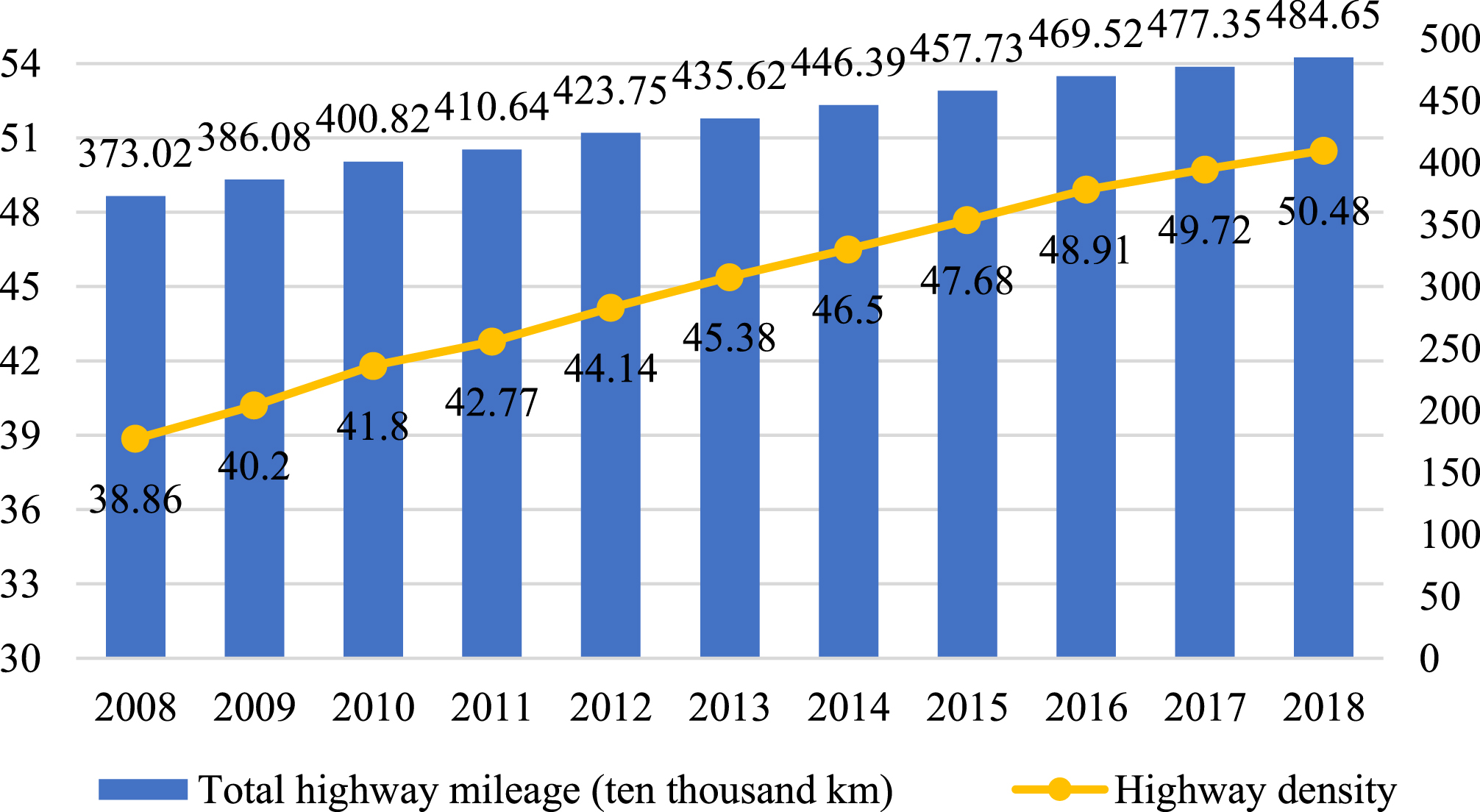
2008–2018 national highway mileage and highway density.
(3) C3: Direct economic losses from natural disasters (100 million yuan)
To illustrate the distribution and impact of natural disasters in China, stacked area maps are used in Fig. 4 to analyze and compare the direct economic losses caused by various natural disasters (Data Sources: Bulletin of flood and drought disaster in China 2018). Considering the sizeable geographical heterogeneity in China, multiple natural disasters are spread across the mainland all year round. Among them are floods, droughts, and typhoon disasters, which occur almost every year. According to Fig. 4, several peaks represent the severe disasters in that year on the national economy. For example, the economic losses caused by the 2008 Wenchuan earthquake (M 8.0, death 69227, injured 374643, missing 17923) accounted for 80% of the total direct financial losses of natural disasters that year [59]. Floods have struck the economy heavily, especially in 2010, 2013, and 2016. Studying the direct economic losses caused by natural disasters and drawing on disaster management experience can improve managing disaster emergencies and eventually reducing the financial losses from the disaster. Many scholars have focused on researching comprehensive loss assessments of natural disasters [60–64]. Environmental security is one of the most critical factors while selecting a BDC location, and a candidate location should avoid areas where natural disasters frequently occur as much as possible.
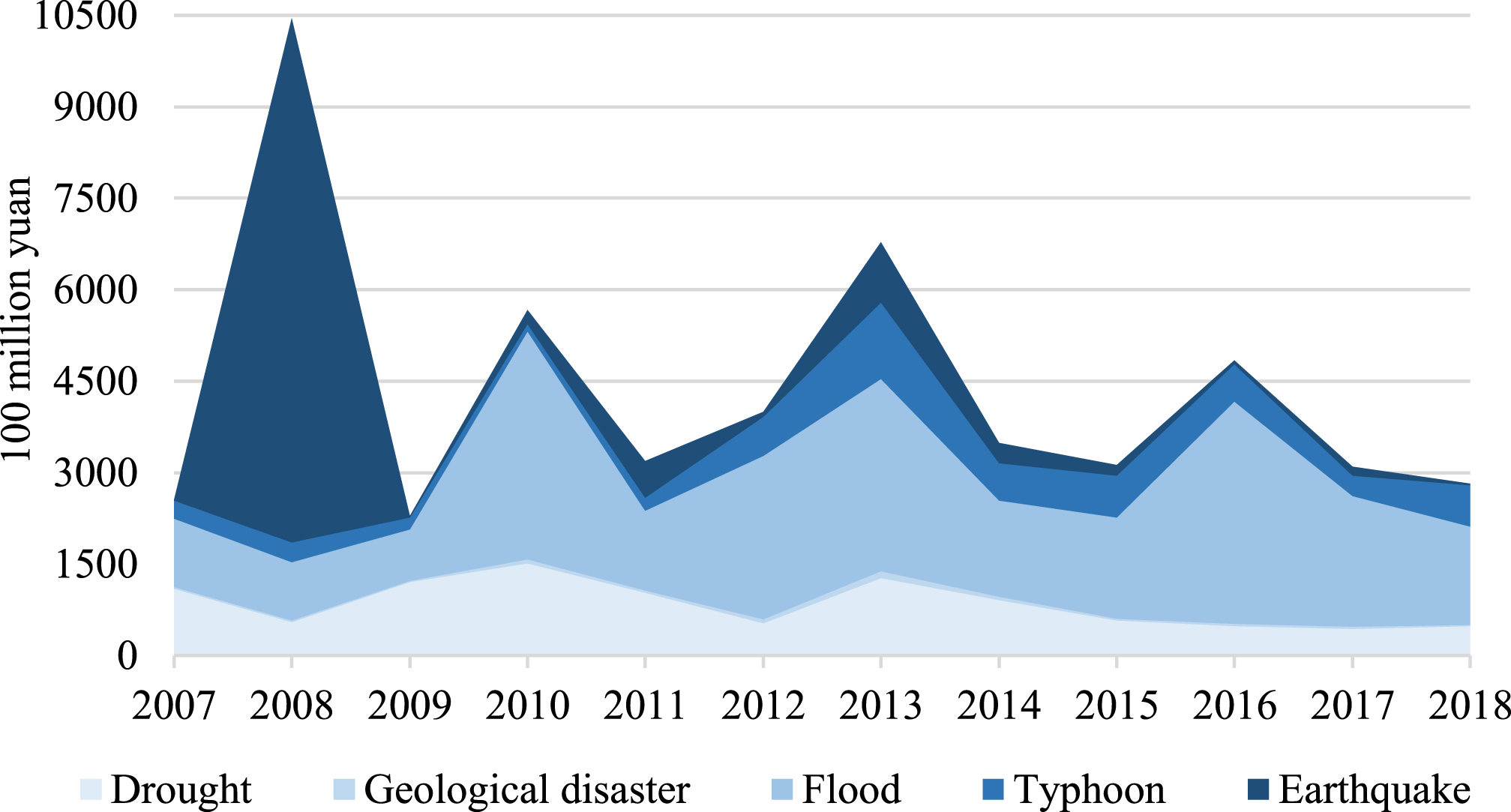
Direct economic losses from various natural disasters.
(4) C4: Water consumption per 10,000-yuan GDP (m3)
China has a total water resource of 2.8 trillion m3, ranking fifth in the world; however, the per capita water resources of China are much lower than the average world level because of the large population base [65]. To describe the comprehensive water use level of a country or a region, water consumption per 10000-yuan GDP is used to intuitively reflect on whether the implementation of a water savings policy has worked in developing the economy and society. Figure 5 depicts the growth trend of the GDP, accompanied by the falling trend in water consumption from 2008 to 2018 (Data Sources: China Environmental Statistics Yearbook; Bulletin of China Water Resources). It is evident that the water consumption per 10,000-yuan GDP has dropped by 211% compared to ten years ago, which means that the water-saving policy is effective in practical economic activities. In China, efficient utilization of water resources is one of the critical measures that can be taken to alleviate the contradiction between the supply and demand of water resources [66, 67]. It is an essential indicator for measuring the development of a green economy.

The growth trend of GDP and water consumption per 10000 GDP.
(5) C5: Per capita disposable annual income of urban households (yuan)
From its reform and opening in 1978 to the beginning of the 21st century, China’s economy has developed swiftly and violently, accompanied by a rapid increase in population. When the current productive workers account for a large proportion of the aging structure of the people, there will be an additional impetus for economic growth, the so-called “demographic dividend” [68]. China’s labor-intensive industries have been leveraging the low-paying advantage of having a “demographic dividend” to develop because of the large population. However, as the working population ages, the demographic dividend will gradually disappear. Currently, China’s age structure (juvenile, adult, or aging) is changing profoundly, as evidenced by a low fertility rate, a booming senior population, and a decreasing labor force [69]. According to Fig. 6, it is observed that with the growing trend of per capita disposable income, labor costs continue to rise. However, the number of individuals in the labor supply has declined year after year since 2015. In the process of site selection, selecting a region with lower labor costs can reduce the total operating expenses.
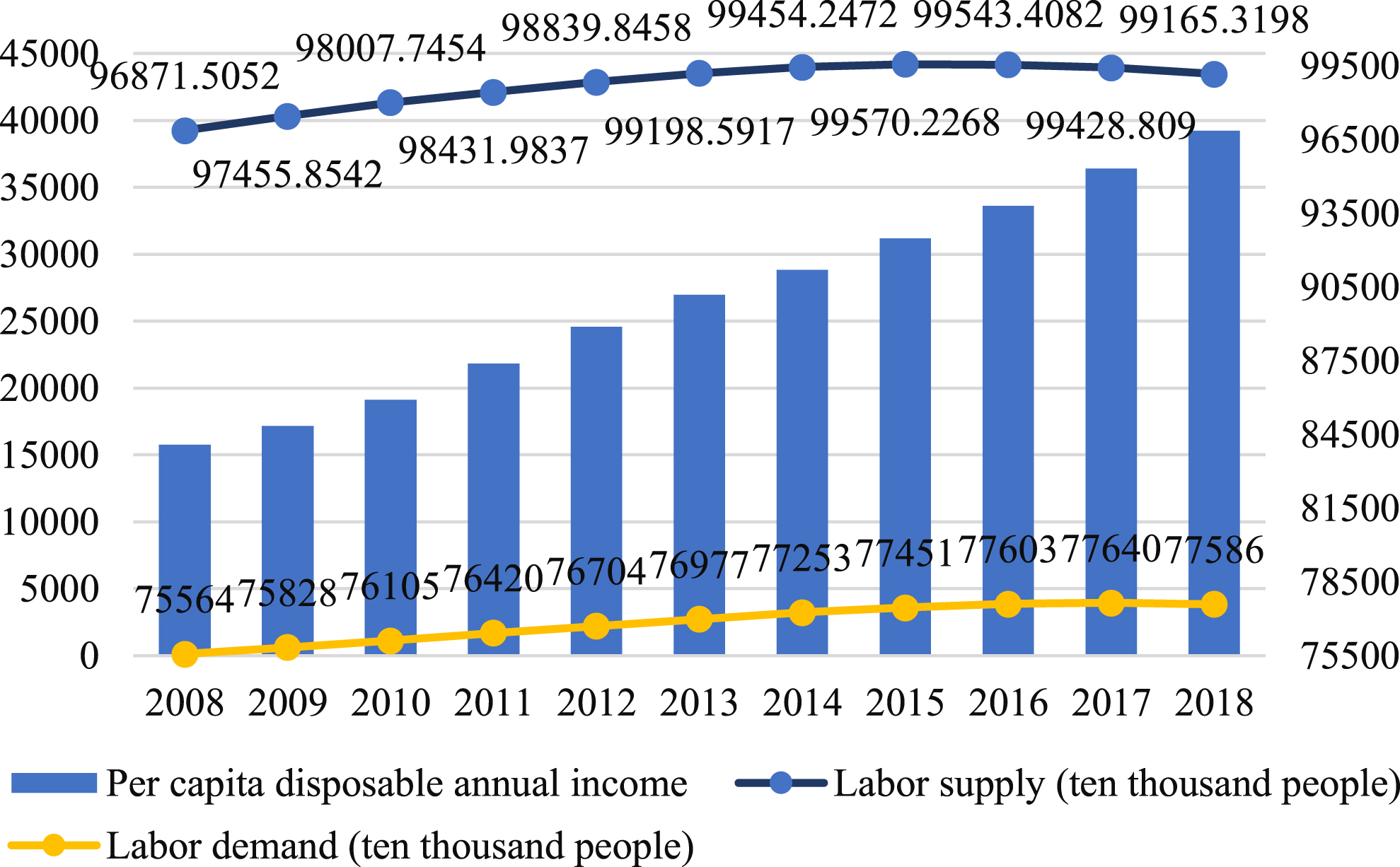
The labor market in China.
Based on the survey for selecting a BDC, how to make full use of regional climate conditions and geographical advantages to reduce costs is a problem worthy of study. Overall, a suitable ambient temperature, humidity, and air cleanliness will reduce the operating costs because different location climate conditions use other air conditioners and fresh air systems. In addition, a sufficient power supply is necessary for the work of a BDC, and therefore, it is significant to select a region that is rich in power resources. In addition to thermal power generation, the power resources can also include clean energy such as hydropower and wind resources.
G1: Mean annual temperature (centigrade)
According to the “Specification” [5], the most suitable temperature of the location chosen for the BDC is between 10 and 20 centigrade, and there are two reasons for this criterion. On the one hand, choose a place for a BDC should consider whether it is conducive to natural cooling under climatic conditions, which depends on the dimensions and altitude of the candidate regions. Since the performance of some devices will be affected when the altitude is too high, it is required that the altitudes of the alternative areas should be lower than 2500 meters. On the other hand, it is necessary to have an effective cooling system because most of the electronic equipment in the data center will generate a large amount of heat during their operation. Overall, it is more suitable to locate data centers in regions where the outdoor ambient temperature is relatively low all year round to reduce the energy consumption of mechanical refrigeration, thereby achieving the goal of saving energy and reducing operating costs.
(2) G2: Amount of hydropower resources (100 million kWh/km2)
To the best of our knowledge, the power consumption of the air conditioning system in a BDC is enormous because 97% of the power consumed by electronic equipment is converted into heat. Therefore, the process of converting heat in an air conditioning system requires a large amount of electricity. There are two operational modes of an air conditioning system: one method is to use the fluidity of the air for heat dissipation; the other mode is to use water vapor evaporation for heat dissipation [8]. Judging from the current refrigeration technology, a refrigeration system that uses a centrifugal cooling-water machine has the highest coefficient of performance (COP) value. A BDC usually uses this type of cooling system to improve the efficiency of machine cooling. However, this system depends on an outdoor wet-bulb temperature to dissipate heat, which requires stable and clean water resources; an area where the water resources are scarce or expensive is not adequate for a BDC. For example, an air conditioning system that uses water vapor evaporation consumes approximately 100 liters of water per kilowatt of electronic equipment each day. In other words, a 10,000-square-meter data center equipped with about 6000 kW of electronic equipment consumes approximately 600 tons of water every day and 200,000 tons of water over a whole year [7]. Therefore, the water resources in the region selected for a BDC that uses vapor evaporation to dissipate heat should be sufficient.
(3) G3: Amount of wind energy reserves (100 million kWh/km2)
BDC belongs to a high-energy-consuming industry; for example, a data center equipped with 100,000 servers requires two or more 50–60 MW power supplies. Moreover, the power load of the data center must be stable. As a result, it should be placed in an area with sufficient energy at a relatively low price to achieve the purpose of reducing operating costs. In addition to considering the cost of the power system, the area where the BDC is located should have alternative energy sources, such as solar energy, wind energy, tidal energy, hydropower, and other renewable energy sources, which is also in line with China’s purpose of developing a green economy. As a typical example, the Norwegian Lefdal mine data center [70], located at 60 degrees north latitude, along the Atlantic coast, is a data center built using abandoned underground mines. There are 350 MW of hydropower and 22 MW of wind power around the data center, with sufficient power resources and a smooth network. The air-conditioned cooling water source is taken from 60 meters below sea level, and the water temperature is maintained at 7°C all year round. It uses siphon technology to draw seawater into the power station of the data center and sends the cooling water to the host room after heat exchange. Using siphon and seawater cooling technology, the PUE of the data center is lower than 1.1. Figures 7 and 8 depict the distribution of hydropower and wind energy resources in China, and the southeast area has abundant reserves of hydropower resources and evenly distributed wind energy resources. The application of clean energy will significantly ease the pressure on the environment caused by industrial development.

Distribution of hydropower resources in China.
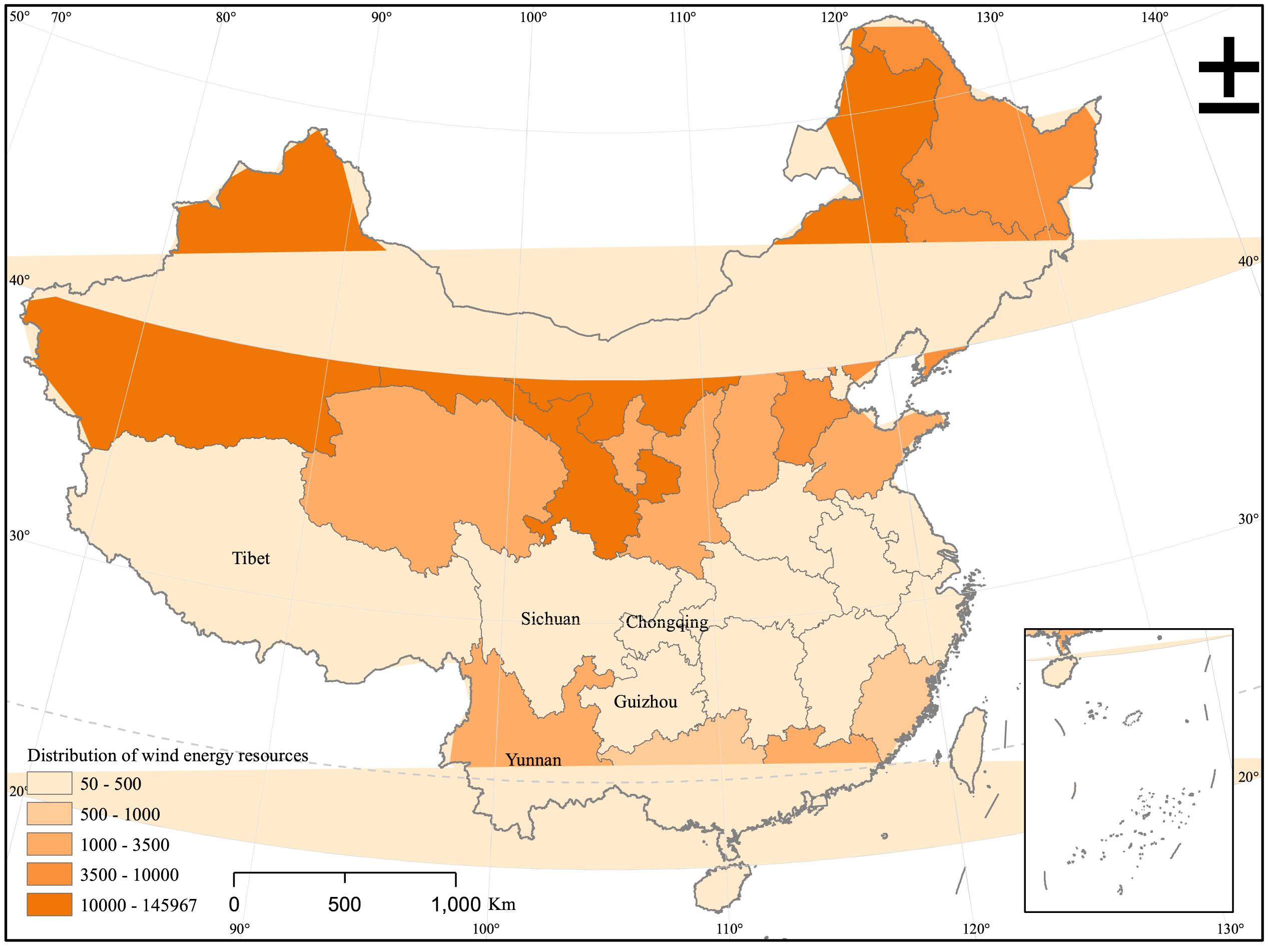
Distribution of Wind Energy Resources in China.
(4) G4: Air quality rate (%)
In the “Specification” [5], the natural environment of the area should be clean. Taking the Japanese IDCF Shriakawa data center as an example, it is in Kitakyushu City, Fukuoka Prefecture, Japan, at 32 degrees north latitude, with a construction area of 45,000 square meters. This BDC uses a chicken-cage architecture design, equipped with a completely new air conditioning system and a closed hot aisle. Wind enters the building from the bottom and exits from the top of the building, making the whole building an air conditioner itself [71]. This type of design has a good effect on energy savings, but it also requires the air quality to be high. Referring to the Japanese IDCF Shriakawa data center, the proportion of days with excellent or good air quality in a year is used to measure the level of the regional natural environment. Figure 9 shows the number of days in a year when the air quality is excellent in each city; the darker the color is, the higher the air quality.
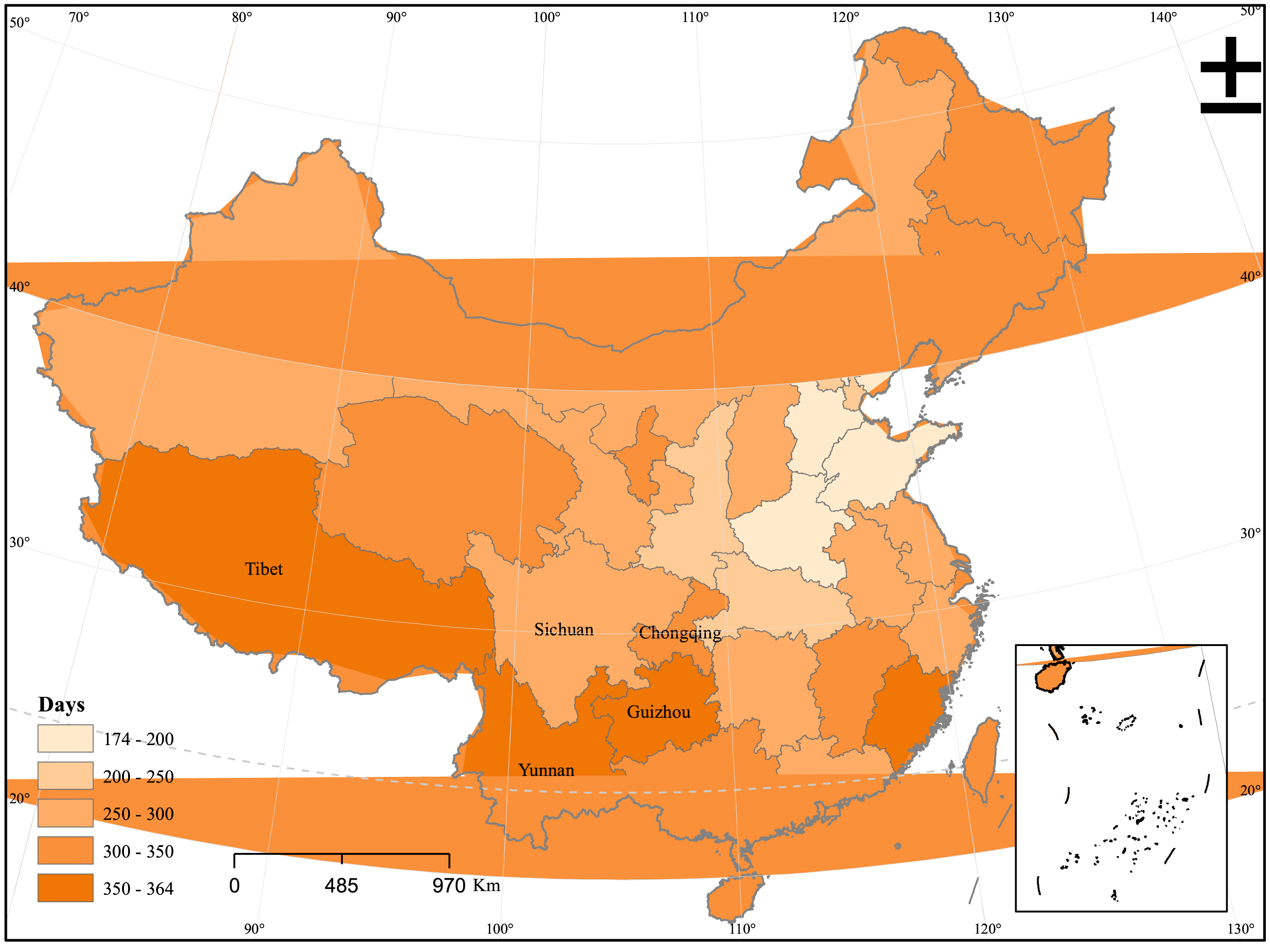
Number of days with good air quality in China in 2019.
(5) G5: Mean annual relative humidity (%)
The discharge phenomenon of static electricity is a typical “invisible killer” in the electronics industry. It will occur at a specific moment when the internal and external conditions are met. IT equipment consists of many chips and components that are very sensitive to static electricity, and different electrostatic sensitive devices have different threshold voltages. If the humidity of the air is too low, then the actions of the staff are prone to generate static voltage, which results in severe electrostatic damage. The air humidity affects the life of the electronic equipment; when the relative humidity is 30%, the electrostatic voltage is 5000 v; when the relative humidity is 20%, the electrostatic voltage is 10,000 v; when the relative humidity is 5%, the electrostatic voltage can be as high as 20,000 v [72]. However, if the moisture in the equipment room is too high, then the insulation performance of the air is reduced. The humidity in the air adheres to the surface of the insulation material, which reduces the insulation resistance of the electronic products. The risk of having leakage current from the equipment is significantly increased, resulting in significant accidents. As required in the “Specification” [5], the relative humidity of the environment around the BDC should not exceed 60%.
(6) G6: The value of the net flow in PROMETHEE
Net flow is a comprehensive index to depict the priority of different alternatives; by applying this index as the coefficient of an objective function in MCGP, the general situation of the economic development in the candidate regions can be determined to select the most suitable location while expecting the best economic growth to achieve the maximum efficiency.
Description of the problem
For a MCDM problem, let C = (C1, C2, …, C a ) be criteria set, for a MCGP problem, let G = (G1, G2, …, G b ) be a goal set. Let x = (x1, x2, …, x m ) be an alternative set, w = (w1, w2, …, w m ) be a weight vector set. Generate the original matrix C and matrix G. To avoid the influences of the different dimensions and units of measure on the criteria and goals, the original matrices should be normalized into a ratio scale as Normalized C and matrix Normalized G. Let φ+ be the leaving flow, φ- be the entering flow.
PROMETHEE method
Before the method elaboration, some comparisons between several frequently used MCDM methods should be listed to make comparisons. Table 2 concludes some advantages and disadvantages of different ways.
The advantages and disadvantages of MCDM methods
The advantages and disadvantages of MCDM methods
Based on the previous comparison, the PROMETHEE method is one of the MCDM approaches to sort the alternatives. This method can reflect many properties of attributes with less information loss [73]. Moreover, the method can adopt lots of preference functions to evaluate alternatives based on the values of each criterion, especially in the field of site selection. It offers a novel idea about comparison among different options that are difficult to distinguish. The main idea of this method is to make full use of the outranking principle to rank and decrease the complexity of calculation at the same time. Brans [39] has proposed six common types of preference functions (acts as membership functions) to facilitate the selection: General criterion, U-shaped criterion, Linear indifference interval criterion, Linear criterion, Multi-level criterion, and Gaussian criterion. This paper utilizes Gaussian criterion to obtain the value of P j :
Where A i and A k are any two alternatives, P j (A i , A k ) is defined as the index to measure the distance d j between alternatives A i and A k , d (A i , A k ) should be calculated before as f (A i ) - f (A k ).
Then, π (A i , A k ) is used to represent the priority of A i to A k :
Where ω j is the weight attached to different attributes, π (A i , A i ) = 0, 0 ⩽ π (A i , A k ) ⩽ 1, 0 ⩽ π (A k , A i ) ⩽ 1, 0 ⩽ π (A i , A k ) + π (A k , A i ) ⩽ 1. It is observed that, if π (A i , A k ) ≈ 0, A i is weaker than A k ; if π (A i , A k ) ≈ 1, A i is better than A k .
Leaving flow:
Entering flow:
And net flow:
The leaving flow, entering the flow, and net flow indicates the priority between candidates. In general, the leaving flow represents how much a i is better than other alternatives, the greater the value, the better the a i . The entering flow indicates the degree to which other candidates are superior to a i . Contrary to the leaving flow, the smaller the value of entering flow, the better the a i . Moreover, the net flow is a comprehensive index to depict the priority of different alternatives, a i is better when the value of φ (a i ) is larger. Finally, the ranking of all plans can be obtained by comparing the net flow values.
To obtain the weight vector of alternatives, the maximum deviation method [74] is used for expanding the differences between attributes and make the ranking order clearer and easier to understand.
Let A i and A k be two arbitrary alternatives and the distance function d (A i , A k ) is Euclidean distance. The mathematical programming model to obtain the weight can be constructed as:
The Lagrange function is used to solve the model, and the result can be easily obtained as:
The GP method is originated with the work of Charnes and Cooper [75]; it is an important technique to find a set of satisfactory solutions to MCDM problems. It was further developed in the subsequent decades using various types of methods. Since then, many GP variants have evolved, such as Weighted GP, Minmax GP, Lexicographic GP, Interval GP, Fuzzy GP, and Stochastic GP. [76, 77]. The main idea of GP is to minimize the deviations between the goals and their aspiration levels [78], rather than the values of the criterion functions themselves. Notably, the model can be converted into a linear programming (LP) model by replacing the objective with linear constraints. However, the aim of GP is to minimize the total deviations from the desired goals, while the purpose of LP is to minimize the objective function directly, and the implications of these two approaches are distinct. Considering that GP can address models that involve multiple goals, the concept of MCGP is proposed.
In real life, many decision/management problems can involve multi-choice aspiration levels (MCALs); these aspiration levels indicate different levels of optimism. For example, a person who wants to buy a television might say, “I expect the price to be no more than 170 $; I would be content with 150 $, and I would be very happy with 120 $. In addition, I will also account for the features of the different kinds of television”. This uncertain/imprecise description is a typical multi-objective decision problem (MODM) with MCALs. Different aspiration levels are added to make it possible for a decision-maker (DM) to choose the most suitable alternative. To address these MODMs, a novel method, the MCGP modeling approach, was proposed by Chang in 2007 [26]:
Where
This model allows DMs to set MCALs for each goal to avoid underestimating the decision; one purpose can be associated with several discretely spanned aspiration lels. However, this expression leads to difficulty in implementation, and it is difficult for industrial participants to understand it concerning practical problems. In 2008, Chang proposed the revised MCGP approach to improve the efficiency of the initial MCGP [27]; the newly proposed method did not involve multiplicative terms of binary variables and can easily be solved by common linear programming packages. In addition, with the new concept of upper gi,min and lower gi,max bound of the ith aspiration level, y i is introduced to the MCGP-achievement. Therefore, the achievement function of the revised MCGP can be formulated according to the following two alternatives [27]:
In the revised MCGP model, shown in (13) to (24),
The proposed method is implemented in two phases, as shown in Fig. 10. The first and most important thing is to determine the indicator framework based on a literature review and the “Specification” [5]. Then, the PROMETHEE method and MCGP model are applied. Phase I uses the PROMETHEE method to evaluate the five economic factors and generate the net flow values, and the evaluation result will be added to the next stage as one of the objectives. Phase II integrates the evaluation value of Phase I with natural climate environment factors and energy resource elements. The steps of the integrated method can be summarized as follows:
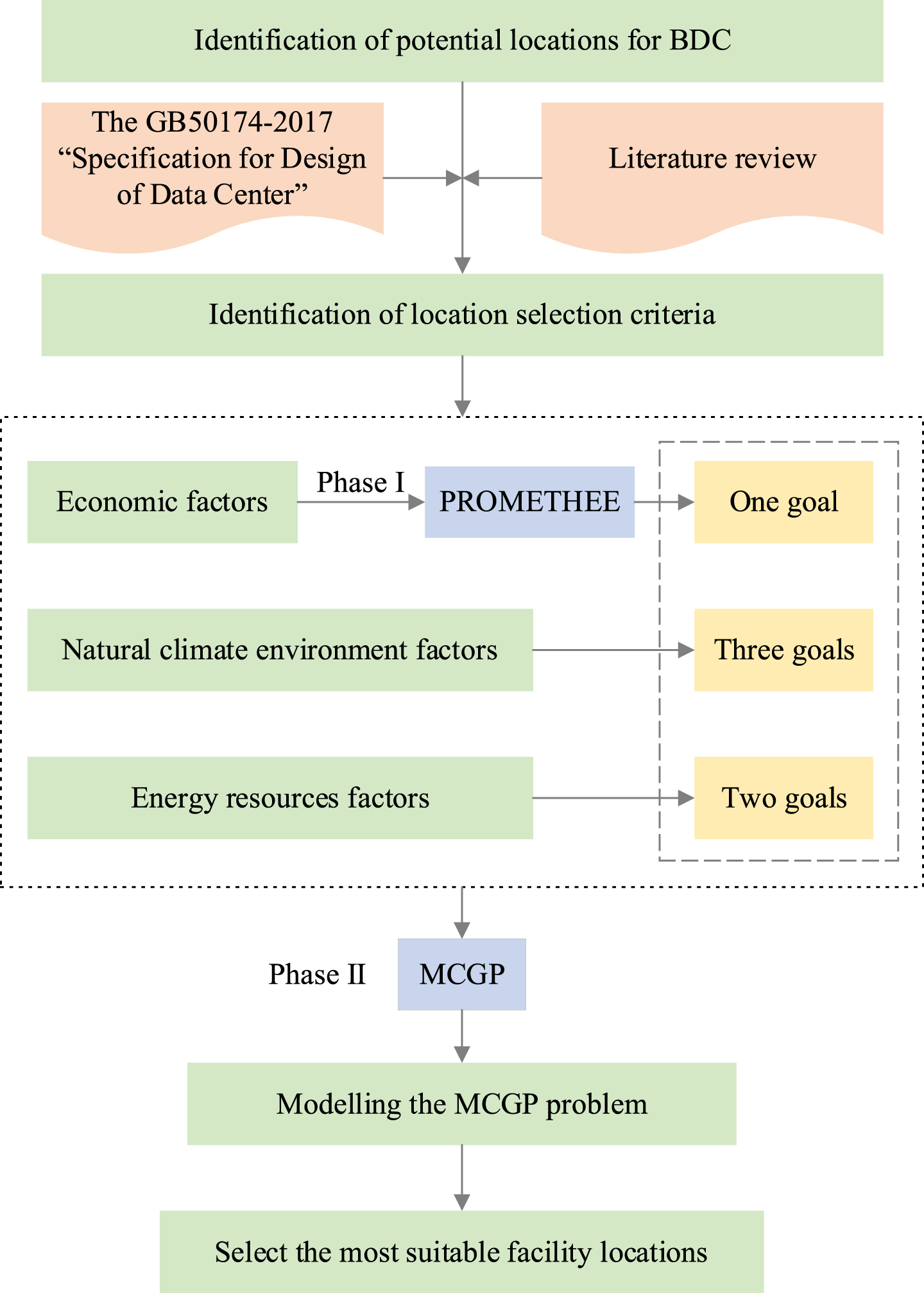
The procedure of research.
Phase I mainly uses the PROMETHEE method to access the economic factors, and the result generated from this stage is the evaluation results of the alternatives. Then, the results of the quantitative analysis are modeled as one of the multi-goals in the next phase. In summary, the entire economic evaluation is the first goal of the MCGP model.
With the gradual advance of the “Internet + ” strategy announced by China in 2015 [45], the new generation of information and communication technology represented by the Internet, big data, and cloud computing has become the mainstream of the current IT infrastructure. In deep and cross-border integration with various economic and social fields, it promotes a new round of global scientific and technological revolution, which has become the core content of the revolution in the new era. To meet the crucial needs of the China National Big Data Strategy, the application of the “Internet + ” model has become an essential part of China’s economic and social development. With the development of digital communications and the IT industry, network models and network application types are also evolving, which gives rise to the market demand for big data services. The market demand directly drives the construction needs of BDCs for Cloud Computing, which is the primary resource of supporting facilities. The data explosion in recent years has also led to rising demand for big data processing in modern data centers, which are usually distributed over different geographic regions [79]. Big data analysis has excellent potential in unearthing valuable insights from data to improve decision-making efficiency and to develop new products and services. Big data has already translated into large prices in videlicet due to its high demand for computation and communication resources [80].
We consider that BDC has the characteristics of requiring a large area, a large amount of investment, high technical requirements, and significant energy consumption. It is irreversible once a project is completed. In addition, many factors should be considered during the construction and operation process; almost all BDCs have experienced a long time of demonstration and research before being put into use. Therefore, establishing a set of scientific and feasible location evaluation indicators is of great significance to guide the construction of such projects. Section 3.1 has illustrated the selection of indicators in detail, and this section will describe the application of the proposed method to selecting a suitable place for building a BDC.
Research area and data source
China has three major big data central bases: the central base –Beijing, the southern base –Guizhou, and the northern base –Wulanchabu. The location selection of BDCs involved in this research focuses on the southern area: Shapingba, Chengdu, Guiyang, Kunming, and Lhasa, representing five southwestern provinces of China: Chongqing, Sichuan, Guizhou, Yunnan, and Xinjiang. These five provinces are stipulated by the state. Similar methods can be applied in the other two areas. Therefore, the research model of Southwest China can be replicated to the other two regions. Considering that data center in Guizhou has been constructed in 2015, the used research statistics were collected in 2015. The sources of data used in this study are mainly from the China Statistical Yearbook (2015-2016), Statistical Yearbook of various places, China City Statistical Yearbook (2015–2016), China Renewable Energy Development Report (2016), and so on. According to the indicators determined before, the collected data for the criteria in MCDM and the goals in MCGP are shown in Tables 3 and 4, respectively.
Criteria in MCDM problem
Criteria in MCDM problem
Goals in MCGP model
Normalized values of criteria in PROMETHEE problem
Normalized values of criteria in PROMETHEE problem
Normalized value of goals in MCGP model
According to
The values of various flow
Note that the values of G6 are calculated based on
The related functions and parameters are listed below:
(Mean annual temperature goal, the less, the better)
(Amount of hydropower resources goal, the more, the better)
(Amount of wind energy reserves goal, the more, the better)
(Air quality rate goal, the more, the better)
(Mean annual relative humidity goal, the less, the better)
(Evaluation value of PROMETHEE, the more, the better)
No penalty weights are assigned in this problem. The normalization process for the data does not need to distinguish whether the attribute of the indicator is cost-based or benefit-based because the value of the auxiliary continuous variables y i can control the requirements of the DM. Based on the proposed models, this problem can be formulated as:
To verify the feasibility and validity of PROMETHEE used in
Comparative analysis
Comparative analysis
It is noted that the ranking orders of five alternatives in
According to the calculated results, Guiyang is the selected city for the location of a BDC. Site selection of a BDC is a complex problem because various factors must be considered simultaneously, and Guiyang does have the advantage of building a BDC. First, the ecological environment and climatic conditions in Guiyang are in line with the requirements of precision manufacturing research and development. The average annual temperature is 15 centigrade and in summer is 24 Celsius; moreover, the air quality is high. The altitude is moderate; thus, the ultraviolet radiation level is not high in Guiyang. In addition, there are few significant disasters, such as earthquakes and typhoons, that have occurred there because the geological structure is stable and safe. Therefore, the safety of the information network equipment can be ensured. Second, Guiyang provides the development of the elements of the BDC. On the one hand, Guiyang has a wide variety of energy sources, and Guizhou Province is the origin of the “West-East electricity transmission” project. Abundant power resources ensure the stable operation of the BDC. On the other hand, in terms of a transportation network, Guiyang is an important transportation hub in the west of China, especially in high-speed rail. Third, Guiyang has a solid industrial support foundation. Since the 1950 s and 1960 s, Guiyang has formed three major systems, aviation, aerospace, and electronics, based on the three military industries. Thus, the development of the electronics industry has a solid foundation. With the rapid growth of Guiyang’s aerospace electronic equipment industry, the independent innovation capability of the industry has been greatly improved, and Guiyang’s electronic information industry chain has been continuously improving, while its supporting capabilities for the big data industry have constantly been improving. Considering these practical conditions, Guiyang is a suitable place for the BDC site selection.
On July 9, 2015, the first national data center was located in Guizhou. The decision-making results of this paper have corroborated that Guiyang is the most suitable place for location. As five criterion and six goals proposed in section 2 are based on the practical requirements of BDCs construction, the result is in line with the reality.
With the explosive growth of demands on data processing, a heavy burden is imposed on computation, communication, and storage in data centers. Site selection of BDCs is a pivotal issue because the selected location with suitable natural conditions and an excellent social environment can reduce operating costs as much as possible from an objective perspective. To help evaluate the five candidate cities in the southwest of China, an integrated method combing PROMETHEE and MCGP is proposed. First, the indicators that influence the location of BDC are classified into economic factors, natural climate environment factors, and energy resources factors according to the previous documents and “Specification”. After describing the meaning of each indicator and the high relevance to this research, the PROMETHEE method, raised from the MCDM framework, is used to evaluate the economic factors. Then, the evaluation result generated from the PROMETHEE method, the net flow values, are added to the subsequent MCGP decision-making progress as one of the objects.
The proposed integration model is applied to the site selection of BDCs in the five southwestern cities of China, and the result shows that Guiyang is the most suitable place for location. Combing the PRMETHEE method and MCGP model can make the best use of resources to achieve the most appropriate solution. Moreover, the MCGP model can change the aspiration level, and there is no need to fix individual expectation values, making the model more convenient to solve practical problems. Empirical studies have verified the applicability and flexibility of the model, and it can also be used to solve other similar practical issues in the future. Future research can consider incorporating fuzzy techniques into mathematical representation to avoid the problem of judgment blurring. In addition, researchers can consider combining Dempster-Shafer’s evidence theory with the proposed model to reduce the number of criteria comparisons and achieve a more objective direction.
Declaration of Competing Interest
None.
Footnotes
Acknowledgments
This research was funded by the China Natural Science Foundation (No.71974100), Natural Science Foundation in Jiangsu Province (No. BK20191402), Major Project of Philosophy and Social Science Research in Colleges and Universities in Jiangsu province (2019SJZDA039), Qing Lan Project (R2019Q05) and Social Science Research in Colleges and Universities in Jiangsu province (2019SJZDA039).