



Abstract
With the rapid developments of data restores and big data technologies in recent years, it aims at applying new technologies in the new stage of smart hospital development and improving scientific and proper management level of hospitals. Based on the constructions of hospital data centers and applications of Internet of things with big data technologies, hospitals can achieve intelligent operations and managements in daily work. With the aids of constructions of the data centers and mass data brought by smart hospital service models, smart management decision-making supports are effectively provided for hospital managers. Through continuous progresses of smart hospital constructions, the operations and managements of hospitals are increasingly dependent based on the supports of the data from the data center in hospital, which form the key in the smart operation and management of hospital in future.
Introduction
In recent years, constructions of electronic medical records and data interconnections in medical institutions has greatly been promoted in domestics, and the information levels of medical institutions has also significantly improved in the decades. With the continuous developments of Mobile Payments, Internet of things, Artificial Intelligence and other new technologies [1, 2], it provides related technical primary elements for the construction and application of smart hospitals [3]. In 2018, China issued a number of guidelines to promote the construction of “Internet & Medical Care”. Such as the notice on carrying out “Internet & Medical Health” convenience in-depth and the benefit activities, and the opinions on promoting the development of “Internet & Medical Health”, which mentioned that the step application of “Internet
As we know, the construction of hospital information system includes hospital information system (HIS), laboratory information system (LIS), radiology information system (RIS), picture archiving and communication system (PACS) and other clinical systems with the architectures of some adopt client/server (C/S) and browser/server (B/S); however, because of the eminent problem of database heterogeneity with different systems, constructions of different systems depend on actual application scenarios without a unified plan and foundation, so as to form a large number of “information islands” in the process of hospital information business.
The framework of the smart hospital data center
Traditional hospital data centers usually extract patients’ information of diagnosis and treatment distributed in clinical information systems (HIS, LIS, RIS, PACS), HRP (Hospital Resource Planning) and the other hospital management systems into the hospital enterprise data warehouse through ETL tools [5]. Through the unification technology of attributes, the processing of invalid values and missing values, heterogeneous data from different systems are unified as a same type or style. In Final, it is presented through the front-terminal display tool for providing data support for operation decision-makings of clinical and administrative managers at all levels in hospital. Hence, traditional data center is only used as a data pool to collect data from heterogeneous systems, and provide data results of different granules or statistical approaches according to the demands of clients, and the architecture of a traditional hospital data center is manifested in Fig. 1.
The framework of a data center under the traditional information architecture in hospital.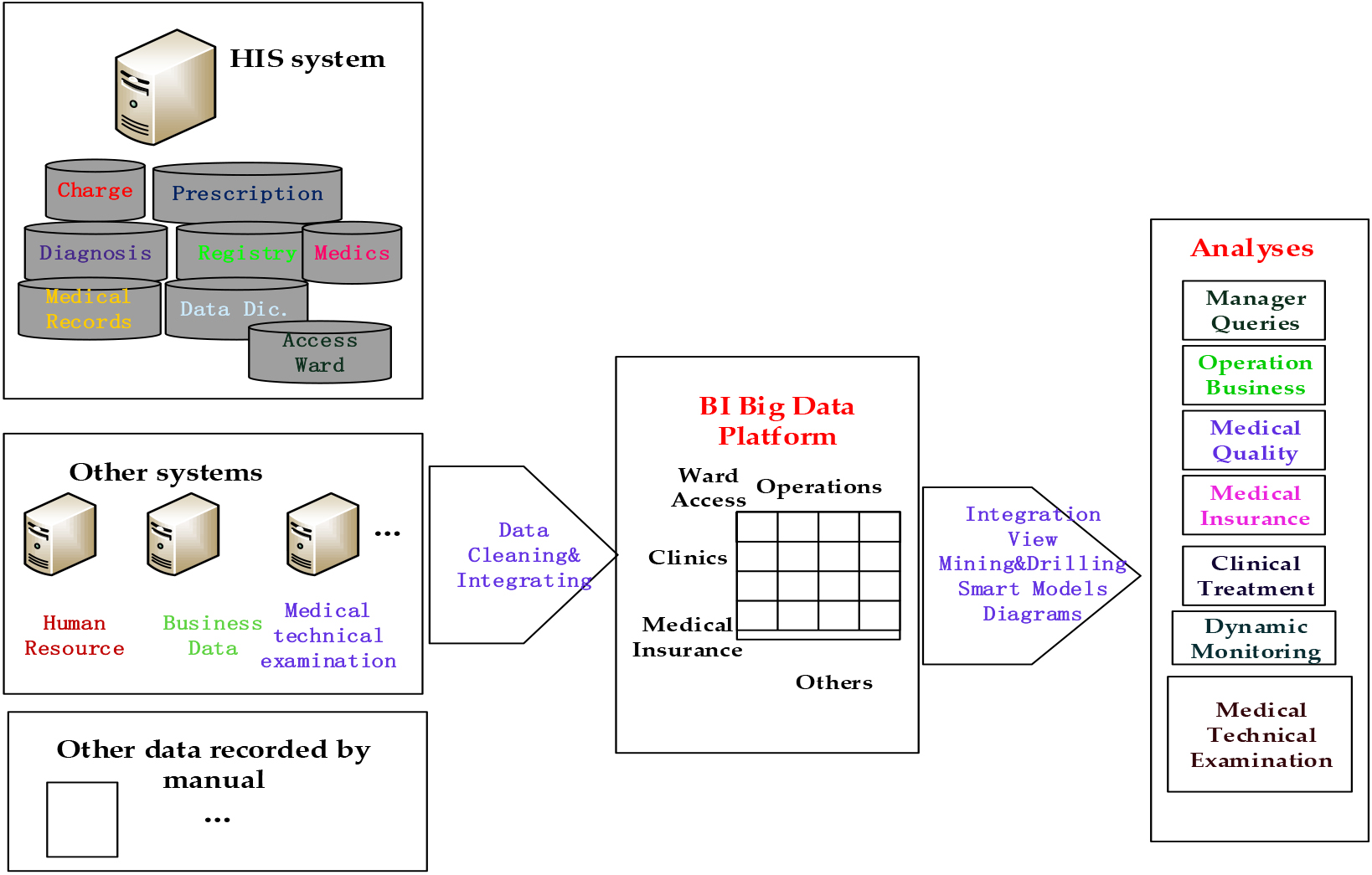
And the data generated by medical activities are not reasonably integrated, with plenty of non-standard and inconsistent data,it still results in the lacks of data supports for the management or operates in hospitals. So it is very important to build a medical data center based on based on the business scenarios of hospitals. Aiming to achieve the data fusion of data center, governance and mining applications, normalize hospital data, and manage medical data with artificial intelligence technology, so as to improve the availability of data and establish a high-quality data resource library. Totally, the basic construction of the hospital data center includes: management design of the enterprise master patient index (EMPI), master data management (MDM), intelligent Extract-Transform-Load (ETL) system and metadata management.
Each hospital business system comes from different providers, owning different architectures, data formats and coding, so it impossible to share patient information and clinical information of different systems. At the same time, inpatients take hospitalization number as the identification, run through the entire hospitalization process and integrate patient diagnosis and treatment information. Outpatients take the clinic number of the current visit as the identification, run through the entire outpatient process and integrate the diagnosis and treatment information as a single outpatient flow. Because of the time expiration of outpatient visit number, the outpatients’ visit records become “dead files”. In addition, a patient usually owns different inpatient and outpatient numbers, it is difficult to integrate and share the inpatient and outpatient information.
And EMPI mainly realizes:
Merge the duplicate patient records to generate the records through the unique patient identification rules; Generate a unique ID for each unique record for identification; Manage the MPI through an independent system; Support the management of multiple types of index information of patients and employees; Provide multiple standardized interface mode interacts with external systems; Provide batch data loading function to read, analyze, standardize and register the original patient data for forming the primary index original database.
Through the construction of EMPI, ID identifications of patient are established, and duplicate patient records are merged to generate the unique record; which realizes the information sharing of outpatient and emergency, inpatient, lab and physical examination and other systems, makes the patient data interaction between systems in standardized approaches, and lays the foundation for the construction of a full view system for patients.
Master Data Management (MDM) refers to the shared data between hospital internal systems, which consists of data entities and data dictionaries. As the main data that can ensure the data consistency among hospital systems including a few data entities, the overall statistical data cannot be obtained and there is no unified data dictionary for each system. The MDM is used to define the data range and formulate standards, establish a standard system to provide the necessary semantic guarantee for interoperability, and implement unified management on basic data such as patients, medical staffs, departments, medical orders, and related master indexes. It achieves an unified access and application of hospital dictionaries, terms, and standards. Standardized master data is the basis for mutual identification, integration, effective interaction, data sharing and analysis between different systems, so as to achieve the data exchange of semantic level standardization between systems. Through the construction of MDM system, data about hospital medical staffs, departments, national standards, and clinics can be in standardized management, and a unified and unique data standard can be built for keeping the correctness and unity of data. Following unified and standardized data, centralized storage and maintenance can greatly improve the systemic maintenance efficiency, prevent occurrences of confusion of object names, complex development interfaces, and useless duplication.
Intelligent ETL system
The process of data extraction, conversion and loading is completed through intelligent ETL system. It focuses on developing and managing the corresponding data engines for different database types, such as Hbase, Hive, SQL Server, and so on. Aiming at different business data, it develops and configures data extraction components for different data extraction logics, such as components of input/output, SQL executor, data merge for meeting the application scenarios. Through the construction of ETL system, it produces a more efficient process of data governance, and it ensure the maximum performance of the system through visual interfaces for making ETL process more intuitive,and guarantee the quality of ETL process data and data tracking.
Metadata management system
Metadata refers to data information in a database,that is “Data about data”, which can be recognized as a group of information used to describe data. All data and information of metadata describe and reflect characteristics of business data. Through the metadata management system, it is available to analyze the attributes of business data, make business data active and reliable, and ensure the standardization, integrity and accuracy of business data. Aiming at constructing a big data hospital integration platform, it mainly includes: business replication library, clinical data repository (CDR), operational data repository (ODR), research data repository (RDR), industry standard library, multidimensional data set and knowledge base. As the core of the platform, the data is extracted to the replication library, and then the data is extracted through extraction transform load (ETL) technology and saved to the CDR, ODR and RDR data centers.
Following the rapid development of smart hospital establishment, traditional hospital data centers gradually fail to meet the actual demands of hospital managers at all levels. Based on the original data center, combined with the demands of smart hospital construction and development, it is necessary to improve data collections of new constructed systems by the smart hospital data center according to the management needs of daily work. Based on the patients’ personal identity authentication as a main index, a data set with patients treatment data in the whole processes is built up as the core formed in the data center [6]. Through the application of Internet of things and big data technologies, an management platform is built on the data center for monitoring and managing the status data of daily operations and businesses, the energy consumption in routine; such as the online data of intelligent devices in hospital, for ensuring the normal operation in hospital. Furthermore, it helps the hospital to significantly improve its quality, operation safety and efficiency in clinical services based on the data collection originating from the device terminals. Meanwhile, by using artificial intelligence technologies such as machine learning, neural network and medical natural language processing, medical information of management data knowledge are extracted and explored in the data center and react on the clinical information systems for achieving the goal of medical knowledge maps assisted diagnosis and treatment [7].
Based on the idea of a new data platform for the purpose of achieving a future smart hospital, the platform is mainly divided into three layers: a unified storage base, a variety of analysis engines, and business applications. At the same time, it provides a safety assurance and standard specification system, its architecture needs to be supported by an intelligent data platform,and the overall design of the intelligent data platform is shown in Fig. 2.
The architecture framework of intelligent data center of smart hospital.
Functions of intelligent data center include: data analysis, exchange and integration, exhibition and resource base, such as clinical big data center or scientific research big data center, and the other related module parts. Through the importation of various data tables related to clinical scientific research, such as HIS database and EMR database into the initial chief database of the data platform, and according to the unified model transformation and the quality control and cleaning of data, it is available to achieve the overall hospital data collection and aggregation. By employing big data governance based on artificial intelligence technology, the constructions of three major health databases in major hospitals are due to accomplished: the clinical database, the operation database and the scientific research database.
In the hardware layer of the platform, the separation architecture of big data storage and computing collaboration is used,and it refers to the separation of Hadoop clusters into two node clusters: computing and storage nodes:
It allocates clusters and nodes for computing services to keep storage independent. The storage node cluster operates through a distributed storage, and uses the original the HDFS (Haadoop Distributed File System) protocol for replacing the local HDFS file management system in the previous big data server.
In the initial development stage of smart hospitals, it mainly achieves the information transformation focusing on the data exchange links in the original hospital processes, through the functions of appointment, patients face recognition, intelligent guidance and navigation, self-service registration and payment, so as to build an efficient and convenient patient treatment process [8]. In this process, through the identity authentication, face recognition and other technical approaches, the previous problems in obtaining the patients treatment information are improved, and it upgrades the data quality of the overall business data in hospital, which builds the foundation for future applications of data center in diagnosis and treatment scenarios of patients.Besides, based on the information construction of the business processes in smart hospital, the management department can analyze the utilization of the consulting rooms, doctor scheduling, the patients’ historical treatment flows and the patients’ appointment information through the data center, which fits a dynamic adjustment in the doctor scheduling, optimizations the utilization efficiency of resources, and improves the patients’ service experience and clinical satisfaction in hospital. And the feedback data of operation status acquired from self-service terminals, and medical equipment through the data center,a detailed analysis report can be provided to maintenance staffs for a optimistic maintenance in real time.
Design of hospital data center integration platform
CDR
On the basis of standards and specifications, all data generated from clinical activities are extracted, converted, cleaned and transferred to standardized CDR data model through CDC, ETL and the other technologies to form a convenient clinical data set organized by field. The implementation of data fields includes: patient information, medical orders, examinations, examinations, pathology, surgery, medical records, medical records, clinical paths, and so on. It involves the data fields of collection, cleaning, transcoding and loading, covers various business systems such as HIS, LIS, RIS, PACS and EMR, heterogeneous databases with Sql server, Oracle, and includes historical and real-time data. After the completion of the clinical data center, it provides more comprehensive, standard and accurate data support for medical quality indicators for a full view of patients, and which forms decision support for clinics. Through CDR, various quality control indicators can be reminded and analyzed through the event, so as to analyze the problems behind the indicators, solve them from root causes, further improve medical qualities and reduce medical risks.
ODR
On the basis of standards and norms, all data generated from hospital management activities are extracted, converted, cleaned and transferred to the standardized ODR data model through CDC, ETL and other technologies to form a convenient management data set organized by field. The implementation of data fields includes personnel, materials, costs and pharmacies, involving the collection, cleaning, transcoding and loading of hundreds of data fields. It covers business systems such as HIS, personnel, materials and equipment, and the data time range includes historical data and real-time data since informatization. The hospital operation analysis system is based on the integration and presentation of data in the medical data center. It monitors the relevant indicators of hospital operation and conducts in-depth analysis from the dimensions of clinical business, efficiency analysis, income analysis, disease analysis, surgery analysis and resource analysis. While intuitively understanding the operation of the hospital, it supports the establishment of early warning settings for key indicators. Through the construction of this system, various operation management indicators can be displayed and analyzed To improve the fine management level of the hospital.
RDR
Constructing a research-oriented scientific research database, which covers data in various fields of science and education. Implementation services of RDR include baseline, follow-up, research objects, researchers, projects, sample data and so on, and the database is employed to support the developments of multiple center researches. The scientific research data center provides more comprehensive, standard and accurate data support for clinical big data search engine, and other scientific research related systems. It includes the following data fields:
Scientific research disease database, research object database, disease database, and so on; Information database, information of retrospective study, information of prospective study and information of disease category; Scientific research sample library, science and education sample information, sample storage location information; Scientific research project library, scientific research project information, scientific research personnel information, scientific research funds information,and so on. Through the construction of RDR, it is probable to search the data demanded by clinical doctors, provide aids for scientific research, and improve the utilization of data.
1. Clinical diagnosis, treatment and medical quality management
(1) Clinical diagnosis and treatment. Through the full view construction of patient and clinical aid decision support based on data center, it is helpful for improving clinical diagnosis and reducing treatment risks.
(2) Medical quality management. By establishing the medical quality monitoring management based on the data center, it is available to analyze and manage the quality control indicators, as to lower down the incidence of medical accidents. Through the adjustment and control of inpatient indicators, it can further reduce the patient’s diagnosis and treatment costs, improve patient satisfaction, ease the doctor-patient relationship.
2. Operation and scientific research management
(1) Operation management. Through the construction of the full view system for medical staffs based on the data center, it can improve the management level and hospital decision-making level of among staffs financial costs, and clinical materials.
(2) Hospital scientific research and development. The establishment of big data search engine and clinical research based on the data center can improve the scientific research efficiency and quality of researchers. In terms of hospital development, the establishment of the medical big data center can integrate and use the extracted data of the hospital, perform to the values of data, and make the scattered data laying the foundation for the construction of digital hospitals and smart hospitals.
The continuous development of smart hospital is more about empowering medical services through information technologies, liberating human resources or staffs from complicated operations in daily work, so as to focus on disease treatments and medical researches. Based on NLP (Natural Language Processing), DP (Deep Learning), NN (Neural Network) and the other artificial intelligence technologies [9], combined with clinical medical orders, diagnoses, inspection reports, EMR data [10, 11, 12], image pictures and so on, the post standardized processing of medical conclusions can be realized for helping doctors and nurses complete the inputs of diagnoses, medical orders and EMR records, safety verification and other daily work. And the data center is not only limited to the summary and statistical analyses of data, feeding back to the medical management department in medical quality control reports, but also empowering through artificial intelligence, simulating as a professional general practitioner, adding prompt aids in all steps or links of medical treatment, for example, aid diagnosis (image, knowledge base), intelligent examination in prescription, intelligent pharmacy, drug traceability and the other process management, which formulates a close combination of management and clinical practice, and achieves the process management of medical quality [13], as it is shown in Fig. 3.
The management process of smart hospital.
The improvements of medical data qualities as the key focus
With the applications of standard digitalization as the foundation, it undoubtedly requires much higher data qualities than those of in the past in smart hospitals. And the data in smart hospital, it demands that each patient’s EMR records, such as: physical examination records, medical treatment records, ward medical records and the other medical related data formulate a unique PHF (Personal Health File), and it employs personal identity authentication with medical insurance cards, medical treatment cards, ID cards as the accesses to the PHF. At present, EMR have endowed great convenience to healthcare professionals in recording patients’ conditions. The template design approach of EMR has indeed improved the efficiency of physicians’ writing to a great extent, The current EMR will provide many templates, and the doctor only needs to choose the appropriate template to fill in some specific details about the condition. And EMR is used to manage the personal health status data of patients, which involves the collection, storage, transmission, processing, and utilization of patient information. It standardizes healthcare staff’s medical behaviors, reduces medical errors, and improves the quality of healthcare services, and it also has outstanding performances in the aspects of experiences in the clinic for patients. Meanwhile, the inforrmatization of medical records is critical in the construction of hospital information systems. Therefore, EMR is the foundation of hospital digital and the personalized development of medical health information. And the latter digital medical services depends on ensuring high-quality data through the proposed data center. In the early development stage of digital hospital, medical institutions have to improve personal identity authentications for ensuring the consistency and integrity of PHF data, which is the key issue to the interconnection of regional medical data and the achievement of the construction of smart hospitals [14].
Integration of traditional hospital system and Internet platform, and the challenges
Notwithstanding, the vast majority of medical resources in China are concentrated in public hospitals, however, the information systems of most public hospitals often run or work in the Intranet environment, and the management mode is very different from that of other industries [15]. Medical services are endowed with the characteristics of public welfare, and strict access mechanisms. At present, the service mode of hospitals in China still lacks accesses permissions in medic scenarios,especially in Internet medicine services, it only includes the services of online consultations and drug prescriptions. More professional medical services such as examinations, inspections and clinical operates must be carried out in professional medical institutions. So, the establishment of communication channel between internet medical platforms and hospital systems still performs as a critical problem to the data integrity of data center. And in recent years, information security incidents have occurred sometimes in healthcare. With the deepening development of the applications in smart hospitals, more digital medical devices will be connected or access to the intranets in hospitals [16]. HIS plays as an indispensable part of hospital operation businesses and processes. In future, medical information security and data security will inevitably face greater challenges, such as network protection, data security or protection, and so on. For modern hospitals, the construction of smart hospital projects have to focusing on the issues of medical information security, and place the information safety issues as the most important topics.
Testing results of Smart Hospital Data Center
The application of the proposed system in the medical ultrasound department lasted from October to November in 2022 for testing classification in decision support of the proposed Smart Hospital Data Center, during the four weeks with the month, a total of 308 patients have been introduced for the test. And we can see the classification accuracy of Smart Hospital Data Center keeps raising during the testing weeks, and performs an improvement of 5–20% in classification, which is figured in Table 1 and Fig. 4.
Statistics of classification accuracy rate of Smart Hospital Data Center
Statistics of classification accuracy rate of Smart Hospital Data Center
Accuracy of classification rate (%) of Smart Hospital Data Center on different week points.
Aiming at the goal of constructing a smart hospital in future, the constructions of medical information in domestic hospitals continue to speed up, which figures out the higher requirements and demands for medical information practitioners. By analyzing the shortcomings of the traditional data platforms, this paper provides a new architecture of the data center in smart hospital, analyzes the actual application scenarios of the proposed data platform, and also estimates the probable related problems with the smart data platform. In this paper, it expounds the specific details of the proposed data platform based on smart hospital, and provides relevant exploration experience for building a more intelligent medical data platform in future. However, because of the different originals of data sources, the optimizations or improvements of data processing will become the point issue in future.
Combined with the business demands of current situation of information construction in hospitals, a medical data center is built based on artificial intelligence for hospitals, aiming to achieve data fusion, governance and mining applications, normalize hospital data, manage medical data with the aid of smart technology, and improve availability and establish high-quality data assets. Meanwhile, it is available to utilize the values of big data in medics, strengthen information management, promote the establishment of high-quality data assets, construct an application platform of big data for achieving the uses of medical service resources, and through the data driven management platform for acquiring better data and decision supports in scenarios of clinical diagnosis and treatment, special disease researches, and clinical scientific research management, furthermore, it also improves medical researches and application efficiency, and upgrades the development of smart hospitals.
Footnotes
Acknowledgments
This work was supported by the General Program of National Natural Science Foundation of China (NSFC) (Grant No. 61806147), the National Natural Science Foundation of China under Grants 71690234 and 61573257, and the Science and Technology Commission of Shanghai Municipality under Grant 19JG0500700.