



Abstract
The theory of three-way concept analysis has been developed into an effective tool for data analysis and knowledge discovery. In this paper, we propose neutrosophic three-way concept lattice by combining neutrosophic set with three-way concept analysis and present an approach for conflict analysis by using neutrosophic three-way concept lattice. Firstly, we propose the notion of neutrosophic formal context, in which the relationships between objects and attributes are expressed by neutrosophic numbers. Three pairs of concept derivation operators are proposed. The basic properties of object-induced and attribute-induced neutrosophic three-way concept lattices are examined. Secondly, we divide the neutrosophic formal context into three classical formal contexts and propose the notions of the candidate neutrosophic three-way concepts and the redundant neutrosophic three-way concepts. Two approaches of constructing object-induced (attribute-induced) neutrosophic three-way concept lattices are presented by using candidate, redundant and original neutrosophic three-way concepts respectively. Finally, we apply the neutrosophic formal concept analysis to the conflict analysis and put forward the corresponding optimal strategy and the calculation method of the alliance.
Keywords
Introduction
In 1982, Wille proposed the formal concept analysis [1], also known as the concept lattice theory. The formal concept analysis is based on the formal context, and the formal concepts in the formal context are generated by some derivation operators. According to a specific order relationship, all formal concepts in a formal context form a complete lattice which is named as concept lattice, and it describes the hierarchical structure between concepts. Concept lattice theory has been widely used in knowledge engineering, machine learning, pattern recognition, expert systems, decision analysis, data mining and other fields.
There are two important extensions of formal concept which are named as the attribute-oriented concept and the object-oriented concept. On the basis of Wille’s concept lattice, Duntsch and Gediga [2] introduced a pair of operators to construct the attribute-oriented concept lattice. It provided a supplementary view of the data in a formal context. The notion of object-oriented concept lattices is introduced by Yao [3, 4]. In addition, the role of different concept lattices in data analysis is compared. Qi et al. [5] proposed three-way concepts in formal contexts by considering jointly possessed attributes and jointly not possessed attributes, extended the traditional two-way concept lattice to three-way. Li et al. [6] proposed two models to construct three-way approximate concepts in incomplete contexts, and then the equivalence of the two models is proved. After that, they discussed attribute reduction and attribute characteristics in the three-way approximate concept lattices. Yao [7] presented a common conceptual framework of the notions of interval sets and incomplete formal contexts for representing partially-known concepts. Qi et al. [8] presented the algorithms of constructing three-way concept lattices. Based on the formal context and its complement context, Yang [9] proposed a new method to construct object-induced (OE) three-way concept lattices and attribute-induced (AE) three-way concept lattices by using the candidate OE (AE) concepts and redundant OE (AE) concepts. Qian [10] presented a method to construct three-way concept lattices for attribute dual context. It is proved that in the attribute dual context, three-way concept lattices and concept lattices are isomorphic. Burusco and González [11] proposed the notion of L-fuzzy formal context and presented the method for calculating the L-fuzzy concept lattices. Xu [12] proposed the attribute-induced fuzzy three-way concepts and the object-induced fuzzy three-way concepts by using fuzzy three-way operator and its inverse operator. The concept-cognitive-learning approach to the fuzzy three-way concept is presented. Ji [13] introduced the theory of Pythagorean fuzzy set into the fuzzy three-way concept lattice and presented the construction method of the Pythagorean fuzzy three-way concept lattice in the Pythagorean fuzzy formal context. Yao [14] presented a common conceptual framework of the notions of interval sets and incomplete formal contexts for representing partially-known concepts. While a complete formal context is induced by a binary relation, an incomplete formal context is induced by an interval binary relation that is interpreted as a family of binary relations. Zhao et al. [15] discussed the relationship between different kinds of three-way concept lattices by reformulating and extending the properties of three-way operators.
Neutrosophic set is proposed by Smarandache [16]. The truth-membership function, the falsity-membership function, and the indeterminacy-membership function are used to characterize the neutrosophic set. Based on the neutrosophic set, Wang et al. [17, 18] proposed the notions of single-valued neutrosophic sets (SVNS) and interval neutrosophic sets (INS). Some set-theoretic operations on SVNS and INS are presented. Ye [19, 20] proposed the correlation coefficients, weighted correlation coefficients and cross-entropy for SVNS. The cross-entropy is applied to multi-attribute decision-making. Harish [21] presented some new kinds of operations named as neutrality addition and scalar multiplication for the pairs of single-valued neutrosophic numbers. Harish et al. [22] presented novel algorithms for solving the multiple attribute decision-making problems under the neutrosophic set environment. He [23] also proposed some distance measures to study discrimination between the SVNSs. Singh [24] combined neutrosophic set with three-way fuzzy concept lattice. He extended the attribute of fuzzy concepts to neutrosophic set, and extended the object set of fuzzy concepts to the covering neutrosophic set of attributes. In addition, Singh [25] proposed complex neutrosophic concept lattice and applied it to air quality analysis. To solve the problems of voting, Singh [26] introduced n-valued neutrosophic context and its graphical structure visualization for descriptive analysis. Mao et al. [27] applied the interval neutrosophic set theory to fuzzy formal concept and proposed a new interval neutrosophic fuzzy concept lattice.
Pawlak [28] initiated the study of conflict analysis by using rough sets. To describe conflict situations, the auxiliary functions and distance functions are presented. Lang [29, 30] presented the notions of the maximum positive alliance, central alliance, and negative alliance for conflict situations according to the two thresholds. The incremental algorithm for constructing probabilistic conflict, neutral and allied sets in dynamic information systems are surveyed. Based on Bayesian minimum risk theory, Lang [31] presented an approach to calculate the positive, neutral and negative alliances by using Pythagorean fuzzy loss function given by experts. Sun et al. [32] put forward a new rough set model for conflict analysis. Based on the rough set theory of two universes, a matrix method of conflict analysis is developed for analyzing and solving conflict situations. Fan et al. [33] put forward a conflict analysis model based on three-way decision. According to the conflict situation, two pairs of evaluation functions are defined by using inclusion degrees. In addition, the trisections of agent set and issue set are used to determine the sub-optimal feasible consensus strategies. Yao [34] suggested three levels of conflict consisting of strong conflict, weak conflict and non-conflict and clarified the importance of conceptual and semantics interpretations in conflict. Sun et al. [35] established the rules of acceptance, rejection and non-commitment in conflict decision-making information system respectively. Through the Bayesian risk decision-making theory over two universes rough sets, the methods of calculating the thresholds of alliance partition are given and a feasible consensus strategy is presented. Lang [36] presented a general model of three-way conflict analysis by using conditional alliance and conflict evaluations of two agents with respect to a subset of issues and made a comparative study with the existing models. Zhi [37] discussed conflict analysis under one-vote veto and described an incremental algorithm for conflict analysis in order to dealing with dynamic environment. In real life, many people have “selective phobia” in some cases. That is to say, when they are faced with some choices, they will be unconfident and lack of self-consciousness. They feel difficult to give own opinions clearly. The final choice of them is often “everything is fine”. It means they can either agree to the issue or reject the issue, or remain neutral. This is different from people who keep a neutral attitude. We note that a neutrosophic set is characterized independently by a truth membership function, a falsity membership function and an indeterminacy membership function. So it is suitable to use neutrosophic numbers to distinguish the two situations mentioned above.
According to all the above discussions, we apply neutrosophic set into formal concept analysis to solve the problems in conflict analysis. We note that the existing neutrosophic three-way concept lattices are mainly constructed by using a pair of derivation operators which are natural generalization of Wille’s concept forming operators. Considering the needed of trisections of agent set and issue set in conflict analysis, different from [24] and [27], we use three pairs of concept forming operators to construct neutrosophic three-way concepts. In addition, Singh [24] proposed three-way fuzzy concepts by using neutrosophic set and Gödel residuated lattice, the intent and extent of concepts are neutrosophic sets. The operator “→”žin Gödel residuated lattice is related to an inclusion relation. The inclusion relation for neutrosophic sets, proposed by Smarandache [16, 38], divides three membership functions into two groups and do not really take advantage of the three membership functions. Actually, this kind of inclusion relation is only suitable for some extreme cases. So we present three pairs of operators to distinguish the different importance of the three membership functions. The main contributions of this study are summarized as follows: Firstly, we present three pairs of approximation operators, namely positive operators, neutral operators and negative operators, to construct neutrosophic three-way concept lattices. Besides, the candidate neutrosophic three-way concepts, the redundant neutrosophic three-way concepts and the original neutrosophic three-way concepts are presented. Accordingly, two type of construction methods of the object-induced (attribute-induced) neutrosophic three-way concept lattices are examined. Finally, we define auxiliary function in neutrosophic conflict information system by using the three pairs of operators in neutrosophic three-way concept lattices and put forward the corresponding optimal strategy and the calculation method of the alliance.
The remaining content of this paper is arranged as follows. In Section 2, we review some related properties of neutrosophic set and concept lattice. In Section 3, we introduce the neutrosophic formal contexts and propose the positive operator, neutral operator and negative operator. The object-induced neutrosophic three-way concept lattices and the attribute-induced neutrosophic three-way concept lattices are investigated. In Section 4, we divide the neutrosophic formal context into positive formal context, neutral formal context and negative formal context. The relationships between the concepts generated in positive formal context, neutral formal context, negative formal context and the concepts generated in the neutrosophic formal context are examined. In Section 5, we apply neutrosophic formal concepts to conflict analysis. The auxiliary function is constructed by the attribute-induced neutrosophic three-way concepts. According to the auxiliary function, the distance function, union classes, neutral classes and conflict classes are investigated.
Preliminaries
In this section, we recall some fundamental notions and properties related to neutrosophic set, conflict analysis and concept lattice.
Neutrosophic set
Smarandache presented the notion of neutrosophic set in1998. On the basis of neutrosophic set, Wang et al. presented the concept of single-valued neutrosophic set (SVNS) as follows.
For single-valued neutrosophic sets, Smarandache [16, 38] presented an original definition of inclusion relation which is called type-1 inclusion relation. Wang [18] and Borzooei [39] presented another definition of inclusion relation which is called type-2 inclusion relation.
Pawlak’s conflict analysis model
The conflict analysis is proposed by Pawlak [28]. In Pawlak’s model, the relationship between agents and issues is described as an information system K = (X, A, R), where X is a nonempty and finite set of agents, A is a nonempty and finite set of issues, and R is a mapping, where R : X × A → {-1, 0, + 1}. R (x, a) = +1 means agent x agrees with issue a, R (x, a) = -1 means agent x objects to issue a, and R (x, a) = 0 means agent x is neutral towards a.
In the Pawlak’s model for conflict analysis, an auxiliary function based on K is presented.
In conflict analysis, φ a (x, y) = 1 indicating that x and y have the same attitude towards a, they are both agree with a or they are both object to a; if φ a (x, y) = 0, then at least one agent in x, y has a neutral attitude towards a; if φ a (x, y) = -1, it means that x and y have different attitudes about a.
An information system of Example 1
An information system of Example 1
On the basis of the auxiliary function, Pawlak proposed the following distance function:
Once the distance of two agents x, y is calculated, then they define the relationship of x and y into the following three categories:
(1) conflict if ρ (x, y) > 0.5;
(2) neutral if ρ (x, y) = 0.5;
(3) allied if ρ (x, y) < 0.5.
Formal concept analysis is a useful knowledge representation framework for describing and summarizing data in data analysis. There are some basic notions related to FCA.
For a formal context F = (G, M, I), H ⊆ G, O ⊆ M, Wille [1] defined the “↑, ↓” operators as follows:
Belohlavek [40] presented fuzzy formal concept analysis by combining fuzzy sets and formal concept analysis. A fuzzy formal context is a triple
For any L-set A ∈ L
H
of objects, a L-set
If
Neutrosophic three-way concept lattice
In this section, we combine neutrosophic set and formal concept analysis to construct the neutrosophic three-way concept lattice. Different from the related situation presented in [24], the relationship between objects and attributes is characterized by neutrosophic sets.
The positive operators: ↑
T
: G → 2
M
, ↓
T
: M → 2
G
:
The positive operators: ↑
T
: 2
G
→ 2
M
, ↓
T
: 2
M
→ 2
G
:
It is worth to note that: we think that only when T o (h) is bigger than a certain threshold while F o (h) is less than a certain threshold, it can be confirmed that the object h has the attribute o.
The object-induced neutrosophic three-way concept lattices
We present the object-induced neutrosophic three-way concept lattices by using three pairs of operators defined in Definition 11. And some related properties are presented in this subsection.
Based on these partial order relations, the following properties can be proved:
(1)
(2) H ⊆ H μν , (O, P, Q) ≤ (O, P, Q) νμ ;
(3) H μ = H μνμ , (O, P, Q) ν = (O, P, Q) νμν ;
(4) H ⊆ (O, P, Q) ν ⇔ (O, P, Q) ≤ X μ ;
(5)
(6)
Proof. (1) Assume that H1 ⊆ H2. For any
The latter formula can be obtained in the same way.
(2) It can be directly proved by the definition.
(3) Let H ∈ 2 G . By (2) we have H ⊆ H μν and hence H μ ≥ H μνμ by (1). Additionally, we have H μ ≤ (H μ ) νμ = H μνμ and consequently H μ = H μνμ .
We can prove (O, P, Q) ν = (O, P, Q) νμν similarly.
(4) H ⊆ (O, P, Q) ν ⇔ H ⊆ O↓ T ∩ P↓ I ∩ Q↓ F ⇔ H ⊆ O↓ T , H ⊆ P↓ I , H ⊆ Q↓ F ⇔ O ⊆ H↑ T , P ⊆ H↑ I , Q ⊆ H↑ F ⇔ (O, P, Q) ≤ (H↑ T , H↑ I , H↑ F ) ⇔ (O, P, Q) ≤ H μ .
(5) We prove that
((O1, P1, Q1) ∪ (O2, P2, Q2)) ν = (O1, P1, Q1) ν ∩ (O2, P2, Q2) ν can be proved similarly.
(6) It can be proved directly by (1). □
Proof. We prove the infimum formula firstly. By ((O1, P1, Q1) ∪ (O2, P2, Q2)) ν = (O1, P1, Q1) ν ∩ (O2, P2, Q2) ν = H1 ∩ H2 it follows that (H1 ∩ H2) μ = ((O1, P1, Q1) ∪ (O2, P2, Q2)) νμ . Additionally, ((O1, P1, Q1) ∪ (O2, P2, Q2)) νμν = ((O1, P1, Q1) ∪ (O2, P2, Q2)) ν = H1 ∩ H2. We conclude that (H1 ∩ H2, ((O1, P1, Q1) ∪ (O2, P2, Q2)) νμ ) is an object-induced neutrosophic three-way concept. By H1 ∩ H2 ⊆ H1 and H1 ∩ H2 ⊆ H2 we have (H1 ∩ H2, ((O1, P1, Q1) ∪ (O2, P2, Q2)) νμ ) ≤ (H1, (O1, P1, Q1)) and (H1 ∩ X2, ((O1, P1, Q1) ∪ (O2, P2, Q2)) νμ ) ≤ (H2, (O2, P2, Q2)). Assume that let (H3, (O3, P3, Q3) is an object-induced neutrosophic three-way concept with (H3, (O3, P3, Q3)) ≤ (H1, (O1, P1, Q1)) and (H3, (O3, P3, Q3)) ≤ (H2, (O2, P2, Q2)). It follows that H3 ⊆ H1, H3 ⊆ H2 and hence H3 ⊆ H1 ∩ H2. We conclude that (H3, (O3, P3, Q3)) ≤ (H1 ∩ H2, ((O1, P1, Q1) ∪ (O2, P2, Q2)) νμ ). Therefore, (H1 ∩ H2, ((O1, P1, Q1) ∪ (O2, P2, Q2)) νμ ) is the infimum of (H1, (O1, P1, Q1)) and (H2, (O2, P2, Q2)).
The supremum formula can be proved in the same way. □
Let
Based on these theorems, we propose Algorithm 1 to compute the object-induced neutrosophic three-way concept lattice. The algorithm is described as follow:
The Neutrosophic formal context
The Neutrosophic formal context
Based on Algorithm 1, we construct the object-induced neutrosophic three-way concept lattice of

The Object-induced Neutrosophic Three-way Concept Lattices
Similar to the subsection 3.1, we present the attribute-induced neutrosophic three-way concept lattices.
Based on these partial order relations, the following properties can be proved:
(1) (H1, J1, S1) ≤ (H2, J2, S2) ⇒ (H1, J1, S1)
f
⊇ (H2, J2, S2)
f
,
(2) O ⊆ O gf , (H, J, S) ≤ (H, J, S) fg ;
(3) O = O gfg , (H, J, S) = (H, J, S) fgf ;
(4) (H, J, S) ≤ O g ⇔ O ⊆ (H, J, S) f ;
(5)
(6)
Proof. The proof is similar to Theorem 2. □
Proof. The proof is similar to Theorem 3. □
Let
Based on the above discussion, we also can give the following Algorithm 2 for computing attribute-induced neutrosophic three-way concept lattice.

The Attribute-induced Neutrosophic Three-way Concept Lattice
In the previous section, we proposed the notion of neutrosophic three-way concept lattices. In this section, we presented a method to constructing neutrosophic three-way concept lattices. Some definitions which provided in this section are positive concept lattice, neutral concept lattice and negative concept lattice, alternate object-induced (attribute-induced) neutrosophic three-way concepts, redundant object-induced (attribute-induced) neutrosophic three-way concepts. We transform the neutrosophic formal context into three classical formal contexts. Then the neutrosophic three-way concept lattices are constructed by using the related three classical formal concept lattices.
Let
Similarly, the definitions of neutral and negative formal context are presented as follows:
Let
Let
The concept lattices
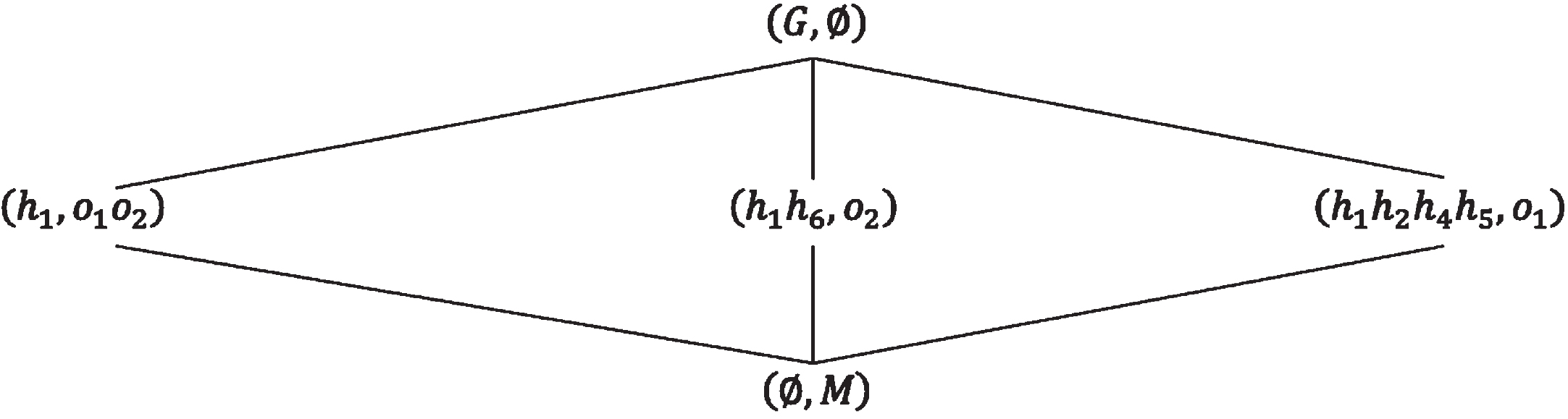
Positive Concept Lattice
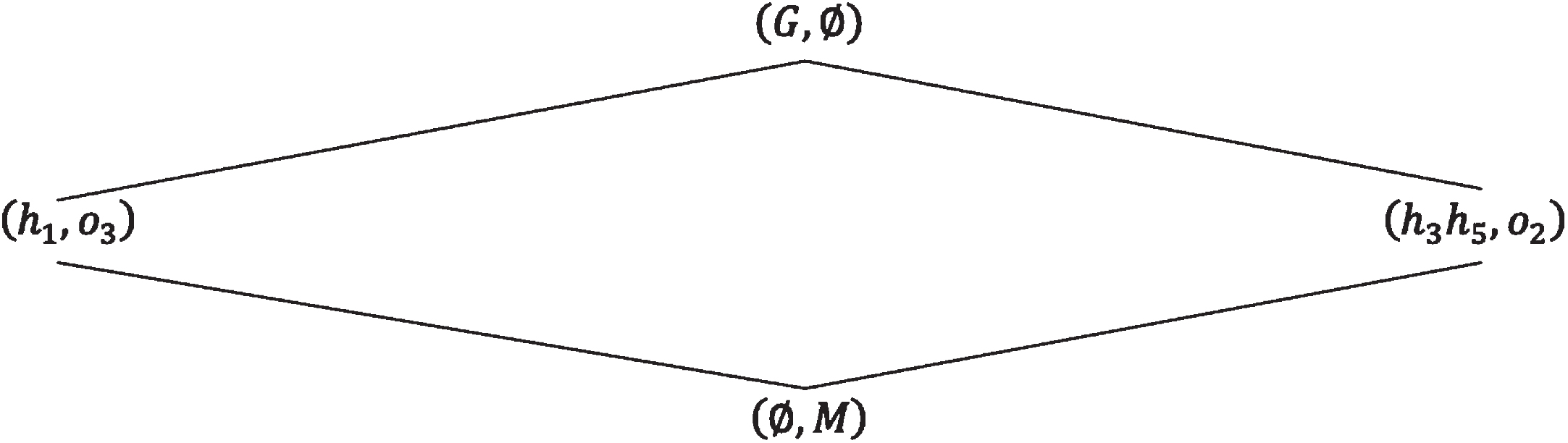
Neutral Concept Lattice

Negative Concept Lattice
Let
Proof. By considering Definition 11 and Definition 18, the proof is straightforward. □
Similarly, the following two Theorems can be obtained.
Proof. By considering Definition 11 and Definition 19, the proof is straightforward. □
Proof. By considering Definition 11 and Definition 20, the proof is straightforward. □
Proof. Firstly, we prove that
(1) (H1 ⋂ H2 ⋂ H3) ↑+ ⊇ O, (H1 ⋂ H2 ⋂ H3) ↑0 ⊇ P, (H1 ⋂ H2 ⋂ H3) ↑- ⊇ Q.
(2) H1 ⋂ H2 ⋂ H3 = O↓+ ⋂ P↓0 ⋂ Q↓-.
Proof. (1) By the definition of H↑+, we have (H1 ⋂ H2
(2) By
Proof. By Theorem 10(2), we have H1 ⋂ H2 ⋂ H3 = O↓+ ⋂ P↓0 ⋂ Q↓-, and (H1 ⋂ H2 ⋂ H3) ↑+ = O, (H1 ⋂ H2 ⋂ H3) ↑0 = P, (H1 ⋂ H2 ⋂ H3) ↑- = Q. Therefore, (H1, O) + OB (H2, P) + OB (H3, Q) = (H1 ⋂ H2 ⋂ H3, (O, P, Q)) is an object-induced neutrosophic three-way concept. □
By this definition, a redundant object-induced neutrosophic three-way concept is clearly not an object-induced neutrosophic three-way concept. The following Theorem presents a method for constructing object-induced neutrosophic three-way concept lattices based on the set of alternate object-induced neutrosophic three-way concept concepts and the set of redundant object-induced neutrosophic three-way concept concepts of a neutrosophic formal context.
Proof. Firstly, we prove that
Secondly, we prove that
(h1, (o1o2, ∅ , ∅)) , (h1, (o1, o3, ∅)) , (h1, (o2, o3, ∅)),
(h1, (∅ , o3, ∅)) , (h5, (o1, o2, o3)) , (h5, (o1, o2, ∅)) , (h2
h4h5, (o1, ∅ , o3)) , (h1h2h4h5, (o1, ∅ , ∅)) , (h4, (o1, ∅ ,
o2o3)) , (h4, (∅ , ∅ , o2o3)) (h6, (o2, ∅ , o1o3)) , (h6, (o2, ∅ ,
o3)) , (h1h6, (o2, ∅ , ∅)) , (h3h5, (∅ , o2, o3)) , (h3h5, (∅ ,
o2, ∅)) , (h3, (∅ , o2, o1o3)) , (h2h3h4h5h6, (∅ , ∅ , o3)) ,
(h3h6, (∅ , ∅ , o1o3)) , (G, (∅ , ∅ , ∅))}.
(h1, (o2, o3, ∅)) , (h1, (∅ , o3, ∅)) , (h5, (o1, o2, ∅)) , (h4,
(∅ , ∅ , o2o3)) , (h6, (o2, ∅ , o3)) , . (h3h5, (∅ , o2, ∅))}.
M, M)) , (h1, (o1o2, o3, ∅)) , (h5, (o1, o2, o3)) , (h2h4h5,
(o1, ∅ , o3)) , (h1h2h4h5, (o1, ∅ , ∅)) , (h4, (o1, ∅ , o2o3)) ,
(h6, (o2, ∅ , o1o3)) , (h1h6, (o2, ∅ , ∅)) , (h3h5, (∅ , o2, o3)) ,
(h3, (∅ , o2, o1o3)) , (h2h3h4h5h6, (∅ , ∅ , o3)) , (h3h6,
(∅ , ∅ , o1o3)) , (G, (∅ , ∅ , ∅))}.
Type-I constructing the attribute-induced neutrosophic three-way concept lattices
Let
The proofs of the following conclusions on attribute-induced neutrosophic three-way concept lattices are similar to that of object-induced neutrosophic three-way concept lattices (Section 4.1). So we omit them.
(1) (O1 ⋂ O2 ⋂ O3) ↓+ ⊇ H, (O1 ⋂ O2 ⋂ O3) ↓0 ⊇ J, (O1 ⋂ O2 ⋂ O3) ↓- ⊇ Q.
(2) O1 ⋂ O2 ⋂ O3 = H↑+ ⋂ J↑0 ⋂ S↑-.
By this definition, a redundant attribute-induced neutrosophic three-way concept is clearly not an attribute-induced neutrosophic three-way concept. The following Theorem presents a method for constructing attribute-induced neutrosophic three-way concept lattices based on the set of alternate attribute-induced neutrosophic three-way concept concepts and the set of redundant attribute-induced neutrosophic three-way concept concepts of a neutrosophic formal context.
Type-II 2 constructing the object-induced neutrosophic three-way concept lattices
In Section 4.1, we present type-I constructing the object-induced neutrosophic three-way concept lattices by
Let F = (G, M, I) be a formal context, H ⊆ G, (H↑↓, H↑) ∈ L (G, M, I). For any (H′, O′) ∈ L (G, M, I), if H ⊆ H′, then we have O′ ⊆ H↑. The following Theorems provide the Type-II 2 method for constructing object-induced neutrosophic three-way concept lattices based on the property.
Proof. We prove (H↑
T
↓
T
∩ H↑
I
↓
I
) ↑
T
= H↑
T
firstly. By (H↑
T
↓
T
∩ H↑
I
↓
I
) ⊆ H↑
T
↓
T
, we have (H↑
T
↓
T
∩ H↑
I
↓
I
) ↑
T
⊇ H↑
T
↓
T
↑
T
= H↑
T
. Then we prove that (H↑
T
↓
T
∩ H↑
I
↓
I
) ↑
T
⊆ H↑
T
. By H1 ∩ H2 = H ⊆ H↑
T
↓
T
and H1 ∩ H2 = H ⊆ H↑
I
↓
I
, we have H1 ∩ H2 ⊆ H↑
T
↓
T
∩ H↑
I
↓
I
, so (H↑
T
↓
T
∩ H↑
I
↓
I
) ↑
T
⊆ (H1 ∩ H2) ↑
T
= H↑
T
. Therefore, (H↑
T
↓
T
∩ H↑
I
↓
I
) ↑
T
= H↑
T
. Similarly, we have (H↑
T
↓
T
∩ H↑
I
↓
I
) ↑
I
= H↑
I
and (H↑
T
↓
T
∩ H↑
I
↓
I
) ↑
F
= (H↑
T
↓
T
∩ H↑
I
↓
I
) ↑
F
. Conversely, (H↑
T
↓
T
∩ H↑
I
↓
I
) ⊆ (H↑
T
↓
T
∩ H↑
I
↓
I
) ↑
F
↓
F
, so H↑
T
↓
T
∩ H↑
I
↓
I
∩ (H↑
T
↓
T
∩ H↑
I
↓
I
) ↑
F
↓
F
= H↑
T
↓
T
∩ H↑
I
↓
I
. In summary,
We call the concepts constructed by Theorem 17–19 as original object-induced neutrosophic three-way concepts, and the set of all the original object-induced neutrosophic three-way concepts are denoted as
Proof. It is obvious that
Type-II 2 constructing the attribute-induced neutrosophic three-way concept lattices
Similar to Section 4.3, we can construct the attribute-induced neutrosophic three-way concept lattices by another way. The proofs of the following conclusions are similar to section 4.3. So we omit them.
Let F = (G, M, I) be a formal context, O ⊆ M, (O↓, O↓↑) ∈ L (G, M, I). For any (H′, O′) ∈ L (G, M, I), if O ⊆ O′, then we have H′ ⊆ O↓. The following Theorems provide the Type-II 2 method for constructing attribute-induced neutrosophic three-way concept lattices based on the property.
We call the concepts constructed by Theorem 21–23 as original attribute-induced neutrosophic three-way concepts, and the set of all the original attribute-induced neutrosophic three-way concepts are denoted as
Conflict analysis model based on neutrosophic three-way concept lattices
In this section, we study the conflict analysis model based on the neutrosophic three-way concept lattices. Some definitions which provided in this section are the neutrosophic conflict information system, the auxiliary function, the union class, the neutral class, the conflict class and so on.
Positive formal context
Positive formal context
Neutral formal context
Negative formal context
Neutrosophic conflict infonnation system
Similarly, we can define the distance function as follows:
Similarly, for two given agents, we calculate their distance, then we can define their relationship as the following three kinds of categories:
(1) conflict if ζ (h i , h j ) > t2;
(2) neutral if t1 ≤ ζ (h i , h j ) ≤ t2;
(3) allied if ζ (h i , h j ) < t1.
[h i ] POS ={ h j ∈ G|ζ (h i , h j ) < t1 },
[h i ] NEU ={ h j ∈ G|t1 ≤ ζ (h i , h j ) ≤ t2 },
[h i ] NEG ={ h j ∈ G|ζ (h i , h j ) > t2 }.
(1) POS (h i ) is the maximum set that satisfies:
“POS (h i ) ⊆ [h i ] POS , ∀h j , h m ∈ POS (h i ) (ζ (h j , h m ) lessthant1)”.
(2) NEU (h i ) is the maximum set that satisfies:
“NEU (h i ) ⊆ [h i ] NEU , ∀h j , h m ∈ NEU (h i ) (t1 ≤ ζ (h j , h m ) ≤ t2)”.
(3) NEG (h i ) is the maximum set that satisfies:
“NEG (h i ) ⊆ [h i ] NEG , ∀h j , h m ∈ NEG (h i ) (ζ (h j , h m ) greaterthant2)”.
It is easy to conclude that the distance between any two agents in the positive region is less than t1, the distance between any two agents in the neutral region is between t1 and t2, and the distance between any two agents in the negative region is more than t2.
The above method is considered from the perspective of the attribute-induced neutrosophic three-way concepts, then we will consider from the perspective of the object-induced neutrosophic three-way concepts. For the convenience, we denote the set of union issues of h i and h j as α (h i , h j ), the set of conflicting issues of h i and h j as β (h i , h j ) and the set of neutral issues of h i and h j as γ (h i , h j ).
(1)
(2)
(3)
Proof. (1) Let o ∈ M, if
(2) Let o ∈ M, if
(3) It can be directly obtained from the first two conclusions. □
In conflict analysis, we are mainly interested in two things. One is to find out the relationships between the agents involved in the conflict, and the other is how to resolve conflicts and find the optimal strategy that satisfies agents as many as possible. We will discuss the optimal strategy, Firstly, we assign a value to each agent’s attitude to each issue, and call all the values as the values of attribute. Then we calculate the optimal strategy by computing the values attribute.
(1) If o i ∈ h↑ T , then o i (h) = 1.
(2) If o i ∈ h↑ F , then o i (h) = -1.
(3) If o i ∈ h↑ I , when T o (h) > F o (h), then o i (h) = 1, when T o (h) < F o (h), then o i (h) = -1, when T o (h) = F h (h), then o i (h) = 0.
(4) If o i ∉ h↑ T , h↑ I , h↑ F , then o i (h) = 0.
This definition assigns the value of attribute of the strongly supported attitude to 1 and the value of attribute of the strongly objected attitude to -1. The neutral ones can be divided into three categories: when o i ∈ h↑ I , determined by T o (h) and F o (h), if T o (h) > F o (h), then the value of attribute is 1, and when T o (h) < F o (h), the value of attribute is -1, when T o (h) = F o (h) or o i ∉ h↑ T , h↑ I , h↑ F , the value of attribute is 0.
In this definition, o p (Y) = +1 means that in the optimal strategy, the final attitude of all agents in the positive region POS (h i ) towards the issue o p is supportive, o p (Y) = -1 means that the final attitude of all agents in the positive region POS (h i ) on the issue o p is opposed. If o p (Y) = 0, it means that all agents in the positive region POS (h i ) on the issue o p is neutral.
The union classes are: [h1] POS = {h1, h2, h5}, [h2] POS = {h1, h2, h3, h4, h5}, [h3] POS = {h2, h3, h5, h6}, [h4] POS = {h2, h4, h5}, [h5] POS = {h1, h2, h3, h4, h5}, [h6] POS = {h3, h6}.
The neutral classes are: [h1] NEU ={ h4, h6 }, [h2] NEU ={ h6 }, [h3] NEU ={ h4 }, [h4] NEU ={ h1, h3 }, [h5] NEU ={ h6 }, [h6] NEU ={ h1, h2, h5 }.
The conflict classes are: [h1] NEG ={ h3 }, [h3] NEG ={ h1 }, [h4] NEG ={ h6 }, [h6] NEG ={ h4 }.
The positive regions are: POS (h1) = POS1 (h2) = POS1 (h5) ={ h1, h2, h5 }, POS2 (h2) = POS1 (h3) = POS2 (h5) ={ h2, h3, h5 }, POS3 (h2) = POS (x4) = POS3 (h5) ={ h2, h4, h5 }, POS2 (h3) = POS (x6) ={ h3, h6 }.
The neutral regions are: NEU1 (h1) = NEU1 (h4) ={ h1, h4 }, NEU2 (h1) = NEU1 (h6) ={ h1, h6 }, NEU (h2) = NEU2 (h6) ={ h2, h6 }, NEU (h3) = NEU2 (h4) ={ h3, h4 }, NEU (h5) = NEU3 (h6) ={ h5, h6 }.
The negative regions are: NEG (h1) = NEG (h3) ={ h1, h3 }, NEG (h4) = NEG (h6) ={ h4, h6 }.
Then for the positive region POS (h1) = POS1 (h2) = POS1 (h5) ={ h1, h2, h5 }, the optimal strategy is Y1 ={ + 1, + 1, - 1 }. That means h1, h2 and h5 want to go to Beojong and Shanghai, but do not want to go to Chengdu.
For the positive region POS2 (h2) = POS1 (h3) = POS2 (h5) ={ h2, h3, h5 }, the optimal strategy is Y2 ={ + 1, - 1, - 1 }. That means h2, h3 and h5 want to go to Beojong, but do not want to go to Shanghai or Chengdu.
For the positive region POS3 (h2) = POS (h4) = POS3 (h5) ={ h2, h4, h5 }, the optimal strategy is Y3 ={ + 1, - 1, - 1 }. That means h2, h4 and h5 want to go to Beojong, but do not want to go to Shanghai or Chengdu.
For the positive region POS2 (h3) = POS (h6) ={ h3, h6 }, the optimal strategy is Y4 ={ - 1, 0, - 1 }. That means h3 and h6 do not want to go to Beijng or Chengdu, but they are neutral about whether to go to Shanghai or not.
This paper mainly studies the neutrosophic three-way concept lattice to solve the problems in conflict analysis with the agents who have “selective phobia”. When expressing the situation of “the agent’s attitude towards the problem is that everything is fine” with the neutrosophic number (x1, x2, x3), x1, x2 and x3 should all be greater than a threshold. We think the situation of “everyting is fine” can be ignored, but the neutral attitude is to have one’s own choice. Thus, this is reflected in the three sets of approximation operators which we gave. The neutrosophic three-way concept lattice extends the original binary relationship between objects and attributes to neutrosophic relations. We propose the object-induced neutrosophic three-way concept lattices and the attribute-induced neutrosophic three-way concept lattices. In addition, based on the candidate neutrosophic three-way concepts and the redundant neutrosophic three-way concepts, a method for constructing the neutrosophic three-way concept lattice is given. Finally, we apply the neutrosophic three-way concept lattices to conflict analysis, and propose the related optimal strategy.
Footnotes
Acknowledgment
This work has been partially supported by the National Natural Science Foundation of China (Grant No. 61976130).