



Abstract
In practical multiple attribute decision making (MADM) problems, the interest groups or individuals intentionally set attribute weights to achieve their own benefits. In this case, the rankings of different alternatives are changed strategically, which is called the strategic weight manipulation in MADM. Sometimes, the attribute values are given with imprecise forms. Several theories and methods have been developed to deal with uncertainty, such as probability theory, interval values, intuitionistic fuzzy sets, hesitant fuzzy sets, etc. In this paper, we study the strategic weight manipulation based on the belief degree of uncertainty theory, with uncertain attribute values obeying linear uncertain distributions. It allows the attribute values to be considered as a whole in the operation process. A series of mixed 0-1 programming models are constructed to set a strategic weight vector for a desired ranking of a particular alternative. Finally, an example based on the assessment of the performance of COVID-19 vaccines illustrates the validity of the proposed models. Comparison analysis shows that, compared to the deterministic case, it is easier to manipulate attribute weights when the attribute values obey the linear uncertain distribution. And a further comparative analysis highlights the performance of different aggregation operators in defending against the strategic manipulation, and highlights the impacts on ranking range under different belief degrees.
Keywords
Introduction
MADM is an important part of modern decision science. It refers to the problems of selecting the most preferred alternative by aggregating the associated attribute values [1–3]. MADM has received increasing attentions and has been widely used to solve problems of engineering, technology, economy, management and military [4–6, 36].
Strategic manipulation in decision making problems describes those situations in which some decision makers (DMs) strategically set attribute weights, or dishonestly express opinions to obtain their desired rankings of alternatives. Strategic manipulation is a common phenomenon and has been analyzed in depth in different decision contexts. For example, Pelta and Yager [7] have proposed preference aggregation function to defend against the strategic manipulation in group decision making (GDM), while Liu et al. [8] and Dong et al. [9] have proposed mixed 0-1 linear programming models to derive the strategic weight vectors that manipulate the alternatives to the desired rankings. Palomares et al. [10] and Xu et al. [11] have proposed consensus models to prospect and manage noncooperative behaviors in decision making problems with a large number of DMs.
The attribute weights have a great influence on the outcome of MADM problems. Different methods of getting the weights can lead to a huge difference in the rankings of alternatives. In the existing literature, three approaches are widely used to obtain the attribute weights including the subjective approach, the objective approach, and the integrated approach [9, 38]. Besides, attribute values also play an important role in the process of evaluating alternatives. In MADM problems, quantitative or qualitative methods are usually adopted to evaluate the overall performance of all alternatives on each attribute. However, sometimes, DMs might find it difficult to provide accurate evaluation information because of time pressure and complexity of the problems, which could result in uncertainty of attribute values. To deal with uncertainty, several theories and methods have been proposed including probability theory, interval values, linguistic terms, intuitionistic fuzzy sets, hesitant fuzzy sets, etc. [13]. In existing researches, many effective decision methods have been developed for these different uncertain forms. It is helpful for us to find potential approaches for conducting multiple attribute decision analysis with uncertain attribute values [2].
Probability theory has been used to deal with the uncertain quantities for a long time [14, 28]. Interval values, linguistic terms, intuitionistic fuzzy sets and hesitant fuzzy sets have also been widely used in addition to probability theory. For example, Shen et al. [15] extended the TOPSIS to the intuitionistic fuzzy environment to handle the multi-criteria decision making problems. Chen [16] adopted likelihood-based preference functions and raised an interval-valued intuitionistic fuzzy permutation method for solving MADM analysis problems. Cabrerizo et al. [17] studied how to obtain soft consensus measures to handle group decision-making situations in which unbalanced fuzzy linguistic information was used. Liu et al. [18] proposed the interval-valued intuitionistic fuzzy principal component analysis model to provide a decision making method for solving the complex large-group MADM problem. Hao and Chen [19] put forward a new ranking method for MADM problems based on interval valued intuitionistic fuzzy set theory. Considering that the DMs may hesitate between several uncertain opinions during the decision making process, Wu et al. [20] developed compromise solutions for multi-criterion group decision making using hesitant fuzzy linguistic term sets, and considered additional possibility distributions which can represent a much wider range of linguistic data. Liao et al. [21] introduced the concepts of mean and hesitancy degree of hesitant fuzzy linguistic elements, and investigated new correlation measures between HFLTSs, overcoming the drawbacks of the previous correlation measures.
In fact, intuitionistic fuzzy judgement, natural linguistic judgements and many other fuzzy forms are essentially discrete forms, and are usually transformed to interval numbers for calculation. Intuitionistic fuzzy numbers and interval fuzzy numbers are equivalent in a mathematical sense [13]. Although existing numerous methods have a good performance in modeling uncertain attribute values, these operation systems often have the following limitations: The probability theory method can be applied only if the frequency of the indeterminate numbers can be observed, and the obtained probability distribution is close enough to describe the uncertain data. But in practice, it is hard to observe the distribution as we are often in the predicament of deficiency in practical data. Interval values, linguistic terms, intuitionistic fuzzy and hesitant fuzzy data are often processed in discrete forms, and the judgement information is not considered as a whole, that is, the overall characteristics of the data or some inner points are ignored. Judgement information provided by DMs is usually subjective. DMs may have different belief degrees on their own judgements, but these data are often processed with the same importance.
Therefore, to ensure the integrity of the information and consider the belief degree of DMs, a more reasonable tool is needed to construct a new uncertain representation and operations. This tool should effectively overcome the above shortcomings, and it not only fully represents the uncertainty of DMs, but also considers the uncertain values as a whole for calculation. Simultaneously, it can make up for the lack of data and make full use of the judgement information to prevent any distortion in the decision making process.
For modeling uncertainty, uncertainty theory was founded by Liu [31] and perfected by Liu [32] and Liu [33], which aims at dealing with the belief degree and the quantity with human uncertainty. Currently, uncertainty theory has been widely applied in various fields, including portfolio selection, network science, option pricing, graph theory, transportation, supply chain and many other fields [22–24, 34]. Gong et al. [13] applied uncertainty distributions to characterize interval judgements and proposed the concept of uncertain preference relations. However, in the field of multiple attribute decision making and ranking, the uncertainty theory still has not been discussed deeply.
From the above analysis, the main contributions of this paper are as follows: In this paper, attribute values are represented by uncertain variables, mixed 0-1 programming models are proposed to strategically set the attribute weights based on the concepts of belief degree. Linear uncertain distribution is used to characterize attribute values given by DMs, which considers the judgements as a whole and makes full use of decision information. And then a new normalization method of attribute values is constructed. A numerical analysis is conducted to test the validity of the linear uncertain multiple attribute strategic weight manipulation (LU-MASWM) models. Comparison between models with linear uncertain attribute values in this paper and models with specific attribute values is performed. And further comparative analysis to show the effects regarding different belief degrees and different aggregation operators on alternatives’ ranking range is also presented.
The structure of this paper is carried out as follows. Section 2 presents the operation process of MADM, and provides some basic concepts of uncertainty theory. Section 3 proposes a new attribute values normalization method, the concepts of the ranking range of alternatives and strategic attribute weights are discussed and a series of mixed 0-1 programming models are proposed to obtain them, based on that the attribute values are uncertain and obey a linear uncertain distribution. Section 4 provides the example of COVID-19 vaccines to detect the validity of the proposed models, and a comparison between the strategic manipulation model in this paper and classical strategic manipulation model based on specific values is presented. A further comparative analysis to show the effects of different belief degrees and the effects of different operators is also raised in this part. Finally, Section 5 provides some concluding remarks and future research directions.
Preliminaries
This section introduces some basic knowledge regarding MADM problem and uncertainty theory.
MADM problem
An MADM problem can be described as follows: Let X = (x1, x2, . . . , x
n
)
T
be a finite set of alternatives, A = (a1, a2, . . . , a
m
)
T
a set of predefined attributes and W = (w1, w2, . . . , w
m
)
T
the weight vector of the attributes, where 0 ⩽ w
j
⩽ 1 and
(1) Normalization of attribute values
Benefit attribute and cost attribute are two of the most used attribute types. To eliminate the influence from different physical dimensions, the original decision matrix V = [v
ij
] n×m should be transformed into its corresponding normalized form
if a
j
∈ A is a benefit attribute, and
if a j ∈ A is a cost attribute.
(2) Aggregation of the attribute values and ranking of alternatives
The overall evaluation of an alternative is calculated by aggregating its associated attribute values based on an aggregation function F. In MADM problems, the aggregation operators frequently used are the weighted average (WA) operator and the ordered weighted average (OWA) operator. Let D (x
i
) be the decision evaluation value of the alternative x
i
, which is obtained by aggregating its attribute values by the following Equations (3) and (4).
Liu [33] proposed the uncertainty theory systematically. In the framework of uncertainty theory, an uncertain measure is used to indicate the belief degree, and an uncertain variable is used to model the uncertainty quantities. Besides, a concept of uncertain distribution is employed by expert’s experimental data [14]. In this section, we will introduce some concepts that will be used in constructing the LU-MASWM models in the next part.
Four different uncertainty distributions were introduced in [33], which were known as linear uncertainty distribution, zigzag uncertainty distribution, normal uncertainty distribution and lognormal uncertainty distribution. Without loss of generality, we consider a linear uncertainty distribution in this paper.
It can be denoted by

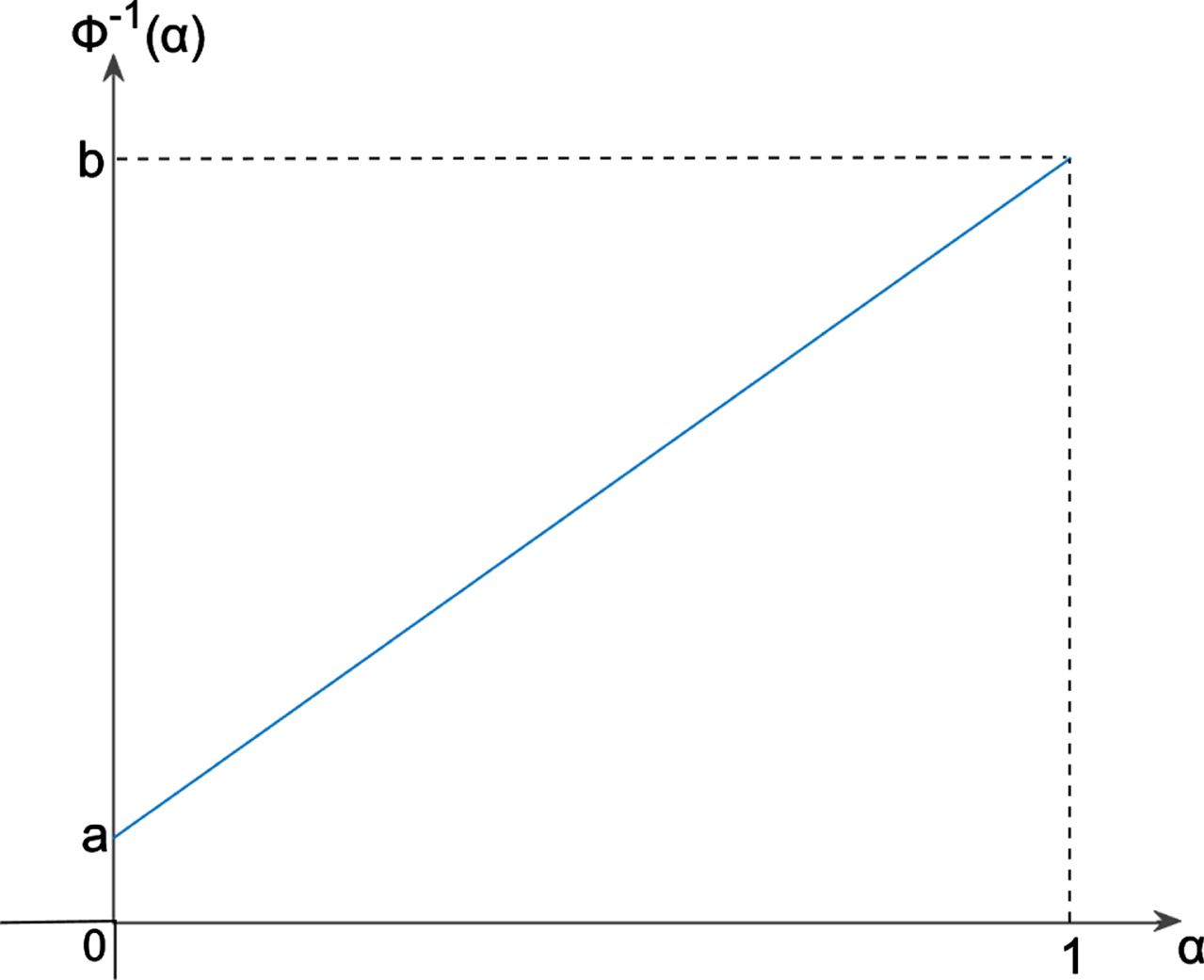
Linear uncertainty distribution.
According to Definition 4, the inverse uncertainty distribution of linear uncertain variable
Inverse linear uncertainty distribution.
In this section, we study the MASWM with minimum weight adjustment with linear uncertain attribute values. The ranking range models and the minimum adjustment strategic weight manipulation model will be formulated and discussed in this section.
MADM with linear uncertain attribute values
In practical decision making problem, it is difficult for experts to give deterministic opinions because of incompleteness of information, emergency of time and other factors. That is, judgements are often made in uncertain forms.
Unlike the deterministic MADM problem, we construct an uncertain MADM problem by using uncertainty theory. An uncertain MADM problem can be described as follows: Let X = (x1, x2, . . . , x
n
)
T
be a finite set of alternatives as before, A = (a1, a2, . . . , a
m
)
T
a set of predefined attributes, and W = (w1, w2, . . . , w
m
)
T
the weight vector of the attributes, where 0 ⩽ w
j
⩽ 1 and
Hence w
j
v
ij
is a linear uncertain variable, that is, w
j
v
ij
∼ L (w
j
a
ij
, w
j
b
ij
). The first part is verified. According to Theorem 4, the inverse uncertainty distribution
The ranking range contains all possible rankings of an alternative. The upper bound of the ranking range represents the worst ranking of the alternative, while the lower bound represents the best ranking of the alternative, which means that manipulator cannot obtain the desired ranking out of the range.
Let y
iq
∈ { 0, 1 } , q = 1, 2. The evaluation value D (x
i
) is defined as Eq. (3). Under the conditions
Based on the above results, we obtain the ranking range
The best ranking of alternative x
k
,
The worst ranking of alternative x
k
,
Let
Then, the worst ranking of alternative x k with OWA operator is obtained.
A vital problem waiting to be solved here is how to rank uncertain variables. Let ξ and η be two uncertain variables, Liu [33] gave the following four ranking criteria:
In this paper, we adopt the expected value criterion to rank the uncertain attribute values. Assume that ξ1, ξ2, ξ3 are three uncertain variables with uncertain distribution Φ1, Φ2, Φ3 respectively. Let
In MADM problems, the setting of attribute weights has an important effect on the ranking of alternatives [9]. The DMs can set the attribute weights intentionally to achieve a desired benefits of them. In this part, mixed 0–1 programming model continue to be used for deriving a strategic ranking with minimum weight adjustment under WA and OWA operators.
Without loss of generality, we assume that the manipulator wants to strategically set attribute weights vector W = (w1, w2, . . . , w
m
)
T
to manipulate the alternatives {xk∈G|G∈ { 1, 2, . . . , n } } to the predefined ranking. Moreover, we assume that the manipulator’s desired ranking of the alternatives in {xk∈G|G∈ { 1, 2, . . . , n } } is {r* (xk∈G) |G∈ { 1, 2, . . . , n } }. That is, r (x
k
) = r* (x
k
). Let W = (w1, w2, . . . , w
m
)
T
be the original attribute weights vector,
Sometimes, it is difficult for manipulator to change the weights too much. Therefore, we assume that the manipulator aims to minimize the total adjustment as follows:
Assuming that the manipulator wants to manipulate the ranking of x
k
to r* (x
k
), then the following equality is expected to hold.
Based on (21) and (22), we construct the MASWM model as
In order to obtain the optimum solution to model (23), binary variables
We can see that model (23) can be transformed into mixed 0-1 programming model (24) based on WA operator.
Let ϒ be the joint distribution of
Therefore, the constraint
Let F be the OWA operator, we can also construct the following linear uncertain MASWM model:
Apparently, if the optimal solution to the linear uncertain MASWM model exists, it is possible for a manipulator to obtain the strategic ranking of alternatives. Otherwise, a strategic weight vector cannot be derived and the preferred ranking cannot be achieved. In order to keep the paper simple and convenient for later numerical analysis, we denote models (17), (18) as P1, and models (19), (20) as P2, model (25) as P3 and model (26) as P4. In both model P1 and model P2,
In this section, an example about the assessment of Coronavirus disease (COVID-19) vaccines is used to illustrate the validity of the proposed linear uncertain MASWM models. A comparative analysis of two strategic manipulation models is provided to show the effect of uncertainty. Moreover, further analysis comparing the performances of the two operators in resisting strategic weight manipulation and the influence of different belief degrees is also included. All the results are calculated by MATLAB 2020a and YALMIP toolbox.
Background description
COVID-19 is an infectious disease caused by a newly discovered coronavirus. Most people infected with the COVID-19 virus will experience mild to moderate respiratory illness [25]. To contain the spread of the virus, social isolation and border closures have been adopted by most countries, but these measures have brought economic shutdowns between different countries. Disrupted global supply chains damage the world economy heavily. In order to contain the virus effectively, the research of COVID-19 vaccines is urgent [26]. There are many types of vaccines under development around the world now. However, vaccine development is a long-term process that requires multiple stages of clinical trials, making it difficult to evaluate the effects of a vaccine immediately. Some experts in relevant fields will evaluate the vaccine based on their own experience and knowledge. In this case, experts’ decision opinions are subjective and uncertain. Uncertainty theory can be used to describe these data.
Some interest groups may want to manipulate the attribute weights of vaccines, to achieve the desired ranking of certain vaccines for their own benefits. By studying how the strategic weight manipulation works, it is of great significance for future research on how to prevent manipulation of alternative ranking. Through an evaluation process, we assume six vaccines {x1, x2, x3, x4, x5, x6} are evaluated from the following five attributes {a1, a2, a3, a4, a5}. The descriptions of the five attributes are shown in Table 2.
Comparisons among this paper and the existing literature with uncertain attribute values
Comparisons among this paper and the existing literature with uncertain attribute values
Five attributes in evaluating the six COVID-19 vaccines
We can find that a1, a4 are cost attributes, a2, a3 and a5 are benefit attributes.
For the sake of brevity, the normalized decision matrix
The standardized evaluation matrix for the six kinds of COVID-19 vaccines
The standardized evaluation matrix for the six kinds of COVID-19 vaccines
The ranking range for the six COVID-19 vaccines under certain belief degree (α= 0.8)
Existing approaches to attribute weights setting [1–3] assume that DMs set attribute weights honestly for optimal rankings of alternatives. However, DMs might be dishonest and manipulate the rankings to obtain their own benefits [9]. Next, based on the information in Table 3, we assume that the manipulator strategically sets attribute weights of the six COVID-19 vaccines, to illustrate how the LU- MASWM models work. For example, assume that a manipulator wants to manipulate the alternative x k to the desired ranking r*. Based on models P3 and P4, the manipulator can set a strategic attribute weights vector w* with minimum adjustment A*, to obtain the desired ranking order. Let x1 be the manipulated alternative and r* (x1) =2 the corresponding desired ranking. If F is the aggregation function with WA operator, we can obtain the strategic attribute weights vector w* = (0.2, 0.2, 0.1443, 0.2, 0.2557) with minimum adjustment A* = 0.1115 by model P3. If F is the aggregation function with OWA operator, the w* = (0.26, 0.14, 0.2, 0.2, 0.2) with minimum weight adjustment A* = 0.12 are calculated by model P4. Then, strategically manipulate x2, x4 and x6, the corresponding results are shown in Table 5.
The strategic weight vector w* and the desired ranking r* under different manipulated alternatives and aggregation operators
A series of comparative analysis is presented in this part. Firstly, comparison between the strategic manipulation model in this paper and the classical model of [9] is presented. Then, a further comparative analysis to show the effects of different belief degrees and the effects of different operators is also presented in this part.
Comparison on the performances of different MASWM models
This section presents a fair comparative study on the performance of previous MASWM model based on the decision metric proposed with deterministic attribute values, and the performance of linear uncertain MASWM model proposed in this paper. Firstly, a representative strategic weight manipulation model is selected. Secondly, the comparative scenarios are described. Finally, a comparative analysis among two models is also performed.
The selected model is a mixed 0-l linear programming model proposed by [9]. To compare the performances of model with linear uncertain attribute values and model with deterministic attribute values, the data in Table 3 should be transformed into its expectation forms. We use Definition 5 to calculate the expectation values of linear uncertain variables in Table 1, and the results are shown in Table 6. Then, set alternative x k to some desired rankings within its ranking range which is denoted by R*. We use models P3 and P4 in this paper and models of [9] respectively to obtain the corresponding total minimum weight adjustments and the results are presented in the following Table 7. For example, through the two kinds of models, we manipulate x1 to a series of ranking {2, 3, 4, 5} and obtain the corresponding average minimum adjustments. If F is the WA operator, the average minimum adjustments of the two models are 0.05575 and 0.066275. If F is the OWA operator, the results are 0.0641 and 0.0853. Then, manipulate the rest of alternatives in a similar way, and the results are also presented in Table 7.
The expectation evaluation matrix for the six kinds of COVID-19 vaccines
The expectation evaluation matrix for the six kinds of COVID-19 vaccines
The comparison of minimum average adjustments of the two models
From Table 7, we can find that the average minimum adjustments obtained by [9] are always larger than the results obtained by LU-MASWM models. We can understand the results in this way: in uncertain environment, the ranking can be manipulated easily. Instead, certainty increases the difficulty of manipulating the ranking and makes the total adjustments increase. Therefore, in order to make the decision effective, we need to reduce the uncertainty in the decision making environment to defend against the dishonest behavior.
Belief degree is an important concept in uncertain theory, which represents the confidence of experts or DMs to an event. Under different belief degree levels, the difficulty of manipulating the goal alternatives may be different. Therefore, we use the fluctuation degree of ranking range to measure the influence from the changing of belief degree. The results are shown in Figs. 3 and 4. We can see that the ranking ranges under both WA and OWA operators of the six alternatives decrease as belief degree constraints increase, which means that the uncertainty of decision making environment decreases with the increasing of DMs’ belief degree, and also means that it will be more difficult to manipulate the ranking of alternatives.

The ranking range of x k with WA operator under different belief degrees.
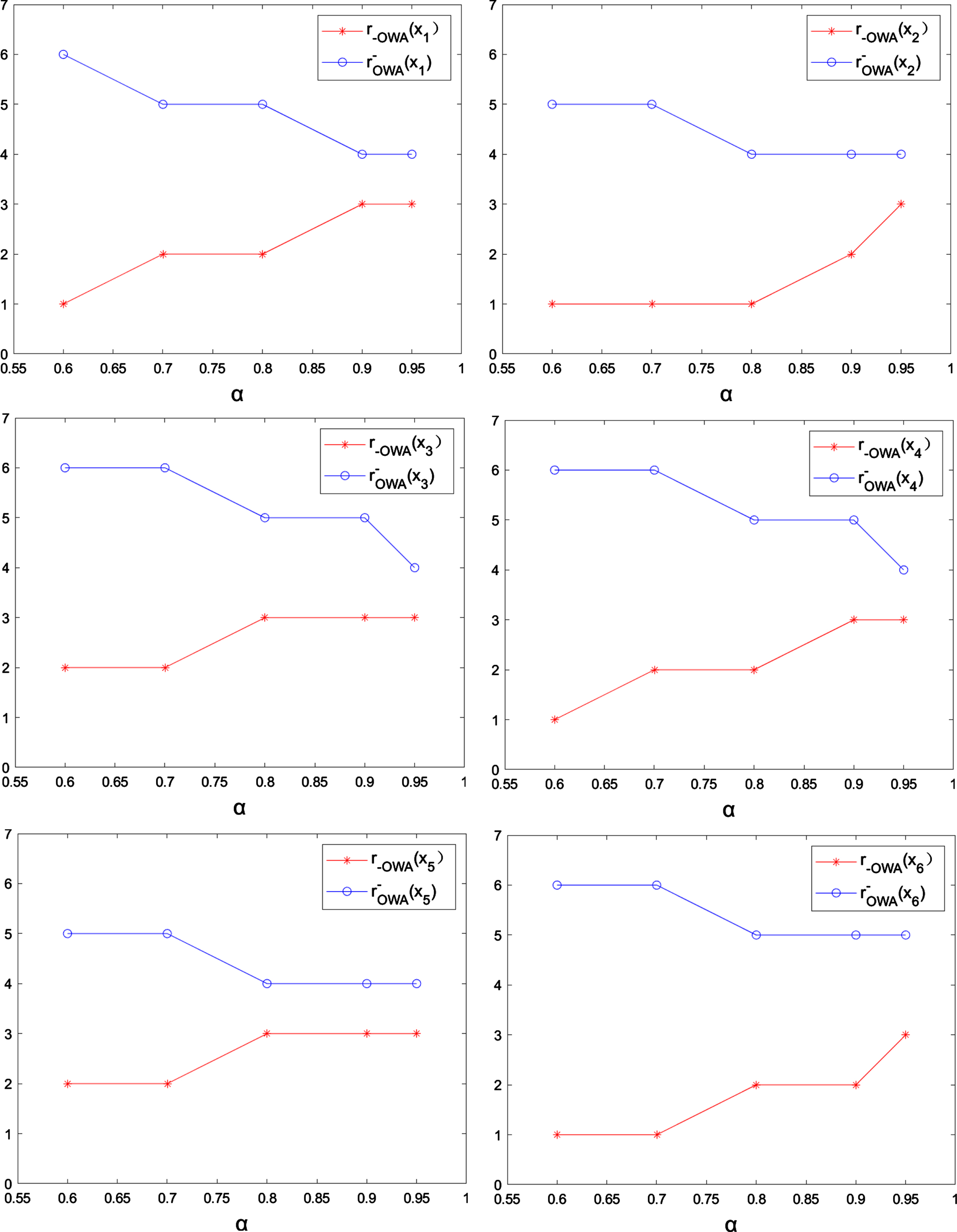
The ranking range of x k with OWA operator under different belief degrees.
In practical decision making, we usually adopt the WA operator and OWA operator to calculate the alternative scores to select the preferred alternatives (Dong et al. 2018). Therefore, it is meaningfully to compare the performances of the two aggregation operators in resisting strategic weight manipulation under uncertain context. To do this, we define the concept of ranking range width.
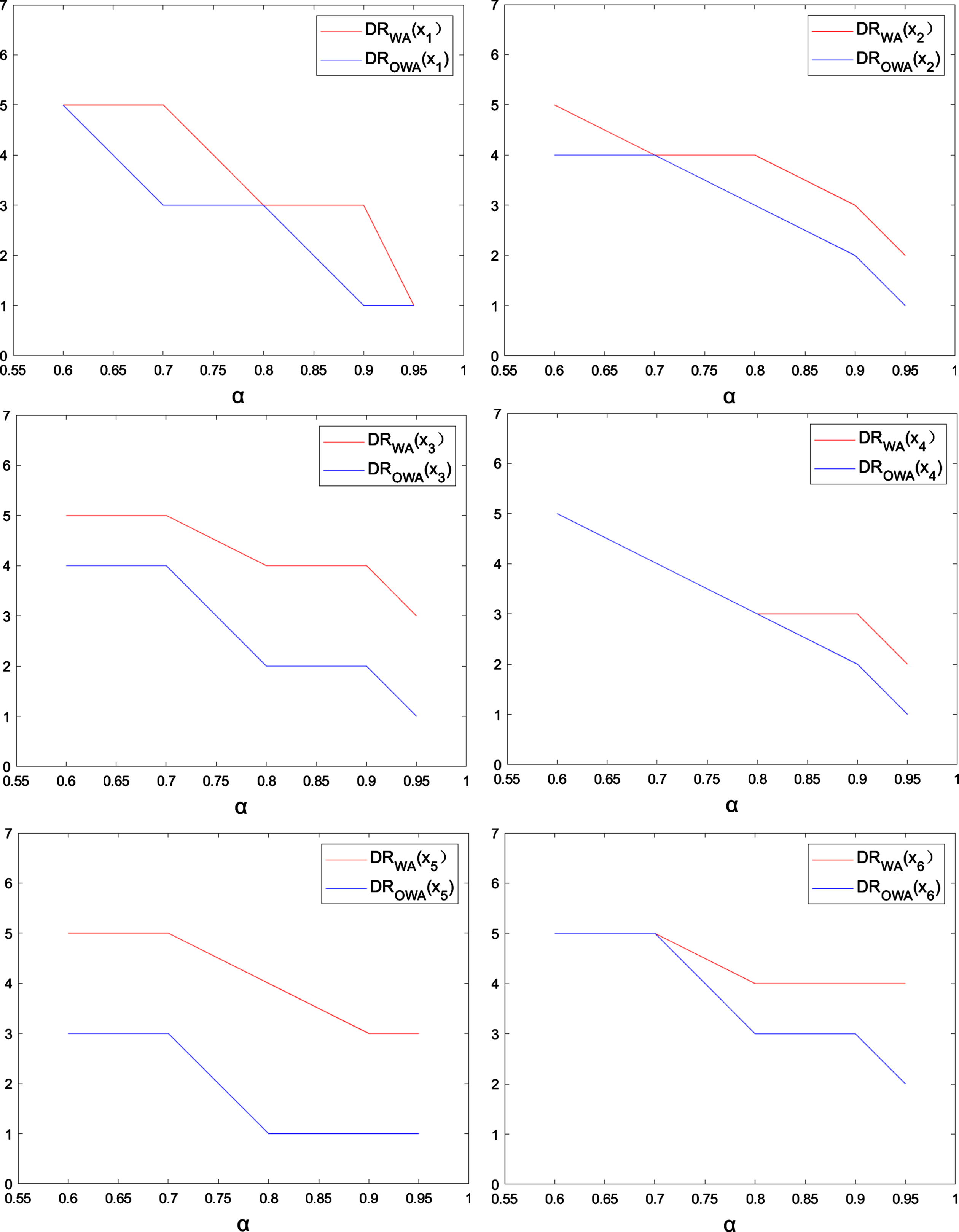
The ranking range width under WA and OWA operators.
Clearly, Fig. 5 shows that the ranking range width under the OWA operator is smaller than that under the WA operator, which means that it is more difficult to manipulate an alternative to a desired ranking under OWA operator. Combined with Table 5, we also find that the average minimum weight adjustment to set strategic weight vectors under the OWA operator is always larger than that under the WA operator. Form both the surveys, the OWA operator performs more well than the WA operator in resisting strategic weight manipulation under a linear uncertain MADM situation.
From all the above comparative analysis, it can be concluded that in order to reduce the impacts of dishonest behavior of DMs, or to resist strategic manipulation, the following effective measures can be adopted. Reduce the uncertainty in the decision making environment. When inviting experts for evaluation, give full consideration to the correlation between the knowledge background of experts and the decision-making problems, to improve the belief degree of experts in their own opinions. Adopt OWA operator rather than WA operator to aggregate attribute values of alternatives more often.
This paper focuses on the strategic weight manipulation with minimum weight adjustment based on belief degree of DMs, in an uncertain environment with linear uncertain distribution attribute values. Uncertainty theory uses uncertain variables to represent indeterminate quantities and invites domain experts to evaluate the possibilities that some events occur based on a belief degree, allowing the attribute values to be considered as a whole in the operation process. This method overcomes the shortcomings of probability theory and many other uncertain methods. That is, enough information cannot always be obtained to estimate the distribution, and the uncertain judgements usually be processed discretely. The main contributions of this research are summarized as follows. The strategic weight manipulation problem is investigated in an uncertain decision making environment, and a series of mixed 0-1 programming models are constructed to obtain the desired ranking of alternatives based on the belief degree of DMs. The attribute values are represented by uncertain variables which obey linear uncertain distribution, and both the integrity and distribution characteristics of attribute values are considered in the calculation process. The strategic weight manipulation model in [9] was investigated in the certainty decision making situation with specific attribute values. In this paper, we present the MASWM model in an uncertain context with linear uncertain attribute values. By comparing the two models, we conclude that it is easier to manipulate rankings in uncertainty situation than certainty situation. Different aggregation operators, WA and OWA, are adopted to study their ability to defend against the strategic manipulation. We conclude that the OWA operator has a better performance than WA operator. Besides, we find that the greater the value of belief degree, the more difficult to manipulate the ranking of alternatives.
In this paper, we only study the case in which the DMs’ opinions obey the linear uncertain distribution. In future research, we will investigate the uncertain attribute values that obey the normal uncertain distribution or other uncertain distributions. In some MADM problems, a large amount of DMs might be involved, therefore, it is also meaningfully for us to study strategic weight manipulation in large scale group decision making with uncertain experts’ opinions information.