A Pythagorean fuzzy set is a powerful model for depicting fuzziness and uncertainty. This model is more flexible and practical as compared to an intuitionistic fuzzy model. This research article presents a new model called LR-type fully Pythagorean fuzzy linear programming problem. We consider the notions of LR-type Pythagorean fuzzy number, ranking for LR-type Pythagorean fuzzy numbers and arithmetic operations for unrestricted LR-type Pythagorean fuzzy numbers. We propose a method to solve LR-type fully Pythagorean fuzzy linear programming problems with equality constraints. We describe our proposed method with numerical examples including diet problem.
Fuzzy set theory [57] deals with the uncertain or vague information. A fuzzy set is characterized by membership function which assigns grades to the elements of fuzzy set. Atanassov [10] proposed the concept of intuitionistic fuzzy set(IFS) to deal with uncertain information. There is a non-membership grade along with the membership grade in IFS but sum of both membership and non-membership grades must not exceed 1. Thus, IFS restricts the decision maker to some extent. A Pythagorean fuzzy set(PFS), discussed by Yager [54], is a generalization of IFS and allows the decision maker to assign membership grades such that the sum of squares of both membership and non-membership must not greater than 1. This shows that PFS is more flexible towards the uncertain information and is more powerful to deal with such kind of information.
Linear programming is a technique in which a function (called objective function) is optimized subject to a given set of restrictions (called constraints). Nowadays, linear programming has become a part and parcel of every industry. The planar is interested to maximize their profit and minimize the cost subject to availability of the resources. Thus, linear programming has become a very vital theory in many real life problems like airline scheduling, telecommunication network, industry and many more. Fuzzy linear programming became an interesting field for many researchers around the globe. The concept of decision making in fuzzy environment was introduced by Bellman and Zadeh [12]. Tanaka et al. [47] considered a method to solve fuzzy mathematical programming problems. Zimmerman [61] developed a method to solve linear programming problem with multi objective function. There are number of methods available in the literature to solve fuzzy linear programming problems in which some or all of the parameters and/or variables are fuzzy numbers or LR-type fuzzy numbers. Kaur and Kumar [21] presented a method to find exact fuzzy optimal solution of fully fuzzy linear programming problems with unrestricted fuzzy variables. Kumar et al. [23] studied a new method for solving fully fuzzy linear programming problems. Kaur and Kumar [22] discussed Mehar’s method for solving fully fuzzy linear programming problems with LR fuzzy parameters. Najafi and Edalatpanah [33] introduced a new method for solving fully fuzzy linear programming problems. Najafi et al. [34] presented a nonlinear model for fully fuzzy linear programming with fully unrestricted variables and parameters. Pérez-Caedo et al. [41] described a revised version of a lexicographical-based method for solving fully fuzzy linear programming problems with inequality constraints. For further terminologies, one may consult [11, 30].
To extend or explore the fuzzy set, Atanassov [10] introduced the concept of fuzzy set to intuitionistic fuzzy set in which there is a non-membership function along with the membership function. Serval researchers have studied certain techniques to solve linear programming problems in an intuitionistic fuzzy environment. Angelov [9] proposed a technique for optimization in an intuitionistic fuzzy environment. Nagoorgani and Ponnalagu [31] discussed an approach for solving intuitionistic fuzzy linear programming problems. Nagoorgani et al. [32] presented a method for the knowledge of expert opinion in intuitionistic fuzzy linear programming problems. Parvathi and Malathi [35] considered another method for intuitionistic fuzzy linear programming problems. Suresh et al. [46] suggested a new method for solving intuitionistic fuzzy linear programming problems by ranking function. Singh and Yadav [45] presented a method to solve LR-type intuitionistic fuzzy linear programming problems. Perez-Canedo and Concepcion-Morales [40] extended the method presented by Singh and Yadav [45] to inequality constraints. Abhishekh and Nishad [1] discussed a novel approach for solving fully LR intuitionistic fuzzy transportation problem. Recently, Akram et al. [5] introduced a method to solve fully Pythagorean fuzzy linear programming problems with equality constraints. Gou et al. [18] presented the properties of continuous Pythagorean fuzzy information. Ren [42] discussed Pythagorean fuzzy TODIM approach to multi-criteria decision making. Wu et al. [50] presented an integrated approach to green supplier selection based on the interval type-2 fuzzy best-worst and extended VIKOR methods. Wu et al. [51] considered a linguistic distribution behavioral multi-criteria group decision making model integrating extended generalized TODIM and quantum decision theory. Wu et al. [52] presented an enhancing multiple attribute group decision making flexibility based on information fusion technique and hesitant Pythagorean fuzzy sets. Zhang et al. [58] described consensus and opinion evolution-based failure mode and effect analysis approach for reliability management in social network and uncertainty contexts. Zhang et al. [59] gave an overview on feedback mechanisms with minimum adjustment or cost in consensus reaching in group decision making: research paradigms and challenges. Kumar et al. [24] presented a Pythagorean fuzzy transportation problem. Wan et al. [48] discussed a Pythagorean fuzzy mathematical programming method for multi-attribute group decision making. Chen [14] considered a Pythagorean fuzzy linear programming technique for multi-dimensional analysis of preference using a squared-distance-based approach for multiple criteria decision analysis.
All the existing methods are applicable to those linear programming problems in which some/all the parameters and variables are non-negative/unrestricted crisp numbers, fuzzy numbers, LR fuzzy numbers, intuitionistic fuzzy numbers and LR intuitionistic fuzzy numbers. The method discussed in this paper deals with the problems in which all the parameters and variables are unrestricted LR-type Pythagorean fuzzy numbers(PFNs) and can also be used to solve almost all the problems which can be solved by existing methods.
In this paper, we define an LR-type PFN and propose a technique to solve LR-type fully Pythagorean fuzzy linear programming problems (FPFLPP) with equality constraints using ranking function. The motivation of this article depends on the following facts:
We present the concept of LR-type PFN and arithmetic operations of LR-type PFNs using α-cut and β-cut.
We introduce the concept of ranking function for LR-type PFNs.
Moreover, we develop a method to solve FPFLPP with equality constraints in which all the parameters and variables are unrestricted LR-type PFNs.
We apply proposed method for solving numerical examples.
The rest of the paper is organized as follows. Section 2 consists of some basic definitions and arithmetic operations. Section 3 explains the proposed method. Section 4 is devoted to numerical examples illustrating the proposed method. In section 5, comparison of the proposed method with the existing technique is given. In Section 6, the paper is concluded and then some references are given at the end.
The list of acronyms used in research paper is given in Table 1.
List of acronyms
Acronyms
Description
IFS
Intuitionistic fuzzy set
PFS
Pythagorean fuzzy set
PFN
Pythagorean fuzzy number
FPFLPP
Fully Pythagorean fuzzy linear programming problem
For further information, the readers are referred to [2–4, 55].
Arithmetic operations
Definition 2.1. [56] Let X be a fixed set. A PFS on X is an object of the form:
characterized by a membership function and a non-membership function , where
such that Moreover, for all x ∈ X, is called a Pythagorean fuzzy index or degree of hesitancy of x in . For computational convenience, is called a PFN [60]. Now we define basic concepts based on [45].
Definition 2.2. Let A be a PFS in X, then its α-cut and β-cut are defined as Aα = {x ∈ X : μA (x) ≥ α} and Aβ = {x ∈ X : νA (x) ≤ β} , ∀α, β ∈ [0, 1] .
Definition 2.3. A PFN A = (a ; l, r ; l′, r′) LR is defined as an LR-type PFN, if its membership (μA) and non-membership (νA) functions are given as:
and
where l ≤ l′,r ≤ r′ and . L and R are monotone, continuous, decreasing functions from [0, ∞) to [0, 1] and L′ and R′ are monotone, continuous, increasing functions from [0, ∞) to [0, 1] such that
L (0) = R (0) =1,
L′(0) = R′(0) =0,
a is called the mean value of A, l and r are the left and right spreads of μA, and l′and r′ are left and right spreads of νA, respectively.
Note: In this paper, we will discuss only those LR-type PFNs in which and
Example 2.1. Consider an LR-type PFN (50 ; 20, 25 ; 30, 35) LR with L (x) = R (x) = max {0, 1 - x3}, L′ (x) = R′ (x) = min {1, x2} . This LR-type PFN is shown graphically in Fig. 1.
LR-type PFN with L (x) = R (x) = max {0, 1 - x3}, L′ (x) = R′ (x) = min {1, x2} .
Remark 2.1. (1) If we set L′ (x) =1 - L (x) and R′ (x) =1 - R (x) in Definition 2.3, then A = (a ; l, r ; l′, r′) LR becomes LR-type intuitionistic fuzzy number [45].
(2) If we take
and
in Definition 2.3, then A = (a ; l, r ; l′, r′) LR becomes triangular PFN.
Definition 2.4. An LR-type PFN A = (a ; l, r ; l′, r′) LR is non-negative(respectively non-positive), denoted as A ≥ 0(respectively A ≤ 0), if a - l′≥0(respectively a + r′≤0) and A is unrestricted if a belongs to real numbers.
Definition 2.5. An LR-type PFN A = (a ; l, r ; l′, r′) LR is positive if a - l′>0 and negative if a + r′<0.
Definition 2.6. An LR-type PFN A = (a ; l, r ; l′, r′) LR is zero if and only if a = 0, l = 0, r = 0, l′=0 and r′=0.
Definition 2.7. Two LR-type PFNs A1 = (a1 ; l1, r1 ; l′1, r′1) LR and A2 = (a2 ; l2, r2 ; l′2, r′2) LR are equal if a1 = a2, l1 = l2, r1 = r2, l1′ = l2′,r1′ = r2′ .
Theorem 2.1.Let A = (a ; l, r ; l′, r′) LR be an LR-type PFN, then its α - cut and β - cut are Aα = [a - lL-1 (α) , a + rR-1 (α)] and Aβ = [a - lL′-1 (β) , a + rR′-1 (β)], ∀α, β ∈ [0, 1].
Proof. By using the Definition 2.2, the theorem can be proved easily. □
Definition 2.8. Let A = (a ; l, r ; l′, r′) LR be an LR-type PFN, then ranking of A, denoted , can be defined as
Let A1 and A2 be two LR-type PFNs, then:
A1 ≺ A2 if ,
A1 ≻ A2 if ,
A1 ≈ A2 if .
Remark 2.2. Ranking function, as in Definition 2.8, is a linear function.
Theorem 2.2.Let A1 = (a1 ; l1, r1 ; l′1, r′1) LR and A2 = (a2 ; l2, r2 ; l′2, r′2) LR be two LR-type PFNs, then A1 ⊕ A2 = (a1 + a2 ; l1 + l2, r1 + r2 ; l1′ + l2′, r1′ + r2′) LR .
Proof. Let A1 = (a1 ; l1, r1 ; l′1, r′1) LR and A2 = (a2 ; l2, r2 ; l′2, r′2) LR be two LR-type PFNs, then their α - cut and β - cut for all α, β ∈ [0, 1] , are given as: ,, , . Thus,
By taking α = 1 in Equation 1, we have
By taking α = 0 in Equation 1, we have
By combining the Equations 2,3,5,6, the result follows. □
Theorem 2.3.Let A1 = (a1 ; l1, r1 ; l′1, r′1) LR and A2 = (a2 ; l2, r2 ; l′2, r′2) LR be two LR-type PFNs, then A1 ⊖ A2 = (a1 - a2 ; l1 + r2, r1 + l2 ; l1′ + r2′, r1′ + l2′) LR .
Proof. Let A1 = (a1 ; l1, r1 ; l′1, r′1) LR and A2 = (a2 ; l2, r2 ; l′2, r′2) LR be two LR-type PFNs, then their α - cut and β - cut for all α, β ∈ [0, 1] , are given as: ,, , .
Thus,
By taking α = 1 in Equation 7, we have
By taking α = 0 in Equation 1, we have
Also,
By taking β = 0 in Equation 4, we have
By taking β = 1 in Equation 4, we have
By combining the Equations 8, 9, 11, 12, the result follows. □
Theorem 2.4.Let A = (a ; l, r ; l′, r′) LR be an LR-type PFN and c be any real number, then
Proof. Let A = (a ; l, r ; l′, r′) LR be an LR-type PFN and c be any real number, then Aα = [a - lL-1 (α) , a + rR-1 (α)], Aβ = [a - l′L′-1 (β) , a + r′R′-1 (β)] .
Now, if c ≥ 0, then
By taking α = 1 in Equation 7, we have
By taking α = 0 in Equation 7, we have
Also,
By taking β = 0 in Equation 10, we have
By taking β = 1 in Equation 10, we have
By combining the Equations 14, 15, 17, 18, the case c ≥ 0 follows.
If c < 0, then
By taking α = 1 in Equation 13, we have
By taking α = 0 in Equation 13, we have
Also,
By taking β = 0 in Equation 22, we have
By taking β = 1 in Equation 22, we have
By combining the Equations 20, 21, 23,24, the case c < 0 follows. This completes the proof. □
Theorem 2.5.Let A1 = (a1 ; l1, r1 ; l′1, r′1) LR and A2 = (a2 ; l2, r2 ; l′2, r′2) LR be two non-negative LR-type PFNs, then A1 ⊗ A2 = (a1a2 ; a1l2 + a2l1 - l1l2, a1r2 + a2r1 + r1r2 ; a1l2′ + a2l1′ - l1′l2′, a1r2′ + a2r1′ + r1′r2′) LR .
Proof. Let A1 = (a1 ; l1, r1 ; l′1, r′1) LR and A2 = (a2 ; l2, r2 ; l′2, r′2) LR be two non-negative LR-type PFNs, then their α - cut and β - cut for all α, β ∈ [0, 1] , are given as: , , , . Thus,
By taking α = 1 in Equation 25, we have
By taking α = 0 in Equation 25, we have
Also
By taking β = 0 in Equation 28, we have
By taking β = 1 in Equation 28, we have
By combining the Equations 26, 27, 29, 30, the result follows. □
Theorem 2.6.Let A1 = (a1 ; l1, r1 ; l′1, r′1) LR be non-negative LR-type PFN, and A2 = (a2 ; l2, r2 ; l′2, r′2) LR be non-positive LR-type PFN, then A1 ⊗ A2 = (a1a2 ; a1l2 - a2r1 + l2r1, a1r2 - a2l1 - l1r2 ; a1l2′ - a2r1′ + l2′r1′, a1r2′ - a2l1′ - l1′r2′) LR .
Proof. Let A1 = (a1 ; l1, r1 ; l′1, r′1) LR be non-negative LR-type PFN and A2 = (a2 ; l2, r2 ; l′2, r′2) LR be non-positive LR-type PFN, then their α - cut and β - cut for all α, β ∈ [0, 1] , are given as: , , , . Thus,
By taking α = 1 in Equation 31, we have
By taking α = 0 in Equation 31, we have
Also
By taking β = 0 in Equation 34, we have
By taking β = 1 in Equation 34, we have
By combining the Equations 32, 33, 35, 36, the result follows. □
Theorem 2.7.Let A1 = (a1 ; l1, r1 ; l′1, r′1) LR be an LR-type PFN in which a1 - l′1 < 0, a1 - l1 ≥ 0 and A2 = (a2 ; l2, r2 ; l′2, r′2) LR be an unrestricted LR-type PFN, then A1 ⊗ A2 = (a ; l, r ; l′, r′) LR, where a = a1a2, l = a1a2 - min {a1a2 - l2a1 - l1a2 + l1l2, a1a2 - l2a1 + r1a2 - l2r1}, r = max {a1a2 + r2a1 + r1a2 + r1r2, a1a2 + r2a1 - l1a2 - l1r2} - a1a2, l′ = a1a2 - min {a1a2 - l1′a2 + r2′a1 - l1′r2′, a1a2 + r1′a2 - l2′a1 - l2′r1′} and r′ = max {a1a2 - l1′a2 - l2′a1 + l1′l2′, a1a2 + r1′a2 + r2′a1 + r1′r2′} - a1a2 .
Proof. Let A1 = (a1 ; l1, r1 ; l′1, r′1) LR be an LR-type PFN such that a1 - l1′<0, a1 - l1 ≥ 0 and A2 = (a2 ; l2, r2 ; l′2, r′2) LR be an unrestricted LR-type PFN, and their α - cut and β - cut for all α, β ∈ [0, 1] , are given as: , , , . Thus,
By taking α = 1 in Equation 97, we have
By taking α = 0 in Equation 97, we have
Also
By taking β = 0 in Equation 40, we have
By taking β = 1 in Equation 41, we have
By combining the Equations 98, 99, 41, 42, the result follows. □
By using similar arguments as used in the Theorem (2.7), the following theorems can be proved easily.
Theorem 2.8Let A1 = (a1 ; l1, r1 ; l′1, r′1) LR be an LR-type PFN in which a1 - l1 < 0, a1 ≥ 0 and A2 = (a2 ; l2, r2 ; l′2, r′2) LR be an unrestricted LR-type PFN, then A1 ⊗ A2 = (a ; l, r ; l′, r′) LR, where a = a1a2, l = a1a2 - min {a1a2 - l1a2 + r2a1 - l1r2, a1a2 + r1a2 - l2a1 - l2r1}, r = max {a1a2 - l1a2 - l2a1 + l1l2, a1a2 + r1a2 + r2a1 + r1r2} - a1a2, l′ = a1a2 - min {a1a2 - l1′a2 + r2′a1 - l1′r2′, a1a2 + r1′a2 - l2′a1 - l2′r1′}, r′ = max {a1a2 - l1′a2 - l2′a1 + l1′l2′, a1a2 + r1′a2 + r2′a1 + r1′r2′} - a1a2 .
Theorem 2.9.Let A1 = (a1 ; l1, r1 ; l′1, r′1) LR be an LR-type PFN in which a1 < 0, a1 + r1 ≥ 0 and A2 = (a2 ; l2, r2 ; l′2, r′2) LR be an unrestricted LR-type PFN, then A1 ⊗ A2 = (a ; l, r ; l′, r′) LR, where a = a1a2, l = a1a2 - min {a1a2 - l1a2 + r2a1 - l1r2, a1a2 + r1a2 - l2a1 - l2r1}, r = max {a1a2 - l1a2 - l2a1 + l1l2, a1a2 + r1a2 + r2a1 + r1r2} - a1a2, l′ = a1a2 - min {a1a2 - l1′a2 + r2′a1 - l1′r2′, a1a2 + r1′a2 - l2′a1 - l2′r1′}, r′ = max {a1a2 - l1′a2 - l2′a1 + l1′l2′, a1a2 + r1′a2 + r2′a1 + r1′r2′} - a1a2 .
Theorem 2.10.Let A1 = (a1 ; l1, r1 ; l′1, r′1) LR be an LR-type PFN in which a1 + r1 < 0, a1 + r1′≥0 and A2 = (a2 ; l2, r2 ; l′2, r′2) LR be an unrestricted LR-type PFN, then A1 ⊗ A2 = (a ; l, r ; l′, r′) LR, where a = a1a2, l = a1a2 - min {a1a2 - l1a2 + r2a1 - l1r2, a1a2 + r2a1 + r1a2 + r1r2}, r = max {a1a2 + r1a2 - l2a1 - l2r1, a1a2 - l2a1 - l1a2 + l1l2} - a1a2, l′ = a1a2 - min {a1a2 - l1′a2 + r2′a1 - l1′r2′, a1a2 + r1′a2 - l2′a1 - l2′r1′}, r′ = max {a1a2 - l1′a2 - l2′a1 + l1′l2′, a1a2 + r1′a2 + r2′a1 + r1′r2′} - a1a2 .
Theorem 2.11.Let A1 = (a1 ; l1, r1 ; l′1, r′1) LR be an LR-type PFN in which a1 + r1′<0 and A2 = (a2 ; l2, r2 ; l′2, r′2) LR be an unrestricted LR-type PFN, then A1 ⊗ A2 = (a ; l, r ; l′, r′) LR, where a = a1a2, l = a1a2 - min {a1a2 - l1a2 + r2a1 - l1r2, a1a2 + r2a1 + r1a2 + r1r2}, r = max {a1a2 + r1a2 - l2a1 - l2r1, a1a2 - l2a1 - l1a2 + l1l2} - a1a2, l′ = a1a2 - min {a1a2 - l1′a2 + r2′a1 - l1′r2′, a1a2 + r2′a1 + r1′a2 + r1′r2′}, r′ = max {a1a2 + r1′a2 - l2′a1 - l2′r1′, a1a2 - l1′a2 - l2′a1 + l1′l2′} - a1a2 .
Theorem 2.12.Let A1 = (a1 ; l1, r1 ; l′1, r′1) LR be an LR-type PFN in which a1 - l′1 ≥ 0, and A2 = (a2 ; l2, r2 ; l′2, r′2) LR be an unrestricted LR-type PFN, then A1 ⊗ A2 = (a ; l, r ; l′, r′) LR, where a = a1a2, l = a1a2 - min {a1a2 - l2a1 - l1a2 + l1l2, a1a2 - l2a1 + r1a2 - l2r1}, r = max {a1a2 + r2a1 + r1a2 + r1r2, a1a2 + r2a1 - l1a2 - l1r2} - a1a2, l′ = a1a2 - min {a1a2 - l2′a1 - l1′a2 + l1′l2′, a1a2 - l2′a1 + r1′a2 - l2′r1′}, r′ = max {a1a2 + r2′a1 + r1′a2 + r1′r2′, a1a2 + r2′a1 - l1′a2 - l1′r2′} - a1a2 .
Methodology
Let us consider FPFLPP with LR-type PFNs.
where Aij,Xj,Bi, and Cj are LR-type PFNs.
Definition 3.1. An LR-type Pythagorean fuzzy optimal solution of FPFLPP 43 with LR-type PFNs will be LR-type PFNs Xj if:
Xj are LR-type PFNs.
, for all i = 1, 2, …, m.
If there exists any LR-type PFN Xj′ satisfying constraints, then in maximization problem and in minimization problem.
We now present procedure to solve FPFLPP 43 with LR-type PFNs as follows:
Step 1: Assuming A = (aij ; lij, rij ; l′ij, r′ij) LR, X = (xj ; yj, zj ; y′j, z′j) LR, B = (bi ; pi, qi ; p′i, q′i) LR, and C = (cj ; mj, nj ; m′j, n′j) LR, the FPFLPP 44 can be written as:
subject to , ∀i = 1, 2, ⋯ , m where (xj ; yj, zj ; y′j, z′j) LR is LR-type PFN.
Step 2: By using the product as proposed in Section 2 and letting (aij ; lij, rij ; l′ij, r′ij) LR ⊗ (xj ; yj, zj ; y′j, z′j) LR = (aij1 ; lij1, rij1 ; l′ij1, r′ij1) LR, the FPFLPP 44 can be written as:
subject to , ∀i = 1, 2, ⋯ , m,
where (xj ; yj, zj ; y′j, z′j) LR is LR-type PFN.
Step 3: By using arithmetic operations as defined in Section 2 and using Definition 2.7, the FPFLPP 45 can be written as:
Step 4: Now we have to find LR-type Pythagorean fuzzy feasible solution such that for all feasible solutions X. Applying ranking, the FPFLPP 46 can be solved by solving
Step 5: Assuming , the Problem 47 can be written as:
subject to , , , , ∀i = 1, 2, ⋯ , m, ∀j = 1, 2, ⋯ , n .
Step 6: As ranking function is linear, thus, Problem 48 can be written as:
subject to , , , , ∀i = 1, 2, ⋯ , m, ∀j = 1, 2, ⋯ , n .
Step 7: Using the Definition 2.8, Problem 49 can be converted into Problem 50:
subject to , , , , ∀i = 1, 2, ⋯ , m, ∀j = 1, 2, ⋯ , n .
Step 8: Solve the crisp non-linear programming Problem 50 by any existing method to find the optimal solution .
Step 9: Find the LR-type Pythagorean fuzzy optimal solution of the FPFLPP 43 by substituting the values of , , , , and in
Step 10: Find the LR-type Pythagorean fuzzy optimal value of the FPFLPP 43 by substituting the values of , as calculated in Step 9, in
Theorem 3.1.The solution of FPFLPP with LR-type PFNs Max/ Min
Xj, Aij,Cj,Bi are LR-type PFNs, exists when the solution of the associated crisp linear programming problem Max/ Min
subject to , , , , ∀i = 1, 2, ⋯ , m, ∀j = 1, 2, ⋯ , n . exists. Otherwise, there is no guarantee that the Pythagorean fuzzy optimal solution exists.
Proof. Straightforward. □
Numerical examples
Example 4.1. Max (5 ;3, 4 ; 4, 5) LR ⊗ X1 ⊕ (6 ; 2, 3 ; 4, 4) LR ⊗ X2
subject to
where Xj are LR-type PFNs for j = 1, 2 and L (x) = R (x) = max {0, 1 - x}, L′ (x) = R′ (x) = min {1, x} .
To solve this problem, we proceed as follows:
Step 1: Let X1 = (x1 ; l1, r1 ; l′1, r′1) LR and X2 = (x2 ; l2, r2 ; l′2, r′2) LR, then problem can be written as Max (5 ;3, 4 ; 4, 5) LR ⊗ (x1 ; l1, r1 ; l′1, r′1) LR ⊕ (6 ; 2, 3 ; 4, 4) LR ⊗ (x2 ; l2, r2 ; l′2, r′2) LR
subject to
where (x1 ; l1, r1 ; l′1, r′1) LR and (x2 ; l2, r2 ; l′2, r′2) LR are LR-type PFNs.
Step 2: Using product defined in Section 2, the FPFLPP, obtained in Step 1, can be written as: Max (5x1 ; 5x1 - min {2x1 - 2l1, 9x1 - 9l1} , max {9x1 + 9r1, 2x1 + 2r1} -5x1 ; 5x1 - min {x1 - l1′, 10x1 - 10l1′} , max {10x1 + 10r1′, x1 + r1′} -5x1) LR ⊕ (6x2 ; 6x2 - min {4x2 - 4l2, 9x2 - 9l2} , max {9x2 + 9r2, 4x2 + 4r2} -6x2 ; 6x2 - min {2x2 - 2l2′, 10x2 - 10l2′} , max {10x2 + 10r2′, 2x2 + 2r2′} -6x2) LR
subject to
(4x1 ; 4x1 - min {3x1 - 3l1, 6x1 - 6l1} , max {6x1 + 6r1, 3x1 + 3r1} -4x1 ; 4x1 - min {x1 - l1′, 8x1 - 8l1′} , max {8x1 + 8r1′, x1 + r1′} -4x1) LR ⊕ (3x2 ; 3x2 - min {1x2 - 1l2, 6x2 - 6l2} , max {6x2 + 6r2, 1x2 + 1r2} -3x2 ; 3x2 - min {0, 8x2 - 8l2′} , max {8x2 + 8r2′, 0} -3x2) LR = (34 ; 29, 68 ; 42, 134) LR
(5x1 ; 5x1 - min {2x1 - 2l1, 8x1 - 8l1} , max {8x1 + 8r1, 2x1 + 2r1} -5x1 ; 5x1 - min {1x1 - 1l1′, 9x1 - 9l1′} , max {9x1 + 9r1′, 1x1 + 1r1′} -5x1) LR ⊕ (4x2 ; 4x2 - min {3x2 - 3l2, 6x2 - 6l2} , max {6x2 + 6r2, 3x2 + 3r2} -4x2 ; 4x2 - min {1x2 - 1l2′, 7x2 - 7l2′} , max {7x2 + 7r2′, 1x2 + 1r2′} -4x2) LR = (44 ; 36, 74 ; 52, 123) LR
where (x1 ; l1, r1 ; l′1, r′1) LR and (x2 ; l2, r2 ; l′2, r′2) LR are LR-type PFNs.
Step 3: By using arithmetic operations which are defined in Section 2 and using Definition 2.7, the FPFLPP, obtained in Step 2, can be rewritten as: Max (5x1 + 6x2 ; 5x1 - min {2x1 - 2l1, 9x1 - 9l1} +6x2 - min {4x2 - 4l2, 9x2 - 9l2} , max {9x1 + 9r1, 2x1 + 2r1} -5x1 + max {9x2 + 9r2, 4x2 + 4r2} -6x2 ; 5x1 - min {x1 - l1′, 10x1 - 10l1′} +6x2 - min {2x2 - 2l2′, 10x2 - 10l2′} , max {10x1 + 10r1′, x1 + r1′} -5x1 + max {10x2 + 10r2′, 2x2 + 2r2′} -6x2) LR
Subject to
Step 4: Using Step 4 of the method which is proposed in Section 3, the FPFLPP, obtained in Step 3, can be rewritten as:
Max
Subject to
Step 5: Using , and Steps 6,7 of the method, presented in Section 3, the FPFLPP, obtained in Step 4, can be written as: Max Subject to
Step 6: The optimal solution of the crisp non-linear programming problem, obtained in Step 5, is x1 = 4, l1 = 3, r1 = 4, l1′=4.5, r1′=6, x2 = 6, l2 = 4, r2 = 3, l2′=6.5 and r2′=5 .
Step 7: Substituting the values of x1, l1, r1, l1′, r1′, x2, l2, r2, l2′, and r2′ in X1 = (x1 ; l1, r1 ; l1′, r1′) LR and X2 = (x2 ; l2, r2 ; l2′, r2′) LR, the exact LR-type Pythagorean fuzzy optimal solution is X1 = (4 ; 3, 4 ; 4.5, 6) LR, X2 = (6 ; 4, 3 ; 6.5, 5) LR .
Step 8: Substituting the values of X1 and X2, obtained in Step 7, into the objective function, the LR-type Pythagorean fuzzy optimal value is (56 ; 46, 107 ; 57.5, 154) LR .
Example 4.2. (Diet Problem). Each unit of food X1 costs Rs. (10 ; 8, 6 ; 10, 8) LR and contains (5 ;3, 2 ; 4, 4) LR grams of protein and (4 ;4, 3 ; 6, 6) LR grams of iron while each unit of food X2 costs Rs. (8 ;6, 6 ; 8, 10) LR and contains (6 ;4, 6 ; 6, 8) LR grams of protein and (7 ;4, 5 ; 6, 8) LR grams of iron as given in Table 2:
Diet problem
Food X1
Food X2
Protein(grams)
(5 ;3, 2 ; 4, 4) LR
(6 ;4, 6 ; 6, 8) LR
Iron(grams)
(4 ;4, 3 ; 6, 6) LR
(7 ;4, 5 ; 6, 8) LR
Each animal must receive (89 ; 77, 187 ; 88, 303) LR grams of protein and (91 ; 82, 185 ; 119, 334) LR grams of iron daily. How many units of each food should be fed to each animal at the minimum possible cost? (Take L (x) = R (x) = max {0, 1 - x}, L′ (x) = R′ (x) = min {1, x} .)
To solve this problem, let us assume that X1 units be taken of food X1 and X2 units be taken of food X2, that should be fed to minimize the cost. Then the given problem becomes the following LR-type FPFLPP.
Min (10 ; 8, 6 ; 10, 8) LR ⊗ X1 ⊕ (8 ; 6, 6 ; 8, 10) LR ⊗ X2
subject to
where Xj are LR-type PFNs, for j = 1, 2 .
Step 1: Let X1 = (x1 ; l1, r1 ; l′1, r′1) LR and X2 = (x2 ; l2, r2 ; l′2, r′2) LR, then problem can be written as Min (5 ;3, 4 ; 4, 5) LR ⊗ (x1 ; l1, r1 ; l′1, r′1) LR ⊕ (6 ; 2, 3 ; 4, 4) LR ⊗ (x2 ; l2, r2 ; l′2, r′2) LR
subject to
where (x1 ; l1, r1 ; l′1, r′1) LR and (x2 ; l2, r2 ; l′2, r′2) LR are LR-type PFNs.
Step 2: Using product defined in Section 2, the FPFLPP, obtained in Step 1, can be written as: Min (10x1 ; 10x1 - min {2x1 - 2l1, 16x1 - 16l1} , max {16x1 + 16r1, 2x1 + 2r1} -10x1 ; 10x1 - min {0, 18x1 - 18l1′} , max {18x1 + 18r1′, 0} -10x1) LR ⊕ (8x2 ; 8x2 - min {2x2 - 2l2, 14x2 - 14l2} , max {14x2 + 14r2, 2x2 + 2r2} -8x2 ; 8x2 - min {0, 18x2 - 18l2′} , max {18x2 + 18r2′, 2x2 + 2r2′} -8x2) LR
subject to
(5x1 ; 5x1 - min {2x1 - 2l1, 7x1 - 7l1} , max {7x1 + 7r1, 2x1 + 2r1} -5x1 ; 5x1 - min {x1 - l1′, 9x1 - 9l1′} , max {9x1 + 9r1′, x1 + r1′} -5x1) LR ⊕ (6x2 ; 6x2 - min {2x2 - 2l2, 12x2 - 12l2} , max {12x2 + 12r2, 2x2 + 2r2} -6x2 ; 6x2 - min {0, 14x2 - 14l2′} , max {14x2 + 14r2′, 0} -6x2) LR = (89 ; 77, 187 ; 88, 303) LR
(4x1 ; 4x1 - min {0, 7x1 - 7l1} , max {7x1 + 7r1, 0} -4x1 ; 4x1 - min {-2x1 - 2r1′, 10x1 - 10l1′} , max {-2x1 + 2l1′, 10x1 + 10r1′} -4x1) LR ⊕ (7x2 ; 7x2 - min {3x2 - 3l2, 12x2 - 12l2} , max {12x2 + 12r2, 3x2 + 3r2} -7x2 ; 7x2 - min {1x2 - 1l2′, 15x2 - 15l2′} , max {15x2 + 15r2′, 1x2 + 1r2′} -7x2) LR = (91 ; 82, 185 ; 119, 334) LR
where (x1 ; l1, r1 ; l′1, r′1) LR and (x2 ; l2, r2 ; l′2, r′2) LR are LR-type PFNs.
Step 3: By using the arithmetic operations as in Section 2 and using Definition 2.7, the FPFLPP, obtained in Step 2, can be written as: Min (10x1 + 8x2 ; 10x1 - min {2x1 - 2l1, 16x1 - 16l1} +8x2 - min {2x2 - 2l2, 14x2 - 14l2} , max {16x1 + 16r1, 2x1 + 2r1} -10x1 + max {14x2 + 14r2, 2x2 + 2r2} -8x2 ; 10x1 - min {0, 18x1 - 18l1′} +8x2 - min {0, 18x2 - 18l2′} , max {9x1 + 9r1′, x1 + r1′} -5x1 + max {14x2 + 14r2′, 0} -6x2) LR
Subject to
Step 4: By using Step 4 of the method which is presented in Section 3, the FPFLPP of Step 3, can be rewritten as: Min
Subject to
Step 5: Using , and Steps 6,7 of the method, presented in Section 3, the FPFLPP of Step 4, can be rewritten as:
Min
Subject to
Step 6: The optimal solution of the crisp non-linear programming problem, obtained in Step 5, is x1 = 7, l1 = 4, r1 = 0, l1′=6, r1′=7, x2 = 9, l2 = 6, r2 = 9.92, l2′=9 and r2′=10 .
Step 7: By substituting the values of x1, l1, r1, l1′, r1′, x2, l2, r2, l2′, and r2′ in X1 = (x1 ; l1, r1 ; l1′, r1′) LR and X2 = (x2 ; l2, r2 ; l2′, r2′) LR, the exact LR-type Pythagorean fuzzy optimal solution is (7 ;4, 0 ; 6, 7) LR, (9 ;6, 9.92 ; 9, 10) LR .
Step 8: By substituting the values of X1 and X2, obtained in Step 7, into the objective function, the LR-type Pythagorean fuzzy optimal value is (142 ; 130, 234.88 ; 142, 452) LR .
Hence (7 ;4, 0 ; 6, 7) LR units of food X1 and (9 ;6, 9.92 ; 9, 10) LR units of food X2 should be fed at a minimum cost of Rs. (142 ; 130, 234.88 ; 142, 452) LR .
Comparative analysis
Consider a model as discussed by Singh and Yadav in [45]:
Min Z = (50 ; 4, 5 ; 5, 6) LR ⊗ (Y1 ⊕ Y2) ⊕ (200 ; 5, 6 ; 6, 7) LR ⊗ (S1 ⊕ S2 ⊕ S3)
subject to
10X1 ≈ (400 ; 22, 13 ; 33, 25) LR ⊕ Y1,
Y1 ⊕ 10X2 ≈ (580 ; 23, 14 ; 34, 25) LR ⊕ Y2,
Y2 ⊕ 10X3 ≈ (480 ; 55, 33 ; 98, 75) LR,
X1 ≈ S1,
X2 ≈ X1 ⊕ S2,
X3 ≈ X2 ⊕ S3,
where X1, X2, X3, Y1 and Y2 are non-negative LR-type intuitionistic fuzzy numbers and S1, S2 and S3 are unrestricted LR-type intuitionistic fuzzy numbers.
Singh and Yadav [45] gave the optimal solution of this model, using L (x) = R (x) = max {0, 1 - x} , as: X1 = (39.75 ; 5.04 × 10⁻⁷, 5 × 10⁻⁷ ; 6.05 × 10⁻⁷, 6.10 × 10⁻⁷) LR, X2 = (57.79 ; 0.21, 0.22 ; 0.29, 0.30) LR, X3 = (47.41 ; 0.15, 0.32 ; 0.20, 0.43) LR, Y1 = (0 ; 0, 0.25 ; 4.64, 1.09) LR, Y2 = (0.16 ; 0, 0.45 ; 4.24, 0.63) LR, S1 = (41.20 ; 0, 2.30 ; 16.78, 2.88) LR, S2 = (19.42 ; 0, 2.44 ; 16.22, 2.78) LR, S3 = (-8.89 ; 0, 2.64 ; 16.85, 2.65) LR and optimal value as: (10354.25 ; 259.41, 1841.10 ; 10210.68, 2158.05) LR .
The same problem solved by our proposed method, using L (x) = R (x) = max {0, 1 - x}, L′ (x) = R′ (x) = min {1, x} , gives: X1 = (39.12 ; 0.39, 0.22 ;0.67, 0.44) LR, X2 = (57.06 ; 0.56, 0.42 ; 0.83, 0.68) LR, X3 = (47.10 ; 1.08, 0.83 ; 1.82, 1.67) LR, Y1 = (0.10 ; 0.1, 0.13 ; 4.74, 0.90) LR, Y2 = (0.11 ;0.12, 0.41 ; 4.40, 0.61) LR, S1 = (41.20 ; 0.04, 2.28 ;16.71, 2.86) LR, S2 = (19.39 ; 0.02, 2.45 ;16.11, 2.80) LR, S3 = (-8.88 ; 0.03, 2.63 ; 16.77, 2.65) LR and optimal value is: (10352.5 ; 287.15, 1837.67 ; 10441.8, 2167.96) LR .
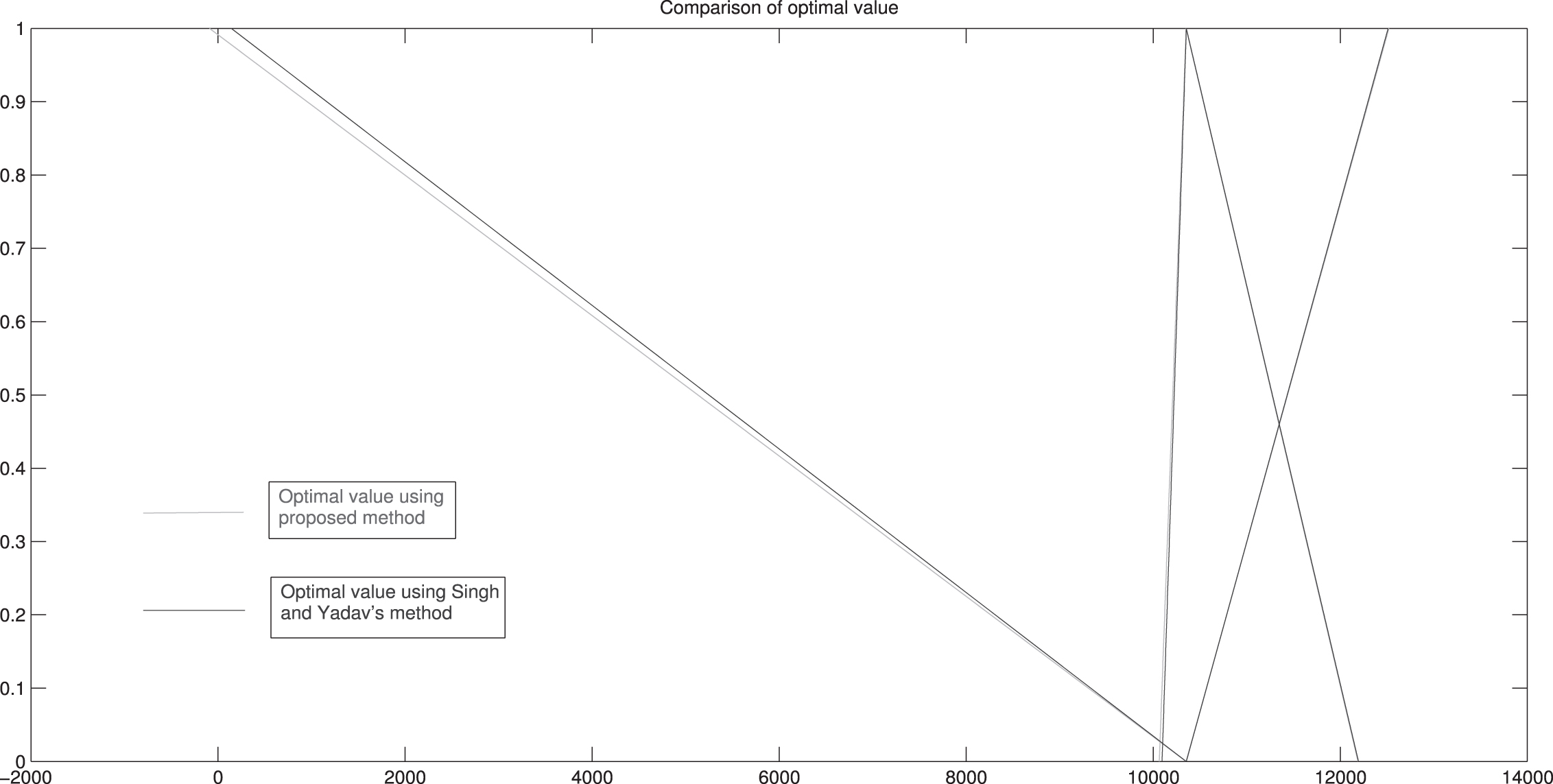
The optimal value of the problem obtained by Singh and Yadav [45]’s method is (10354.25 ; 259.41, 1841.10 ; 10210.68, 2158.05) LR and the optimal value of the same problem obtained by our proposed technique is (10352.5 ; 287.15, 1837.67 ; 10441.8, 2167.96) LR .
The comparison of the obtained optimal values using Singh and Yadav [45]’s method and using the proposed technique is given in Fig. 2.
Comparison of optimal values using proposed method and Singh and Yadav [45]’s method.
It can be seen clearly that both the techniques are comparable but the proposed method is more flexible towards dealing the uncertain information as Pythagorean fuzzy environment has wider space than fuzzy and intuitionistic fuzzy environment.
Conclusion
A Pythagorean fuzzy model is an extension of an intuitionistic fuzzy model. The propriety of Pythagorean fuzzy model in expressing vague information has achieved many researcher’s attention. In the present study, we have made an attempt to define LR-type PFN and their arithmetic operations. We have developed a ranking of the LR-type PFNs and proposed a method to solve FPFLPP with equality constraints having unrestricted LR-type PFNs as parameters and variables. The proposed method is explained with numerical examples. We have compared our proposed technique with the existing method and both the methods agree well. Proposed method has greater space to deal with the uncertainty. The solution by our proposed method satisfies all the constraints that is the best possible optimal solution. Further, this method can be used to solve the FPFLPP having triangular PFNs as variables and parameters by just taking L and R as linear functions. Consequently, our proposed method is more general. In the future, we plan to extend our proposed method to solve FPFLPP having LR-type PFNs as parameters and variables, with inequality constraints.
Conflict of interest
The authors declare no conflict of interest.
References
1.
Abhishekh and NishadA.K., A novel ranking approach to solving fully LR-intuitionistic fuzzy transportation problem, New Mathematics and Natural Computation15(1) (2019), 95–112.
2.
AkramM., IlyasaF. and GargH., Multi-criteria group decision making based on ELECTRE I method in Pythagorean fuzzy information, Soft Computing24(5) (2020), 3425–3453.
3.
AkramM., GargH. and ZahidK., Extensions of ELECTRE-I and TOPSIS methods for group decision-making under complex Pythagorean fuzzy environment, Iranian Journal of Fuzzy Systems17(5) (2020), 147–164.
4.
AkramM., AllahviranlooT., PedryczW., et al., Methods for solving LR-bipolar fuzzy linear systems, Soft Computing25 (2021), 85–108.
5.
AkramM., UllahI., EdalatpanahS.A. and AllahviranlooT., Fully Pythagorean fuzzy linear programming problems with equality constraints, Computational and Applied Mathematics40 (2021), 120.
6.
AllahviranlooT., LotfiF.H., KiasaryM.K., KianiN.A. and ZadehL.A., Solving Fully Fuzzy Linear Programming Problem by the Ranking Function, Applied Mathematical Sciences2(1) (2008), 19–32.
7.
AllahviranlooT., The adomian decomposition method for fuzzy system of linear equations, Applied Mathematics and Computation163(2) (2005), 553–563.
8.
AnJ.J. and LiD.F., A linear programming approach to solve constrained bi-matrix games with intuitionistic fuzzy payoffs, International Journal of Fuzzy Systems21(3) (2019), 908–915.
9.
AngelovP.P., Optimization in an intuitionistic fuzzy environment, Fuzzy Sets and Systems86(3) (1997), 299–306.
10.
AtanassovK.T., Intuitionistic fuzzy sets, Fuzzy Sets and Systems20 (1986), 87–96.
11.
BeheraD., PetersK., EdalatpanahS.A. and QiuD., New methods for solving imprecisely defined linear programming problem under trapezoidal fuzzy uncertainty, Journal of Information and Optimization Sciences (2020), 1–27. https://doi.org/10.1080/02522667.2020.1758369.
12.
BellmanR.E. and ZadehL.A., Decision making in a fuzzy environment, Management Science17 (1970), 141–164.
13.
BharatiS.K. and SinghS.R., Solution of multiobjective linear programming problems in intervalvalued intuitionistic fuzzy environment, Soft Computing23(1) (2019), 77–84.
14.
ChenT.Y., Pythagorean fuzzy linear programming technique for multidimensional analysis of preference using a squared-distance-based approach for multiple criteria decision analysis, Expert Systems with Applications164, 113908.
15.
DubeyD. and MehraA., Linear programming with triangular intuitionistic fuzzy number, Advances in Intelligent Systems Research1(1) (2011), 563–569.
16.
EdalatpanahS.A., A data envelopment analysis model with triangular intuitionistic fuzzy numbers, International Journal of Data Envelopment Analysis7(4) (2019), 47–58.
17.
GargH., RaniM., SharmaS.P. and VishwakarmaY., Intuitionistic fuzzy optimization technique for solving multi-objective reliability optimization problems in interval environment, Expert Systems with Applications41(7) (2014), 3157–3167.
18.
GouX., XuZ. and RenP., The properties of continuous Pythagorean fuzzy information, International Journal of Intelligent Systems31(5) (2016), 401–424.
19.
KabirajA., NayakP.K. and RahaS., Solving intuitionistic fuzzy linear programming problem, International Journal of Intelligence Science9 (2019), 44–58.
20.
KaurJ. and KumarA., An introduction to fuzzy linear programming problems, Springer Science and Business Media LLC, (2016).
21.
KaurJ. and KumarA., Exact fuzzy optimal solution of fully fuzzy linear programming problems with unrestricted fuzzy variables, Applied Intelligence37 (2012), 145–154.
22.
KaurJ. and KumarA., Mehar’s method for solving fully fuzzy linear programming problems with LR fuzzy parameters, Applied Mathematical Modelling37 (2013), 7142–7153.
23.
KumarA., KaurJ. and SinghP., A new method for solving fully fuzzy linear programming problems, Applied Mathematical Modelling35 (2011), 817–823.
24.
KumarR., EdalatpanahS.A., JhaS. and SinghR., A Pythagorean fuzzy approach to the transportation problem, Complex and Intelligent Systems5 (2019), 255–263.
25.
LotfiF.H., AllahviranlooT., JondabehM.A. and ZadehL.A., Solving a full fuzzy linear programming using lexicography method and fuzzy approximate solution, Applied Mathematical Modelling33(7) (2009), 3151–3156.
26.
LuqmanA., AkramM. and AlcantudJ.C.R., Digraph and matrix approach for risk evaluations under pythagorean fuzzy information, Expert Systems with Applications (2020), 114518.
27.
MahapatraG.S. and RoyT.K., Reliability evaluation using triangular intuitionistic fuzzy numbers arithmetic operations, World Acadmy of Science, Engineering and Technology50 (2009), 574–581.
28.
MahapatraG.S. and RoyT.K., Intuitionistic fuzzy number and its arithmetic operation with application on system failure, Journal of Uncertain Systems7(2) (2013), 92–107.
29.
MalathiC. and UmadeviP., A new procedure for solving linear programming problems in an intuitionistic fuzzy environment, IOP Conf. Series: Journal of Physics: Conf. Series1139 (2018), 012079.
30.
MoloudzadehS., AllahviranlooT. and DarabiP., A new method for solving an arbitrary fully fuzzy linear system, Soft Computing17(9) (2013), 1725–1731.
31.
NagoorganiA. and PonnalaguK., A new approach on solving intuitionistic fuzzy linear programming problem, Applied Mathematical Sciences6(70) (2012), 3467–3474.
32.
NagoorganiA., KavikumarJ. and PonnalaguK., The knowledge of expert opinion in intuitionistic fuzzy linear programming problem, Mathematical Problems in Engineering (2015), Article ID 875460.
33.
NajafiH.S. and EdalatpanahS.A., A note on “A new method for solving fully fuzzy linear programming problems", Applied Mathematical Modelling37(14-15) (2013), 7865–7867.
34.
NajafiH.S., EdalatpanahS.A. and DuttaH., A nonlinear model for fully fuzzy linear programming with fully unrestricted variables and parameters, Alexandria Engineering Journal55(3) (2016), 2589–2595.
35.
ParvathiR. and MalathiC., Intuitionistic fuzzy linear programming problems, World Applied Sciences Journal17(12) (2012), 1787–1791.
36.
ParvathiR. and MalathiC., Intuitionistic fuzzy linear optimization, Notes on Intuitionistic Fuzzy Sets18(1) (2012), 48–56.
37.
ParvathiR., MalathiC., AkramM. and AtanassovK.T., Intuitionistic fuzzy linear regression analysis, Fuzzy Optimization and Decision Making12(2) (2013), 215–229.
38.
PengX. and YangY., Some results for Pythagorean fuzzy sets, International Journal of Intelligent Systems30(11) (2015), 11331160.
39.
PengX., YuanH. and YangY., Pythagorean fuzzy information measures and their applications, International Journal of Intelligent Systems32(10) (2017), 991–1029.
40.
Pśerez-CañedoB. and Concepción-MoralesE.R., On LR-type fully intuitionistic fuzzy linear programming with inequality constraints: Solutions with unique optimal values, Expert Systems with Applications128 (2019), 246–255.
41.
Pérez-CañedoB., Concepción-MoralesE.R. and EdalatpanahS.A., A revised version of a lexicographical-based method for solving fully fuzzy linear programming problems with inequality constraints, Fuzzy Information and Engineering (2020), 1–20. https://doi.org/10.1080/16168658.2020.1761511.
42.
RenP., XuZ. and GouX., Pythagorean fuzzy TODIM approach to multi-criteria decision making, Applied Soft Computing42 (2016), 246–259.
43.
SaqibM., AkramM., ShahidaB. and AllahviranlooT., Numerical solution of bipolar fuzzy initial value problem, Journal of Intelligent and Fuzzy Systems40(1) (2021), 1309–1341.
44.
SinghS.K. and YadavS.P., Intuitionistic fuzzy multi-objective linear programming problem with various membership functions, Annals of Operations Research269(1-2) (2018), 693–707.
45.
SinghV. and YadavS.P., Development and optimization of unrestricted LR-type intuitionistic fuzzy mathematical programming problems, Expert Systems With Applications80 (2017), 147–161.
46.
SureshM., VengataasalamS. and ArunP.K., Solving intuitionistic fuzzy linear programming problems by ranking function, Journal of Intelligent and Fuzzy Systems27(6) (2014), 3081–3087.
47.
TanakaH., OkuduT. and AsaiK., On fuzzy-mathematical programming, Journal of Cybernetics3(4) (1973), 37–46.
48.
WanS.P., JinZ. and DongJ.Y., Pythagorean fuzzy mathematical programming method for multiattribute group decision making with Pythagorean fuzzy truth degrees, Knowledge and Information Systems55 (2018), 437–466.
49.
WanS.P., JinZ. and DongJ.Y., A new order relation for Pythagorean fuzzy numbers and application to multi-attribute group decision making, Knowledge and Information Systems62 (2020), 751–785.
50.
WuQ., ZhouL., ChenY. and ChenH., An integrated approach to green supplier selection based on the inreval type-2 fuzzy best-worst and extended VIKOR methods, Information Sciences502 (2019), 394–417.
51.
WuQ., LiuX., QinJ., WangW. and ZhouL., A linguistic distribution behavioral multi-criteria group decision making model integrating extended generalized TODIM and quantum decision theory, Applied Soft Computing98 (2021), 106757.
52.
WuQ., LinW., ZhouL., ChenY. and ChenH., Enhancing multiple attribute group decision making flexibility based on information fusion technique and hesitant Pythagorean fuzzy sets, Computers & Industrial Engineering127 (2019), 954–970.
53.
XueW., XuZ., ZhangX. and TianX., Pythagorean fuzzy LINMAP method based on the entropy theory for railway project investment decision making, International Journal of Intelligent Systems33(1) (2018), 93–125.
54.
YagerR.R., Pythagorean fuzzy subsets, in: Proc. Joint IFSA World Congress and NAFIPS Annual Meeting, Edmonton, Canada, (2013), 57–61.
55.
YagerR.R. and AbbasovA.M., Pythagorean membership grades, complex numbers and decision making, International Journal of Intelligent Systems28(5) (2013), 436–452.
56.
YagerR.R., Pythagorean membership grades in multi-criteria decision making, IEEE Transactions on Fuzzy Systems22(4) (2014), 958–965.
57.
ZadehL.A., Fuzzy sets, Information and Control8 (1965), 338–353.
58.
ZhangH., DongY., XiaoJ., ChiclanaF. and Herrera-ViedmaE., Consensus and opinion evolutionbased failure mode and effect analysis approach for reliability management in social network and uncertainty contexts, Reliability Engineering & System Safety208 (2021), 107425.
59.
ZhangH., ZhaoS., KouG., LiC.-C., DongY. and HerreraF., An overview on feedback mechanisms with minimum adjustment or cost in consensus reaching in group decision making: research paradigms and challenges, Information Fusion60 (2020), 65–79.
60.
ZhangX. and XuZ., Extension of TOPSIS to multiple-criteria decision making with Pythagorean fuzzy sets, International Journal of Intelligent Systems29(12) (2014), 1061–1078.
61.
ZimmermanH.J., Fuzzy programming and linear programming with several objective functions, Fuzzy Sets and Systems1(1) (1978), 45–55.