



Abstract
In recent years, lakes pollution has become increasingly serious, so water quality monitoring is becoming increasingly important. The concentration of total organic carbon (TOC) in lakes is an important indicator for monitoring the emission of organic pollutants. Therefore, it is of great significance to determine the TOC concentration in lakes. In this paper, the water quality dataset of the middle and lower reaches of the Yangtze River is obtained, and then the temperature, transparency, pH value, dissolved oxygen, conductivity, chlorophyll and ammonia nitrogen content are taken as the impact factors, and the stacking of different epochs’ deep neural networks (SDE-DNN) model is constructed to predict the TOC concentration in water. Five deep neural networks and linear regression are integrated into a strong prediction model by the stacking ensemble method. The experimental results show the prediction performance, the Nash-Sutcliffe efficiency coefficient (NSE) is 0.5312, the mean absolute error (MAE) is 0.2108 mg/L, the symmetric mean absolute percentage error (SMAPE) is 43.92%, and the root mean squared error (RMSE) is 0.3064 mg/L. The model has good prediction performance for the TOC concentration in water. Compared with the common machine learning models, traditional ensemble learning models and existing TOC prediction methods, the prediction error of this model is lower, and it is more suitable for predicting the TOC concentration. The model can use a wireless sensor network to obtain water quality data, thus predicting the TOC concentration of lakes in real time, reducing the cost of manual testing, and improving the detection efficiency.
Keywords
Introduction
With the rapid development of the economy, environmental pollution is becoming increasingly serious, so water quality monitoring has become very important [1]. Water quality monitoring is a process of evaluating water quality by monitoring and determining the types of pollutants in water, the concentration of pollutants and the change in different pollutants. The scope of water quality monitoring is very wide, including uncontaminated and contaminated natural water (river, lake, sea and underground water) and all kinds of industrial drainage. The main monitoring items can be divided into two categories: one is a comprehensive index reflecting water quality, such as temperature, chroma, turbidity, pH value, conductivity, suspended matter, dissolved oxygen, chemical oxygen demand and biochemical oxygen demand [2]. The other is toxic substances, such as phenol, cyanogen, arsenic, lead, chromium, cadmium, mercury and organic pesticides. To evaluate the water quality of rivers and oceans more objectively, in addition to the above monitoring items, flow velocity and water flow are sometimes measured [3, 4].
The emission of organic pollutants is one of the main causes of lake pollution. The comprehensive index of organic pollution mainly includes chemical oxygen demand and total organic carbon (TOC) concentration [5–7]. TOC in inland waters is an important part of the global carbon cycle. As a channel between the terrestrial environment and the ocean, lakes and rivers control the emission of greenhouse gases and store carbon in their sediments. In the function of aquatic ecosystem, TOC concentration plays an important role by affecting the physical and chemical properties of water, and then affecting the structure of biological community [8]. For example, TOC affects water acidity, dissolved oxygen level, water color, light penetration and thermal penetration, thereby regulating the development of thermal stratification and anoxia. TOC is also closely related to nutrients, which together affect the species distribution of fish and the habitat availability of primary producers (bacteria and algae), thus affecting the productivity of aquatic ecosystems. In addition, TOC also affects the transportation and storage of metal and organic pollutants, the growth of toxic algae and the related costs of drinking water treatment [9]. Therefore, in the study of environmental science, it is very important to monitor the TOC concentration in aquatic ecosystem, especially for the lakes in densely populated and economically active areas.
Traditional water quality monitoring technologies are mainly physical and chemical monitoring technologies, including chemical methods, electrochemical methods, atomic absorption spectrometry, ion-selective electrode methods, ion chromatography, gas chromatography, and plasma emission spectrometry [10]. In recent years, biological monitoring, remote sensing monitoring and wireless sensor network monitoring have also been applied to monitor water quality [11–13]. Especially with the development of wireless sensor networks, the data acquired by various sensors are transmitted to the server in real time, which can monitor the water quality changes in real time. It is more efficient and inexpensive than traditional artificial physical and chemical testing [14, 15].
In recent years, machine learning and deep learning have been widely used in various fields of environmental science and has made many achievements. Considering the weather of the previous day, taking wind field, temperature and air pollution concentration as the input of the model, Sayeed et al. developed a deep convolutional neural network model to predict the ozone concentration 24 hours in advance. The model has been trained to have a better performance in predicting the next day’s 24-hour ozone concentration [16]. To better control and manage the harbor water quality of New York City and other coastal cities, a deep learning model was proposed for water quality prediction. The model combined deep matrix decomposition and a deep neural network, which can solve the sparse matrix problem more intelligently and predict the BOD value more accurately. To test its effectiveness, 32,323 water samples were used to study the port water in New York City. The results show that compared with the traditional matrix completion method, the RMSE of this method is reduced by 11.54%–17.23%, and compared with the traditional machine learning algorithm, the RMSE is reduced by 19.20%–25.16%[17]. Pudashine et al. proposed a rainfall retrieval deep learning model based on a long short-term memory (LSTM) model architecture, which was trained with data provided by mobile network operators. The experimental results show that the coefficient of determination (R-2) for rainfall prediction increases from 0.86 to 0.97, and the observed total rainfall estimates significantly improved [18]. Chen et al. endeavored to compare the water quality prediction performance of 10 learning models (7 traditional and 3 ensemble models) using big data (33,612 observations) from the major rivers and lakes in China from 2012 to 2018 based on the precision, recall, F1-score, and weighted F1-score and explored the potential key water parameters for future model prediction. The results showed that bigger data can improve the performance of learning models in the prediction of water quality [19].
For predicting TOC concentration using machine learning and deep learning, there are also some preliminary researches [20]. Meyer-Jacob et al. proposed an orthogonal partial least squares model (PLS) to infer TOC concentrations in lakes of northern Europe and North America. Based on the surface water data of 345 Arctic to north temperate lakes in Canada, Greenland, Sweden and Finland, the model used the visible near infrared (VNIR) spectra of lake sediments to predict the TOC concentration of lakes in southern Ontario and Scotland. The experimental results showed that the R-2 of the model cross validation is 0.57 [21]. Shalaby et al. studied the TOC concentration in Taranaki Basin, five machine learning techniques, namely Bayesian regularization for feed-forward neural networks (BRNNs), random forest (RF), support vector machine (SVM) for regression, linear regression (LR) and Gaussian process regression (GPR), were employed for prediction of TOC, the results showed that the prediction performance of random forest is the best, and achieved the R-2 value of 0.964 [22]. Handhal et al. evaluated the use of three machine learning models namely, RF, rotation forest (rF), K-nearest neighbors (KNN) to estimate TOC based on conventional well logs data. Results indicated the KNN was the best followed by RF and then rF. The study confirmed the ability of machine learning models for building efficient model for estimating TOC [23]. Lu et al. constructed TOC prediction model by combining abnormal sample elimination, spectral feature transformation and feature wavelength extraction to predict the TOC concentration in intertidal sediments, and used PLS, least squares support vector machine (LSSVM) and BP Neural Network (BPNN) to model and predict sediment TOC concentration, the experimental results showed that the prediction accuracy of LSSVM is the highest, with the R-2 value of 0.86 [24]. The above researches are helpful exploration of machine learning and deep learning in the prediction of TOC concentration. However, the research areas of these studies are generally small, while these areas are sparsely populated and economic production activities are not active, which means almost uncontaminated; on the other hand, the prediction accuracy of the above methods needs to be improved.
Ensemble learning is a meta method that combines several machine learning models into a whole prediction model. The prediction performance of this model is usually better than that of the single models [25, 26]. Therefore, ensemble learning method can greatly improve the prediction accuracy. In recent years, ensemble learning has been widely used in various fields of research. Wang et al. combined an adaptive neuro-fuzzy inference system (ANFIS) with two metaheuristic methods of biogeography, the ensemble methods were more effective than ANFIS in the study area [27]. Bui et al. provided an approach for flash flood susceptibility modeling based on a feature selection method (FSM) and tree based ensemble methods, and compared to a conventional rule based method, the approach gave more accurate predictive results [28]. In the field of industry electronic, Zhao et al. predicted the eddy current losses of metal fasteners in rotor slots of a large nuclear steam turbine generator, the ensemble model presented better performance [29].
In this paper, to improve the prediction precision of the TOC concentration in lakes, a new ensemble model is proposed, named the stacking of different epochs’ deep neural networks (SDE-DNN) model. By taking temperature, transparency, pH value, dissolved oxygen, conductivity, chlorophyll and ammonia nitrogen as inputs of the model, the TOC concentration is predicted. Compared with other models listed, the superiority of the proposed model in predicting the TOC concentration in water is verified. This method can use other indexes obtained by sensor networks to predict the TOC concentration of lakes in real time, while avoiding excessive human participation, improving efficiency and reducing testing cost.
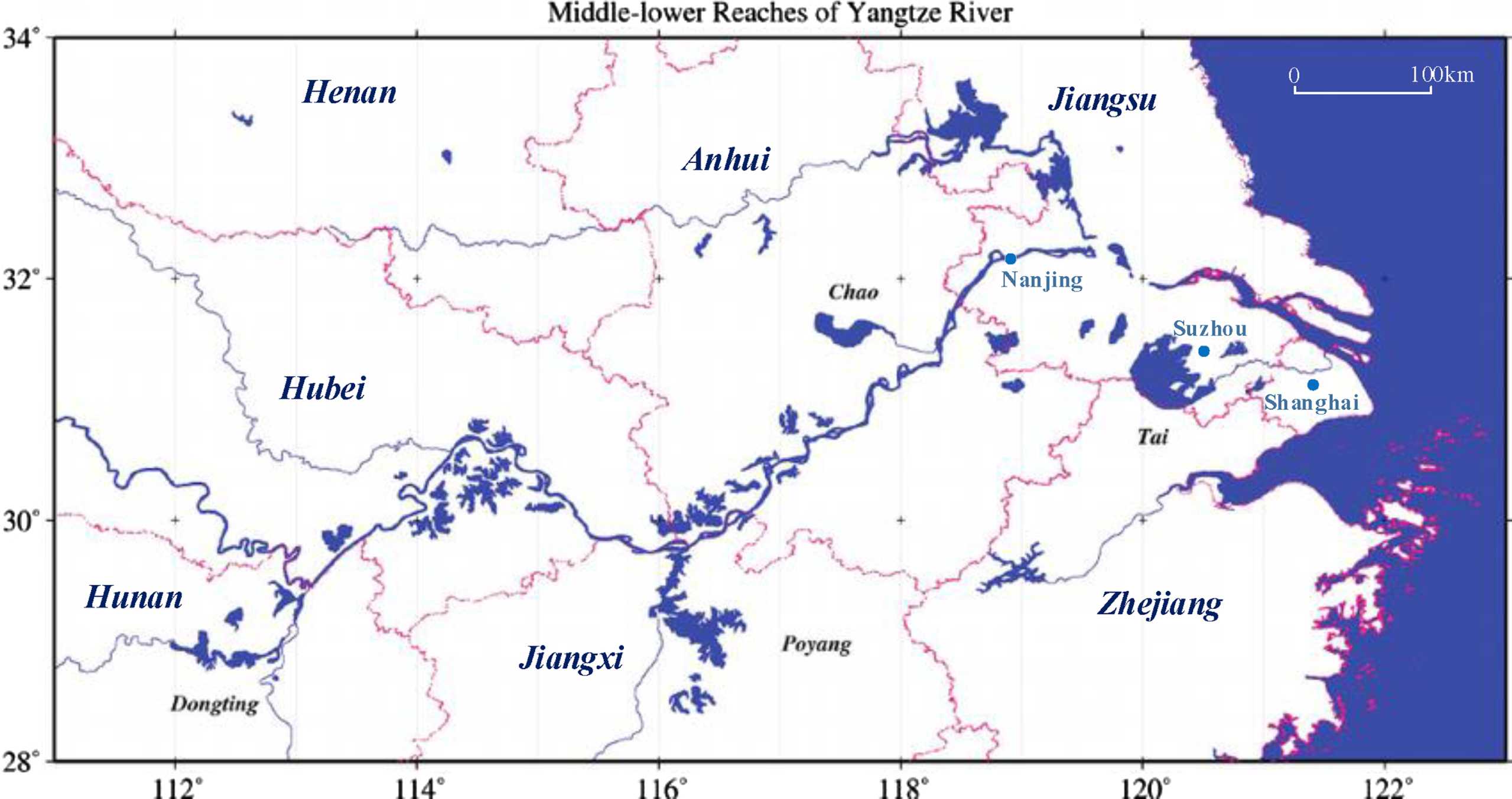
Distribution of lakes in the middle and lower reaches of the Yangtze River.
Description of the study area
There are more than 24,800 lakes in China, including 2,800 natural lakes with an area of more than 1 square kilometer. Although the number of lakes is large, the regional distribution is very uneven. In general, the eastern monsoon region, especially the middle and lower reaches of the Yangtze River, is the largest freshwater lake area in China [30, 31].
The geographical range of the middle and lower reaches of the Yangtze River is between 28°45’ –33° 25’ N and 111°17’ –123°25’ E. There are 642 lakes with a total area of 15794.6 km2. The distribution of lakes in the middle and lower reaches of the Yangtze River is shown in Fig. 1. Due to the small drop of water level and small flow velocity in plain area, the flow direction is uncertain due to the height control of water conservancy project and the influence of gate opening and closing and water diversion and drainage. In addition to the local surface water runoff, the rivers and lakes also bear the water from the upper 15 provinces with an area of about 2 million km2. In flood years, the middle and lower reaches of the Yangtze River are the flood corridors of the upstream water systems. Facing the ocean, they are easily attacked by storm rain and storm surge from Taiwan, which often lead to external flood, internal waterlogging or concurrent flood of external flood and internal waterlogging. In drought years, there is little water from the upper reaches, which often leads to serious drought and worsens the water quality of rivers and lakes. In addition, some rivers have high sediment concentration, channel siltation, river bed slope slowing down, and reservoir sediment deposition makes sediment absorb pollutants, which aggravates the pollution of water environment and increases the difficulty of development and utilization of water resources.
Meanwhile, the middle and lower reaches of the Yangtze River are important industrial production bases in China. The main cities in the region include Shanghai, Nanjing, Suzhou and other first tier cities, and the total population of the region is about 74,047,100. Dense population and frequent human activities further aggravate the water pollution situation in this area, and the importance of water quality monitoring is self-evident.
The Nanjing Institute of Geography and Lakes of the Chinese Academy of Sciences (CAS) has set up a large number of water quality monitoring stations in the main lakes in the middle and lower reaches of the Yangtze River through the construction of the “scientific database” of the Chinese Academy of Sciences, the “China Lake database” of the 10th 5-year plan, the “China Lake Science Professional Database” of the 11th 5-year plan, and the “key database of science and technology data resource integration and sharing project” of the 12th 5-year plan. Table 1 shows the monitoring stations in the main lakes in the middle and lower reaches of the Yangtze River.
Large lakes in the middle and lower reaches of the Yangtze River
Large lakes in the middle and lower reaches of the Yangtze River
These stations use artificial physical and chemical detection and automatic monitoring to obtain data. The TOC concentration can only be detected by artificial physical and chemical stations. This paper focuses on the middle and lower reaches of the Yangtze River, using the water quality performance data measured by artificial physical and chemical detection to predict the TOC concentration in lakes by machine learning methods.
To verify the prediction model of the TOC concentration in water, the monitoring data of water quality in the middle and lower reaches of the Yangtze River from 2007 to 2009 were obtained from the Lake-Basin thematic database in the middle and lower reaches of the Yangtze River (http://www.lakesci.csdb.cn/front/detail-lake2014$zdhpszrgjc?id=2000) of the China lake database. The lakes as data sources are shown in Table 1. A total of 272 water quality monitoring samples were selected from the above database as the samples of this experiment. The samples were obtained by water quality monitoring stations around the main lakes along the Yangtze River. The water quality samples were collected from 74 lakes from October 11, 2007 to April 9, 2009. The number of water quality samples collected from each lake ranged from 1 to 25. Detailed data can be found in Tables S2 in the Appendix A.
According to the data obtained by wireless network, water temperature (°C), transparency (m), pH value, dissolved oxygen (mg/L), conductivity (μs/cm), chlorophyll (μg/L) and ammonia nitrogen (mg/L) were taken as the input to the model, and the output was the TOC concentration (mg/L). Figure 2 shows all of the water quality monitoring samples. The data come from different monitoring stations in different lakes at different times, so the values of water quality samples may be biased. In Fig. 2, the data with abnormally high DO value comes from the second monitoring station of Yuandang Lake, and the data with abnormally high chlorophyll value comes from the third monitoring station of Xinmiao Lake. The reason for the abnormality may be the deviation caused by the different geographical location of the lake or the statistical error of the monitoring station. In order to ensure the reliability of the prediction results, we remove the outliers.

Water quality monitoring samples: (a) water temperature, (b) transparency, (c) pH value, (d) dissolved oxygen, (e) conductivity, (f) chlorophyll, (g) ammonia nitrogen, (h) content of TOC.
The K-means clustering method is used to divide the data into three clusters, and the number of each group is different. Synthetic Minority Oversampling Technique (SMOTE) and Adaptive Synthetic Sampling Algorithm (ADASYM) can be used to solve this problem [32]. In this paper, SMOTE is selected, therefore, a total of 357 pieces of data are finally obtained, which are divided into three groups, with 119 pieces of data in each group. The final data image is shown in Fig. 3.
Correlation analysis was conducted to the collected data samples. Figure 4 shows the correlation coefficient matrix. It can be seen that conductivity and chlorophyll have stronger positively correlation with TOC concentration under the samples, and the correlation coefficients are 0.58, and 0.45 respectively. While the temperature is stronger negatively correlated to TOC concentration with the correlation coefficient of –0.38. The correlation between transparency, pH value, dissolved oxygen, ammonia nitrogen and TOC concentration is weak, and the correlation coefficients are –0.16, 0.07, 0.25 and 0.03, respectively.
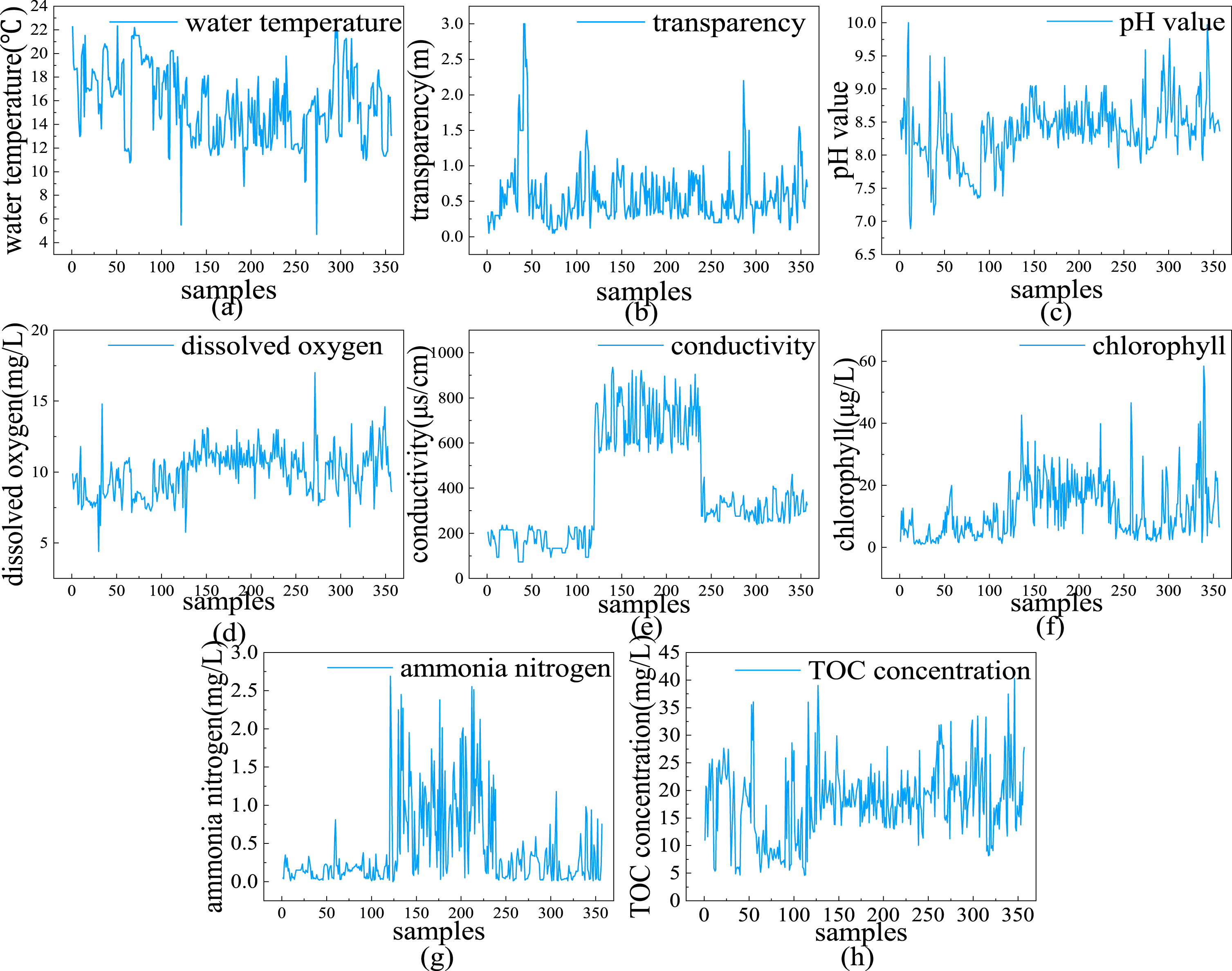
Water quality monitoring samples after outliers removed: (a) water temperature, (b) transparency, (c) pH value, (d) dissolved oxygen, (e) conductivity, (f) chlorophyll, (g) ammonia nitrogen, (h) content of TOC.
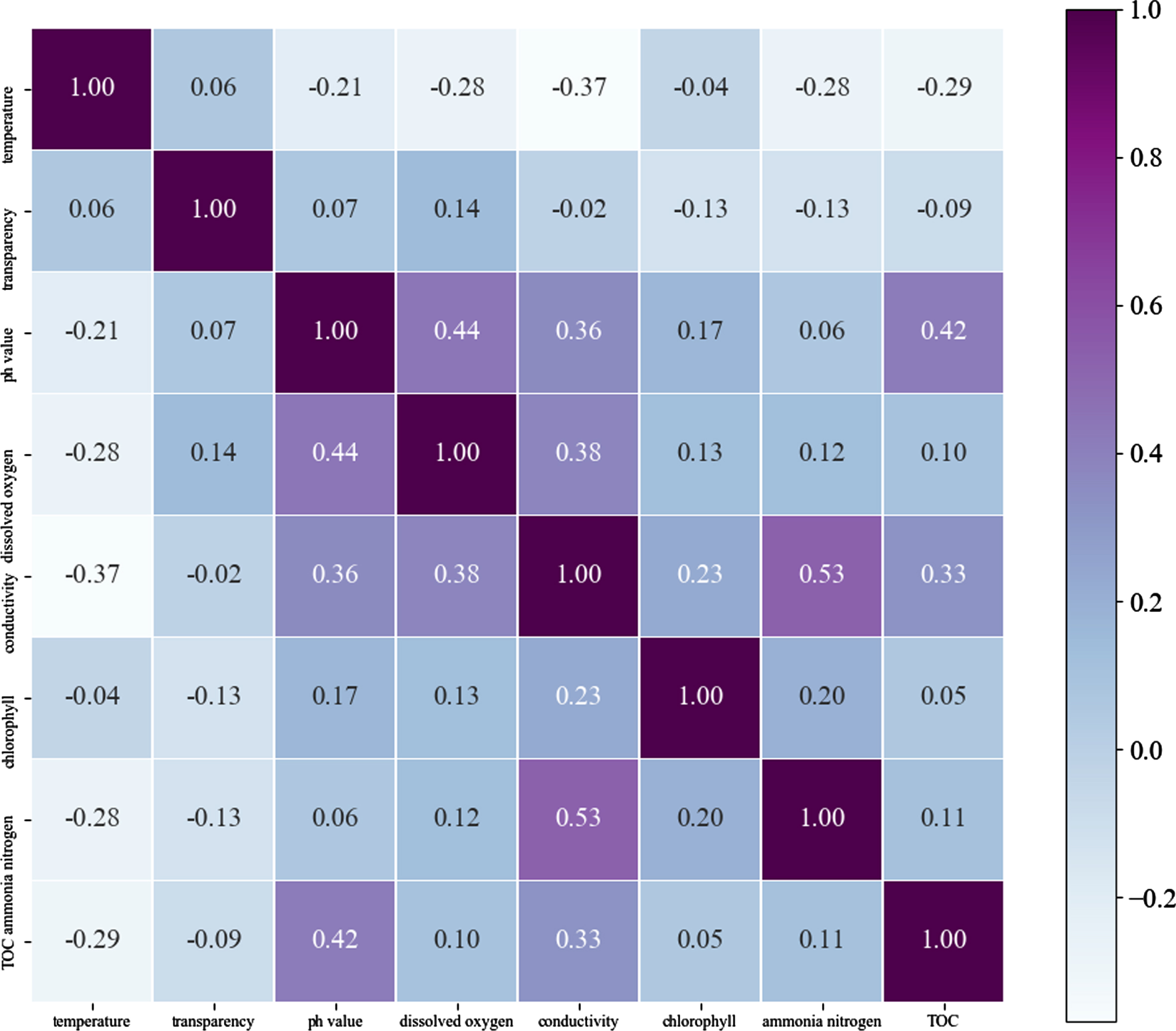
Correlation coefficient matrix of the water quality parameters.
Ensemble learning
Ensemble learning is a meta method that integrates multiple weak classifiers or regression models into a strong classifier or regression model. It can be used for the ensemble of classification problems, regression problems, feature selection, outlier detection, etc. [33]. Common ensemble learning methods include bagging, boosting, and stacking.
The training set of bagging’s individual weak learner is obtained by random sampling [34]. Through T random sampling iterations, we can obtain T sample sets. For these T sample sets, we can train T weak learners independently and then obtain the final strong learners through the aggregation strategy.
Boosting is a family of algorithms that can promote weak learners to strong learners [35]. The mechanism of the algorithm is to train a base learner from the initial training set and then adjust the distribution of training samples according to the performance of the base learner so that the training samples that the previous base learners trained incorrectly will receive more attention in the follow-up. Then, the next basic learner was trained based on the adjusted sample distribution; this process is repeated until the number of base learners reaches the preassigned value T, and finally, the T base learners are weighted combined.
Stacking is a typical representative ensemble learning method. It is a hierarchical ensemble model [36]. The stacking model is usually divided into two layers: a level 0 layer and a level 1 layer. Generally, the level 1 layer is called the metalayer. The learners in the level 0 layer are called base learners, and the learners in the level 1 layer are called metalearners. Stacking uses the initial training set to train the base learner and then generates a new dataset to train metalearners. In this new dataset, the output of the base learner is treated as an input sample, while the label of the initial sample is still treated as a sample label. Unlike bagging and boosting, stacking is asynchronous integration, which can integrate different types of classifiers or regression models.
Deep neural network
The basis of deep neural network (DNN) is artificial neural network (ANN). ANN is a mathematical model inspired by the structure and function of biological neural network [37]. It has the ability to deal with complex and nonlinear input-output relations and dimension problems, and has been widely used in various fields [38]. Figure 5(a) shows the general structure of ANN. DNN is the extension of ANN, so that its structure is similar to ANN [39, 40]. As shown in Fig. 5(b), the layers of DNN are fully connected, that is, each neuron in the previous layer must be connected with all neurons in this layer. According to different location of the layers, they can be divided into input layer, hidden layer and output layer. Generally, the first layer is the input layer, the last layer is the output layer, and the intermediate layers are hidden layers.

Structures of an artificial neural network (ANN) and a deep neural network (DNN). (a) A simple example of an ANN. (b) A DNN with more layers.
DNN has also developed many variants of neural networks, such as Convolutional Neural Network (CNN) and Long Short-Term Memory (LSTM) [41–43]. CNN is generally used to solve the problem of image recognition, while LSTM is a special recurrent neural network model. Its special structure design makes it possible to avoid the problem of long-term dependence. However, this paper focuses on regression prediction, which is a method to predict the development trend and level of dependent variables based on one or several independent variables. This trend and level of change is not only reflected in the regularity of natural changes in time series, but also in the regularity of causality between variables. Therefore, the fully connected DNN model is still a suitable choice.
When the deep neural network is used for regression prediction, the prediction results may be different due to the change in epochs of backpropagation training [44]. Therefore, this paper combines deep learning with ensemble learning and proposes the stacking of different epochs’ deep neural networks (SDE-DNN) model. The model adopts a two-layer stacking structure. The first layer uses five deep neural network models. These models are derived from the same base DNN model. The structure of the base model is shown in Fig. 6(a). Table 2 shows the information of the base DNN model.
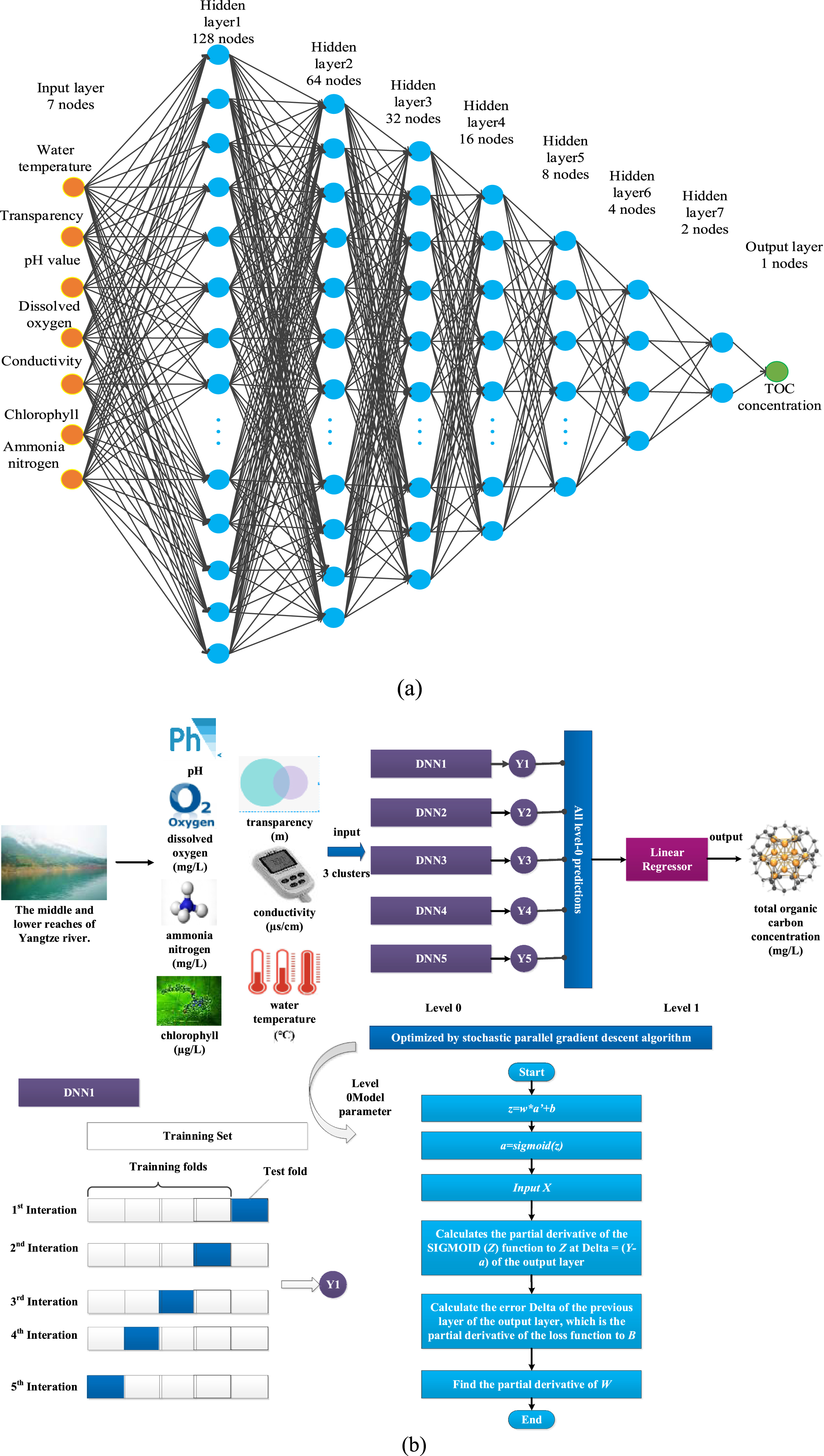
Prediction model of TOC in water based on the SDE-DNN: (a) base DNN model, (b) overall process of TOC concentration prediction in water.
The structure and parameters of the basic DNN model are determined by a large number of experiments. Here are some experimental results. Table 3 shows the prediction results of SDE-DNN models with different basic DNN models. More detailed results can be found in Section 3.4. Generally, the results of the basic DNN model used in this paper are better than other basic DNN models.
In this paper, the water temperature, transparency, pH value, dissolved oxygen, conductivity, chlorophyll and ammonia nitrogen are taken as the input to the model, and the TOC concentration in water is taken as the output of the model. Figure 6(b) shows the complete process of predicting the TOC concentration in water.
For each cluster, by setting the epochs of backpropagation training from 100 to 500 with a step size equal to 100, five deep neural network models DNN1-DNN5 are obtained. Inputting the dataset established in Section 2.2 into the 5 DNN models, then the prediction output Y1 to Y5 can be obtained. Among them, Y1 is the concatenation of the 5 prediction results (y_pred11 to y_pred15) of DNN1 after 5-fold cross validation, Y2-Y5 are calculated in the similar way.
The output Y1 to Y5 of the first layer is collected and transferred to the linear regression model of the metalayer, and the final prediction results can be obtained through calculation. The specific process is shown in Fig. 7. It can be seen that, during 5-fold validation, each DNN model generate 5 results, such as y_pred11 to y_pred15. These results concatenate to a feature Y1, and for 5 DNN models, 5 features Y1 to Y5 can be concatenated to a new training set D′. Similarly, 5 test set y_pred_new1 to y_pred_new5 can be obtained by inputting original test set into 5 DNN models, and a new test set F′ can be concatenated by these new test sets.
Prediction results of different DNN models
Information of the base DNN model
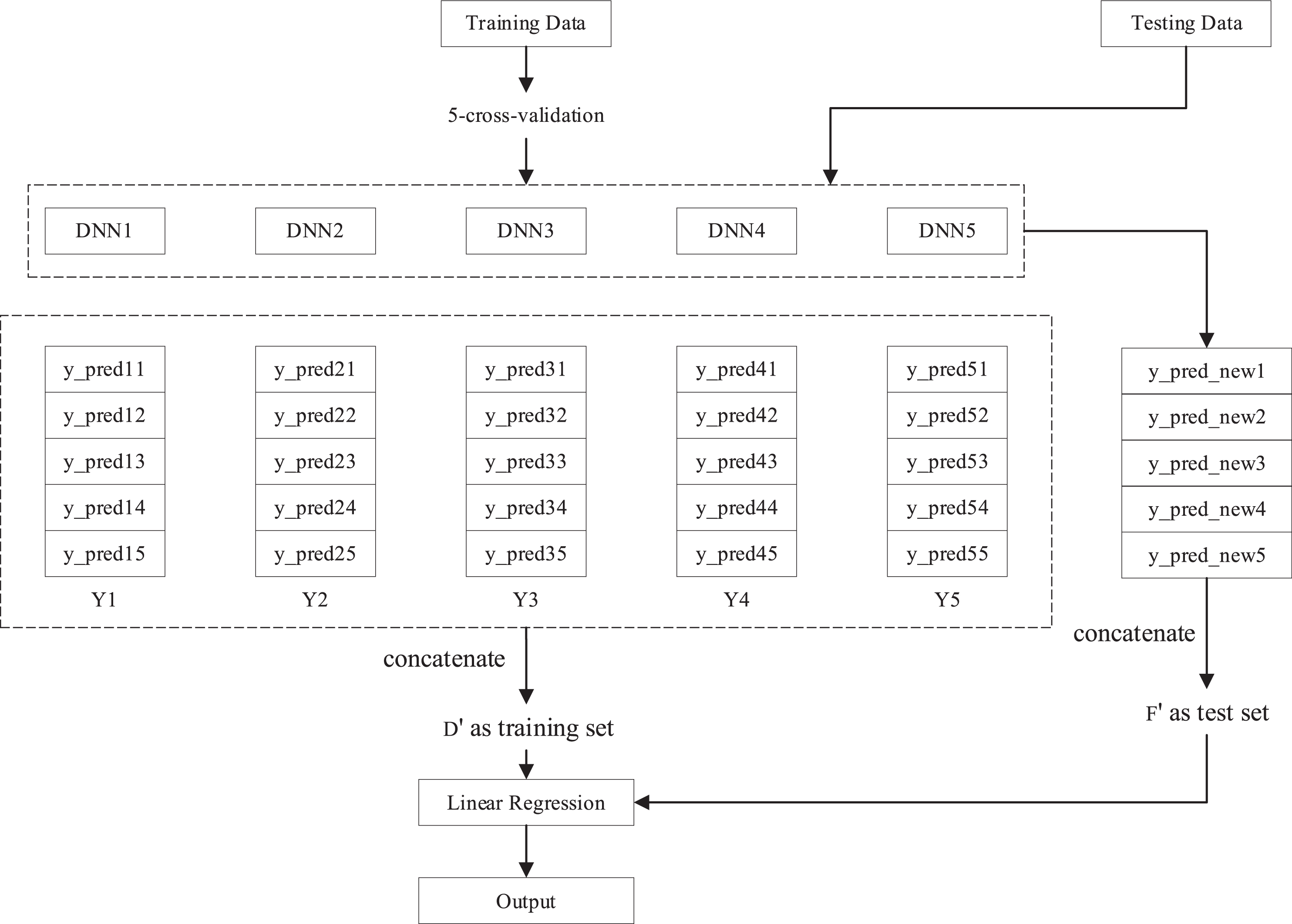
Training and testing process of the SDE-DNN model.
The details of the algorithm are as follows:
Algorithm:
Experimental conditions
The computer specification used in this experiment is a dual-channel Intel E52690v2 CPU and 128 GB DDR-RAM. The programming language is Python, and the model used is the SDE-DNN model built in Section 2.3.3. The data and code for the paper are uploaded to Github, and available on https://github.com/kerlansherry/TOC_prediction.
Min-max normalization
To eliminate the difference in magnitude of data characteristics, this paper uses min-max normalization to process the sample data and normalize the data to the interval of [–1,1], as shown in Equation (1),
In this paper, MAE, SMAPE, RMSE and NSE are selected to measure the reliability and accuracy of the model prediction. MAE is the average value of the absolute errors between the observed values and the predicted values, which can be used to measure the distance between the predicted values and the observed values. SMAPE is the symmetric mean absolute percentage error. RMSE are used to measure the error of the predicted value from the observed value. For the above three metrics, the smaller their values, the higher the prediction accuracy, and the higher the ability of model to fit data. NSE is generally used to verify the results of hydrological model simulation, and its value range is from negative infinity to 1. If NSE close to 1, it means that the model has good quality and high credibility; Close to 0 indicates that the simulation results are close to the average level of the observed values, that is, the overall results are reliable, but the process simulation error is large; Far less than 0, the model is not credible. The calculation formula of the four indexes is shown in Equations (5),
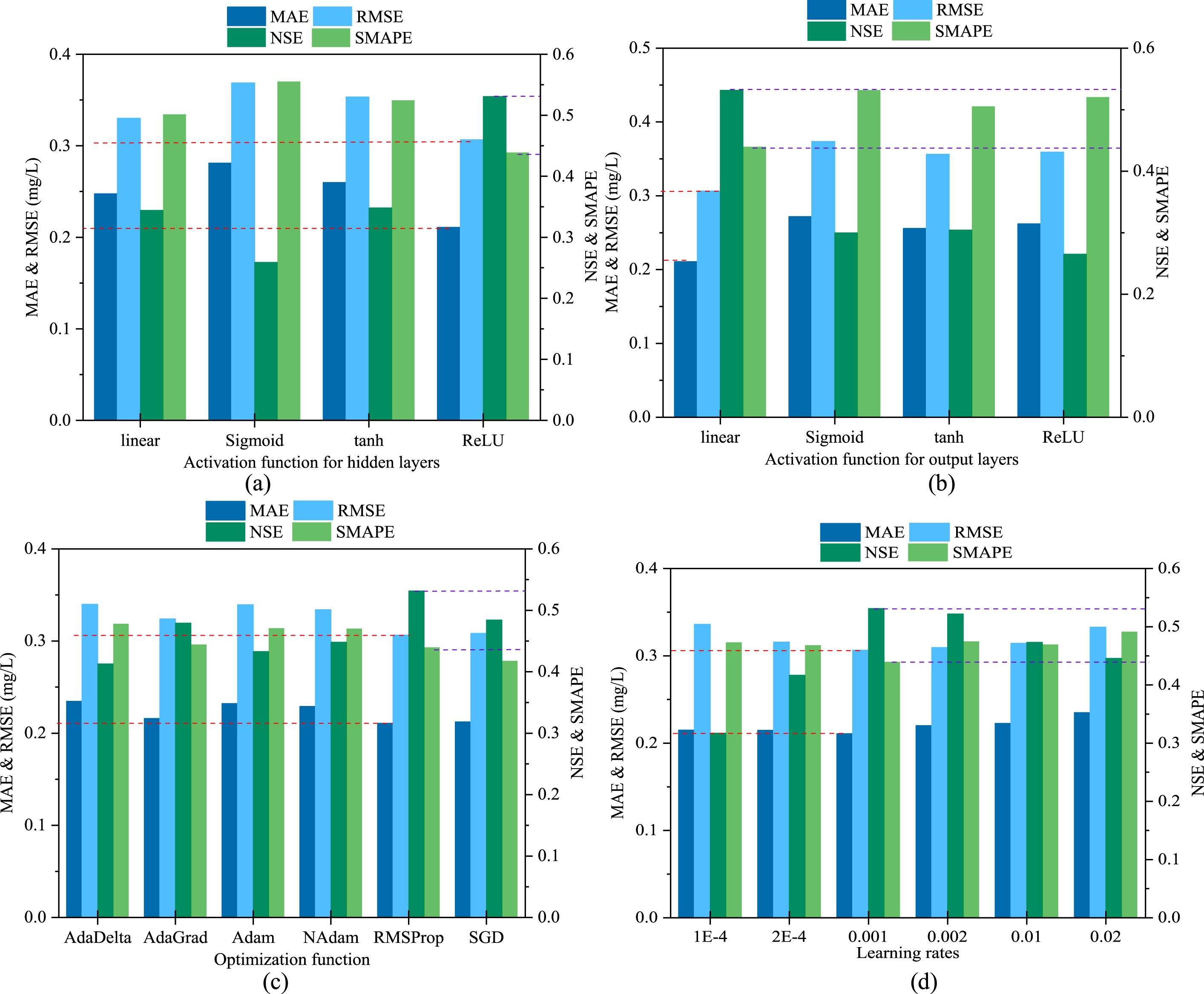
Experiment results of comparing with different models (a) activation functions of hidden layers (b) activation functions of output layers (c) optimization functions (d) learning rates.
The network topology of DNN consists of the number of hidden layers, the number of neurons in the hidden layer, the activation function of the output layer and hidden layer, and the learning rate, which have a very important influence on the prediction performance of DNN. DNN with unsuitable topology will not only increase the training time but also lead to “over-fitting” or “under-fitting”.
This paper focuses on the influence of the stacking ensemble method on the DNN architecture rather than the topology of the base DNN model. Therefore, this paper does not carry out experimental research on the number of layers and neurons per layer of base DNN models.
To determine the influence of different activation functions of the hidden layer on the prediction performance of the SDE-DNN model, the linear function, sigmoid function, tanh function and ReLU function are selected as activation functions of the hidden layer of the base DNN models, and these models are tested. Other parameters remain at their default values during the test. Figure 8(a) shows the results. The prediction accuracy of the model using ReLU was the highest, with RMSE of 0.3064 mg/L and MAE of 0.2108 mg/L. The experimental results verify the advantages of the proposed model in prediction performance.
To determine the influence of different activation functions of the output layer on the network prediction performance, the linear function, sigmoid function, tanh function and ReLU function are selected as activation functions of the output layer of the base DNN models, and these models are tested. Other parameters remain at their default values during the test. Figure 8(b) shows the results. The linear model had the highest prediction accuracy, with NSE of 0.5312 and SMAPE of 43.92%. The experimental results verify the advantages of the proposed model in prediction performance.
To determine the influence of different optimization functions on network prediction performance, the AdaDelta function, AdaGrad function, Adam function, NAdam function, RMSProp function and SGD function are selected as the optimization functions of the base DNN model, and these models are tested. Other parameters remain at their default values during the test. Figure 8(c) shows the results. The model using the RMSProp function has the highest prediction accuracy, the minimum RMSE is 0.3064 mg/L, and the minimum MAE is 0.2108 mg/L. The experimental results verify the advantages of the proposed model in prediction performance.
To determine the influence of the learning rate of the backpropagation algorithm on the prediction performance of the SDE-DNN model, six different learning rates are used to establish the base DNN models for testing. Other parameters remain at their default values during the test. Figure 8(d) shows the experimental results. When the learning rate is 0.01, the minimum RMSE of the model is 0.3064 mg/L, and the minimum SMAPE is 43.92%. The experimental results verify the superiority of the proposed model in predicting TOC content in water.
In conclusion, the proposed SDE-DNN model shows the best prediction performance in all experiments, which means it is the first choice to predict the TOC concentration in lakes.
Experimental results
A method similar to grid search is used to adjust the hyperparameters of the model, so as to determine the activation function, optimization function and learning rate of the model. The specific process is presented in Section 3.4. After repeated experiments, the hidden layer activation function is set to the ReLU function, the output layer activation function is set to the linear function, the optimization function is set to the RMSProp function and the learning rate is set to 0.001. Similarly, the epoch number is selected after a lot of experiments. If the epoch number is too small, the model does not converge, and there will be under-fitting. If the epoch is too large, excessive computation resources are required. Finally, The SDE-DNN model is constructed with five base DNN models with epochs from 100 to 500 with steps of 100 as the level 0 layer and a linear regression model as the metalayer.
According to machine learning theory, the more training samples, the higher prediction accuracy of the model. However, the distribution of our samples is very uneven, there is no duplication of samples collected from each lake, and the number of samples collected from a single lake is small. The increase of training proportion will lead to the decrease of prediction accuracy. The 272 pieces of water quality monitoring data samples of the middle and lower reaches of the Yangtze River are preprocessed, a dataset with total 379 pieces of data is obtained. For each cluster, 60%(71) of which are training sets, and 40%(48) are test sets. The water temperature, transparency, pH value, dissolved oxygen, electrical conductivity, chlorophyll and ammonia nitrogen are taken as the input of the model, and the TOC concentration in water was taken as the output of the model.
The prediction results of the model are shown in Fig. 9. The stacking ensemble learning method can effectively improve the prediction accuracy of deep neural networks. After stacking, the absolute error of the SDE-DNN model is decreased, MAE is 0.2108 mg/L, SMAPE is 43.92%, the squared error is also reduced, NSE is 0.5312 and RMSE is 0.3064 mg/L. Compared with the base DNN models, MAE is decreased by at least 0.0402 mg/L, which is approximately 16%lower than that of the original base model.
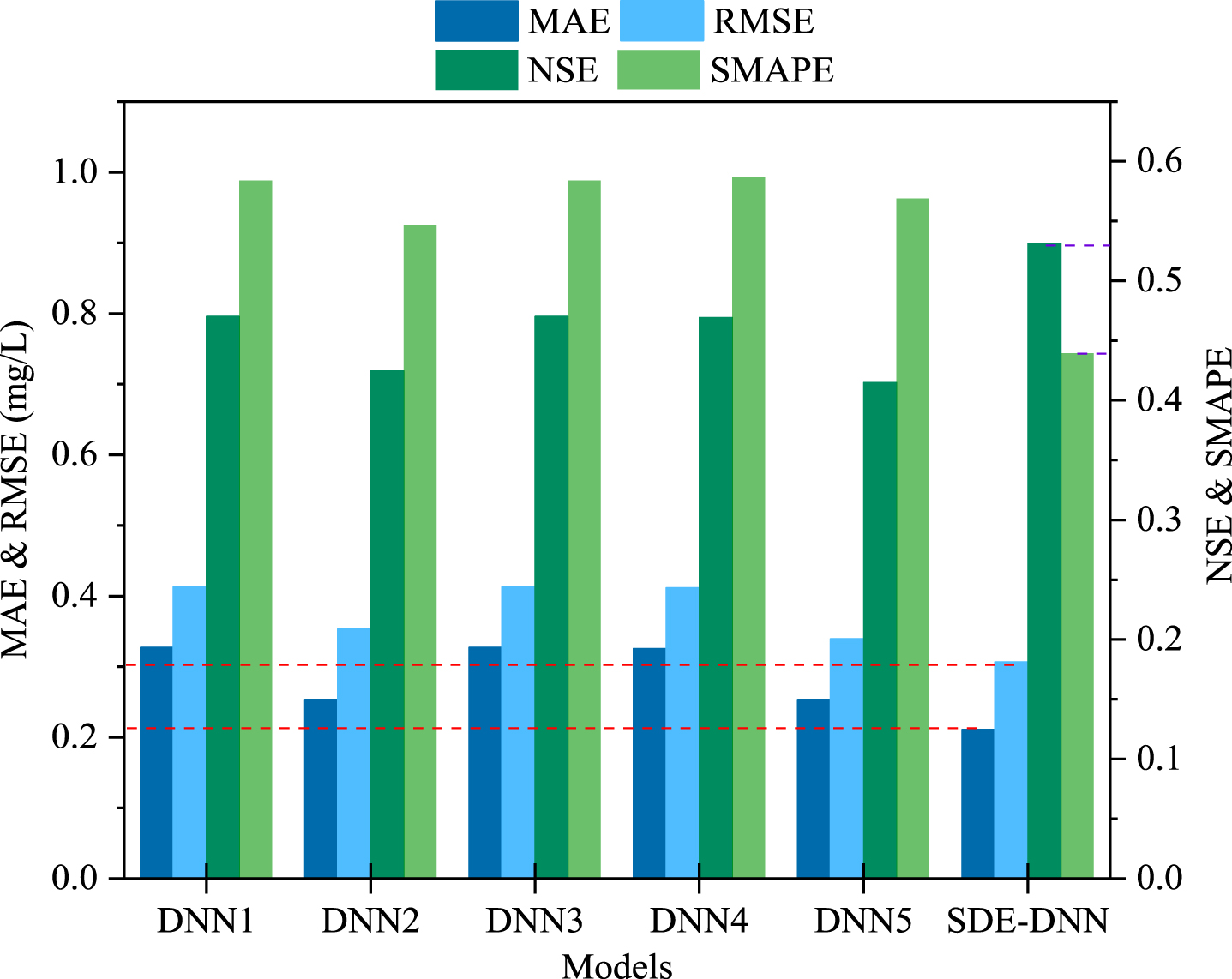
Prediction performance of the proposed SDE-DNN model.
SPSS software is used to analyze the statistical significance of real values and predicted values. Using the paired-sample T test method, the p value is approximately 0.0000, the p value is < 0.01, and the correlation coefficient is 0.7683. Therefore, there is a strong correlation between the two groups of samples; that is, real values and predicted values are highly correlated.
To analyze the influence of the ratio of dividing dataset, test set size is set to 20%, 30%, 40%, 50%, and 60%respectively. The experiment results are shown in Fig. 10. It can be seen that although the MAE and RMSE is the lowest when the test size is 0.3, the NSE is 0.5312 which is the highest and the SMAPE is 0.4392 which is the lowest when test size is 0.4. Therefore, when the test size equals to 0.4, the model’s performance is the best.
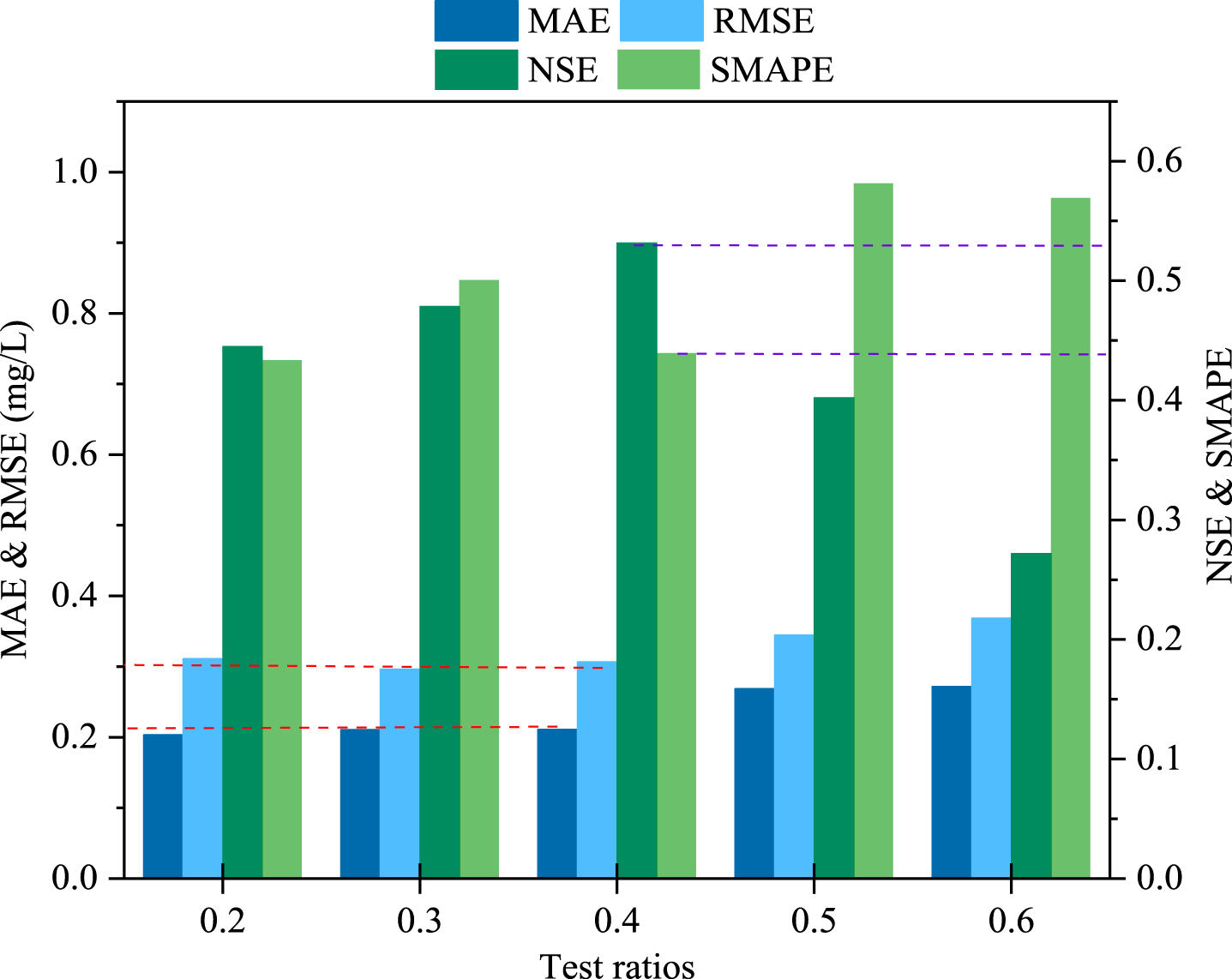
Prediction performance of different ratios.
In order to analyze the water quality prediction of specific lakes, 4 sample points were randomly selected from the data set for experiments with the No. of 14, 66, 112, 258. The number refers to the no. of Table S1 in Appendix A. Figure 11(a) shows the deviation between the observed and predicted values, and Fig. 11(b) shows the absolute error and the absolute error percentage.
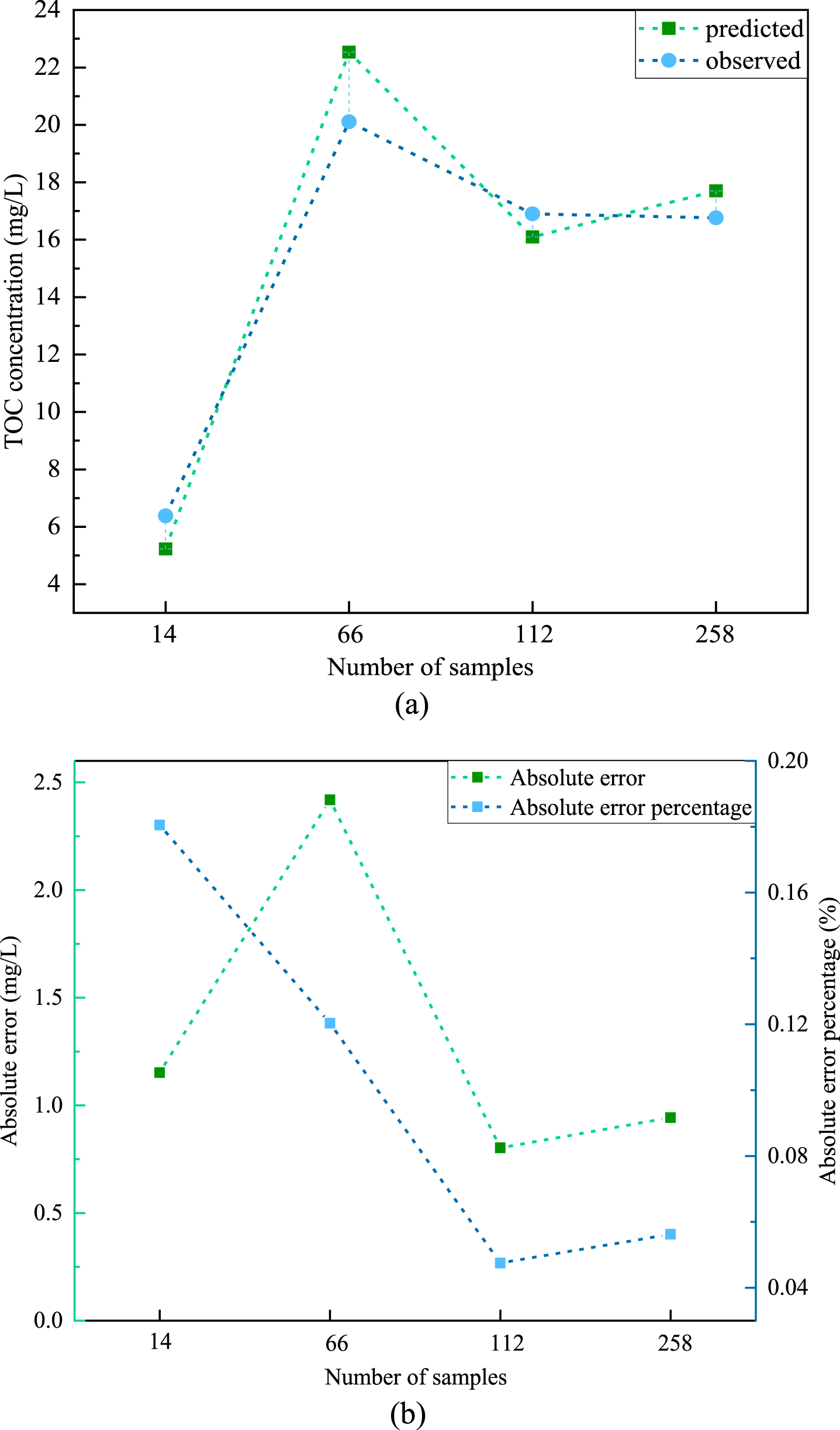
Prediction performance of the specific samples (a) deviation between the observed and predicted values (b) absolute error and absolute error percentage.
Four samples were collected from tph3, dth14, ynh2 and yd2 stations. It can be seen that the percentage of prediction error is generally small, below 20%, while the minimum error percentage of No.112 and No.258 is only 4.74%and 5.62%, that means that the model has a good generalization performance. For No.14, the training data is less, so the prediction error is fairly high. For No.16, although there are many data collected in Dongting Lake, because of the large area of the lake, the uneven development of industry and agriculture and the difference of economic activity around the lake, the prediction error is relatively high, and the absolute error percentage is 12.03%. Overall, the results fully show that the proposed SDE-DNN model has a strong prediction ability for TOC concentration of lakes in the middle and lower reaches of the Yangtze River.
To verify the effectiveness of the SDE-DNN model in predicting TOC concentration in water, it was compared with other machine learning methods. Selecting the decision tree, linear regression, support vector regression (SVR), K-nearest neighbors (KNN), ridge, lasso and other commonly used machine learning methods, the performance in this sample is shown in Fig. 12. It can be seen that the SVR model performed fairly well in listed above machine learning methods, but it is still poor compared with the proposed SDE-DNN model. Compared with the SDE-DNN model, its MAE is increased by 0.0451 mg/L, and the NSE is decreased by 0.3050.
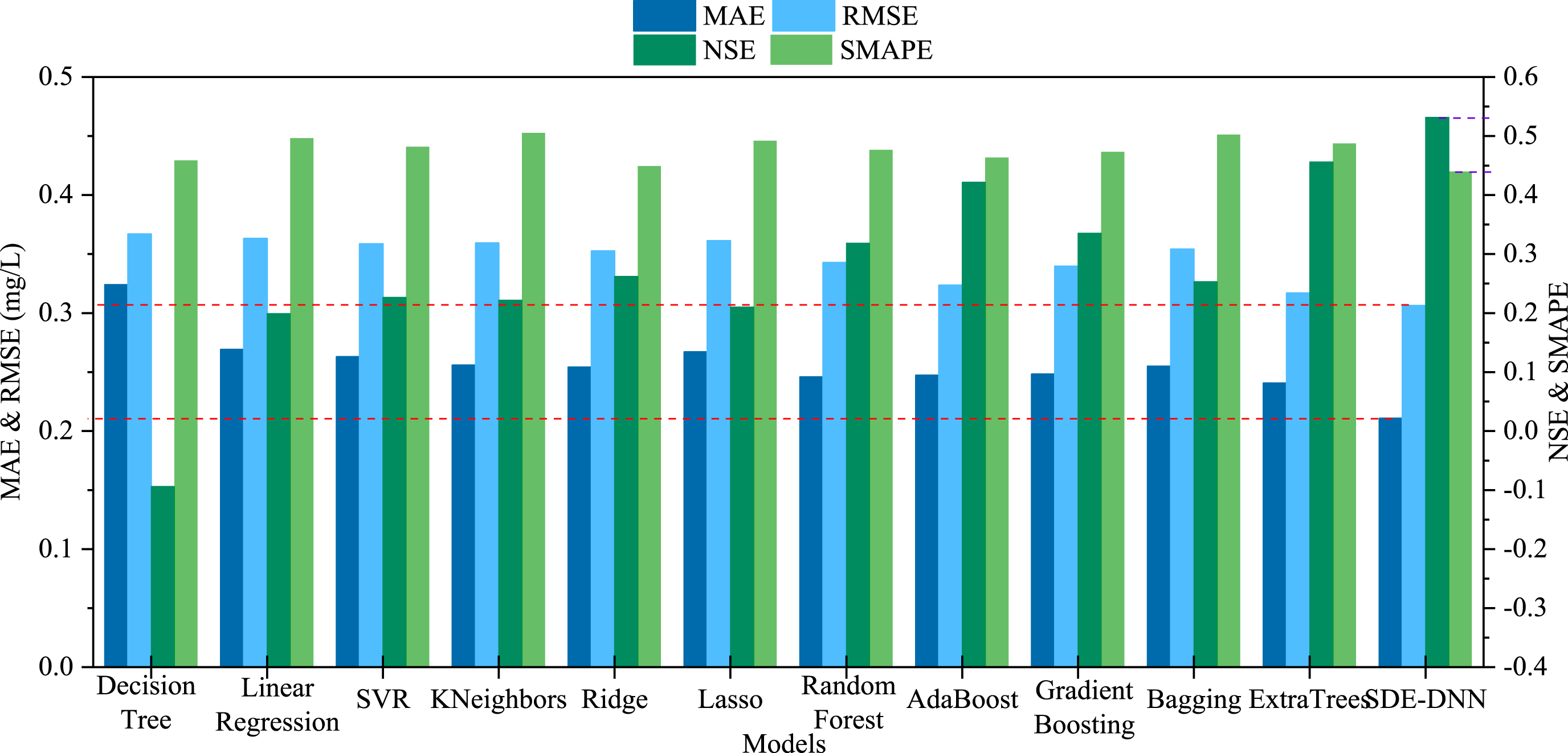
Experiment results of SDE-DNN model and other machine learning models on TOC concentration dataset.
Under the same experimental conditions, the SDE-DNN model is compared with traditional ensemble learning methods such as random forest regression, bagging regression, and AdaBoost regression. After conducting experiments, the results are shown in Fig. 12. It can be seen that the results of ensemble learning method are generally better than those of traditional machine learning methods but still inferior to the proposed SDE-DNN model. Using samples in this paper, the performance of Extra Trees regression method is fairly good, MAE is 0.2406 mg/L, and RMSE is 0.3169 mg/L; however, the result of SDE-DNN is better, with MAE reducing by 0.0298 mg/L and RMSE decreasing by 0.0105 mg/L.
In order to further prove the validity of the model, an additional experiment is conducted on a lake temperature dataset. The dataset is available through a data release on the U.S. Geological Survey’s ScienceBase platform, and all study lakes are located in the Midwestern United States [45]. Figure 13 shows the experiment results. It’s apparently that the SDE-DNN model has a superior prediction performance.
Meanwhile, the Auto MPG data set, PM2.5 data set and kin8 nm data set are selected as common dataset to verify the effectiveness of SDE-DNN. Auto mpg dataset is a slightly modified version of the dataset provided in the StatLib library in 1970 s. In line with the use by Ross Quinlan in predicting the attribute “mpg”. The data concerns city-cycle fuel consumption in miles per gallon, to be predicted in terms of 3 multivalued discrete and 5 continuous attributes [46]. Beijing PM2.5 dataset collected a time period of factors influencing the value of PM2.5 between Jan 1st, 2010 to Dec 31st, 2014. It contains 8 attributes to predict the value of PM2.5 [47]. Kin8 nm dataset is concerned with the forward kinematics of an 8 link robot arm. It also contains 8 attributes to predict the target value [48]. Table S3 in the Appendix A presents the results of the experiments. It can be seen that compared with other machine learning models, SDE-DNN has the best regression prediction fitting effect, the highest generalization accuracy and the better universality of the model.
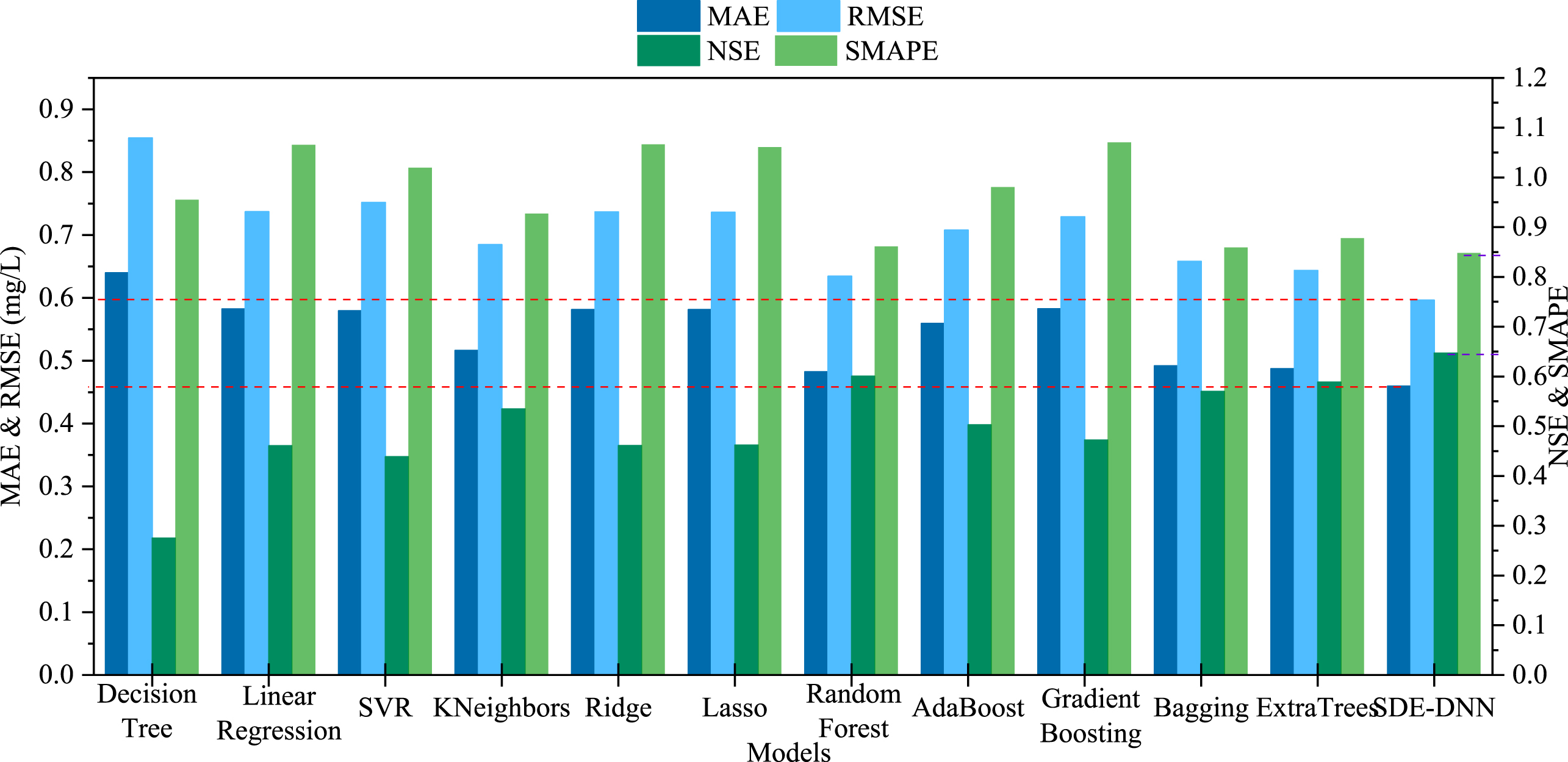
Experiment results of SDE-DNN model and other machine learning models on lake temperature dataset.
In this paper, the TOC concentration in lakes along the middle and lower reaches of the Yangtze River is studied. Different from the above studied areas, this area is the most densely populated, economically developed and the most frequent industrial production area in China. The lakes area is greatly affected by human activities and industrial production and is vulnerable to pollution, forming a more complex aquatic ecosystem, thus it’s more difficult to predict the TOC concentration. Meanwhile, most of people’s domestic water and agricultural water comes from lakes. Therefore, the requirement for the accuracy of water quality prediction in this area is higher than that in the above study area.
Generally, compared with the shallow learning method such as multiple regression, the deep learning method can extract more information from the data, so as to make more accurate prediction. While the ensemble learning method can improve the prediction performance by combining multiple individual learners.
In this study, a SDE-DNN method is proposed to predict TOC concentration using machine learning method. With 7 water quality parameters as input and the TOC concentration as output, it is feasible to establish a prediction model based on SDE-DNN to predict the concentration of TOC. In order to further verify the effectiveness of the proposed method, SDE-DNN is compared with other TOC prediction methods. These methods come from the literature cited in Introduction. The experiments are conducted on the TOC concentration dataset collected in this paper, and the prediction results are shown in Table 4.
Comparison with existing TOC prediction methods
Comparison with existing TOC prediction methods
It can be seen that under the same experimental conditions, the prediction error of this model is smaller than that of other existing machine learning models. The result indicates that in lakes along the middle and lower reaches of the Yangtze River, the accuracy of the TOC concentration prediction model based on SDE-DNN is better than other models, and it is more suitable for the prediction of the TOC concentration.
As a universal analysis, the experiments are conducted on the Midwestern United States lake temperature data set. The specific details are shown in section 3.6. The experimental results show that the proposed method is not only suitable for TOC concentration prediction in the middle and lower reaches of the Yangtze River, but also suitable for Midwestern United States lake temperature prediction. Furthermore, experiments are carried out on three common sample sets. The results verify the feasibility and universality of proposed SDE-DNN method.
SDE-DNN method not only has the characteristics of convenience and high prediction accuracy, but also can more accurately analyze the nonlinear relations in complex systems, so as to achieve more accurate real-time prediction of the TOC concentration in lakes under complex nonlinear conditions. It can effectively save funds and time.
However, the research has some limitations. The data collected in this study are concentrated in the drought season, and the attention paid to the water quality data in the rainy season is not enough. Therefore, future research in this area will pay more attention to the balance of data collection, so as to further improve the generalization performance of the model.
With the development of research and application, as an advanced artificial intelligence algorithm and new prediction method, the ensemble learning method will be more widely used in the prediction of the concentration of other substances in water. In the future, more in-depth learning methods can be used to predict the TOC concentration under larger data samples, and the prediction accuracy can be further improved, which can provide more accurate decision-making basis for the sustainable use of water resources.
In this paper, an ensemble model namely SDE-DNN is established by stacking five different epochs’ base DNN models in level 0 and a linear regression model in level 1, and applied to predict the TOC concentration in lakes of the middle and lower reaches of the Yangtze River. To verify the effectiveness of the model, 272 pieces of data from the water quality monitoring dataset are selected as samples for experiments. After preprocessing, a dataset with total 379 pieces of data is obtained. Conducting experiments on this dataset. The results show that the model has high prediction precision, MAE is 0.2108 mg/L, SMAPE is 43.92%, NSE is 0.5312, and RMSE is 0.3064 mg/L. The model can well predict the TOC concentration in water. At the same time, the regression accuracy of the SDE-DNN model is better than that of the single DNN model, illustrating that the stacking method can integrate deep neural networks with good effects.
On the water quality monitoring samples of total organic carbon concentration in lakes along the middle and lower reaches of the Yangtze River, the prediction performance of the proposed SDE-DNN model is satisfying. Therefore, using the water quality parameters obtained by sensor networks, the SDE-DNN model can predict the TOC concentration of lakes with high accuracy in real time. The results of this study suggest that the machine learning methods can provide appropriate suggestions on water quality prediction and help for the management of aquatic ecosystems.
However, there are still some deficiencies in this study. The data collected are unbalance, and the prediction results of the proposed model are still unstable, and further experiments are needed to improve its performance. In the future study, on one hand, we will try to increase the samples of each lake of different time and different seasons, and will consider the impact of spatial and geographical location on the water quality of the lake. On the other hand, we will try to change the structure of base DNN model to improve the predicting performance and stability.
Footnotes
Acknowledgments
This work was supported only by the Social Science Fund of Ministry of Education of China (No. 18YJCZH040). Authors gratefully acknowledge the helpful comments and suggestions of the reviewers who improved the presentation.
Appendix A
Detailed data of water quality monitoring samples Table of lake stations and names Prediction results of SDE-DNN and other machine learning methods on different datasets
No.
Date of collection
Station number
Water temperature (°C)
Transparency (m)
pH value
Dissolved oxygen (mg/L)
Conductivity (μs/cm)
Chlorophyll (μg/L)
Ammonia nitrogen (mg/L)
TOC concentration (mg/L)
1
2007/10/11
pyh1
21.44
0.15
7.53
7.15
133.8
3.7
0.1
8.98
2
2007/10/11
pyh2
21.51
0.15
7.73
8.07
133.8
4.67
0.09
8.36
3
2007/10/11
pyh3
21.25
0.1
7.67
8.1
133.8
7
0.12
17.32
4
2007/10/11
pyh4
22.2
0.15
7.72
7.82
133.8
4.33
0.08
8.75
5
2007/10/12
chhu3
21.53
0.8
8.73
9.52
215
6.59
0.09
12.67
6
2007/10/13
pyh5
21.53
0.45
7.89
8.49
93.2
3.6
0.16
8.03
7
2007/10/13
pyh6
21.53
0.3
7.77
7.92
113.5
2.97
0.25
5.97
8
2007/10/13
pyh7
21.53
0.05
7.71
8.64
133.8
9.93
0.23
8.44
9
2007/10/13
pyh8
21.52
0.1
7.72
8.57
133.8
5.67
0.14
9.53
10
2007/10/13
pyh9
21.53
0.05
7.72
8.5
133.8
7.1
0.16
9.41
11
2007/10/13
pyh10
20.57
0.1
7.72
8.53
133.8
8.13
0.13
7.71
12
2007/10/13
pyh11
20.59
0.1
7.65
8.41
133.8
6.1
0.15
7.38
13
2007/10/15
tph1
18.79
0.4
7.9
7.92
174.4
7.74
0.11
5.56
14
2007/10/15
tph2
18.75
0.4
7.98
8.39
174.4
8.23
0.04
6.38
15
2007/10/15
tph3
18.78
0.4
8.14
8.68
174.4
7.33
0.05
6.57
16
2007/10/16
pyh12
19.05
0.1
7.55
8.06
133.8
9.77
0.14
9.36
17
2007/10/16
pyh13
19.15
0.3
7.52
8.08
133.8
5
0.18
8.34
18
2007/10/16
pyh14
19.52
0.3
7.54
8.11
133.8
7.67
0.18
7.71
19
2007/10/16
pyh15
19.31
0.25
7.53
8.25
133.8
3.6
0.2
8.48
20
2007/10/16
pyh16
19.52
0.15
7.56
7.48
133.8
3.9
0.2
9.67
21
2007/10/17
xmh1
18.91
0.3
7.46
8.1
133.8
8.17
0.14
7.98
22
2007/10/17
xmh2
19.05
0.3
7.52
8.11
133.8
8.38
0.15
7.46
23
2007/10/17
xmh3
19.68
0.3
7.96
7.16
133.8
224.19
0.13
7.51
24
2007/10/18
pyh17
19.9
0.2
7.4
7.4
133.8
4.17
0.23
7.61
25
2007/10/18
pyh18
19.49
0.6
7.42
7.55
113.5
2.13
0.19
10.9
26
2007/10/18
pyh19
19.78
0.6
7.48
7.78
113.5
2.42
0.18
7.14
27
2007/10/18
pyh20
19.45
0.5
7.43
7.72
113.5
2.28
0.2
6.6
28
2007/10/18
pyh21
18.8
0.15
7.35
7.4
113.5
5.21
0.15
7.11
29
2007/10/18
pyh22
19.09
0.1
7.39
7.25
133.8
3.47
0.21
7.03
30
2007/10/18
pyh23
19.72
0.25
7.36
7.42
133.8
3.79
0.14
7.35
31
2007/10/18
pyh24
19.41
0.35
7.39
7.64
154.1
3.44
0.32
6.08
32
2007/10/19
nbh1
19.17
0.45
7.64
7.32
215
16.36
0.05
13.37
33
2007/10/19
nbh2
19.3
0.4
8.19
8.5
215
18.5
0.05
12.43
34
2007/10/19
nbh3
19.52
0.4
8.63
9.99
215
19.97
0.04
12.09
35
2007/10/21
bl1
19.78
0.45
8.57
10.15
275.9
21.31
0.04
10.07
36
2007/10/21
sh1
18.83
0.5
8.45
9.17
262.4
5.8
0.04
9.02
37
2007/10/21
sh2
18.86
0.65
8.56
9.3
255.6
4.71
0.04
9.97
38
2007/10/21
sh3
18.85
0.55
8.46
8.48
255.6
6.23
0.04
8.16
39
2007/10/21
sh4
19.17
0.55
8.54
9.4
255.6
4.96
0.05
8.34
40
2007/10/23
zh1
20.1
1.3
8.17
9.16
93.2
2.98
0.03
6.07
41
2007/10/23
zh2
20.25
1.5
7.91
9.01
93.2
2.38
0.04
5.82
42
2007/10/23
zh3
20.22
1.3
7.82
8.54
93.2
3.14
0.04
4.64
43
2007/10/23
zh4
20.23
1.2
7.77
9.18
93.2
2.58
0.03
4.71
44
2007/10/25
jsh2
20.29
1.8
7.29
8.47
72.9
1.28
0.04
4.89
45
2007/10/25
jsh3
20.5
2
7.46
8.44
72.9
1.91
0.05
5.83
46
2007/10/25
jsh4
20.81
1.5
7.78
8.17
72.9
2.49
0.04
6.1
47
2007/10/25
jsh5
20.5
1.5
7.1
8.3
72.9
1.68
0.04
5.79
48
2007/10/25
jsh6
20.6
1.5
7.21
8.4
72.9
1.91
0.09
6.1
49
2007/10/25
jsh7
20.15
1.5
7.27
8.55
72.9
1.33
0.04
4.68
50
2007/10/26
cj1
19.78
0.3
7.12
7.35
93.2
8.83
0.11
5.88
51
2007/10/26
cj2
20.31
0.3
6.89
7.59
93.2
7.38
0.05
5.39
52
2007/10/26
cj3
20.77
0.3
7.03
7.68
93.2
7.06
0.06
5.63
53
2007/11/1
dth1
16.73
0.3
8.16
8.02
215
1.52
0.15
24.67
54
2007/11/1
dth2
17.06
0.7
8.18
8.22
235.3
1.07
0.15
25.46
55
2007/11/1
dth3
17.06
0.6
8.19
7.96
215
1.73
0.15
21.72
56
2007/11/1
dth4
16.99
0.4
8.18
7.88
215
2.36
0.15
21.19
57
2007/11/1
dth5
16.83
0.6
8.15
7.96
215
1.74
0.15
22.47
58
2007/11/1
dth6
16.97
0.5
8.22
7.66
215
1.28
0.15
24.71
59
2007/11/1
dth7
16.91
0.45
8.47
7.87
235.3
2.6
0.17
27.65
60
2007/11/2
dth8
18.68
0.8
7.98
7.47
215
1.5
0.23
25.64
61
2007/11/2
dth9
18.37
0.7
8.11
7.75
215
0.91
0.13
22.94
62
2007/11/2
dth10
18.47
0.7
8.08
7.89
215
1.49
0.13
22.02
63
2007/11/2
dth11
18.17
0.7
8.07
7.56
215
1.32
0.11
22.97
64
2007/11/2
dth12
17.83
0.9
8.08
7.83
215
1.13
0.15
27.44
65
2007/11/2
dth13
17.72
0.9
8.13
7.8
215
1.18
0.13
21.69
66
2007/11/2
dth14
17.71
0.8
8.13
8.41
215
1.63
0.12
20.11
67
2007/11/3
dth1-2
14.9
0.6
7.94
4.4
174.4
3.69
0.33
6.36
68
2007/11/3
dth2-2
15.72
1.1
7.88
9.05
133.8
1.87
0.26
12.63
69
2007/11/3
dth3-2
15.67
0.5
7.67
6.24
160.9
5.53
0.19
16.19
70
2007/11/5
hndh1
16.03
0.65
7.95
8.74
316.5
7.07
0.37
15.05
71
2007/11/5
hndh2
15.65
0.25
7.88
7.96
316.5
9.16
0.53
14.6
72
2007/11/5
hndh3
16
1.2
8.35
9.71
316.5
9.03
0.38
15.45
73
2007/11/6
dath1
14.76
0.6
8.16
8.33
336.8
2.55
0.32
31.82
74
2007/11/6
dath2
14.89
0.5
8.13
8.4
336.8
3.4
0.43
28.38
75
2007/11/6
dath3
15.1
0.4
8.35
8.79
357.1
10.57
0.29
31.9
76
2007/11/6
dath4
15.25
0.4
8.15
8.63
336.8
2.3
0.22
29.06
77
2007/11/6
dath5
15.11
0.5
8.41
9.3
336.8
5.32
0.29
27.63
78
2007/11/6
dath6
15.53
0.3
8.32
8.84
336.8
6.25
0.14
28.16
79
2007/11/7
dth15
15.32
0.5
8.02
7.64
357.1
2.53
0.08
32.48
80
2007/11/10
lyh1
16.83
0.3
8.13
8
235.3
5.23
0.19
19.02
81
2007/11/10
lyh2
16.82
0.6
8.02
7.95
215
4.78
0.22
18.85
82
2007/11/10
lyh3
17.23
0.6
8.28
9.36
215
8.72
0.23
17.38
83
2007/11/11
mlh1
16.57
0.6
7.91
8.88
154.1
13.22
0.15
35.51
84
2007/11/11
mlh2
16.85
0.8
8.32
9.51
174.4
10.48
0.2
29.15
85
2007/11/11
mlh3
16.49
0.4
7.71
8.55
154.1
11.59
0.21
36.03
86
2007/11/11
shanbh1
15.58
0.4
8.75
8.7
397.7
16.92
0.21
9.52
87
2007/11/11
shanbh2
15.84
0.6
8.44
8.31
397.7
14.48
0.11
9.98
88
2007/11/11
shanbh3
15.84
0.5
8.46
7.73
397.7
13.47
0.12
9.1
89
2007/11/12
bem1
15.13
0.25
8.02
8.39
248.8
11.81
0.28
12.42
90
2007/11/12
bem2
15.12
0.5
7.81
8.48
255.6
15.57
0.3
11.38
91
2007/11/19
dth16
14.01
0.25
8.26
8.5
296.2
4.14
0.11
20.07
92
2007/11/19
dth17
14.64
0.3
8.09
7.89
275.9
2.9
0.33
22.97
93
2007/11/19
dth18
14.71
0.25
8.08
7.89
275.9
2.59
0.39
22.16
94
2007/11/19
dth20
14.67
0.25
8.09
8.06
275.9
3.2
0.35
17.96
95
2007/11/19
dth21
14.87
0.2
8.12
8
275.9
2.14
0.34
22.75
96
2007/11/19
dth22
14.74
0.25
8.11
8.04
275.9
2.94
0.34
21.09
97
2007/11/19
dth23
14.97
0.3
8.12
8.04
275.9
2.5
0.33
20.92
98
2007/11/20
nh1
14.23
0.9
8.28
7.89
316.5
13.93
0.27
24.83
99
2007/11/20
nh2
14.39
0.6
8.01
6.13
316.5
13.99
0.16
25.9
100
2007/11/21
bj2
17.33
0.35
8.7
8.96
275.9
16.18
0.1
27.25
101
2007/11/22
hugh1
13.48
0.25
8.53
10.23
255.6
23.87
0.22
31.15
102
2007/11/22
hugh2
12.97
0.5
8.71
11.77
316.5
18.33
0.75
32.77
103
2008/3/5
chah1
11.6
1.3
8.55
13.2
279
8.2
0.01
13.32
104
2008/3/5
chah2
11.35
1.55
8.57
13
282.7
7.7
0.48
12.69
105
2008/3/5
chah3
11.3
1.45
8.64
14.6
287
11.2
0.37
17.2
106
2008/3/6
chah4
11.33
1
8.47
12.2
329
13.6
0.03
15.85
107
2008/3/6
chah5
11.61
1.2
8.34
10.5
373.7
15.7
0.05
15.24
108
2008/3/6
chah6
11.77
0.5
8.47
11.8
392
24.5
0.82
21.51
109
2008/3/7
chh1
9.13
0.2
8.43
9.6
367
4.7
0.04
28.9
110
2008/3/7
chh2
9.27
0.2
8.32
10
362
5.2
0.04
18.58
111
2008/3/7
ynh1
11.22
0.5
8.12
9.7
225
14.2
0.07
14.82
112
2008/3/7
ynh2
11.06
0.5
8.12
9.9
233
11.9
0.08
16.9
113
2008/3/8
nlh1
10.76
0.85
8.13
10
210.3
2
0.03
11.04
114
2008/3/8
nlh2
11
0.9
7.92
10.2
208
1.5
0.03
12.77
115
2008/3/8
yh1
11.92
0.2
8.4
10.2
364
8
0.14
40.28
116
2008/3/9
shajh1
11.82
0.85
8.17
9.7
288
3.9
0.03
16.81
117
2008/3/9
shajh2
12.26
0.8
8.08
9.4
283.7
5.1
0.02
13.76
118
2008/3/10
hh3
14.48
0.4
8.52
10.7
303.3
4.4
0.02
16
119
2008/3/10
hh4
15.13
0.6
8.49
10.8
294.7
6.4
0.03
22.7
120
2008/3/10
hh6
16.06
0.6
8.5
9.5
271.5
2.7
0.02
16.6
121
2008/3/12
hbdh1
16.4
0.4
9.15
17
332.3
29.4
0.02
14.13
122
2008/3/12
hbdh2
14.86
0.4
8.81
13.1
320.5
16.7
0.03
19.9
123
2008/3/12
hbdh3
4.7
0.5
8.57
10.8
350
6.8
0.04
20.5
124
2008/3/14
tjh1
14.7
0.1
8.02
7.4
245
1.6
0.1
14.44
125
2008/3/14
tjh2
15.64
0.1
7.92
8.8
263
6.5
0.02
11.76
126
2008/3/14
yzh1
17.22
1
9.97
13.1
276.7
3.8
0.03
21.71
127
2008/3/14
yzh2
17.1
0.6
9.7
12.3
321
19.4
0.04
18.09
128
2008/3/14
yzh3
16.72
0.35
9.14
10.5
367
12.8
0.94
25.14
129
2008/3/15
hbnh1
18.75
0.3
8.85
11
359.5
25.1
0.04
16.32
130
2008/3/15
hbnh1
21.25
0.4
9.05
13.4
351
32.3
0.02
15.67
131
2008/3/17
dxch3
17.05
0.65
9.59
12.6
383
9.4
0.04
11.25
132
2008/3/19
wh1
18.53
1
8.38
10.9
216
3.2
0.02
10.33
133
2008/3/19
wh2
18.22
1.2
8.57
10.7
212
6.4
0.03
10.08
134
2008/3/19
zdh1
16.45
0.5
8.47
10
295
21.5
0.03
13.77
135
2008/3/19
zdh2
15.88
0.4
8.49
9.7
298
22.3
0.02
19.71
136
2008/3/19
zdh3
16.29
0.65
8.53
10
297
14.8
0.02
17.39
137
2008/3/20
lh1
17.41
0.55
8.64
10.3
206
4.8
0.03
14.09
138
2008/3/20
lh2
17.91
0.3
8.29
9.7
244
9.6
0.02
11.55
139
2008/3/20
lh3
18.53
0.35
8.3
9.8
253
6.9
0.01
21.27
140
2008/3/21
xlh3
16.95
0.65
8.14
9.2
204
14.3
0.36
14.75
141
2008/3/22
fth1
13.62
0.4
8.46
10.2
206
7.5
0.04
23.41
142
2008/3/22
fth3
17.07
0.35
9.5
14.8
158
3.9
0.14
17.67
143
2008/3/23
ssh1
17.24
0.45
8.52
10.9
202
3.2
0.05
11.3
144
2008/3/24
hyxh1
16.5
1.6
8.49
9.5
263
3.6
0.24
14.93
145
2008/3/24
hyxh2
16.92
1.5
8.72
11.4
260
4.2
0.03
12.13
146
2008/3/24
hgh1
18.98
1.5
9.27
12.4
251.3
8.1
0.05
25.16
147
2008/3/24
hgh2
19.25
0.6
8.97
12.5
294.7
24.9
0.23
13.32
148
2008/3/26
txh1
17.05
0.7
8.73
10.8
370.3
16
0.37
18.4
149
2008/3/26
txh2
17.24
0.7
9.25
13.6
388.8
40.6
0.08
29.8
150
2008/3/26
txh3
17.51
0.6
9.08
12.2
378
30.8
0.13
28.53
151
2008/3/27
yxh1
18.03
0.75
8.71
10.7
367.3
17.4
0.16
18.67
152
2008/3/27
yxh2
18.59
0.6
8.86
11.8
383.3
22.3
0.12
30.14
153
2008/3/28
lzh1
17.77
3
8.05
9.1
157
3
0.03
15.35
154
2008/3/28
lzh2
17.95
3
8.16
9.1
168
3.2
0.02
17.15
155
2008/3/28
lzh4
17.14
2.4
8.56
9.8
165.3
1.2
0.03
18.58
156
2008/3/29
lzh5
16.39
2.5
9.11
10.7
151
3.9
0.03
20.24
157
2008/3/29
lzh6
16.3
2.2
8.96
10
170
3.6
0.04
22.4
158
2008/3/29
lzh7
16.45
0.8
8.29
9.1
209
2.9
0.02
20.44
159
2008/3/30
ba1
14.26
1
8.48
9.6
407.7
2.8
0.04
17.33
160
2008/3/30
ba2
14.62
0.75
8.36
9.8
448.7
5.4
0.02
16.53
161
2008/3/30
ba3
14.55
1
8.1
10.2
628
5.2
0.02
15.11
162
2008/3/30
sash1
13.52
0.7
8.4
10.6
232.5
4.5
0.38
25.9
163
2008/3/30
sash2
14.07
0.5
8.51
10.5
408.5
8.2
0.01
26.52
164
2008/3/31
hush1
13.13
0.4
9.25
11.4
250
4.7
0.14
15.35
165
2008/3/31
hush2
12.96
0.5
9.76
10.4
239
2.5
0.01
19.42
166
2008/4/1
ceh1
12.98
0.3
9.71
10.4
159
3.2
0.05
25.66
167
2008/4/1
ceh2
13.12
0.3
10
11.8
147.5
5.8
0.01
20.32
168
2008/4/1
cd1
14.4
0.2
8.84
12.1
253.5
46.6
0.01
23.27
169
2008/4/1
cd2
14.65
0.25
8.46
9.6
215
12.6
0.03
24.06
170
2008/4/1
cd3
14.86
0.25
8.63
10.3
251.7
33.4
0.02
26.05
171
2008/4/2
wah1
14.74
0.45
8.62
10.4
226.7
10.1
0.3
28.62
172
2008/4/2
wah2
14.46
0.6
8.65
10.5
226
8.1
0.05
21.73
173
2008/4/2
wah3
14.74
0.9
8.54
10
227.7
5.4
0.01
27.2
174
2008/4/2
zph1
13.1
0.8
8.44
8.7
338.5
6.6
0.22
26.78
175
2008/4/2
zph2
13.06
0.7
8.36
8.6
324
6.7
0.76
27.87
176
2008/4/3
dyh1
16.54
0.35
8.16
7.5
705
3.7
0
30.43
177
2008/4/3
dyh2
16.32
0.6
8.57
11.4
556.5
7.8
0.02
13.9
178
2008/4/3
dyh3
15.37
0.45
8.4
10
578.5
15.2
0.21
27.81
179
2008/4/4
wsh1
14.78
0.4
8.55
11.1
409.5
58.4
0.98
37.46
180
2008/4/4
wsh2
14.72
0.3
8.29
9
460.5
52.2
0.89
26.66
181
2008/4/5
tbh1
15.64
0.5
8.9
10.9
245
27
0.27
18.07
182
2008/4/5
tbh2
15.34
0.6
8.92
11.3
284.5
21.9
0.35
21.09
183
2008/4/5
tbh3
15.44
0.6
9.04
13.2
379
39.8
0.63
21.84
184
2008/4/6
lgh2
17.99
0.4
8.77
10.2
356
10.1
0.49
27.73
185
2008/4/6
lgh3
19.78
0.4
8.5
10.2
244
8.2
0.02
20.78
186
2008/4/6
lgh4
16.99
0.8
9.48
10.2
232
3.9
0.22
17.02
187
2008/4/7
lgh5
21.09
0.4
8.62
9.4
346
2.6
0.28
25.58
188
2008/4/7
lgh6
21.14
0.4
8.97
10
313
5.1
0.62
33.47
189
2008/4/7
lgh7
21.26
0.5
9.33
11.3
248
7
1.18
24
190
2008/4/7
lgh8
22.33
0.25
8.63
9.4
211
11.3
0.2
21.29
191
2008/4/8
hdh1
22.33
0.45
9.51
9.7
282
12.5
0.4
17.24
192
2008/4/8
hdh2
21.33
0.45
9.19
8.7
301
7.8
0.44
18.43
193
2008/4/8
hdh4
21.99
0.4
8.97
8.5
295
8.1
0.1
18.79
194
2008/4/9
hdh5
19.1
0.05
8.26
8.3
278
25.9
0.2
23.19
195
2008/4/10
bh1
19.15
0.05
8.24
8.8
168
11.7
0.04
20.76
196
2008/4/10
bh2
18.62
0.2
8.56
9.3
153
5.9
0.24
20.32
197
2008/4/10
bh3
18.66
0.2
8.4
9.3
144
12.7
0.35
11.61
198
2008/4/10
bh4
18.68
0.35
8.86
9.8
214
4
0.19
18.65
199
2008/4/10
bh5
18.75
0.35
8.8
9.9
207
6
0.31
24.82
200
2008/4/11
wch1-2
17.47
0.25
8.31
8.9
132
8.9
0.03
12.53
201
2008/4/11
wch2-2
17.63
0.3
8.03
8.5
129
7.6
0.19
9.04
202
2008/4/15
shjh1
16.16
0.35
8.33
8.6
193
5
0.06
21.43
203
2008/4/15
shjh2
16.14
0.25
8.44
8.9
183
11.7
0.04
21.73
204
2008/4/16
pgh1
16.59
0.5
8.9
10
250
9.8
0.03
24.88
205
2008/4/16
pgh2
16.16
0.5
8.48
9.3
264
10.8
0.03
33.3
206
2008/4/17
bd1
22.32
0.3
8.53
9.9
207
1.8
0.05
10.89
207
2008/4/17
cz1-2
16.54
0.2
8.02
7.7
175
5.5
0.14
18.2
208
2008/4/17
cz2-2
14.38
0.1
8.57
7.8
188
5.1
0.17
23.19
209
2008/10/25
dzh1
17.6
0.4
7.9
5.76
566
3.2
0.27
39.04
210
2008/10/25
dzh2
17.97
0.45
8.09
7.73
621
6.5
0.14
31.4
211
2008/11/21
cha1
11.94
0.3
8.57
11.43
292
6.4
0.25
20.46
212
2008/11/21
cha2
11.92
0.3
8.43
10.45
281
7.5
0.06
19.97
213
2008/11/21
cha3
11.87
0.25
8.39
10.3
289
5.9
0.05
19.18
214
2008/11/21
cha4
12.22
0.25
8.35
11.26
285
6
0.05
19.55
215
2008/11/21
cha5
12.31
0.3
8.38
10.88
291
5.2
0.04
20.01
216
2008/11/21
cha6
12.33
0.5
8.36
11.57
308
4.8
0.07
19.77
217
2008/11/21
cha7
12.31
0.3
8.34
10.49
292
5.6
0.06
19.24
218
2008/11/21
cha8
12.39
0.35
8.38
9.51
301
6.3
0.09
19.13
219
2008/11/21
cha9
11.8
0.2
8.35
10.99
274
4.3
0.27
17.74
220
2008/11/21
cha10
11.55
0.2
8.15
9.98
290
5.4
0.04
22.48
221
2008/11/21
cha11
11.76
0.2
8.21
10.13
296
5.6
0.15
19.86
222
2008/11/21
cha12
12.04
0.2
8.16
9.99
328
7.2
0.38
24.06
223
2008/11/21
cha13
11.97
0.2
8.13
10.18
258
3.9
0.27
15.25
224
2009/3/26
gch1
12.76
0.45
8.23
10.68
320
8.5
0.59
22.74
225
2009/3/26
gch2
12.47
1
8.29
10.67
323
3.6
0.33
22.3
226
2009/3/26
gch3
12.7
0.25
8.22
10.51
329
6.1
0.31
19.01
227
2009/3/26
gch4
13.01
2.2
8.26
10.78
366
1.9
0.27
19.81
228
2009/3/27
nyh1
11.78
0.45
8.22
10.69
214
5.8
0.58
8.6
229
2009/3/27
nyh2
11.92
0.75
8.11
10.57
186
9.9
0.81
9.84
230
2009/3/27
nyh3
11.75
0.25
8.09
10.79
139
4.4
0.21
11.52
231
2009/3/27
nyh4
11.74
0.3
8.04
10.6
119
3
0.21
6.58
232
2009/3/27
nyh5
11.95
0.2
7.98
10.7
140
6.4
0.1
5.19
233
2009/3/27
nyh6
11.67
0.55
7.72
11.01
188
10
0.3
7.08
234
2009/3/27
sjh2
13.05
0.3
8.3
10.68
267
11.9
0.07
17.36
235
2009/3/27
sjh3
13.03
0.2
8.37
10.37
251
20.1
0.09
13.79
236
2009/3/27
sjh7
13.2
0.75
8.23
10.43
300
12.5
0.14
18.6
237
2009/3/30
sjh1
11.12
0.25
8.48
11.34
251
13.1
0.07
16.32
238
2009/3/30
sjh4
10.97
0.75
8.3
11.36
289
9.1
0.14
17.75
239
2009/3/30
sjh5
11.24
1
8.44
11.48
339
5.1
0.13
13.02
240
2009/4/1
gh1
12.22
0.3
8.22
10.48
569
15.5
2.45
16.79
241
2009/4/1
gh2
12.02
0.3
8.31
10.82
596
21.2
1.46
16.85
242
2009/4/1
gh3
12.97
0.25
8.22
10.36
647
22.1
2.27
27.01
243
2009/4/1
gh4
12.84
0.25
8.76
11.34
572
42.6
0.63
20.1
244
2009/4/1
gh5
12.86
0.3
8.78
12.27
628
30.9
1.06
17.8
245
2009/4/1
gh6
12
0.3
8.27
10.33
605
21.8
0.91
18.99
246
2009/4/2
cdh1
12.21
0.5
8.64
10.98
543
13.5
0.55
13.69
247
2009/4/2
cdh2
11.81
0.3
8.56
11.27
700
26.1
1.42
17.93
248
2009/4/2
cdh3
11.39
0.25
8.54
11.34
601
24.7
0.99
17.02
249
2009/4/2
cdh4
11.85
0.35
8.75
11.52
640
25
0.7
23.64
250
2009/4/2
cdh5
12.08
0.4
8.4
10.65
592
12.6
1.3
17.06
251
2009/4/3
xzdq1
12.25
0.25
8.25
10.52
598
15.1
1.95
17.42
252
2009/4/3
xzdq2
13.16
0.35
8.51
11.19
562
34
1.25
21.25
253
2009/4/3
xzdq3
12.6
0.35
8.3
10.8
595
20.9
1.44
19.92
254
2009/4/5
dsh1
13.95
0.5
8.26
10.62
695
7.2
0.26
18.08
255
2009/4/5
dsh2
13.96
0.45
8.22
10.14
739
14.5
2.25
14.71
256
2009/4/5
dsh3
13.76
0.4
8.53
11.39
860
17.7
0.45
18.6
257
2009/4/5
dsh4
14.07
0.5
8.45
11.08
789
15.5
0.36
21.94
258
2009/4/5
yd2
14.4
1
8.06
40.08
691
7.3
0.37
16.76
259
2009/4/6
ch1
15.61
0.5
8.13
10.29
768
16.6
2.69
13.16
260
2009/4/6
ch2
5.49
0.6
8.51
10.63
778
24
2.02
12.47
261
2009/4/6
ch3
15.64
0.65
8.58
10.78
774
24.5
0.79
12.55
262
2009/4/7
kch1
13.98
0.7
8.39
10.02
900
18.4
0.8
19.86
263
2009/4/7
kch2
14.61
0.9
8.49
11.47
935
26.5
0.77
21.76
264
2009/4/7
kch3
15.1
0.9
8.73
11.3
907
25.6
0.39
18.14
265
2009/4/9
ych1
16.93
1.1
8.94
11.86
822
23.4
1.03
13.86
266
2009/4/9
ych2
17.83
0.9
9.05
12.98
763
21.5
0.11
13.79
267
2009/4/9
ych3
16.61
0.8
8.88
11.72
849
20.6
0.08
23.74
268
2009/4/9
ych4
18.09
0.8
9.04
12.65
780
15.4
0.92
29.88
269
2009/4/9
ych5
16.31
0.7
8.69
11.28
849
8.2
0.15
23.07
270
2009/4/9
ych6
16.56
0.9
8.5
10.41
838
7
0.19
21.84
271
2009/4/9
ych7
17.43
1
9.03
13.12
768
34.2
0.35
20.83
272
2009/4/9
ych8
18.14
1
9.05
13.04
759
12.9
0.1
17.9
Stations
Name of lakes
Number of samples
bl
Bali Lake
1
bj
Bajiao Lake
1
bd
Baidang Lake
1
ba
Bao’an Lake
3
bem
Beimin Lake
2
bh
Bo Lake
5
cz
Caizi Lake
2
ceh
Ce Lake
2
cha
Chao Lake
13
cj
Chenjia Lake
3
ch
Cheng Lake
3
cd
Chidong Lake
3
chhu
Chi Lake
1
chh
Chong Lake
2
dath
Datong Lake
6
dyh
Daye Lake
3
dzh
Dazong Lake
2
dsh
Dingshan Lake
4
hndh
Dong Lake (Hunan)
3
hbdh
Dong Lake (Hubei)
3
dxch
Dongxicha Lake
1
dth
Dongting Lake
25
fth
Futou Lake
2
gh
Ge Lake
6
gch
Gucheng Lake
4
hyxh
Hanyangxi Lake
2
hh
Hong Lake
3
hgh
Houguan Lake
2
hdh
Huangda Lake
4
hugh
Huanggai Lake
2
hush
Huangshan Lake
2
jsh
Junshan Lake
6
kch
Kuncheng Lake
3
lzh
Liangzi Lake
6
lyh
Liuye Lake
3
lgh
Longgan Lake
7
lh
Lu Lake
3
mlh
Maoli Lake
3
nbh
Nanbei Lake
3
nh
Nan Lake (Hunan)
2
hbnh
Nan Lake (Hubei)
2
nyh
Nanyi Lake
6
nlh
Niulang Lake
2
pyh
Poyang Lake
24
pgh
Pogang Lake
2
sh
Sai Lake
4
sash
Sanshan Lake
2
shanbh
Shanpo Lake
3
shajh
Shangjin Lake
2
ssh
ShangShe Lake
1
shjh
Shengjin Lake
2
sjh
Shijiu Lake
6
tbh
Taibai Lake
3
tph
Taibo Lake
3
txh
Tangxun Lake
3
tjh
Tongjia Lake
2
wah
Wang Lake
3
wch
Wuchang Lake
2
wh
Wu Lake
2
wsh
Wushan Lake
2
xzdq
Xiqiu Lake, Zhongqiu Lake, Dongqiu Lake
3
xlh
Xiliang Lake
1
xmh
Xinmiao Lake
3
yxh
Yanxi Lake
2
ych
Yangcheng Lake
8
yzh
Yezhu Lake
3
ynh
Yuni Lake
2
yh
Yu Lake
1
yd
Yuandang Lake
1
cdh
Changdang Lake
5
chah
Chang Lake
6
zdh
Zhangdu Lake
3
zph
Zhupo Lake
2
zh
Zhu Lake
4
Dataset
Methods
RMSE
MAE
SMAPE
NSE
Auto MPG
DecisionTree
0.2132
0.1504
60.5222%
0.7314
LinearRegression
0.1727
0.1337
58.6079%
0.8238
SVR
0.1443
0.1113
52.1369%
0.8770
KNeighbors
0.1649
0.1217
55.0764%
0.8393
Ridge
0.1728
0.1338
58.7938%
0.8237
Lasso
0.2786
0.2249
94.9539%
0.5414
RandomForest
0.1433
0.1046
48.1114%
0.8787
AdaBoost
0.1667
0.1262
56.0834%
0.8358
GradientBoost
0.1549
0.1138
50.5540%
0.8582
Bagging
0.1424
0.1057
48.4316%
0.8802
ExtraTrees
0.1393
0.1020
0.8853
SDE-DNN
48.7495%
PM2.5
DecisionTree
0.1154
0.0588
13.7670%
0.8793
LinearRegression
0.1388
0.0821
19.8851%
0.8252
SVR
0.0877
0.0598
13.2228%
0.9302
KNeighbors
0.0969
0.0533
12.7350%
0.9149
Ridge
0.1388
0.0821
19.8625%
0.8252
Lasso
0.3198
0.2366
36.7665%
0.0724
RandomForest
0.0947
0.0469
11.4596%
0.9186
AdaBoost
0.1130
0.0812
16.8880%
0.8843
GradientBoost
0.0911
0.0526
12.7182%
0.9247
Bagging
0.0935
0.0466
11.2628%
0.9207
ExtraTrees
0.0787
0.0428
0.9438
SDE-DNN
10.8739%
Kin8nm
DecisionTree
0.3262
0.2497
101.4621%
0.2221
LinearRegression
0.2835
0.2284
108.3427%
0.4125
SVR
0.1166
0.0898
53.1576%
0.9006
KNeighbors
0.1834
0.1428
75.1948%
0.7540
Ridge
0.2835
0.2284
108.3448%
0.4125
Lasso
0.3593
0.2935
156.7537%
0.0558
RandomForest
0.2149
0.1703
86.6000%
0.6623
AdaBoost
0.2960
0.2464
113.6831%
0.3595
GradientBoost
0.2606
0.2093
101.8058%
0.5034
Bagging
0.2161
0.1716
87.5931%
0.6584
ExtraTrees
0.2079
0.1659
85.5067%
0.6841
SDE-DNN