



Abstract
The customer demands of various products bring a challenge for manufacturers. They have to design customized products while maintaining economies of scale and low costs. In this paper, to address this challenge, four approaches are argued to help companies find out the optimal solutions of products’ performance and the maximum profit: (i) only platform modularity without component sharing (ii) only component sharing without platform modularity, (iii) using both platform modularity and component sharing to develop products, or iv) the products are developed individually from a given unshared components set. A theoretical model is proposed and the most profitable approach is found to develop a whole new product family when uncertainty exists in the customer demand and economies of scale with pre-defined parameters. We find that, when consumers’ valuation is considered, the manufacturer may prefer to adopt platform or component sharing individually rather than combining them because the performance of high-end products using platform and component sharing strategies is worse than that using two strategies separately. If platform and component sharing are adopted, the high-end product is under designed, but the manufacturer can benefit from economies of scale. When economies of scale of the platform are greater than or equal to that of component sharing, the optimal performance level of low-end products under platform strategy is lower than that under component sharing strategy. Finally, the detailed numerical analysis provides support for the feasibility and effectiveness of the model.
Introduction
There are two definitions of product variety: the category of products the company offers at a given time and the rate at which the company replaces existing products with new ones [21]. Both dissensions of variety have been adopted increasingly by many industries, so that the managerial challenge now is how to provide a high degree of variety to increase customer satisfaction while maintaining economies of scale and low cost.
In order to meet the above challenge, most manufacturers take the platform-based strategy into account. The platform strategy adopted by firms to achieve product variety can shorten lead-time, reduce development and manufacturing costs, enhance reliability, and strengthen manufacturing flexibility. There are many successful industrial examples: [11] first adopts 3D-MFD application and modular bus units to develop a flexible bus dispatching system. Compared with the commonly used bus system, their system reduces the total system costs. In a virtual environment, platform modular design is adopted in personalizing 3D virtual fashion stores with consumer-identified optional modules [15, 16]. Hewlett Packard has successfully developed several ink jets and laser ink jet printers by platform modularity to attain the benefits of variety in the competition [9].
The existing research has shown that abusing the platform-based strategy may cause some problems. The major challenge that manufacturers faced with is to balance commonality and product differentiation: emphasizing the modularity and commonality in the product platforms can effectively reduce unit costs, where economies of scale play an important role. However, it will hamper the product variety and decrease customer satisfaction. When the platform is introduced, the performance of the platform components is the same for all products, which leads to over design of low-end products or inadequate design of high-end products. Therefore, in this paper, we investigate the product performance considering some constraints to keep the balance of commonality and product differentiation, thereby ensuring the consumer’s utility.
Another feature of this paper is that we incorporate component sharing into platform design. Component sharing is a product-based strategy of sharing product-specific components and concepts across projects or products. Because component sharing does not need to build a platform, the fixed cost of adopting this strategy is lower than that of the platform strategy. At the same time, the economies of scale it brings are also lower than that of platform strategy. Therefore, we propose four methods and try to find the optimal product performance and strategy. The optimal product performance is the trade-off between the manufacturer’s profits and the customer’s utility. With the optimal product performance, the manufacturer can use the matching strategy to design the optimal product configuration.
In the product configuration, there exist many uncertain factors, such as customer demand, economies of scale. To handle these uncertainties, many researchers use probability theory and assume these uncertain factors are based on a special probability distribution [8, 23]. However, in some cases, it is difficult to get accurate information about consumer demand and utility with the rapid changes in mass customization products such as mobile phones and tablets, as historical data is usually not available for new products [25]. When no data is available to estimate a probability distribution, managers usually invite some domain experts to evaluate the belief degree the event will happen. Many researchers describe the belief degree as a subjective probability or as a fuzzy set. However, in this case, there will be some counterintuitive results [5]. Therefore, we apply uncertainty theory to improve the robustness of our model. As far as we know, the uncertainty theory has not been fully studied in the platform and component sharing problem, which is the goal of this paper.
Despite the fact that platform modularity and component sharing are popular in the industry, combining both have not been studied sufficiently. Furthermore, the effectiveness of uncertainty theory to estimate customer demands and economies of scale has received little research attention. Therefore, we intend to fill this void in the literature by formulating a simple but easily extensible model of platform modularity and component sharing. The research questions we address in this paper are as follows:
(1) How the platform modularity and component sharing strategies affect the products’ performance?
(2) What are the key factors that influence the manufacturers’ decision on which strategy to adopt?
(3) Which of the four approaches, (i) Only the platform modularity without component sharing (ii) Only the component sharing without platform modularity, (iii) Using both platform modularity and component sharing to develop two products, Or iv) The products are developed separately from an already given unshared component set, is the most profitable approach given pre-defined parameters?
The purpose of this work is to find which approach is preferred by the firm under what conditions and the optimal product performance when facing with under designed high-end products and uncertain customer demands and economies of scale. Specifically, building upon a theoretical production decision-making model, we derive the uncertain expectation optimal solutions of the manufacturer under four production structures. We find that when consumers’ valuation is considered, the manufacturer may prefer to adopt platform or component sharing individually rather than combining them, because the performance of high-end products using platform and component sharing strategies is worse than that using two strategies separately. If platform or component sharing is adopted, the high-end product is under designed, but the manufacturer can benefit from economies of scale. When economies of scale of the platform are greater than or equal to that of component sharing, the optimal performance level of low-end products under platform strategy is lower than that under component sharing strategy.
Krishnan and Gupta’s (2001) research is closely related to our study as we use the same cost equations and constraints. However, their model is proposed in the deterministic environment without considering the inventory problem, so that the results are not valid under an uncertain environment. Our study considers the uncertainty that exists in the customer demand and economies of scale, and introduces another popular strategy, component sharing, to see which one is the most profitable. In addition, the primary research motivation is different. Krishnan and Gupta (2001) mainly focus on the product platforms’ appropriateness and their impact on product-planning decisions, and our research focuses on the impact of uncertainty on profits and the comparison of four approaches to finding the most profitable one [32].
This paper is structured as follows. Following the introduction, Sections 2 provides reviews of the literature relating to platform and component sharing based on the evidence from the mass customization. Sections 3 describes the case of our problem and the model. Given the accurate value, we present the analytical results of four approaches in Sections 5. The conclusion in Section 6 provides a summary and overview of this paper.
Literature review
Mass customization
Since the late 1980s, the analysis and implementation of mass customization (MC) systems have received extensive attention from researchers and practitioners. Mass customization (MC) refers to a significant production paradigm, which focuses on providing a high volume of various customized products and services in a large market with near-mass production efficiency [29]. This paradigm attempts to combine the benefits of craft production in the pre-industrial economy and the mass production in the industrial economy. It has become a necessary condition for many companies to surviving in an increasingly diversified and highly competitive markets [33]. Revolutionary progress in technologies such as information technology, flexible manufacturing systems, and rapid prototyping makes it possible to transform the production paradigm from mass production to mass customization [31].
Platform modularity
Under MC, platform modular design has been a cost-effective approach to achieve the goal of highly differentiated products with standardized modules and a common platform [20]. Early research on product platform modularity regards product platforms as common modules or design variables and aimed to identify a standard set of components or variables to form a platform for developing a product family. Researchers have found that platform modularity has several advantages. For example, [23] investigates serial production systems with uncertain product quality, and finds integrated modularity has economic advantage on supply and production planning decisions. Furthermore, [20] integrates the sales, product modular design, and production to minimize the costs and completion time. They propose a modular configuration evaluation for companies to select optimal decisions with different costs and time.
Some researchers have expanded the concept of production cost to reflect product preference or quality, for each module behaves differently in terms of its preference. The connection between production costs and module preference generates several preference-cost functions, where the module preference depends essentially on the production costs [13, 32]. For example, [32] considers manufacturers’ joint decisions about platform-based development and product performance. They characterize the preference-cost function by a linear model, which is also adopted in our paper. Following their research, [13] considers a joint technology and integration of manufacturing under conditions of mass customization. They use the same linear preference-cost function and find that the subsystem-based royalty method is the optimal business model when the degree of consumers’ diversity is low. [30] adopts Kanos model to classify customer requirements qualitatively and proposes a multi-objective model to solve the product configuration. Besides the above extensions of platform modularity, many researchers also take into account other considerations, such as commonality and product performance [10], commonality and modularity in product platform development [14], and the tradeoff between customer utility and mass production [13].
Among these considerations, product performance is assumed not to be affected by the platform strategy. However, abuse of platform strategy will bring a series of problems. When the platform is introduced, the performance of the platform components is the same for all products, which leads to over-designing low-end products or inadequate design of high-end products. The above-mentioned product platform research ignores the product performance, assuming the more components in the platform, the better platform configuration. In this work, optimal product preference and profits are both considered to improve both efficiency and effectiveness of a product platform.
Component sharing
The literature relating to component sharing is broad and diverse. It has been studied from a multi-project management perspective [17], from the perspective of software or component reuse [2] and the supply chain management [7]. There are many different criteria that manufacturers have employed to determine whether they should use the component sharing strategy. For example, [24] considers component sharing in a vehicle manufacturer’s vertical production process with consumers’ valuation on luxury, volume, and economy brands. Their results show that a volume brand shares components with an economy brand outperform a luxury brand with a volume brand. [1] investigates components’ sets with sensitive information. With the proposed framework, the optimal component configuration can facilitate sharing and protect identified sensitive information. However, little research has focused on the impact of component sharing on product preference. Our research combines the platform modularity with component sharing and intends to provide guidance to the manufacturers when maximizing profit when taking product preference into consideration.
Uncertainty theory
The uncertain programming was founded by Liu [3], and it provides a way to solve mathematical programming involving uncertain variables. For example, Liu [4] has already used uncertain programming in the study of the machine scheduling problem with uncertain processing times, the vehicle routing problem with uncertain travel times, the project scheduling problem with uncertain duration times, etc. As extensions of uncertain programming theory, Liu and Chen [6] proposed the uncertain multi-objective programming and uncertain goal programming. Following that, uncertain programming has led to fruitful results in both theory and practice.
This paper contributes to the above literature in the following ways. First, prior research on the theoretical model of product configuration considers the platform an effective way to reduce costs but neglects it hurts the consumer’s utility. Second, we contribute to the platform literature by considering the significant role uncertainties play in a product strategy choice. Our analysis provides guidelines for the manufacturer who plans to design and develop new products.
Model description
We begin this section by describing the background of our problem. A firm decides to develop a whole new product family which is composed of two different types of products, high-end type of products and low-end type of products. These two types of products aim at two different customer groups: a high-spending consumer group and a public consumer group. The high-end type of products perform better than the other type due to some performance of its components is higher than the other type. Therefore it has a higher price. The low-end type of products has a lower price accordingly. Two strategies have been considered to develop this product family: platform and component sharing. In our model, the platform is a common basis for sharing components across the whole product family with some components developed. Component sharing is another popular strategy. It allows the same components to be used across multiple products without designing a platform, which helps the components be easily removed, upgraded, or replaced for the redesign. The remaining components of the product, which define the individual characteristics of the two products, cannot be shared across the whole product family.
In response to this diversity of the product family, the two strategies, platform modularity and component sharing, which help the firm to develop products, generate four possible cases: (i) Only the platform modularity without component sharing (ii) Only the component sharing without platform modularity, (iii) Using both platform modularity and component sharing to develop two products, Or iv) The products are developed separately from an already given unshared component set. These four cases will be referred to as A1, A2, A3, and A4, respectively. We use a performance-based approach to analyze which one of the four is the most profitable scenario.
We assume that the uncertain demand of high-end and low-end types of products are independent, and the consumer is homogeneous in the amount of utility he derives from these types of products. As for the firm, we assume the sales price is greater than the unit cost plus the salvage. Since the upgrade of products leads to the rapid depreciation of the components’ value, it decreases the value of recycling and reusing components (s
h
, s
l
) significantly. Let v
h
, v
l
denote the valuation per unit of the high-end and low-end products’ performance, respectively (v
h
> v
l
> 0). Let q
h
, q
l
denote the performance levels of the high-end and low-end products, respectively. The performance level is assumed to be a continuous variable. In real-world practice, the performance level of many products is continuous, such as the purity degree of alcohol, the maximum mileage allowed for a car, and battery duration performance, etc. The customers value high-end and low-end products with performance level q
h
, q
l
at v
h
q
h
, v
l
q
l
, respectively. This means that the customer’s valuation is in a linear relationship with product performance, which is also adopted in literature [12, 32]. According to the industrial observation, fixed cost is proportional to the performance q of the product. Therefore the function of fixed cost is given by the function Aq
β
[31, 32], where A and β are constants. The fixed costs of high-end or low-end products are
The firm also has the choice to develop its two products based on a platform. If it decides to do so, the fixed cost of product family is changed from designing and manufacturing a platform. Assume the platform delivers q
p
units of performance where q
p
≤ q
l
. Two products both use platform module q
p
, and are different with each other for q
h
, q
l
. The fixed cost of platform is
Similar to the fixed cost, variable cost is represented by the function Cq γ , where C and γ are constants. When platform and component sharing are introduced to design a product family, they have several advantages to decline the variable cost of products. As both strategies need a large volume of the same components, economies of scale play a leading role in reducing the variable cost of products. Economies of scale refer to the decline in the variable costs as expanding the scale of production. When a large number of the same products or components are produced, economies of scale play a role. In our model, the economies of scale are denoted by g (0 < g < 1). Obviously, the smaller the value of g, the stronger the effect played by economies of scale. As the historical data is not available when we adopt the platform or component sharing strategies, the parameter g is uncertain. Therefore, we assume it as an uncertain variable taking value in the interval [0, 1].
Although it seems that the products benefit from such a platform, this strategy also has some drawbacks. One of them is a loss of perceived differentiation among products. When the platform is introduced, the performance of the platform components is the same for both high-end and low-end products, which leads to over design of low-end products or inadequate design of high-end products. We considered the under design situation because it is a similar approach as the analysis of over design. We assume that the under design coefficient of high-end products is u1 (0 < u1 ≤ 1) and the variable costs of high-end products c
h
and low-end products c
l
are given by
Considering the inventory problem, we denote by Q h , Q l the production quantity, D h , D l the demand of the high-end or low-end products, respectively. We assume D h , D l as uncertain variables because uncertainty exists in estimating the demand quantity, for there is no data about the market demand of the product family. When production is greater than demand, there are remaining products. We need to consider the salvage value of the remaining high-end or low-end products, denoted by s h , s l , respectively. Similarly, let r h , r l be the price of the high-end and low-end products, respectively. In this paper, we focus on maximizing the total profit, which is dependent on the decision variables of q h , q l , q p , r h , r l . The objective function is written as Π = min(D h , Q h ) (r h - c h ) + min(D l , Q l ) (r l - c l ) + s h (Q h - D h ) + + s l (Q l - D l ) + - c f .
The notations are summarized in Table 1. First, we formulate the basic mathematical model as follows.
Notations
Notations
Eq.(1) is the objective function of the model. Eq.(2) indicates that the high-spending customers’ utility from the higher-performance products should be no less than its utility from the lower performance product, ensuring that the high-spending customer purchases product with performance pf h . Eq.(3) works in a similar manner for the low-end product. Eq.(4) and (5) ensure that the product utility to a consumer is not lower than its price. Eq.(6) makes sure that the performance of the high-end products is not lower than that of low-end products. These constraints are similar to the ones used by [32].
According to the prior research, we have known that in order to get the optimal solution, the firm will extract the profit from the low-end products and price the high-end products so that the high-end customers are indifferent with two products [19]. Therefore, Constraints 2 and 4 will be satisfied as equalities
The definition of the above model is not clear due to the existence of uncertain variables in the objective function. It is meaningless to optimize the uncertain function or compare the value of the uncertain function to a crisp number without any decision criteria. The advanced model follows the view that the value of the uncertain function can be naturally estimated by its expected value, which is called the uncertain expectation model (EVM).
The uncertain expected value model for the platform modularity without component sharing approach is simplified as follows.
Let f (D h ) = min(D h , Q h ) (r h - c h ) + s h (Q h - D h ) +, f (D l ) = min(D l , Q l ) (r l - c l ) + s l (Q l - D l ) +, then E [Π] = E [f (D h )] + E [(D l )] - c f .
For min(D h , Q h ) = [Q h - (Q h - D h ) +], we have f (D h ) = (Q h - D h ) + (s h - r h + c h ) + Q h (r h - c h ) .
In a similar way f (D l ) = (Q l - D l ) + (s l - r l + c l ) + Q l (r l - c l ) .
The objective function
Let D
h
, D
l
, g have inverse uncertainty distributions
For
From the above objective function, we see that if P > 2A, the profit is maximized with q p = 0, which means there is no platform, and two products are developed independently; if P < 2A, the platform should deliver a performance at q p = q l . According to [32], we assume β = γ > 1 to derive closed-form expressions of the optimal performance levels and the net profit. When γ ≤ 1, the profit function is convex in q l and q h and is maximized at the endpoint. So we only consider the cases when β = γ > 1.
Platform-based approach (A1)
From the above analysis, we only consider the case of P < 2A, and the platform delivers performance at q p = q l to get the optimal solution.
The corresponding second order derivatives of the equivalent objective function E [Π] 1 can be found
As stated in Lemma 1, when consumers’ utility is concerned, the performance level of high-end products decreases with the under design coefficient. In addition, as the unit costs of low-end products do not depend on the under design coefficient, the optimal performance of low-end products is not affected by it.
As to the fixed cost parameter, the optimal performance of low-end products increases with the product fixed cost parameter. When P < 2A, the platform delivers a performance at q
p
= q
l
. When the upper and lower bounds of the platform increases (i.e., A increases), on the one hand, the fixed cost of the platform becomes larger; on the other hand, the performance of the platform may increase, which benefits the low-end products produced on it. In addition, as the fixed cost of low-end products
Next, we derive the optimal profit of the manufacturer.
Let
As shown in Proposition 4.1 and 4.1, the optimal performance levels
In the component sharing approach, the fixed cost is
The objective function is given by:
Similar to the analysis of the platform-based approach, when q cs = q l we get the optimal solution.
The optimal results in Proposition 3 are similar to Proposition 1 and 2. The high customers’ demands and valuation push up both the optimal performance levels
We next derive the impact of the under design coefficient and fixed cost parameters on the optimal performance levels
(1) the optimal performance of high-end products
(2) the optimal performance of high-end products
The result in Lemma 3 is similar to that of Lemma 1 and 2. We next derive the optimal decisions when both platform modularity and component sharing are used in THE production process.
If the manufacturer decides to use both platform modularity and component sharing to develop two products, the objective function is:
For component sharing q cs , for B < 2A + P then q cs = q l .
Lemma 4 implies that component sharing can always provide a positive economic benefit, while the platform is dependent on its manufacturing and designing costs.
When both platform modularity and component sharing are considered in the production process, the optimal performance levels
Note that the optimal performance of high-end products depends on both under design coefficients in platform and component sharing, which means that it is more sensitive to the under design.
When the manufacturer decides to develop two products individually, there is no platform or component sharing, so q p = 0, q cs = 0. Therefore, the economies of scale E [g] =1, E [k] =1, and the under design coefficient u1 = 1, u2 = 1.
When the manufacturer develops two products individually, the optimal performance levels are solely driven by the consumers valuation and demands, where the customer utility is the maximum without any compromise.
In this section, we compare the performance of four approaches analyzed in sections 4.1-4.4. First, we present the following comparison.
Naturally, because the platform fixed cost is higher than that of component sharing, that is, B < P, when economies of scale of the platform are greater than or equal to that under component sharing, the optimal performance level of low-end products under the platform strategy is lower than that under component sharing strategy. This directly affects average consumers utility in terms of low-end product performance.
Lemma 7 shows that the approach combining the platform and component sharing dampens the utility of the high-spending consumer group, which may consequently decrease manufacturers’ profitability. Hence, unless economies of scale are large significantly in A3, the manufacturer is reluctant to adopt A3, which may hurt the surplus of the high-spending consumer group.
Numerical experiments
In this section, we will analyze the four approaches of profitability and the conditions that must be applied for a particular method. Though the formulas proposed in the previous sections are generic, in order to obtain close results and provide valuable insights on the profitability of different approaches, we set β = γ = 2.
The above models consist of many parameters. Therefore, we do not choose direct mathematical comparisons based on the above four profitability equations. Instead, we consider numerical experiments to compare the results and use graphical analysis to draw the necessary conclusions. The values of constant parameters are shown in the following Table 2.
The value of constant parameters
The value of constant parameters
With rapid generational changes among mass customized products such as mobile phones, panel computers, etc., it is difficult to get precise information on consumers’ demands for the reason that historical data is usually not available for new products. Besides, as firms have no data on cost saving in the new-designed platform, the economies of scale are uncertain before the platform is put into use. In the above cases, due to the lack of historical data, the uncertainty exists in the customer demand and the economies of scale [26, 27]. In order to improve the robustness of platform-based or component sharing production, uncertainty theory [3] is taken into account in the models. The customers’ demands are supposed to be normal uncertain variables. And the high-end product demand D
h
and low-end product demand D
l
have normal uncertainty distribution denoted by
Distributions of uncertain variables
After we get all values of parameters, the computational results are shown in Table 4.
Optimal results for each model
From the results of four models A1, A2, A3, and A4, it is known that the expected profit of A3 is the lowest. There are two reasons to explain this phenomenon. Firstly, suppose the firm decides to use both platform modularity and component sharing to develop two products. In that case, the performance levels
We consider four variable parameters, specifically b1 in the
We first focus on how the economies of scale g and k impact the results of the models. We fix

Profit of all approaches versus b1 in the distribution
Although the profit decreases as the value of b1 increases, A1 is still the best approach for the firm until the value of b1 becomes 0.86. If we further increase the value of b1, A2 becomes most profitable, even though it is independent of b1. Since the firm cannot determine the value of g, they have to decide the most lucrative approach by estimating the uncertainty distribution of g. If the firm cannot decrease the economies of scale g to 0.86 through mass production, only component sharing A2 shall be favored. It may be noted that the graph in Fig. 1 depends on the data set considered. Consequently, it depends on the expected value of k too. If the actual value of k is greater than the assumed value, A1 shall be adopted; otherwise, A2 will be more lucrative for the manufacturer. Therefore, when the platform strategy cannot provide high economies of scale, the manufacturer should choose component sharing. In addition, with component sharing, when k ≤ g, the average consumers can get higher utility.
In Fig. 2, we report the results of solving models with the distribution
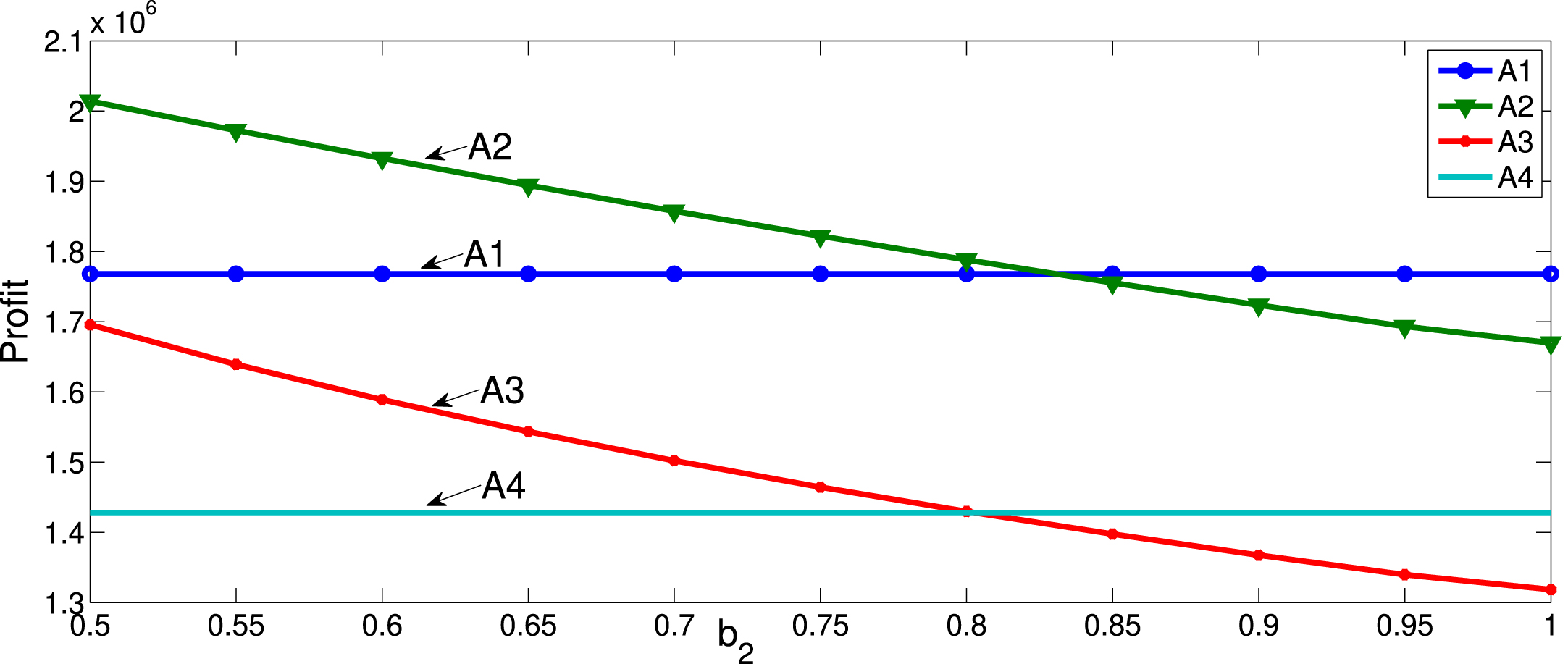
Profit of all approaches versus b2 in the distribution
An in-depth study of the variations in g, k is given in Fig. 3. It depicts the most profitable approach that the firm should adopt with the given sets of b1 (X-axis) and b2 (Y-axis). For a particular set of values of b1 and b2, different methods may be profitable. These are shown in the area given in Fig. 3. Therefore, once the firm knows the distribution of economies of scale g and k, it can choose the appropriate approach. Figure 3also shows that although when the approach which combined platform and component sharing may result in a most profitable product family, it is limited in a narrow range of parameters compared to the other approaches applied individually. However, it is more profitable than the approach of independent development. Therefore, the manufacturer should adopt A3 cautiously, because A3 may excessively damage the utility of high-spending consumer groups and ultimately hurt the manufacturer’s profits.
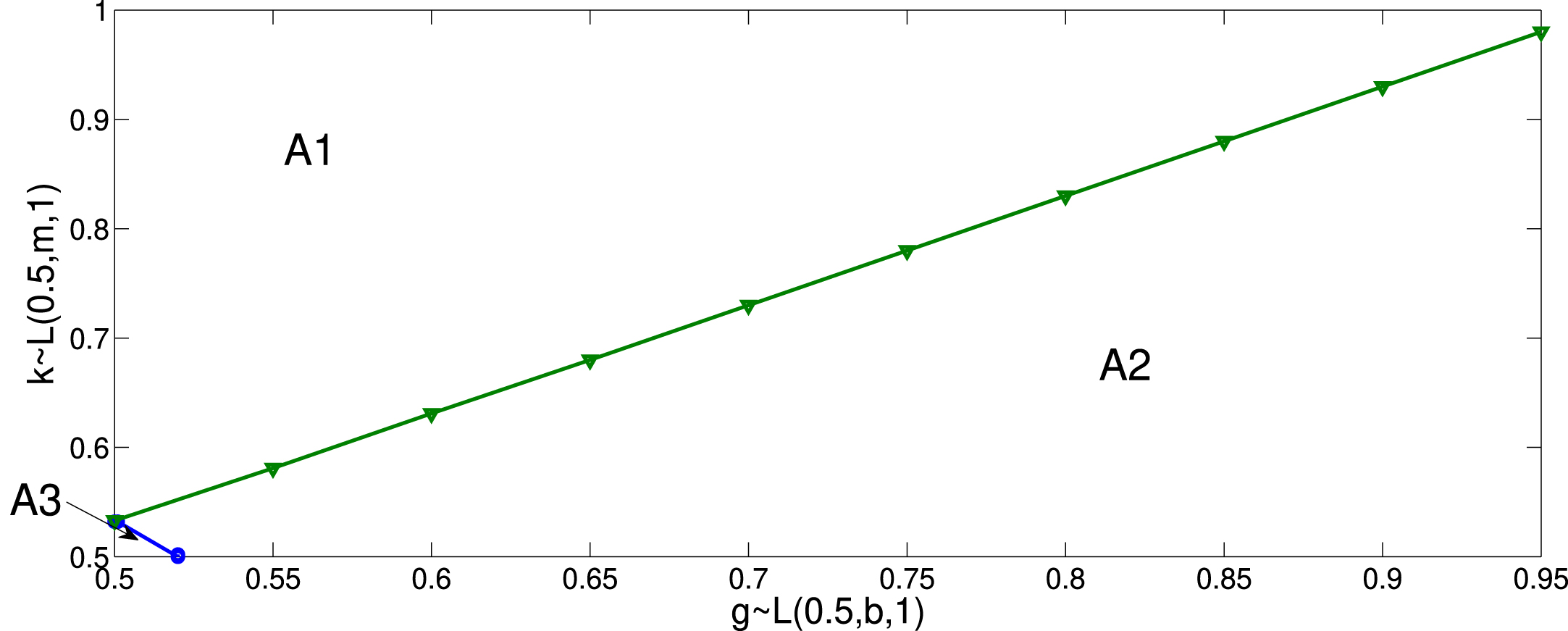
Plot between
Figure 4, 5, and 6 show the variance of the advantage of one approach over the other when coefficients b1 in
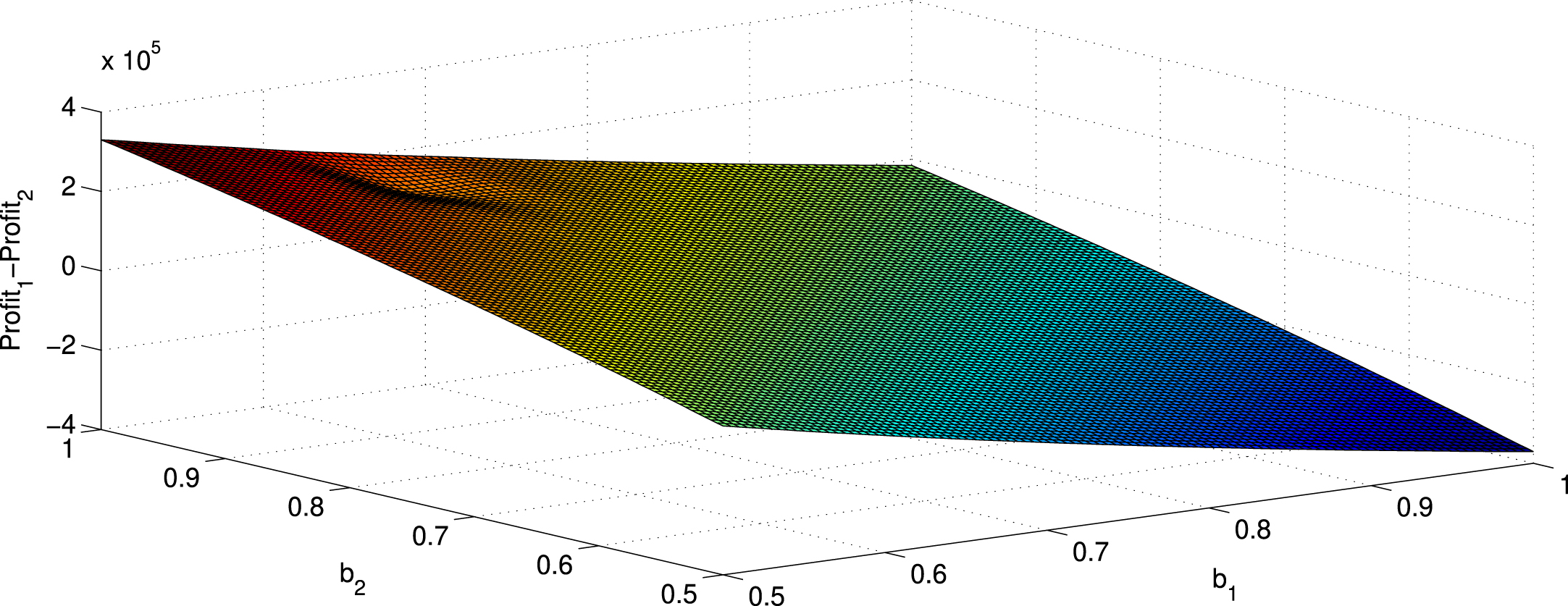
The profit (1 -2) results with different values of g and k.
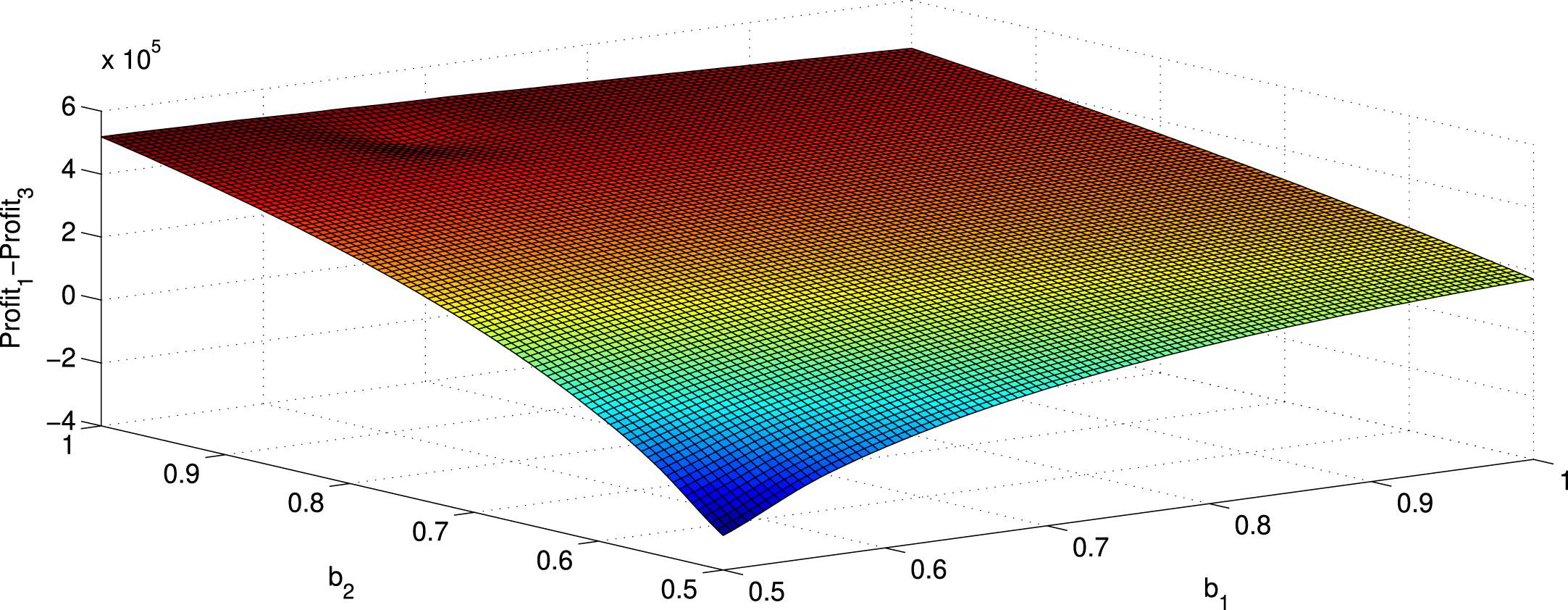
The profit (1 -3) results with different values of g and k.
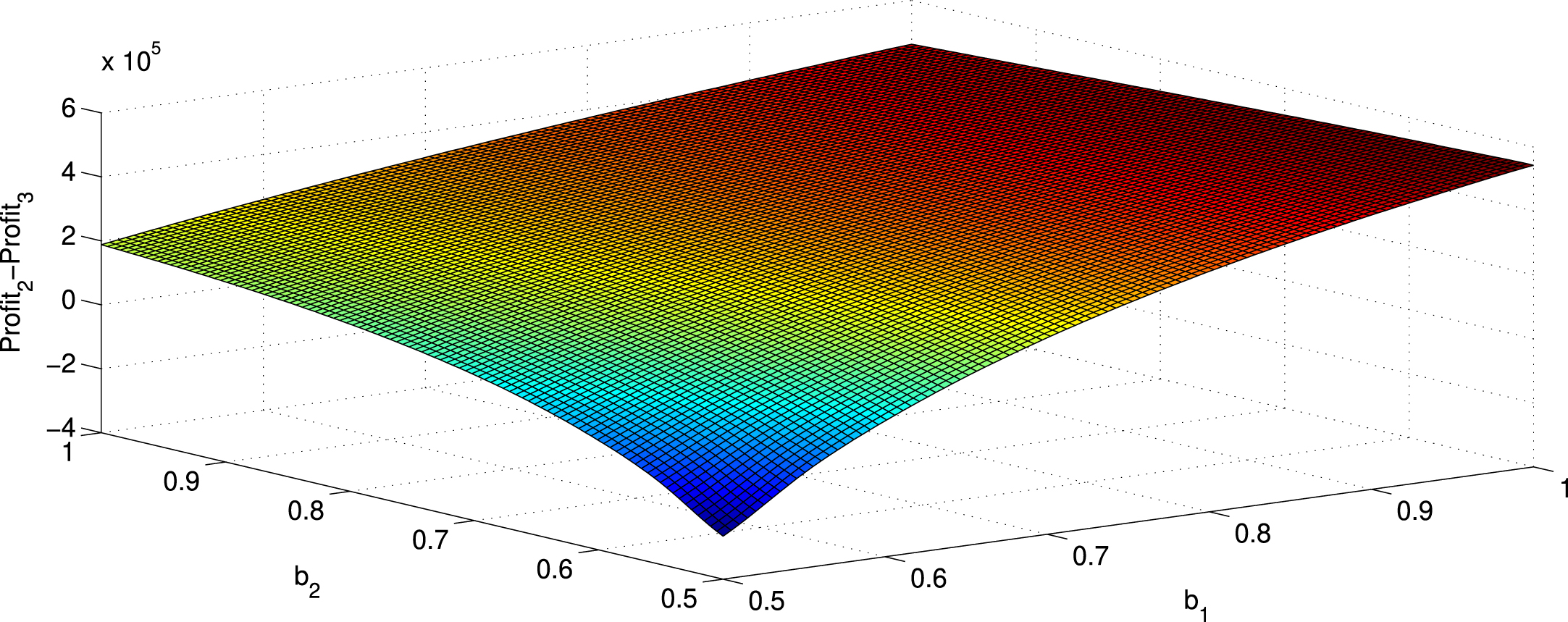
The profit (2 -3) results with different values of g and k.
The under design coefficients u1 and u2 also influence the most profitable approach. Our numerical experiemtn design is as follows: For each given value of u1 in steps of 0.01 in (0.5, 1), we calculate the optimal profits of the manufacturer in Equations 15, 23, 27, and 30. Figure 7 illustrates the effect of varying the under design coefficient u1 in platform on the various approaches. Approaches A2 and A4 are independent of the under design coefficient of the platform and subsequently, they do not change with u1. It is clear that when u1 increases, both A1 and A3 decrease considerably. Referring to Fig. 7, we can see that the firm will benefit the most from A1 when the value of u1 is less than 0.93, otherwise, approach A2 should be adopted.
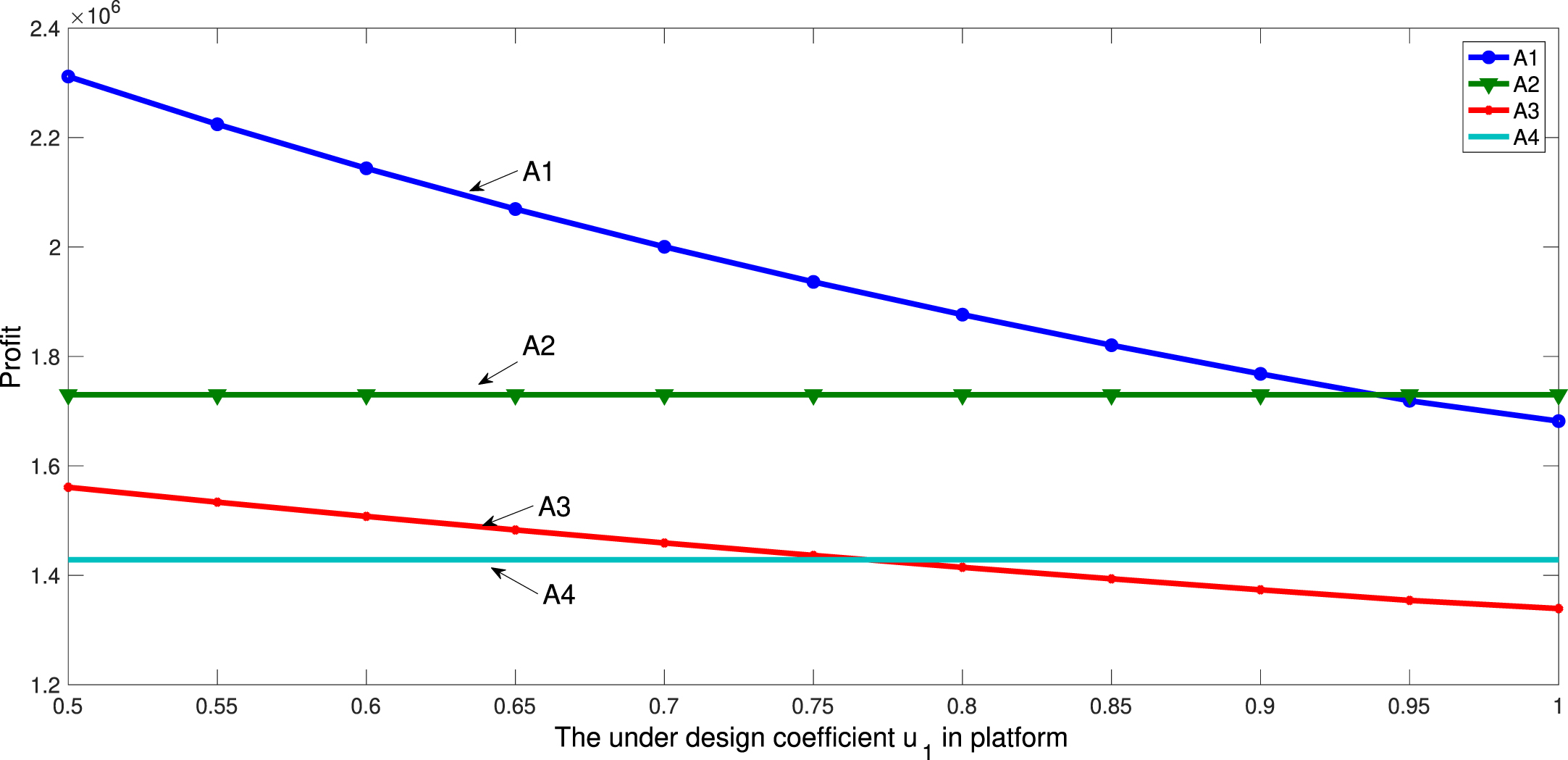
The models’ results with different values of u1.
Figure 8 is the plot between the under design coefficient u2 of component sharing and profit. In this scenario, approaches A1 and A4 are independent of u2, and thus the horizontal line is justified. The conclusion is similar to Fig. 7. It is obvious that the firm will benefit the most from A2 when the value of u2 is less than 0.86; otherwise, approach A1 should be adopted.

The models’ results with different values of u2.
In this paper, we have studied how to optimally design a product family chosen from four approaches when uncertainty exists in the customer demand and economies of scale. We unravel how under design coefficients and uncertainties in economies of scale interact with the manufacturer’s product performance decisions under two product configuration strategies, platform and component sharing. By comparing the firm’s profits under four approaches, we intend to address which approach is preferred by the firm under what conditions when facing with under designed high-end products and uncertain customer demand and economies of scale. Specifically, building upon a theoretical production decision-making model, we derive the uncertain expectation optimal solutions of the manufacturer under four production structures. This model is then applied on a numerical data set, and the behavior of various parameters is analyzed. Due to the complexity of the optimal solutions, uncertainties in customer demands and economies of scale in the model cannot be solved analytically. An example is considered and the findings are as follows.
Interestingly, we show that when consumers’ valuation is considered, the manufacturer may prefer to adopt platform and component sharing individually rather than combining them. Most existing research intends to find more commonality in products mainly due to the economies of scale. However, our study shows that consumers’ valuation may lead to the loss of the manufacturer’s profits when too much commonality exists in the products. This is mainly because though the approach combining platform and component sharing decreases the unit costs, it dampens the high-end consumers’ utility, which in turn, hurts the manufacturer. From this angle, we reveal that the manufacturer should not only pay attention to products commonality to achieve the goal of low cost, but also concern the differences between products, so as to make more profits in the high-end market. Our results emphasize the importance of incorporating customers’ valuation into product configuration design. The robustness of our findings is well verified in numerical experiments.
Our research also contributes in the following ways. First, when the platform or component sharing is adopted, the high-end product is under designed, but the manufacturer can benefit from economies of scale. Second, when the platform and/or component sharing are adopted, the optimal performance of high-end products decreases with the fixed cost. In contrast, the optimal performance of low-end products increases with it due to the improved platform performance. Third, when the platform’s economies of scale are greater than or equal to that under component sharing, the optimal performance level of low-end products under platform strategy is lower than that under component sharing strategy. Furthermore, the performance of high-end products using platform and component sharing strategies is worse than using two strategies separately.
Some important managerial insights for the manufacturer are discussed as follows: (1) although when the approach which combined platform and component sharing may result in a profitable product family, it is limited in a narrow range of parameters compared to the other approaches applied individually. However, it is more profitable than the approach of independent development; (2) though adopting the platform and component sharing at the same time could bring high economies of scale, the manufacturer should adopt A3 cautiously, because A3 may excessively damage the utility of high-spending consumer group and ultimately hurt the profits of the manufacturer; (3) based on the data set considered, the optimal approach of four (A1, A2, A3, A4) in the range of values of various parameters (k, g, u1 and u2) to build the most profitable product family is obtained. Based on the above findings, our model can be used to develop a new product family with no samples. In this scenario, companies can estimate the data set and parameters’ distributions using uncertainty theory. After companies obtain the range of values of the parameters involved, they can easily choose the best approach to develop the most beneficial product family.
Our research has certain limitations which can be addressed in future research. The most interesting extension is to test the validity of the results discussed in the previous section by the empirical study. Our theoretical research is limited to examine the impact of the uncertain economies of scale and under design coefficients on the production decision-making model. Therefore, an empirical study is valuable for our results. For the theoretical model side, first, future research can consider a product family with more than two products and investigate the multi-platform modularity. Second, the performance-cost function and the under design coefficient of products can be replaced by more complex and appropriate functions. Third, future research could consider dividing the product performance into multiple components’ performances and study the optimal components’ performances to assemble the products.